Cost to Paint Kitchen Cabinets Professionally (October 2026)
The cost to paint kitchen cabinets professionally runs about $2,000 to $6,500 for a whole kitchen in the US, and most homeowners land somewhere between $3,000 and $5,500. That figure covers prepping, priming and spraying the doors, drawer fronts and face frames, and it moves with your region, your cabinet material and how much repair work the old finish needs.
Repainting cabinets is the cheapest way to change the whole look of a kitchen, usually for a fraction of what new cabinetry costs. I want to give you the numbers clearly, including which ones to trust, because the estimates you will find on marketplace sites are often quoting a two-door project, not your kitchen.
Contents
Prices below reflect US market rates for 2026. Labor rates swing a lot by metro, so treat everything here as a range and get two or three itemized quotes before setting a ceiling.
Professional Kitchen Cabinet Painting Costs at a Glance
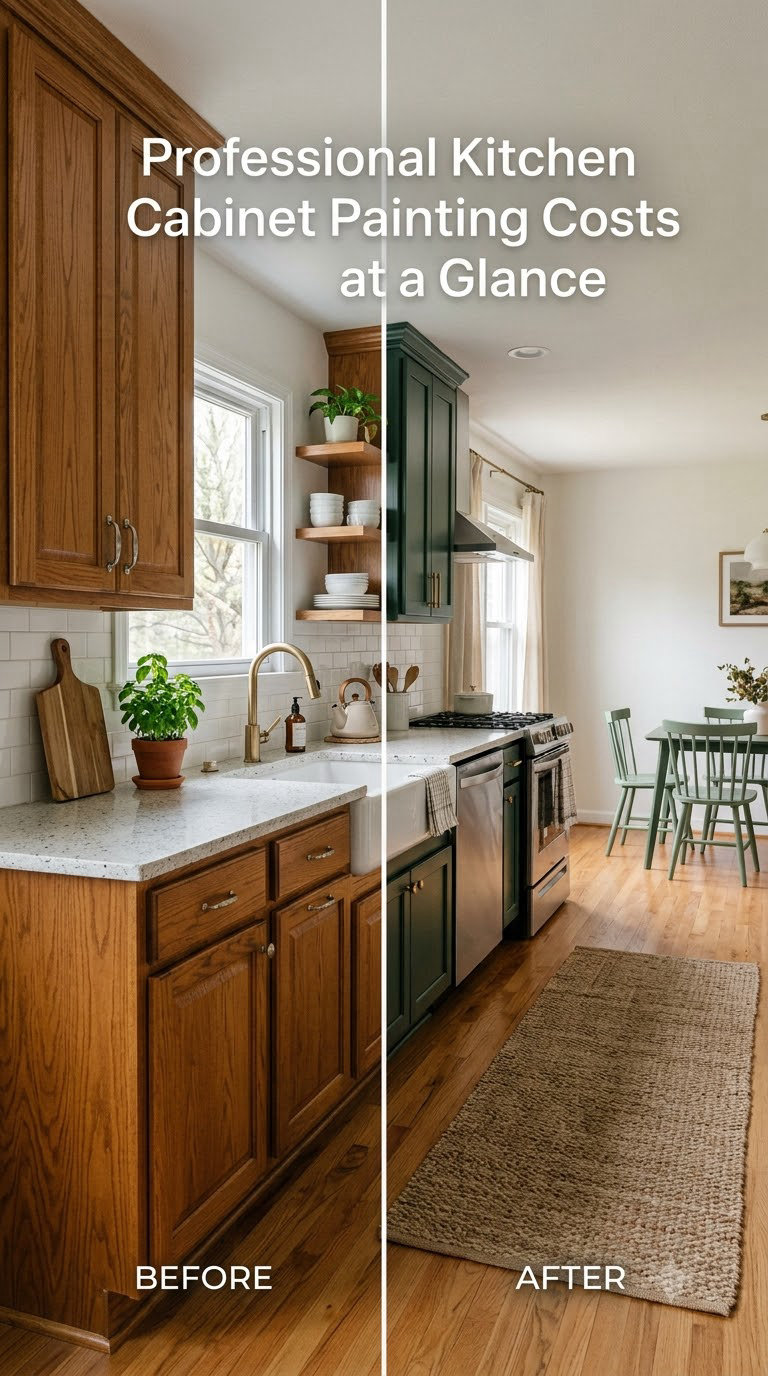
A professional cabinet painter typically charges between $2,000 and $6,500 for a full kitchen, with most households spending $3,000 to $5,500. Per piece, working painters quote $100 to $175 for a door and $100 to $125 for a drawer front, sprayed both sides with a fine finish.
Those per-piece rates are the number that actually matters. Multiply them by your own door and drawer count and you have a defensible estimate you can hand to a contractor and argue with.
| How painters charge | Typical US range | What it covers |
|---|---|---|
| Per door or drawer front | $100 to $175 per door, $100 to $125 per drawer face | Both sides sprayed, hinges removed and rehung |
| Per piece, sprayed finish | $125 to $185 per piece | Door or drawer, fine finish spray, single colour |
| Per linear foot of run | $30 to $60 per linear foot | Roughly 8 to 10 inches of cabinet face per foot |
| Per square foot of cabinet face | $3 to $10 per square foot | Useful only as a cross-check on a per-piece quote |
| Per cabinet box | $75 to $200 per box | Face frame and interior of the carcase, if included |
| Hourly labor | $20 to $50 per hour | Labor usually runs 70 to 85 percent of the total |
| Per door side, first coat | About $38 and up | Practitioner figure for the initial application only |
How much does it cost to paint kitchen cabinets professionally?
Expect $2,000 to $6,500 for a typical kitchen, with most people spending $3,000 to $5,500. A paint-only package normally includes removing the doors and drawer fronts, taking the hardware off, degreasing and sanding or filling the surfaces, a bonding primer, one to two finish coats, rehanging the doors and reinstalling the pulls, plus cleanup. Cabinet interiors, new hardware and counter removal are usually extra.
One painter I checked quoted around $2,500 for a normal job and reported material spend in the $2,200 to $2,900 range across larger projects, which tells you paint and prep products are a real slice of the ticket, not a rounding error.
Cabinet Size and Project Scope
Kitchen size matters less than piece count. A galley kitchen with 10 doors costs far less than a big island kitchen with 35, and a contractor pricing by the piece will show you exactly where the money goes.
| Kitchen size | Typical pieces | Professional total |
|---|---|---|
| Small | 8 to 12 doors, 3 to 6 drawers | $2,000 to $4,000 |
| Medium | 15 to 22 doors, 6 to 12 drawers | $4,000 to $5,500 |
| Large | 25 to 35 doors, 10 to 18 drawers | $7,000 to $10,000 and up |
| Custom or specialty cabinetry | Curved, glass front, built-in appliances, wine racks | Quoted individually, often well above the large tier |
Painting, refinishing and replacing are three different projects and their numbers are not comparable. Refinishing usually means stripping an existing finish back to bare wood or veneer and applying a new clear coat, which suits thick solid-wood doors with a finish worth keeping. Painting covers anything with a good surface, whatever is underneath. Refacing swaps new door and drawer fronts onto the existing boxes. Full replacement means new boxes, doors, hardware and often new countertops and sink.
Standard-height flat or shaker doors are the cheapest to spray. Raised panel, cathedral, glass front and furniture-style doors take longer because the profile has edges and valleys to spray without leaving dust behind.
How Cabinet Material and Condition Affect Cost
Material decides the prep, and prep decides the price. Solid wood and veneer accept paint well and sand back cleanly. MDF and particle board are common in builder-grade kitchens and paint fine, but they swell if you let moisture sit on them, so a pro will dry-sand and prime fast. Thermofoil and laminate have a slick factory skin that needs a bonding primer or the finish peels off within months.
Condition matters just as much. Cabinets that already carry thick sprayed paint, or oak that has been painted and repainted twice, take longer to strip. Peeling, chipping and water damage along a sink base can push a quote up by several hundred dollars for repair and filler work. Pea soups and nicotine-yellow walls also need extra coats to cover, so going from a dark colour to a pale one adds time.
Professional Cabinet Painting vs. DIY
A pro job typically runs $2,000 to $6,500 and three to five days on site. Doing it yourself costs a few hundred dollars in materials and roughly 40 to 60 labor hours, spread over a couple of weekends.
| Factor | Hire a professional | Do it yourself |
|---|---|---|
| Total cost | $2,000 to $6,500 | About $200 to $600 in paint, prep and tools |
| Time | 3 to 5 days, crew handles the heavy work | 40 to 60 labor hours across 2 or 3 weekends |
| Finish | Even factory-style spray, edges and crevices included | Depends heavily on your brush, roller and prep |
| Risk | Contractor liability for damage in your house | You own the drips, missed spots and re-do work |
| Best fit | Large kitchens, glass fronts, tight schedules | Flat doors, spare rooms, rental refreshes |
| Tools | Supplied | Sprayer, tack cloth, liquid deglosser, 180 to 220 grit, grain filler |
The middle option is worth a serious look. You pull the hardware, degrease and sand the doors, then a pro sprays them in a booth. Plenty of painters offer this split, and it takes a few hundred dollars off the total without touching the quality of the finish. If you are doing the prep yourself, you will be stirring and thinning paint all weekend, so our picks on the [best paint mixer attachments for drills](https://www.rosenberryrooms.com/best-paint-mixers-attachments-for-drill-powered-mixing/) save you time there. If you want a fine sprayed look, our picks on the [best HVLP paint sprayers for homeowners](https://www.rosenberryrooms.com/best-hvlp-paint-sprayers-for-homeowners/) cover the gear, and the [best small paint sprayers for homeowner use](https://www.rosenberryrooms.com/best-small-paint-sprayers-for-homeowner/) cover single-piece jobs like a sideboard or a set of pantry doors.
What Changes the Price?
The cost to paint kitchen cabinets professionally is driven by roughly eight things, and prep plus piece count are the two biggest. Here is what contractors quote for separately, in the order it usually hits the invoice.
- Number of doors and drawers. The base rate. Count every front, including pantry doors, drawer banks and any glass inserts.
- Paint system. A single-can alkyd enamel brushed on is the budget option. A sprayed two-part polyurethane system costs more in material and setup but lasts longer.
- Colour change. Going dark to light or from a strong colour to white usually needs an extra coat and better coverage primer.
- Prep intensity. Stripping old paint, filling grain on oak, deglossing laminate and repairing water damage all add hours. Threads on painting forums keep saying the same thing: prep takes longer than painting and it decides whether the finish peels in year one.
- Hardware. Removing and reinstalling pulls and hinges is usually included. Replacing the hardware is usually not.
- Protection and containment. A pro masks and covers counters, floors and appliances. Dust control in an occupied home costs labor.
- Cabinet interiors and face frames. Painting inside the boxes is commonly skipped. Ask whether your quote includes it before assuming.
- Moving and disposal. Some painters will deck the kitchen, meaning removing counters, appliances and the sink so the tops and boxes can be reached. That is a separate line item and a real one.
Spray versus brush and roller is the other fork. Spray gives an even, factory-style surface and is the standard for a professional finish, and it costs more because of setup, masking and booth time. Brush and roller work well on flat shaker doors and save money. If you are planning colours, our [kitchen paint colour ideas](https://www.rosenberryrooms.com/kitchen-paint-color-ideas/) and [kitchen paint colours for small spaces](https://www.rosenberryrooms.com/kitchen-paint-colors/) roundups are worth a look before you commit to a swatch.
Why published cost estimates disagree
You will find numbers all over the place online, and they are not all wrong. Marketplace sites quote small jobs. HomeAdvisor lists $425 to $1,466 for cabinet painting with most homeowners near $942, and Thumbtack reports a national average of $1,390 to $3,353 with most people around $2,164. Both are landing-page figures drawn from lead data for small or partial projects, such as one door or a bathroom vanity, not a full kitchen. Homewyse works from square footage at $5.51 to $10.98 per square foot, a method that is fine for painting walls and misleading for cabinetry, because a kitchen packs a lot of surface into very few square feet.
Working painters and editors publishing real project data sit far higher, at $2,000 to $6,500. The recurring forum complaint is exactly this gap. A homeowner with 20 doors and 4 drawers reported bids from about $900 for a handyman up past $6,000 from a contractor, while another with 16 doors was quoted $4,000 and had no idea if that was normal. The spread comes down to scope: a handyman brushing one coat of cheap enamel is not quoting the same job as a contractor spraying two coats of a two-part system with full prep.
Labor is the other half of the ticket. Professional painters bill $20 to $50 an hour, and labor typically accounts for about 85 percent of the job, so regional rates move the final number more than the paint does. A homeowner in New Jersey quoted $4,000 for 16 doors painted white, while a larger kitchen quoted elsewhere in the country for 33 doors came in around $3,000. That spread is geography and piece count together.
So do not treat a marketplace number as a fair-offer benchmark for your kitchen. Use it for a single door, then price the rest per piece.
What homeowners actually paid
Real reported figures are more useful than any national average, because each one comes with a piece count attached. Here is what homeowners and contractors described in recent painting and remodeling threads, normalized so you can compare them.
| Reported amount | Scope | Implied per piece |
|---|---|---|
| $3,000 | 33 cabinet doors | About $90 per door |
| $4,000 | 16 cabinet doors painted white, North Jersey | About $250 per door |
| $900 up to $6,000 | 20 doors and 4 drawers, bids across a wide spread | About $38 to $200 per piece |
| $6,000 | Full kitchen repaint | Mid-range for a larger layout |
| $100 to $175 per door | Practitioner rate card, doors | Working painter pricing |
| $100 to $125 per drawer face | Practitioner rate card, drawer fronts | Working painter pricing |
The $38-per-piece low end is brush-and-roll work on flat doors. The $250-per-door high end is a full kitchen in an expensive metro with heavy prep. Both are legitimate; they are just different jobs.
Ways to bring the number down
Four moves reliably cut the total, in the order of savings to effort. First, do your own prep: pull every knob and hinge, wash the fronts with a degreaser, and fill the nail holes and chips. Painters charge by the hour, so hours you do not buy are hours you do not pay for. Second, reuse the existing hardware instead of replacing it. Third, stay on a single colour for the whole kitchen, since a two-tone scheme means extra masking and extra coats. Fourth, get three quotes and take the middle one.
What is not worth trimming is the paint system. A cheap enamel that peels in a year costs more once you add a second job on top of the first.
Paint and Finish Options for Kitchen Cabinets
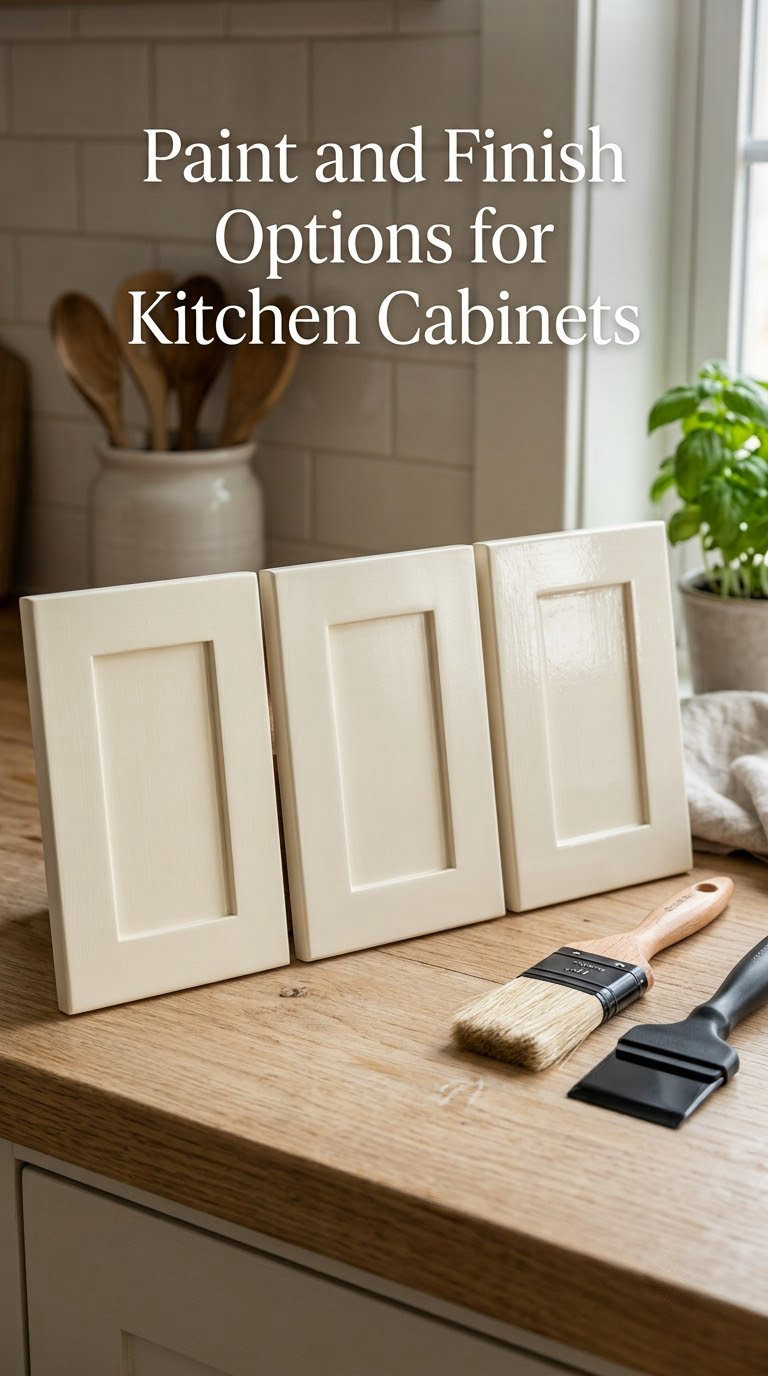
Kitchen cabinet paint has to survive steam, grease, splashes and a decade of scrubbing, so wall latex is the wrong product. The realistic choices are a single-can alkyd cabinet enamel or a sprayed two-part polyurethane system, and the finish level matters as much as the chemistry.
| Sheen | Look | Cleaning resistance | Typical use |
|---|---|---|---|
| Flat | Matte, hides flaws best | Low, marks wipe off | Rarely used on cabinets |
| Eggshell | Soft sheen | Moderate | Walls and trim, not cabinet faces |
| Satin | Subtle sheen | Good | The most common cabinet finish |
| Semi-gloss | Sharper reflection | Best of the common sheens | Popular in 2026 for a bright, washable look |
A single-can alkyd enamel brushed or rolled on properly typically lasts 8 to 15 years. A sprayed two-part polyurethane finish can run 10 to 20 years because the catalyst chemically hardens the film rather than relying on air drying alone. The sprayed system costs more upfront and needs proper spray equipment and safety gear, which is exactly why a pro quote for it is higher.
Curing is separate from drying. Touch dry is not cured. Expect at least 24 to 48 hours before loading drawers with dishes, and up to a week before the finish is at full hardness.
How to Compare Professional Painting Quotes
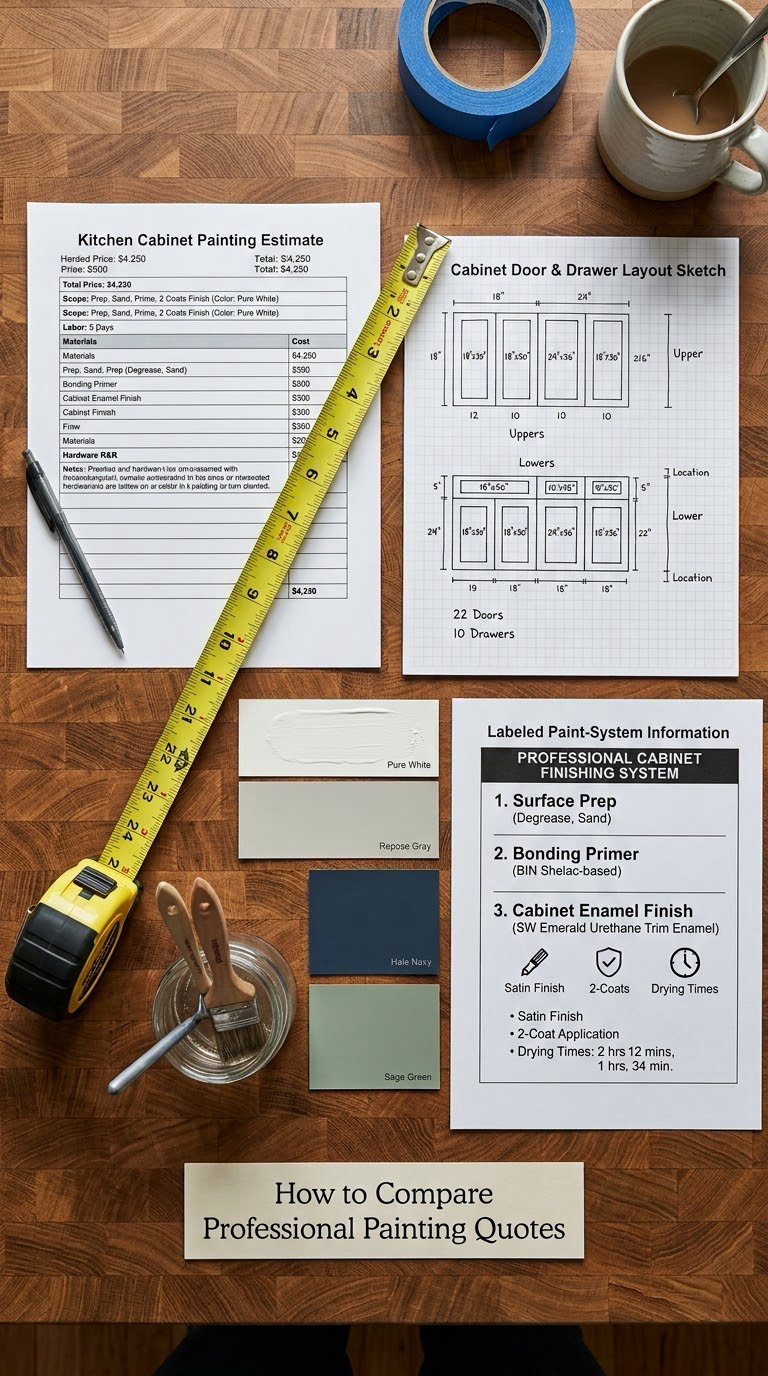
Two quotes are only comparable if they cover the same scope. Ask each painter to itemize the following in writing, then compare line by line rather than just the total.
- Exact piece count. Doors and drawer fronts listed one by one. Two quotes for a “small kitchen” can be 100 dollars apart purely on counting.
- Prep process. Washing, deglossing, sanding grit, grain filling and how many coats of primer.
- Paint system named. Product type and sheen, not “good quality paint”.
- Spray or brush. Where each is used and whether the price assumes the doors are sprayed off site.
- Hardware. Removal and reinstallation included, replacement excluded, or priced separately.
- Cabinet interiors. Included or not, in plain words.
- Protection, moving and disposal. Whether the kitchen gets decked and who hauls away anything.
- Timeline and cure time. How many days on site and when you can use the cabinets again.
- Warranty and payment schedule. Deposit, progress payments, and what happens if a door peels in six months.
Before you sign, ask to see finished kitchens they painted, then look closely at edges and inside corners for drips or thin spots. Ask whether they carry liability insurance. A painter who removes hardware instead of taping over knobs is the one doing this properly, because tape pulls the finish off a door every time. Get a fixed written quote rather than an open estimate wherever you can, and treat any quote far below the per-piece range as a quote for a different, smaller job.
Frequently Asked Questions
How much does it typically cost to have kitchen cabinets painted?
A full kitchen repaint by a professional runs $2,000 to $6,500 in the US, and most homeowners spend $3,000 to $5,500. Per piece, painters quote $100 to $175 per door and $100 to $125 per drawer face, sprayed both sides. Labor is usually 70 to 85 percent of the total, so the piece count and prep level matter far more than the paint itself.
Should I paint or refinish my kitchen cabinets?
Refinish when the doors are thick solid wood or good veneer with a finish worth keeping, especially in good shape. Refinishing strips back to bare material and applies a clear coat, so it preserves the wood character. Paint everything else, including MDF, thermofoil and laminate, because their factory skin does not strip cleanly. Painting also lets you change the colour.
What type of paint is best for professional cabinet painting?
Look for a cabinet alkyd enamel or a sprayed two-part polyurethane system, both of which form a hard, washable film. Single-can alkyd enamel typically lasts 8 to 15 years; sprayed two-part polyurethane can reach 10 to 20 years. Wall latex is not suitable for cabinet faces. Satin is the most common finish, with semi-gloss chosen for extra scrub resistance.
How long does it take a professional to paint kitchen cabinets?
A medium kitchen takes three to five days on site, including prep, drying between coats and rehanging. A large kitchen with an island can run a week or more. Do not load painted drawers with dishes for 24 to 48 hours after the final coat, and allow up to a week for the finish to reach full hardness. DIY jobs run 40 to 60 labor hours.
Is painting laminate kitchen cabinets worth the cost?
It can be, provided the laminate is in good condition and the painter uses a bonding primer designed for non-porous surfaces. Expect an extra step in prep, so the quote sits near the top of the per-piece range. Cheap laminate that is already lifting or delaminating at the edges is not worth painting, because the new finish will peel with it. Inspect the edges first.
Should I replace kitchen cabinets instead of painting them?
Replace when the boxes are warped, water-damaged or soft, when hinges have pulled loose from failing cabinet joints, or when the layout no longer works for how you cook. Paint when the cabinetry is structurally sound but looks dated. Replacement usually costs several times more than repainting and means new counters, sink and hardware in most remodels.
Conclusion: Set a Realistic Cabinet Painting Budget
Start with the piece count, not the square footage. Write down every door and drawer front, then price the job at $100 to $175 per door and $100 to $125 per drawer, and add prep, hardware and any decking. That lands you in the $3,000 to $5,500 band most homeowners pay, and it gives you something concrete to compare against every quote.
Ask each painter to name the paint system and itemize the scope in writing, then pick the middle bid from the three you collect. It is almost always the right call, and it is the cost to paint kitchen cabinets professionally figured honestly rather than guessed.