Cost to Replace a Sump Pump: Simple Guide (October 2026)
The cost to replace a sump pump usually lands between $450 and $1,200 for a straightforward swap in an existing basin, and climbs to $1,500 or more once a new discharge line, pit work or battery backup enters the picture. The pump itself is the cheap part. Most of the money is labor and the extra plumbing that comes with it.
Sump pumps die quietly, usually in the middle of the wettest week of the year. Nobody budgets for a replacement, they just notice the pit is full and the water is not moving. Then they open a retailer page, see a $180 pump, assume that’s the job, and get blindsided by an invoice three or four times higher.
Contents
That gap is the whole story of this query, so let’s get into the numbers. Every range below is a realistic US figure; rates in high-cost metros and rural areas can sit well outside them, and your local quote is the only number that truly counts.
Cost to Replace a Sump Pump by Pump Type and Size
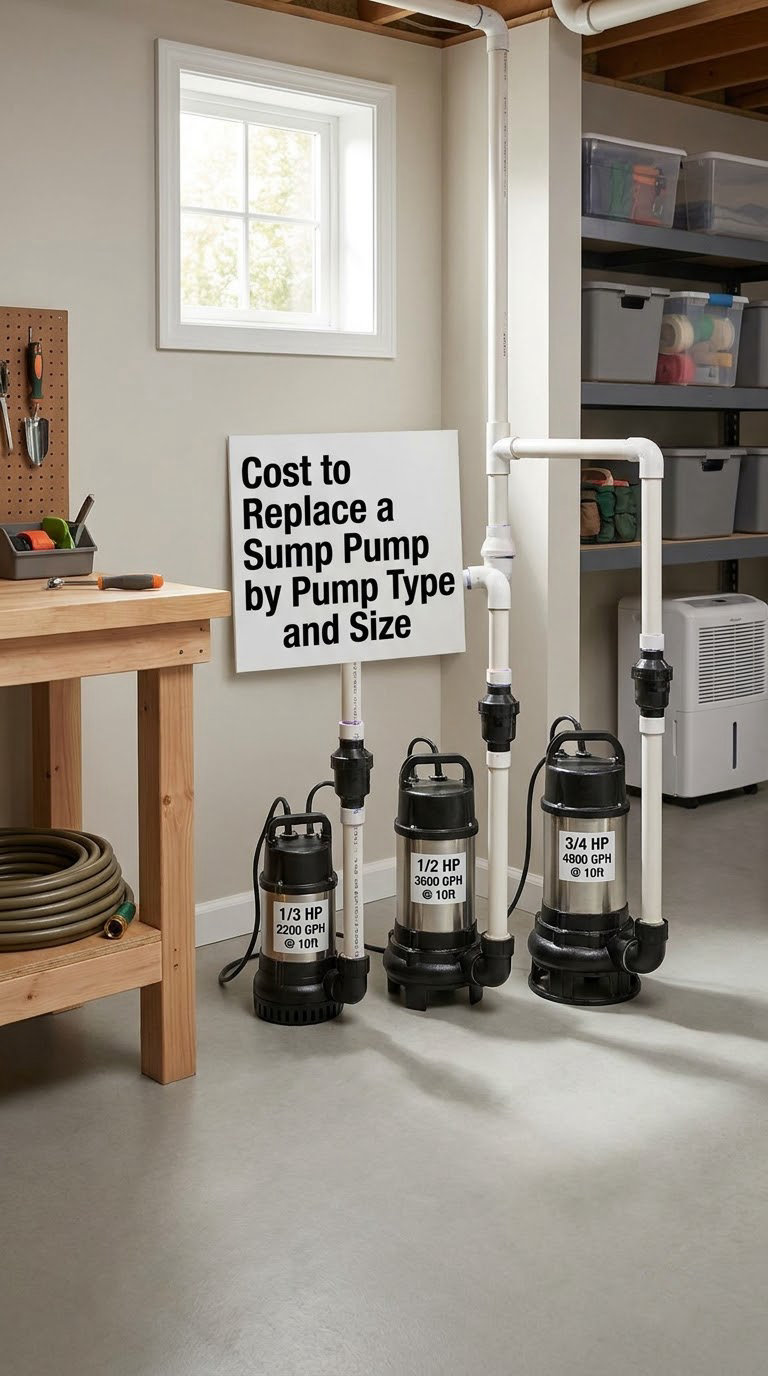
The fastest way to budget is to identify your pump’s horsepower, then look at the installed total for that class rather than the sticker price.
What Is the Cost to Replace a Sump Pump?
Most homeowners pay $450 to $1,200 to replace a sump pump in an existing basin, including labor. Two things set your number: which pump you install and how much extra plumbing work the old setup needs. Pump units alone run $115 to $470. Adding a battery backup, new discharge line or a new electrical circuit pushes the job to $1,500 and beyond.
That answer block is the headline, but it hides two important distinctions. Unit price and installed cost are different numbers, and a simple swap and a full plumbing job are different projects wearing the same name.
| Pump type | Typical use | Pump price | Installed total |
|---|---|---|---|
| 1/3 HP submersible | Shallow pits, low water volume, mild soil | $115 to $220 | $450 to $800 |
| 1/2 HP submersible | Most homes with a high water table or sand in the soil | $150 to $330 | $600 to $1,100 |
| 3/4 HP submersible | Deep basins, heavy inflow, frequent storm runoff | $280 to $470 | $800 to $1,200 |
| Pedestal pump | Unfinished basements, low water volume, easy access | $130 to $300 | $550 to $950 |
| Pre-plumbed combo system | Homes adding backup for the first time | $400 to $600 | $1,100 to $1,900 |
Cast iron bodies run a step above plastic and usually last longer, which matters more if you dislike doing this job twice. If you are still deciding between sizes, our 3/4 HP sump pump review walks through how capacity is actually rated.
The horsepower you need is mostly about basin depth and how fast water arrives. An undersized pump short-cycles and wears out early; an oversized one costs more up front and can still fail on a jammed float. When in doubt, match the replacement to what was working, or go up one step if your pit is deeper than about 24 inches.
DIY Versus Professional Sump-Pump Replacement Costs
If you are weighing the cost to replace a sump pump yourself against hiring out, start with the basin. A same-model swap in a dry, unfinished basement is a realistic weekend project. Anything involving new pipe, electrical work or a finished ceiling is not.
| Route | What you pay | What’s covered |
|---|---|---|
| DIY, parts only | $180 to $450 | Pump, new check valve, fittings, sealant, any pipe you replace yourself |
| Handyman or plumber, simple swap | $450 to $900 | Parts, removal, reconnection, water test |
| Plumber, check valve or discharge work | $650 to $1,200 | Adds valve or line replacement and the extra hours to reach them |
| Plumber with battery backup and electrical | $1,200 to $2,100 | Backup unit, controller, possible new GFCI circuit |
Do the swap yourself when the basin is dry, the discharge line is sound, and the outlet already has GFCI protection on a dedicated breaker. Kill the breaker before you touch the plug, not after. Keep a shop vac and towels within reach, because pulling a pump out of a wet pit is unpleasant even when it works perfectly.
Hire a pro when the pit has standing water, the discharge line is older than the pump, the outlet is not GFCI-protected, or the basement is finished and you would rather not open a wall twice. Changing pump type also earns a pro: swapping a submersible for a pedestal means reworking the discharge height and cutting the floor, which is a different job with different risks.
Buying the pump yourself and handing it to a plumber is a fair middle ground. Confirm in writing that the labor is quoted separately, and pick the model based on basin depth, not on what someone else had in their basement.
Pros and Cons of Replacing a Sump Pump
Before spending money, decide whether the old pump is worth another few years. A failed pump under five or six years old with a single dead component often deserves a repair instead.
| Factor | Points toward keeping the pump | Points toward replacing it |
|---|---|---|
| Reliability | One clear failure, everything else quiet | Failed during a storm or a power outage |
| Warranty | Still under the manufacturer warranty | Warranty expired, replacement cheap relative to repair |
| Energy use | Pump is recent and efficient | Old motor drawing high current on an old circuit |
| Noise | Pump runs quietly when tested | Grinding, rattling or chattering on startup |
| Capacity | Handles inflow without short-cycling | Cannot keep up, runs almost continuously |
| Repairability | Only the float switch or check valve died | Impeller and motor are both worn, parts are scarce |
| Compatibility | Existing plumbing and electrical fit a replacement | New discharge height, pit liner or circuit needed |
| Value | Repair lands under half of replacement cost | Repair bill exceeds half of a new installed pump |
The last row is the rule of thumb worth memorizing. If the repair quote comes in above 50 percent of what a new pump would cost installed, and the old unit is past about seven years, replace it.
A typical repair lands somewhere between $200 and $550, mostly labor for a float switch or check valve swap. If you are shopping for a backup while you are in there, our battery backup sump pump system roundup covers what the extra hardware actually does.
What Changes the Price of a Sump-Pump Replacement?
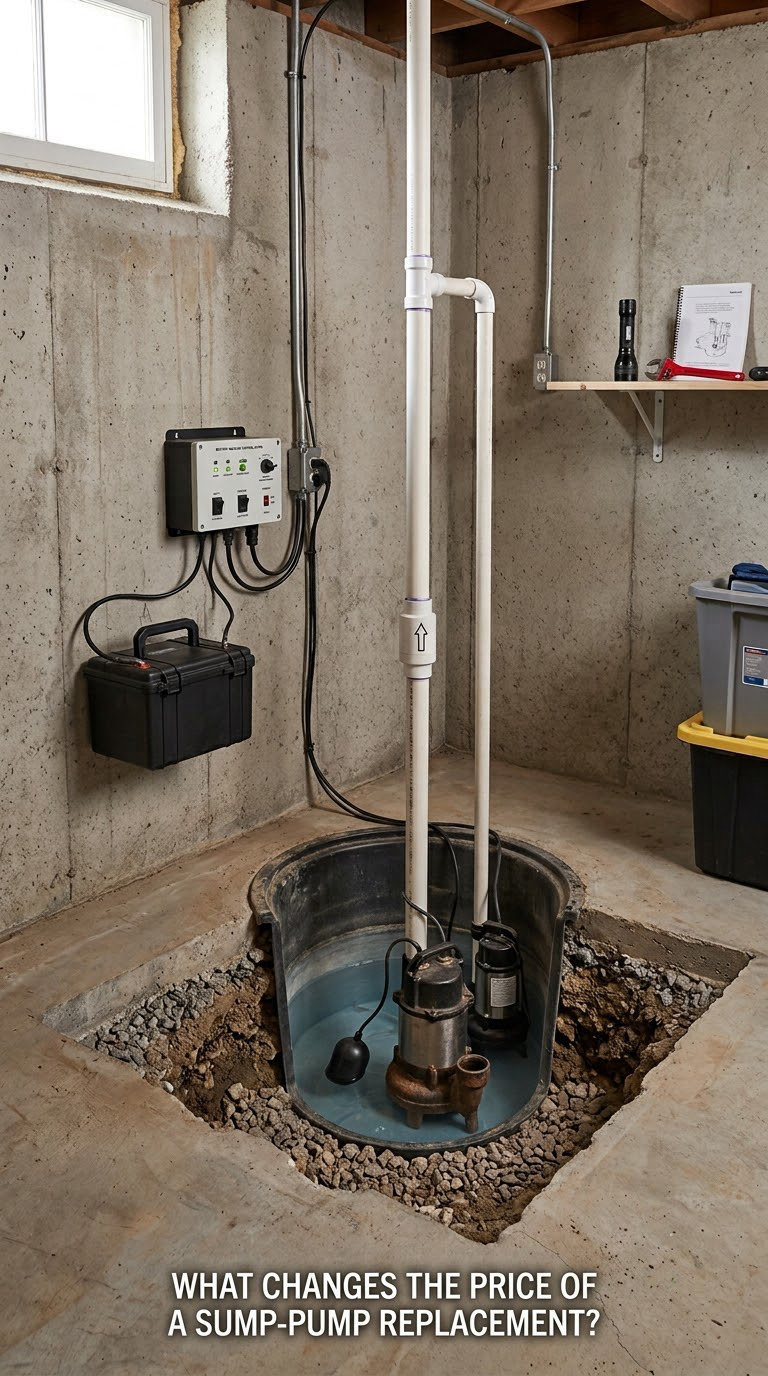
Eight things move the total, and most of them are visible before anyone quotes.
- Horsepower and capacity. Jumping from a 1/3 HP to a 3/4 HP adds real money to the unit price, and a bigger pump sometimes needs a wider discharge line to match.
- Basin depth. A pit deeper than about 24 inches needs a pump rated for that lift, which usually means a higher price bracket.
- Discharge pipe condition. Replacing a brittle section of pipe or re-routing the exit point can add $150 to $350 in labor on its own.
- Check valve work. A stuck or leaking valve has to be cut out, and a new one added with unions so the next swap is fast. That runs about $50 to $150 as an add-on.
- Battery backup. A standard backup system adds roughly $350 to $900 installed. Larger battery capacity, higher output or a smart controller pushes that to $700 or more.
- Electrical work. A new dedicated circuit or GFCI upgrade adds $200 to $600 and occasionally requires a permit depending on your municipality.
- Emergency service. A call at 9 at night or on a holiday carries an after-hours fee and a rush premium, often doubling the labor line.
- Regional rates. Labor in a high cost-of-living metro runs meaningfully more than the national average, which is why published averages understate the bill in exactly the places people search from.
Clear the pit yourself before anyone arrives. A basin packed with sediment turns a one-hour job into a two-hour one, and contractors charge by the hour for a job that suddenly got longer.
Frequently Asked Questions
How much does it cost to replace a sump pump in 2026?
Plenty of homeowners budget between $450 and $1,200 for a standard replacement in an existing basin, pump and labor included. Pedestal pumps tend to land lower, near $550 to $950, while 3/4 HP submersible models and battery backup installations push toward $1,200 to $2,100. Ask for a written quote before buying anything.
Is replacing a sump pump worth it instead of repairing it?
Usually yes, once the pump passes seven years or the repair quote climbs above half of a new installed pump. Repairing makes sense when one component failed, the pump is young and still under warranty, and the remaining parts are in good shape. A pump that failed during a storm or outage is telling you something about its condition.
Can I replace a sump pump myself without a plumber?
Yes, if the pit is dry, the discharge line is sound, the outlet already has GFCI protection, and you are swapping for the same pump type. You will still need a new check valve and fittings, and you should kill the breaker before unplugging anything. Finished basements, new discharge routing and backup wiring belong with a licensed plumber.
How much extra does a battery backup sump pump cost to install?
Expect roughly $350 to $900 added to a standard replacement, or $700 to $1,400 for higher-capacity batteries, higher output or a smart controller with remote alerts. The backup also needs a controller installed near the existing pump and a properly protected outlet, which can add electrical labor on top of the hardware.
Why does sump-pump replacement cost more than the new pump?
Because the pump is only the parts line. Labor typically runs $90 to $600 depending on how long the job takes, and scope add-ons like a new check valve, discharge pipe work, pit cleanup or electrical upgrades add more. A $180 pump on an easy swap may total $600; the same pump behind a finished wall with a rusted check valve can total $1,400.
If you are planning a backup rather than just a replacement, our guide to sump pumps with battery backup compares the hardware before you commit to the electrical work.
Conclusion
The cost to replace a sump pump usually falls between $450 and $1,200 in an existing basin, with backup systems and electrical work pushing a project into the low thousands. Your pump’s sticker price is a small slice of that, so budgeting off the retail listing alone will leave you short.
Before the contractor arrives, note the horsepower stamped on the old pump, look at the discharge pipe and check valve for corrosion, and get two or three written quotes that itemize the labor separately from the parts. Then hold back 10 to 15 percent for sediment cleanup or a fitting that turns out to be worse than it looked. That reserve has saved more homeowners from a surprise than any single pump choice.