Cost to Install a Walk In Shower: October 2026 Guide
The cost to install a walk in shower averages about $9,500 across the US, and most homeowners spend between $4,500 and $15,000 for professional work. The final number swings wildly depending on whether you choose a prefabricated kit or a custom tiled build, and on whether the plumber has to move your drain. Here is how the money actually breaks down, updated for 2026.
I have watched enough remodel bids to know that the published average is the least useful part of the conversation. What matters is which bucket your project falls into, and what your existing plumbing lets you keep.
Contents
All ranges below are US figures and shift with regional labor rates. A Boston plumber bills roughly twice what a contractor in rural Tennessee charges for the same two hours, and no national average accounts for that.
Cost to Install a Walk In Shower at a Glance
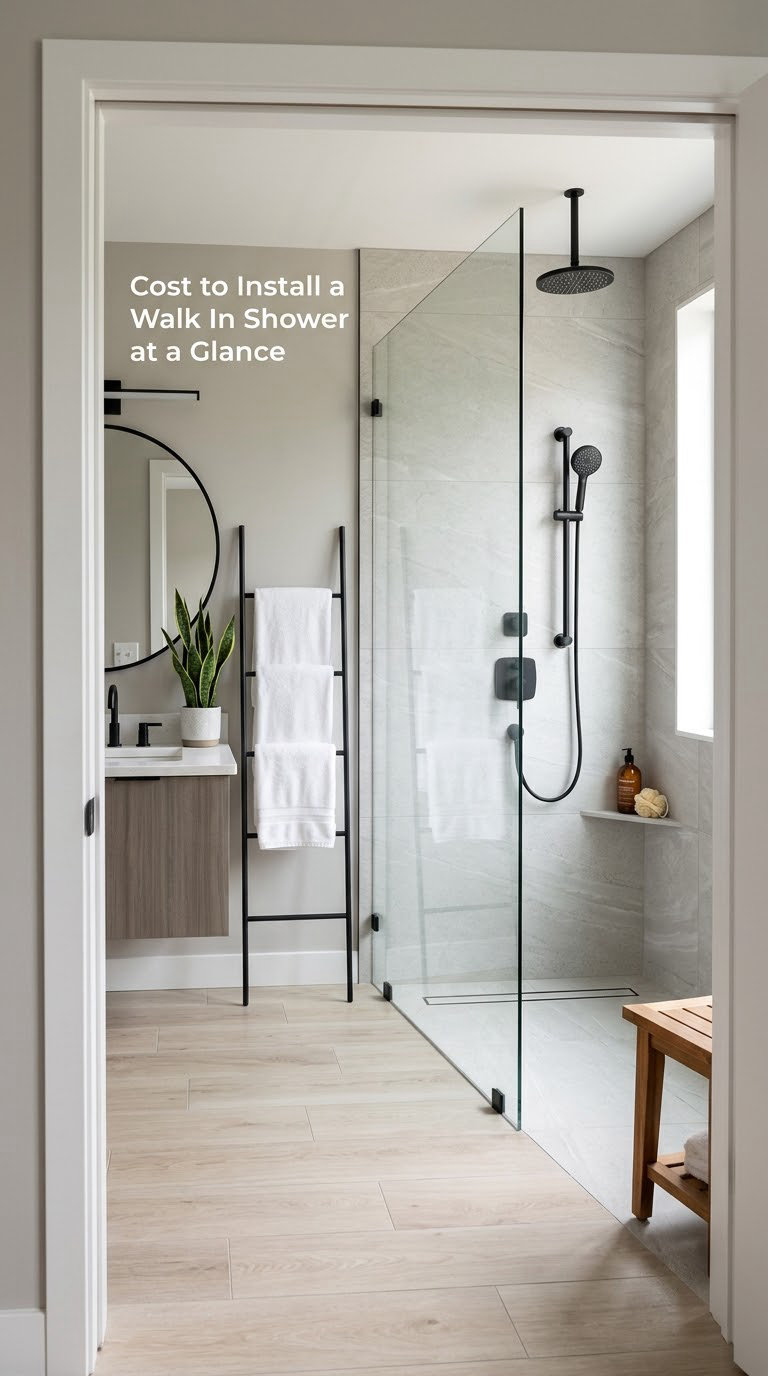
Here is where the money goes, using the six components that make up nearly every walk-in shower bid I have seen:
- Labor: $2,000 to $4,000 — roughly 40% to 65% of the total bill
- Wall materials: $1,500 to $3,500 — acrylic cheapest and easiest to clean, tile durable but labor-intensive, natural stone carries a major premium
- Glass enclosure or door: $1,200 to $3,000 — sliding or framed units sit at the low end, custom-cut frameless glass at the high end
- Shower base or pan: $800 to $1,800 — premade acrylic pans are economical, while a curbless pan built from scratch needs slope framing and heavier waterproofing
- Plumbing modifications: $600 to $1,500 — keeping the drain and supply lines where they are saves thousands, and moving a drain can add $500 to $3,000
- Demolition and removal: $500 to $1,500 — hauling out an old alcove shower or a full tub conversion adds both labor and disposal fees
| Project tier | Installed cost | What you get |
|---|---|---|
| Basic prefabricated kit | $4,000 to $7,000 | Acrylic pan, molded surround, framed glass door, new valve |
| Midrange tiled shower | $8,000 to $13,000 | Custom pan, tile walls, frameless or semi-frameless glass, niche |
| High-end custom | $14,000 to $20,000 and up | Natural stone or large-format tile, curbless entry, bench, linear drain |
| Tub-to-shower conversion | $1,200 to $8,000 depending on scope | Tub removed, footprint reframed or reskinned, drain usually stays put |
Those tiers overlap more than most articles admit. A good contractor can land a midrange tile shower in the $7,000 range in a lower-cost market, and a supposedly basic prefab job can hit $10,000 once the subfloor turns out to be rotten.
Walk-In Shower Installation Costs by Size
Shower size drives cost through two channels: how much wall and floor area needs a waterproofing membrane and tile, and how much labor the substrate and finishing work takes. The second channel usually matters more.
| Shower footprint | Base installation | With tile, glass and a niche |
|---|---|---|
| Compact 3 by 5 ft (36 by 60 inch) | $3,500 to $6,000 | $6,000 to $9,500 |
| Standard 5 by 5 ft (60 by 60 inch) | $5,500 to $9,000 | $9,000 to $14,000 |
| Large 5 by 7 ft (60 by 84 inch) | $8,000 to $13,000 | $13,000 to $20,000 |
A 3 by 5 shower is the standard tub alcove footprint, which is why prefab kits are engineered for it. Growing that same alcove to 5 by 5 feet means new framing on at least one side, new wallboard, more membrane and roughly a third more tile, and the plumbing often has to shift to hit the drain center.
If your bathroom is small, expanding the shower by even a foot can eat the whole gain in floor space you were hoping for. Measure the finished wall clearances before you commit, because tile thickness and the glass swing eat into the usable opening.
Walk-In Shower Costs by Material
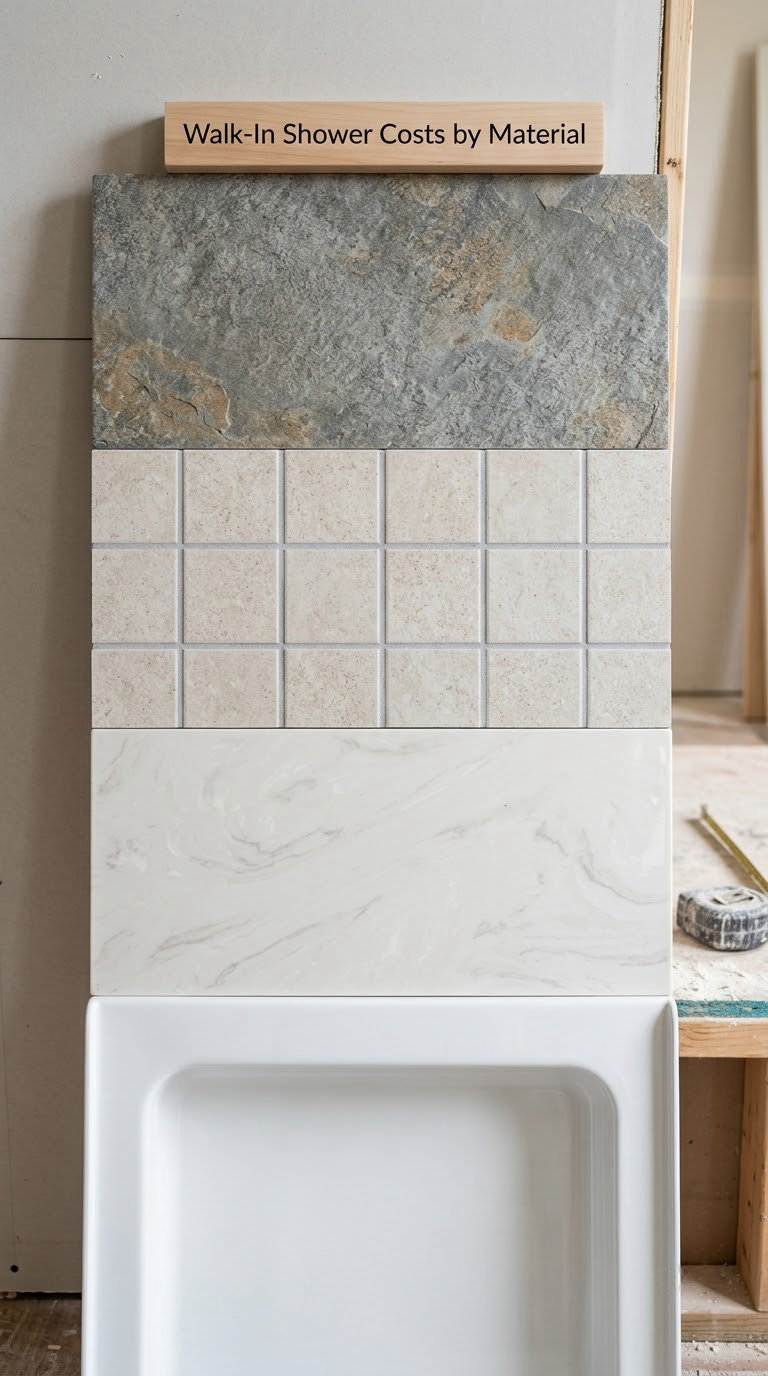
Material choice is the single biggest price jump in a walk-in shower. One homeowner reported being quoted $4,000 to $5,000 for an acrylic walk-in with an acrylic surround, then $8,000 to $12,000 for the same footprint in synthetic stone or tile. Same room, same plumbing, double the bill.
| Material | Cost per square foot | Best for |
|---|---|---|
| Acrylic wall system | $2 to $10 installed | Fast installs, easy cleaning, tight budgets |
| Fiberglass | $3 to $12 installed | Secondary baths and rental properties |
| Cultured marble or stone | $40 to $65 | A one-piece molded look without the weight of real stone |
| Ceramic and porcelain tile | $2 to $17 for tile, $12 to $30 installed | Durability and design flexibility |
| Natural stone (marble, slate, granite) | $10 to $35 for material, $20 to $50 installed | A high-end look; needs sealing and careful handling |
Acrylic and fiberglass are molded panels that screw to the studs. They install in a day or two, need no grout, and their seams can flex slightly. The drawback is that panels are made to a limited set of sizes, and a very large or very odd shower leaves awkward filler strips.
Cultured marble gives you the look of stone with none of the weight, which matters on an upper floor. It arrives in panels that get sealed and caulked, so the joints are the weak point over time.
Porcelain tile is the workhorse for custom builds. It handles water better than ceramic, and large-format tile cuts down on grout lines and labor. The trade-off is that large-format tile is harder to set on a sloped floor, so pans usually get more cuts and more labor hours.
Natural stone looks the best and needs the most care. Marble and limestone have to be sealed, they stain if you skip it, and some stones are too soft for a shower floor. If you go this route, read up on dedicated steam shower generators for marble showers first, since a sealed enclosure and steam change the stone’s behavior.
What Is Included in the Installed Price?
Most full-service quotes cover the same core scope. Typically included: demolition and disposal of the old tub or shower, framing changes inside the existing footprint, backer board, the waterproofing membrane, the shower pan or base, tile or surround installation, the valve and trim, a glass door or panel, fixture set-up, and final cleanup.
Common exclusions catch people out. Permit fees often sit outside the contract, typically $250 to $500 depending on your municipality. Sales tax on materials may or may not be baked in. General contractor supervision adds 13% to 22% when a contractor sub-contracts the trades rather than running their own crew.
Other line items that regularly appear as surprises: asbestos or lead testing in homes built before the 1980s, subfloor repair, wall removal back to the studs, and mold remediation if the old pan failed silently. One homeowner on a concrete slab reported a much higher quote simply because moving the drain meant cutting concrete.
Ask every bidder for the same itemized list in writing. If one quote is a single lump sum and the next is twenty line items, the lump sum is not cheaper, it is just less visible.
What Changes the Cost to Install a Walk In Shower?
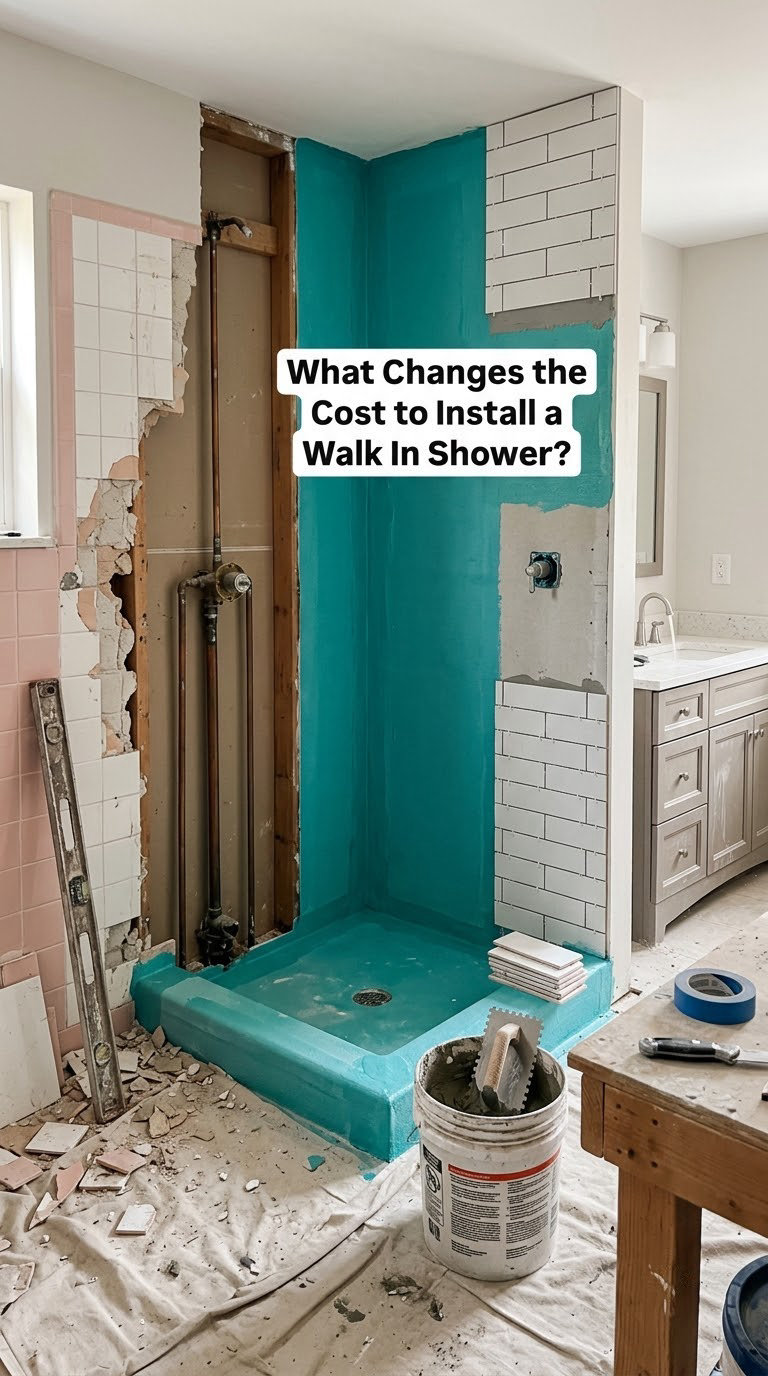
Ten things move the price more than anything else:
- Removing a tub or an existing shower: $50 to $100 for a basic shower removal, $250 to $1,000 when a wall comes down
- Moving the drain: $500 to $3,000, and more on a slab where concrete gets cut
- Framing and wall demolition: charged per wall, per hour, or per linear foot depending on the crew
- Waterproofing scope: $50 to $800 for a liquid membrane, $500 to $1,000 for sheet membrane
- Glass choice: $500 to $1,200 framed, $1,000 to $3,000 or more for frameless
- A curbless entry: adds roughly $2,000 to $5,000 over a curbed shower because the floor needs slope framing and a linear drain
- Bench and shelving: a recessed niche or built-in shelves add tile cutting and framing labor
- Fixture choices: a standard valve and trim runs $500 to $1,200, and thermostatic or rainfall systems push higher
- Permits and inspections: a few hundred dollars and a few days of scheduling
- Hidden damage: the big unknown, and the reason contingency matters
Upgrades stack. A curbless entry plus frameless glass plus natural stone plus a bench can triple a midrange quote without a single surprise appearing on the invoice.
How to Estimate Your Walk-In Shower Budget
Build the number in this order rather than working backwards from a headline average.
Step 1: Price the footprint. Multiply your interior wall and floor area by the installed material rate from the table above. A 5 by 5 foot shower has roughly 50 square feet of wall and 25 square feet of floor once you count the wet walls.
Step 2: Price the equipment. Pan or base, glass, valve and trim, showerhead, and any bench or niche. For a standard showerhead setup, expect $500 to $1,200 for the valve and trim alone.
Step 3: Price the labor separately. Plumbers typically bill $45 to $200 per hour depending on market, tile work runs $30 to $120 per hour, and electrical runs $50 to $100 per hour. Multiply the estimated crew hours by the rate, then add the contractor’s supervision markup.
Step 4: Add the soft costs. Permit, disposal, sales tax, and a contingency reserve of 10% to 15% if your bathroom is more than about twenty years old.
Worked example for a 5 by 5 foot tiled shower in a mid-cost market: porcelain tile and membrane at $1,800, pan and framing at $1,200, glass at $1,600, valve and trim at $900, labor at $3,200, permit and disposal at $500. That lands near $9,200 before contingency, or roughly $10,400 with a 13% buffer.
Older homes deserve a bigger cushion. In a survey of homeowners who had completed a bathroom renovation, 38% reported paying more than they expected, and most of that surprise came from labor and materials rather than a single catastrophic discovery. If your house is more than twenty years old, budget the 15% figure rather than the 10% one.
Before you go further, decide what fixture level you want. If you like the idea of a rainfall head or two showerheads, look at our picks for dual shower heads and how steam shower generators for tile showers change the plumbing rough-in before you sign anything.
DIY Versus Hiring a Walk-In Shower Installer
DIY is genuinely doable for a straightforward prefabricated kit if the drain stays where it is. Homeowners working this way report spending $2,500 to $3,500 all in, with roughly $1,000 to $2,000 of that being labor they supplied themselves through friends or subcontracted help.
The savings come from labor, which is 40% to 65% of a professional bill. For custom tile work the gap widens, since a pro’s membrane and slope experience is what keeps water out of your subfloor.
Some parts should stay with licensed trades. Plumbing rough-in and drain relocation need a permit in most jurisdictions and are covered by insurance only when done by a licensed plumber. Electrical changes for heated floors, lighting in a wet location, or a smart valve do too. Structural changes to a load-bearing wall definitely do.
Waterproofing is the DIY grey zone that matters most. One homeowner had to replace a shower renovated only a few years earlier after a pan leak and pipe failure, which is exactly the outcome that follows a rushed membrane step. If you are tiling, I would not negotiate here.
Accessibility upgrades are worth pricing early. Grab bars, a curbless entry and a bench add up but pay off if you are planning to age in place, since retrofitting later means tearing out finished work. If you want shelving without core drilling, our guide to installing a corner shower caddy covers the renter-friendly option.
Frequently Asked Questions
How much does it cost to remove a tub and install a walk-in shower?
A basic tub-to-shower conversion typically runs $1,200 to $8,000 depending on scope. Staying inside the existing alcove footprint keeps costs low because the drain and supply lines can stay in place. Expanding the shower, relocating the drain, or moving to tile and frameless glass pushes the same job toward the top of that range. One professional install reported removing a tub and surround and fitting a new prefab walk-in with a glass door for $3,750.
How much does Home Depot charge to install a walk-in shower?
Big-box installation services are priced per project rather than by the square foot, and most sellers quote only after an in-home visit. Historically those programs handled straightforward replacements in the lower-middle of the market range and declined heavily customized work, directing buyers toward independent contractors for tile or curbless builds. Because published pricing is thin and quotes are local, get an itemized written bid and compare it against a general contractor before committing.
Is $10,000 enough for a walk-in shower?
For a midrange tiled shower in an existing alcove with the drain staying put, $10,000 is usually enough. It is comfortable for a prefabricated kit with glass, and tight for a curbless entry, natural stone, or frameless glass combined. The budget breaks first when plumbing moves or the subfloor needs repair, so hold back 10% to 15% in a home older than twenty years.
Do I need a permit for a shower conversion?
Usually yes if you are relocating a drain, moving supply lines, framing new walls, or altering electrical, and sometimes even for a straightforward replacement depending on local rules. Permit fees commonly run $250 to $500. Unpermitted plumbing work can complicate a future sale, so ask your municipality before demolition starts rather than after.
How long does it take to install a walk-in shower?
A prefabricated kit in an existing alcove often goes in over two to three days plus curing time. A custom tiled shower usually takes two to three weeks, with more for a curbless build. Add drying and grout curing before the glass goes on, and remember that waterproofing membranes need their own cure window that cannot be rushed.
Can I convert my tub to a walk-in shower myself?
You can, if the drain stays put and you are comfortable with waterproofing. Removing the tub, framing the surround, setting a prefab pan and installing a curtain rod is realistic for a handy homeowner. Once drain relocation, new electrical, or hand-set tile is involved, most homeowners get better results and fewer leaks hiring a licensed crew. Budget $2,500 to $3,500 for a DIY-scale project.
Conclusion
Start by measuring your interior footprint and finding out whether the drain has to move. Those two facts decide whether your project lands near $5,000 or past $15,000, and everything else is refinement. Then get three itemized quotes and compare line by line rather than totals.
If you are still choosing materials, our roundup of the best walk-in shower kits covers the prefabricated options that keep both budget and timeline short.