How Long Does It Take to Texture a Wall? October 2026
How long does it take to texture a wall? A single standard 12×12 ft (3.6 x 3.6 m) wall takes roughly 1 to 2 hours of active application, and a full 12×12 room runs 3 to 5 hours of hands-on work for someone who has textured before. Add drying, and you are looking at 2 to 3 days of elapsed time before paint goes on.
The gap between those two numbers is where most weekend projects go sideways. People budget for the part with the mud on the wall and forget the two days of drying around it. Fall is a good time to start, since the extra days cost you nothing but patience.
Contents
I break the numbers below by texture style, wall size and who is holding the trowel, so you can find the line that matches your room. Dry time rules follow the same logic as how long bathroom paint takes to dry, just with more moisture in the mix.
How Long Does It Take to Texture a Wall?
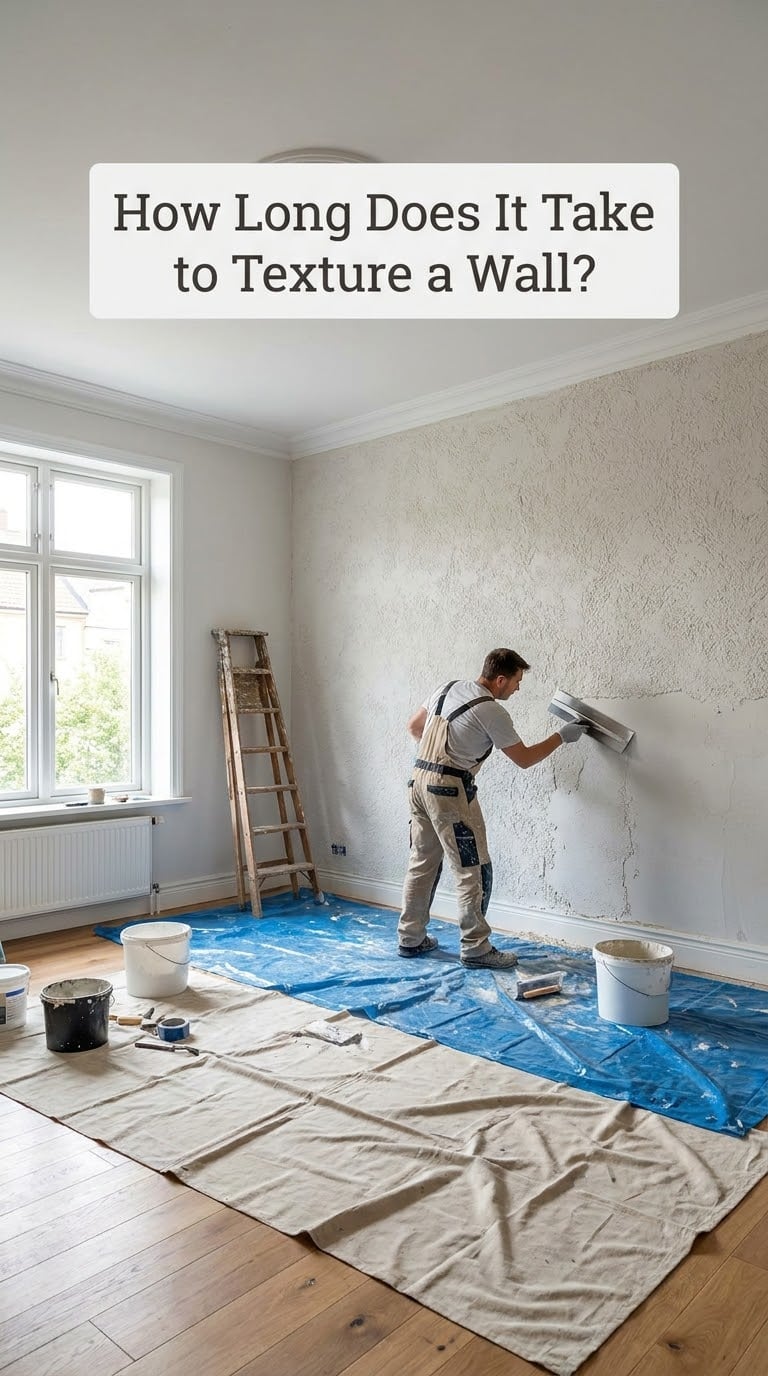
The active work clock is what most people picture when they ask the question. On bare drywall that has already been taped, skim-coated and sanded, a practiced hand moves roughly 150 to 250 sq ft (14 to 23 sq m) per hour with a stomp brush or notched trowel.
A first-timer runs about half that speed. That is not a skill insult, it is the practice curve. You are holding a consistent angle, reloading the tool without dripping, and reading the wet material all at once.
Count on these active hours for a competent DIYer:
- One 12×12 wall: 1 to 2 hours
- Four walls of a 12×12 room, about 400 sq ft: 3 to 5 hours
- One average ceiling, 120 sq ft: 1 to 2 hours by hand, 20 to 30 minutes with a hopper gun
- A 1,500 sq ft house, walls only, with the drywall already finished: 3 to 5 full days
Add 1 to 2 hours for masking and room prep, and another 1 to 2 hours to haul plastic, drop the dust and clean tools once the texture has hardened. Prep and cleanup are the two line items that turn a two-hour job into a weekend.
Wall Texture Timing at a Glance
Here is the whole picture in one place, measured against a typical 12×12 room with about 400 sq ft of wall surface.
| Texture style | Active application | In-process wait | Dry before paint | Total elapsed |
|---|---|---|---|---|
| Orange peel, hand | 3 to 5 hours | None | 24 to 48 hours | 2 to 3 days |
| Orange peel, sprayed | 1.5 to 2.5 hours | None | 24 to 48 hours | 2 days |
| Knockdown | 2 to 4 hours | 10 to 15 minutes per pass | 24 hours minimum | 2 to 3 days |
| Popcorn or acoustic | 2 to 4 hours | None | 24 to 48 hours | 2 to 3 days |
| Skip trowel or old world | 2 to 3 hours | None | 24 hours | 2 days |
| Fine sand or powder texture | 1 to 2 hours | None | 24 hours | 1.5 to 2 days |
| Sponge or roller faux finish | 2 to 4 hours | 1 to 4 hours to recoat | Not required | 1 day |
The last row is the reason some painters finish a room in an afternoon. A faux finish painted on with a sponge or a thick-nap roller never dries as a separate layer, so there is no 24-hour wait before colour goes on.
How Texture Type Changes the Time
Texture style is only one of the four things that move the clock. The rest are wall height, access and the state of the surface underneath.
Wall height and ceiling access
Everything above 8 ft (2.4 m) puts you on a ladder, and a ladder roughly halves your output. Sprayed texture helps here because an extension pole handles the walls and the ceiling without climbing. Hand-stomp work above shoulder height gets tiring fast, so a 9 ft wall usually takes half again as long as an 8 ft wall.
Fixtures, outlets and tight corners
Work around light fixtures, ceiling fans, window casings and a dozen outlet boxes. A standard room has enough of these to add 45 to 90 minutes once you are masking, cutting compound around them and cleaning squeeze-outs off the trim.
Coats and the surface underneath
Texturing bare drywall is not the same job as retexturing. New drywall wants at least a skim coat to fill the tape ridges before texture goes on, which adds a full 24-hour dry cycle plus 2 to 3 hours of application per room. Re-spraying over existing texture can take a third off the application time, though matching the old pattern is where beginners lose hours.
Compound type changes the drying, not the spreading
All-purpose joint compound gives you a forgiving 60 to 90 minute working window. Setting-type compounds such as 20-minute or 45-minute mud harden on a clock but still need 24 hours or more to dry through, which is the single most misunderstood number in this whole topic. Fast-setting does not mean fast-drying.
How to Estimate the Time for Your Wall
Run the arithmetic before you open the bucket.
- Measure the wall. Width in feet times height in feet, minus about 10 percent for openings and trim.
- Pick your rate. 150 to 250 sq ft per hour by hand, 300 to 400 sq ft per hour sprayed.
- Add a 50 percent penalty if this is your first textured wall.
- Add prep and cleanup. One hour to mask, one hour to strip and clean.
- Add 48 hours minimum of drying before you prime or paint.
That gives a defensible schedule. A 12×12 wall at 144 sq ft, 180 sq ft per hour, comes to about 50 minutes of mud work, so call it 2 hours with prep, cleanup and touch-ups.
| Project size | Experienced DIYer | First-timer | Including drying |
|---|---|---|---|
| One wall, about 150 sq ft | 2 hours | 3 hours | 2 days |
| 12×12 room, about 400 sq ft | 1 day | 1.5 days | 2 to 3 days |
| 16×12 room, about 550 sq ft | 1.5 days | 2 to 3 days | 3 days |
| 500 sq ft of wall area | 2 to 3 days | 3 to 4 days | 4 to 5 days |
| 1,500 sq ft house, walls only | 3 to 5 days | 2 weeks | 7 to 10 days |
A workable week looks like this: day one prep, mask and first coat; day two knockdown or second coat; days three and four dry and sand; day five prime; days six and seven paint. Contracting crews working warm, dry conditions can compress that, and one crew documented finishing texture at 9:00 am and spraying it by 11:30 am the same day, but that schedule depends on thin coats and fans running hard.
Wall Texture Costs by Size and Material
Texture material is cheap. Labor is not, and in most cases labor is nearly all of the number. Figures below are realistic US ranges and vary by region.
| Project size | DIY supplies | Contractor, hand texture | Contractor, spray texture |
|---|---|---|---|
| One wall, 150 sq ft | $25 to $60 | $300 to $500 | $225 to $400 |
| 12×12 room, 400 sq ft | $60 to $130 | $700 to $1,200 | $550 to $950 |
| Large room, 600 sq ft | $90 to $180 | $1,050 to $1,800 | $850 to $1,400 |
| 1,500 sq ft house, walls | $400 to $800 | $4,500 to $7,500 | $3,500 to $6,000 |
By material, the same 400 sq ft room lands roughly here:
- Lightweight all-purpose joint compound, hand applied: $60 to $90 in product, mostly for tubs, a tray, blades and a roller frame.
- Setting-type compound or 20-minute mud: $40 to $70 in product, less waste, more touch-ups, and a dry time that does not improve.
- Powdered texture with a hopper gun: $70 to $120 in product plus $40 to $90 a day to rent the gun and a compressor.
- Textured paint, sponge or roller faux finish: $60 to $110, and no 24-hour dry window.
One caution before you touch an old popcorn ceiling. Texture applied before 1978 may contain asbestos, and testing needs to be done by a lab. Removal in that case is a job for a licensed abatement contractor, not a weekend.
Pros and Cons of Popular Wall Texture Styles
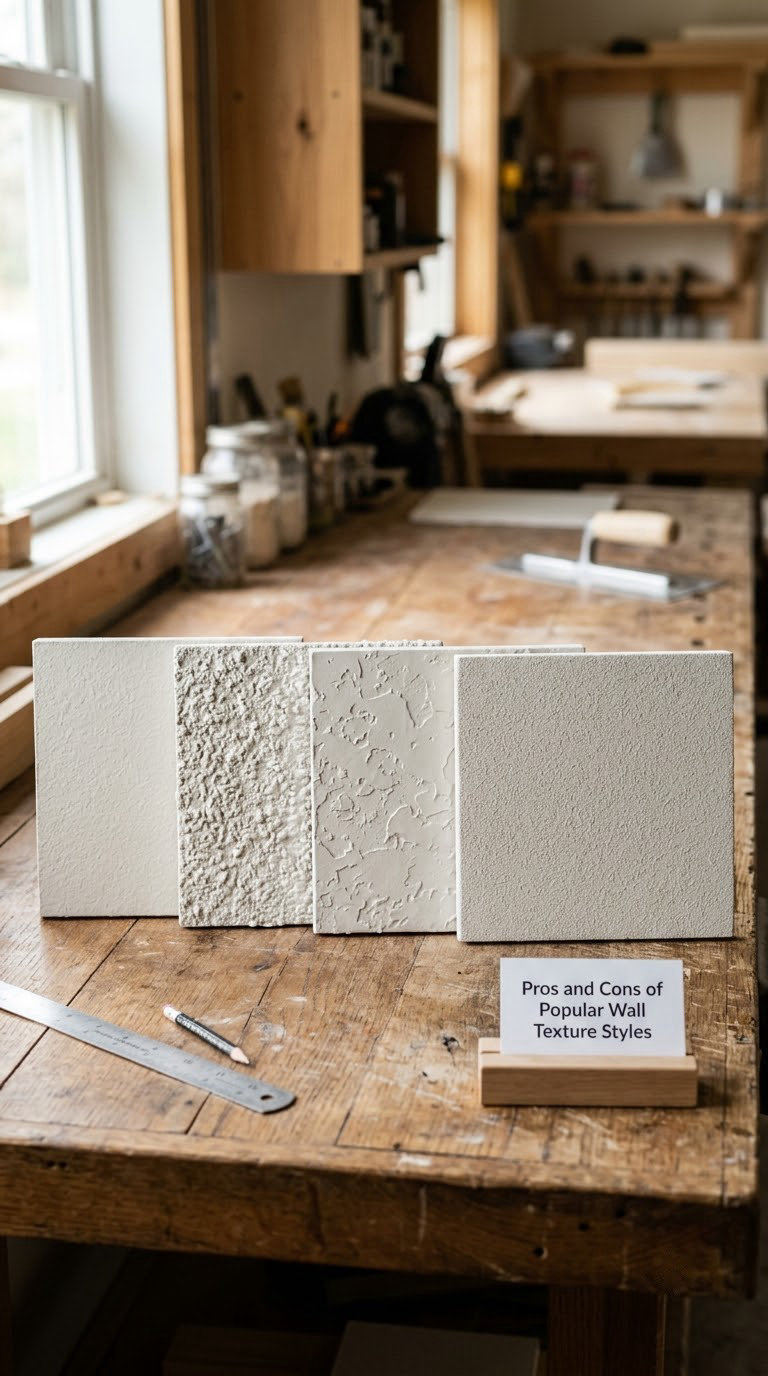
Texture style shapes the look of a room as much as the paint colour does, and each one carries a different time and repair bill.
| Style | Look | Difficulty | Cleanup | Repair later | Time for 400 sq ft |
|---|---|---|---|---|---|
| Orange peel | Subtle, stippled, modern | Low | Messy but normal | Easy to spot and blend | 3 to 5 hours hand, 1.5 to 2.5 sprayed |
| Knockdown | Soft peaks, directional sweep | Medium | Worst of the four, everything clings | Harder, patch shows | 2 to 4 hours |
| Popcorn or acoustic | Heavy, cottage-like, dated | Low by hand, high by spray | Heavy, use plastic | Difficult, often skim and redo | 2 to 4 hours |
| Sand or fine texture | Matte, almost flat | Low | Light | Nearly invisible | 1 to 2 hours |
If your goal is a smooth look rather than a traditional one, texture is optional. Many people in smoother-wall regions go the other direction and treat one wall as an accent, which you can read about in wallpaper ideas for a feature wall. The same accent-wall logic works around a fireplace, where the finish has to handle soot and heat.
What Changes the Price
- Condition of the wall. Sound, taped drywall needs texture only. Walls with water stains, popped screws or torn corners need repair and a skim coat first, which adds both days and dollars.
- Access. Walls behind fixed furniture, in closets or above a staircase cost more in labour than an open rectangular room.
- Removal. Stripping existing popcorn or knockdown runs roughly $1 to $2 per sq ft, and it can rival the cost of the new texture.
- Room size. Labour scales with square footage, but a 12×12 room carries a minimum visit charge that makes small jobs proportionally expensive.
- Finish complexity. Flat, even orange peel is the fastest. A matched hand-trowel pattern on an old house is slow, skilled work.
- Regional rates. Texture is standard on most West Coast homes and uncommon in smooth-wall homes in the East and Midwest, which changes both what you pay and whether you are matching or replacing.
Frequently Asked Questions
Can you texture a wall in one day?
You can apply texture to a single wall in one day, especially with a hopper gun. A 12×12 wall takes 1 to 2 hours of active work plus an hour of prep, so you will finish applying before lunch. You cannot finish the whole job, because the texture needs 24 hours minimum to dry before priming, and a knockdown pass adds a 10 to 15 minute wait between spraying and flattening.
How long does wall texture take to dry before painting?
Plan on 24 hours minimum and 48 hours in cool or humid conditions. Setting-type compounds such as 20-minute mud harden fast but still hold moisture long after they set, and painting over damp compound causes adhesion failure. Some trades wait three days to a week before painting or hanging anything on fresh texture, especially in cold weather.
Is spray texture faster than applying texture by hand?
Yes, and the difference is large. A hopper gun covers roughly 300 to 400 sq ft an hour against 150 to 250 sq ft by hand. The catch is setup: mixing, testing the spray pattern on cardboard and cleaning the gun add 45 to 60 minutes, so renting a gun only pays off past about 300 sq ft.
Should I texture a wall before or after painting it?
Texture first, always. Joint compound will not bond properly to a painted surface, so any wall that needs texture has to be sanded back to bare drywall or primed with a bonding primer first. The order is repair, skim coat, sand, texture, dry, prime, paint.
Can textured walls be repaired without redoing the whole wall?
Yes, in most cases. A nail pop or small dent gets a dab of setting-type compound, a light sand, and a matching texture dab applied with a stomp brush or small hopper gun, then a paint touch-up. Large damaged areas read as patches no matter how carefully you blend them, and those are usually better handled with a skim coat across the full wall.
How do I know if a textured wall needs a professional?
Hire a pro when the wall is not flat drywall underneath, when you are matching an existing hand-trowel pattern, when the ceiling is over 10 ft (3 m), or when old popcorn predates 1978 and may contain asbestos. Experienced sprayers can cover an average ceiling in 5 to 10 minutes, which is the speed a first-timer rarely reaches.
Conclusion: Plan for More Than the Application Time
The fastest honest schedule for one wall is a two-hour application day, a full 24 to 48 hours of drying, then priming and paint. A whole room runs three to five hours of active work spread over two to three elapsed days, and a first-timer should double the application portion.
Start by measuring the wall and checking what is under it, since compound will not stick to paint. Then decide on one texture style, buy all the compound you need in one trip, and set your real deadline two days after you think you are finished.