Cost to Add a Half Bathroom to a House (October 2026)
Most homeowners spend between $5,000 and $15,000 to add a half bathroom inside their existing footprint, and the national average sits near $6,500. That is the cost to add a half bathroom to a house for a typical project: a closet, an under-stair nook, or a laundry corner converted into a powder room with a toilet and a sink and nothing else.
Regional labor rates and the condition of your existing plumbing can move that number by thousands in either direction. This guide breaks the budget into pieces you can actually control, so you can build a defensible estimate before anyone hands you a quote.
Contents
Cost to Add a Half Bathroom to a House
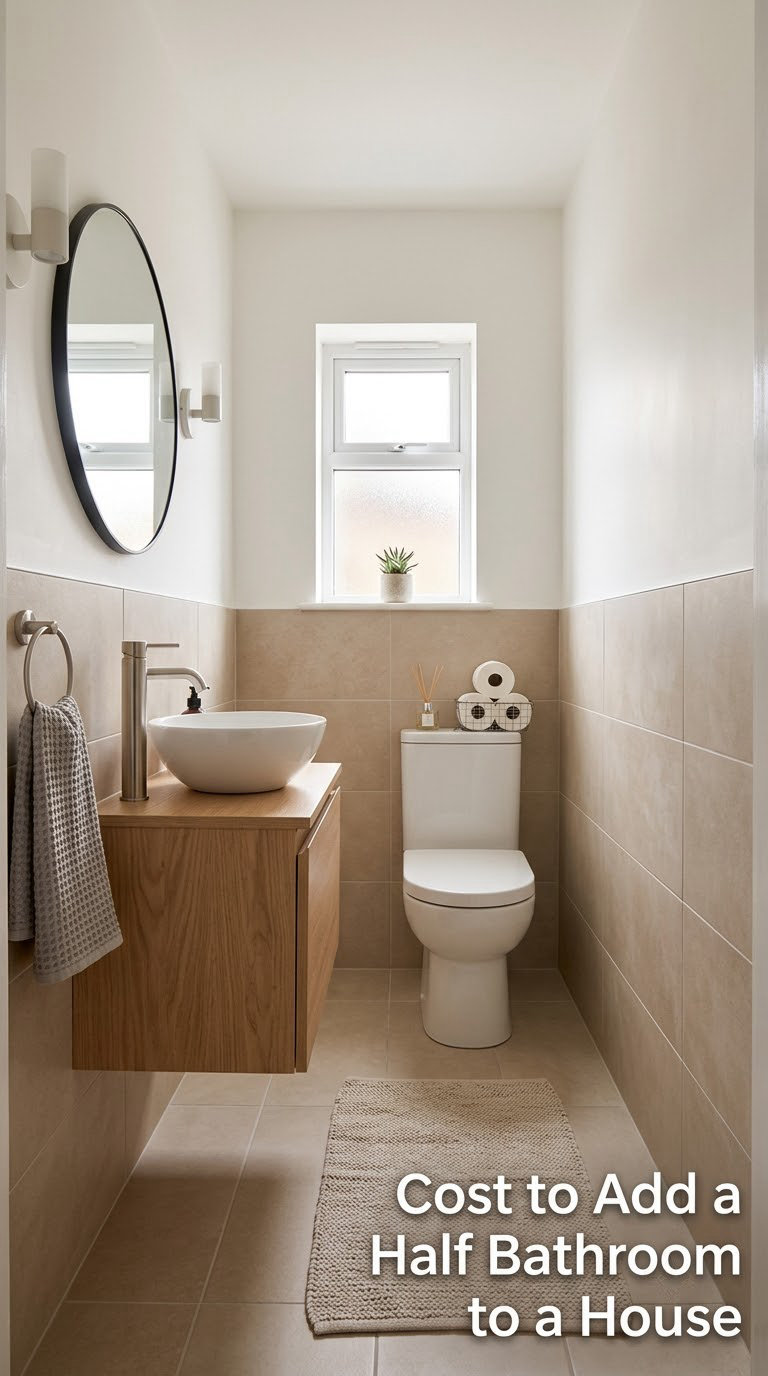
A half bathroom, also called a powder room, partial bath, or guest bath, is a room with a toilet and a sink but no tub or shower. Most run 15 to 32 square feet, and the cost to add a half bathroom to a house in that footprint is driven almost entirely by how the new room connects to your plumbing.
Published national ranges run from roughly $3,800 at the bare-bones end to $25,000 when a room sits far from an existing waste stack, over a concrete slab, or below the sewer line. Editors covering this topic quote $230 to $550 per square foot, but treat that number carefully in a 20-square-foot room. A toilet, a sink, a vent, a GFCI receptacle, and a permit are fixed costs, so per-square-foot math breaks down badly in small spaces.
Half Bathroom Costs by Project Size
The table below separates labor from materials for three project tiers. Labor typically runs about 70% of the budget, which is why the same room costs very different amounts in different cities.
| Project tier | Labor | Materials | Installed total | What drives the price |
|---|---|---|---|---|
| Basic conversion (closet or under-stair space beside an existing bath) | $2,500 to $4,500 | $2,500 to $4,500 | $5,000 to $9,000 | Short waste and vent runs, no wall relocation, stock fixtures |
| Mid-range conversion (laundry, mudroom, or hallway) | $4,000 to $7,000 | $3,500 to $6,000 | $7,000 to $13,000 | Longer drain run, custom tile, stone or solid wood vanity top |
| Custom project (far from the stack, over a slab, below sewer grade, or a new bump-out) | $9,000 to $15,000 | $6,000 to $10,000 | $15,000 to $25,000 | New supply and waste lines, trenching, ejector pump, exterior work |
These tiers describe adding a room that does not currently have plumbing. A whole-bathroom remodel, where you are replacing everything inside an existing full bath, is a different scope and a different budget.
What Does a Half Bathroom Installation Include?
Ask for the scope in writing. Most bids for this project cover the same sequence:
- Demolition and debris removal of the old closet, wall, or finish
- Framing, blocking, and any wall relocation to fit the room
- Plumbing rough-in: new waste, vent, and supply lines with shutoff valves
- Electrical work: a GFCI-protected receptacle, lighting, and an exhaust fan or window check
- Waterproofing and a shower-tub area only if you are converting toward a full bath later
- Subfloor repair, flooring, and tile
- Drywall, paint, baseboard, and trim
- A door with hardware
- A toilet, a vanity, a sink, a mirror, and lighting fixtures
- Permit fees and required inspections
Usually excluded: architectural or design fees (often 8% to 15% of the project), a general contractor markup (commonly 15% to 25%), landscaping, and any repair of finishes in rooms the pipe route passes through. That last one catches people. A drain run that crosses a hallway means patching and repainting that hallway too.
How to estimate the cost to add a half bathroom to a house
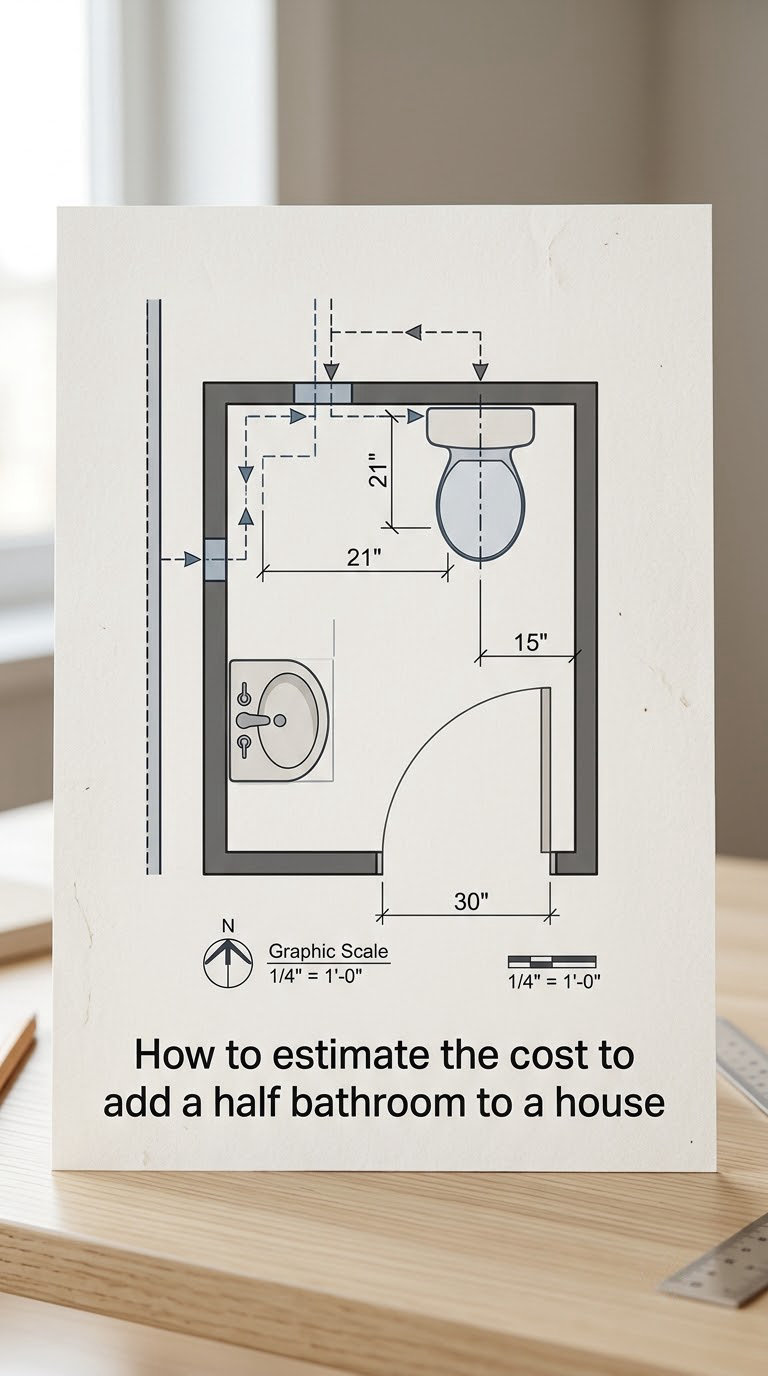
Start with the plumbing, not the paint. Every serious estimate begins by finding the nearest waste and vent stack and measuring how far the new room sits from it, because that distance sets your labor bill more than any finish choice.
Then work through these steps in order.
Measure the room and the clearances. A half bath fits in 20 to 30 square feet comfortably. Toilet placement needs about 15 inches from the toilet centerline to the side wall and about 21 inches of clear space in front, and code also sets minimum spacing between the toilet and the vanity. Measure door swing before you pick a layout, because a door that hits the toilet in a small room is an expensive mistake to fix later.
Map the plumbing route. Trace the path from the new room to the nearest stack. Gravity drainage only works while the sewer line sits below the finished floor, so rooms above that line may need a sewage ejector system. Rooms over a concrete slab may need the slab cut and trenched.
Confirm whether a permit is required. Adding new plumbing almost always triggers a permit from your local building department. Ask before you design, not after.
Split the quote into labor and materials. A bid that shows both lets you shop for fixtures yourself and compare the labor figure against other bids. A lump-sum number tells you nothing.
Add a contingency. Put 10% on top for concealed damage, and 10% to 20% in a home built before 1978 where opening a wall can turn up galvanized pipe, old wiring, or lead paint that has to be handled per EPA rules. This is the situation the 30% rule is meant for: when hidden conditions push the job well past its original scope, stop, document, and renegotiate instead of absorbing it silently.
Materials and Finish-Level Costs
Fixtures are where homeowners try to save. These are realistic US material ranges before installation.
| Item | Economical | Mid-range | High-end |
|---|---|---|---|
| Toilet | $200 to $350 | $400 to $700 | $800 to $1,600 |
| Vanity and sink | $250 to $500 | $600 to $1,200 | $1,400 to $2,500 |
| Wall or backsplash tile | $2 to $4 per sq ft | $5 to $9 per sq ft | $12 to $25 per sq ft |
| Flooring | $3 to $6 per sq ft | $6 to $12 per sq ft | $14 to $30 per sq ft |
| Exhaust fan | $150 to $300 | $300 to $600 | $600 to $1,000 |
| Lighting and mirror | $150 to $300 | $400 to $800 | $900 to $2,000 |
| Trim, paint, and drywall | $300 to $700 | $800 to $1,500 | $1,800 to $3,000 |
The highest visual and resale return usually comes from tile work, the vanity, and lighting, since those are what a buyer sees first. Wall-mount faucets and compact floating vanities are a common upgrade in a small powder room, and they buy back a little floor space in a room where clearance is the whole design problem.
What Changes the Price?
Distance from the existing waste stack is the biggest lever. A room placed back-to-back with an existing kitchen or laundry line can save several thousand dollars compared with the same room at the far end of a house.
Beyond that, these items move the total:
- Location. A closet, under-stair nook, or hallway on the same floor as an existing bath sits at the low end. A basement, garage, or attic conversion sits at the high end because the drain and vent runs get longer.
- Permits and inspections. Expect a few hundred dollars in fees depending on your jurisdiction, plus corrections if something is signed off wrongly.
- Demolition. Removing a finished closet or cutting a doorway adds hours you did not plan for.
- Framing and structural work. Moving or removing a load-bearing wall is a different project, with engineering and permits attached.
- Electrical. A new circuit and an exhaust fan run add up quickly. Our guide to adding an electric outlet in a bathroom covers the code basics.
- Ventilation. Under the IRC, a bathroom needs an operable window or a mechanical exhaust fan ducted outdoors. A short duct run is cheap; a long one through a finished ceiling is not.
- Custom tile and stone. Labor on hand-set tile can equal the material cost.
- Who does the work. A licensed general contractor adds a markup layer on top of the trades. A handyperson may be cheaper and may not be permitted to pull the permit.
If you are planning a basement powder room, read this on adding a shower to a basement half bath before you commit to a layout: how to add a shower to a basement half bath. Designing for a future full bath now costs far less than adding the tub and shower later.
DIY or Hire a Contractor?
Parts of this project are friendly to a competent DIYer and parts are not. The split is clean once you see it by task.
| Task | DIY verdict | Why |
|---|---|---|
| Demolition and hauling | Reasonable | Slow, dusty, and easy to damage drywall you meant to keep |
| Framing, drywall, paint, flooring | Reasonable with experience | Finish work rewards patience more than skill |
| Fixture setting and caulking | Reasonable | Straightforward once the rough-in is correct |
| Plumbing rough-in and drain line | Not recommended | Drain slope and vent placement must pass inspection, and a mistake inside a wall is expensive to reopen |
| Electrical work | Not recommended | GFCI protection and fan wiring are code requirements in most jurisdictions |
| Permits and inspections | Owner can pull in some areas | Many jurisdictions require a licensed trade to sign off |
| Liability and workmanship | On you | A licensed contractor carries insurance and usually a warranty on the work |
One more caution about partial DIY: if you do the demolition and finishes yourself but hire trades for the plumbing and electrical, you still need permits and inspections, and many contractors will not warranty work performed over somebody else’s rough-in.
How much of the cost to add a half bathroom is labor?
Roughly 70% of the budget in a typical project. One homeowner described in renovation forums a 7 by 3 powder room remodel that billed about $6,400 in labor against roughly $2,000 in materials, which is about the split most contractors report.
That ratio is why the cheapest way to control the cost of this project is placement. Move the room closer to the existing stack and you cut labor. Choose a cheaper tile instead and you have shaved a few hundred dollars off a bill where labor still dominates.
How to Keep the Project on Budget
Get three itemized quotes and compare them line by line, not by total. The spread between quotes is normal. In one renovation group post, a homeowner compared a $4,000 quote with a $13,000 quote for the same half bath, and the difference was almost entirely scope. One bid priced the permit, wall repair, a new circuit, and ventilation. The other treated them as extras.
Confirm in writing that each quote prices the plumbing route and vent path explicitly, states which assumptions were made, and lists what is excluded. A contractor who pulls the permit and schedules the inspections themselves is worth paying for.
Beyond that, a few habits keep the number honest:
- Retain the existing plumbing whenever the room allows it.
- Set a firm finish allowance and shop for the vanity, toilet, and tile yourself.
- Order fixtures and tile early; lead times on custom tile can stall a schedule.
- Freeze the layout once it is drawn. Moving a toilet after the drain is set means starting over.
- Hold back 10% for hidden conditions until the final inspection passes.
- Avoid changing finishes mid-project, and plan your payment schedule with a deposit, progress draws, and a final holdback rather than paying most of it upfront.
One more thing worth checking: published ranges disagree widely, from $5,000 to $15,000 on one end and $4,000 to $12,000 on another, with regional figures far lower. Homeowners in the Midwest report paying roughly $3,500 to $7,500, well under coastal averages. Find out where your own market sits before you decide whether a quote is high.
Frequently Asked Questions
How much does it cost to add a half bathroom to a house?
Most homeowners spend between $5,000 and $15,000 to add a half bathroom inside an existing footprint, with a national average near $6,500. A closet or under-stair conversion beside an existing bathroom runs $5,000 to $9,000. A room far from the waste stack, over a slab, or below the sewer line can reach $15,000 to $25,000. Labor makes up about 70% of that budget.
Do I need a permit to add a half bathroom?
In most US jurisdictions, yes. Adding a toilet and sink introduces new drain, vent, and supply lines, which triggers a permit from the local building department. Some areas also require permits for the exhaust fan and any new electrical circuit. Ask your building department before design work starts, and confirm whether a licensed trade must pull the permit or you may pull it yourself.
Is it cheaper to add a half bathroom near an existing bathroom?
It is, and the difference is usually measured in thousands. Placing the new room back-to-back with an existing bathroom or near a kitchen or laundry line shortens the waste and vent runs, which is the single biggest driver of labor cost. Homeowners who compare plumbing routes before choosing a room frequently land at the low end of the published range.
Can I add a half bathroom myself?
Partly. Demolition, framing, drywall, paint, flooring, and setting fixtures are reasonable for an experienced DIYer. Plumbing rough-in and electrical work are not, because drain slope, vent placement, and GFCI protection must pass inspection, and errors mean reopening finished walls. Budget about 70% of the total for labor either way, since materials are the smaller share.
Does adding a half bathroom increase home value?
It usually does, and the effect depends on how many bathrooms the house already has. Common estimates run from about 6% on larger homes with several baths to 10% or more in a small house with a single shared bathroom. Appraisers weigh added function and finished square footage, so a well-built powder room in a 1,500-square-foot house tends to return more than the same room in a 4,000-square-foot house.
Start with the plumbing route, not the tile sample. Measure the distance from your candidate room to the nearest waste stack, check that distance against your local plumber’s rough-in price, and hold your budget with a 10% contingency. Once you have three itemized quotes priced the same way, the right number usually becomes obvious, and the cost to add a half bathroom to a house stops being a guessing game.