Cost to Install Recessed Lighting Per Can: 2026 Price Guide
The cost to install recessed lighting per can runs about 125 to 300 for a standard job, and 200 to 400 per can when an electrician has to cut into a ceiling that is already finished. That figure normally covers the light plus the labor. All prices in this guide are US dollars, and they shift with where you live and what your ceiling looks like behind the drywall.
You will see four or five different ranges online, and they are not all wrong. Each one prices a different situation: a can going into a brand new ceiling costs very little in labor, while a can in a furnished room with a wire that has to be fished through a joist can cost several times more. Once you know which situation you are in, the per-can number becomes useful instead of confusing.
Contents
Here is how the pricing breaks down by can size, what you actually pay for when you hire someone, and which details move the total.
Recessed Lighting Installation Costs by Can Size
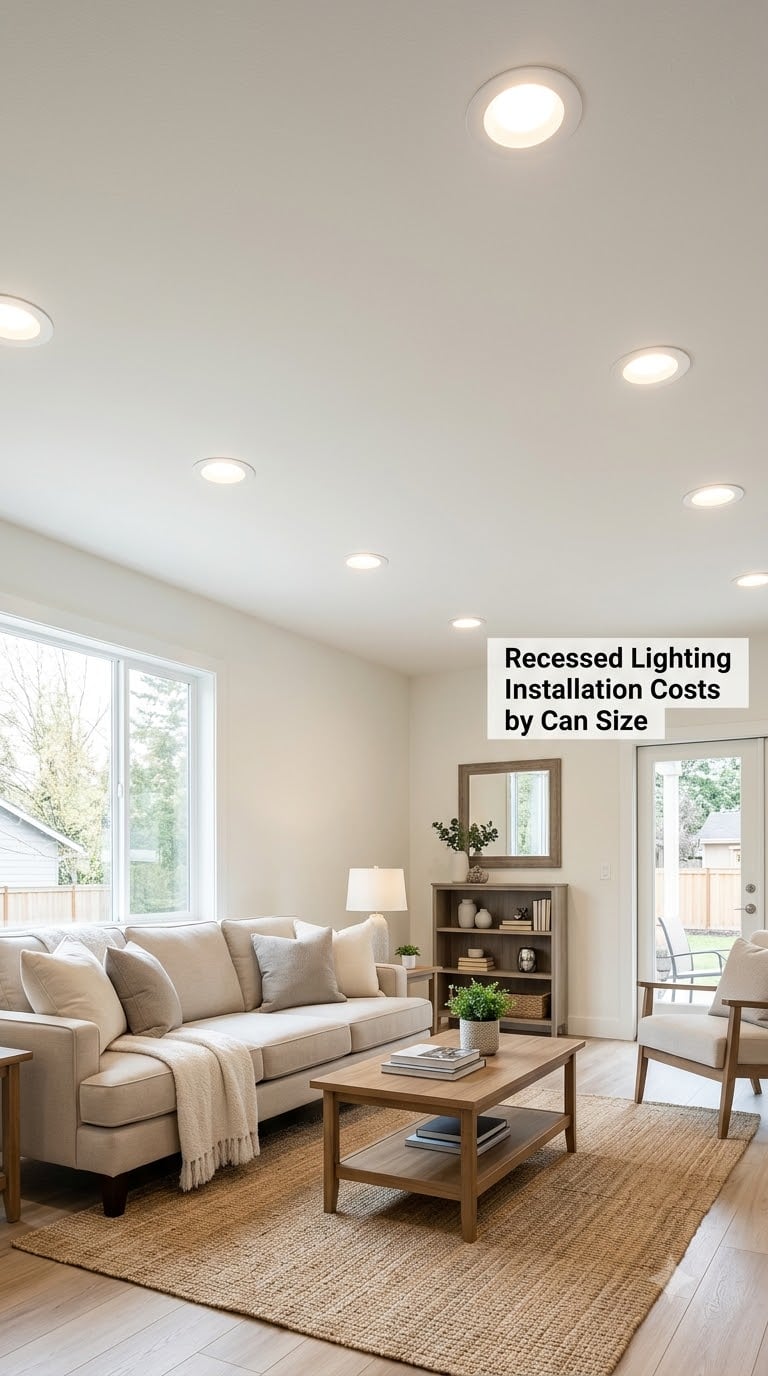
The short version: 4-inch cans land around 140 to 290 per can installed, 5-inch cans around 170 to 360, and 6-inch cans around 200 to 430. Bigger cans cost more because the light itself costs more and the hole in the ceiling is wider to cut and patch.
| Can size | Typical fixture cost | Typical labor cost | Installed cost per can |
|---|---|---|---|
| 4 inch | 40 to 90 | 100 to 200 | 140 to 290 |
| 5 inch | 60 to 140 | 110 to 220 | 170 to 360 |
| 6 inch | 80 to 180 | 120 to 250 | 200 to 430 |
| Trimless or wet-rated | 120 to 300 | 140 to 280 | 260 to 580 |
Most homes use 6-inch cans. The 4-inch can exists for narrow joist bays and shallow ceilings, and the 5-inch is a compromise that fits between the two. Buying the 4-inch to save money on the fixture rarely pays off, because the labor to cut and patch the hole stays exactly the same.
How to calculate the cost to install recessed lighting per can
Most electricians quote a straight price per can for a straightforward job rather than billing strictly by the hour. Your total is then the number of cans multiplied by the per-can rate, plus a handful of flat extras.
A quick worked example for a 12 by 14 kitchen with six 6-inch cans: 6 cans at 275 each is 1,650 for lights and labor. Add a new 20-amp circuit at 350, a permit at 90, and drywall patching and paint for 250, and the room lands near 2,340. For four cans in a bedroom at the same rate you would be closer to 1,600 all in. For ten cans across a main floor, 3,000 to 4,500 is a fair expectation.
Two numbers quietly inflate those totals. Most electricians charge a minimum labor charge of two hours on any job, so one or two cans cost far more per can than eight do. And if you go through a general contractor rather than hiring the electrician directly, expect a markup of roughly 13 to 22 percent on top of the electrical scope.
How many cans a room needs
Count first, price second. Lights are usually spaced 4 to 6 feet apart along the length of the room, roughly 3 feet off the walls, and no closer than 18 inches to a joist.
| Room size | Typical can count | Estimated installed total |
|---|---|---|
| 10 by 10 bedroom | 4 | 1,000 to 1,600 |
| 12 by 12 bedroom | 4 to 6 | 1,000 to 2,000 |
| 14 by 16 living room | 6 to 8 | 1,800 to 2,900 |
| 16 by 20 living room | 8 to 10 | 2,400 to 3,600 |
| Kitchen with island | 6 to 10 | 1,900 to 3,500 |
| Basement drop ceiling | 8 to 14 | 2,400 to 4,500 |
Replacing existing cans versus adding new ones
Swapping the bulb in a twenty-year-old can is nearly free. Swapping the whole can for a new LED one is a different job, usually 90 to 200 per can if the wiring and attic access are already in place. Many owners are replacing halogen cans that have gone yellow or flicker, and this is where picking fixtures first pays off. Our picks for the best LED recessed lights cover the common sizes and trims.
Adding new cans where none existed is the expensive version, because you are paying for wire as well as a hole. In a basement where the joists are already exposed, basement recessed lighting kits go in fast and cheaply. In a finished second floor, that same can can double in price.
Pros and Cons of DIY vs Hiring an Electrician
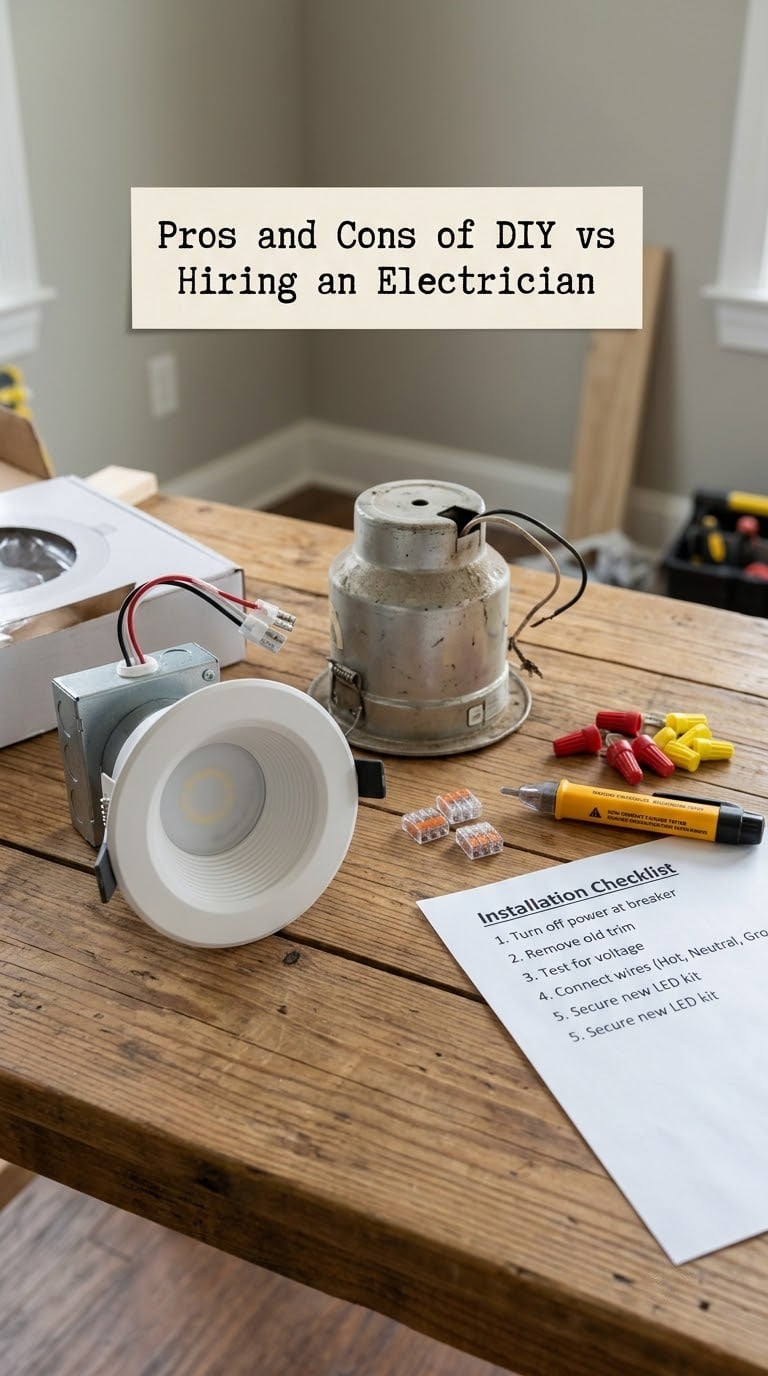
Hiring a licensed electrician costs roughly 100 to 250 per can in labor. Doing it yourself costs only the fixture and a hole saw, but you are working on your own live wiring in a ceiling you cannot see once the job is finished.
| Factor | DIY | Licensed electrician |
|---|---|---|
| Cost per can | 60 to 200 for parts only | 140 to 430 all in |
| Skill needed | Confident with NM wire, box placement and circuit load | None from you |
| Safety | Live panel, attic work, ladder and saw at height | Handled by the crew |
| Permit | You pull it and schedule the inspection | Usually included |
| Drywall patching | Yours to do | Often extra, sometimes included |
| Warranty | None | Workmanship warranty, licensed and insured |
The cost argument for DIY looks strong and then stops being strong. You save the labor line, which is usually the larger half of the bill, but you still need a drywall plug, joint compound, a skim coat and paint that matches the ceiling. Electricians often leave finish work to the drywaller anyway, which is one reason homeowners see a second bill after the electrical invoice clears.
My advice is to split it by skill. Pull the cans out of the attic, patch the ceiling and paint after the electrician finishes, and let them handle every wire. On a six-can kitchen that alone can shave 300 to 500 off the electrical invoice without anyone getting hurt.
Hire someone outright when the panel is full, the wiring is aluminum or knob-and-tube, the ceiling is vaulted or concrete, or a permit is required in your area. Electrical work has to follow the local code, and the inspector will not accept a homeowner install without one.
What Changes the Price of Installing Recessed Lights
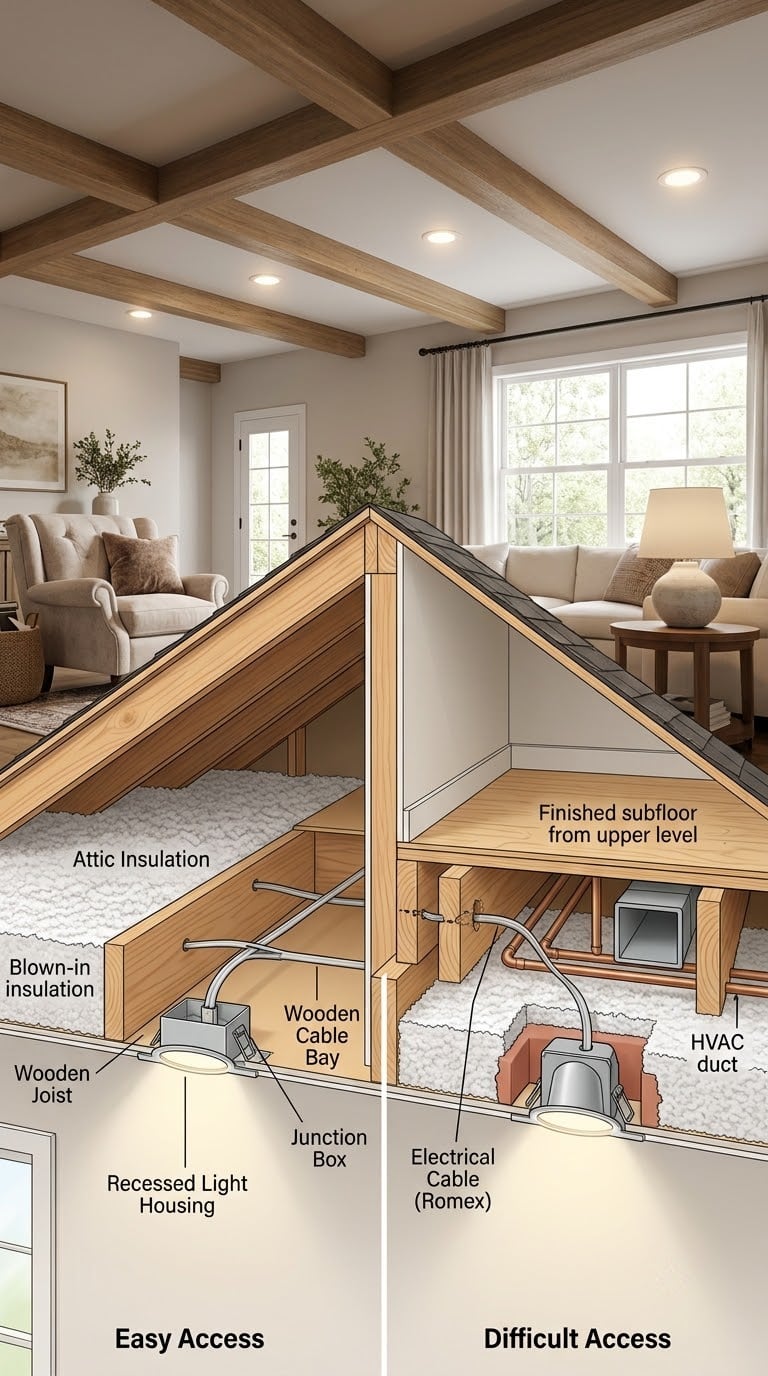
The per-can rate is only the starting number. These are the details that move it.
New construction versus retrofit. A can going into a ceiling that is still open costs about 125 to 250 because the electrician can see the bay and clip the wire in seconds. The same can in a finished ceiling runs 200 to 400, a 25 to 50 percent premium, because of the cutting, the fishing and the patching.
Access. An attic you can walk into is worth a lot. No attic access, or a vaulted ceiling where the can has to be installed from the floor through a hole cut from above, pushes the labor toward 280 per can.
Where the circuit is. Lights that share one existing circuit run cheapest. Each new circuit adds roughly 300 to 450, and moving a switch to the far end of the room is another 150 to 300.
Panel capacity. An old 100-amp panel with no room for a circuit may need a subpanel or a service change, which is a change order of 1,500 or more that nobody puts in the per-can quote. Ask about spare breaker space before you sign anything.
Housing type. IC-rated, airtight and wet-rated housings cost more than a basic non-IC can, but IC-rated is the one to insist on whenever insulation sits above the ceiling. A screw-in can or a trimless fixture adds another 20 to 60 in parts.
Wet and damp locations. A shower or covered porch needs a wet-rated trim and a correctly placed junction box behind a gasketed cover, which is a different trim price.
Finishing. Ask whether drywall patching and paint are in the price. If they are not, add 40 to 90 per can for patching and texture matching, more if your ceiling has a hand-applied texture that will not blend.
Regional labor and markup. Electrician rates run about 65 to 95 per hour in much of the Midwest and South and 120 to 190 per hour in high-cost coastal metros, which alone can double a per-can figure. If the job passes through a general contractor, add 13 to 22 percent.
Add-ons to price separately. Dimmer switches run 40 to 90 installed, a permit 60 to 150, and a canless LED disk light trades the housing entirely for a flat fixture, usually 90 to 160 all in when the wiring already exists.
Before you commit, walk a quote line by line and ask what is included: are permits pulled, is drywall patched, who paints, is the old fixture removed, and is the panel checked for spare capacity. Our bathtub drain replacement cost guide uses the same checklist approach for a different trade, and the questions transfer well.
Frequently Asked Questions
How much does it cost to install one recessed light?
Expect 140 to 290 for a 4-inch can, 170 to 360 for a 5-inch can, and 200 to 430 for a 6-inch can, including the fixture and labor. Adding a single light to a finished ceiling often costs more per can than adding six, because most electricians charge a two-hour minimum on any job.
Can I install recessed lighting myself?
You can, if your local rules allow a homeowner to do it and you are comfortable working on NM wire, mounting a junction box and staying within circuit load limits. You also have to patch and paint the ceiling afterward. If the panel is full, the wiring is old aluminum, or a permit is required, hire a licensed electrician.
How much does it cost to add recessed lights to an existing ceiling?
Retrofitting an existing finished ceiling usually runs 200 to 400 per can, which is a 25 to 50 percent premium over new construction. The extra covers cutting the hole, fishing wire through the joist bay, patching drywall and matching the paint. Add 300 to 450 if a new circuit is needed.
What size recessed light should I choose for a typical room?
Six-inch cans suit most living rooms, kitchens and bedrooms. Four-inch cans only make sense where a shallow ceiling or a narrow joist bay leaves no choice, and five-inch cans are a middle option. Whatever the size, stay within 18 inches of a joist and space the cans 4 to 6 feet apart.
Do recessed lights need a permit?
Requirements vary by jurisdiction. Adding a new circuit or running new wire usually needs a permit and an inspection, while swapping a trim on an existing can often does not. Your electrical department will tell you either way, and many electricians pull the permit as part of the job.
Should I use IC-rated recessed lights?
Yes, whenever insulation sits above or behind the ceiling. An IC-rated housing is built to be in contact with insulation without overheating, which protects you from a fixture that gets too hot. Non-IC cans need an air gap and are only appropriate where the ceiling cavity is clear.
Start by counting the cans your rooms actually need and checking whether the circuit they will land on has the capacity. Get two or three quotes that break out labor, materials and finish work by line item, then the cost to install recessed lighting per can stops being a mystery number and turns into a line on your own budget.