Cost to Install New Kitchen Countertops: October 2026 Guide
The cost to install new kitchen countertops runs $1,850 to $4,500 fully installed for a standard 30 to 40 square foot kitchen, with a national average near $3,100. The floor is about $400 for a DIY laminate kit. The ceiling is well past $8,000 for exotic natural stone in a large kitchen.
Those numbers are US ranges as of 2026, and where you live moves them. A fabricator in a high-cost metro can quote 30 to 50 percent more than a shop two states away, and the same slab in the same kitchen can swing by a few hundred dollars depending on the edge profile and how many cutouts you need.
Contents
Material is only about half the invoice. Fabrication, labor, cutouts, edge work, tear-out and plumbing reconnects add another 30 to 50 percent on top, which is exactly where homeowners get surprised. Here is how each piece gets priced so you can build a number you trust before anyone starts cutting.
Kitchen Countertop Installation Costs by Material
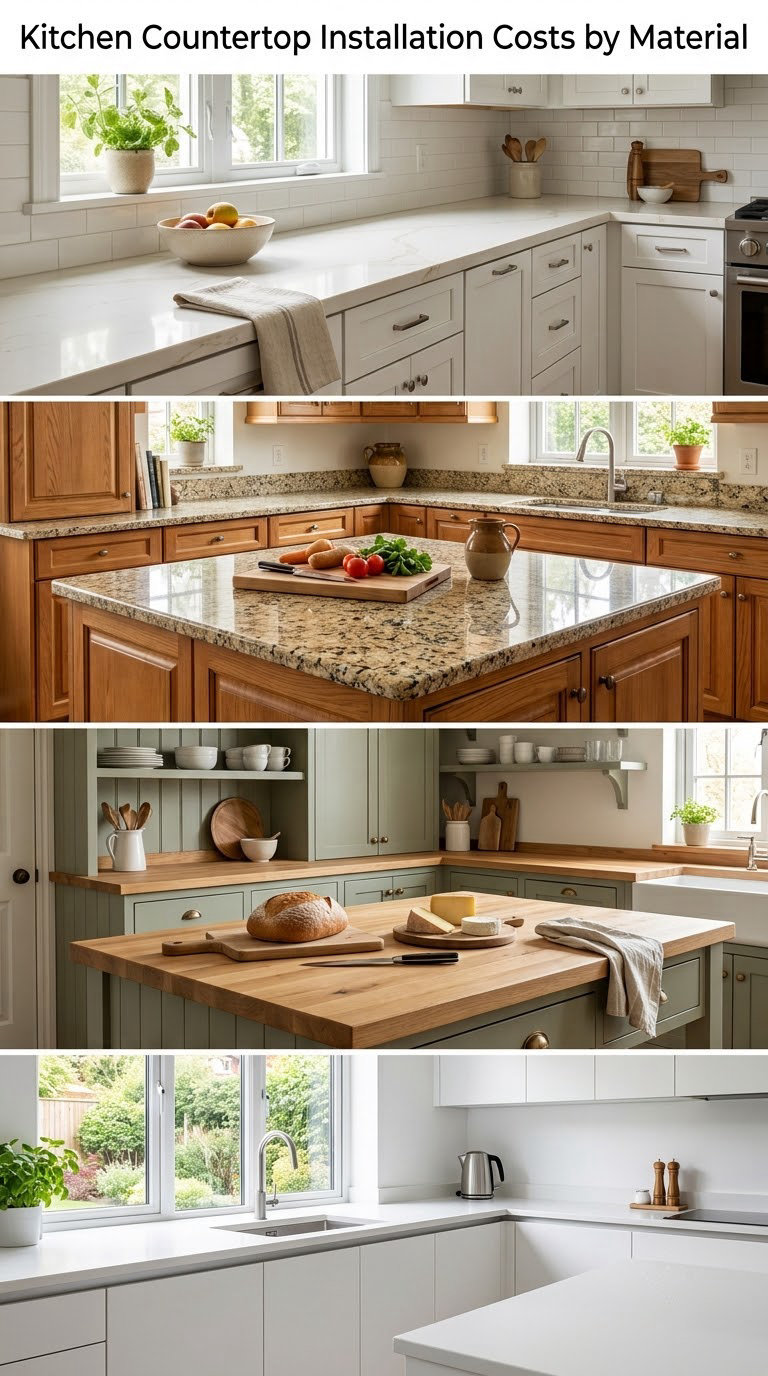
Quartz and granite do most of the work in American kitchens, but the spread between the cheapest and most expensive surface is wider than most people expect. Quartz holds roughly a third of the new-countertop market, and engineered stone has pushed granite down to under 10 percent of sales.
| Material | Material per sq ft | Labor per sq ft | Installed per sq ft | 30 sq ft kitchen |
|---|---|---|---|---|
| Laminate (prefabricated) | $15 to $40 | $15 to $25 | $45 to $70 | $1,350 to $2,100 |
| Ceramic tile | $10 to $25 | $25 to $45 | $35 to $70 | $1,050 to $2,100 |
| Butcher block (hardwood) | $40 to $75 | $20 to $35 | $60 to $110 | $1,800 to $3,300 |
| Porcelain slab | $50 to $90 | $25 to $40 | $75 to $130 | $2,250 to $3,900 |
| Granite | $45 to $125 | $20 to $35 | $80 to $200 | $2,400 to $6,000 |
| Engineered quartz | $60 to $140 | $20 to $35 | $80 to $175 | $2,400 to $5,250 |
| Solid surface | $60 to $110 | $20 to $35 | $80 to $145 | $2,400 to $4,350 |
| Marble | $70 to $120 | $25 to $40 | $70 to $200 | $2,100 to $6,000 |
| Quartzite | $90 to $200 | $25 to $40 | $115 to $240 | $3,450 to $7,200 |
| Concrete or stainless | Custom | $30 to $50 | $150 to $350 | $4,500 and up |
Angi puts the national average installed countertop job at $3,160, based on 8,820 verified projects, with most homeowners paying between $1,882 and $4,484. Home Depot’s published guide lands in a similar band, averaging $34 to $97 per square foot depending on material, with higher ranges for complex layouts.
Homewyse lists a laminate countertop install at $45 to $69 per square foot in its latest national survey, which is why a competent DIY laminate job is the only route under $1,000. One thing worth knowing: granite is not the cheapest stone you can install. A granite run often costs about the same as quartz, and marble can cost less.
How Much Do New Kitchen Countertops Cost by Size?
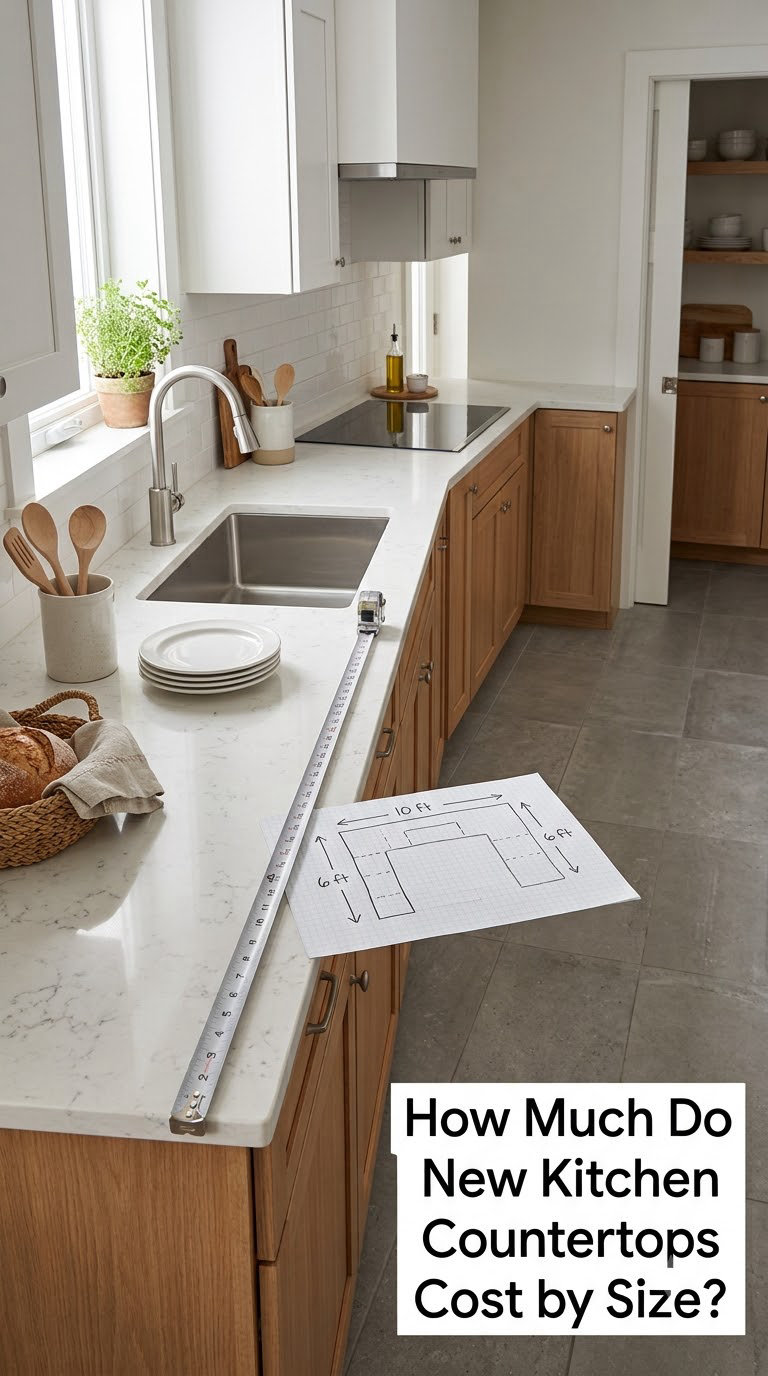
Size drives the bill more than style does. A galley kitchen and an L-shape with an island can use the same material and differ by thousands, mostly because of seam count, handling time and how many cutouts the layout forces.
| Kitchen layout | Typical square footage | Installed range (mid-grade quartz or granite) |
|---|---|---|
| Small galley | 15 to 20 sq ft | $1,200 to $2,600 |
| Standard single run | 25 to 35 sq ft | $1,850 to $4,500 |
| L-shape | 35 to 50 sq ft | $2,700 to $6,500 |
| L-shape with island | 50 to 70 sq ft | $4,000 to $9,000 |
Measure it yourself in about five minutes. Measure the length of each cabinet run, multiply by 25 inches for a standard counter depth, and add about 4 square feet for every inside corner. Twenty linear feet comes out to roughly 42 square feet once corners and the sink cutout allowance are counted, which is why a quote for a 20 foot granite run usually lands somewhere between $2,400 and $4,000.
Slab yield is the piece most people miss. Stone comes in slabs, and a fabricator can only use the shapes that fit them. A layout that needs four pieces instead of two pays fabrication, handling and two more seams, which is where a waterfall edge on an island can add $300 to $600 per side and a mitred seam adds roughly $150 to $300 per seam.
Pros and Cons of Popular Kitchen Countertop Materials
Here is the honest version, based on how each surface behaves in a real working kitchen rather than on a showroom sample.
| Material | Pros | Cons |
|---|---|---|
| Engineered quartz | No sealing, huge color range, uniform slab, stains and scratches barely register | Heat can discolor it, chips are visible on dark colors, slabs are limited so big kitchens need seams |
| Granite | Handles hot pans, lasts decades, hides stains, every slab is unique | Needs sealing every 1 to 3 years, cold to the touch, repair resin shows on light stone |
| Laminate | Cheapest by a wide margin, easy to replace, no sealing | Burns at high heat, seams show, not repairable, roughly 10 to 15 year lifespan |
| Butcher block | Warm look, can be refinished rather than replaced, gentle on knives | Water and heat damage it, needs oiling every few months, no undermount sink option |
| Ceramic tile | Very heat and stain resistant, budget friendly, patterns available | Grout lines trap grease and discolor, feels cold, high labor to install well |
| Porcelain slab | Thin, heat and stain proof, consistent color, no sealing | Edges chip during handling, limited repair, few shops stock it |
If you cook a lot and use a stand mixer every week, quartz or granite earns its money. If the kitchen is mostly assembly and storage, laminate with a good edge band looks better than you would guess. Butcher block suits a person who treats a counter as a work surface, and our butcher block countertop picks cover the grades worth looking at.
What Changes the Cost to Install New Kitchen Countertops?
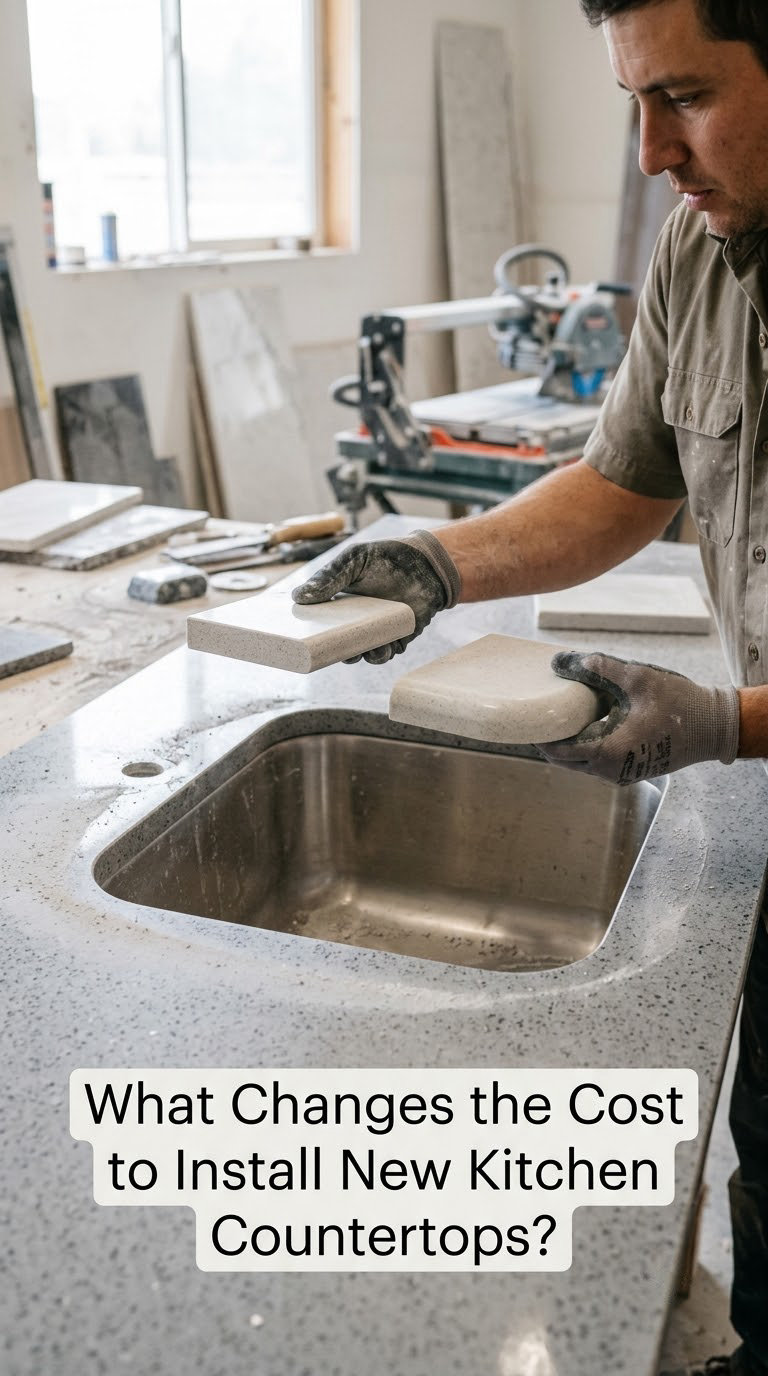
Add-ons are where a mid-range quote turns into a bigger bill. Here is what to check line by line.
- Removal and haul-away: $150 to $400 for a standard kitchen. Disposal fees at the county level can add to that.
- Plumbing disconnect and reconnect: $250 to $600 combined. A new undermount sink or faucet runs $200 to $700 more, and moving a drain line can push it higher. Our undermount sink guide covers what works with stone.
- Cutouts: faucet holes usually run $50 to $100, sink and cooktop cutouts $100 to $300 each. A reinforced or polished cutout edge costs more again.
- Edge profile: an eased edge is standard. Bevel, bullnose and ogee run $10 to $40 per linear foot on top.
- Cabinet prep: leveling and shimming $200 to $600. Repairing cabinets that were never level can cost more than that.
- Out-of-square walls: $300 to $800 to scribe or furring a wall that was built crooked.
- Electrical: a new outlet for a coffee station or induction cooktop adds $250 to $600 and may need a permit.
- Backsplash: tile runs $15 to $40 per linear foot, or $10 to $25 per square foot. Ask whether it is included, because it often is not.
- Sealing: $150 to $300 for natural stone on install day, then $50 to $200 every 1 to 3 years.
- Access: a second-floor kitchen, a narrow staircase or a tight parking spot adds $150 to $500. Stone arrives on an A-frame and gets carried by suction cups.
- Shop minimum: most fabricators have a $300 to $500 minimum job, which is why a small bathroom vanity can cost more per square foot than a full kitchen.
How to Compare Countertop Quotes and Avoid Surprises
Two quotes that differ by $900 may cover the same job, or they may not. The only way to tell is to force both shops onto the same page.
Ten line items every countertop quote should show
- Square footage and the measurement method used to get it
- Material by brand series and slab thickness
- Number of pieces and number of seams, with seam placement noted
- Edge profile priced per linear foot
- Each cutout listed separately, sink and cooktop included
- Template and fabrication charges
- Removal and disposal of the old countertop
- Plumbing disconnect and reconnect, with a plumber or an installer named
- Backsplash, if any
- Installer workmanship warranty separate from the material warranty
If labor appears as a percentage of material cost instead of a square foot or hourly figure, ask for the underlying math. Forum homeowners on r/HomeImprovement and r/Homeowners report seeing roughly 50 percent of material cost added as an install line, which is normal in principle but useless for comparing bids.
What to ask before you sign a cost to install new kitchen countertops quote
- Do you template with a laser or digital device, or a tape measure and a notepad?
- Who is named on the quote, and do you fabricate in your own shop or subcontract the slab?
- Who reconnects the sink and disposal, and is that inside this price?
- What happens if the slab arrives and does not fit?
- What does a change order cost, and how much can the total move once demolition starts?
Where the surprise bills actually come from
Homeowners on home improvement forums report final invoices well above their first quote most often for the same three reasons: add-ons discovered after the old counter is off, a bundled general contractor line item that does not match a standalone fabricator quote, and small-job minimums padding the per-square-foot price.
One installer cut an overhang to 1 inch instead of the specified 1.5 inches and had to recut a whole slab. The fix came within a day, but it is the reason template quality is worth asking about.
The buffer that covers most of this is a 10 to 15 percent contingency. On a $3,100 average install that is roughly $310 to $465 held back until the cabinets are cleared and the plumber has looked at the drain.
Ask installers about off-peak scheduling too. November through February is the slowest stretch of the year for most shops, and it is the easiest time to get a preferred slot or a small discount.
Frequently Asked Questions
How much should I budget for new kitchen countertops?
For a standard 30 to 40 square foot kitchen, budget $1,850 to $4,500 fully installed, with a national average near $3,100. Laminate sits at the bottom of the range and exotic stone at the top. Add a 10 to 15 percent contingency for plumbing surprises, out-of-square walls and cabinet leveling, which is where most overages come from.
How long does it take to install new kitchen countertops?
Templating takes 30 to 90 minutes on site. After that, fabrication usually runs 1 to 3 weeks depending on the shop queue and material. Install day itself is 2 to 4 hours for laminate and quartz, and 4 to 8 hours for stone that needs a two-person crew. Allow a week for cabinet leveling or plumbing work if either surfaces late.
Can I install kitchen countertops myself?
Prefabricated laminate is a realistic DIY job if your cabinets are level and the pieces are straight. Anything fabricated for your kitchen is different, and stone is not DIY-friendly because of its weight and the need for a seam that matches. Solid surface can sometimes be joined with adhesive, but most fabricators will not warranty a homeowner install.
How much does it cost to remove and haul away old countertops?
Expect $150 to $400 for a standard kitchen, and confirm that disposal is included rather than quoted as a separate dump fee. If you remove the old counter yourself, some fabricators will credit $100 to $300 off the install. Replacing a failing garbage disposal before tear-out can also save over $1,000 in re-plumbing later.
What is cheaper to install, granite or quartz?
They usually cost about the same installed, between $80 and $175 per square foot, and granite is sometimes the cheaper of the two. Granite needs periodic sealing and reads as cold. Quartz needs none and offers more color choice but can discolor with direct heat. Choose on how you cook rather than on the price difference.
Do I need a permit to install kitchen countertops?
A straight replacement in the same footprint usually needs no permit. You will generally need one if you are moving gas or electrical, adding a cooktop circuit, changing a structural wall, or altering plumbing. Granite over 60 square feet or an island with a cantilevered overhang may also require engineering review in some jurisdictions.
Conclusion: Start With a Measured Kitchen Plan
The cost to install new kitchen countertops comes down to three things: how many square feet, what surface, and how much labor the layout demands. Material is roughly half the invoice, and fabrication, cutouts, edge work, tear-out and plumbing make up the rest.
Start by measuring your cabinet runs and adding 4 square feet for each inside corner. Pick the material that matches how you actually cook, then get three written quotes with the ten line items listed above. Hold back 10 to 15 percent until the old counter is off and the plumbing has been checked. That is the difference between a $3,100 project and a $6,000 one.
If you are also refreshing the rest of the room, our granite countertop ideas show the same material choices working outside the kitchen.