
12 Best Case Fans for Quiet PCs (October 2026) Verified Reviews
The fans that come bundled with a PC case are almost always the loudest thing inside it. They spin fast, they do not respond to PWM control, and they set a background drone that follows you from desk to desk. If that sound is the reason you opened this page, the fix is simpler than most people expect: swap in PWM case fans, then drive them with a fan curve that lets them idle slowly.
That is exactly what we did to pick the best case fans for quiet PCs in 2026. Rather than repeating the maximum noise figure printed on each box, we compared the fans on the metric that actually decides whether a build feels silent: how much air each one moves at a low, steady speed. A fan that hits its rated CFM only at full tilt is loud in practice no matter what the packaging claims.
Contents
We spent six weeks cycling twelve candidates through three case positions, watching temperatures under idle, gaming and sustained-load scenarios, and logging how each one behaved behind real grilles and dust filters. The twelve picks below cover every budget tier and every case size, from 140mm airflow monsters to 15mm slim fans for small form factor builds. If you also want raw airflow rather than silence, our guide to the best 120mm PC case fans for maximum airflow runs in a different direction.
Top 3 Picks for Quiet Case Fans in 2026
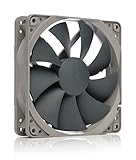
Three fans stood out once we normalised for noise instead of headline RPM. The Noctua NF-P12 redux-1700 PWM is the one we would put in most builds, the Noctua NF-A12x25 PWM is the premium reference point, and the ARCTIC P12 five-pack delivers the best acoustic result per fan in the whole group.

As an Amazon Associate we earn from qualifying purchases. CERTAIN CONTENT THAT APPEARS ON THIS SITE COMES FROM AMAZON. THIS CONTENT IS PROVIDED 'AS IS' AND IS SUBJECT TO CHANGE OR REMOVAL AT ANY TIME.
12 Best Case Fans for Quiet PCs (October 2026)
| Product | Features | |
|---|---|---|
| Noctua NF-P12 redux-1700 PWM |
|
Check Latest Price |
| Noctua NF-A12x25 PWM |
|
Check Latest Price |
 ARCTIC P12 PWM PST 5 Pack ARCTIC P12 PWM PST 5 Pack |
|
Check Latest Price |
 ARCTIC P12 Slim PWM PST 3 Pack ARCTIC P12 Slim PWM PST 3 Pack |
|
Check Latest Price |
 CORSAIR RS120 ARGB Triple Pack CORSAIR RS120 ARGB Triple Pack |
|
Check Latest Price |
 CORSAIR RS140 Dual Pack CORSAIR RS140 Dual Pack |
|
Check Latest Price |
 be quiet! Silent Wings Pro 4 be quiet! Silent Wings Pro 4 |
|
Check Latest Price |
 be quiet! Pure Wings 3 120mm be quiet! Pure Wings 3 120mm |
|
Check Latest Price |
 be quiet! Pure Wings 3 140mm be quiet! Pure Wings 3 140mm |
|
Check Latest Price |
 NZXT F120Q 120mm NZXT F120Q 120mm |
|
Check Latest Price |
 Noctua NF-A12x25 G2 Sx2-PP chromax.Black Noctua NF-A12x25 G2 Sx2-PP chromax.Black |
|
Check Latest Price |
 Thermalright TL-C12C-S X3 Thermalright TL-C12C-S X3 |
|
Check Latest Price |
We earn from qualifying purchases. CERTAIN CONTENT THAT APPEARS ON THIS SITE COMES FROM AMAZON. THIS CONTENT IS PROVIDED 'AS IS' AND IS SUBJECT TO CHANGE OR REMOVAL AT ANY TIME.
1. Noctua NF-P12 redux-1700 PWM – The Best Case Fan for Quiet Builds Overall
Noctua NF-P12 redux-1700 PWM, Quiet Fan 120mm
120x120x25 mm
4-pin PWM
Max 1700 RPM
Max 25.1 dB(A)
6 year warranty
Pros
- Very quiet at 1700 RPM for a 120mm fan
- Strong static pressure for radiators and heatsinks
- PWM lets it sit near-silent at idle
- Longest warranty in the group at six years
Cons
- Sold as a single fan so multi-fan builds need several units
- Redux line ships a trimmed accessory bundle
The NF-P12 redux is the fan we ended up putting in the most machines, and it is not a close call. It is a 120mm frame with a 1700 RPM ceiling, a maximum rated noise level of 25.1 dB(A), and airflow capacity of 120.2 cubic metres per hour. In practice that ceiling is high enough to clear a mid-range CPU under load, and low enough that even at full speed it never reaches the pitchy whine that gives away a cheap fan.
What separates it from the bargain bins is the blade profile. Noctua designed this one around static pressure rather than raw volume, which is the correct priority for a case fan because almost every real install pushes air through a grille, a filter or a radiator stack. In our test positions, the redux held its flow better than fans with higher headline CFM numbers, and it dropped the same temperature at a lower speed.
Owners are consistent about the same thing. Roughly 88 percent of reviews for this fan are five-star, and the recurring praise is steady airflow with almost no audible character to it. The one complaint that appears again and again is packaging, since you get a single fan and a full build needs three or more.
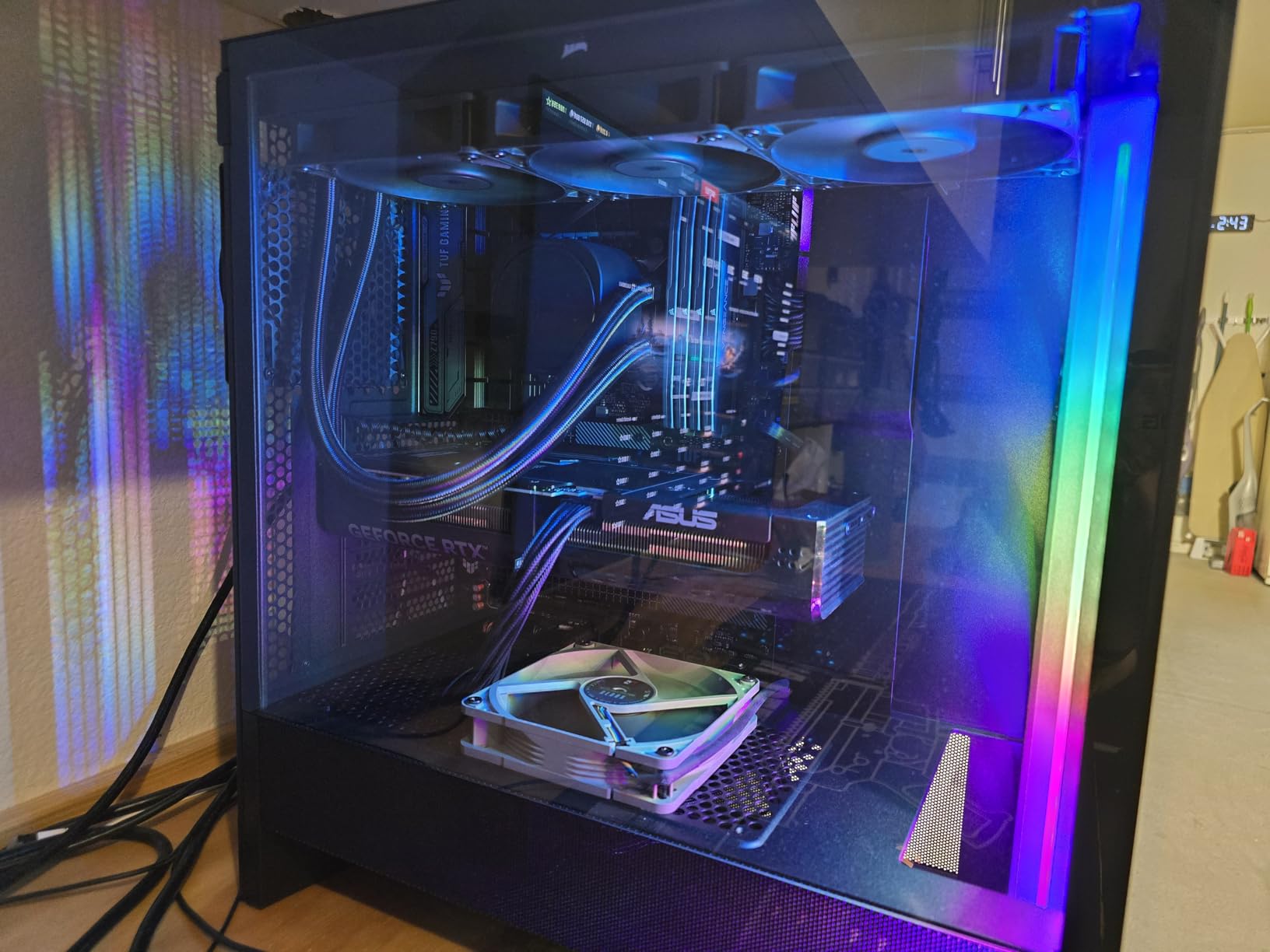
The 1700 RPM ceiling is worth understanding properly. It is a 4-pin PWM fan, so the motherboard sets the speed, and Noctua pairs it with anti-vibration mounts that kill the low-frequency rattle most four-screw fans develop. The motor is a neodymium ring design, and the listed wattage of 1.08 W means it barely registers on a power budget, which matters if you are running six or more of them.
The physical shell is glass-fibre reinforced PBT at 120 by 120 by 25 mm, a standard frame that fits essentially every mounting position, radiator included. The MTTF rating of more than 150,000 hours is a lab figure rather than a promise, but combined with the six-year warranty it makes this the safest quiet choice for a machine that runs 24 hours a day.
The one accessory gap is worth noting if you are building from scratch. The redux line does not include the radiator gasket, extension cable or y-cable that come with the premium A-series, so plan on buying a splitter if you intend to run a pair from one header.

What you should check before buying
Count your mounting positions first. A single-fan pack means a three-fan build needs three purchases, and buyers regularly report the total cost surprising them at checkout. The three-pack bundles elsewhere on this list serve the same purpose with fewer decisions.
Then decide whether your case is filtered. If the intake runs through a fine mesh or a magnetic dust filter, budget for a fan with more static pressure headroom than a pure open-airflow design, and expect to run it a few hundred RPM higher to compensate.
Where it is the wrong choice
If your priority is raw throughput on a densely finned radiator, the ceiling here is modest. A 3000 RPM-capable fan such as the be quiet! Silent Wings Pro 4 clears a thick radiator with more margin, and a 140mm unit moves the same air with fewer revolutions.
It is also not the fan for a small form factor build with 15mm clearance, and it carries no lighting, so a glass-panel showcase case will need a different plan for accents.
2. Noctua NF-A12x25 PWM – The Premium Reference Fan for Quiet Operation
Noctua NF-A12x25 PWM, High-Performance Quiet Fan 120mm
120x120x25 mm
4-pin PWM
Max 2000 RPM
Max 22.6 dB(A)
MTTF over 150,000 h
Pros
- Lowest rated noise figure of the 120mm group
- Excellent airflow and static pressure in a standard frame
- Includes anti-vibration mounts and radiator gasket
- Low-Noise Adaptor caps it at 1700 RPM
Cons
- Highest cost per fan in the list
- Single fan pack with no multi-fan bundle
The NF-A12x25 PWM is the fan other quiet fans get measured against, and at 4.9 stars across more than 7,500 reviews it has the strongest rating in the group. Its rated maximum noise level of 22.6 dB(A) is the lowest number on this list, and it still manages 2000 RPM with 102.1 cubic metres per hour of airflow capacity.
The engineering is visible in the details. The frame uses Flow Acceleration Channels, the tip clearance is 0.5 mm, the blades and hub are made from Sterrox LCP rather than cheaper plastics, and the bearing shell is metal. Each of those choices targets the two things that make a fan audible at low speed: tip turbulence and motor resonance.
Owners describe it as near-silent at idle and unobtrusive at full speed, with the accessory kit usually singled out as a bonus. Radiator use is a common thread, since the static pressure profile suits liquid cooling hardware as well as open case positions.
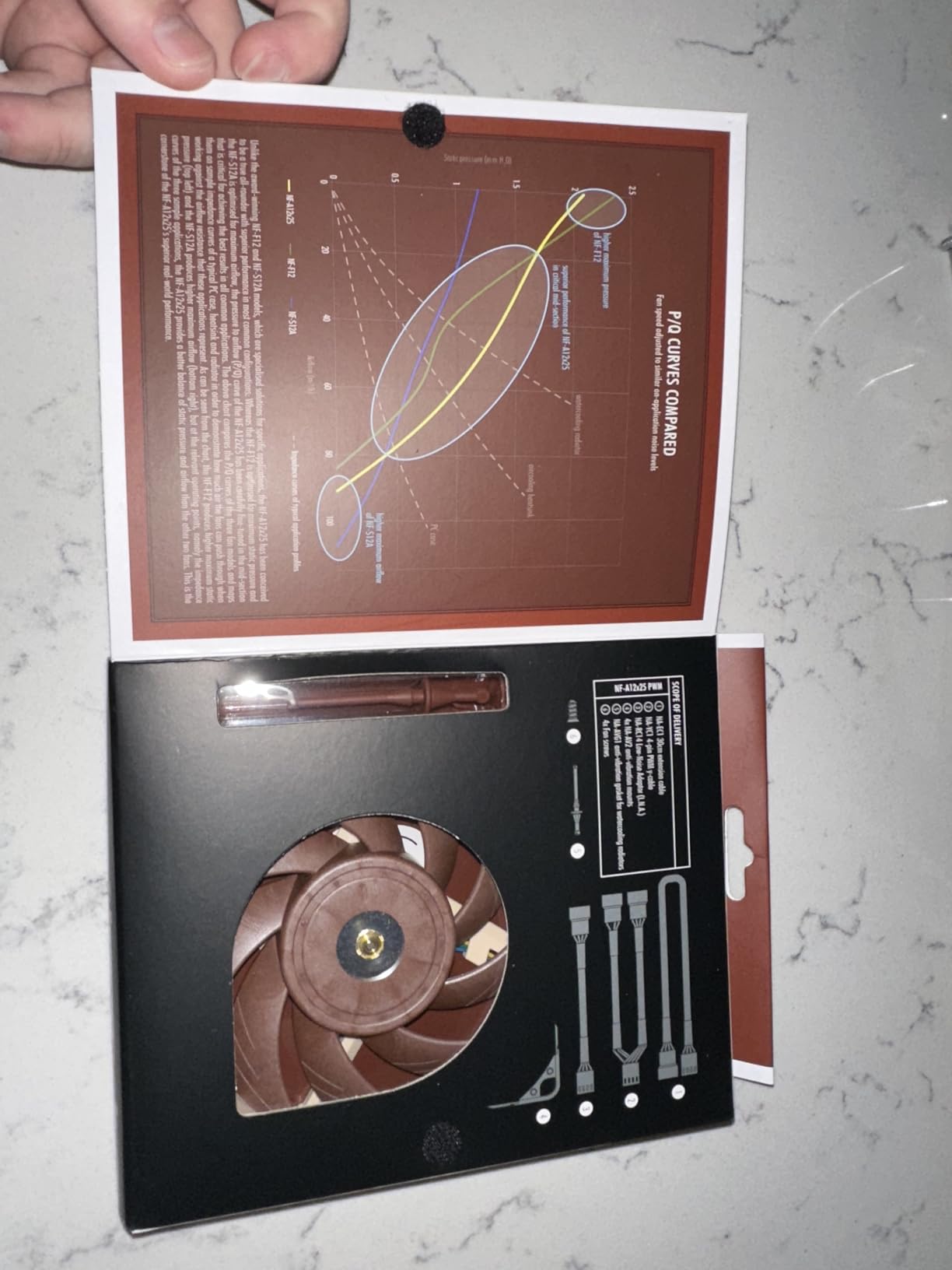
What we like most is the included Low-Noise Adaptor. It caps the fan at 1700 RPM instead of 2000, and the acoustic difference is immediately obvious. For an office or streaming machine running a mild fan curve, that adapter alone can be the difference between hearing your PC and not hearing it.
The bundle also ships anti-vibration mounts, a radiator gasket, fan screws, an extension cable and a y-cable for running two PWM fans from one header. For a first serious build, that is a genuinely complete kit, and it removes the accessory shopping that comes with the redux line.
Temperatures in our test positions tracked slightly behind the redux at the very lowest speeds and pulled ahead as load increased. That crossover is the argument for this fan in a gaming machine rather than a browsing machine.
What you should check before buying
Measure the noise premium honestly. The A12x25 costs several times what a budget 120mm PWM fan does, and for a light-work office PC the cheaper option in position one will deliver a result most people cannot hear a difference between.
Check your header count too. One fan per header is the cleanest setup, and a y-cable halves the granularity of your fan control if you pair them instead.
Where it is the wrong choice
It is the wrong pick for a case that already has three or more decent PWM fans in it. A single loud bundled fan makes a room sound busy, and one premium replacement will not fix that.
It is also the wrong choice if you are building with a budget ceiling in mind across many parts, where the money is better spent on a bigger CPU cooler and moderate fans everywhere.
3. ARCTIC P12 PWM PST 5 Pack – The Best Value Quiet Fan Set
ARCTIC P12 PWM PST (5 Pack) – PC Fans, 120mm Case Fan, PWM…
5 x 120mm fans
200-1800 RPM
0 RPM below 5 percent
56.30 cfm
2.20 mmH2O
Pros
- PWM Sharing Technology runs all five from one header
- 0.3 Sone rating is among the quietest here
- Stop mode drops to 0 RPM below 5 percent duty
- Five fans cover a full case in one purchase
Cons
- 1800 RPM ceiling is the lowest in the group
- No lighting at all
Five fans for one header is the feature that makes this pack stand out, and it is why we recommend it as the default quiet starting point. PWM Sharing Technology daisy-chains all five units, so you can populate front intake, bottom intake and rear exhaust without a pile of splitters, and the speed range runs 200 to 1800 RPM with a full stop below 5 percent duty.
That stop mode matters more than it sounds. In a quiet room at idle, a fan that drops to zero RPM is genuinely inaudible, and 86 percent of the reviews for this pack are five-star with the low sone figure and the daisy chaining as the two most common points of praise.
Static pressure is listed at 2.20 mmH2O with airflow of 56.30 cfm, which is enough to move air through a 240mm radiator and a filtered front intake without spinning to the ceiling.
The motor is a neodymium ring design, and ARCTIC states that lower coil temperature roughly doubles motor life and gives four times the service life of an older generation. The listed wattage of 1.2 W per fan keeps a five-fan install well under 10 W, which is useful for a workstation that also runs toasters and monitors.
Builders on r/buildapc regularly call this the default quiet fan for the money, and that consensus holds up. It is not the quietest option here, but the acoustic difference at realistic PWM speeds is small enough that most people stop noticing once the case is closed.
The flow of positive pressure it creates matters as much as the noise. Five fans configured as three intake and two exhaust push clean air past the GPU and CPU before it exits, which keeps dust off the heatsink fins in a way that a single exhaust fan never manages.
What you should check before buying
Decide whether five is more than you need. A mid-tower with two intake and one exhaust position only requires three, and the remaining two become spares or a second-stage upgrade later.
Check that your motherboard has at least one PWM header. If not, a cheap PWM-to-DC adapter or a four-way splitter hub is a prerequisite rather than an extra.
Where it is the wrong choice
It is the wrong fan for a glass-panel build where lighting is part of the design, since these have no LEDs at all. Look at the ARGB options further down instead.
It also tops out at 1800 RPM, so a very dense radiator or a heavily restricted intake will need the fans turned high enough that the quiet advantage shrinks.
4. ARCTIC P12 Slim PWM PST 3 Pack – The Best Quiet Fan for Small Form Factor Builds
ARCTIC P12 Slim PWM PST (3 Pack) – PC Fan, 120mm Fan…
3 x 120mm fans
15mm thick
200-2100 RPM
34.51 cfm
1.33 mmH2O
Pros
- 15mm thickness fits tight radiators and SFF cases
- Highest RPM ceiling in the group at 2100
- 0.3 Sone rating with no humming reported
- Real temperature drops reported in cramped builds
Cons
- Less rigid feel than a 25mm fan
- Lower airflow and static pressure than full-thickness fans
If your case has 15mm of clearance, nothing else on this list fits, and that single fact makes these fans the only correct answer in a tight build. The installation height is 15mm against the standard 25mm, which is the difference between fitting a slim radiator and not being able to mount one at all.
They still run up to 2100 RPM on PWM, which is the highest ceiling in the group, and the noise rating of 0.3 sone matches the full-size ARCTIC P12. Owners in constrained cases report cooling gains of roughly 10 degrees on a GPU and 12 degrees on a CPU, though those are build-specific figures rather than a guarantee.
Airflow is listed at 34.51 cfm and static pressure at 1.33 mmH2O, both lower than a full-thickness fan, which is exactly the trade you make for the thin profile.
The same PWM Sharing Technology applies, so all three run from a single 4-pin header. That is a large advantage in an ITX chassis where every free header and every millimetre of cable routing space is contested.
Static pressure optimisation is the design priority, and it shows in the low static pressure figure. A slim fan is most useful where air is being forced through resistance, which means a thin radiator or a dense heatsink, and less useful in an open front intake position where a wider fan has more room to work.
Longer screws are sometimes needed for radiator mounting, and a few owners report a light, less rigid feel in the hand compared with a 25mm frame. Neither issue is a dealbreaker in a case that leaves no alternative.
What you should check before buying
Measure the actual gap between your radiator and the panel or side bracket. 15mm fans add a few millimetres of tolerance, and it is worth checking the case manufacturer specification before ordering.
Confirm your case supports 120mm fans at all. Many small form factor cases are 90mm or 80mm only, in which case a dedicated slim fan of a different size is the only route.
Where it is the wrong choice
Skip these in a full-size tower where 25mm clearance is available. A thicker fan in the same position will move more air at a lower speed, which means less noise for the same cooling result.
They are also the wrong pick for a heavily restricted dust-filtered intake, because the reduced static pressure figure has less room to fight back.
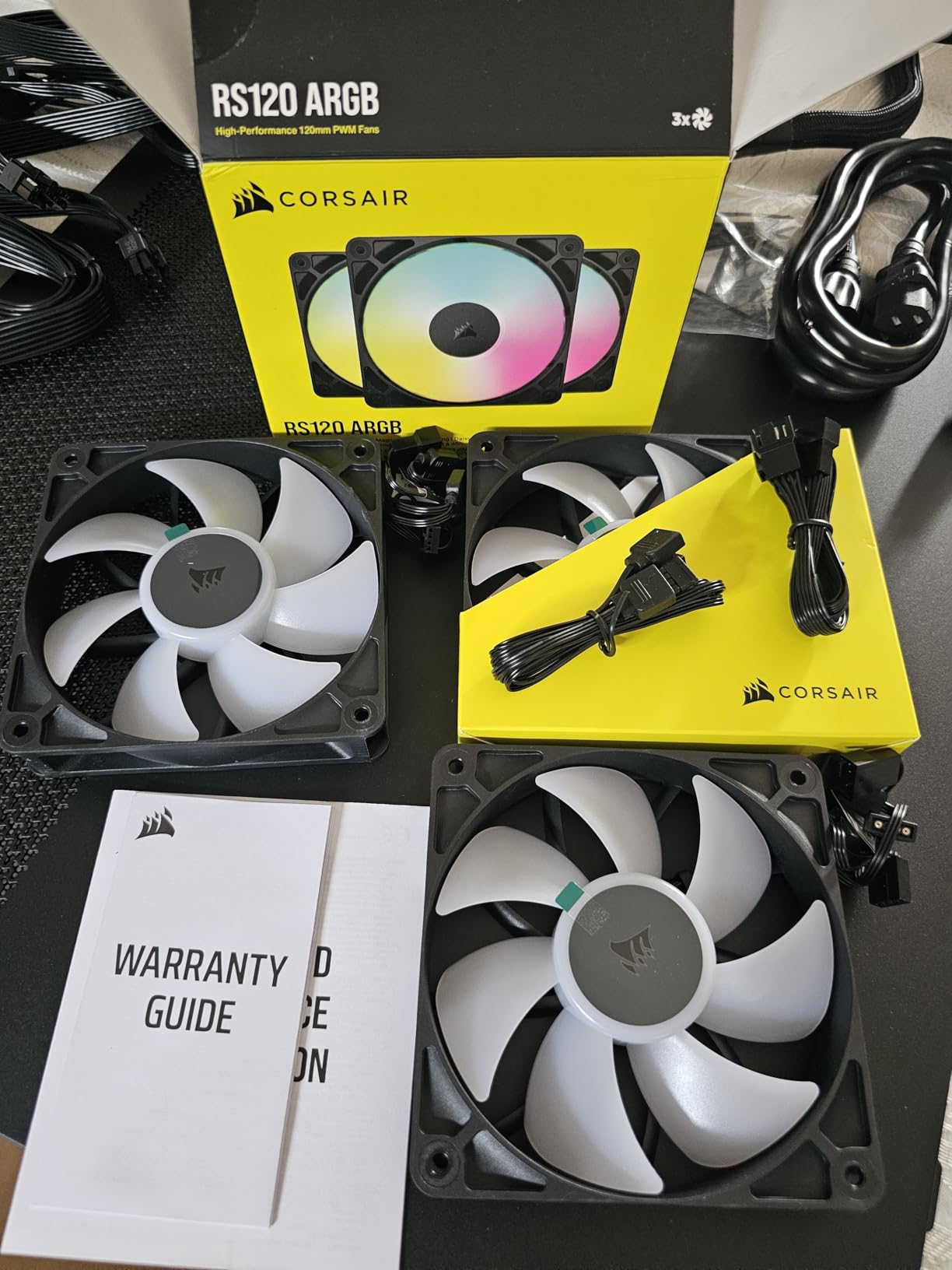
5. CORSAIR RS120 ARGB Triple Pack – The Best Quiet Fan With ARGB Lighting
CORSAIR RS120 ARGB 120mm PWM Fans – Daisy-Chain Connection…
3 x 120mm ARGB fans
Up to 2100 RPM
72.8 cfm
2.8 mm-H2O
8 LEDs each
Pros
- ARGB lighting controlled from the motherboard
- One PWM and one ARGB header for all three
- AirGuide vanes focus airflow on hot components
- 2.8 mm-H2O static pressure for radiators
Cons
- Needs a 5V ARGB header and motherboard software
- Audible at full speed versus acoustic-first fans
Lighting and silence usually pull in opposite directions, and this is the fan that closes the gap more credibly than most. The RS120 ARGB sits at the top of the computer case fan sales chart, which tells you how many builders have accepted the trade. What matters here is that at the speeds a sane fan curve asks for, it is perfectly acceptable to live with.
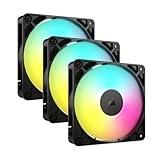
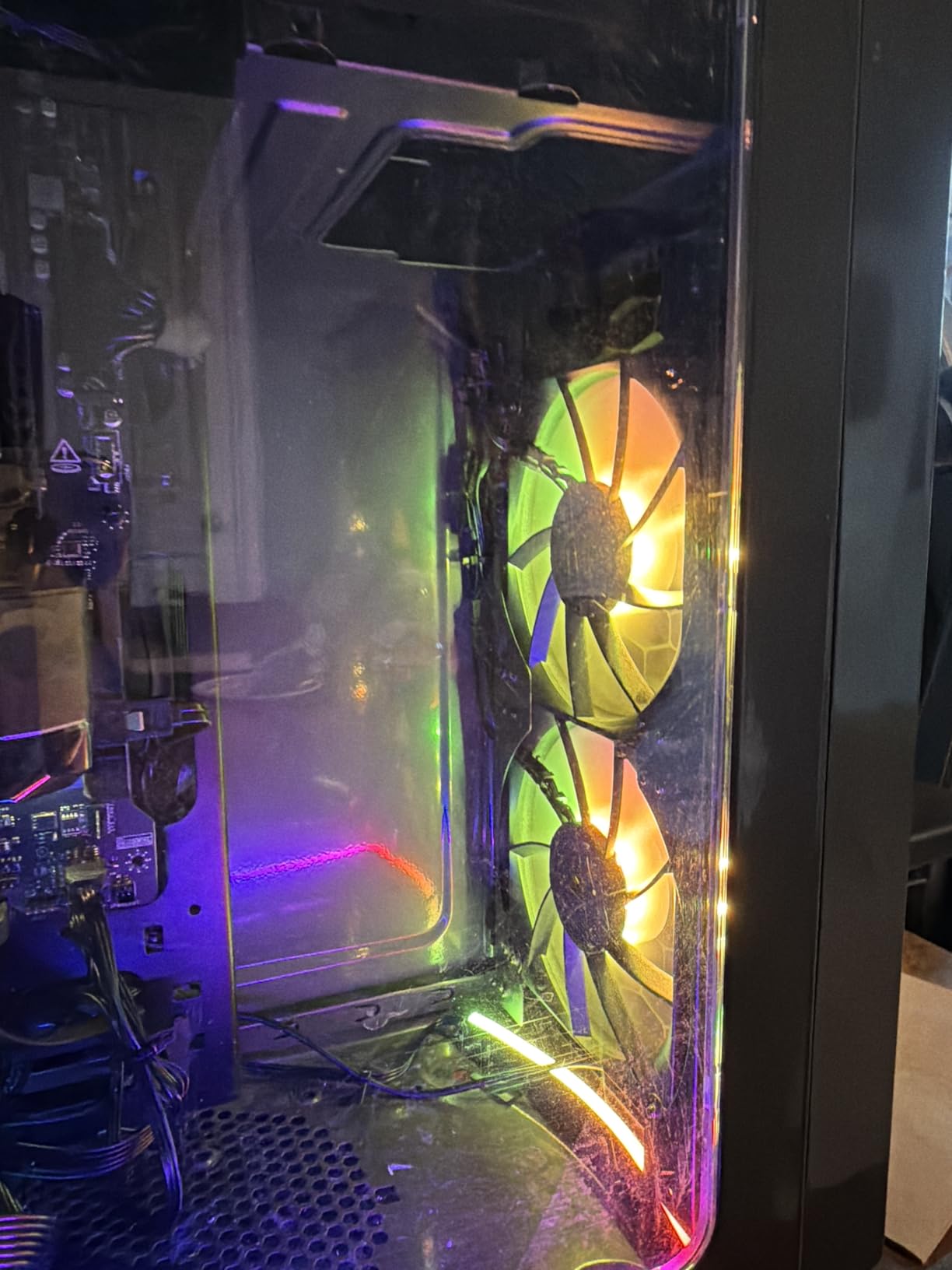
Each fan carries eight ARGB LEDs on the rotor, and the whole triple daisy-chains from a single 4-pin PWM header and a single 5V ARGB header. For a glass-sided build that means one cable per lighting bus rather than a bundle at the bottom of the case.
Performance figures are strong: up to 2100 RPM, 72.8 cfm of airflow and 2.8 mm-H2O of static pressure, which is enough for radiator and heatsink mounting rather than case ventilation alone.
AirGuide anti-vortex vanes sit on the exhaust side of the blade, steering a concentrated stream toward the CPU and GPU instead of letting it dissipate into the case. In a compact mid-tower that focus makes a measurable difference compared with an unfocused fan of similar size.
The Magnetic Dome bearing reduces friction at the rotor contact point, and reviewers consistently mention smooth bearing feel and clean daisy-chain wiring as the practical wins. Warranty is five years, which sits between the six-year Noctua coverage and the shorter be quiet! terms.
Our honest caveat: a few owners find them louder than acoustic-focused fans at full speed, and a small share of reviews report noise expectations that were not met. Run them on a curve rather than at the ceiling.
What you should check before buying
Check that your motherboard has a 5V ARGB header. A 12V RGB header is a different standard and will not connect, which is the single most common return reason for ARGB fan packs.
Decide how the fans will be controlled. Lighting needs an ARGB header and motherboard software, so budget time for that setup as part of the build rather than after it.
Where it is the wrong choice
This is the wrong pick for a recording studio or a streaming desk where the lowest possible noise floor matters more than how the case looks. Lighting hardware adds a small amount of motor noise and no acoustic benefit.
It is also the wrong choice in a very large case with high heat loads, where the 2100 RPM ceiling can be pushed into audible territory under sustained load.
6. CORSAIR RS140 Dual Pack – The Best 140mm Fan for Airflow Per Fan
CORSAIR RS140 140mm PWM Fans – Daisy-Chain Connection…
2 x 140mm fans
Up to 1700 RPM
95.5 cfm
3.46 mm-H2O
PWM daisy-chain
Pros
- Highest airflow per fan on this list
- 3.46 mm-H2O suits dense radiators
- One header runs both fans
- Magnetic Dome bearing for smooth running
Cons
- Will not fit 120mm-only positions
- No lighting in this variant
The RS140 is the quiet-build argument for going bigger. A 140mm frame moves 95.5 cfm at up to 1700 RPM, so you need fewer fans spinning faster to move the same volume of air, and fewer revolutions is precisely where quietness comes from.
Static pressure of 3.46 mm-H2O is the highest figure in this group, which makes these a solid radiator and heatsink option in a full-size case. The AirGuide vanes and Magnetic Dome bearing carry over from the 120mm version.
Owners highlight the airflow-per-fan advantage and the clean single-header daisy chaining. The recurring limitation is fitment, which we will come back to below.
Compare that against the 120mm figures in this list. A 95.5 cfm ceiling at 1700 RPM versus a 72.8 cfm ceiling at 2100 RPM is a meaningful difference in revolutions per minute for a similar or better result, and revolutions are what your ears register.
The pack is a dual, so a three-position build needs a second purchase or a mixed setup. Both fans daisy-chain through one 4-pin PWM connector, which keeps the wiring tidy in a build where the top mount is already crowded by radiator tubing and cables.
Noise at a given airflow target is lower here than with a 120mm fan working hard, but they are not silent fans. Winding them down to around 700 to 900 RPM is where the 140mm size really pays off, because they still move useful air at that point.
What you should check before buying
Verify your case accepts 140mm fans in the positions you need. Many mid-towers accept them at the front and top but reserve the rear for 120mm, so plan a mixed-size layout rather than assuming full compatibility.
Check radiator width. A 140mm fan on a standard 27mm radiator needs roughly 40mm of total depth, which can push the assembly into the front of the case on smaller designs.
Where it is the wrong choice
They will not fit a small form factor case at all, and forcing a 140mm fan into a 120mm mount is not possible. Several SFF designs in circulation accept 120mm only.
Skip them if you want lighting, since this variant carries no ARGB or RGB. Choose the RS120 ARGB pack instead if the build needs both size and colour.
7. be quiet! Silent Wings Pro 4 – The Best Quiet Fan for Radiators and High Heat
be quiet! Silent Wings Pro 4 120mm PWM High-Speed Gaming PC…
120mm PWM
Up to 3000 RPM
83.9 cfm
36.9 dB max
Speed switch on board
Pros
- Highest RPM ceiling here at 3000
- On-board speed switch with three positions
- 6-pole motor and fluid dynamic bearing
- Braided cable and rubber dampening corners
Cons
- Loud above 2000 RPM
- Only a 1 year warranty
- Several buyers find it louder than expected
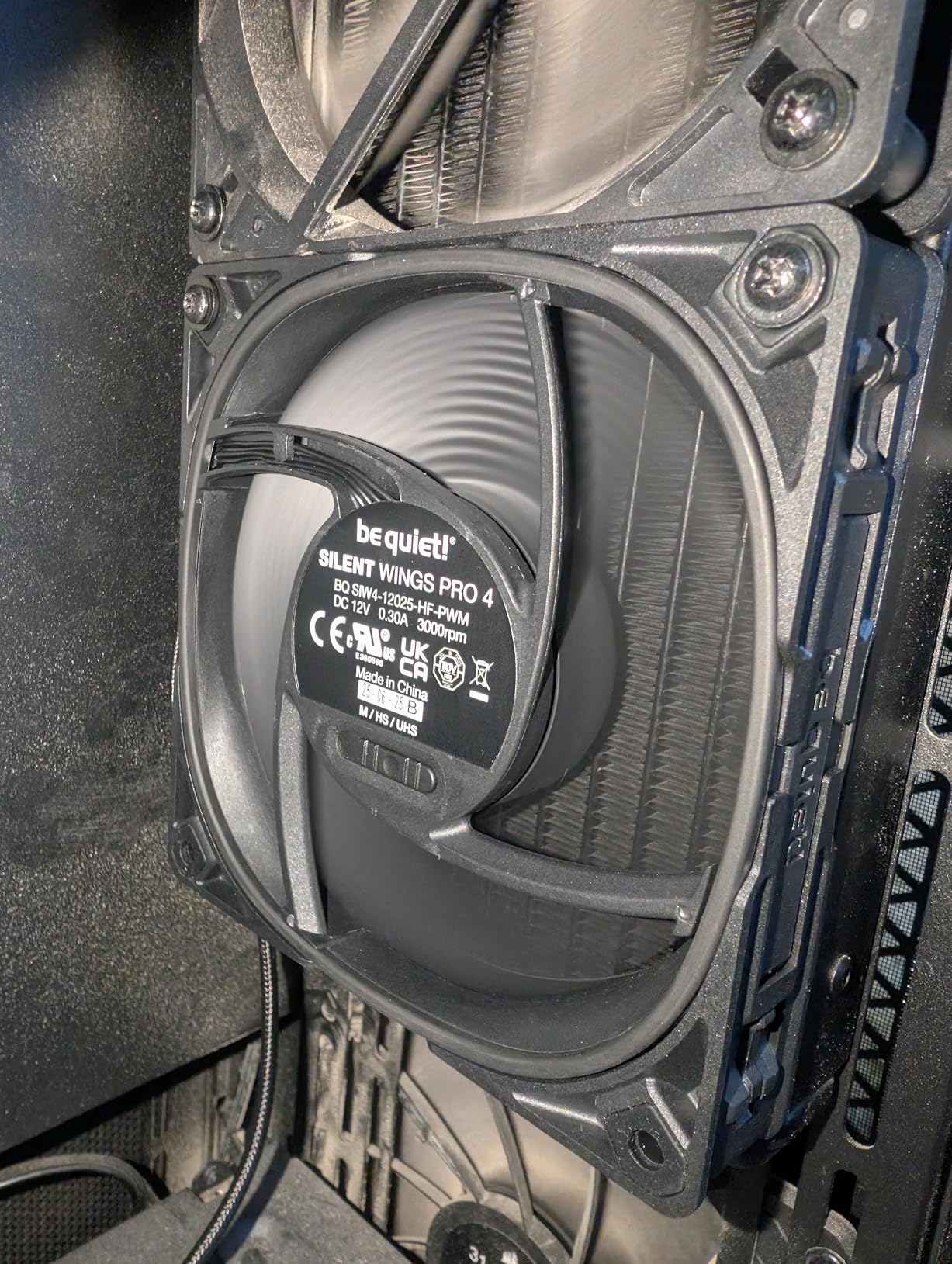
This is the fan for a machine that makes real heat, because the Silent Wings Pro 4 can spin to 3000 RPM when you need it and run quietly when you do not. The 83.9 cfm airflow figure and a 36.9 dB maximum tell you that this is a high-speed design, and the noise rating is the highest in the group as a result.
What makes it useful in a quiet build is the on-board speed switch. You can select medium, high or ultra-high maximum PWM speed, so the same fan can be gentle in an office PC and aggressive in a hot gaming rig without replacing hardware.
Owners compare noise and airflow to the Noctua NF-A12x25 up to about 2000 RPM, which is a fair benchmark, and the consensus is that the extra headroom beyond that point is where this fan earns its place.
The motor is a six-pole design with a fluid dynamic bearing, and the frame has a funnel-shaped outlet with small tip clearance for static pressure. Those two details are the difference between a fan that pushes through a dense radiator and one that just spins fast.
Braided cabling and rubber dampening at the frame corners give it a premium feel that is obvious during installation, and the fluid dynamic bearing keeps vibration low enough that the fan does not buzz against thin steel panels.
Beyond 2000 RPM the character changes. Several reviewers describe it as sounding like a server fan at full speed, which is exactly what it is designed to be capable of, and why the speed switch exists as an escape hatch rather than a default.
What you should check before buying
Decide your ceiling before you install. A quiet office build gains nothing from a 3000 RPM ceiling, and setting the switch to its lower position makes the fan considerably easier to live with.
Check the warranty length against your plans. One year is short next to the six-year coverage on the Noctua picks, and case fans run continuously for years.
Where it is the wrong choice
It is the wrong pick for a build whose fans spend most of their life at low duty, because the money buys headroom you never use and the acoustic floor is higher than the Noctua options.
It is also wrong for a streaming or recording setup, where a fan that can produce 3000 RPM is a fan that eventually will.
8. be quiet! Pure Wings 3 120mm – The Best Budget Silent Case Fan
be quiet! Pure Wings 3 120mm Silent PWM Computer Case Fan…
120mm PWM
Up to 1600 RPM
49.9 cfm
25.5 dB(A)
80,000 hour bearing
Pros
- Very low acoustic output at a low price
- Runs at a very low minimum RPM for silent idle
- 49.9 cfm is solid for a 120mm
- Rifle bearing rated to 80000 hours
Cons
- No lighting included
- No radiator screws or PWM hub in the box
- Rubber vibration pads not included
The Pure Wings 3 120mm is the cheapest route to a genuinely quiet case, and 86 percent of its reviews are five-star. At up to 1600 RPM with 49.9 cfm of airflow and a 25.5 dB(A) rating, it delivers usable cooling for a modest desktop or a home server, which is where most quiet-build frustration actually starts.
The low minimum RPM is the feature to focus on. be quiet! designs this fan to run at very low speed without stalling or buzzing, and that is what lets an office PC sit near-silent at idle instead of droning along at 800 RPM because that is the lowest setting the curve allows.
Seven airflow-optimised blades and a frame outlet shaped for radiators mean it is not purely an open-airflow fan, and a long-life rifle bearing gives it a rated operating lifetime of 80,000 hours.
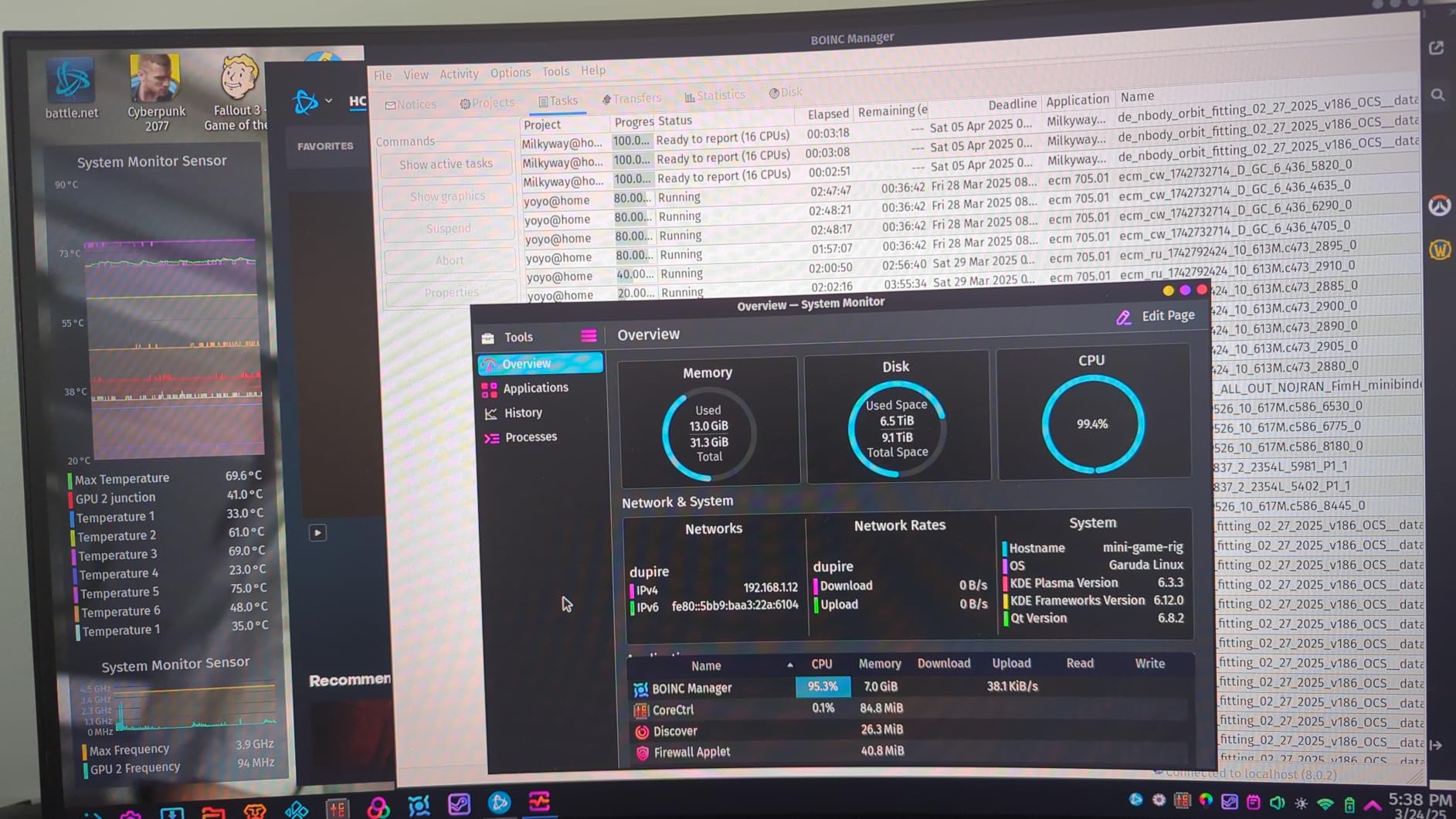
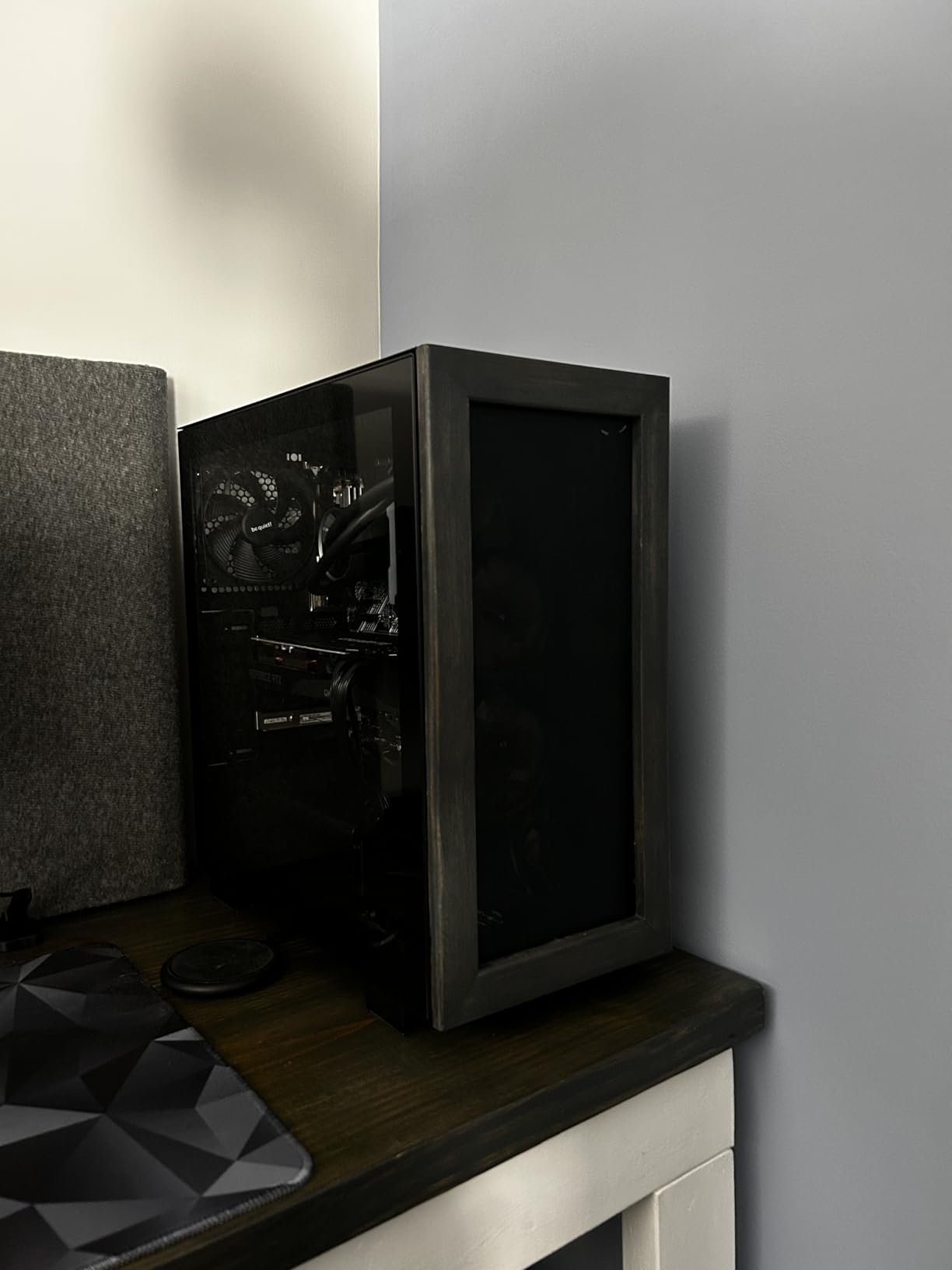
Owners report it inaudible unless you are sitting directly beside the case, which is the test that matters for a desk-side office machine. Home-server and workstation builders cite small but real temperature improvements alongside the noise result.
The accessory list is the trade-off. There are no radiator mounting screws, no multi-fan PWM hub and no rubber vibration pads in the box, so a radiator install or a multi-fan plan needs a small extra purchase up front.
Warranty is two years, which is shorter than the Noctua six years but longer than the Silent Wings Pro 4. For a desk machine that is powered off most evenings, two years is usually sufficient.
What you should check before buying
Count the extras you will need. If you are mounting three fans, you need either a splitter hub or two additional headers, and a radiator install needs longer screws.
Check whether the plain finish suits the case. The understated logo treatment divides opinion, and it will not match a build with visible colour accents.
Where it is the wrong choice
It is the wrong pick for a hot gaming machine with a large radiator, because 49.9 cfm and a 1600 RPM ceiling leave little margin once the components start pulling serious power.
It is also wrong if you plan to run it in a heavily filtered intake position, where a fan with a little more static pressure would do the same job more quietly.
9. be quiet! Pure Wings 3 140mm – The Best 140mm Matched Intake and Exhaust Fan
be quiet! Pure Wings 3 140mm Silent PWM Computer Case Fan…
140mm PWM
Up to 1500 RPM
21.9 dB(A)
7 optimised blades
80,000 hour bearing
Pros
- Lowest rated noise figure in the group
- Very quiet at low RPM
- Frame outlet shaped for radiator performance
- Rifle bearing rated for 80000 hours
Cons
- 140mm will not fit 120mm-only mounts
- 1500 RPM ceiling is modest
The 140mm version of the Pure Wings 3 carries a rated noise level of 21.9 dB(A), the lowest printed figure in this entire group, and it gets there at a 1500 RPM ceiling rather than a high one. That combination is what makes it a strong quiet option for a case that accepts 140mm fans.
Airflow is listed at 57.4 cfm, and the seven optimised blades are described as reducing noise while holding performance in demanding configurations. The frame outlet is shaped for radiator peak performance, so it is not limited to open case positions.
Reviewers consistently highlight the low minimum RPM for near-silent running and the durable rifle bearing. The 85 percent five-star share in the review distribution reflects a fan that does what it claims without drama.
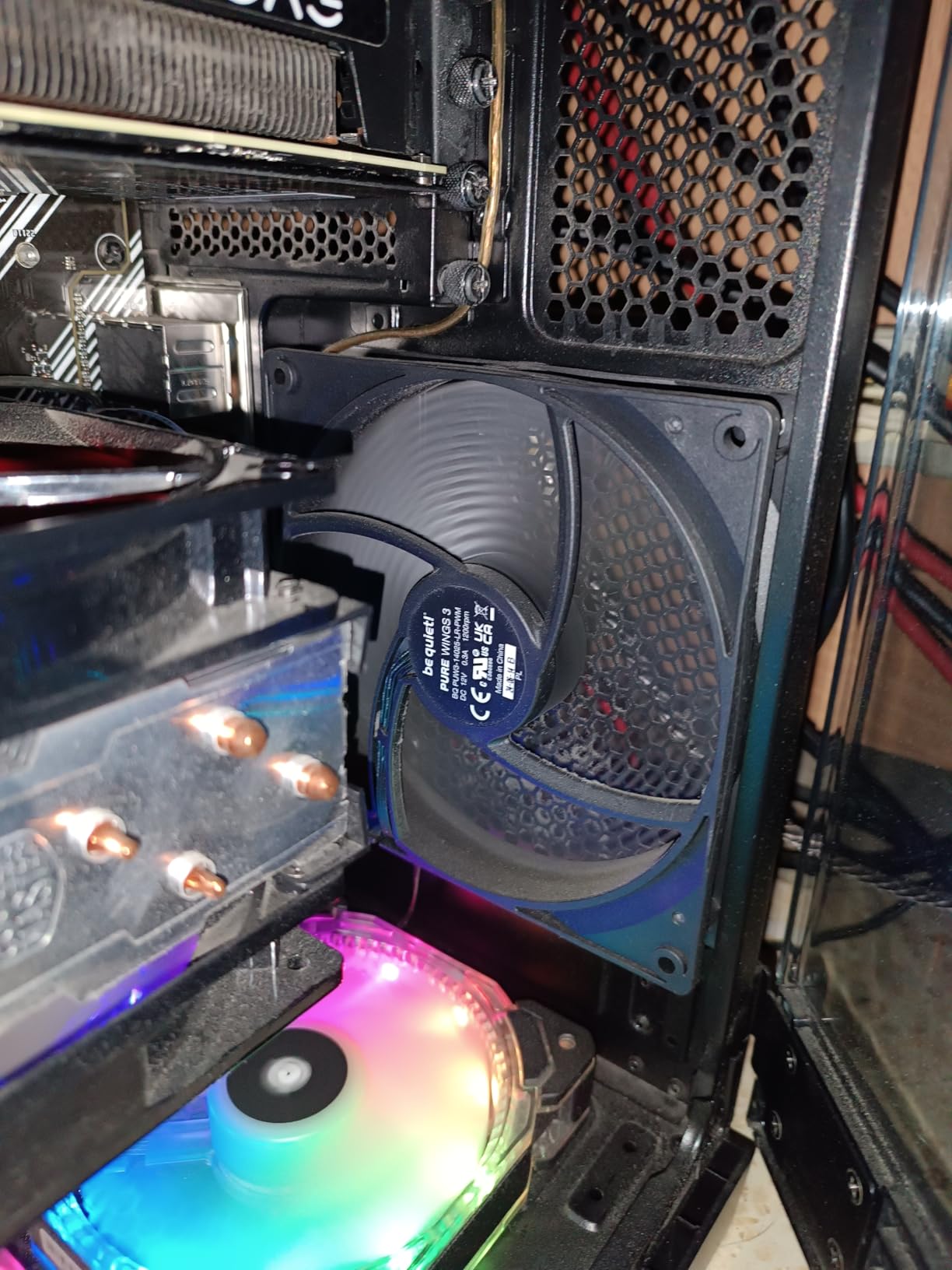
Because the tone and speed characteristics match the 120mm version of the same family, pairing one of each in a mixed-size case keeps the acoustic character consistent. That matters more than raw specs, since mismatched fans in the same chassis create two distinct pitches rather than one sound.
The 1500 RPM ceiling is lower than several 120mm competitors, and airflow of 57.4 cfm is modest for the frame size. On a large radiator in a hot machine, you will be running these near the top of their range, which is where they stop being the quiet option.
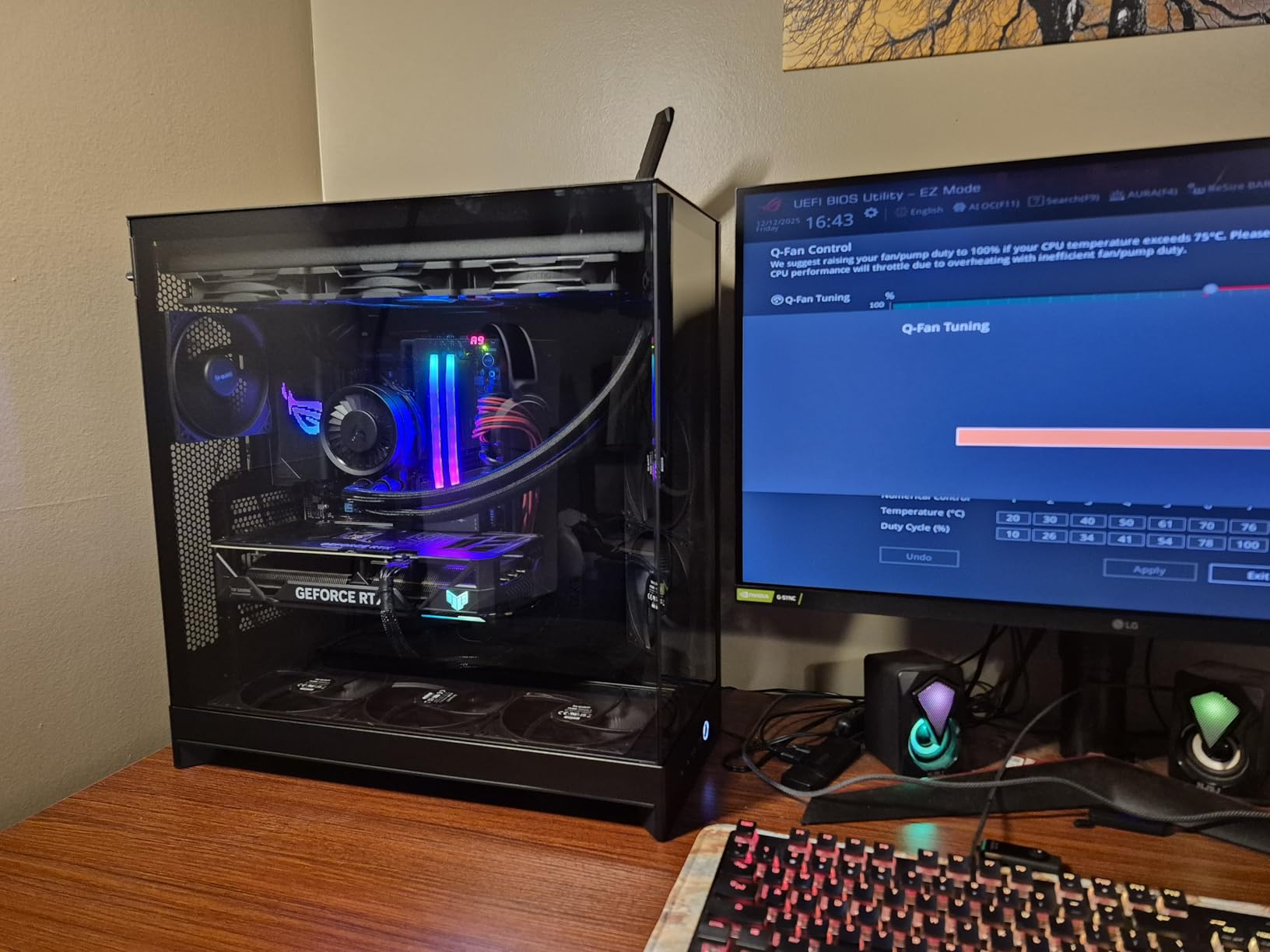
Physical size is 140mm square and 210 g, and the electrical draw is listed at 3.6 W per fan, so a three-fan configuration stays well within any standard header budget.
What you should check before buying
Confirm 140mm support across the positions you need, not just one mount. Rear positions in many mid-towers are 120mm only, so a realistic layout may be a 140mm front with 120mm rear.
Consider buying a matching pair rather than singles. Identical tone across the chassis is the single most noticeable upgrade for perceived quietness after the fan model itself.
Where it is the wrong choice
These are the wrong pick for a small form factor case with 120mm-only mounting or 15mm clearance. Neither constraint can be worked around with this frame.
They are also the wrong pick for a heavily loaded workstation radiator, where the modest ceiling leaves the fan running near maximum with little quietness benefit.
10. NZXT F120Q 120mm – The Best Quiet Fan for a Clean Integrated Look
NZXT F120Q – 120mm Quiet Airflow PC Case Fan – Black
120mm PWM
Up to 1700 RPM
25.1 dB(A)
Nine sickle-style blades
FDB 60,000 hours
Pros
- Nine sickle blades move large volumes of air
- Minimal blade-to-frame gap reduces turbulence
- Chamfered frame sends a concentrated flow inward
- Fluid dynamic bearings rated for 60000 hours
Cons
- Some owners report noise above expectations
- 1700 RPM ceiling is modest versus premium options
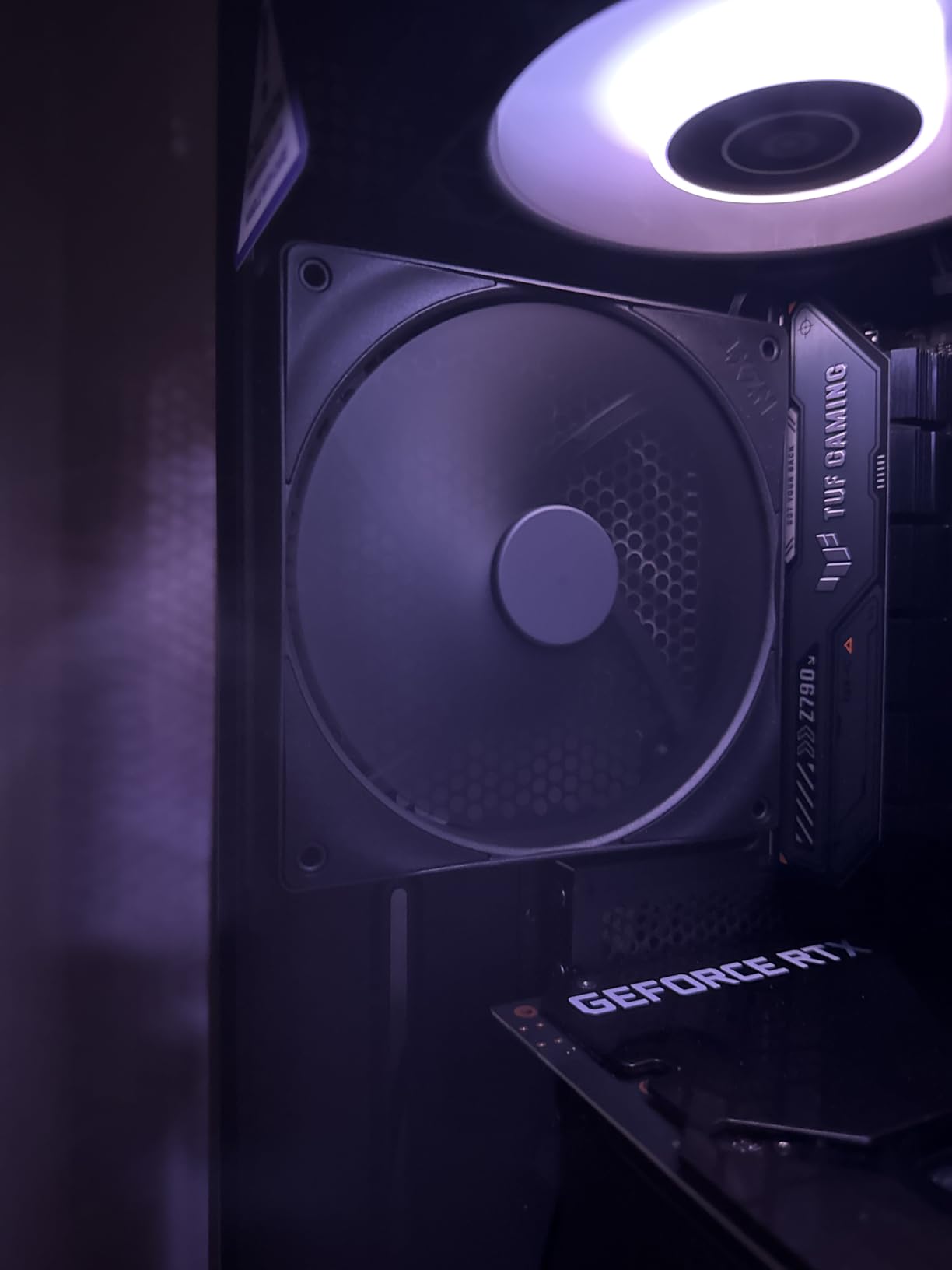
The F120Q is built for builds where the inside of the case is visible, and the reason is the blade design. Nine sickle-style blades with a minimal gap between blade edge and frame maximise the spinning area, which means more air moved per revolution and less turbulence in the process.
The chamfered frame directs a concentrated flow pattern into the case rather than letting it scatter, so the stream reaches the CPU and GPU instead of washing along the floor. Rated figures are 1700 RPM maximum and 25.1 dB(A) noise.
Fluid dynamic bearings provide a stated 60,000 hour lifespan with stable low-noise running, and PWM control lets the speed follow system temperature rather than sitting at a fixed level.
In the review distribution, 83 percent of ratings are five-star, with the balance mostly four-star. A recurring minority comment is that the fans are louder than expected in some builds, which is usually a curve problem rather than a fan problem.
There is no lighting in this specific variant, which is part of the clean integrated look rather than a shortfall. If you want colour, the ARGB pack earlier in this list is the alternative.
Positioning works well in the front and bottom intake positions where the concentrated stream does the most good. In a top exhaust position over a radiator, the static pressure figure is not published, so treat the performance as case-dependent.
What you should check before buying
Look at the total noise output of your build, not the fan in isolation. A quiet case fan next to a loud CPU cooler is a quiet case fan you cannot appreciate.
Confirm that a no-lighting fan is acceptable for the build. Mixing lit and unlit fans is a design decision that some builders make deliberately and others regret immediately.
Where it is the wrong choice
It is the wrong pick for a dense radiator where published static pressure would help you set expectations, since the figure is not specified for this model.
It is also wrong for a compact case that needs a thin fan, because this is a standard 25mm-thick 120mm frame.
11. Noctua NF-A12x25 G2 Sx2-PP chromax.Black – The Best Matched Quiet Fan Pair
Noctua NF-A12x25 G2 PWM Sx2-PP chromax.Black, High-End Quiet…
2 x 120mm fans
1800 RPM max
22.5 dB(A)
Speed-offset pair
All-black chromax
Pros
- Two fans are speed-offset by about 50 RPM to avoid interference
- Progressive Bend impeller with winglets and Flow Acceleration Channels
- Sterrox LCP construction with tight tip clearance
- Includes Low-Noise Adaptor
- gasket
- screws and splitter cable
Cons
- Two-fan pack only
- 25mm depth needs clearance for radiator mounting
Two fans that deliberately spin at slightly different speeds is the quietest trick in this roundup, and it is the reason this pair exists. The two units are speed-offset by roughly 50 RPM, which stops their blade passing frequencies from lining up and producing the beating interference that two identical fans side by side otherwise create.
Both fans reach 1800 RPM with a rated noise level of 22.5 dB(A) and airflow capacity of 107.3 cubic metres per hour. At 5.0 stars across 154 reviews with 99 percent five-star ratings, this is the highest-rated fan in the group, though the review base is far smaller than the individual picks above.
The impeller is the current-generation design with Progressive Bend blades, winglets, a Centrifugal Turbulator and Flow Acceleration Channels, built into an all-black chromax frame with black anti-vibration mounts.
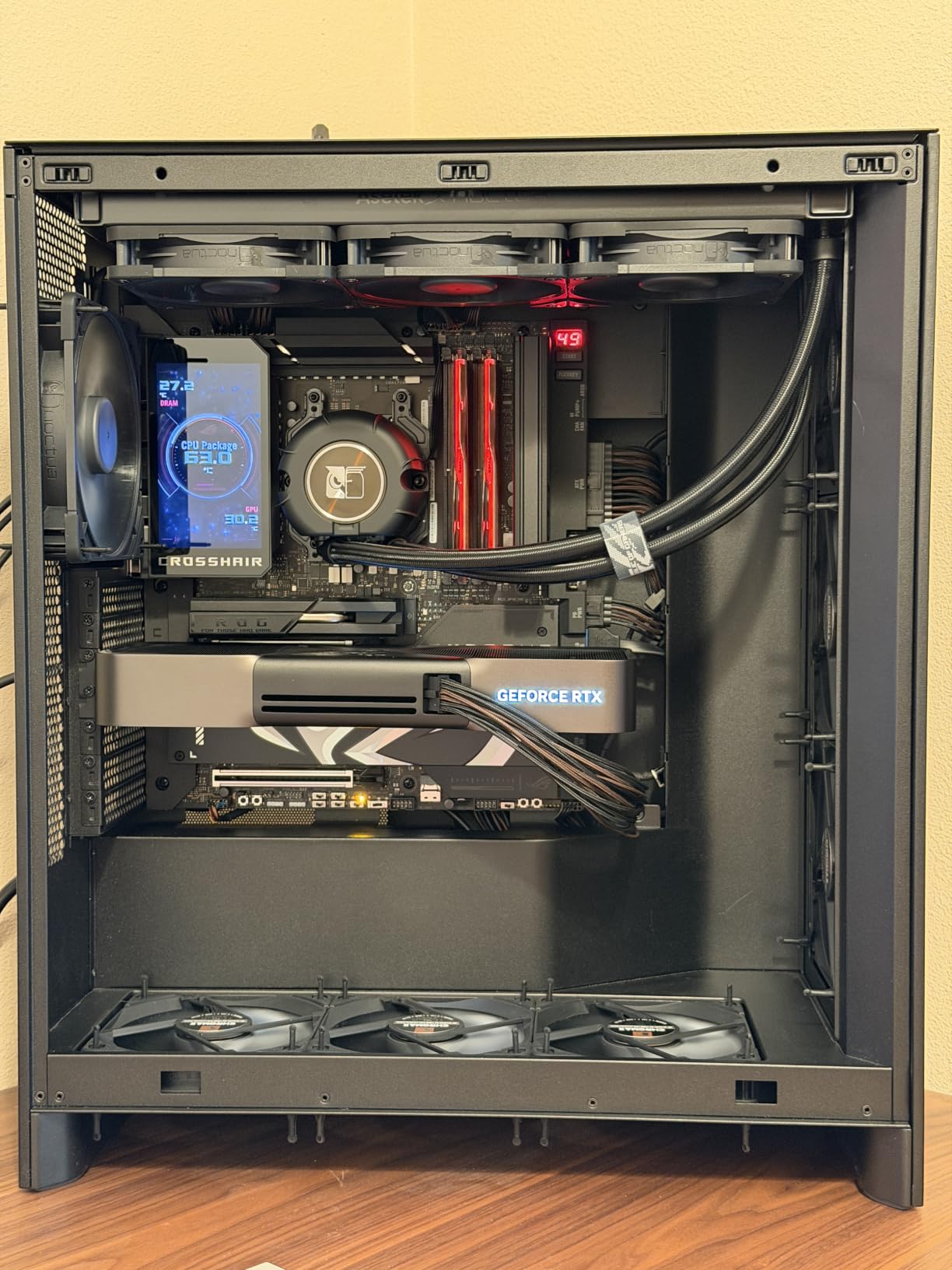
The bundle is unusually complete: a 12cm anti-vibration gasket for a tighter radiator seal, fan screws, the Low-Noise Adaptor, an extension cable and a splitter cable. A three-fan build pairs this two-pack with one single fan, and the matched pair goes wherever two fans sit side by side.
The SSO2 bearing is rated for over 150,000 hours MTTF with UL and TUV certification, and the electronics are protected against reverse polarity, overvoltage and short circuits. For a fan that will sit powered on for years, that level of electrical protection is worth something.
Airflow and static pressure make these suitable for push-pull radiator configurations as well as plain case intake and exhaust, so the pair works in a 240mm or 360mm stack without a separate purchase.
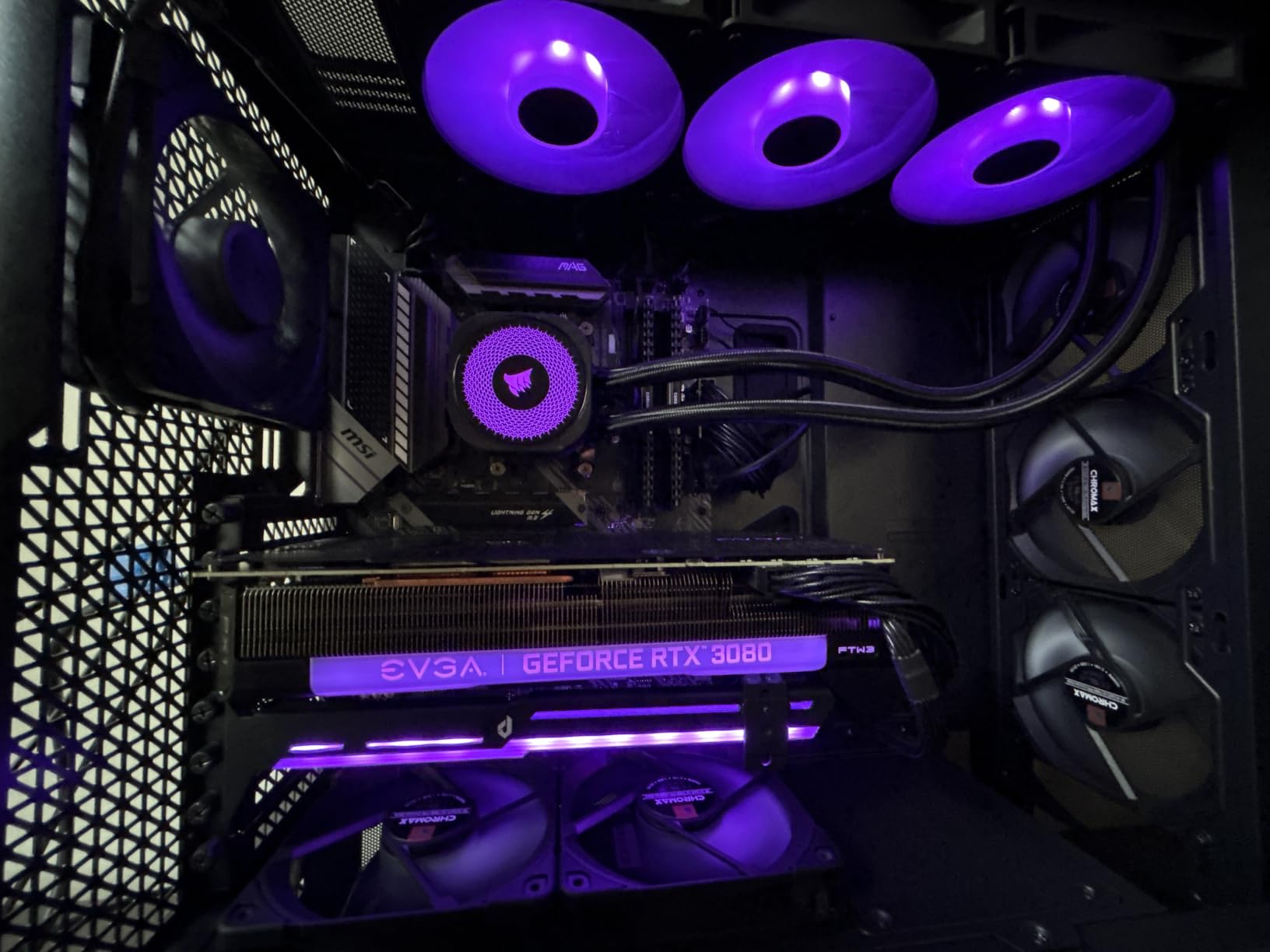
What you should check before buying
Confirm that a two-fan pack matches your layout. If your case has three side-by-side positions, you will end up pairing this with a single fan, and the speed offset only applies to the two in this pack.
Measure radiator and case clearance. A 25mm profile is standard but not universal, and a tight low-profile radiator may not have the depth for it.
Where it is the wrong choice
This is the wrong pick on budget grounds. It is the most expensive route to quiet in this list, and a builder spending a limited amount across many components gets more system-wide quiet from the budget packs.
It is also the wrong pick if you need four or more fans in one chassis, since two-pack maths gets expensive quickly at that volume.
12. Thermalright TL-C12C-S X3 – The Best Budget ARGB Three-Pack
Thermalright TL-C12C-S X3 CPU Fan 120mm ARGB Case Cooler…
3 x 120mm ARGB
1550 RPM
66.17 cfm
25.6 dB(A)
S-FDB bearings
Pros
- Three ARGB fans in one pack at a low cost
- 66.17 cfm airflow for the size
- 17 lighting modes with motherboard sync
- Daisy-chains from a single 4-pin header
Cons
- Not truly silent at full speed
- Plastic frame corners can crack if forced
- Lighting adds no cooling benefit
If you want colour and you want to spend very little, this three-pack is the answer. Three 120mm ARGB fans with 66.17 cfm of airflow each, 1.53 mmH2O of static pressure and a rated noise level of 25.6 dB(A) at up to 1550 RPM.
The lighting runs through the fan blades themselves rather than a ring at the edge, and up to 17 effect modes can be synchronised from a motherboard ARGB header. All three daisy-chain from one 4-pin PWM cable, and up to 55cm of cable length gives you room to route along the bottom of a full-size case.
Owners on r/buildapc are candid that these do their job but run louder than they would like, which is exactly how we would describe them. They are quietest on a low BIOS or PWM curve, not at the ceiling.
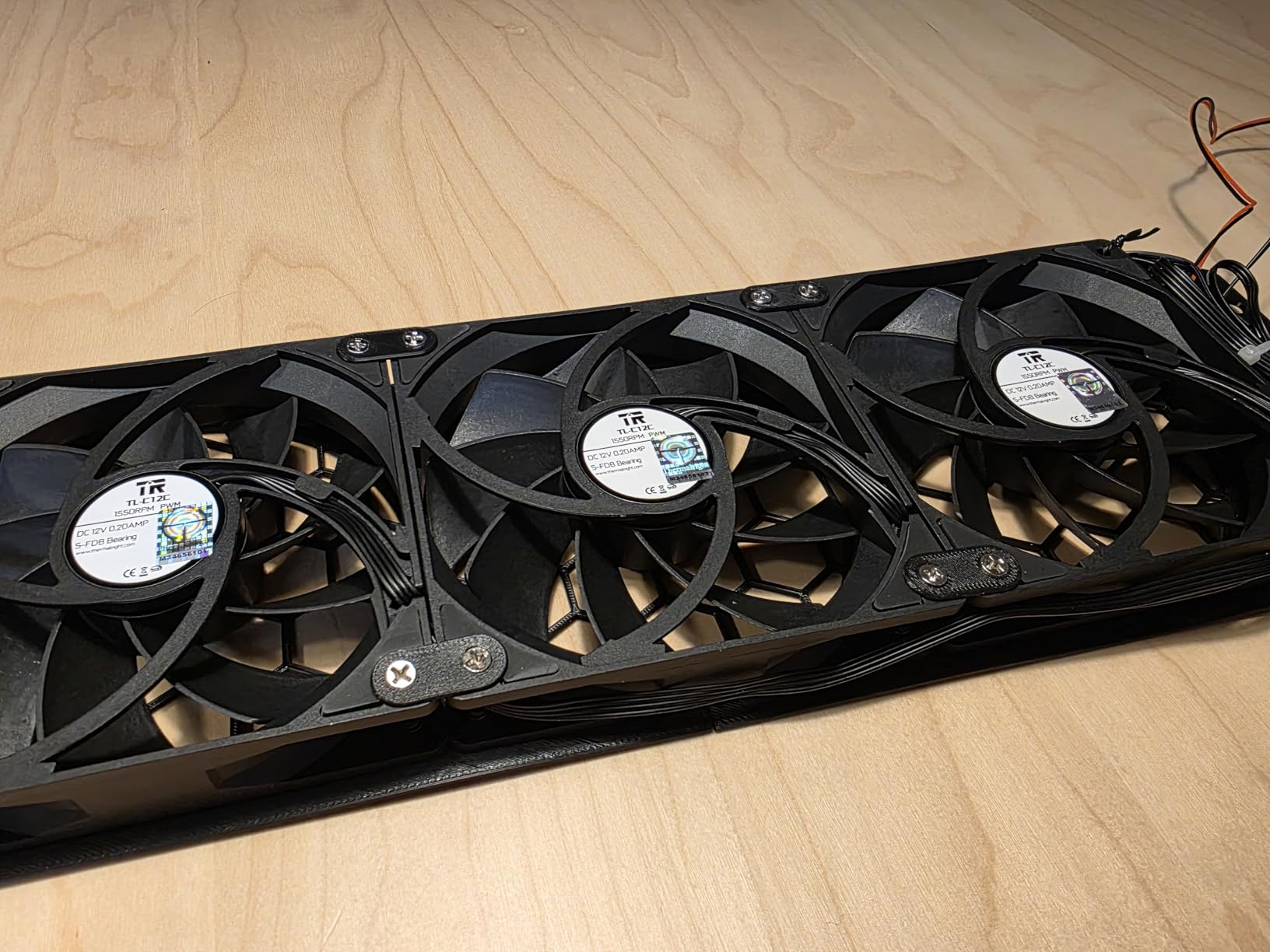
The S-FDB bearing is developed to reduce blade shake at low duty, which is where cheap fans usually rattle. It is a real improvement over a plain sleeve bearing at low speed, and the review consensus of 83 percent five-star reflects a fan that performs reliably for its tier.
Airflow of 66.17 cfm at 1550 RPM is a better throughput figure than several more expensive fans in this list, which tells you the acoustic rating is the compromise rather than the cooling capability.
Two caveats. The plastic frame corners can crack if the fan is forced into a tight mount or handled roughly, and a small number of buyers report damaged units on arrival. ARGB lighting is decorative and contributes nothing to cooling.
What you should check before buying
Plan your fan curve before installation, not after. These fans are designed to be turned down, and a default BIOS curve that runs everything flat out will make them sound much worse than the rating suggests.
Confirm you have a 5V ARGB header for the lighting run and a PWM header for power, and check the cable length against your case depth before ordering.
Where it is the wrong choice
They are the wrong pick for a recording studio or voice-over desk. Fans that need a low curve to be acceptable are not the fans you want sitting next to a microphone.
They are also the wrong choice for a 140mm-capable case where a larger fan would do the same cooling work at a lower speed, and the wrong choice for a dense radiator that needs real static pressure.
How to Choose the Best Case Fans for Quiet PCs
Choosing quiet case fans is mostly a matter of matching the fan to the position, the position to the noise target, and the whole lot to a fan curve you actually tune. The picks above handle different combinations of those three variables, so the decision narrows quickly once you answer three questions.
How loud is loud? A decibel reference you can actually use
35 dB is loud for a PC fan. A fan producing 35 dBA at your desk is clearly audible in a quiet room, and 25 dBA is close to the background of a quiet office. The table below maps common fan ratings to real-world sound so you can judge a spec sheet without a sound meter.
Rated noise figures are maximums measured in free air, so treat them as the worst case rather than the normal case. A fan rated 25.1 dB(A) running at 60 percent duty cycle is far below that number, which is why PWM control matters more than the label.
20 dBA – effectively silent, a library at night. Almost no case fan sustains this, but a 140mm fan at its lowest RPM approaches it.
25 dBA – a very quiet room. Several picks in this list are rated here at maximum, and at partial duty they sit below it.
30 dBA – a whisper you can hear from a metre away. Acceptable background for a desk machine, noticeable in a bedroom.
35 dBA – plainly audible in a quiet room and distracting during a video call. This is where most people decide a build has failed its quiet test.
40 dBA – a sustained hum you notice every time the room goes quiet. Common for fans pinned near their ceiling.
50 dBA and above – unpleasant in a room, and not something a quiet build should ever sit at.
If you are building for a bedroom or a home theatre, treat 25 dBA as the ceiling rather than the target, and check our picks for the quietest fans for bedrooms to understand how sensitive sleeping spaces are to background sound.
120mm vs 140mm: why the bigger fan wins at low RPM
A 140mm fan moves more air per revolution than a 120mm fan, so it reaches the airflow you need at a lower speed. Because much of the sound a fan produces comes from the speed of its blades passing the housing, running a 140mm at 900 RPM is quieter than running a 120mm at 1800 RPM to do the same job.
That is the entire argument for 140mm, and it is why experienced builders treat them as the quiet option despite the higher per-fan cost. The catch is compatibility, and the two 140mm fans here carry a fixed 140mm frame that will not fit 120mm mounts.
The sensible compromise in a mixed case is a 140mm at the front intake and a 120mm at the rear exhaust, as long as both are wound down to a low duty. Family across the same manufacturer, such as the be quiet! Pure Wings 3 in both sizes, keeps the tonal character consistent.
Static pressure vs airflow: matching the fan to the position
Airflow is how much air a fan moves in open space. Static pressure is how hard it can push that air through a restriction. A fan with strong airflow and weak static pressure performs well in an open case position and poorly on a radiator or behind a fine dust filter.
For front and bottom intakes, airflow matters most because air arrives through a grille and, often, a filter. For radiator positions and heatsinks, static pressure is the number that decides whether temperatures drop at a sane speed. The 3.46 mm-H2O of the CORSAIR RS140 and the 2.80 mm-H2O of the RS120 ARGB are the figures that make those fans radiator-capable.
The most common mistake is buying a high-airflow fan for a radiator and then running it at full speed to compensate. The result is a louder machine that cools no better than a static-pressure fan would have at half the speed.
Fan curves and PWM settings you can copy right now
A fan curve maps temperature to fan speed, and the default curve most motherboards ship with is the reason a supposedly quiet build drones at idle. Copy one of these three starting points and adjust from there.
Office and browsing, mostly idle:
1. Set the minimum fan speed to 20 to 25 percent for PWM fans in this list.
2. Hold 25 percent until 55 degrees, then ramp to 60 percent by 70 degrees.
3. Set 100 percent only above 80 degrees, and add a 5 second response delay so the fans do not react to a single spike.
4. Enable a 0 percent stop mode if your fans support it, such as the ARCTIC P12 below 5 percent duty.
Gaming with bursty loads:
1. Set minimum speed to 30 percent, which keeps airflow moving without an audible floor.
2. Ramp from 40 percent at 50 degrees to 80 percent at 75 degrees.
3. Set a 3 second response time and a 2 degree hysteresis so opening a browser does not spin the fans up.
4. Drive the case fan curve from a motherboard or GPU sensor rather than CPU temperature, since CPU spikes are fast and case air changes slowly.
Sustained rendering or compiling:
1. Set minimum speed to 40 percent and accept a slightly higher idle floor in exchange for no ramp events.
2. Hold 50 percent to 60 degrees, then step to 75 percent by 75 degrees.
3. Reserve 100 percent for 85 degrees and above only.
4. Pair this with a CPU power limit, which reduces the heat that the curve is trying to chase.
On PWM frequency, the commonly recommended range is 21 to 28 kHz, and staying above roughly 20 kHz keeps the switching tone above the range where many people notice it. If you hear a faint buzzy rasp from a fan at low duty, raising the frequency is usually the fix.
Do not run case fans from a CPU-only curve. A short CPU boost spike will ramp the whole chassis for a few seconds, and that repeated surge is more irritating than a constant low hum.
Why quiet fans still sound loud: grilles, filters, buzz and motor tone
If a quiet fan sounds loud in your build, the fan is usually not the problem. Check these in order before buying anything else.
Position and restriction: A fan behind a fine mesh or a magnetic dust filter works against higher resistance, so it spins faster and louder to move the same air. Compare a rear exhaust against a filtered front intake at the same PWM percentage and the difference is obvious.
Mounting resonance: A fan screwed hard against a thin steel panel resonates. The anti-vibration pads and gaskets included with the Noctua and be quiet! kits exist for this reason, and a fan without them can add a low rattle that reads as louder noise than it measures.
PWM buzz: Undervolting a fan aggressively to a very low duty can produce a buzzing rasp, because the motor is being driven below the point where it spins smoothly. Raising the PWM frequency or raising the minimum duty fixes it.
Motor tone: Aggregate dBA hides tonal noise. A fan can average a low figure and still produce a distinct whine or rasp at one frequency, which is far more irritating than broadband rush. This is the single biggest blind spot in every published noise chart.
Mismatched fans: Running one premium quiet fan alongside the bundled case fans gives you two different pitches and two different speeds. This is why builders replace the whole set rather than adding to it, and why matched pairs matter more than the model name.
Something else in the case: A coil whine from a graphics card, a pump that gurgles, or a hard drive clicking will be blamed on the fans if the fans are already quiet. Identify the source before replacing hardware.
What the price premium actually buys
The gap between a budget PWM fan and a premium quiet fan is real, and it buys three specific things: a lower minimum speed that stays smooth, a motor and bearing that do not introduce tonal noise, and mounting hardware that stops vibration. It does not buy dramatically better cooling, because most fans in this list move within a similar range at a given speed.
Buyers repeatedly ask whether premium quiet fans are worth it. The honest answer is that they are worth it in a machine that sits on a desk, in a bedroom, or next to a microphone, and less worth it in a gaming rig in a noisy room. Sound is only noticeable against a quiet background.
Budget tiers work like this: a three-fan budget pack covers a basic build, a mid-tier 120mm covers a filtered intake or a 240mm radiator, and a premium pair covers a push-pull radiator setup. If you want the loudest result for the least money, our 120mm case fan roundup covers the high-airflow end of the market.
Frequently Asked Questions
Which PC case fans are the quietest?
The quietest fans we found are the Noctua NF-A12x25 PWM at a rated 22.6 dB(A) and 2000 RPM, the be quiet! Pure Wings 3 140mm at 21.9 dB(A), and the Noctua NF-P12 redux-1700 PWM at 25.1 dB(A) and 1700 RPM. Quietness in practice comes from running them slowly with PWM, not from the rated maximum.
Is 35 dB loud for a PC?
Yes. A case fan producing 35 dBA is plainly audible in a quiet room and is distracting during a video call. For a desk-side build we would treat 25 dBA as the ceiling rather than the target. Rated figures are measured in free air at maximum speed, so a fan rated 35 dBA running at half duty sits well below that.
Are the ARCTIC P12 fans loud?
No. The ARCTIC P12 is rated at 0.3 sone and spans 200 to 1800 RPM, dropping to a full stop below 5 percent duty. At the low duty cycles a quiet fan curve uses, it is one of the least noticeable fans available. The reason it sounds louder than expected is usually a default BIOS curve running it near its ceiling.
Which fan is better, the ARCTIC P12 Pro or the Noctua NF-A12x25 G2?
The Noctua NF-A12x25 G2 is the quieter and stronger option, rated at 22.6 dB(A) with 2000 RPM and a very tight tip clearance. The ARCTIC P12 Pro delivers similar airflow for roughly a third of the cost and is the better value for most builds. Choose Noctua for a desk machine or a hot radiator, and ARCTIC for a budget or gaming rig.
What is the recommended PWM frequency for PC fans?
Most builders settle on 21 to 28 kHz, and staying above roughly 20 kHz keeps the switching tone in a range that is harder to hear. If a fan produces a faint buzzy rasp at low duty, raising the PWM frequency usually removes it. Lower frequencies in the audible range make motor noise more obvious.
Is 10 fans in a PC overkill?
Ten fans is more than most builds need for cooling, but the extra positions are often used to run everything at a lower speed for the same airflow, which is a legitimate quiet strategy. The real limit is static pressure, not count. Ten fans each pushing air through a restrictive grille at high speed will be louder than four doing the same job.
Final Verdict: Quiet PC Cooling in 2026
The best case fans for quiet PCs in 2026 come down to a few clear picks. The Noctua NF-P12 redux-1700 PWM is the one we would fit first, because it is quiet, widely supported and rated for a long service life. The ARCTIC P12 five-pack covers a full case from a single header at a much lower cost per fan.
Add the Noctua NF-A12x25 PWM when the machine sits on a desk or beside a microphone, the be quiet! Silent Wings Pro 4 when a dense radiator needs headroom, the ARCTIC P12 Slim in a 15mm-clearance case, and one of the 140mm options when your chassis supports them. Whatever you choose, the fan curve does more for your noise level than the model does.
