
Cost to Build a Deck Per Square Foot: October 2026 Costs
Most homeowners pay between 30 and 60 dollars per square foot to have a deck built, once framing, decking, railing, stairs, footings and labor are all included. Prices in this guide are as of 2026 and shift with your region, season and deck height.
That headline number is the one most people find first, and it is also the one that quietly leaves out the most. Published averages usually cover a straight ground-level platform with nothing complicated attached to it, while the quote that lands on your kitchen table covers your deck exactly.
Contents
So this guide does two things. It gives you the real per-square-foot ranges by size and material, then it shows you what each square foot of that price is actually made of, so you can tell a fair quote from a padded one.
One thing worth saying up front: regional labor rates swing the figure more than any material choice. A 300-square-foot deck quoted in the Northeast can land near twice the number of the same deck in the South, using the same lumber.
Deck Building Costs at a Glance
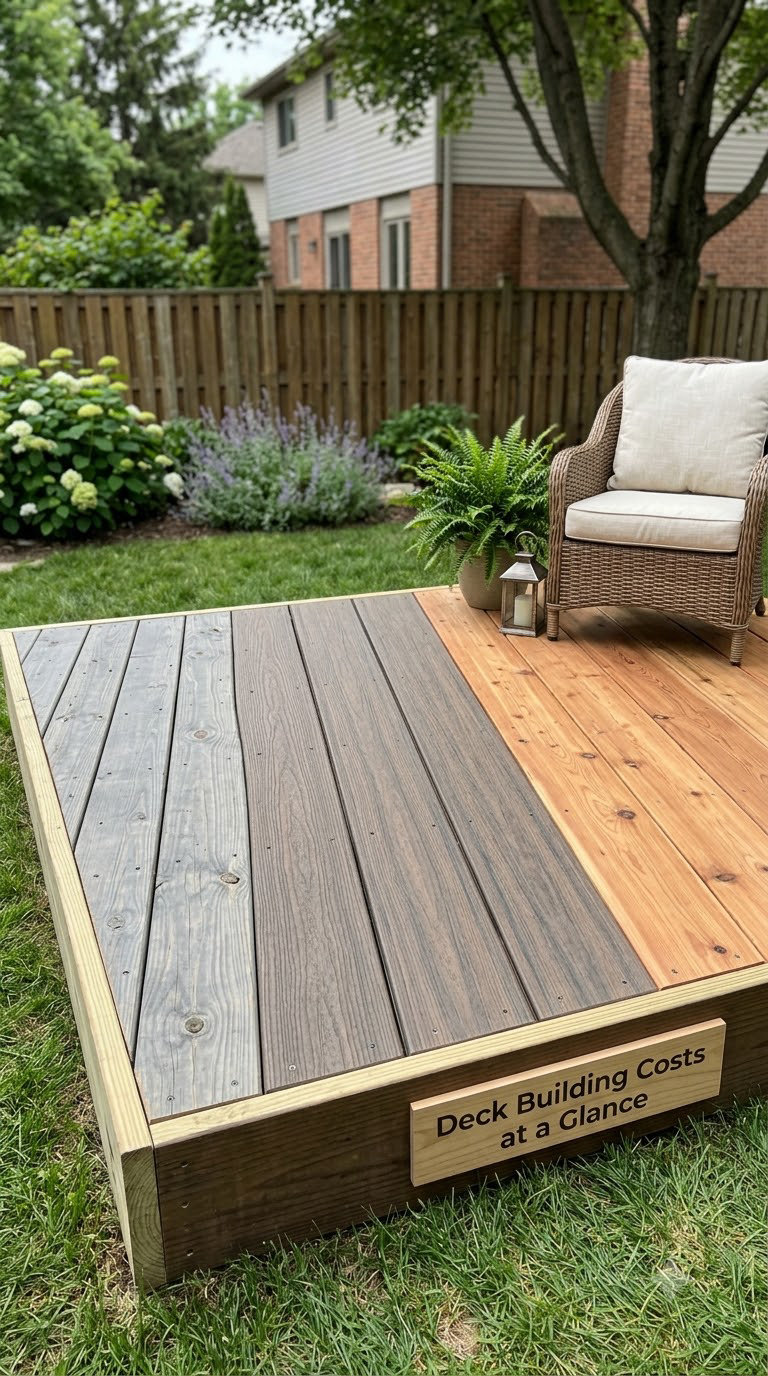
A basic ground-level deck built in pressure-treated pine, with a basic rail and one small set of steps, generally runs 25 to 40 dollars per square foot installed. A midrange job in composite decking with a proper code rail and standard stairs usually lands between 45 and 75 dollars per square foot. Premium cedar, redwood or ipe, multi-level framing or a wraparound shape push it to 90 to 160 dollars per square foot.
Those three bands assume a single level no more than about 3 feet off the ground, straightforward access, and a permit drawn from your building department. Anything taller than that changes the math fast.
| Deck tier | Typical material | Installed cost per square foot | Assumes |
|---|---|---|---|
| Basic | Pressure-treated pine | 25-40 dollars | Ground level, simple rail, few stairs |
| Midrange | Composite decking | 45-75 dollars | Code-compliant rail, standard stairs, one level |
| Premium | Cedar, redwood or ipe | 90-160 dollars | Elevated or multi-level, custom rail, complex shape |
Two rules of thumb hold up across most of the country. An elevated deck above 3 feet costs roughly two to three times a ground-level deck of the same size, and a deck larger than about 400 square feet drops in price per square foot because fixed costs like mobilization and permits spread over more surface.
All figures here are US ranges and vary by region and by season. Framing crews book solid from April through September, and that demand shows up in the quote.
How Much Does It Cost to Build a Deck by Size?
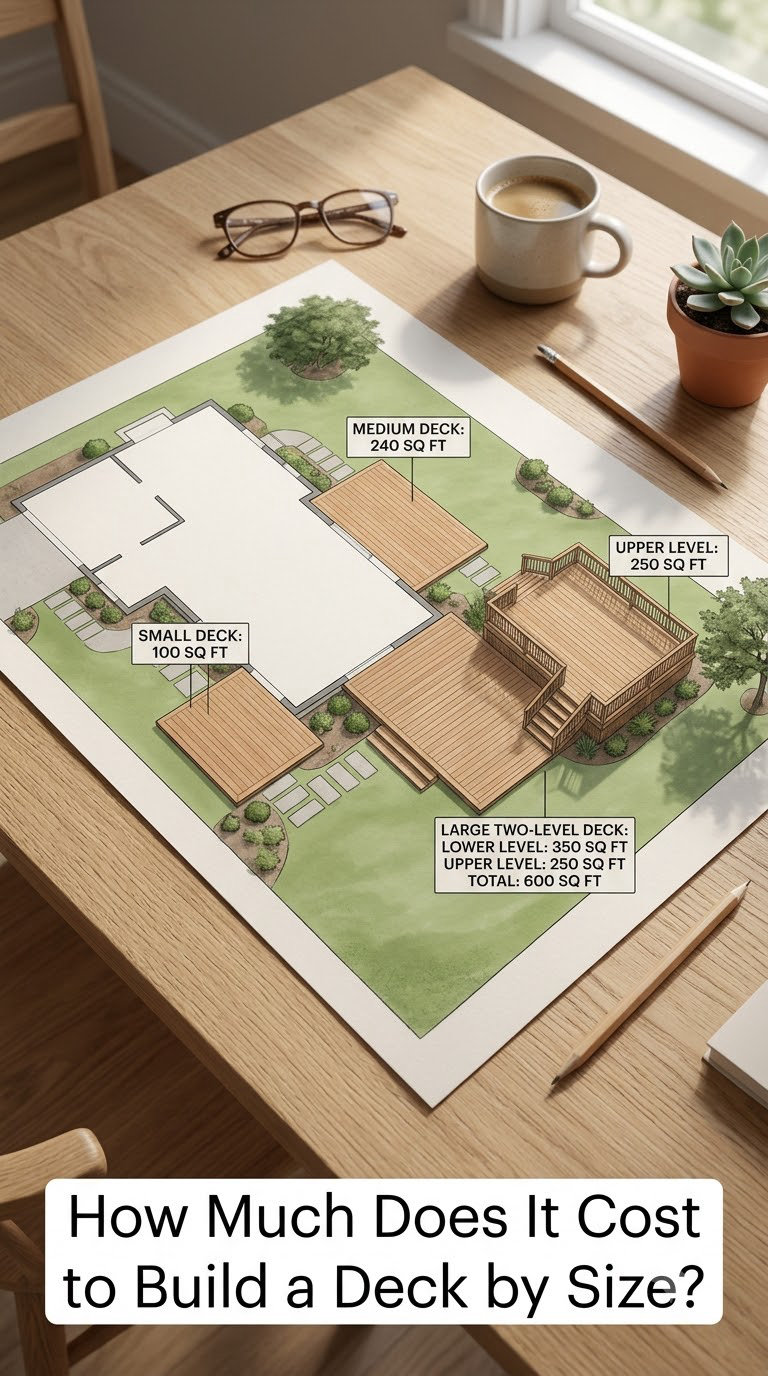
Size drives the fixed costs, not the per-foot costs. A 144-square-foot deck and a 400-square-foot deck use nearly identical lumber prices per square foot, but the small one carries the same permit fee, the same delivery trip and the same crew mobilization spread over a quarter of the surface.
| Deck size | Square feet | Materials only (DIY) | Typical installed | High end |
|---|---|---|---|---|
| 12 x 12 | 144 | 12-18 dollars | 35-55 dollars per sq ft | Up to 80 dollars per sq ft |
| 12 x 20 | 240 | 14-22 dollars | 35-55 dollars per sq ft | Up to 85 dollars per sq ft |
| 12 x 24 | 288 | 14-24 dollars | 38-60 dollars per sq ft | Up to 90 dollars per sq ft |
| 14 x 20 | 280 | 15-24 dollars | 38-60 dollars per sq ft | Up to 90 dollars per sq ft |
| 16 x 16 | 256 | 15-24 dollars | 38-60 dollars per sq ft | Up to 90 dollars per sq ft |
| 20 x 20 | 400 | 16-28 dollars | 40-65 dollars per sq ft | 100 dollars or more per sq ft |
| 20 x 40 | 800 | 18-32 dollars | 45-70 dollars per sq ft | 110 dollars or more per sq ft |
Small decks look expensive per square foot for a mechanical reason. A 12 x 12 platform needs a full day of crew time and a full permit, and there is very little surface to spread that across.
Complexity reverses the trend. A 20 x 40 wraparound with two level changes needs more framing members per square foot, more footings, longer joist spans and more steel connectors, so the per-square-foot price climbs back up as the deck grows. Straight and low is cheap; elaborate is not.
Homeowners comparing actual quotes tend to land well above the published band. One 288-square-foot deck was quoted at roughly 160 dollars per square foot, while a 730-square-foot composite deck came in near 70 dollars per square foot. Real quotes cluster somewhere between 50 and 160 dollars per square foot, which tells you the national averages describe the easy jobs.
What Do Deck Materials Cost per Square Foot?
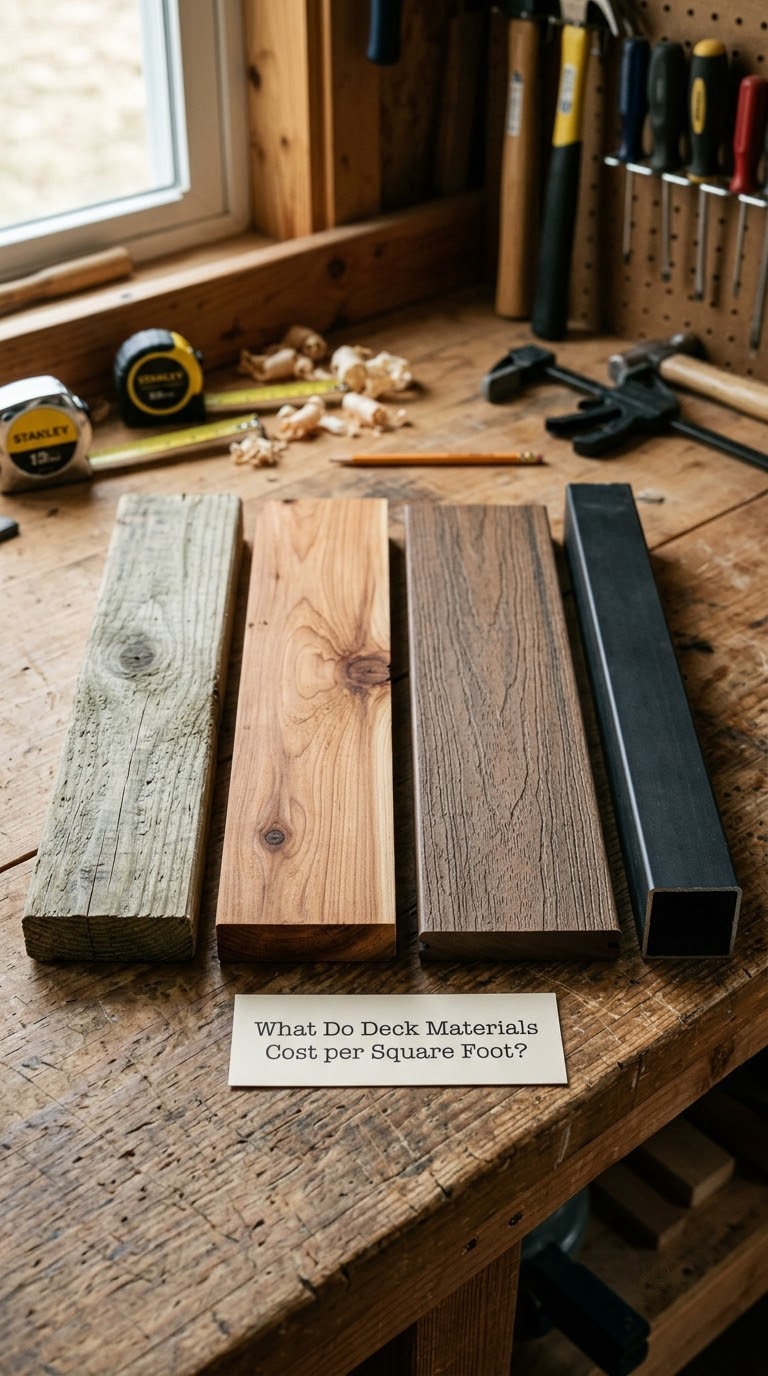
Material choice moves the decking cost more than it moves the total, because framing, footings and labor are largely fixed no matter what surface you put on top. Pressure-treated pine and cedar are cheap per board; composite and aluminum carry a higher material price but erase the stain cycle.
| Material | Material cost per sq ft | Installed total | Upkeep | Best for |
|---|---|---|---|---|
| Pressure-treated pine | 8-14 dollars | 35-55 dollars per sq ft | Stain or seal every 1-2 years | Budget builds, easy to cut yourself |
| Cedar or redwood | 14-24 dollars | 45-75 dollars per sq ft | Wash yearly, stain every 2-3 years | Natural look, naturally rot-resistant |
| Composite | 18-32 dollars | 50-85 dollars per sq ft | Hose off, no stain | Lowest long-term upkeep, deep color choice |
| Exotic hardwood or ipe | 30-50 dollars | 80-130 dollars per sq ft | Oil every 1-2 years, no stain | Premium look, very long life |
| Aluminum framing with boards | 35-55 dollars | 95-150 dollars per sq ft | Minimal | Wet climates, sloped sites, coastal air |
That composite row is the one that changes a homeowner’s mind after five years. Pressure-treated boards need a stain every other spring, and that is your own weekend each time. One DIY builder in a 168-square-foot project tracked 2,676 dollars in receipts, which worked out to about 16 dollars per square foot for materials only before any labor.
Cedar sits in the middle and appeals if you like the color wood turns as it weathers. It is softer than pressure-treated pine, so it dents and scuffs more easily under furniture feet and does not take screws as well near knots.
Is It Cheaper to Build a Deck Yourself or Hire a Contractor?
DIY almost always wins on paper. You pay for materials and your own time instead of a crew’s time. The gap is typically 30 to 60 percent, and it is entirely hidden-cost work that closes the gap faster than most people expect.
| Factor | Build it yourself | Hire a contractor |
|---|---|---|
| Cash cost | Materials, permits, tool rental, disposal | One itemized invoice |
| Time cost | Several weekends, often more | Two to six weeks elapsed |
| Footings and setbacks | You call 811 and dig, then guess if unsure | Engineered layout, correct frost depth |
| Permits | You apply and schedule inspection | Usually included in overhead |
| Failure risk | Undersized joists, skipped notching | Rework if something is wrong |
| Warranty | None | Workmanship warranty, often one to five years |
The DIY case falls apart on tall or complicated work. Footings for a 10-foot elevation need a plan and a dig depth you have to hit exactly. Getting that wrong means re-digging, and re-digging near a finished house is no fun at all.
The tool list is longer than people expect: a circular saw, a miter saw, an impact driver, a post-hole digger or auger attachment, a laser or 4-foot level, a socket set and a rental plate compactor if you are working close to the house. Renting is cheaper than buying for a one-off build.
My take after watching a lot of these go wrong: build it yourself if it is ground-level, rectangular and under about 200 square feet. Above that, the framing mistakes get expensive, and the labor you save narrows fast.
What Changes the Cost to Build a Deck per Square Foot?
Height is the biggest lever, then shape, then access. Material choice is further down the list than most homeowners expect, because the surface boards are only part of what you pay for.
Height and elevation
A ground-level platform sits on blocking or low piers. An elevated deck needs posts, beams, larger footings, taller footings dug to frost depth, and often a permit with a plan check. Same square footage, two to three times the price. That is the single biggest reason a real quote runs above a published average.
Shape, levels and stairs
Every corner adds framing. A wraparound deck uses more joist ends, more rim board and more footings than a plain rectangle of the same area. Each stair step costs extra, and a wide staircase on a tall deck can add several thousand dollars on its own.
Site access and soil
A gate narrower than 36 inches, a steep side yard or a backyard with no driveway path forces crews to hand-carry material. That gets priced as a labor premium. Rocky or fill soil means hand excavation, and fill soil on a slope often forces an engineer’s design rather than a standard detail.
What the per-square-foot dollar is made of
| Line item | Share of a typical installed square foot | Notes |
|---|---|---|
| Footings, posts and concrete | 8-18% | Higher on elevated or sloped sites |
| Framing lumber and connectors | 20-32% | Pressure-treated 2×8 and 2×10 joists |
| Decking boards | 10-25% | Widest spread between materials |
| Labor | 28-45% | Roughly half of the total on most quotes |
| Railing | 5-15% | Billed per linear foot |
| Stairs | 3-12% | Billed per step or as a unit |
| Permits, tax, markup | 5-12% | Overhead and markup commonly add 13-22% |
Labor and materials each take close to half the budget on a standard quote. The expensive part of a deck is not the wood you can see. It is the footings and framing underneath it, which is why an undersized joist is the most expensive defect you can buy.
Materials versus labor
Ask any two contractors to split their quote and you will find labor running from 28 to 45 percent depending on region. On a ground-level deck in a low labor market, materials can win outright. On an elevated deck in a coastal market, labor can reach two-thirds of the invoice.
The 3/4/5 rule and permits
The 3/4/5 rule says a deck needs no permit if it stays under 200 square feet at the ground level, is no more than 30 inches above grade, and does not attach to the house. Most homeowners in this range check the local rules, and many local rules are stricter than the federal model anyway. A permit often runs a few hundred dollars plus inspection fees, and it also forces a plan that sometimes reveals you need deeper footings than you planned. Skipping the permit saves a fee and can cost you a resale problem later.
Add-ons people forget
| Add-on | Typical cost |
|---|---|
| Demolition and disposal | 4-12 dollars per square foot of old deck, plus a dump fee |
| Code-compliant railing | 35-90 dollars per linear foot installed |
| Stairs | 180-450 dollars per step, more for closed risers |
| Permit and inspection | 300-900 dollars depending on the jurisdiction |
| Sales tax on materials | Rates vary by state and county |
| Contractor overhead and markup | 13-22% added to materials and labor |
How to Estimate Your Deck Budget
Estimate the shape first, then the surface. Start with the footprint, not the material, because material choice is a decision you can make later while the size is not.
Step 1: measure the footprint
Sketch the outline with dimensions, then multiply length by width for rectangles and break odd shapes into rectangles. Do not use the house wall as one edge without checking that it is actually straight. Measure twice; it is the oldest advice in this article for a reason.
Step 2: pick a realistic material tier
Decide between pressure-treated, cedar and composite before you start collecting quotes, and use the material table above for the materials-only band. Add 15 percent for waste, offcuts and the boards that will warp.
Step 3: price the add-ons separately
Count linear feet of railing, count steps, and add demolition if an old deck exists. Most blowups come from a quote that covered the surface and nothing else.
Step 4: add the soft costs
Permit fees, inspection, sales tax and disposal. Then add a 10 percent contingency, because soil conditions and code requirements are not knowable from a plan.
Step 5: get three itemized quotes
Ask each one to list quantities and unit prices for footings, framing, decking, railing, stairs, demolition and permits, and to state overhead and markup as a separate line. If a quote arrives as a single lump number, ask for it broken out. Check that the three bids are drawing the same scope, since a low bid missing railing is not a lower price.
Step 6: talk to your building department early
Talk to your local code officials about setbacks, footings and ledger attachment before drawing anything final. If your deck attaches to the house, carries a roof, or will hold heavy loads, involve a qualified contractor or an engineer. Getting that conversation in the first week costs nothing. Getting it in week six costs a redesign.
Frequently Asked Questions
How much does it cost to build a 20 by 20 foot deck?
A 20 by 20 deck covers 400 square feet. Built at the typical installed range, it lands between 16,000 and 26,000 dollars for a pressure-treated ground-level deck, and between 20,000 and 34,000 dollars in composite. Elevated or multi-level versions of the same size routinely reach 40,000 dollars and beyond, because footings and framing dominate the cost. Get two or three itemized quotes before you commit to either number.
Is it cheaper to build a deck yourself or hire a contractor?
DIY is cheaper on paper, usually by 30 to 60 percent, because you trade a crew’s labor rate for your own weekends. The savings shrink fast on tall or complex decks where footings must hit frost depth and framing must carry real load. Ground-level rectangular decks under about 200 square feet are the sweet spot for DIY. Above that, mistakes get expensive to fix.
What is the cheapest long-lasting deck material?
Pressure-treated pine is the cheapest durable option at 8 to 14 dollars per square foot for materials, and it can last 25 years when it is sealed on schedule. Composite runs 18 to 32 dollars per square foot but needs no stain, so the ten-year total often lands lower. If minimizing the first bill matters most, choose pressure-treated. If minimizing weekends matters more, choose composite.
Do I need a permit to build a deck in the US?
Most jurisdictions require one, and the common exemption is the 3/4/5 rule: under 200 square feet, no more than 30 inches above grade, and not attached to the house. Local rules are often stricter, so check with your building department even when your deck seems to qualify. Permit and inspection fees commonly run 300 to 900 dollars, and an unpermitted deck can complicate a future sale.
How much does it cost to replace deck boards on an existing deck?
Resurfacing runs about 6 to 14 dollars per square foot of existing deck when the framing underneath is sound. That covers removing old boards, replacing rotted joists, installing new boards and refastening. If the ledger, beams or footings are compromised, replacement stops being a resurfacing job and becomes a rebuild in the 35 to 60 dollar per square foot range. Have the framing checked before ordering material.
Why do deck estimates cost more per square foot for small projects?
Because the fixed costs never shrink. The permit fee, the delivery trip, the crew mobilization and the single mobilization charge for tools are all spread across 144 square feet instead of 400. That is why a 12 by 12 deck can price out at 45 dollars per square foot while a 20 by 40 prices closer to 50 for a far simpler build. Small footprints carry proportionally more overhead.
Start With the Height, Not the Wood
The cost to build a deck per square foot lands somewhere between 25 and 160 dollars depending on height, shape and material, so the fastest way to a real number is to decide the height and outline first. Sketch the footprint, pick a material tier, price the railing and stairs separately, and then get three itemized quotes that you can actually compare line by line.
Before you finalize anything, check what you already own that works outside. A deck built this year usually gets a table, a fire pit and planters on it within a month, and those pieces change the square footage you need more than another 100 square feet of boards would.
Our picks for the accessories that go on top of the framing: the best above ground pools with deck if the yard is flat and sunny, the best fire pit tables for deck for cooler evenings, and the best raised garden beds for deck when you want food instead of furniture.
