How Long Does Grout Take to Dry? Grout Types Compared (2026)
So, how long does grout take to dry? Most cement-based grout is touch-dry at about 24 hours and needs 48 to 72 hours to fully cure. Epoxy grout sets much faster, usually within 12 to 24 hours. Quick-set cement grout takes light foot traffic in 2 to 4 hours. The bag you actually used beats any generic number on the internet.
If you grouted a shower this week, that first sentence is probably the whole question. Most people want one number, then they find four of them online and no way to tell which one governs their floor. The honest answer is that grout runs on several clocks at once, and only one of them is a clock you control.
Contents
Fall projects land harder than summer ones here, because you often grout a shower and then still need a working bathroom for weeks. Nobody plans for the wait. Plan for it, though, and the timeline stops being stressful.
This guide walks through how long grout takes to dry by type, what stretches that timeline, and how to tell when a joint is genuinely ready rather than just looking pale. It is written from installer habits and published manufacturer guidance, and it is current as of 2026.
How Long Does Grout Take to Dry at a Glance?
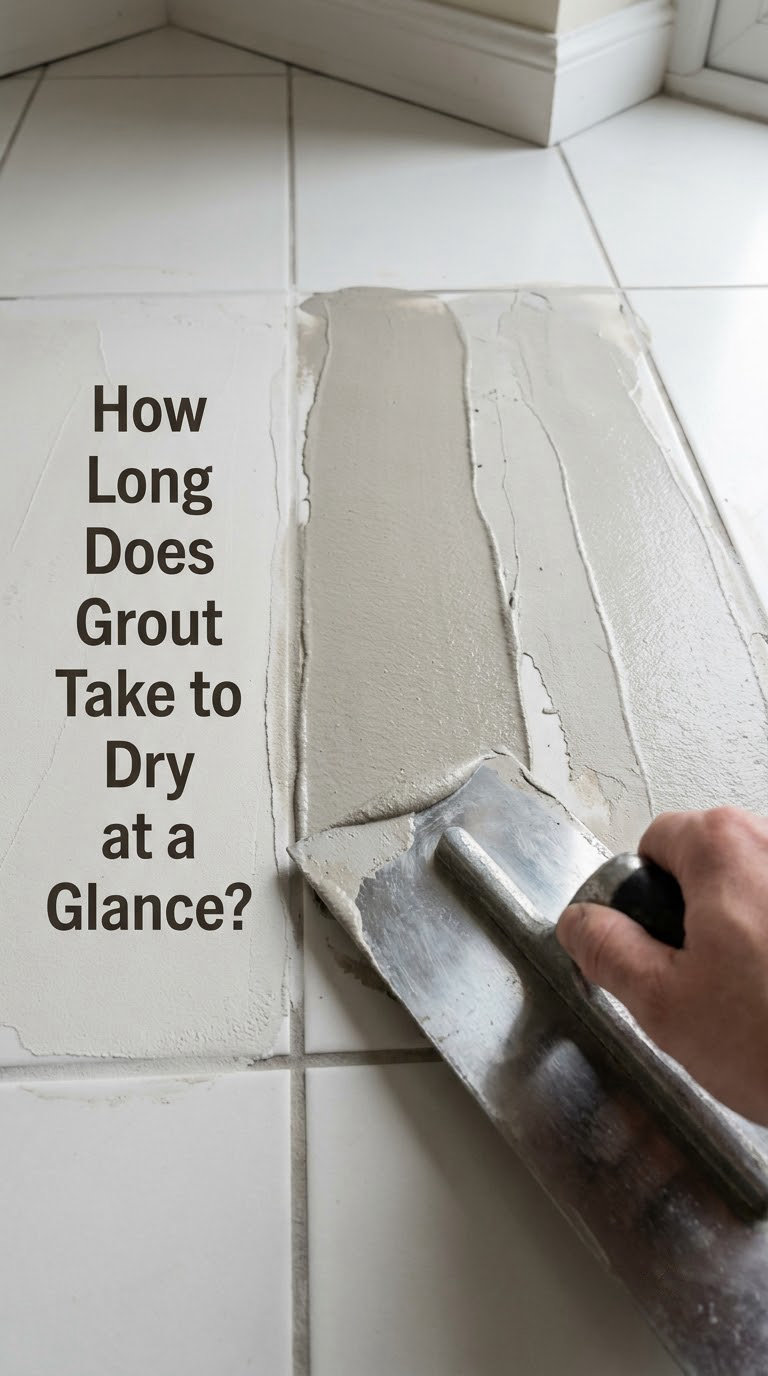
Cement grout reaches touch-dry at roughly 24 hours and full cure at 48 to 72 hours. Epoxy is the fastest, and pre-mixed urethane grout sits in between. Here are the typical ranges, not promises.
| Grout type | Touch-dry | Water ready | Full cure | Seal needed |
|---|---|---|---|---|
| Standard cement grout | 24 to 48 hours | 48 to 72 hours | 28 days for full strength | Yes, generally |
| Quick-set cement grout | 2 to 6 hours | 24 hours | 3 days | Varies by product |
| Pre-mixed cement grout | 24 to 72 hours | 72 hours | 28 days | Yes, generally |
| Epoxy grout | 3 to 6 hours | 24 hours | 24 to 72 hours | No |
| Urethane grout | 12 to 24 hours | 24 to 48 hours | 3 to 7 days | No |
| Color-packed grout | 24 to 48 hours | 72 hours | 28 days | Yes, generally |
The three clocks are worth separating before anything else. Setting is the first few minutes, when the material stops moving. Drying is water leaving the surface, and you can see it. Curing is the chemical reaction between cement and water that builds calcium silicate hydrate crystals inside the joint, and that part you cannot see at all.
A surface can be bone dry at 24 hours and still be weak in the middle of the joint at day three. That gap is exactly where most regrouting failures live. Grout that gets walked on or soaked too early stays soft, cracks, flakes, and lets water behind the tile where it can sit for years doing quiet damage.
Drying is also not the same as clean. The haze you see on freshly grouted tile is dried cement film on the surface, not grout that has cured. Removing it too early can pull colour out of the joint, so most people wait 24 to 48 hours before the final wipe-down.
Cement Grout Drying and Curing Times
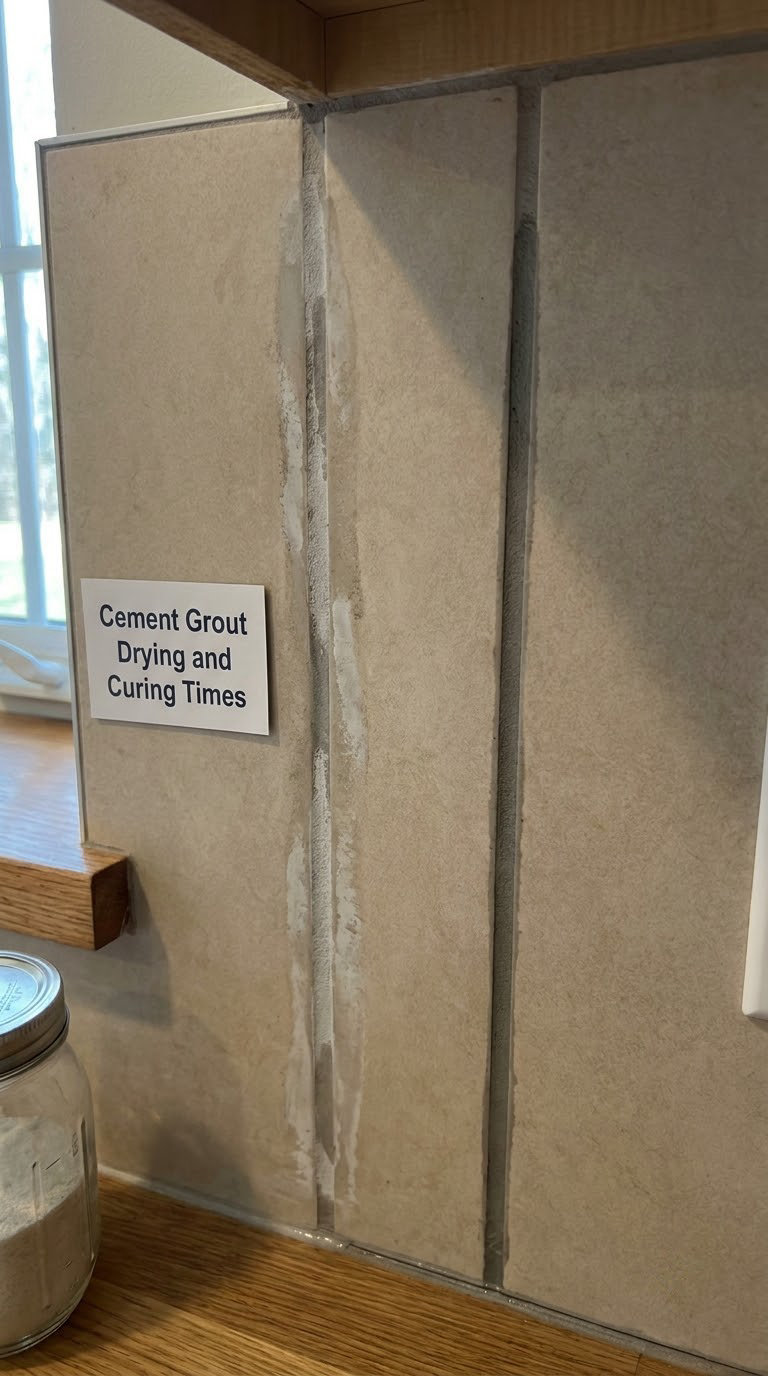
Standard cement grout — sometimes called Portland-cement or cementitious grout — is the default for floors, showers and most exterior work. Plan on 24 hours before light foot traffic, 48 to 72 hours before water hits it, and about 28 days before it reaches its full compressive strength.
Sanded grout carries a silica filler, which makes it stable in wider joints of an eighth of an inch (3 mm) and up. Unsanded grout is used for narrower wall joints and for tile that scratches easily, like zellige or polished ceramic.
Quick-set cement grout is the answer to a schedule problem. It reaches light foot traffic in 2 to 4 hours, water exposure around 24 hours, and full cure in roughly 3 days. Many of these products are sold as one-hour-set varieties that take 15 to 30 minutes to haze and firm up enough to sponge off.
That speed costs something. Quick-set grout often colours unevenly on porous or handmade tile, and it has less working time to fix mistakes. On zellige, terracotta or cement tile, I would still pick the 24-hour grout and plan the wait.
Pre-mixed grout is a standard cement mix already combined with water in a tub. It cures the same way but more slowly, since evaporation still has to happen and the mix is thinner. Manufacturers commonly quote 24 to 72 hours before traffic, so buy the tub size you need and expect a longer schedule than a dry mix.
Two rules extend every cement schedule. Thick joints hold more water in the middle, and the colder and more humid the room, the longer the tail. Follow the manufacturer directions on the bag, because those are what a warranty is measured against.
Epoxy, Urethane, and Color-Packed Grout Times

Epoxy grout has no evaporation stage at all. It is resin and hardener, not water and cement, so nothing has to dry out of the joint. Most epoxy grout is spongeable after 15 to 30 minutes, walkable within 4 to 6 hours, and ready for water in 24 hours, with some products reaching full cure at 72 hours.
The catch is that epoxy cures by chemical reaction, and that reaction reacts to temperature. Cold resin cures slowly and can turn brittle. Manufacturers commonly specify a working range of roughly 50 to 90 F (10 to 32 C), and a shower grouted on a 45 F morning may take twice as long as the label promises.
Urethane grout is a hybrid. It is a urethane emulsion that partly dries like cement grout and partly cures like epoxy. Typical numbers are 12 to 24 hours to touch-dry and 3 to 7 days for full cure. Many installers prefer it over epoxy on shower floors because it is slightly forgiving on out-of-plumb work.
Color-packed grout takes the cement route with pigment already mixed in. It behaves like standard cement grout, 24 to 48 hours to dry and 72 hours before water exposure. One honest note: precolored grout is colour-through rather than colour-coated, so a scuff does not reveal a white core the way it does with some cement products.
Neither epoxy nor urethane needs sealing. That saves a day of waiting later and is the strongest practical argument for paying more up front in a shower.
What Factors Change Grout Drying and Curing Time?
Which environmental conditions slow grout down most?
Humidity, temperature and joint size do most of the work. Cement grout cures fastest between 50 and 90 F (10 to 32 C) with moderate airflow. Cold air and high humidity slow evaporation, so a late-fall grouting job in a closed bathroom will run past the bag’s number.
Does grout dry faster outside?
Sunlight and dry air help surface drying, but exterior work carries a freeze risk. Water held in a cement joint that freezes expands and can crush the line, so grout outside is not walkable until temperatures have stayed above freezing overnight. Some installers protect fresh exterior joints with a cover for a day, and exterior projects typically need the full 72 hours before rain.
How does joint width and depth change the schedule?
A wider and deeper joint holds more water in its centre than a narrow one, and evaporation only happens at the two surfaces. Narrow joints dry close to the surface estimate. Joints over three-eighths of an inch deep, or heavily packed grout that was overworked with too much water, can take several extra days at the core.
What else moves the numbers?
Porous tile pulls water out of the joint quickly but can blotch the colour, so porous zellige and terracotta often take extra time before the shade settles. A damp substrate does the same from below. Too much water added during mixing lengthens everything. Air conditioning vents blowing straight at a fresh joint pull moisture out too fast on the surface while leaving the middle wet.
None of these are emergencies. They are reasons to read the bag, then add a day if your numbers sit at the cold end.
How to Tell When Grout Is Ready for Use
Colour is the first signal, and it is unreliable on its own. Cement grout darkens as it wets and lightens as it dries, so a light joint is usually progressing, but a uniform shade is a hint rather than proof. Do not judge readiness by colour alone.
Run these four checks instead.
- Firmness. Press a fingernail into the joint centre. A soft dent means it is not ready. Any surface that takes an impression will hold that mark permanently.
- Temperature. Wet grout stays noticeably cooler than the surrounding tile. Once the joint feels the same temperature as the floor, evaporation has finished at the surface.
- Haze. Wipe a dry cloth across the joint. If the cloth picks up pale powder, the grout is still releasing water and you are looking at cement film, not a cured joint.
- Corner test. Press a coin into the outside edge of the joint where the tile edge is exposed. Softer there means the core is not ready either.
Each use has its own clock. Light foot traffic usually opens at 24 hours for standard cement grout and hours sooner for quick-set. Water exposure waits for 48 to 72 hours. Furniture needs about 48 hours, because a caster foot concentrates load on a small line. Sealing waits until the bag’s stated period, commonly 48 to 72 hours for cement grout, and epoxy skips it.
The sealer runs on its own schedule too. Penetrating sealer feels dry to the touch in about 2 hours and can take up to 72 hours to cure. Do not get the floor wet or heavy during that window, and expect the full colour to settle once it cures.
Grout smell follows the same clock. Cement grout releases a faint alkaline odour for 24 to 72 hours. Keep the room ventilated, and treat epoxy fumes as a ventilation job for the whole install day.
Grout Costs by Type and Project Size
Grout is cheap by the pound, so total material cost is usually a rounding error next to labour. Here are realistic US material ranges, expressed in dollars per pound for the bag, plus what a whole project typically consumes.
| Project size | Area | Grout needed | Typical material cost |
|---|---|---|---|
| Small repair | Up to 25 sq ft | 2 to 5 lb | USD 12 to 30 |
| Backsplash | 25 to 60 sq ft | 5 to 10 lb | USD 25 to 60 |
| Bathroom floor | 60 to 120 sq ft | 10 to 20 lb | USD 50 to 130 |
| Shower, floor and walls | 120 to 200 sq ft | 20 to 40 lb | USD 100 to 260 |
| Kitchen floor or large area | 200 to 400 sq ft | 40 to 80 lb | USD 200 to 500 |
Prices vary by region, brand, joint width and retailer, so treat these as planning ranges. Standard cement grout sits near USD 10 to 25 per pound, premixed tubs run higher per pound because you are buying water, epoxy lands around USD 30 to 60, and urethane sits between the two. Sealer adds roughly USD 20 to 40 per pound of treated area when you need it at all.
Pros and Cons of Each Grout Type
Faster curing is not the same as better performance. A quick-set grout that takes foot traffic in three hours may outlast a slow one in a kitchen floor and lose in a shower.
| Grout type | Drying behaviour | Durability and stains | Install difficulty | Repairable | Best used for |
|---|---|---|---|---|---|
| Standard cement | 24 to 48 hours dry, 28 days cure | Good, stains if unsealed | Easy | Yes, raking out is routine | Floors, showers, exterior work |
| Quick-set cement | 2 to 6 hours dry, 3 days cure | Good, colour can blotch | Easy but fast | Yes, once cured | Repairs, tight schedules |
| Pre-mixed cement | 24 to 72 hours dry, 28 days cure | Good, no mixing needed | Easiest | Yes | Small jobs, touch-ups |
| Epoxy | No evaporation, 24 to 72 hours cure | Excellent, stain proof | Hard, narrow working window | Difficult, needs a saw | Showers, commercial kitchens |
| Urethane | 12 to 24 hours dry, 3 to 7 days cure | Very good | Moderate | Moderate | Showers, wet rooms |
| Color-packed cement | 24 to 48 hours dry, 28 days cure | Good, colour-through | Easy | Yes | Small tiled projects |
Epoxy is stain resistant and needs no sealer, which is why it shows up in commercial kitchens and busy showers. Cement grout is far easier to rake out and re-point later, and in a home that flexibility matters more than a perfect stain record.
What Changes the Price of Grout?
Chemistry is the biggest lever. Cement sits at the bottom of the range, urethane in the middle, and epoxy at the top. Beyond that, quantity is driven by joint width and depth: doubling the joint width roughly doubles the grout a project eats.
Colour matters too, since matched custom colours run higher than a standard white or grey. Add sealing if the grout type needs it, and remember that difficult access adds cost rather than material. A shower pan with a curb and a niche uses more labour than a flat floor of the same square footage, and a commercial surface with many cuts and edges uses far more grout per square foot than a simple field.
One thing that does not change the price is drying time itself. A slow-curing grout is not more expensive to buy. The waiting costs you days, not dollars.
While you are waiting, do the cleaning you have been postponing. Once grout haze is removed after 24 to 48 hours, a steam cleaner is genuinely useful on the joints, and our picks for the best steam cleaners for grout cover the main types. For routine soap scum, our best cleaners for shower tile and grout roundup compares what actually works on each surface.
Frequently Asked Questions
Can I walk on grout after 24 hours?
For standard cement grout, 24 hours gives you light foot traffic on a clean, dry floor with no furniture in place. Keep heels, hard soles and casters off it, and treat that as a walking window, not a moving-in window. Quick-set grout handles traffic in 2 to 4 hours. Epoxy is walkable in 4 to 6 hours. Whatever your product says on the bag beats any number here, and cold or damp rooms need extra hours.
How long before I can shower after grouting?
Wait 48 to 72 hours after grouting a shower floor with standard cement grout before turning water on. Some manufacturers specify up to 7 days, and installers commonly add margin. Quick-set cement grout can see water at around 24 hours, while epoxy only needs the same window because it cures chemically. Plan the outage before you start: on a bathroom remodel, add at least a week to the schedule.
Is grout dry when it turns a different color?
A lighter colour means water is leaving the joint, which is a good sign, but it is not proof of a cure. Cement grout lightens as it dries, and porous tile can blotch that lightening unevenly while the joint is still damp inside. Use the fingernail test, the temperature test and a coin edge test on a spare tile first. When all three agree, the joint is ready, and you can seal or shower.
Does epoxy grout need to cure like cement grout?
No, and the difference matters. Cement grout dries by water evaporating, then hardens through a chemical reaction over weeks. Epoxy grout has no water to evaporate, so it does not dry at all, it cures as a resin reaction. Typical numbers are spongeable after 15 to 30 minutes, walkable in 4 to 6 hours, water ready in 24 hours, and fully cured within 24 to 72 hours depending on temperature.
How can I speed up grout drying safely?
Ventilation and steady moderate airflow help most, along with keeping the room between 50 and 90 F (10 to 32 C). A dehumidifier pulling moisture from the air can shorten a humid-room schedule. What does not work: a heat gun, a space heater aimed at the joint, or a fan blasting the surface, which dries the skin fast and leaves the core damp. Lowering humidity helps only modestly once the air is reasonably dry.
Do I have to seal every type of grout?
No. Standard cement, quick-set cement, pre-mixed and color-packed grout all benefit from a penetrating sealer because their pores absorb water and stain. Epoxy and urethane grout are sealed by their own chemistry and should not be sealed at all. Most contractors seal cement grout 3 to 4 days after installing it, then reapply once around a month later. If you skip sealing, expect colour variation on a floor or shower.
What to Do First
Identify your grout type before you plan anything, because the clock starts there. Read the data sheet on the bag you bought and use its longest listed restriction for foot traffic or water, not the shortest. Then set your calendar from that number and stop re-checking the colour every few hours. Grout that feels solid in the morning can still be soft underneath, and how long does grout take to dry is settled by chemistry, not by looking at it.
If you are waiting on a bathroom remodel and wondering what to do with the room meanwhile, our guide to how long bathroom paint takes to dry covers the other clock running in your house at the same time.