How Long Does Exterior Paint Last? Lifespan Guide 2026
Most exterior paint jobs last 5 to 10 years. Homes painted well in a moderate climate usually get 7 to 15 years, and a few stable surfaces hold on longer. How long does exterior paint last on your house depends on the siding underneath, the paint you use, and how the west and south walls take the sun.
Paint is not just colour on the outside of your home. It is the first barrier between rain, ultraviolet light, and freeze-thaw cycles and the wood, masonry, or metal behind it. When that film breaks down, moisture gets in and small repairs turn into board replacement.
Contents
Fall is a good time to walk around and look, before you make any spring plans. Here is what longevity actually looks like by surface, what shortens it, and what a repaint really involves.
How Long Does Exterior Paint Last?
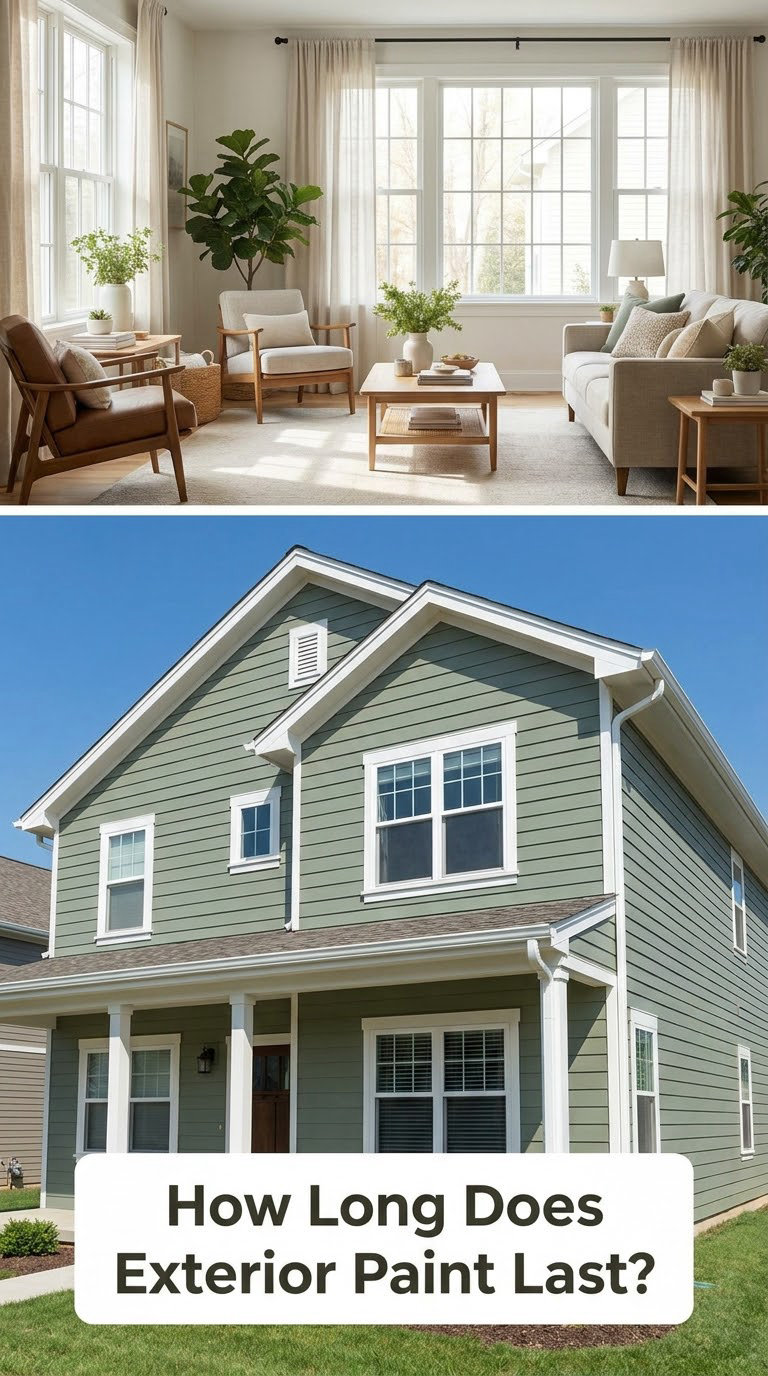
Here are realistic ranges. They assume an exterior-rated acrylic coating, primer where the surface needs one, two coats, and prep done properly.
| Exterior surface | Typical lifespan | Longest realistic run |
|---|---|---|
| Wood siding and trim | 5 to 7 years | 10 years |
| T1-11 and other plywood panel | 4 to 7 years | 10 years |
| Cedar shingle | 3 to 6 years | 8 years |
| Aluminum siding | 5 to 8 years | 20 years |
| Vinyl siding | 5 to 10 years | 15 years |
| Fiber cement siding | 10 to 15 years | 20 years |
| Stucco | 8 to 10 years | 15 years |
| Painted brick | 10 to 20 years | 25 years |
| Steel or garage doors | 7 to 12 years | 15 years |
Wood moves the most. It swells when wet and shrinks when dry, and that cycle works the paint film loose from the inside out. Masonry barely moves at all, which is why painted brick often outlives everything else on the same house.
Contractors who post on the Painttalk forum generally put professional work at 7 to 15 years, and treat anything past 20 years as the exception that needs near-perfect conditions on every side. That matches the table above.
Professional repainting across the US generally runs 1.50 to 4.00 dollars per square foot of exterior wall area for a straightforward job, or roughly 6,000 to 16,000 dollars for a typical two-story home. Regional labour rates and how much surface preparation the house needs move that number more than the paint itself does.
Exterior Paint Lifespan by Surface and Paint Type
The surface sets the ceiling. The paint type decides how close you get to it.
| Paint type | Where it fits | Realistic lifespan |
|---|---|---|
| 100% acrylic latex | Most siding, trim, fiber cement | 10 to 15 years |
| Acrylic-latex blend | Budget coats on siding and trim | 5 to 10 years |
| Oil-based | Trim, shutters, hard-working surfaces | 8 to 12 years |
| Elastomeric | Stucco, hairline-cracked masonry | 10 to 20 years |
| Masonry or silicate paint | Brick and heavy stucco | 15 to 25 years |
| Solid or semi-solid stain | Wood siding, cedar, log walls | 3 to 7 years |
100% acrylic is the default for a reason. It stays flexible in cold weather, resists ultraviolet light better than older chemistries, and lets the wood underneath breathe. Painters on contractor forums consistently rank premium acrylic lines ahead of entry-level acrylics for how long the film holds together.
Oil-based paint still earns its place on trim, shutters, and handrails. It takes more scuffs and handles brush loading better, and it stays put on horizontal surfaces that collect water.
Elastomeric coatings are thick films that bridge small cracks in stucco. They only belong on masonry that is sound, and sealing a wall that already holds water just traps it inside the wall.
Solid stain behaves differently from paint. It soaks into the wood and colours the grain rather than sealing it, which means it will not crack or peel, but it also will not hide old paint or stop a board from checking. On T1-11, contractors on Painttalk report solid stains holding about 10 years.
Whichever type you pick, the manufacturer’s technical data sheet outranks any range on the internet, including this one. Read the surface-preparation section and the recommended film thickness before you buy.
For ideas on what colour to put on the wall in the first place, see our guides to popular Sherwin-Williams exterior paint colours and 25 Benjamin Moore exterior paint colours.
What Changes How Long Exterior Paint Lasts?
Two houses with the same siding, same paint, and same year can be five years apart when you start scraping them. These are the variables that cause the gap.
How long does exterior paint last in different climates?
Southern and western exposures fail first. Ultraviolet light breaks down the binder, and south-facing walls fade noticeably faster than north-facing ones. Coastal homes get hit with salt that pulls moisture out of the film and corrodes fasteners underneath; painters in those markets report 3 to 5 year repaint cycles as normal.
Freeze-thaw cycles are the northern enemy. Water gets into a crack, freezes, expands, and pushes the coating off the board. Wide daily temperature swings cause the same movement without the ice.
Desert air is dry but not gentle. Heavy ultraviolet load and dust staining shorten the attractive life of a light colour long before the film fails.
Surface preparation
Preparation decides whether paint sticks or slides off. Loose chalky paint has to come off, bare wood and bare metal have to be primed, and every joint has to be caulked so water never gets behind the film. One homeowner on Reddit described finding twenty-year-old paint on their shingles that a paint seller had promised would last twenty-five years; the paint was fine, the preparation under it was not.
Paint quality and application
Two full coats beat one thick coat every time. A second dry film adds real protection, and it gives you a repair window when the first coat weathers. One contractor on Painttalk reported fiber cement painted with an entry-level acrylic that was badly faded after four years of all-day sun, while the same board with a premium acrylic still looked new past year five.
Substrate movement and moisture
Wood expands and contracts. Fiber cement does not. Metal corrodes and rust pushes paint off in flakes. A leak behind a wall shows up as blistered paint long before you find the failed flashing.
Colour
Red, yellow, and other warm hues fade fastest because their organic pigments break down under ultraviolet light. Whites and off-whites yellow slightly. Dark colours hold their depth but absorb heat and can hit a wall harder in summer.
Signs Your Exterior Paint Needs Repainting
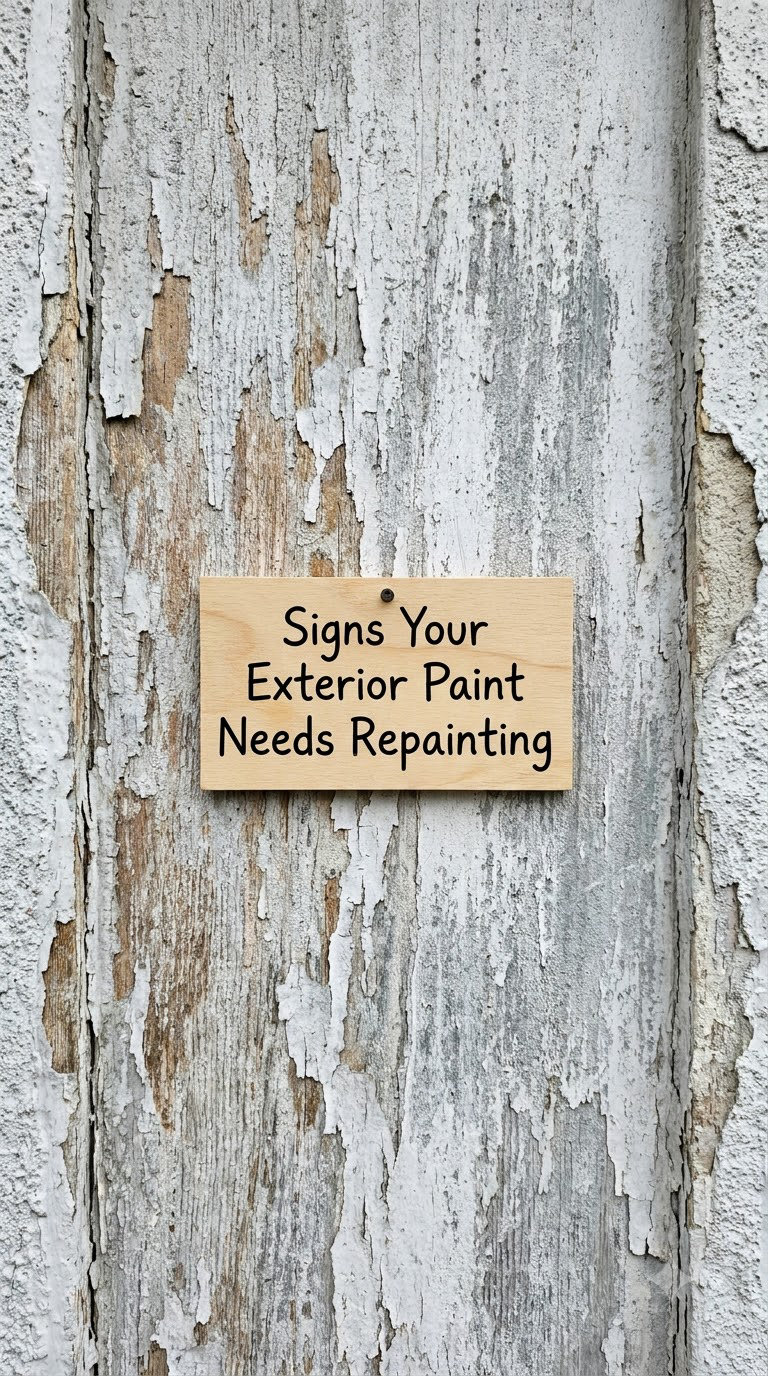
Watch for these, in rough order of how much trouble they cause.
- Fading and uneven colour. One wall a shade lighter than the rest means the sun is through with that face.
- Chalking. Run your finger across the siding. If a powdery white residue comes off on your hand, the binder at the surface has broken down and adhesion is going with it.
- Peeling and flaking. Edges curling away from the siding, or sheets of paint coming loose in the wind.
- Cracking or alligatoring. A cracked pattern that looks like reptile skin usually means a thick, brittle film applied over an unstable surface.
- Blistering. Bubbles or bubbles that popped and left bald spots, almost always moisture trapped under the film.
- Mildew and algae. Green or black growth in shaded damp corners, especially north of a tree line.
- Exposed substrate. Bare wood, grey fibre cement, or rust showing through.
- Water beading on the wall. If rain sits in beads instead of washing off, the coating has lost its ability to shed water.
Chalking and light fading are slow and can be monitored for a season or two. Peeling, blistering, and exposed substrate are failures. Fix those before you restain anything, because moisture is already reaching the material behind the paint.
How to Make Exterior Paint Last Longer
You will not add fifteen years with a garden hose. You can, however, stop a lot of small problems from becoming a full repaint.
- Walk the house twice a year. Spring after the wet season and October after the leaves drop. Look at the south and west walls first.
- Wash gently once a year. Soft-bristle brush and mild detergent, low-pressure rinse. A pressure washer set too close will etch the film you are trying to save.
- Caulk on a schedule. Recaulking exposed trim joints and around windows every few years costs very little and keeps water out of the wall.
- Touch up chips the same season. A spot prime and one coat on a scraped area takes under an hour and stops the bare wood from wicking water.
- Keep plants off the wall. Leave 6 to 12 inches of clearance so shrubs and vines do not hold moisture against the siding or rub the finish.
- Fix drips and runoff. A downspout dumping at the foundation keeps one wall damp year-round.
- Clean the gutters. Overflow behind the fascia shows up as peeling trim years later.
If you are painting at all, use primer on bare wood, bare metal, and anything repaired, and a bonding primer over chalky existing paint. Never paint a damp surface. For drying-time questions on a smaller job, our guide to how long bathroom paint takes to dry covers the timing rules that apply indoors, and the same basics hold outside.
What Does It Cost to Repaint the Exterior of a House?
Costs vary by region and by how much wood rot is underneath. These are typical US ranges for a paintable exterior, not a quote.
| Home size | Professional job | DIY materials only |
|---|---|---|
| Small one-story, under 1,500 sq ft | 4,000 to 9,000 dollars | 600 to 1,500 dollars |
| Two-story, 1,500 to 2,500 sq ft | 6,000 to 16,000 dollars | 900 to 2,500 dollars |
| Larger or three-story | 12,000 to 30,000 dollars | 1,800 to 4,500 dollars |
Professional work breaks into three parts: preparation, paint and supplies, and labour. Preparation is usually the line item that surprises people, because scraping loose paint, replacing bad boards, caulking joints, and fixing window trim takes more hours than the painting itself on an old house.
Buy one extra gallon for a two-coat job on trim. Running out mid-wall means a visible lap line you will live with for a decade.
DIY Repainting vs. Hiring a Professional
There is no wrong answer here. There is only the trade between money and time.
| Doing it yourself | Hiring a pro |
|---|---|
| Full control over colour, timing, and quality | Done in days without a month of scaffolding around the house |
| Materials cost is a fraction of the job | Prep done to a spec that holds up to inspection |
| You are stuck with the ladder work | Repairs to rotten boards handled before painting |
| Two to four weeks for a medium house | Even, sprayed-and-rolled finish on large surfaces |
| A mistake stays visible for years | Warranty on labour for the work itself |
Hire a contractor when the house is three storeys or taller, when the ground drops away under the second floor, when boards need replacing, or when the previous paint is alligatored and has to come off. None of that is a weekend job.
If the paint is in decent shape and the walls are within reach of an extension ladder, painting it yourself is very doable. Just budget real time for prep, which is usually two-thirds of the job.
How to Choose Exterior Paint for a Longer Service Life
Match the coating to the substrate and the exposure, then read what the label says rather than what the label promises.
- Exterior-rated only. Interior latex lacks the flexibility and ultraviolet resistance for weather. Look for exterior on the can.
- Read the technical data sheet. It lists surface preparation, maximum moisture content, temperature range, and recommended dry film thickness. That sheet is the contract.
- Prime properly. Bare wood, new fiber cement, bare metal, and any patched area get primer. Over chalky paint, use a bonding primer or strip it back.
- Estimate quantity, then add 10 percent. Measure the wall area, multiply by the coverage rate on the label, and remember two coats need roughly twice the paint.
- Buy the whole job in one batch. Colour can shift slightly between production runs, so buy everything at once and stir the pails together.
- Check the stir date. Paint that has frozen in the warehouse is not a bargain, and unopened pails have a shelf life of roughly two years.
- Mind the weather window. Most exterior acrylics want a surface temperature between 50 and 85 degrees Fahrenheit, low humidity, and at least a few dry hours before dew.
On warranties, take the number seriously but not literally. A lifetime warranty on a can typically covers adhesion failure of the product itself under its stated conditions. It does not cover chalking, colour fade, peeling over damp wood, or poor preparation. Painters on contractor forums read those documents as marketing rather than a promise of 20 years on your siding.
Frequently Asked Questions
What is the average lifespan of exterior house paint?
Most exterior paint jobs last 5 to 10 years. Homes painted with a premium acrylic over sound, well-prepared surfaces in a moderate climate usually reach 7 to 15 years. Vinyl and fiber cement hold longest at 10 to 15 years, while wood siding and cedar shingles sit closer to the 5 to 7 year mark. Continuous direct sun and salt air pull those numbers toward the low end.
Does exterior paint last longer on siding than on stucco?
Not usually. Properly painted stucco with an elastomeric or masonry coating often lasts 8 to 10 years, and sometimes 15, because stucco does not move with weather the way wood does. Siding is a category, not one answer: fiber cement outlasts wood by years, while vinyl can trap moisture behind it and shorten the job. The paint type matters as much as the surface.
Why is my exterior paint peeling after only a few years?
Peeling that early almost always points at a cause other than the paint itself. Common culprits are painting damp or unseasoned wood, skipping primer on bare or chalky surfaces, failing to caulk joints so water gets behind the film, or one heavy coat instead of two. A bonding primer and proper preparation usually fix a peeling job that started early.
Can I paint over exterior paint that is fading or chalky?
Lightly chalky paint can sometimes be painted with a bonding primer after a thorough wash and a scuff-sand. Heavily chalking or peeling paint will not hold a new film, and painting over it just locks the failure in place. Scrape or sand back to sound material, prime the bare areas, and apply two fresh coats for a result that lasts.
Is exterior paint safe to use on wood, vinyl, and stucco?
Yes, as long as the product is labelled for exterior use on that surface. Wood wants an acrylic exterior coating with primer, and stucco wants a breathable masonry or elastomeric paint so trapped moisture can escape. Vinyl is different: use a paint made for vinyl siding, because ordinary exterior paint can stick to it and peel off in sheets.
How often should I inspect the outside of my house?
Twice a year is enough for most homes: once after the wet season and again in autumn after the leaves drop. Check the south and west elevations, the trim around windows, and any place water runs. The inspection takes twenty minutes, and catching a single chipped board now costs one hour instead of replacing a wall of siding later.
What to Do First This Year
Walk your house in daylight and find the worst wall. That single wall usually tells you whether you need touch-ups, a partial repaint, or the whole job. Everything else on this page follows from what you see there.