Cost to Replace Windows in a House: October 2026 Guide
The cost to replace windows in a house runs roughly 500 to 1,100 dollars per installed window for a standard opening, and most whole-house projects land somewhere between 7,000 and 20,000 dollars once you count custom sizes, second-story work, and rotted framing. This Old House’s 2026 survey of 1,000 window customers puts the average at about 517 dollars per window and about 7,183 dollars per project.
Those two numbers are the baseline. Everything that moves your quote sits on top of them, so the fastest way to a realistic budget is to know which extras your house actually needs.
Contents
Key numbers to know before you call anyone:
- Average per installed window: about 500 to 1,100 dollars for a standard insert replacement.
- Average whole-house project: about 7,000 to 20,000 dollars for 10 to 20 windows.
- Labor-only removal and install: 150 to 250 dollars per window in a straightforward opening, more where the framing is soft.
- Most common glass package: double-pane with a low-e coating, which is where most buyers land.
- Best value frame material: vinyl for most houses; fiberglass or composite on large or exposed openings.
Window Replacement Costs by Window Size
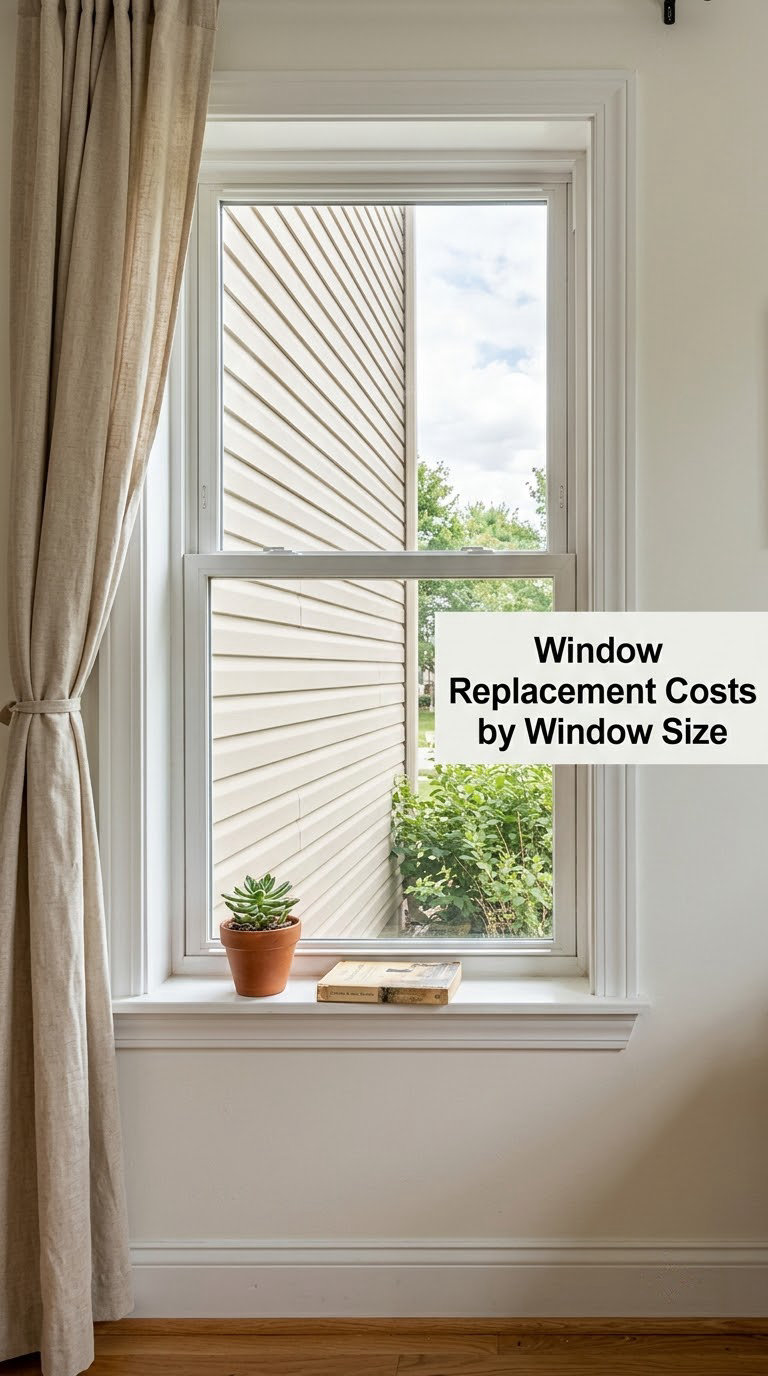
Size moves the price more than most people expect, because a window is priced by square footage of glass and every step up in size adds frame, glass area, and labor time. Home Depot’s published service ranges run from 478 dollars for a standard double-hung up past 6,000 dollars for a shaped unit, which tells you how wide the spread gets once you leave the common sizes.
| Window opening | Typical installed cost per window | Where you see it |
|---|---|---|
| Small standard opening, up to 3 square feet | 500 to 1,100 dollars | Bathrooms, half baths, small bedrooms |
| Standard single-hung or double-hung | 600 to 1,400 dollars | Bedrooms and living rooms in most homes |
| Large double-hung or wide picture window | 900 to 2,000 dollars | Living rooms, front elevations |
| Casement or awning | 600 to 3,000 dollars | Vintage homes, high ceilings, egress-required rooms |
| Bay or garden window | 2,500 to 6,500 dollars | Projecting front or back walls |
| Arched, elliptical, or clipped corner | 1,200 to 4,000 dollars | Historic and Craftsman homes |
How the cost scales with the number of windows
Here is the ladder most homeowners find useful, because it answers the question readers ask most: what does a given count actually cost? Low figures assume standard sizes and simple access. High figures assume custom work, upper stories, and framing repair.
| Number of windows | Lower end | Typical range | Upper end |
|---|---|---|---|
| 5 windows | 3,000 dollars | 4,000 to 7,000 dollars | 9,000 dollars |
| 7 windows | 4,500 dollars | 6,000 to 11,000 dollars | 15,000 dollars |
| 10 windows | 6,500 dollars | 9,000 to 15,000 dollars | 20,000 dollars |
| 14 windows | 9,000 dollars | 13,000 to 21,000 dollars | 28,000 dollars |
| 20 windows | 13,000 dollars | 18,000 to 30,000 dollars | 42,000 dollars |
A standard single-story home usually carries 8 to 15 openings, so most people land between the 7-window and 14-window rows. Pella’s whole-house guidance puts a full single-story replacement between 4,500 dollars and the low tens of thousands depending on count and product tier.
Removal difficulty is the other half of the size question. A ground-floor window with siding that comes off in one piece is the easy case. A second-story opening needs a lift, exterior platform, and someone to catch and bag the old unit, and that setup is regularly billed as a separate line.
Window Replacement Costs by Material
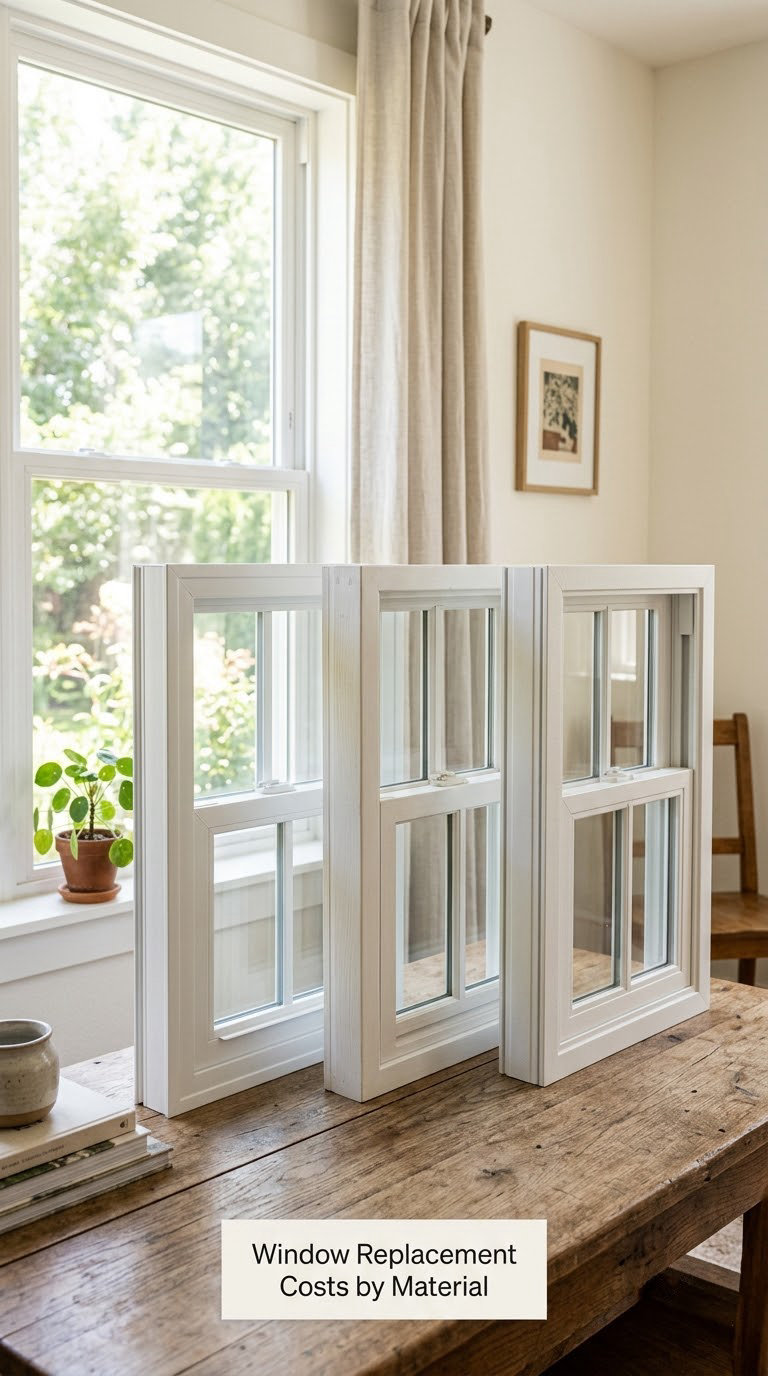
Material sets the price band and the maintenance story. Realtor.com’s published ranges put vinyl at 300 to 800 dollars each, wood at 700 to 1,200, and fiberglass or composite at 800 to 1,500 or more, which lines up with what installers quote in most markets.
| Frame material | Installed cost per window | Main benefit | Main tradeoff |
|---|---|---|---|
| Aluminum | 400 to 1,000 dollars | Thin profile, large glass area, low weight | Condensation and heat transfer on cold frames, dents easily |
| Vinyl | 300 to 900 dollars | Lowest upkeep, no repainting, good insulator | Weld lines can look plastic; expands and contracts more than wood |
| Wood | 700 to 1,500 dollars | Paints or stains like trim, holds a fine profile, repairable | Needs repainting or restaining every few years |
| Fiberglass | 800 to 1,500 dollars | Stable in heat and cold, strong sash, paintable | Higher cost, fewer style options |
| Composite | 800 to 1,600 dollars | Wood interior with a durable exterior, good insulation | Premium pricing for many homes |
Vinyl earns its place on most houses because it holds its shape, needs no finish work, and gives you the most glass area for the money. Fiberglass and composite earn their higher price on a large opening where a vinyl frame can soften in summer, or on a wall you want to paint instead of leave white.
Wood is worth the extra when trim is the point: a Victorian front elevation, a Craftsman with real muntins, or a room where the window is the feature. It is the wrong call in coastal and humid climates unless you are committed to the paint cycle.
Glass package matters more than most buyers plan for. Double-pane with a low-e coating is the sensible default. Single-pane is only for a cheap outbuilding. Triple-pane and laminated or impact-resistant glass add real money per window and pay off in specific places, like a bedroom on a road or a house in a hurricane zone.
What Changes the Cost to Replace Windows in a House?
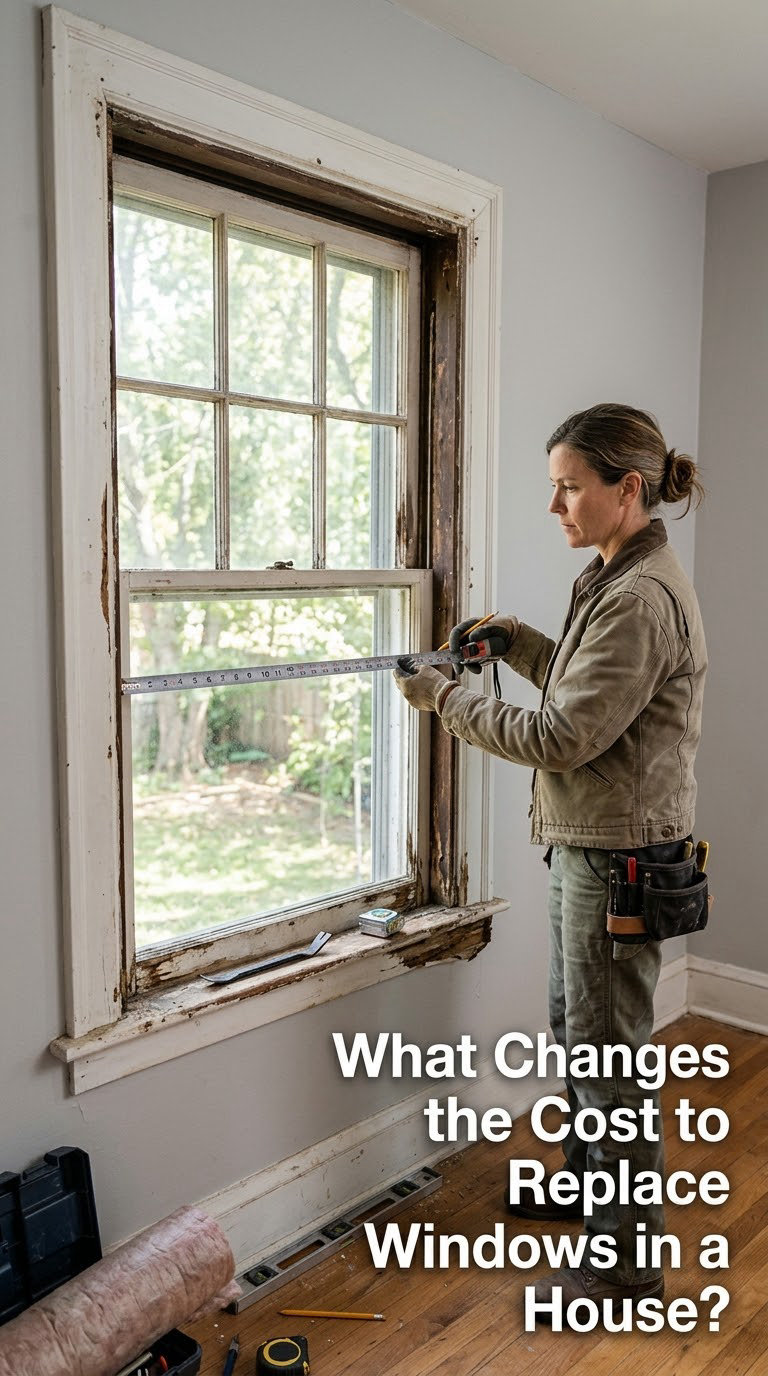
This is the section that explains why two quotes for the identical window list can differ by thousands. Here are the drivers that move the total most, roughly in order of how often they catch people out.
- Number of openings. Larger jobs get package pricing, but only when they happen in one visit. Splitting a project into two phases usually costs more per window overall.
- Custom sizes. Anything not a standard rough opening gets made to order, which adds weeks and money. Old homes are full of odd sizes.
- Insert versus full-frame. An insert sits inside the existing frame and is cheaper and faster. A full-frame replacement takes the frame, sash, and trim out, which is the right call when the frame or sill is rotted.
- Frame condition. Water damage in the jamb or sill is the single most common budget-breaker. Nobody can price it honestly from outside, and it shows up after the old unit is out.
- Glass package. Going from single to double-pane, adding low-e, or moving to triple-pane changes every line on the quote.
- Second-story access. A lift, scaffold, or exterior platform can add several hundred dollars and show up as its own line item.
- Trim and interior repair. Drywall, baseboard, and sill patching after removal is often quoted as an extra, sometimes by the hour.
- Permits and inspection. Permits are usually modest, often a few hundred dollars at the county level, and some jurisdictions require a licensed installer to pull them.
- Disposal. Some companies include hauling the old windows away. Others bill per window, and a few charge more for a second-story removal.
- Historic district or HOA rules. Approved material lists and required profiles restrict your options, and review boards add lead time before work starts.
- Regional pricing. Labor rates, permitting, and even how much prep a crew will do vary widely by market.
On that last point: these are US national ranges. Labor and permitting in a high-cost coastal market can run well above them, and a rural crew can come in under. Ask for a quote that names your ZIP code, and treat any national average as a starting point rather than a promise.
Replacement vs. Repair: Which Option Is Worth It?
Repair wins when the frame is sound and the problem is a component. A new sash, new hardware, a reglazed pane, or fresh weatherstripping can buy years for a fraction of replacement, especially on a solid-wood or early aluminum unit.
| Situation | Better call | Why |
|---|---|---|
| Broken crank, lock, or hinge on a good frame | Repair | Hardware and sash kits are inexpensive and quick |
| One fogged pane in a double-pane unit | Repair if the frame is good | You can swap the insulated glass unit without a full replacement |
| Drafts around a solid frame | Repair | New weatherstripping and caulking fix most air leakage cheaply |
| Rot in the sill, jamb, or frame | Replace | Water damage spreads to sheathing and framing; patching is temporary |
| Single-pane glass in a cold climate | Replace | Insulation gain is the whole point and cannot be reached any other way |
| Road noise, a bedroom on a busy street | Replace | Thicker or laminated glass handles noise better than any repair |
| Planned sale within a year or two | Repair, then revisit | Buyers do not pay a premium for windows they consider a normal upgrade |
The break-even question is straightforward. If a repair quote comes in under roughly a third of the replacement cost per window and the frame is not decaying, repair is the sensible move. Realtor.com’s data also suggests return on investment for full replacement typically lands in the 50 to 75 percent range, with one source claiming as much as 85 percent, which is a strong argument for doing the whole house at once rather than a few units at a time.
How to Budget for a Whole-House Window Replacement
Start by counting openings, not bedrooms. Walk the house and write down every window and door unit, marking standard sizes, odd sizes, and which ones are up high. That list is the only accurate basis for a budget.
Then run the arithmetic:
- Multiply the count by your per-window range. Use 500 to 1,100 dollars for standard ground-floor inserts, and add a premium row for casements, bays, or shaped units.
- Add your access premium. Count the second-story and above-the-kitchen openings, and add several hundred dollars each for lift setup and exterior access.
- Add a repair allowance. On a home over 30 years old, budget for jamb and sill work. Call it 150 to 400 dollars per opening, and treat it as a reserve rather than a bill.
- Add the soft costs. Permits, disposal, interior trim patching, and any HOA or historic review fees. A few hundred to a couple thousand dollars total.
- Hold back 10 percent. This Old House’s survey found 27 percent of customers paid more than they were quoted. That number is your contingency, not you being pessimistic.
All at once or in phases? Doing the whole house in one visit is cheaper per window because the crew sets up once, disposal is efficient, and most sellers offer package pricing at 10 openings or more. The same survey noted homeowners are actually shrinking projects from around 9 windows to 7, mostly because of budget pressure.
Staging still makes sense if you are financing the work or the house has access problems. Just expect the per-window price to run higher and the total to exceed what a single-visit quote would have quoted.
If your project is part of a broader refresh this year, our guides on replacing an air conditioner filter and replacing a bathtub drain elbow cover the maintenance side of keeping an older house tight.
How to Compare Window Replacement Quotes
Get three written, itemized estimates on the same scope, and compare them line by line rather than comparing the total on page one. Forum threads on Reddit and Houzz make the same point repeatedly: homeowners have posted quotes for the same 13-window job at 10,300 dollars and again at 10,800 dollars, and another pair of quotes for an identical 14-window scope spanning 7,000 to 30,000 dollars.
Line by line, check for these things:
- Window count, sizes, and locations. If one estimate lists 14 openings and another lists 12, you are not comparing the same project.
- Manufacturer and series. Compare like for like. One homeowner reported roughly 800 dollars per window from one company and nearly 2,000 from another for the same list, and a Marvin rep quoted about 3,000 to 3,500 dollars per window on a small casement job.
- Glass package. Double-pane with low-e should be spelled out, not implied.
- Labor scope. Ask whether removal, disposal, shimming, insulation, and securing are included. Labor-only rates for that work commonly run 150 to 250 dollars per window in a clean opening.
- Second-story setup. Look for lift, scaffold, or area-protection line items. A hurricane-rated job of 14 windows and a sliding door ran 18,000 to 22,000 dollars, with setup called out separately.
- Trim, interior patching, and disposal. Each should have its own line, even if small.
- Permits and inspection. Who pulls them, and what the fee is.
- Warranty. Manufacturer product warranty, plus a separate workmanship warranty from the installer. These are not the same thing.
- Payment schedule. A deposit of 30 to 50 percent is normal. Full payment up front is a reason to keep looking.
- References and insurance. Ask for two recent jobs and proof of liability and workers’ compensation coverage.
Watch the pressure tactics too. One homeowner was offered 10 percent off only if they signed before the rep finished the estimate. A discount that expires in an hour is not a discount.
The real upper bound worth knowing about: a Pella Impervia casement job of 43 windows plus two doors in Central Virginia came in at 62,000 dollars installed. Nobody budgets for that by accident. It happens when the product tier, the count, and the house all sit at the high end, and it is exactly why you should price a project before you assume it is ordinary.
DIY or Hire a Window Installer?
Some window work is genuinely reasonable for a skilled homeowner. Replacing an interior sash, swapping hardware, or installing a storm insert on a first-floor opening needs basic tools and a few hours. Buying the windows yourself and hiring a labor-only crew can also work, and it is worth asking about.
| Task | DIY is realistic | Hire a licensed pro |
|---|---|---|
| Interior sash or hardware swap | Yes | Optional |
| First-floor insert replacement | Possible, if you are careful with flashing | Recommended on a house you plan to sell |
| Full-frame replacement | Rarely | Yes |
| Second-story openings | No | Yes, with equipment and fall protection |
| Structural changes, enlarging an opening | No | Yes, permit required |
| Bay or shaped windows | No | Yes |
| Homes built before 1978 with suspect materials | No | Yes, with a lead-safe crew |
The line is not skill, it is consequences. A window that is flashed wrong lets water into the wall behind it, and the damage shows up years later as rotted sheathing. Anything above the first floor, anything that changes the size of an opening, and anything on a home old enough to have lead paint belongs with a licensed installer who can pull a permit if one is required.
Labor-only work in older homes is quoted around 150 to 250 dollars per window, and runs higher where framing is rotted. On a 40-year-old house, that framing is often the real cost driver, not the window.
While the crew is in the house, it is an efficient time to handle a related fix. Our guide to replacing a two-handle shower valve covers a job with similar access and cleanup planning.
Frequently Asked Questions
How much does it cost to replace one window in a house?
A standard ground-floor window replacement typically runs 500 to 1,100 dollars installed, according to This Old House’s 2026 survey of 1,000 window customers, which averaged 517 dollars per window. Add 150 to 250 dollars in labor if a company bills removal and installation separately, and more for second-story access, custom sizes, or rotted framing discovered after removal.
What is the cheapest type of window to install?
Vinyl is the cheapest option, running about 300 to 800 dollars installed per Realtor.com’s published ranges, with no repainting or staining required afterward. Aluminum is close behind and gives you a thinner frame and more glass area for the same money. Skip single-pane glass even on a cheap job; double-pane with a low-e coating is the value pick that most buyers settle on.
Can I replace old windows without removing the existing frame?
Yes. An insert window fits inside the existing frame and keeps the surrounding trim, which is faster, cheaper, and the most common approach. A full-frame replacement takes out the frame, sash, and trim and is the better choice when the sill or jambs are rotted or you want a different frame material. Your installer can tell you which one your opening needs once the old unit is out.
How long does it take to replace all the windows in a house?
A typical crew replaces one window in one to two hours, so a 10-window single-story project usually takes one to two working days. Add time for second-story access, exterior platform setup, and interior drywall patching. A 20-window two-story house is usually a three to five day job. Order custom-sized units well ahead, since made-to-order windows add lead time before installation can start.
Will new windows reduce energy bills?
Usually, and the gain comes mostly from glass, not the frame. This Old House’s survey found 36 percent of double-pane buyers reported saving 25 to 49 dollars a month. In a cold climate, moving from single to double-pane with a low-e coating is the change that matters most. Be skeptical of anyone promising a specific payback figure on the spot; savings depend on your climate, fuel type, and how many windows you are replacing.
Should I replace all house windows at once or one at a time?
All at once costs less per window because the crew sets up once, disposal runs efficiently, and package pricing usually starts around 10 openings. The same survey found homeowners are shrinking projects from about 9 windows to 7 anyway, mostly on budget. Staging makes sense if you are financing the work or access is difficult, but expect a higher per-window price and a larger total than a single-visit quote.
Where to Start With Your Window Budget
Count your openings, then price the worst two or three rather than all of them. If the second-floor casements or the bay drive most of the total, a phased plan starting with the main-floor doubles usually gives you the comfort and energy gain for the least money per window replaced.