
Cost to Insulate an Attic in October 2026: Proven Guide
The cost to insulate an attic runs about 1 to 7 dollars per square foot, which puts a typical 1,000 to 1,500 square foot attic somewhere between 1,500 and 3,500 dollars all in. Topping up a thin layer of blown-in cellulose sits at the low end. Replacing contaminated insulation in a cramped, hard-to-reach space sits at the high end.
You will see three different national averages quoted online, and none of them are wrong. HomeGuide puts the average job at 1,000 to 2,700 dollars, Bob Vila cites 1,500 to 3,500 dollars with a 2,500 dollar average from Angi and HomeAdvisor data, and Forbes Home quotes 1 to 7 dollars per square foot with materials included. Each one assumes a different attic, and this guide breaks down which attic produces which number.
Contents
It is also the cheapest meaningful energy upgrade most homeowners will ever do. Federal energy efficiency guidance puts the whole-home ceiling at roughly 20 percent, and attic work usually lands in the 10 to 20 percent range on your heating and cooling bills. If you are planning this in autumn, order materials now, since contractors book solid from October through January.
Cost to Insulate an Attic at a Glance
The table below covers the most common residential case: a vented attic with floor joists, no existing insulation removal, and a target of roughly R-38 to R-49. Ranges reflect published 2026 figures from HomeGuide, Forbes Home, Bob Vila, and retailer cost guides, plus real quotes shared by homeowners.
| Attic size | DIY materials only | DIY including blower and vacuum rental | Contractor installed |
|---|---|---|---|
| 500 sq ft | 350 to 700 dollars | 600 to 1,100 dollars | 1,500 to 3,000 dollars |
| 700 sq ft | 450 to 900 dollars | 700 to 1,300 dollars | 1,800 to 3,500 dollars |
| 1,000 sq ft | 600 to 1,300 dollars | 900 to 1,700 dollars | 2,200 to 4,500 dollars |
| 1,200 sq ft | 750 to 1,500 dollars | 1,050 to 1,900 dollars | 2,500 to 5,200 dollars |
| 1,500 sq ft | 900 to 1,900 dollars | 1,200 to 2,300 dollars | 3,000 to 6,000 dollars |
| 2,000 sq ft | 1,200 to 2,500 dollars | 1,500 to 2,900 dollars | 3,800 to 7,500 dollars |
Cost per square foot vs total project cost
Per-square-foot pricing flatters small attics. Most contractors apply a minimum project charge of 1,500 to 2,000 dollars, so a 500 square foot attic and a 700 square foot attic often cost nearly the same to have done professionally. This is the single biggest reason small-attic quotes look inflated, and the main reason DIY starts looking sensible below about 1,000 square feet.
Figures were checked against published cost guides in October 2026. Regional labor rates, local material pricing, and the condition of what is already up there move the final number more than the material choice does.
How Much Does Attic Insulation Cost by Material?
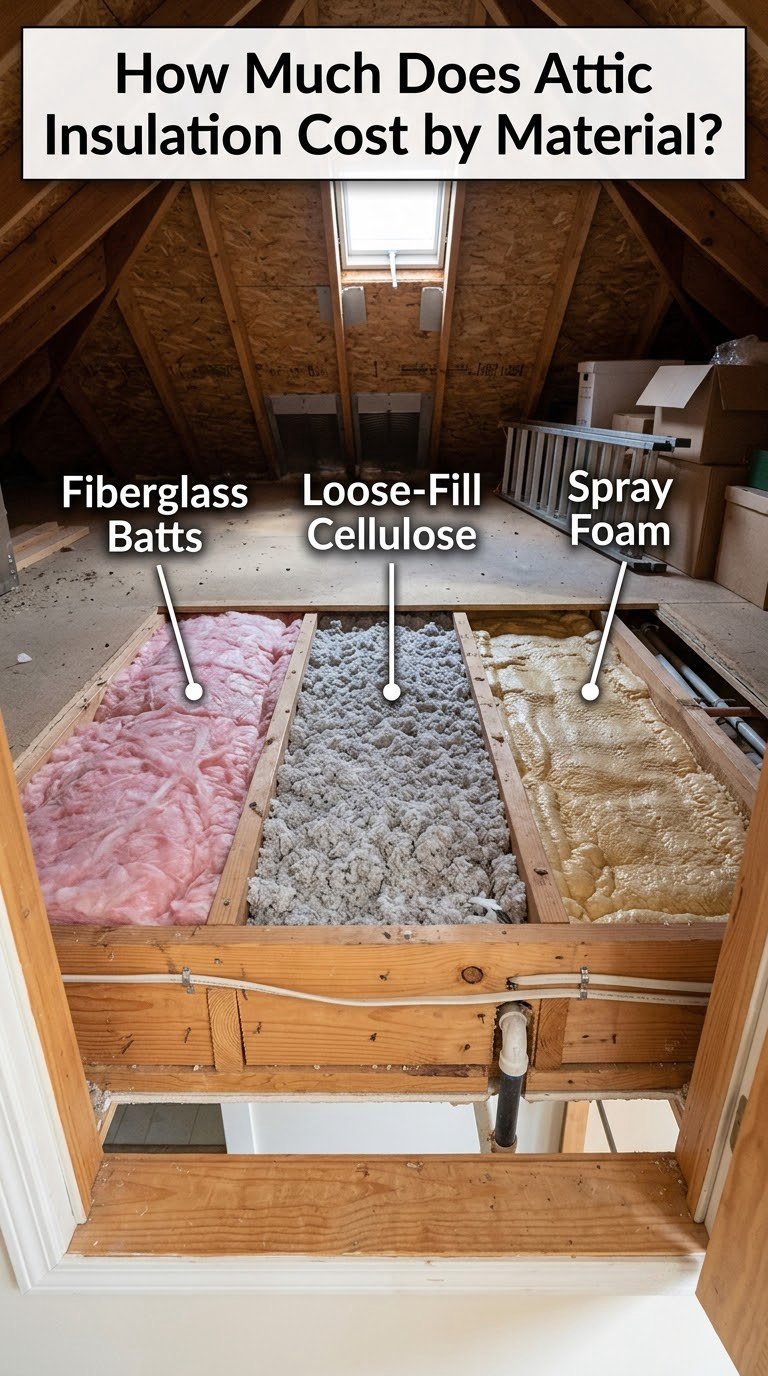
Material choice moves installed cost roughly two to three times over, which is far more than most first-time buyers expect. A cellulose attic lands around 2 to 4 dollars per square foot installed. The same attic in closed-cell spray foam can run 3 to 5 dollars per square foot, and structural panels for new construction reach 4 to 7 dollars per square foot.
| Material | R-value per inch | Material cost per sq ft | Installed per sq ft | Best for |
|---|---|---|---|---|
| Fiberglass batts | 3.0 to 3.8 | 0.60 to 1.10 dollars | 2 to 4 dollars | Standard attics with clear joist bays and easy access |
| Loose-fill cellulose | 3.2 to 3.8 | 0.60 to 1.20 dollars | 2 to 4 dollars | Retrofit over existing insulation and irregular framing |
| Blown-in fiberglass | 2.5 to 3.0 | 0.50 to 1.00 dollars | 2 to 3.50 dollars | Fast top-ups and the lowest material price per square foot |
| Spray foam, open cell | 3.5 to 3.8 | 1.20 to 2.00 dollars | 3 to 5 dollars | Air sealing and moderate climate zones |
| Spray foam, closed cell | 6.5 to 7.0 | 2.00 to 3.00 dollars | 3 to 5 dollars | Cold zones, vaulted ceilings, low roof decks |
| Structural panels | Full wall or roof assembly | Not applicable to retrofit | 4 to 7 dollars | New construction only |
Spray foam is priced by the board foot, which is 1 square foot of insulation 1 inch thick. A 1,000 square foot attic at R-49 with closed-cell foam takes roughly 490 board feet. Homeowners comparing quotes should ask for the board foot count on the invoice, since it is the easiest number to verify and the easiest one to inflate.
Fiberglass batts versus cellulose
Batts are the traditional choice because they are cheap and go in fast between joists. They need a complete, unobstructed bay, though, which most older attics do not have. Cellulose blows into any shape and settles around wiring and blocking, which is why it is the default recommendation for retrofits. If you want to narrow the material question first, our guide to the best insulation types for attics walks through the performance differences.
Cellulose carries one honest drawback: it settles. A dense-pack top-up job is cheaper than full removal and replacement, and many contractors charge full removal pricing anyway. Ask whether the settling warranty is written into the contract, and how long it lasts.
Spray foam at the floor or the roof deck
Spraying the attic floor seals air leaks and lets you keep ventilation. Spraying the underside of the roof deck creates a conditioned space and cuts heating costs more, but it requires the roof to be in good shape first. Roof leak repairs run 500 to 1,200 dollars before any foam goes on. On a roof with unresolved leaks, foam traps moisture against the deck and rots it.
Pros and cons of each material
| Material | Pros | Cons |
|---|---|---|
| Fiberglass batts | Lowest installed cost, widely available, easy to cut | Needs clear bays, gaps at the eaves, degrades over time |
| Loose-fill cellulose | Fills irregular spaces, good R-value, settles over time, recycled content | Dust during install, requires a blower, settles and needs top-ups |
| Blown-in fiberglass | Cheapest per bag, light, easy cleanup | Lower R-value per inch, degrades fastest of the three |
| Spray foam | Seals air as it installs, resists moisture, adds structural strength | Highest cost, must be sprayed by trained crews, degrades if exposed to UV before being covered |
| Reflective foil | Blocks radiant heat in hot climates, cheap | Does not add meaningful R-value, loses performance with dust on the foil |
What Changes the Cost of Attic Insulation?
Once you have a per-square-foot number, nine factors decide the invoice. Most quotes differ by two to three times over for the exact same attic, and nearly all of that spread traces back to the items below.
- Attic square footage. Footprint at the ceiling line, not roof footprint. Roughly 70 percent of a two-story home’s conditioned square footage applies.
- Target R-value. Moving from R-38 to R-60 can nearly double material cost in cold zones.
- Existing insulation condition. Clean, evenly settled cellulose can be topped up. Contaminated or compressed vermiculite gets removed first.
- Access. A hatch-and-ladder attic costs far less than one you reach through a bedroom closet. Walkable decking adds cost and adds future value.
- Ventilation condition. New roof vents run 200 to 700 dollars each and baffles run 2 to 3 dollars each.
- Air sealing. Ranges from 250 to 750 dollars for a simple job up to 3,000 dollars for a full attic. Sealing before insulating is the order that pays off.
- Removal and disposal. 1 to 2 dollars per square foot, or 1 to 1.50 dollars per square foot on a full replace job that runs 2 to 8.50 dollars per square foot.
- Hazards. Asbestos testing runs 250 to 750 dollars with removal at 20 to 65 dollars per square foot. Mold remediation runs 1,500 to 3,500 dollars and pest inspections 40 to 150 dollars.
- Location. Regional labor rates swing 2 to 3 times over. Homeowners in Ottawa quoted 3,000 to 6,000 dollars for a little over 1,000 square feet, while one Northern Virginia job was quoted near 8,000 dollars for 2,000 square feet.
A few of those deserve expansion. Air sealing gets treated as an upsell by some homeowners and as the most valuable line item by others, and the honest answer is that it depends. Blowing insulation over a leaky attic without sealing first traps escaping heated air, which is how moisture ends up in your sheathing. Full replacement of attic insulation runs 2 to 8.50 dollars per square foot versus 1 to 2 dollars for removal alone.
Other work that shows up on estimates: attic cleaning and preparation at 100 to 300 dollars, an inspection at 100 to 300 dollars, an energy audit at 145 to 420 dollars, humidity repairs at 100 to 1,000 dollars, and roof leak repairs at 500 to 1,200 dollars. If you are converting the space into living quarters rather than insulating the floor, you are looking at a different project entirely, closer to the scope in our attic bathroom design ideas than to insulation alone.
Do not forget rebates. The federal 25C energy efficiency credit has applied to qualifying insulation work and continues to draw questions, since eligibility has shifted with recent federal legislation. Verify current status with the IRS and check your state utility for rebates before you sign anything.
DIY vs. Hiring a Professional
On paper, DIY wins by a wide margin and the gap grows as the attic gets smaller. Renters on r/DIY reported spending roughly 1,000 to 1,500 dollars in materials for about 2,000 square feet against an 8,000 dollar quote. A loose-fill buyer on r/HomeMaintenance counted 20 bags at about 62 dollars each to hit R-38 over 1,000 square feet, with a free machine rental attached to the purchase.
| Factor | DIY | Professional |
|---|---|---|
| 1,000 sq ft installed cost | 900 to 1,700 dollars | 2,200 to 4,500 dollars |
| Equipment needed | Insulation blower, vacuum, rented or purchased | All included |
| Time on site | Two long days for 1,000 sq ft | 6 to 8 hours for an average attic |
| Labor rate | Your weekend | About 70 dollars per hour, or 1.50 to 3.50 dollars per sq ft |
| Air sealing | Slow, meticulous, often skipped | Included or itemized |
| Warranty | None | Written settling warranty if offered |
| Risk | Walking joists, dust, blocked vents | None to the homeowner |
The catch is that blown-in insulation is genuinely safe to install in a typical unfinished attic, as long as three rules hold. Protect the soffit vents, because burying them is the mistake that shortens shingle life and drives ice dams. Walk the joist tops or lay planks, because the drywall underneath is not a walking surface. Wear a respirator and eye protection, because cellulose dust is unpleasant at best.
Hire a contractor when the attic is contaminated, when you need air sealing done properly, when you have vaulted ceilings or complex framing, when you are spraying foam, or when your home predates 1980 and asbestos testing has not been done. Testing before anyone opens a wall is far cheaper than removal after.
How to Get an Accurate Attic Insulation Estimate
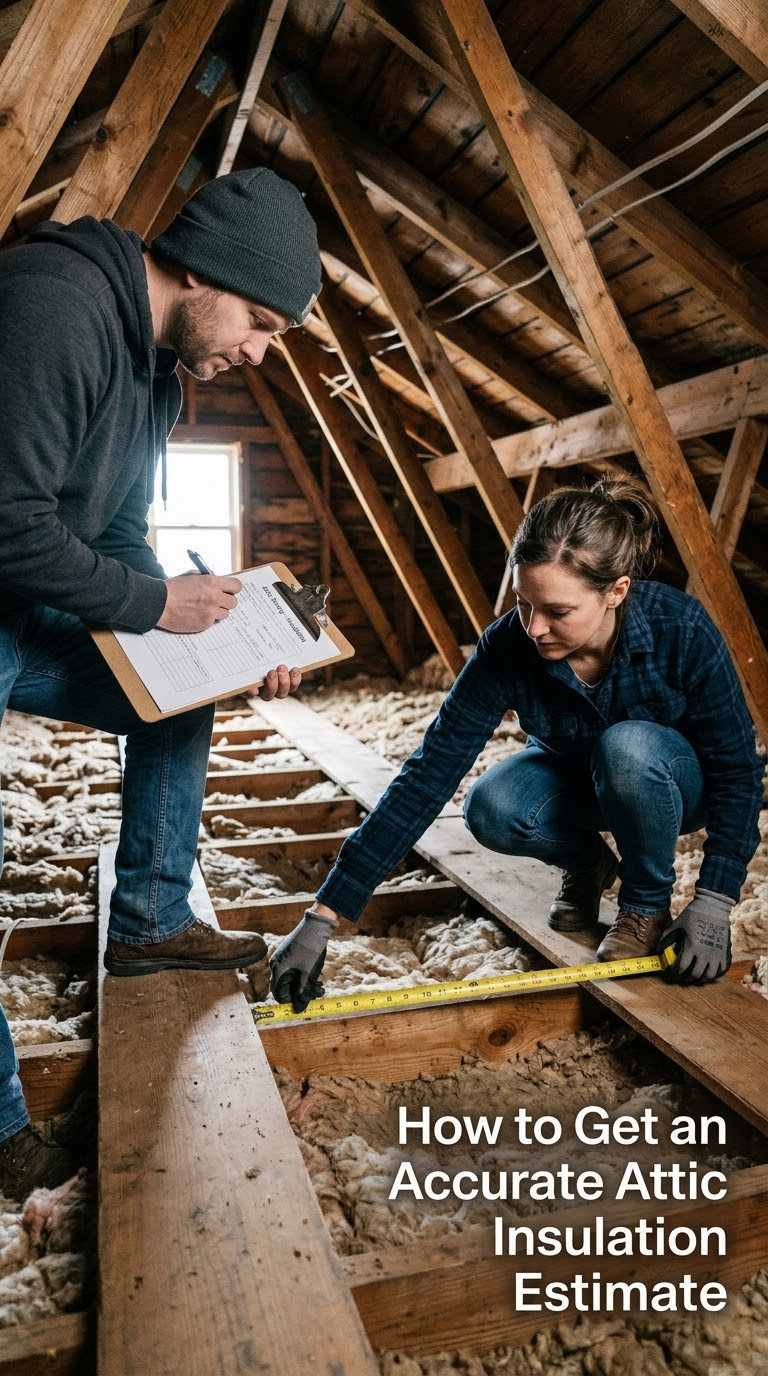
Most bad quotes start with a bad measurement. Work through these steps before you contact anyone, and you will filter out the vague numbers fast.
1. Measure the floor, not the roof
Measure length and width of the attic floor at the joists and multiply. A 40 by 32 foot attic is 1,280 square feet, which is the job behind the three quotes homeowners on r/HomeImprovement reported at 2,500, 4,300, and 5,600 dollars for what was supposed to be the same scope.
2. Check what is already up there
Look at depth, uniformity, and smell. Even, clean, roughly 6 to 8 inches of loose fill means a top-up. Grey, matted, or vermiculite material means removal, and removal is a separate line item at 1 to 2 dollars per square foot.
3. Settle the R-value target
Cold-climate attics generally target R-49 to R-60, temperate zones R-38 to R-49, and mild zones R-38. Going higher than the code minimum in a heating-dominant climate has thin returns once you pass the local target, which is why over-insulating is money left in the attic.
4. Pick a material before you collect quotes
Decide between a cellulose top-up, a full blown-in replacement, and closed-cell spray foam before anyone shows up. Otherwise you are comparing three different scopes and calling the spread a price difference.
5. Ask for itemized written quotes
Every quote needs separate lines for materials by bag or board foot, labor rate per square foot or per hour, removal and disposal, air sealing, baffles and vents, and any accessory. One itemized estimate shared on r/Insulation broke down as 2,880 dollars of insulation, 150 for baffles, 150 for air sealing supplies, 75 for rodent proofing, 300 for a weekend vacuum rental, and 100 for bags, on a 6,884 dollar contract price.
That gap is the whole story. Materials ran about 3,655 dollars and the contract came to 6,884, which puts labor and overhead at roughly 1.79 dollars per square foot on a 1,600 square foot attic. Nothing dishonest there, but you cannot compare that quote to a lump-sum price without normalizing the line items first.
6. Normalize before you decide
Line up every quote in the same columns and divide labor, materials, and extras separately. If one quote includes air sealing and baffles and another does not, the cheaper one is not cheaper. Ask each contractor to state the labor rate openly and confirm whether the price includes removal, disposal, and vent work.
7. Budget the accessories separately
Keep a 10 to 15 percent buffer for a hatch cover, extra baffles, an attic door upgrade, or a mold or pest issue discovered mid-job. Then check whether your state or utility offers a rebate before you finalize the number.
Frequently Asked Questions
How much does it cost to insulate a 1,000-square-foot attic?
A 1,000 square foot attic costs about 2,200 to 4,500 dollars to have insulated professionally, or roughly 900 to 1,700 dollars if you do the labor yourself and rent the blower and vacuum. Cellulose and blown-in fiberglass land at the lower end, spray foam at the upper end. Removal of old insulation adds 1 to 2 dollars per square foot.
What is the cheapest type of attic insulation?
Loose-fill fiberglass is the cheapest per bag, typically 0.50 to 1.00 dollars per square foot in material. Blown-in cellulose is close behind and delivers a higher R-value per inch, which is why most contractors recommend it. Fiberglass batts are the cheapest installed option because labor is fast, though they need unobstructed joist bays to work well.
Do I need to remove old attic insulation before installing new insulation?
Only if it is contaminated, wet, matted, or unevenly settled. Clean and even existing insulation can usually be topped up with another 4 to 6 inches for a fraction of full removal pricing. Removal runs 1 to 2 dollars per square foot, so a full replace job lands between 2 and 8.50 dollars per square foot depending on material.
How much attic insulation do I need for a cold climate?
Cold regions generally call for R-49 to R-60, which usually means roughly 14 to 16 inches of cellulose or about 8 to 10 inches of closed-cell spray foam. Temperate zones land at R-38 to R-49 and mild zones at R-38. Your local energy code sets the minimum, and going well past it in a heating-dominant climate gives thin returns.
Is blown-in insulation safe to install in an unfinished attic?
Yes, in a typical unfinished attic with proper protection. Wear a respirator and eye protection because cellulose dust irritates, walk the joist tops or lay planks rather than the drywall, and keep every soffit vent clear. Blowing insulation over the vents is the most common DIY error and can shorten shingle life and cause ice dams.
Should I insulate the attic myself or hire a contractor?
DIY makes sense on a small attic with clean existing insulation and straightforward access, where the material cost runs 600 to 1,300 dollars against a 2,200 dollar-plus contractor price. Hire a pro when you need removal, air sealing, spray foam, vaulted ceilings, or asbestos testing. Below about 1,000 square feet, the 1,500 to 2,000 dollar minimum project charge makes DIY far more attractive.
Start by walking into the attic with a tape measure and a flashlight, not by calling a contractor. Measure the floor, look at what is already up there, and decide between a top-up and a full replacement. Those three answers tell you more about your final price than any material comparison will.
