
Cost to Replace a Roof and What Affects It: 2026 Price Guide
The cost to replace a roof in the US runs about 9,500 dollars on average, with most homeowners paying somewhere between 5,800 and 12,800 dollars. Plan on 4 to 11 dollars per square foot, and expect labor to eat roughly 60 percent of that total.
That single average hides a lot. A simple asphalt shingle job on a 1,200 square foot ranch and a slate roof on a steep 3,000 square foot house are priced by completely different rules, and the same house can draw quotes that are 13,500 dollars apart.
Contents
Here is what moves the number, and how to work out a realistic budget before anyone hands you a contract.
Roof Replacement Cost by Size and Material
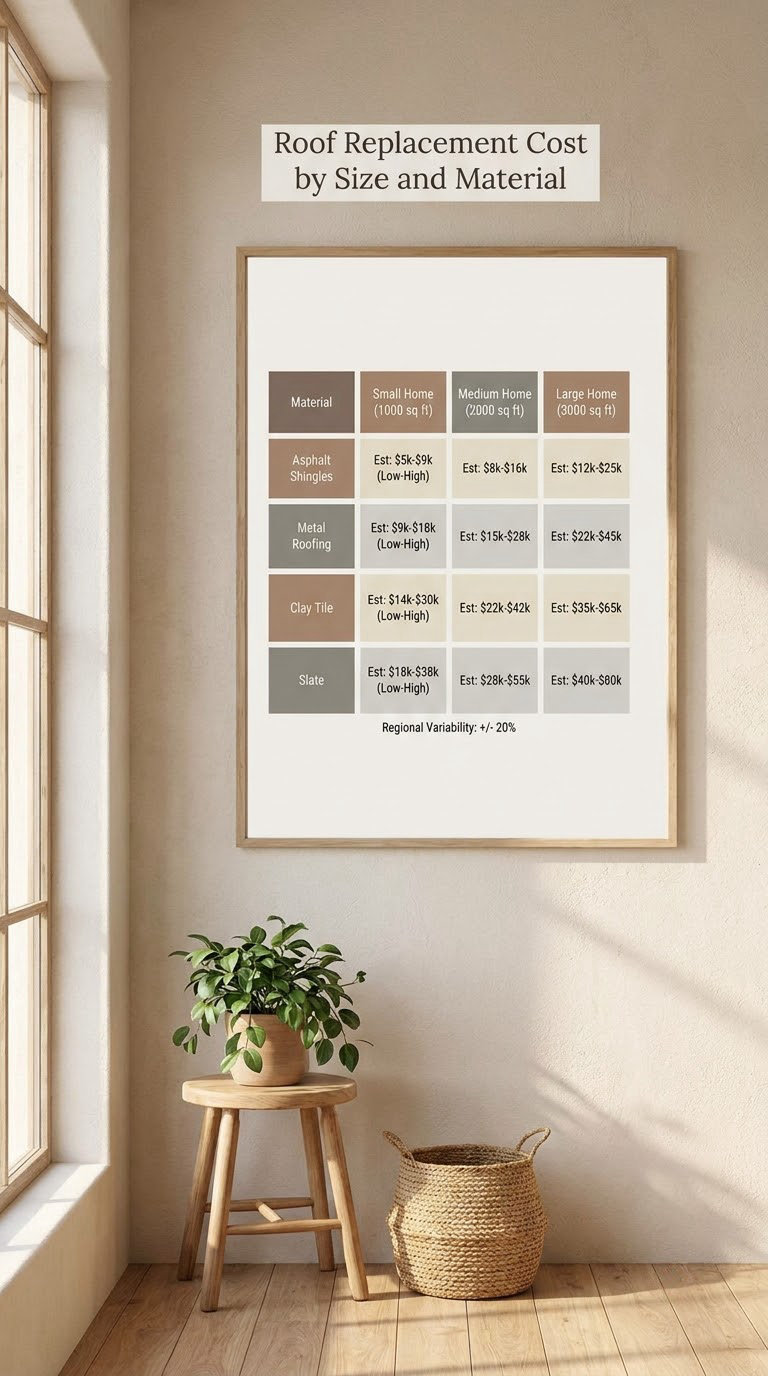
Roofers price by the roofing square, which is 100 square feet of roof surface. A 1,700 square foot house usually has 2,000 or more square feet of actual roof once you account for slope and overhang, so it takes about 20 squares plus a waste factor of 10 to 12 percent.
The table below assumes architectural asphalt shingles, a standard pitch, one layer of tear-off, and average US labor rates. Costs climb in high-cost metros and in snow or hurricane regions, and drop in rural areas with soft competition.
| Home size | Approx. roofing squares | Typical total cost |
|---|---|---|
| 1,000 sq ft | 13-14 | 5,800-8,500 dollars |
| 1,200 sq ft | 15-16 | 7,000-10,500 dollars |
| 1,500 sq ft | 18-20 | 8,500-13,000 dollars |
| 1,700 sq ft | 21-23 | 10,000-15,500 dollars |
| 2,000 sq ft | 25-27 | 12,000-19,000 dollars |
| 2,400 sq ft | 30-32 | 15,000-24,000 dollars |
| 3,000 sq ft | 38-40 | 19,000-30,000 dollars |
Metal, tile and slate push those totals much higher. A 2,000 square foot home in California with a standing seam metal roof can run well past 30,000 dollars, while the same footprint re-roofed with three-tab asphalt shingles usually lands between 12,000 and 19,000 dollars.
Homeowners in r/Roofing have posted the same math from their own projects. One estimate came to roughly 1,100 dollars per roofing square, another 34,000 dollar quote covered a 20-square roof, and a third homeowner paid 17,000 dollars for 41 squares, or about 415 dollars per square.
Per square, not per square foot. Mixing those two units is the single most common reason people think a quote is wildly out of line when it is perfectly normal.
Cost to Replace a Roof and What Affects It
Cost to replace a roof and what affects it comes down to ten things, and most quotes move because one of them changes. Here is the list to check before you assume a bid is padded.
How do roof size, pitch and stories change the price?
Roof area is the driver. Every roofing square added multiplies both material and labor, so a 3,000 square foot house costs roughly three times what a 1,000 square foot house costs.
Pitch adds a premium on top of area because crews work slower and need more fall protection. A 6:12 slope is routine. A 10:12 or 12:12 slope on a three-story house can add 30 to 50 percent, and dormers, valleys and multiple roof planes add labor hours that do not show up in a simple area calculation.
What other factors change the total?
- Material. Asphalt shingles are the cheapest mainstream option. Metal runs roughly two to four times the asphalt total, and slate or tile can reach five times.
- Tear-off and deck condition. A second layer of shingles has to come off and be disposed of. Soft or rotten decking underneath gets replaced at roughly 2.20 to 3.00 dollars per square foot.
- Underlayment and ice barrier. Synthetic underlayment adds about 1.50 to 2.10 dollars per square foot. Ice and water barrier along eaves and valleys costs more and is required in snow country.
- Flashing and penetrations. New flashing runs about 9 to 11 dollars per linear foot. Each pipe boot or vent replacement runs 63 to 85 dollars.
- Location and labor market. Coastal California, the Northeast and major metro areas price far higher than rural southern states for the same roof.
- Permits and code requirements. Permit fees are usually modest, but high-wind and impact-rated codes in hurricane zones raise the material spec and the price.
- Roof complexity. Skylights, chimneys, satellite mounts and solar panels each add a line item and a crew hour.
- Fascia and soffit work. Rotted fascia boards are often discovered mid-job and priced separately.
- Upgrades. Impact-rated shingles, upgraded ventilation and extended workmanship warranties all add money but can lower your insurance premium.
- Timing. Roofers are busiest after hail and storm seasons. Scheduling into a slower month usually brings better crew availability.
Labor is the biggest single line. Crews typically bill 40 to 90 dollars per worker-hour, and labor alone runs about 60 percent of a standard asphalt replacement.
Roof Replacement Materials: Pros and Cons
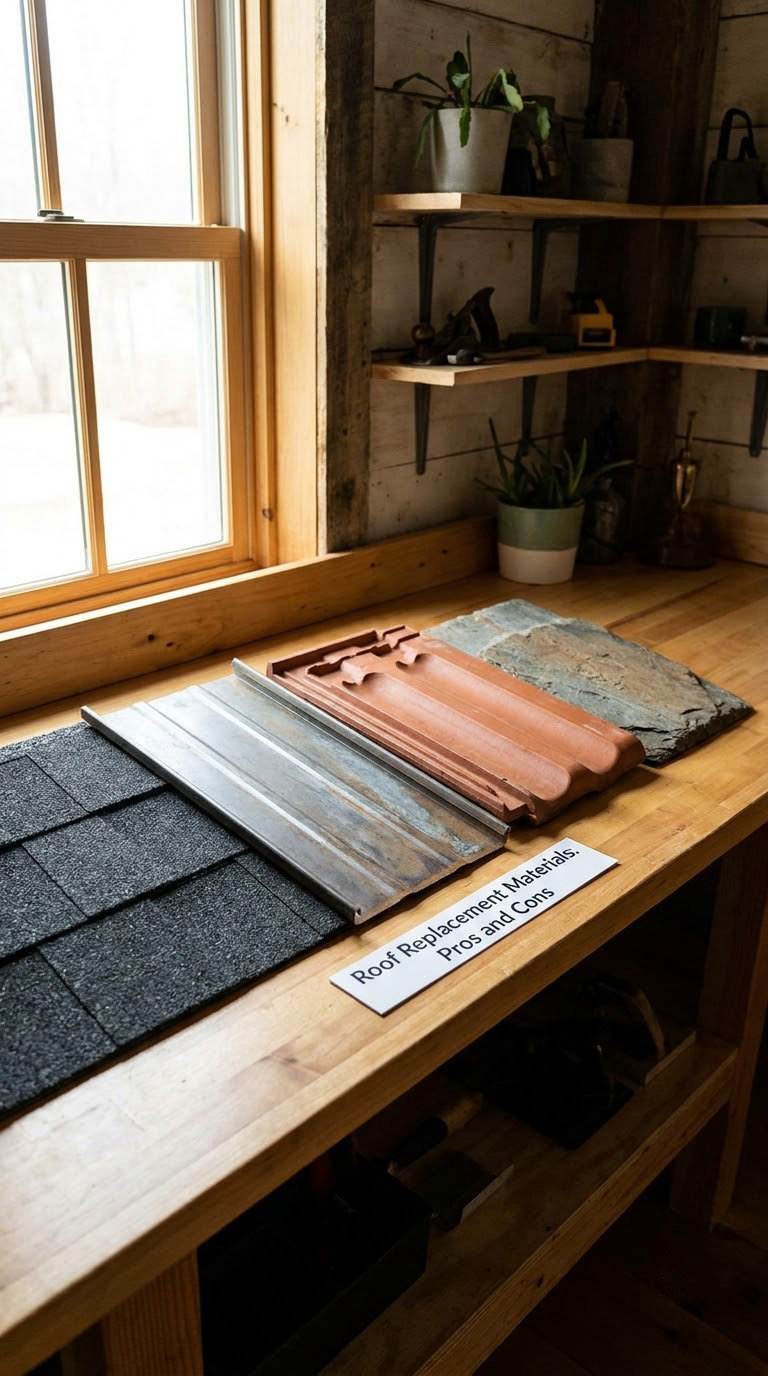
Material choice sets both the upfront cost and how long you go before doing this again. Here is how the common options compare.
| Material | Typical lifespan | Maintenance | Weight | Install complexity | Relative cost |
|---|---|---|---|---|---|
| 3-tab asphalt | 15-20 years | Low | Light | Easy | Lowest |
| Architectural asphalt | 25-35 years | Low | Light | Easy | Low |
| Metal (standing seam or shingle style) | 40-70 years | Low | Medium | Moderate | High |
| Wood shake | 25-40 years | High in wet climates | Light | Moderate | High |
| Concrete or clay tile | 50-100 years | Low | Heavy | High | High |
| Natural slate | 75-150 years | Low | Very heavy | Very high | Highest |
| Synthetic (composite) shingles | 30-50 years | Low | Light | Easy | Moderate |
Heavy material changes the job itself. Tile and slate often need reinforced framing checked before installation, and that structural work is a real line item rather than an exception.
Homeowners comparing quotes sometimes use a rule of thumb of about 600 dollars per square for asphalt and 1,400 dollars per square for tile including waste. Treat those as sanity checks for a straightforward roof, not as quotes.
How to Estimate Your Roof Replacement Budget
Start with the footprint, not the floor plan. Multiply length by width for the main rectangle, then add roughly 50 percent for a moderate pitch. That gives you roof area in square feet.
Divide by 100 to get roofing squares. For a 1,600 square foot house with a 6:12 pitch, footprint area of 1,600 square feet becomes about 2,080 square feet of roof, or roughly 21 squares. Add 10 percent waste and you are buying 23 squares.
Now sanity-check whether you need a replacement at all. The 25 percent rule says that if your roof needs more than a quarter of its surface repaired, a full replacement usually costs less than repeated patches, and it protects you from mismatched shingle color between repairs.
Then add the allowances that get missed: tear-off and disposal, underlayment, new flashing, decking repair contingency, permit fees, and 10 percent for anything found once the old roof is off. Our rule is to hold back 15 percent for a roof where the decking condition is unknown, which is most of them.
Do not forget ventilation while you are planning the budget. Attic ventilation works differently from a bathroom vent, and roof venting versus a soffit vent is worth understanding before a contractor talks you into extra components. Poor ventilation shortens shingle life and raises your utility bill, so it belongs in the scope from day one. If you also maintain an RV or a camper, RV roof vent fan upgrades cover the same airflow problem in a much smaller space.
Finally, set aside a 10 to 15 percent contingency and keep it out of the signed contract. That money is for decking, fascia and code items that cannot be priced until the roof is open. A contractor who will not price it or will not commit to a firm number before tear-off is being honest, not evasive.
Questions to Ask a Roof Replacement Contractor
Get three to five written estimates and read them side by side. Homeowners on r/homeowners reported collecting five to eight quotes, and that is standard practice for a job this size.
- Are you licensed and insured in my state? Ask for the license number and proof of both liability and workers compensation coverage.
- Who pulls the permit? In many jurisdictions the contractor pulls it, and that means they are accountable for code compliance and final inspection.
- Does this estimate include tear-off, disposal and cleanup? If those three are missing, the number is not comparable to bids that include them.
- What is the contingency for decking? Ask what happens to the price and the schedule if rotted boards appear.
- What underlayment and flashing are included? Cheap bids often skip ice barrier in valleys or reuse old flashing.
- Which warranty is manufacturer and which is workmanship? A manufacturer warranty covers defects. A workmanship warranty covers installation errors and is the one you actually need, so read the term length carefully.
- What is the payment schedule? A deposit, a midpoint payment and a final payment after inspection is normal. Never pay the full amount before the work is done and inspected.
- Can you give me local references for jobs done in the last year? A crew that travels in from out of state is harder to hold accountable later.
Watch for pressure tactics. If a salesperson tells you prices are going up and you must sign today, walk away. Roofers who are worth hiring will still be worth hiring in a week.
Homeowner reports of quotes swinging from 13,500 dollars to 30,000 dollars on the same house are not usually fraud. They usually mean different assumptions about tear-off layers, decking, material grade, flashing and ventilation.
Frequently Asked Questions
How much does it cost to replace a roof in the US?
The average is roughly 9,500 dollars, and most homeowners land between 5,800 and 12,800 dollars. Per square foot, plan on 4 to 11 dollars for asphalt shingles and considerably more for metal, tile or slate. Large or high-end roofs can run past 46,000 dollars. Labor accounts for about 60 percent of the total.
Is it cheaper to repair or replace a roof?
If the damage covers less than about 25 percent of the roof surface, a repair is usually the cheaper move. Past that point, a full replacement costs less than repeated patches and avoids mismatched shingle color. If the decking is sagging or wet, repair is not an option at all.
How much does a metal roof cost compared with asphalt shingles?
A metal roof typically costs two to four times more than architectural asphalt shingles on the same house. Asphalt shingles last 25 to 35 years while metal commonly lasts 40 to 70 years, so the higher upfront cost spreads over a much longer life. Wind and fire ratings are also higher.
Can a homeowner replace a roof themselves?
Not a full replacement. Roof work at height needs fall protection, permits in most jurisdictions, and code-compliant flashing and underlayment, and mistakes show up as leaks months later. Repairing a few shingles, replacing a pipe boot, or clearing debris and cleaning gutters are reasonable homeowner jobs.
How long does a roof replacement take?
Most asphalt replacements on a standard single-family home finish in one to three days once materials arrive. Metal, tile and slate take considerably longer, and steep or complex roofs stretch the schedule. Weather, decking condition and permit scheduling can all add days, so allow a week of slack.
Why do roof replacement estimates differ so much?
Quotes diverge because contractors assume different things: how many layers come off, whether decking is replaced, which underlayment and flashing are included, what material grade is used, and who pays for disposal and permits. Line-item estimates that spell out each assumption are the ones worth comparing.
Start by measuring your roof and multiplying by your local rate per square, then get three to five written, line-item estimates before you commit to anything. Most of the cost surprises come from assumptions nobody wrote down. Understanding the cost to replace a roof and what affects it before the first quote is what keeps you from paying for someone else’s bad guess.
