How to Fix a Window That Wont Stay Up: Easy DIY Guide 2026
A window that won’t stay up is almost never a broken window. In most cases the sash has slipped off the balance shoe inside the side track, so the counterbalance never grips it. Five minutes with a flathead screwdriver usually puts it back.
Before you touch anything, know that how to fix a window that won’t stay up changes completely depending on what kind of window you own. A modern vinyl double-hung uses spring-loaded balance shoes. An old wood sash-and-weight window uses cords and cast-iron weights. A slider uses a roller in a track. Diagnose first, then repair.
Contents
Time: 30 to 90 minutes for most repairs · Cost: free if the hardware just needs reseating, otherwise a small hardware-store part · Difficulty: Easy DIY to Moderate DIY · Skill level: Comfortable with hand tools
Tools and Materials
You can do most of this with what is already in a junk drawer. Buy parts only after you have the sash out and know exactly what failed.
Hand tools
- Flathead screwdriver, 1/4 inch blade, long enough to reach the balance shoe slot at the bottom of the track
- Phillips screwdriver, #2, for removing the sash and the plastic jamb stops
- Putty knife or paint scraper, 1 inch wide, for scraping paint off the sash grooves
- Soft nylon brush, about 1 inch wide, for cleaning the side tracks
- Utility knife with a fresh blade for trimming shims and splitting old cords
- Vacuum with a brush attachment, or a shop vac on the extension hose
- Tape measure and a pencil for marking the sash position before shimming
Safety gear and supplies
- Safety glasses with side shields — balance shoes sit under spring pressure
- Work gloves with grip, but not so bulky that you cannot feel the shoe engage
- Silicone-based lubricant or spray for the sash channels. Not petroleum grease and not WD-40; those gum up the vinyl and collect dust
- Painter’s tape and a drop cloth to protect the sill and floor
- A wedge, a sash chain or a sash lift to hold the window in place while you work
- Replacement parts once identified: balance shoe, tilt latch, pivot bar, balance, or sash cord and weights
Before You Start
Identify the window first. Look inside the jamb pocket on a tilt-in window and you will see a plastic cover hiding a metal bar. That means you have a modern vinyl or aluminum replacement window with balance hardware. On an older home you may see a rope or chain running over a pulley at the top of the sash channel, which points to a wood sash-and-weight design. A sliding window has no sash at all, just a panel riding on rollers.
Then inspect for damage. Press the lower rail of the sash with your thumb. If it feels soft, spongy or hollow, the wood underneath has rotted and no amount of hardware will fix it. Check the bottom sill for paint that has swollen and sealed the track shut. Check the sash cords if you have them; fraying or a cord hanging loose means the cord has already let go.
Protect your work area and keep people out of the room. A window that drops unexpectedly can catch fingers or land on a foot, so clear the area and work alone rather than with a helper holding the sash by hand. If the window is above the first floor, stop and read the section on when to call a pro before you touch it.
One more check that costs you nothing: if the home was built before 1978, assume the painted surfaces may contain lead. Do not sand or scrape without testing. This is especially relevant if you have small children who might put flakes in their mouths.
Step-by-Step Instructions
Work through the steps in order. Most of the time you will find the fault in step one or two and stop there.
Step 1: Diagnose Why Your Window Won’t Stay Up
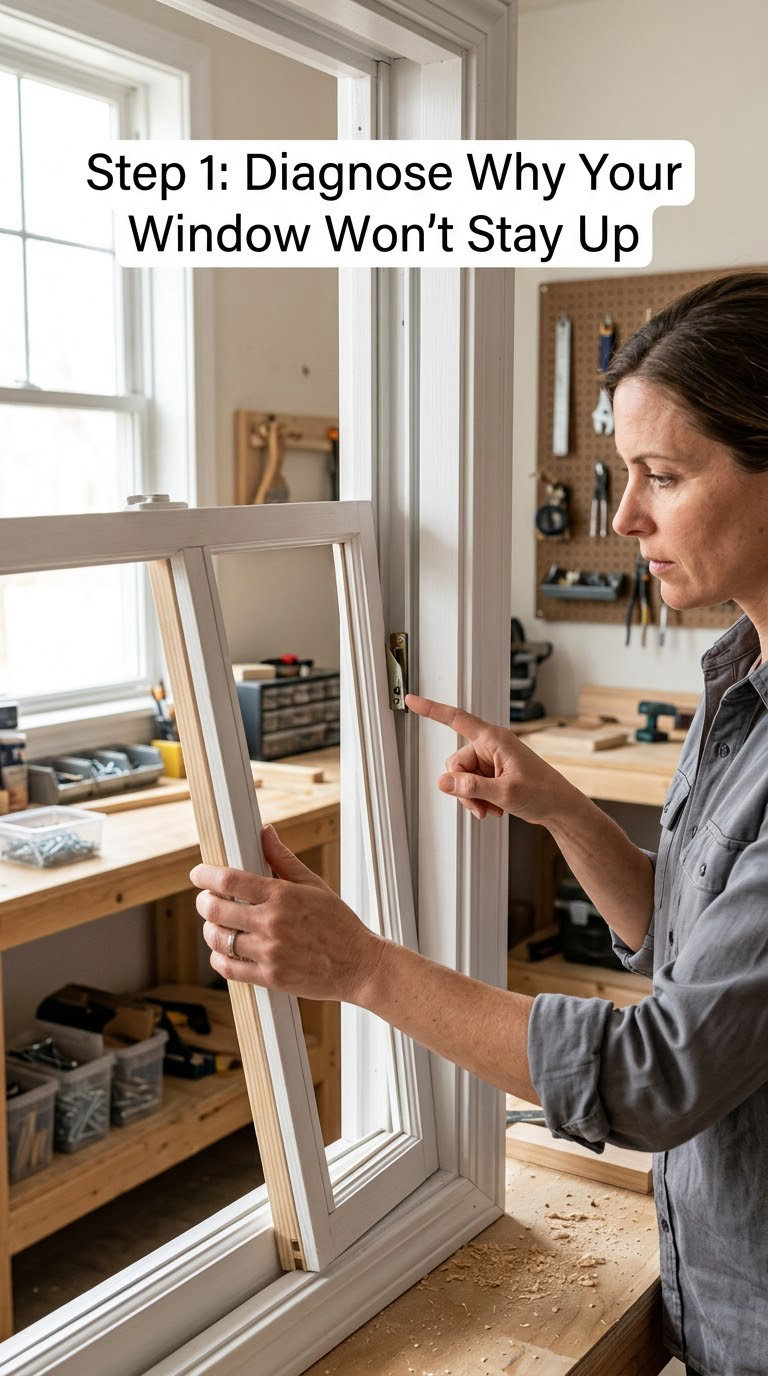
Open the sash slowly and let go about halfway. If it slides down on its own, the counterbalance has lost tension or disengaged. Now watch what happens to the tilt latch at the top of the lower rail. When you squeeze the rails together, does the latch pull clear of the stop?
If the latch never engages anything, the sash is not hanging on the pivot bar and it is sitting loose in the track. If the latch engages but the sash still drops, the balance itself has lost its power. If the sash binds or rubs at one corner before it closes, you have an alignment problem rather than a balance problem.
Use this table to route yourself to the right fix.
| Window type | How the counterbalance works | Where the part lives | Go to |
|---|---|---|---|
| Modern vinyl or aluminum double-hung | Spring or coil inside the jamb, feeding a balance shoe the sash locks into | Inside the side track, behind the sash | Step 3 and Step 4 |
| Old wood sash-and-weight | Cord over a pulley, attached to cast-iron weights in the jamb | Along the channel wall beside the sash | Step 4 |
| Sliding window | Roller in a fixed track, plus a roller housing | At the bottom corners of the panel | Step 3 |
| Casement or crank-out | Tension spring at the operator or a gas strut | Beside the hinge or at the crank | Step 3 |
Don’t force a window closed to test it. Pressing it shut against a loose sash puts bending stress on the frame and can bow the rail for good.
Step 2: Clean and Inspect the Sash and Track
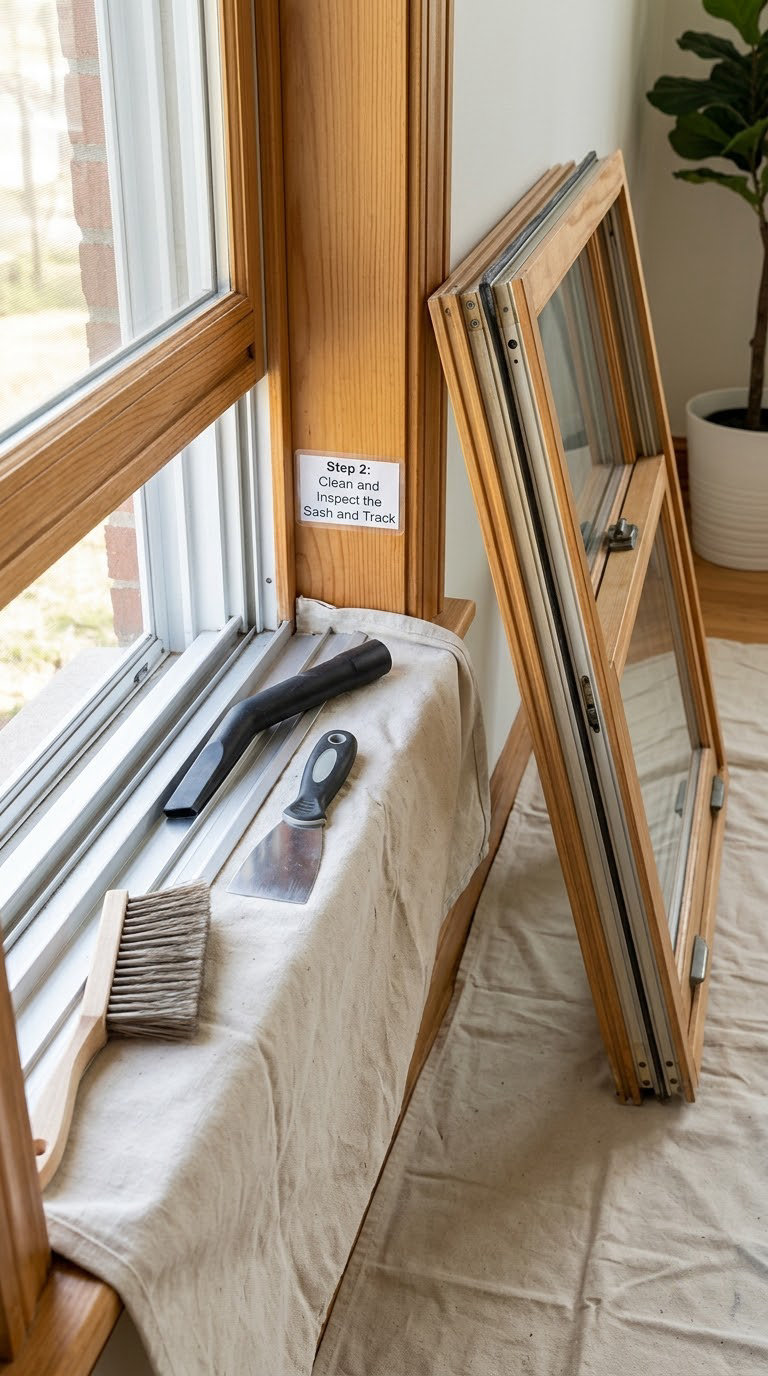
Half of all window complaints turn out to be paint, pet hair and dried mud. A sash that will not slide up is often a sash that is simply heavy with debris in its grooves, not a broken mechanism.
Open the sash and lay it on a drop cloth. Vacuum both side tracks and the bottom channel. Run a wet cloth down the grooves in the sash rails and wipe them dry — grit left behind there is what scratches the vinyl and wears the rollers over time.
Take the putty knife and scrape any hardened paint drips out of the grooves. Then close the window and slide it up and down three or four times by hand. If it moves freely and stays wherever you leave it, you are done. That was the whole repair.
Lubricate the channels with a silicone product at this stage, not petroleum. A light coat is enough; wipe off the excess so it doesn’t run down onto the glass.
Step 3: Repair or Replace Damaged Hardware
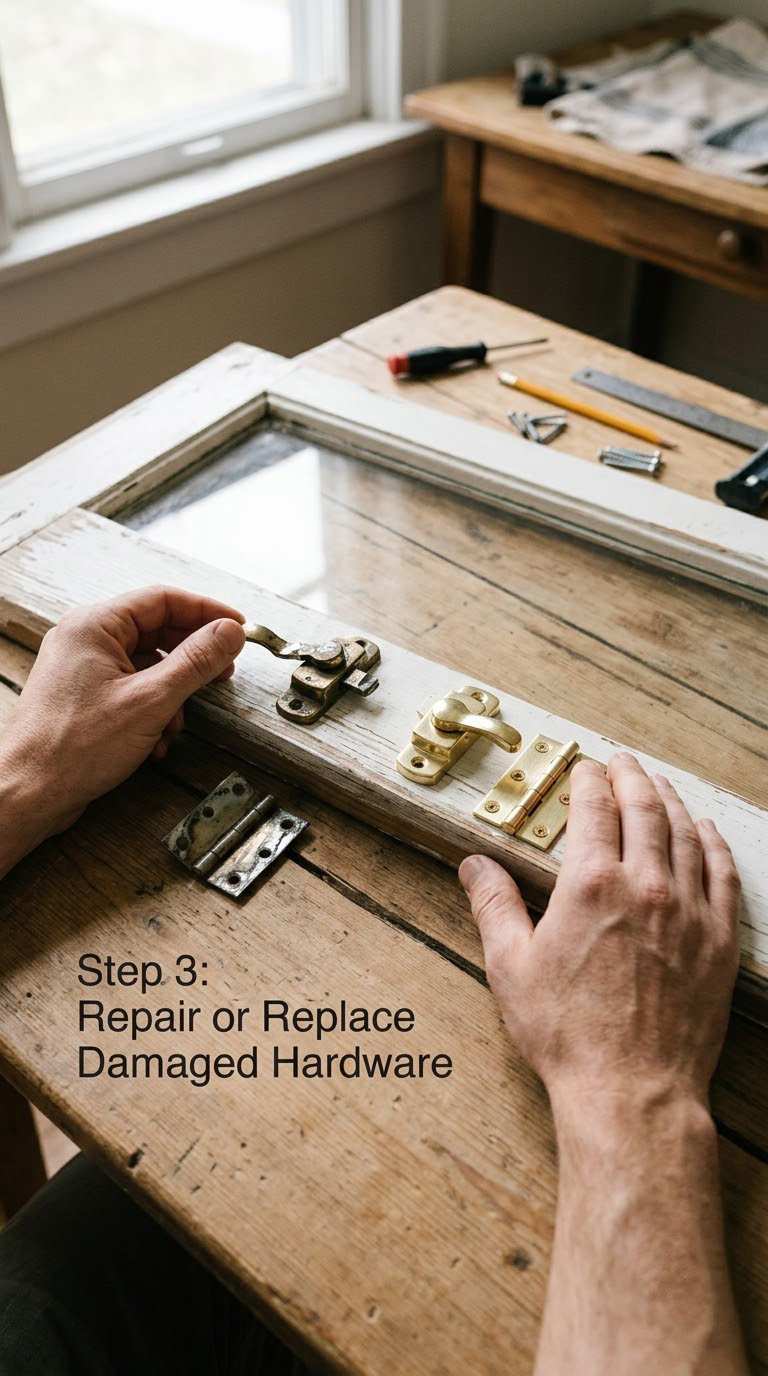
Tilt-in sashes come out with a flat screwdriver. Put the blade under each corner of the sash rail at the top and bottom, twist gently and lift the sash inward. Set it down on sawhorses padded with towels. If your window has a sash lock, take the screws out before you move anything.
With the sash out you can see the pivot bar running up each side. It is a metal strip riveted to the frame with pins that stick up. The sash has a small block, the balance shoe, that rides on this bar. The pins enter holes in the shoe and hold the sash up.
Common faults and their fixes:
- Shoe sitting too high or too low in the track. Reset it. Turn the shoe a quarter turn with a flat screwdriver to unlock it, slide it down 3 to 4 inches from the bottom, then turn it back to lock it at that height.
- Pins broken or bent. This usually means the sash dropped hard enough to twist them. Replace the pivot bar and pin both shoes back on the new bar before reinstalling the sash.
- Shoe broken or missing. Take the old shoe to a hardware store. Balance shoes are sold in diameter fractions and heights, so match both.
- Tilt latch loose or broken. Squeeze the rails together, drive the old screws out, and set the new latch so the sash locks flat against the jamb stop when the rails are compressed.
If you cannot find the window brand, look inside the jamb pocket cover for a stamped code on the balance. A marking such as 20B tells you the manufacturer and series, and the balance is ordered by that code. When the original part is discontinued, measure the sash width and height and the balance length in inches and look for a universal part that matches those numbers.
Some owners with a house full of identical old windows bring a working sash to the store and match the parts directly. It works well when the windows are the same age and brand.
Step 4: Fix the Window Balance or Lift Cord
The balance shoe is spring-loaded and pushes upward hard. Before you move a shoe, hold downward pressure on it with one hand or it can shoot up the track and damage the stop or pinch your fingers. This is the single most important safety step in the whole procedure.
Here is the reset that fixes most windows:
- Hold downward pressure on the sash so the weight stays low.
- Put the flat screwdriver into the groove on the top of the balance shoe. A U shape means locked. A C shape means unlocked.
- Turn the screwdriver until the U becomes a C. That is roughly a 90 degree turn.
- Slide the shoe down to 3 or 4 inches above the bottom of the track while keeping pressure on it.
- Turn the screwdriver back until the U reappears. That locks the shoe at the new height.
- Line the sash up with the shoe and tilt the sash inward, keeping it parallel to the floor.
- Set the sash so the pivot pins enter the shoes. Push down gently near each shoe until you feel it click into place.
- Return the sash to the closed position, then lift it and let go. If it holds, the pins are engaged.
Repeat the alignment steps on both sides. If one shoe sits lower than the other, the sash will hang crooked and bind. Both shoes belong at the same height.
Now the balance itself. Three types show up in homes. A spiral balance is a flat steel coil the cord plugs into, found on older vinyl windows. A constant force balance is a coiled spring in a tube. A block and tackle balance uses a pulley and several strands of cord. Worn or broken spiral balances are the ones that fail most; they can snap and let the cord whip back into the jamb.
Replace the balance if the cord is frayed, the spiral coil is broken or separated, or the spring has no tension left. Match the replacement to the type and to the window’s height. Follow the manufacturer’s routing diagram for the cord through the pulleys, because getting the strands crossed or running the cord over the wrong pulley is a common reason a new balance fails immediately.
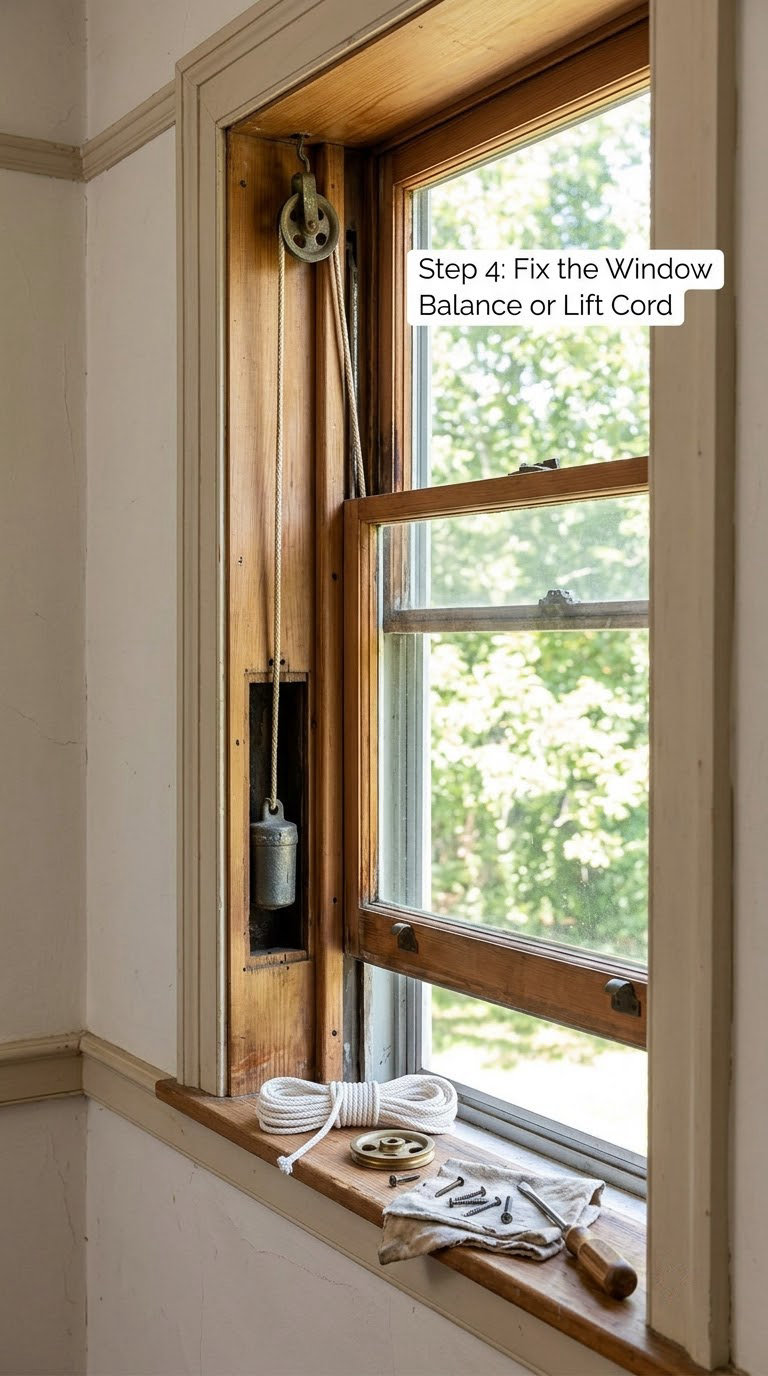
On an old wood sash-and-weight window, the job is different and slower. Remove the sash, cut or untie the cord, and expect a cast-iron weight to drop when the last strand releases. Support it with your hand before you let go of the cord, never after. Then thread new cord through the pulley and tie it to the existing weight or to a new one, following the original path exactly.
Replacing sashes and cords on older homes takes longer than any modern window repair. Our guide to fixing a window air conditioner leaking water inside covers the same weight-and-hardware care around the same part of the house.
Step 5: Adjust or Shim a Misaligned Window
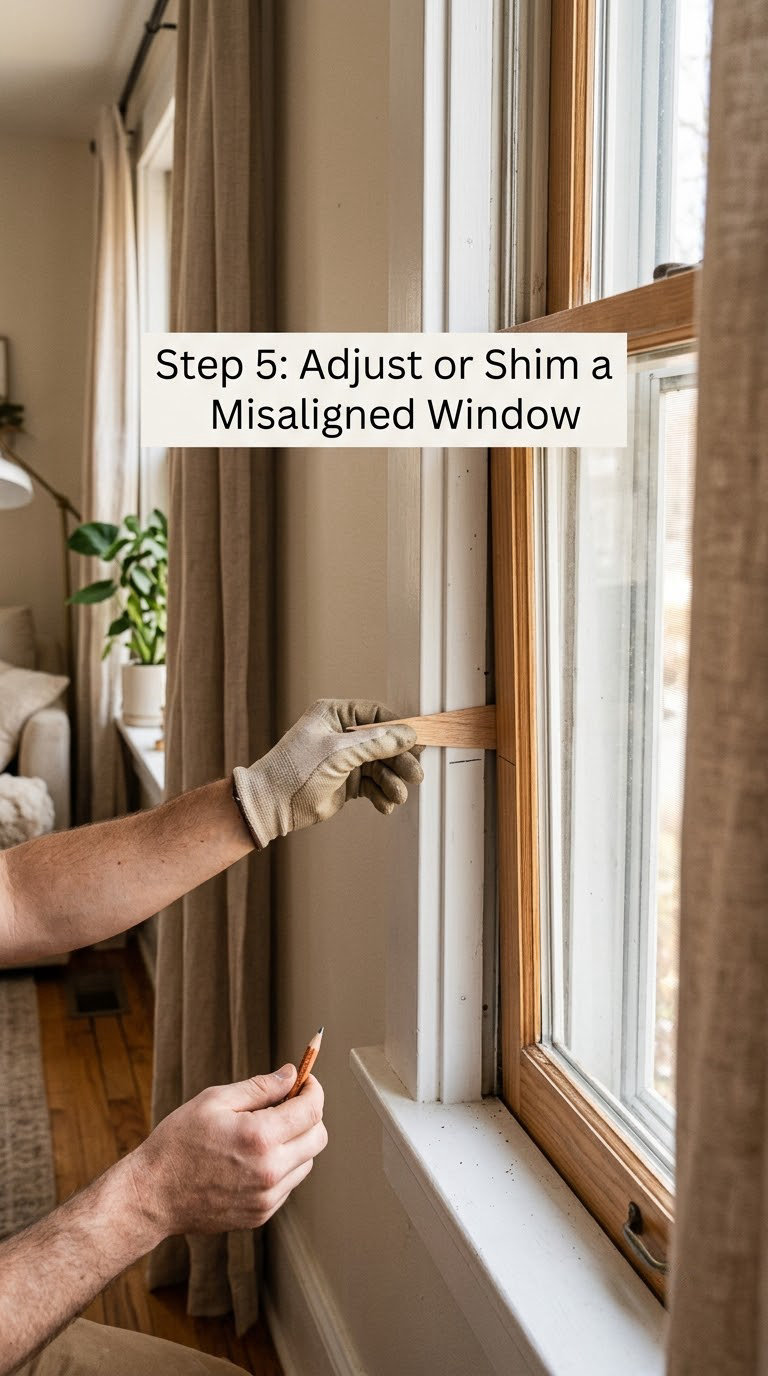
If the sash rubs, catches or closes hard on one corner, no balance work will fix it. Watch where it touches as you close it and mark the spot with a pencil.
Most alignment problems are corrected by setting the sash into the jamb the same way it sat originally. Seat the top of the sash first, check that the gap between the rails and the frame is even on both sides, then set the bottom down. An uneven reveal of more than a sixteenth of an inch will throw the balance off.
If the hinge screws are loose, tighten those before shimming anything. Loose hinge screws let the frame side of the window shift, and that is a five-minute fix disguised as a carpentry problem.
For a sash that has genuinely sagged, shim the low corner with a piece of hardwood cut to the measured gap, no thicker than an eighth of an inch, tapered slightly. Slip it between the sash rail and the jamb, not between the sash and the stop. Trim it flush with a utility knife, then close the window and re-measure the reveal.
Do not stack shims. A stack loosens, and a loose shim under a sash will rattle and wear the pivot pins. One well-fitted piece or none at all.
Step 6: Test and Maintain the Repaired Window
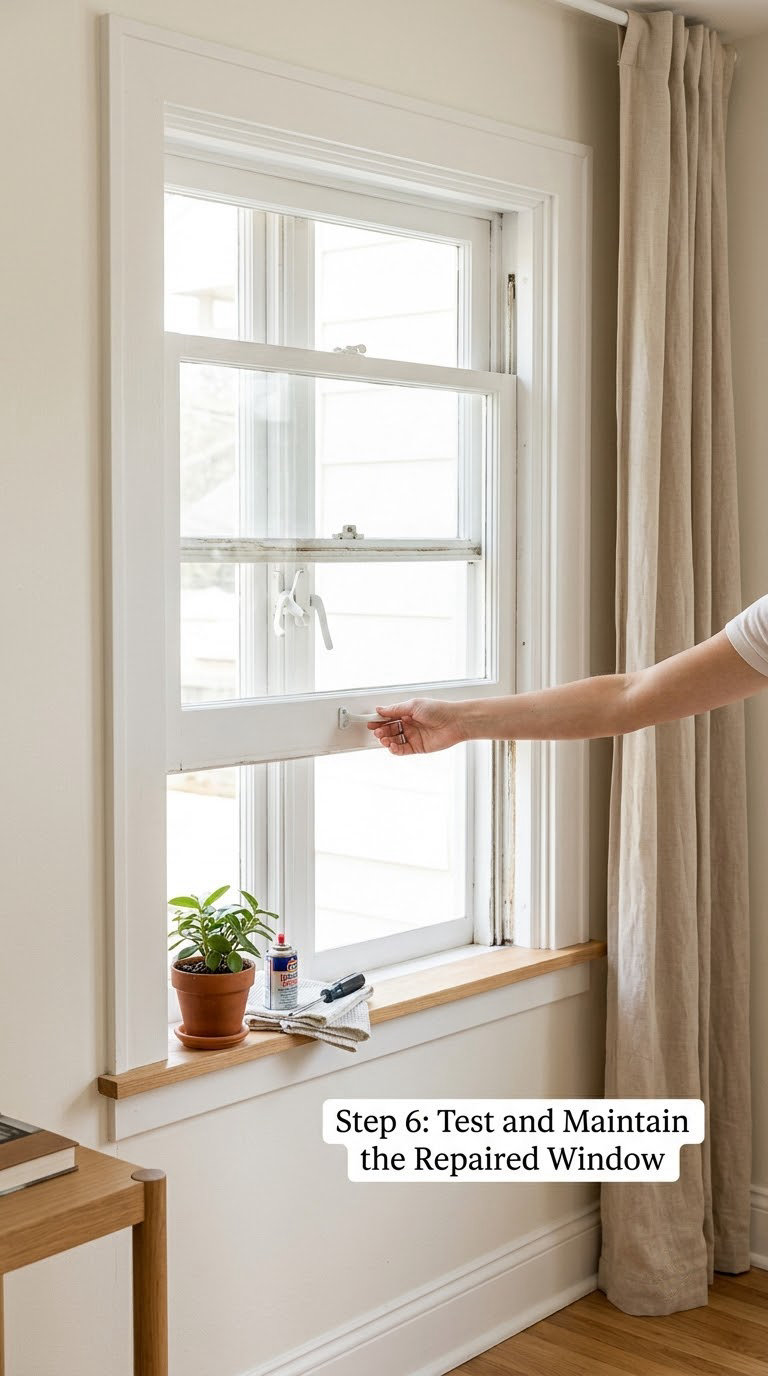
Put the sash back in and close the window. Then run a proper test: open it to about six inches and let go, then to waist height, then all the way up. It should stay at each position without creeping down.
Stand to one side and look at the perimeter. The reveal should look even on all four sides, and the latch should pull the sash firmly against the stop with a firm tug. Press the lower rail and watch for rattles. A window that holds position but knocks is telling you the sash is loose in its shoes, and the pin engagement needs another look.
Open the sash, tilt it inward and check that the pivot pins are fully inside the shoes, not resting on top of them. This is worth doing at the six-inch position where most people stop testing.
For similar repairs on the same kind of hardware, our guide on fixing a bathtub drain lever that won’t stay down follows the same diagnose-then-replace approach.
Common Mistakes to Avoid When Fixing a Window That Won’t Stay Up
- Forcing a stuck sash. Pushing hard on a sash that is caught on paint or a swollen rail bends the rail and can crack the frame. Scrape and clean first.
- Lubricating a dirty track. Silicone over grit just packs the grit in harder. Clean, then lubricate.
- Using the wrong balance. A balance that is too short or too light will hold the sash for a week and then fail. Match the stamp code or the sash dimensions.
- Over-tightening screws. The tilt latch and jamb screws are set into vinyl and soft wood. Drive them until snug, then stop.
- Installing a cord without checking the routing. Trace the old cord path first and photograph it. Crossing the strands or bypassing a pulley throws the whole balance off.
- Piling up shims. Shims should correct a gap, not fill a structural sag. If a stack is needed, the frame is moving and needs a professional.
- Letting go of a spring-loaded shoe. Keep downward pressure on the sash the entire time you turn the shoe.
When to Call a Pro
Some window problems are not worth a weekend. Call a window professional when you find any of these.
- Rot in the sill, jamb or sash rail. If the wood is soft, spongy or crumbly, the repair is carpentry, not hardware. Matching new wood into an old frame is skilled work.
- Movement in the framing itself. A window that stays out of square months after a balance repair points at the wall or the header.
- Second-story work or heavy sashes. Large glass and upper-floor windows are a fall hazard. The cost of a service call is cheaper than an ER visit.
- Historic or lead-painted windows. Original wood sash in a registered district may be regulated, and disturbing lead paint creates a health risk for everyone in the house.
- Fire egress or code requirements. Bedroom windows that serve as emergency escape openings have minimum clear-opening requirements. Changing the sash or the hardware can affect that.
- Gas struts or sealed hardware on a tilt-and-turn window. European-style hardware is usually supplied as a matched set and rarely worth piecing together.
Our guide to fixing bathroom sinks that keep backing up covers another job where calling early costs less than a weekend of guessing.
Maintenance
A window that has just been repaired is easy to keep working. Twice a year, open and close it fully and note anything that changed. The rattle or the drag almost always shows up months before the window actually stops staying up.
Vacuum the side tracks and the bottom channel, wipe the sash grooves with a damp cloth and apply a light coat of silicone lubricant. Keep paint off the moving parts; when you notice a drip starting to harden in a groove, scrape it out while it is still soft.
Check that both tilt latches snap firmly and that the sash meets the jamb stop evenly. Tighten loose hinge screws. Look at the weather-stripping while you are there; if you can see daylight or feel a draft with the window closed, replace the strip before cold weather arrives.
If the window is on an old wood house, look at the sash cords and the lower sash rail once a year. A cord that has started to fray will eventually let go, and replacing it deliberately is a much better afternoon than replacing it after the sash has fallen into the room.
Frequently Asked Questions
How to fix a window that keeps falling down?
On a modern double-hung window it is almost always the balance shoe. Hold the sash down, turn the shoe with a flat screwdriver until the U shape becomes a C, slide it down 3 to 4 inches, then turn it back to lock it. Line the sash up with the shoes, tilt it in and push gently until the pivot pins click into place.
Why does my window keep rolling down?
The counterbalance has disengaged or lost its tension, so gravity is the only thing left holding the sash. Common causes are a balance shoe sitting at the wrong height, broken pivot pins, a snapped spiral balance or a broken sash cord on an older wood window. Diagnose which one you have before buying any part.
Why won’t the top sash of my double hung window stay up?
The top sash on a double-hung runs in its own set of balance shoes, so a failure there is separate from the bottom sash. Remove that sash, check that its shoes are seated at the same height and that its pivot pins are intact, and confirm its balance is the matching part. Both balances should be the same type and size on a healthy window.
My window sash cord is broken. How can I fix it?
Support the sash weight with your hand before you release the last cord strand, because the weight drops as soon as the tension is gone. Remove the sash, thread new cord through the pulley at the top, follow the original path exactly and tie it to the existing weight. Test the balance at several heights before trimming any excess cord.
Why does my window sash keep falling down after I open it?
If it holds closed but drops as soon as you open it, the balance does not have enough tension for the weight of the sash, or the shoes are set too low. If it drops immediately after unlocking the tilt latch, the pivot pins are not fully seated in the shoes. Reset the shoes first; replace the balance only if the reset does not hold.
Can you force a window to roll up?
You can close and latch it, but do not force the sash up against resistance. A sash caught on hardened paint or a swollen rail will bend and crack if you push it. Scrape the grooves, clean the track, then try again. For a temporary hold while you wait for a part, use a sash chain or wedge rather than forcing the window.
Start with the easy part: open the sash, let go, and look at whether the balance shoe is riding at the right height. On most windows that is the entire repair. If the reset holds, clean the tracks, lubricate them with silicone and check again in six months. If it does not hold, you now know whether you are looking at a broken balance, broken pivot pins or a sash that has sagged, and each of those is a straightforward part to replace.