Cost to Replace a Kitchen Sink in 2026: Simple Guide
Replacing a kitchen sink usually costs between $400 and $1,400 in total across the US, including the sink, labor and any plumbing work. A straightforward drop-in swap at the front of the counter lands nearer the bottom of that range. A farmhouse sink, new countertop or new faucet pushes it toward the top.
That first number covers a lot of ground, so the useful question is what your specific job costs. Two things decide it: how much plumbing work is hiding behind the cabinet doors, and whether the countertop has to be cut.
Contents
If you’re still choosing a sink, our kitchen sink reviews break down the sizes and materials worth considering before you buy anything.
Cost to Replace a Kitchen Sink: Typical US Prices
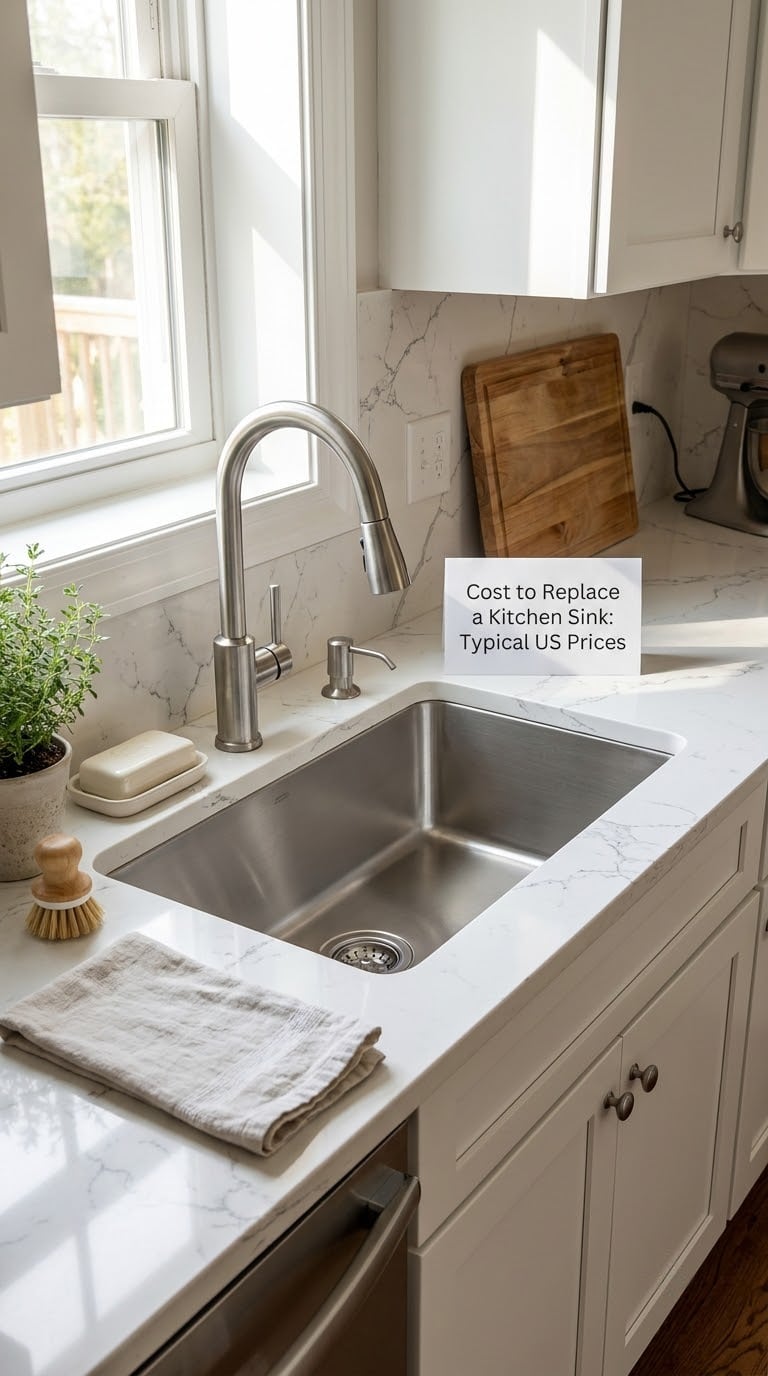
Here is where the money actually goes. Most projects break into four buckets: the sink, removing the old one, installing the new one, and anything unexpected behind the cabinet.
| Cost component | Typical US range | Notes |
|---|---|---|
| Sink purchase | $100 – $2,000+ | Stainless steel sits low, fireclay and stone composites sit high |
| Old sink removal and disposal | $50 – $150 | Higher if the old sink is cast iron or badly stuck |
| Installation labor | $150 – $800 | About 2 to 4 hours of work at $50 – $200 an hour |
| Faucet replacement | $100 – $400 installed | Optional, but common while the counter is apart |
| Plumbing modifications | $150 – $500 | Moving the drain or replacing corroded supply lines |
| Countertop cutout or replacement | $150 – $1,500+ | The single biggest cost driver in most jobs |
Now split that by how the sink gets installed. This is the clearest way to see why two people get very different quotes for what looks like the same swap.
| Installation type | Total project cost | Time |
|---|---|---|
| Drop-in, straight swap, DIY | $150 – $400 | 4 – 8 hours |
| Drop-in, straight swap, plumber | $400 – $800 | 2 – 3 hours |
| Drop-in to undermount conversion | $600 – $1,400 | 6 – 10 hours |
| Farmhouse or apron-front sink | $700 – $1,600 | 6 – 12 hours |
| Sink, faucet and disposal together | $900 – $2,000+ | 1 day |
These are nationwide averages. Coastal metros and high-cost states run 30 to 50 percent above them, and rural areas often run below. Your existing plumbing matters more than your ZIP code, though. Get two written quotes before you assume the low end is realistic.
What Changes the Cost to Replace a Kitchen Sink?
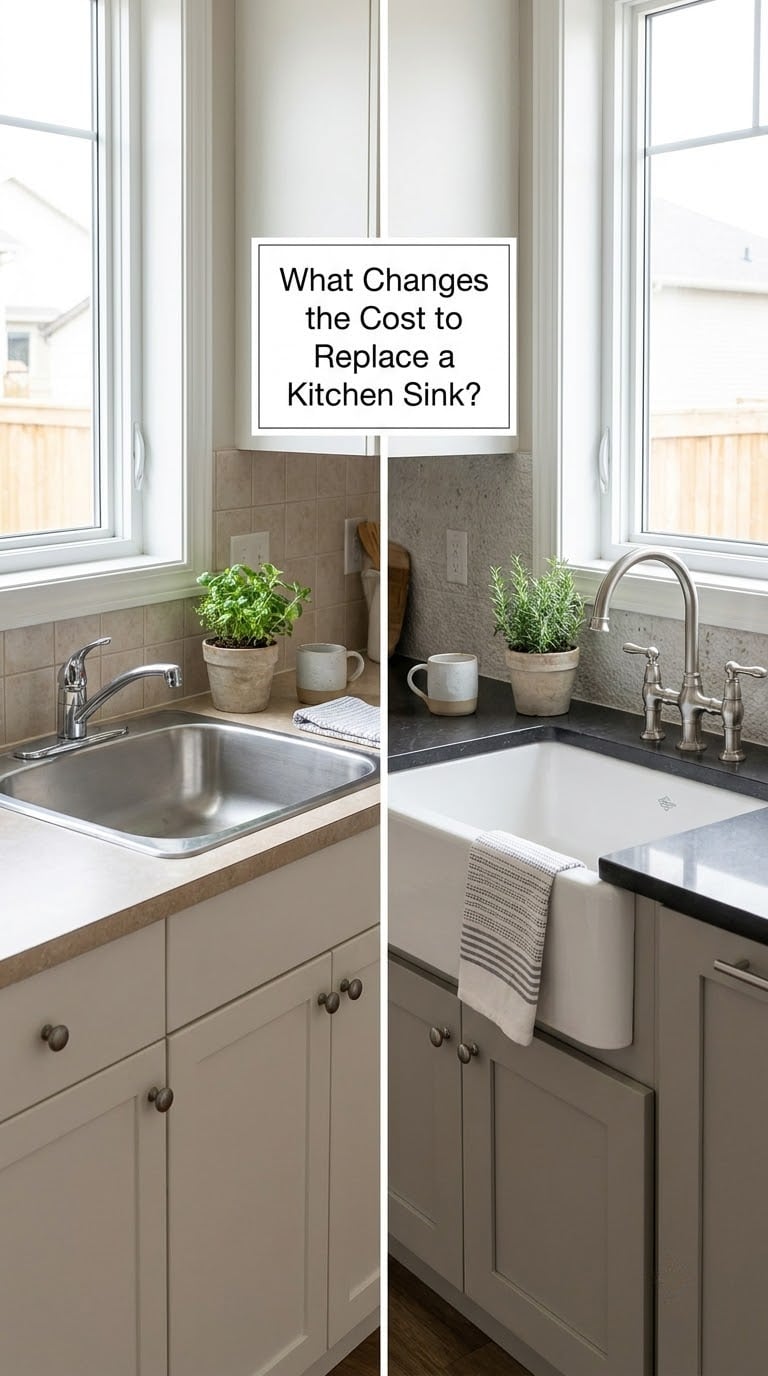
Almost every surprise in this project traces back to one of six things. Learn to spot them and you can price the job before anyone hands you an invoice.
Sink size and material
A 30 inch single basin in 16 gauge stainless steel is the budget end of the market. An oversized workstation sink in cast iron or granite composite runs several times more, and heavy materials often need extra cabinet support underneath.
If you are leaning toward the apron-front look, our farmhouse sink picks cover the sizes and weights worth comparing first.
Drop-in versus undermount installation
Drop-in sinks drop into an existing cutout and clamp from above. Undermount sinks mount beneath the countertop and need a new cutout routed to fit, plus adhesive and support clips, which is why the conversion costs several hundred more.
Faucet compatibility
You can reuse your existing faucet in most like-for-like swaps if it still has three holes at the right spacing and clears the new bowl. Switching between deck-mount and wall-mount, or adding a pot filler, means new plumbing and new cost.
Countertop and cabinet work
A farmhouse sink usually needs the cabinet front cut back, and any sink changing size needs a new cutout. Stone and quartz countertops must be cut by a fabricator, not on site, and that visit alone runs $150 to $500.
Plumbing changes and the garbage disposal
Old homes often have galvanized supply lines or a shut-off valve that no longer turns. Replacing a basket strainer runs $20 to $60 in parts, a new disposal $150 to $400, and moving a drain to a new sink position adds $200 to $500.
Who does the work, and permits
Licensed plumbers charge $50 to $200 an hour depending on region. Handymen typically run $300 to $450 for a simple drop-in swap. A permit is uncommon for a like-for-like replacement but often required when plumbing is relocated.
Two examples show the range. An older builder-grade drop-in sink replaced with a mid-range stainless model, reusing the faucet, disposal and supply lines, lands around $250 in materials and a plumber’s minimum. The same kitchen with a new quartz countertop, a workstation sink, a new faucet and a relocated drain runs past $3,000.
Kitchen Sink Replacement Options and Their Trade-Offs
Four routes cover almost every household. Each buys something different, and the table below makes the trade plain.
| Option | Typical cost | Pros | Cons |
|---|---|---|---|
| DIY replacement | $50 – $200 in parts | Lowest cost, you control the timeline | Risk of leaks, no labor warranty, slow if you are learning as you go |
| Licensed plumber | $300 – $800 labor | Insured, warranty on the work, handles surprises | Highest hourly rate, scheduling waits |
| Handyman | $200 – $450 labor | Cheaper than a plumber, often faster | Verify licensing and insurance in your state before hiring |
| Countertop or full faucet upgrade | $1,500 – $5,000+ | Best-looking result, everything coordinated | Long lead times, a second trade to schedule |
A straight drop-in or undermount swap in good condition suits an experienced DIYer. Anything involving a new countertop, a moved drain line or a permit belongs with a licensed plumber. Handymen sit in between, and the deciding question is whether your state requires licensing for the specific work.
DIY or Hire a Plumber?
Replacing a kitchen sink is one of the friendlier DIY plumbing jobs, mostly because mistakes are visible while the water is off. It goes wrong when people rush the drain connection or trust old valves.
Tools and materials
You need an adjustable wrench, channel-lock pliers, a bucket, a flat screwdriver or nut driver, plumber’s putty or the manufacturer-specified sealant, PTFE tape, and a tube of silicone for the rim. A wet vac or towels matter more than people expect.
Time and skill
Experienced DIYers finish in 2 to 4 hours. First-timers on r/Plumbing and r/HomeImprovement commonly report 6 to 8 hours, most of it draining standing water and fighting a misaligned P-trap.
What holds an undermount sink in place
Undermount sinks rely on mounting clips or brackets tightened against the underside of the countertop, bonded in with a construction adhesive or epoxy specified by the manufacturer. The clip spacing matters more than the amount of adhesive.
When to call a pro
Stop and hire a plumber if the supply lines are corroded, the shut-off valves will not turn, the drain is cast iron, or you are moving the sink location. Water damage behind a finished cabinet costs far more than the hour you saved.
Safety first, every time: turn off both shut-off valves and open the faucet to relieve pressure, then confirm the water is off at the tap before you cut anything. If anything under there looks unfamiliar, stop there and call someone.
How to Keep Your Kitchen Sink Replacement Budget Under Control
Run this checklist before you buy a single part. It catches nearly every expensive surprise in advance.
- Measure the cabinet width, wall-to-wall space and the existing cutout. Standard US sink bowls run 30 to 36 inches wide, but cabinetry is not.
- Confirm the new sink’s cutout dimensions against the old one. Overmount and undermount cutouts differ by an inch or more on each side.
- Check faucet hole count and spacing. Three-hole 8 inch centers are common; single-hole and wall-mount are not.
- Ask whether the countertop fabricator or the plumber makes the cut, and get that cost in the written quote.
- Test both shut-off valves with a towel and a screwdriver before you commit to the job. A valve that will not close is a plumber call.
- Get two or three itemized quotes that separate parts, labor and disposal. A flat number hides what you are actually paying for.
- Ask whether a permit applies. Renting or selling later makes compliance worth checking.
- Set aside a 10 to 15 percent contingency. It covers the supply line, strainer or trap that fails the day you start.
- Check your home warranty and any existing sink coverage before buying. Extended warranties on appliances rarely cover fixtures.
- Group the work if you can. Replacing the faucet and disposal during the same visit costs less than three separate appointments.
If you are refreshing the water at that tap too, our kitchen sink filtration guide covers what fits under a standard cabinet without hogging space.
Frequently Asked Questions
How much does it cost to replace a kitchen sink?
Most US households spend between $400 and $1,400 for a full kitchen sink replacement including the sink itself, removal of the old unit, and installation labor. A drop-in swap with a plumber usually runs $400 to $800. Undermount conversions and farmhouse sinks run $600 to $1,600 because the countertop needs cutting.
Do I need a professional to replace a kitchen sink?
Not always. A like-for-like drop-in replacement is a realistic job for an experienced DIYer with basic tools. Hire a licensed plumber if the supply lines are corroded, the shut-off valves stick, the drain is cast iron, you are moving the sink location, or a permit applies in your area. Leaks behind finished cabinetry are expensive.
Can I reuse my existing faucet when replacing the sink?
Usually yes, if the faucet is deck-mounted with three holes at standard 8 inch centers and it clears the new bowl in height and reach. You will need new supply lines and a basket strainer regardless. Wall-mounted, pull-down with a high arc, or single-hole faucets often need replacing with the sink.
Does replacing a kitchen sink require a permit?
A straight swap at the same location usually does not, because the drain rough-in is unchanged. Moving the sink, adding a second basin, or altering the drain line generally does require a permit depending on your state and city. Your plumber will know the local rules, so ask before work starts.
How long does it take to install a kitchen sink?
A plumber typically needs 2 to 4 hours on a straightforward replacement. A first-time DIYer should plan 6 to 8 hours, mostly on draining water and aligning the P-trap. Switching from drop-in to undermount, or adding a farmhouse sink, stretches that to a full day because of countertop work.
Why does removing an old kitchen sink cost more than installing a new one?
Removal is slower and messier than it sounds. An old cast iron sink weighs 200 to 350 pounds and is often welded in place, while corroded shut-off valves can crumble when you touch them. Removing the old sink also often exposes supply lines and a drain that need replacing before the new one goes in.
What to Do First
Measure the cutout and the cabinet, test both shut-off valves, and then pick the sink. That order costs you an afternoon and tells you whether you have a straightforward swap or a countertop job hiding underneath.
Once you know which one it is, get two itemized quotes and compare the labor lines, not the totals. Most homeowners who plan carefully keep the cost to replace a kitchen sink near the middle of the range, and the ones who overspend skipped the measuring step.