How to Fix a Cabinet Door That Wont Close 2026 | Easy DIY Guide
A cabinet door that will not close is almost always a hinge that has loosened, slipped out of adjustment, or worn out. Nine times out of ten the repair is a screwdriver, ten minutes, and three small screws on a concealed hinge that move the door in three directions. Before you take anything apart, work out which of two problems you have: a door that will not close all the way, or a door that closes and pops straight back open. Those need different fixes, and most troubleshooting guides blur them together.
The honest answer for a warped solid wood door is that adjustment will not save it. Everything else on this list is fixable at home.
Contents
Time: 10 to 45 minutes for most doors · Cost: nothing for an adjustment, a few dollars for a screw or a catch · Difficulty: Easy to moderate · Skill level: Beginner, as long as you own a screwdriver
Tools and Materials
You do not need much. Grab these before you start, because halfway through a repair is the worst time to discover the screwdriver is across the room.
- Phillips and flat-blade screwdrivers — a 2-inch and a 6-inch shaft. Concealed hinges use Phillips; some older exposed hinges use a flat blade.
- A second Phillips screwdriver or a plastic pick — to back out one screw while you hold the hinge in place.
- A folded towel or a block of wood — to rest a removed door on without scratching the countertop.
- A pencil — to mark the hinge position before you loosen anything, so you can put it back where it started.
- Ruler or tape measure — to check the reveal gap around the door, aim for an even 1/8 inch (3 mm) on the sides and top.
- Painter’s tape — to protect the finish and mark your depth setting.
Replacement parts you might need, and what each one signals:
- Wood glue and toothpicks — for a stripped screw hole in the cabinet box.
- Longer cabinet screws — 1.5 inch instead of the 1 inch that came out, so the screw reaches solid wood behind the particle board.
- Wood filler — for holes larger than a pencil eraser.
- A magnetic catch with strike plate — if the door closes but will not stay shut.
- A matching concealed hinge — if the hinge body is cracked, bent, or missing its adjustment hardware. See our bathroom door fix guide for the same three-axis alignment idea on a different door.
Before You Start
Identify the hinge type. Most modern cabinets use concealed European hinges: a round cup screws into the back of the door and a mounting plate screws to the cabinet box. If you see a metal butterfly hinge or a stamped face-frame hinge screwed to the visible edge of the cabinet, you have an old exposed hinge with no adjustment screws, and the fixes in Step 4 do not apply. Lift the door slightly and look at the arm; if it disappears into the cabinet when closed, it is concealed.
Inspect before you touch. Open and close the door slowly and watch where it stops. Does it stop an inch short and drift? Does it hit the frame on the way closed? Does it swing open on its own once latched? Write the symptom down in your own words, because that sentence is what tells you which branch to take.
Empty the cabinet. Contents fall out the moment the door comes loose, and they land on whatever finish you care about most.
Protect the finish. Lay a towel under the work area, and keep a rag handy for drips. On painted doors, note the hinge position with pencil so you can hide the new screws under the same paint colour later.
Know what you cannot fix. If the cabinet box itself is cracked, soft at the bottom, or pulling away from the wall, stop. That is not a door problem. Also keep hands clear when the top hinge is loaded — a door under tension can drop the moment the last screw comes out.
How to Fix a Cabinet Door That Won’t Close: Step-by-Step Instructions
Step 1: Diagnose Why the Cabinet Door Won’t Close
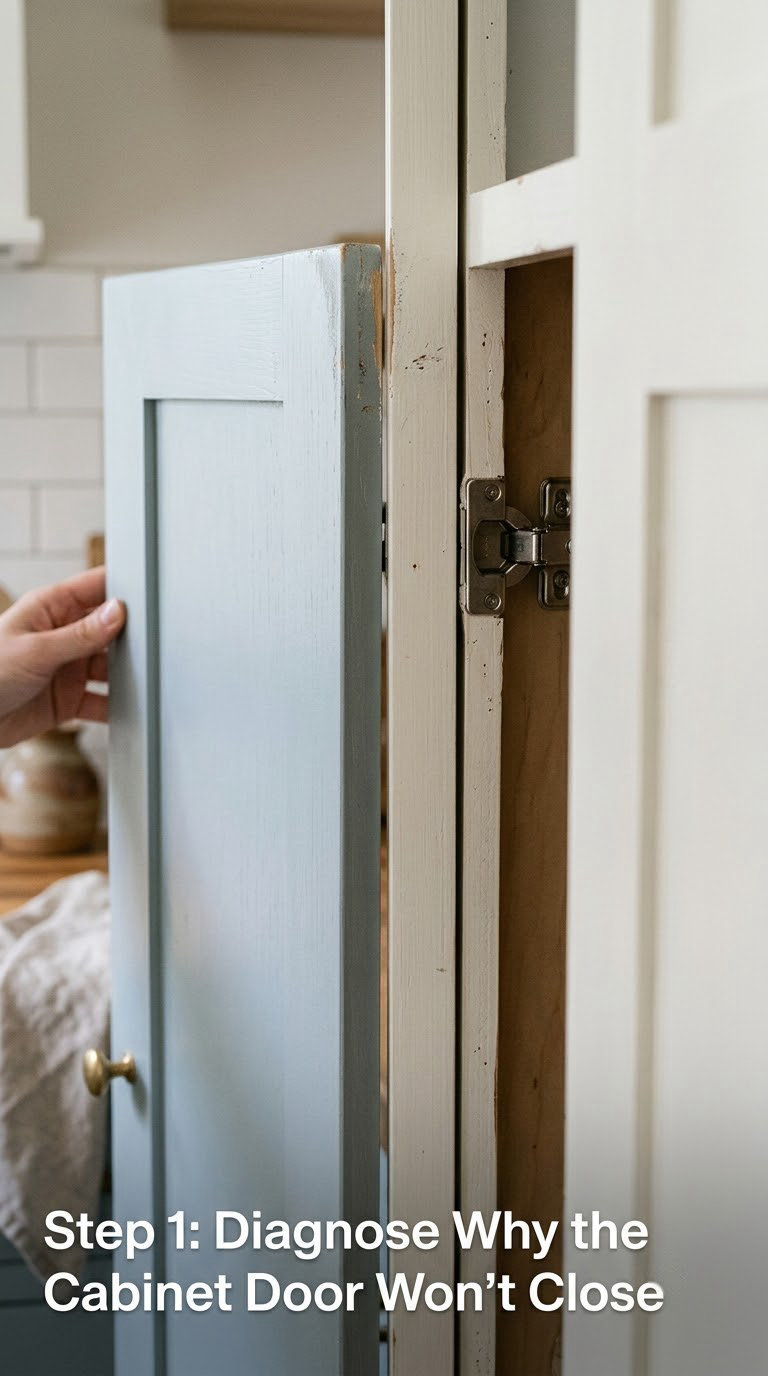
Start by watching the door fail. Close it from about an inch away and note the exact spot where it jams, the width of the gap at the top and bottom, and whether the face is flush or poking forward.
Read the symptom like this:
- Door rubs on the frame as it swings shut, then stops — hinge out of adjustment or a sagging top hinge.
- Door stops an inch short and drifts back open — depth adjustment is off, and on a soft-close hinge the damper cannot engage.
- Door closes and bounces straight back open — missing or weak magnetic catch, or soft-close tension turned too high.
- Door drops toward the floor and drags — loose hinge screws, most likely at the top hinge.
- Door fits fine in winter, binds in July — solid wood swelling with humidity.
- Screws spin without biting — the hole is stripped; tightening will not help.
Forum advice worth taking seriously: compare the broken door against a working door on the same run. They were installed with the same original settings, so whatever looks different is your clue. People on r/cabinetry reach for this comparison more than any other trick.
Step 2: Remove the Door or Access the Hinges
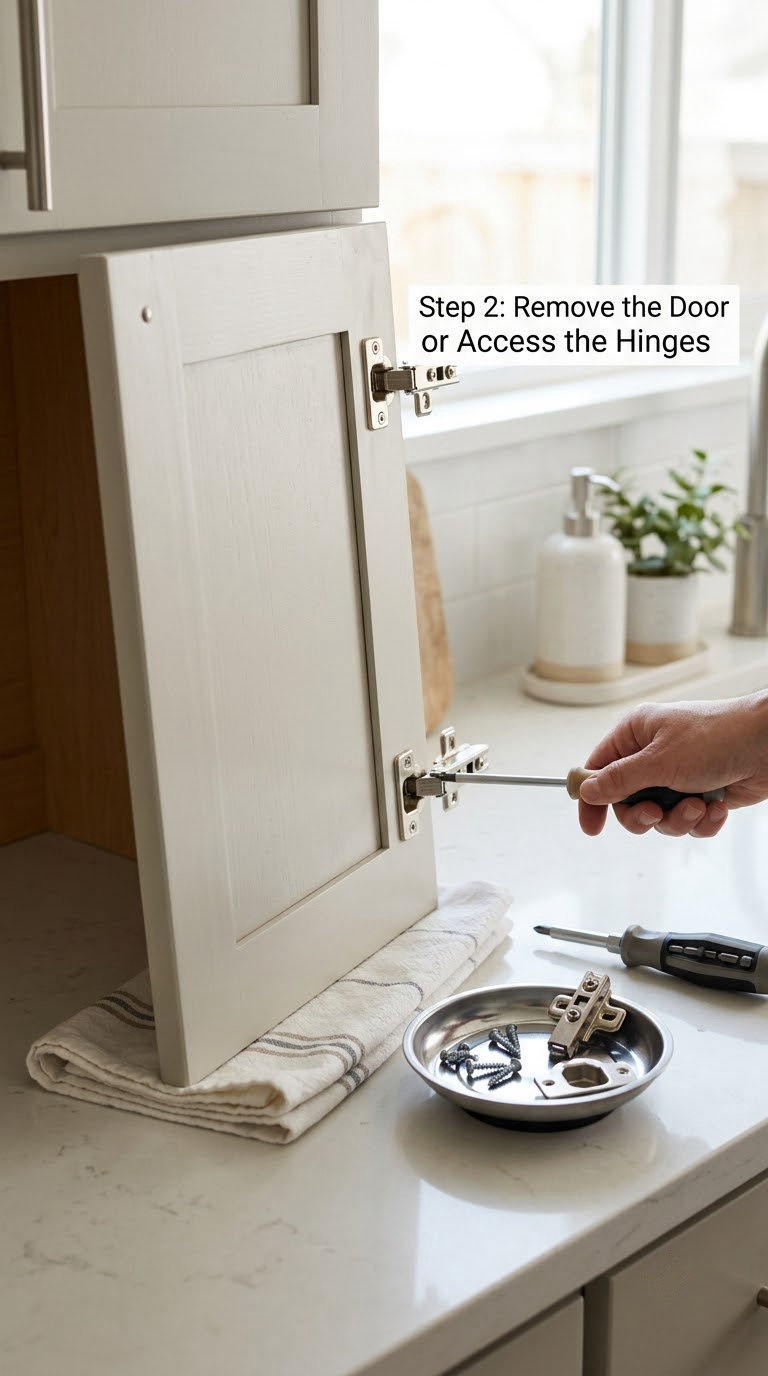
You can often adjust a concealed hinge without removing the door at all, which saves time and protects the finish. Mark the hinge position with pencil, then open the door wide and work on it in place.
For full access, or for an old exposed hinge, remove the door: back the screws out a quarter turn first to break any paint or glue seal, then unscrew fully while holding the door. Rest it on the folded towel, hinge side up. Do not let the weight hang off the last screw in the top hinge.
Step 3: Tighten or Replace Loose Hinge Screws
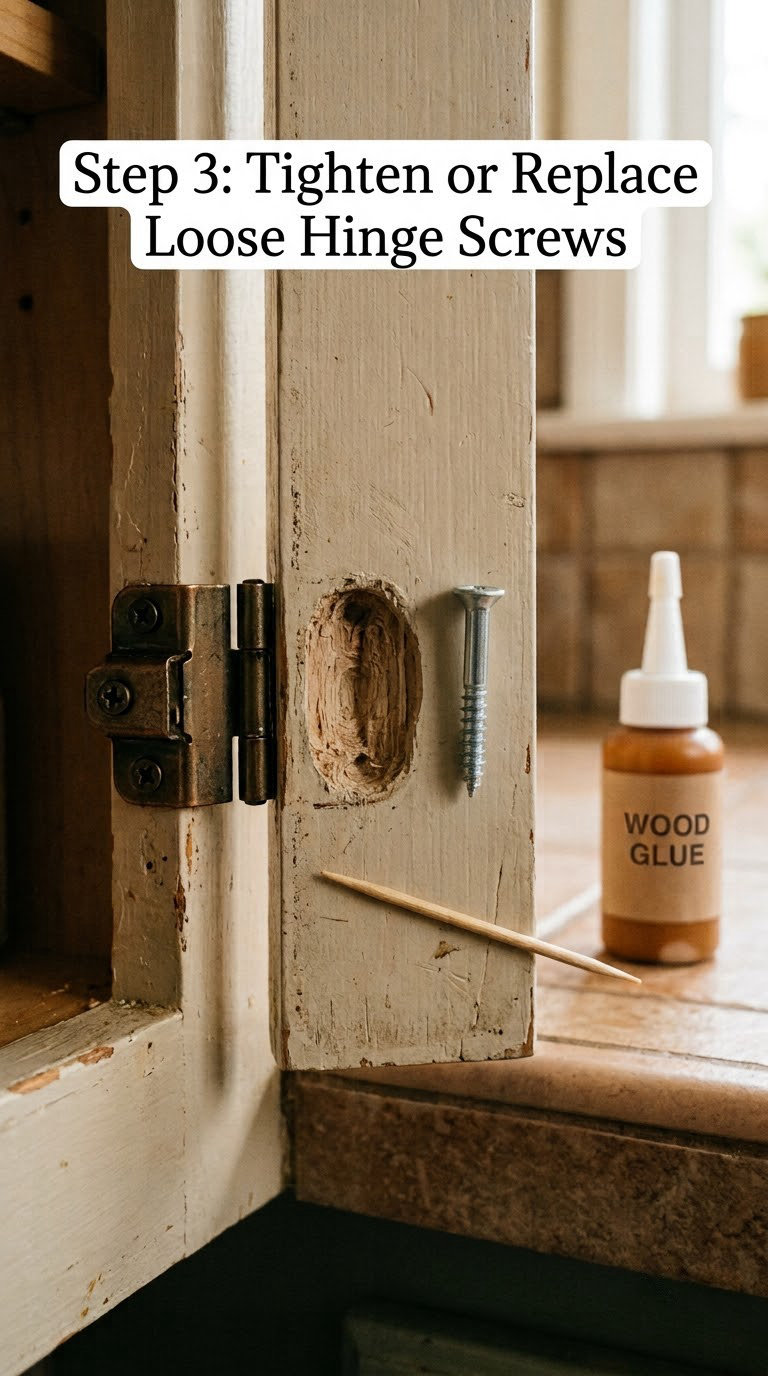
Loose hinge screws are the most common cause of a sagging cabinet door, and the most common fix takes about five minutes.
Run the screwdriver straight down the screw. If the screw head is chewed, place a rubber band over it for grip. Tighten each screw snug, then a quarter turn more, alternating between the cup screw and the mounting plate screw so the door stays square.
Do not drive a screw deep into the cabinet box without checking what is behind it. Hit a plumbing line or an electrical cable and you have a much bigger problem than a sticking door. Stop at the first resistance past the thickness of the panel.
If the hole is stripped: coat three or four toothpicks in wood glue, push them into the hole, break them off flush, and let the glue dry for 20 minutes. Then re-drill a pilot hole slightly smaller than the screw and reinstall. A screw with nothing to bite into will strip again in a month, so this is worth the drying time.
If the hole is chewed out entirely: fill it with wood filler, let it dry, then try a longer 1.5 inch screw so the threads find solid material behind the particle board. Or drop in a wooden screw anchor rated for the load.
Step 4: Adjust Hinges to Correct Door Alignment
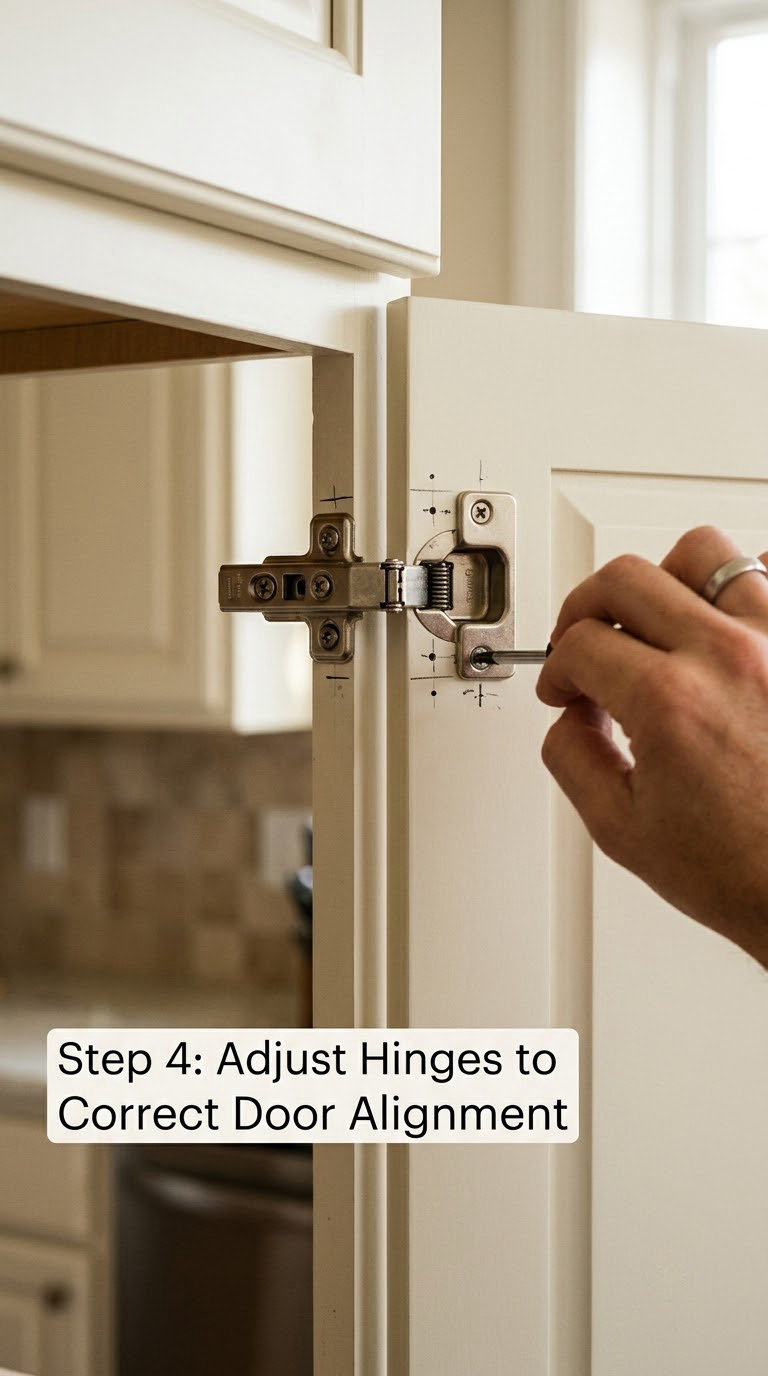
A concealed hinge moves the door in three directions, and each direction has its own screw. Learn these three and most door problems are solved.
- Side-to-side — the screw on the mounting plate nearest the door edge. Turning it clockwise pulls the door toward the centre of the cabinet, counterclockwise pushes it toward the hinge side. This is the fix for two double doors that overlap or leave a gap in the middle.
- Height — the screw on the mounting plate next to the first one. Turn it clockwise to raise the door, counterclockwise to drop it. This is the fix for a sagging door.
- Depth — the screw furthest back on the mounting plate, closest to the cabinet wall. Turning it clockwise pulls the door toward the front of the cabinet. This is the fix for a door that hits the frame on the way closed, and for a soft-close door that stops short.
Loosen the mounting plate screws slightly, make one adjustment in quarter turns, then tighten them and close the door to check. Never turn an adjustment screw more than a quarter turn before testing; the most common beginner mistake is over-adjusting and creating a new problem in a different direction.
On soft-close hinges, fix alignment first, every time. The fluid damper only engages when the door sits at the correct depth, so adjusting tension or turning the depth screw back to stop a door from slamming will simply stop it from closing at all. This one cause explains more “the door will not close” complaints than any other hardware fault, and it is the piece most guides skip.
Step 5: Fix a Door That Swells or Binds
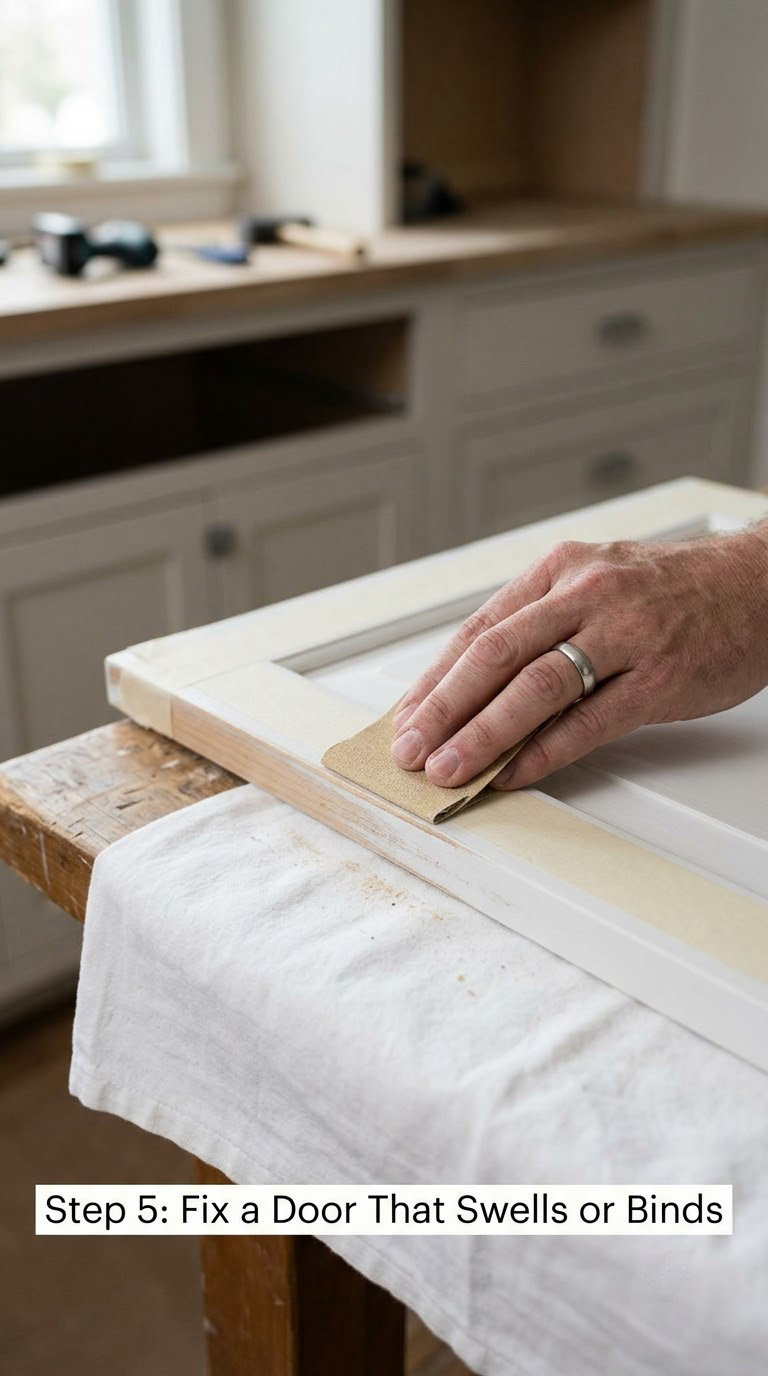
A solid wood door that closes in January and binds in July is swelling with seasonal humidity. Particle board and MDF doors stay flat, so if yours is the solid wood one, this is almost certainly your problem.
Mark the binding spots with pencil first, then remove only the high spots. Work with 120 to 180 grit sandpaper by hand, along the grain, taking off a few thousandths of an inch at a time and rechecking the fit. Test by closing the door on the hinge, not the frame.
Time it to the season, not to the weekend. If you sand a swollen door down during dry winter weather, it will fit all winter and bind worse next July. If the door is merely tight, first try adjusting the hinges or leaving it closed through a dry spell, which lets the wood shrink back on its own.
Once the edge is bare, seal it with a clear finish or matching paint so it does not absorb the next spike of humidity. If more than an eighth of an inch (3 mm) of wood has to come off, the door is warped beyond what repair can reverse.
Step 6: Rehang and Test the Cabinet Door
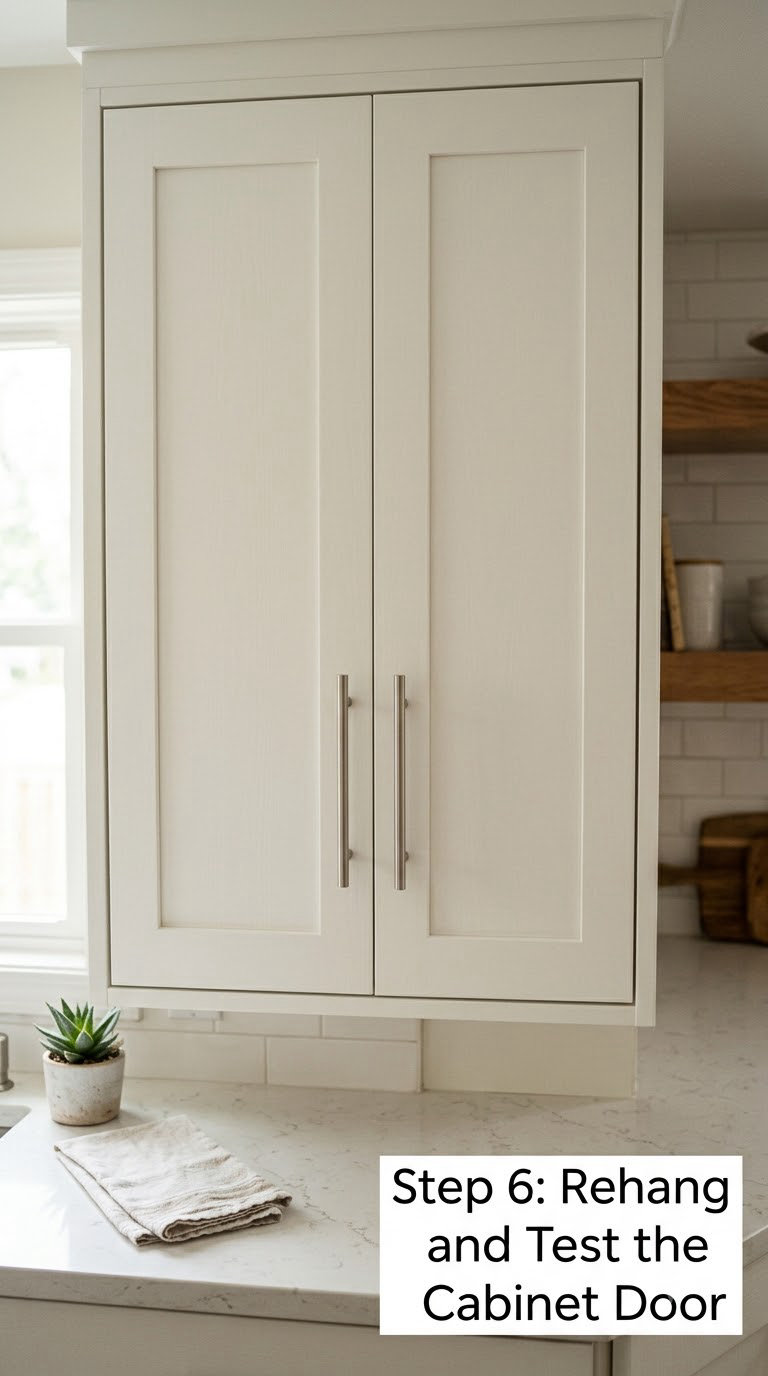
Reinstall the hinge cup first, pushing the door onto the arm until the mounting plate slots in, then tighten both screws snug and an extra quarter turn. Work the adjustment screws until the reveal gap reads an even 1/8 inch (3 mm) on the sides and top, and the door face sits flush with its neighbours.
Open and close it five to ten times, then check the gap from an angle in the light. Doors that look square from straight on are often off in daylight. Confirm the latch, the handle, and any soft-close action as the door swings the last inch. If a magnetic catch feels weak, mount it on the cabinet box with the strike plate on the door, lined up so they meet square.
Tools and technique for doors generally are covered in our recliner repair guide, which shares the same slow-and-diagnose-first approach.
Common Mistakes to Avoid
- Forcing the door closed. You will drive the hinge out of alignment and chip the frame. If it needs force, something is still binding.
- Over-sanding a swollen door. Sand in dry weather and you are fitting the door to January, not to the year.
- Over-tightening hinge screws. They crush particle board, sink below the surface, and strip on the next adjustment.
- Driving long screws without checking what is behind the panel. Cabinet backs hide plumbing and wiring.
- Adjusting soft-close tension before alignment. Correct the depth setting first or the damper never engages.
- Mixing hinge types. A half-overlay hinge on a full-overlay door will never sit right, no matter how you adjust it.
- Ignoring frame damage. A loose face frame or a sagging cabinet box moves every door on the run, and no amount of hinge work holds.
- Covering a crooked mounting screw with paint. If the screw into the face frame sits off-square, the door cannot be squared no matter which adjustment screw you turn.
When to Call a Pro
Hand this to a carpenter or cabinetmaker when the problem is behind the hinge rather than in it: a cabinet box that is cracked, soft or delaminated at the bottom, a face frame pulling loose, or doors out of square because the whole cabinet has moved off the wall.
Get help for specialty finishes such as fumed, antiqued or hand-painted doors, where sanding and touch-up will show. Water damage that has swollen the box itself, or a door that needs to be ripped down, re-glued and fabricated in a shop, is beyond a screwdriver.
Also worth a pro: the door sat open and the hinges have pulled the mounting plate loose from the cabinet box, leaving torn particle board that will not hold new screws.
Maintenance
- Check the screws twice a year. A quarter turn each on every hinge catches sag before it becomes a problem.
- Vacuum hinge hardware and wipe it clean. Grease and dust grit act like a slow hinge pin.
- Control kitchen humidity. Running the range hood and keeping the dishwasher closed while it runs cuts the moisture load that swells wood doors.
- Look for leaks. A slow drip under a sink behind a cabinet door is what warps the box and softens the screws.
- Seal any bare wood after any repair, especially edges and screw holes.
- Do not paint over the hinge screws. Build-up under the head is the reason many old painted hinges will not tighten. Scrape it back with a screwdriver bit and a cloth first.
Frequently Asked Questions
What causes a cabinet door not to close?
Usually a loose or stripped hinge screw, or a hinge that has slipped out of alignment. Wood swelling with humidity, a door falling onto an obstruction, a too-deep soft-close setting that stops the damper engaging, and a missing magnetic catch are the other common causes. Close the door slowly and watch where it stops, which tells you which one you have.
Can I fix a cabinet door that will not close without replacing it?
In most cases, yes. Tightening or repairing loose screws and working the three adjustment screws on a concealed hinge solves the majority of problems in ten to thirty minutes with no parts at all. Replacement is only needed when the hinge body is cracked or bent, the screw holes are destroyed beyond a filler repair, or a solid wood door is warped more than about an eighth of an inch.
How do I fix a swollen cabinet door?
First, try the hinge adjustment and leave the door closed through a dry spell, since solid wood shrinks back on its own. If it still binds, mark the high spots and sand only those, a few thousandths of an inch at a time with 120 to 180 grit. Seal the bare edge afterwards. Sand it in winter and it will fit again, then bind harder next summer.
Why does my cabinet door rub and stick?
A rubbing door is almost always out of alignment. Loosen the mounting plate screws and turn the side-to-side screw to move the door toward the centre of the cabinet, or the depth screw to pull it forward off the frame. Work in quarter turns, tightening and re-testing each time. A sagging door that drags on the floor usually needs the height screw turned clockwise.
What if the cabinet hinge screws will not hold?
If the screw spins without biting, the hole in the particle board is stripped. Coat a few toothpicks in wood glue, push them in, snap them off flush, wait 20 minutes, then drill a fresh pilot hole. For a chewed-out hole, fill it with wood filler and use a longer 1.5 inch screw or a wooden screw anchor to reach solid wood behind the panel.
Should I replace or repair a warped cabinet door?
A badly warped solid wood door cannot be straightened permanently, so replacement is the honest answer when more than an eighth of an inch has to be removed to make it close. Mild warp responds to hinge adjustment and to letting the door rest closed through a dry spell. Replacing a single door is straightforward if it matches the others; mismatched replacement doors are where the look falls apart.
Conclusion
Start with the screws, then the adjustment screws, then the door itself. Tighten anything loose, turn the side-to-side, height and depth screws a quarter turn at a time until the reveal gap is even, and only then touch a soft-close damper or fit a magnetic catch.
If the door binds on a swollen solid wood edge and it is a dry month, close it up and wait. If the cabinet box or face frame is damaged, or the wood has to come off in thick shavings, that is where the screwdriver stops and a cabinetmaker starts.