How Long Does It Take for Grout Sealer to Dry? (2026) Guide
How long does it take for grout sealer to dry? Most sealers are dry to the touch in 1 to 3 hours, and the floor is safe for light foot traffic after 2 to 6 hours. Full cure takes 24 to 72 hours, and water exposure should wait for the end of that window.
Those two numbers get mixed up constantly, which is where the frustrating Friday-sealing, Monday-unusable shower problem comes from. Touch-dry just means the carrier has evaporated off the surface. Cured means the resin has bonded to the grout and the barrier actually repels water.
Contents
There is a second wait people forget entirely, on the other side of the job. Freshly grouted cement-based grout needs its own curing period of at least 48 hours, and up to a week is better, before you even open the sealer. Sealing wet grout locks the moisture in and ruins both the grout and the seal.
Timing matters here more than in most tile projects, because grout sealer cure time sets the date the room comes back to life. If you also need equipment for the cleanup afterwards, our picks on seal applicators cover the spray and roller options that work on vertical walls.
Grout Sealer Drying Times at a Glance
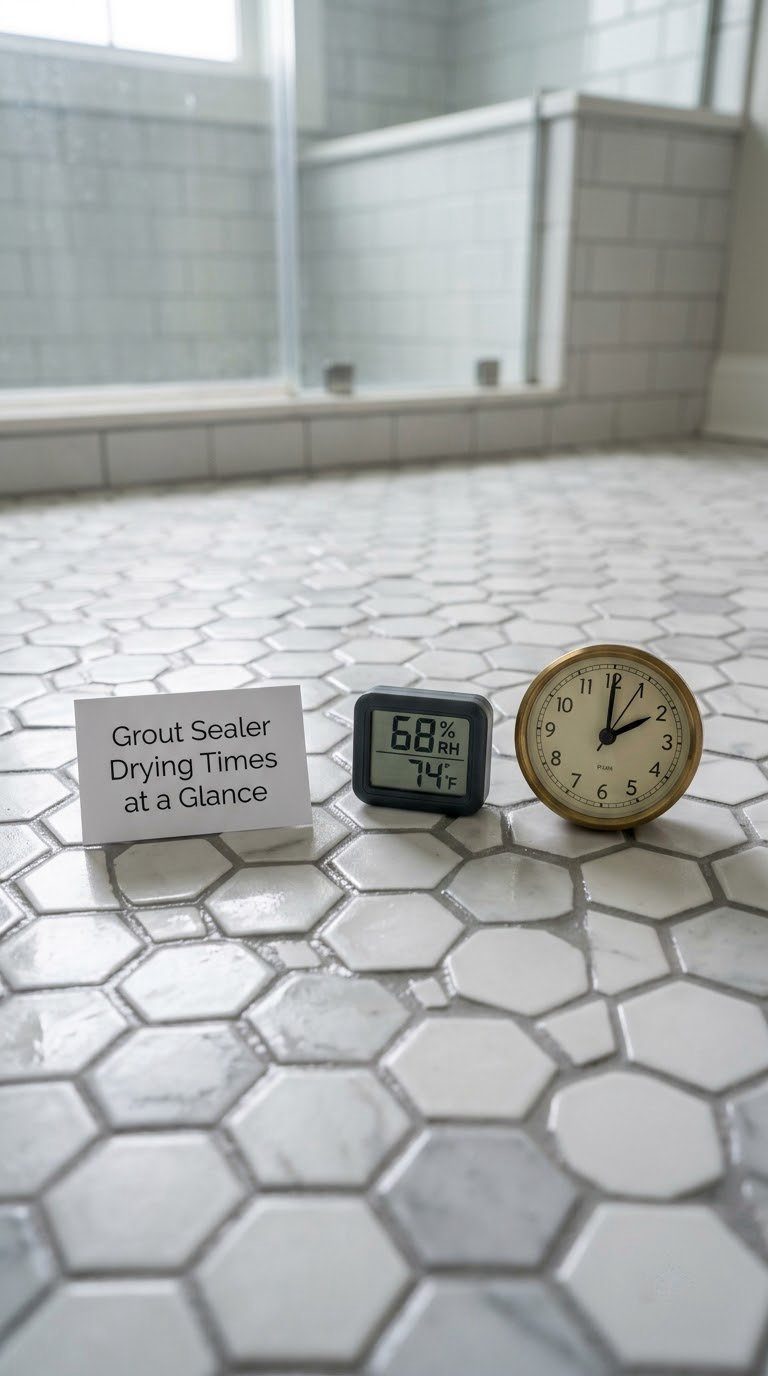
Here is the short version in one table. Read the water-ready row carefully, because it is the one people ignore and then wonder why the shower went cloudy.
| Milestone | Typical wait | What is safe at this point |
|---|---|---|
| Dry to the touch | 30 minutes to 3 hours | Fingertip and cloth contact only. No shoes, no kneeling, no water. |
| Light foot traffic | 2 to 6 hours | Socks or bare feet only, and only in an area that stays dry. |
| Furniture and bath mats back in place | 24 hours minimum | Light pieces. Keep heavy furniture until full cure. |
| Water ready: shower, mopping, sink splashes | 24 to 72 hours | Nothing wet before the full window has passed. |
| Fully cured | 24 to 72 hours | Routine cleaning, showering, normal traffic. |
These ranges are typical, not a promise. The label on your bottle wins every time it disagrees with this table, and the label on your particular sealer is almost always more conservative than what a blog says.
The numbers come straight from manufacturer technical data sheets rather than guesswork. A typical grout and stone sealer data sheet states it will be dry to the touch in 1 to 3 hours, and that the area should be kept dry and free from staining materials for 72 hours. That single sheet covers the entire range people search for.
On the forums, the numbers run a touch longer than the labels. A regular on r/HomeImprovement put it as you can touch it in 2 to 5 hours, but you should not get it wet, like with a shower, until after 72 hours. That is good practical advice, and it lines up with the cautious end of the range.
Here is the distinction worth keeping in your head: drying is the fast, physical step where solvent or water evaporates out of the sealer. Curing is the slow chemical step where the resin hardens and bonds inside the pores. You can touch grout long before it can handle a shower.
What Type of Grout Sealer Are You Using?
Sealer chemistry moves that table around more than any other factor. Three families cover nearly everything sold in the US.
| Sealer type | Dry to touch | Full cure | How it behaves |
|---|---|---|---|
| Penetrating, water-based | 1 to 3 hours | 24 to 72 hours | Soaks into pores with no film. Low odor, no color change, needs more frequent reapplication. |
| Penetrating, solvent-based | 30 minutes to 2 hours | 24 to 48 hours | Dries fastest, penetrates deepest. Stronger odor, needs ventilation while you work. |
| Color-enhancing or film-forming | 2 to 6 hours | 48 to 72 hours | Lays a surface film that evens out grout color and can add sheen. Shows roller marks and haze if wiped late. |
Penetrating sealers: the 24 to 48 hour job
Penetrating sealers soak into the pores of the grout and leave nothing on top. Because there is no film to form, the dry time is short and the cure is mostly the resin setting inside the grout.
Most of these are water-based, which is what you want in an occupied house. The odor is mild, cleanup is soap and water, and a 24-hour cure is usually enough for a bathroom floor or backsplash.
If the bottle lists VOC content and a flash point, it is solvent-based. Those dry faster, and they smell strong enough that you open the windows and leave the room while it works.
Color-enhancing sealers: budget 72 hours
These are the ones people rush, and the ones that fail publicly. A film-forming sealer sits on top of the grout as a thin polymer layer that levels the color and can add a slight sheen.
That film needs longer to harden, so plan on the full 72 hours before water. It also has to be wiped off the tile face within the dwell window the label specifies, usually about 10 minutes, or it dries into a haze you will be scrubbing later.
Forum DIYers name that haze as their single biggest sealing mistake, and the fix was not more product. It was wiping faster and using less.
Two exceptions to all of this: epoxy grout and factory pre-sealed grout do not need sealing. Epoxy is non-porous, and sealing it adds nothing but risk.
What Changes the Drying and Curing Time?
Read your conditions and then add time. Most people who feel rushed are working in a room that is cooler and more humid than the one the label assumes.
- Grout porosity: standard cement-based grout drinks sealer in. Larger grout gaps and wider joints take longer to wet out and longer to finish.
- Tile density: dense porcelain or glass tile absorbs almost nothing, so you are relying on evaporation alone. Heavier stone takes the sealer deeper and dries from the inside out.
- Temperature: warm, dry air is the friendliest condition. Cold air slows evaporation and slows the chemical set at the same time.
- Humidity: high relative humidity traps the carrier in the room. A basement bathroom can sit well past the label window with no sign of trouble.
- Ventilation: a closed room with no air movement keeps solvent vapor around the surface instead of letting it clear.
- How much you applied: one thin coat dries faster and absorbs better than a heavy one. Puddles sit on top and cure last.
- Number of coats: each coat needs its own window before the next goes on. See below.
- Sun and weather outdoors: UV and standing water both extend the timeline on a patio or pool deck, and sealer on a wet outdoor joint can never cure properly.
A useful cross-reference if you are painting in the same project: how long bathroom paint takes to dry follows the same logic, and humidity and airflow push both jobs the same direction.
How to Tell When Grout Sealer Is Ready
Do not guess from how the grout looks. Sealant can feel dry on the surface while remaining soft and permeable underneath.
How long does grout sealer take to dry in a cold or humid room?
Add hours, not minutes. In a cool, damp room, add several hours to the touch-dry figure and treat 72 hours as the minimum before water, not the maximum.
Below 50F the cure slows dramatically, and some sealers stop curing altogether until the room warms up. Warm the room before you start rather than after.
The checks, in order of usefulness:
- Read the label. The stated cure time is the number that governs, and it is a floor rather than a target.
- Run the water-drop test on a hidden joint. Put a few drops of plain water on a joint out of sight. If it beads and sits, the seal is working. If it darkens and soaks in, it is still porous.
- Look for even color. Penetrating sealers leave no film, so an even matte finish with no wet patches is the sign of uniform absorption.
- Check a closet corner first. Test the least visible joint before trusting the shower floor.
- Watch the timeline, not the surface. Dry to the touch is not permission to shower. The cure clock is what counts.
If water hit the grout before it cured, do not panic and do not mop it. Blot standing water with a clean towel, keep traffic off the area, let it finish curing on its own, then test again. If the drop test fails after 72 hours, spot-seal that joint after it has dried rather than redoing the whole floor.
To get sealer off the tile face, wait until it has fully hardened, then use a tile-safe grout haze remover or a mild acidic cleaner with a soft pad. Test a small area first and stay away from acid on natural stone.
How to Speed Up Drying Safely
A few things genuinely help, and a few popular ones just push moisture around.
- Warm the room first, then seal. A comfortable 65 to 75F with low humidity is the easiest condition you can hand yourself.
- Run a dehumidifier. This is the single most effective change in a basement or enclosed bathroom, because it pulls the carrier out of the air instead of merely circulating it.
- Use gentle air movement. A box fan set far enough away to blow across the floor at low speed helps evaporation without blasting the sealer off the joint.
- Apply thinner coats. Two light coats dry faster than one heavy coat and seal better.
- Spread coats over two days when you can. Interrupting the cure beats rushing it.
What to avoid: pointing a fan directly at the grout, cranking the heat, sealing a surface that is already damp, mopping while the sealer is still soft, and letting anyone walk the joints to test them. Shoes crush a curing sealer film and leave permanent scuff marks that no amount of resealing hides.
Frequently Asked Questions
How long after sealing grout can I shower?
Wait the full cure window on your label, which is usually 24 to 72 hours, before a shower touches the grout. Forum advice treats 24 hours as optimistic and 72 hours as the safe number. If the room is cool or humid, assume the long end. Showering early weakens the seal, the grout can stain within weeks, and you end up stripping and resealing.
How long after sealing grout can you walk on it?
Most people wait 2 to 6 hours before stepping on sealed tile, and keep to socks or bare feet in a dry area. Hold off on shoes, mats, and furniture for at least 24 hours. Heavy pieces such as a vanity or a hamper should wait for full cure, because a hard load can crush a sealer film that has not hardened.
Do I need two coats of grout sealer?
Two coats are the usual recommendation for standard cement-based grout, and the second coat fills pores the first one missed. Let the first coat dry fully, typically 1 to 4 hours, then apply the second and wipe off the excess within the dwell window the label specifies. One coat is enough for pre-sealed grout, and epoxy grout needs no sealer at all.
What happens if you seal grout too early?
Sealing wet grout traps moisture inside the joint. The grout can stay weak, discolor, or crumble later, and the seal itself will not bond properly. Cement-based grout needs at least 48 hours, and up to a week is better, before the first coat goes on. The haze on the tile face should already be removed before you start.
What happens if grout sealer gets wet before it cures?
Blot standing water with a clean towel rather than mopping it. Keep traffic off the area and let the sealer finish curing on its own, which takes the full 24 to 72 hour window. Then run a water-drop test on a hidden joint. If the water soaks in, let the grout dry completely and spot-seal that joint instead of stripping the entire floor.
How to tell if grout is properly sealed?
Place a few drops of plain water on a grout joint, ideally one out of sight. Properly sealed grout beads the water so it sits on the surface. If the water darkens the joint and disappears into it, the sealer has not fully cured or did not penetrate. Wait another 24 hours and retest before applying an extra coat.
What happens if grout sealer dries on the tile face?
Dried residue on tile is a haze, not a failure, and it comes off after the sealer hardens fully. Use a tile-safe grout haze remover or a mild acidic cleaner with a soft pad, working a small section at a time. Never use acid on natural stone or marble. Keeping to the label dwell window when wiping is what prevents it in the first place.
What to Do First
Check your label’s cure number before you start the job, then work backward from the day you need the room back. Seal on a weekday in dry, warm weather, keep the area dry for the full window, and test one hidden joint with water before you commit to a shower.
And if you only have 24 hours, seal it anyway, keep everything dry for the first day, and accept that you may need to spot-treat a joint or two later. The cure window is the one part of this job you cannot shorten with impatience.