Cost to Replace Carpet with Vinyl Plank: Simple Guide 2026
Most homeowners spend $4 to $12 per square foot to replace carpet with vinyl plank, installed. That figure covers the planks, carpet and pad removal, underlayment, and installation labor — but subfloor repair is usually billed on top once the old carpet is pulled up.
The wide gap between the low and high end is not about flooring being fancy. It is about what the carpet was hiding. A clean plywood subfloor with a flat surface keeps a project at the lower end; a concrete slab with soft spots and moisture pushes it toward the upper one.
Contents
Fall is the busiest season for flooring work, and contractors book solid weeks out from September through November. Measure your room now, pull a few quotes before the queue builds, and you will have real numbers instead of a range you cannot plan around.
Vinyl Plank Replacement Costs by Room Size
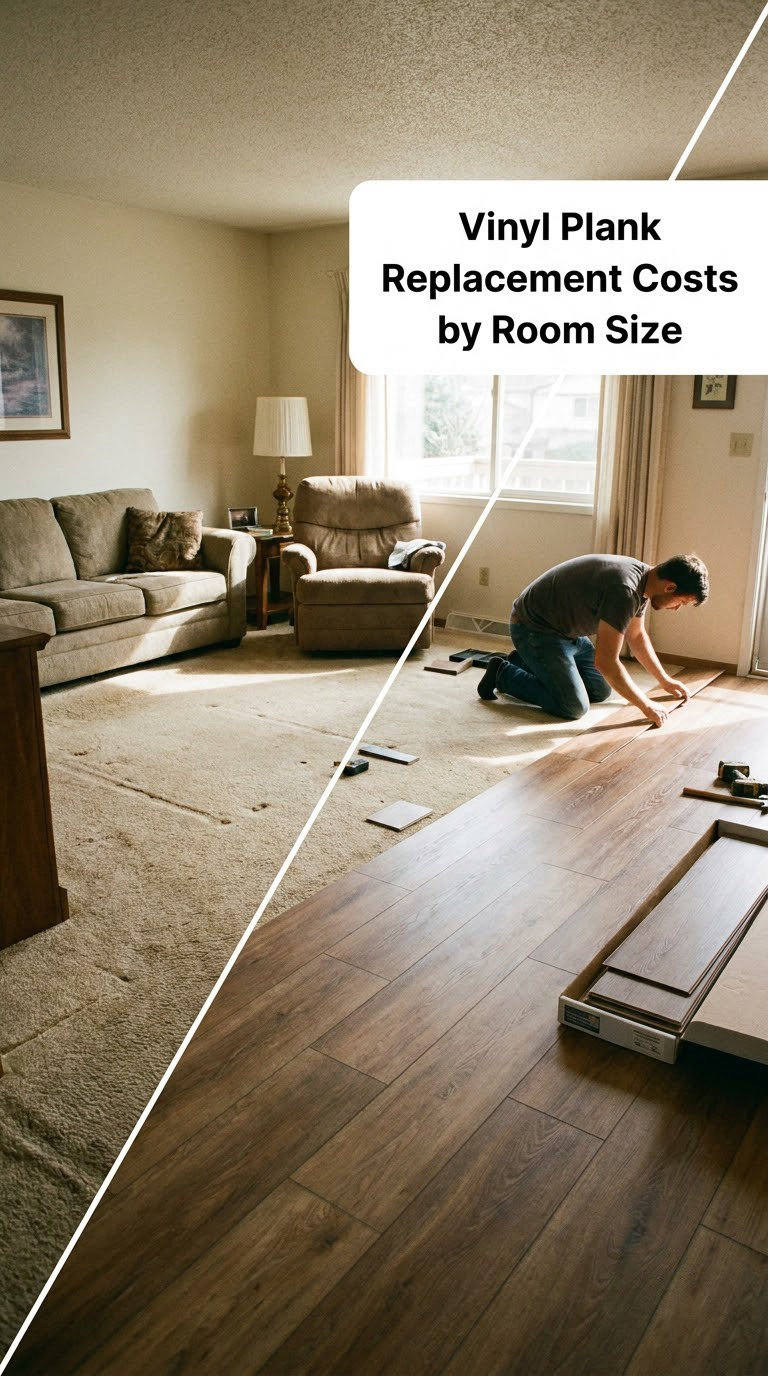
The table below gives realistic installed totals for a straightforward carpet-to-vinyl-plank conversion, assuming a flat subfloor and a rectangular room with no stairs. Small jobs carry the highest per-square-foot cost because crews charge a minimum job charge that a 900 sq ft job spreads out across hundreds of feet.
| Room or area size | Floor area | Estimated installed cost | Typical per sq ft |
|---|---|---|---|
| Small bedroom | 120 sq ft | $900 to $1,900 | $7.50 to $15.80 |
| Average bedroom | 180 sq ft | $1,100 to $2,100 | $6.10 to $11.70 |
| Standard living room | 300 sq ft | $1,700 to $3,300 | $5.70 to $11.00 |
| Three-bedroom main floor | 900 sq ft | $4,500 to $9,000 | $5.00 to $10.00 |
| Whole main level | 1,500 sq ft | $7,000 to $15,000 | $4.70 to $10.00 |
| Large open plan | 2,000 sq ft | $9,000 to $20,000 | $4.50 to $10.00 |
A room under about 100 sq ft is the outlier. Contractors in the Seattle area quoted roughly $2.50 per sq ft starting for vinyl plus carpet removal, which sounds cheap until the minimum job charge of $400 to $700 lands on a 60 sq ft bathroom. Expect a small room to bill closer to a half-day of crew time than to its square footage.
How Much Does It Cost to Replace Carpet with Vinyl Plank?
A carpet-to-vinyl-plank conversion runs $4 to $12 per square foot installed. That total includes flooring material, carpet and pad tear-out with disposal, underlayment, and installation labor. Subfloor leveling, subfloor repair, stair work, and trim or transition pieces usually sit outside that range and are quoted separately.
Regional labor markets move these numbers a lot. A metro with expensive trades can run 20 percent above the national average, while parts of the South and Midwest often come in under it. Treat the ranges above as a planning guide, not a bid.
Vinyl Plank Material Cost Comparison
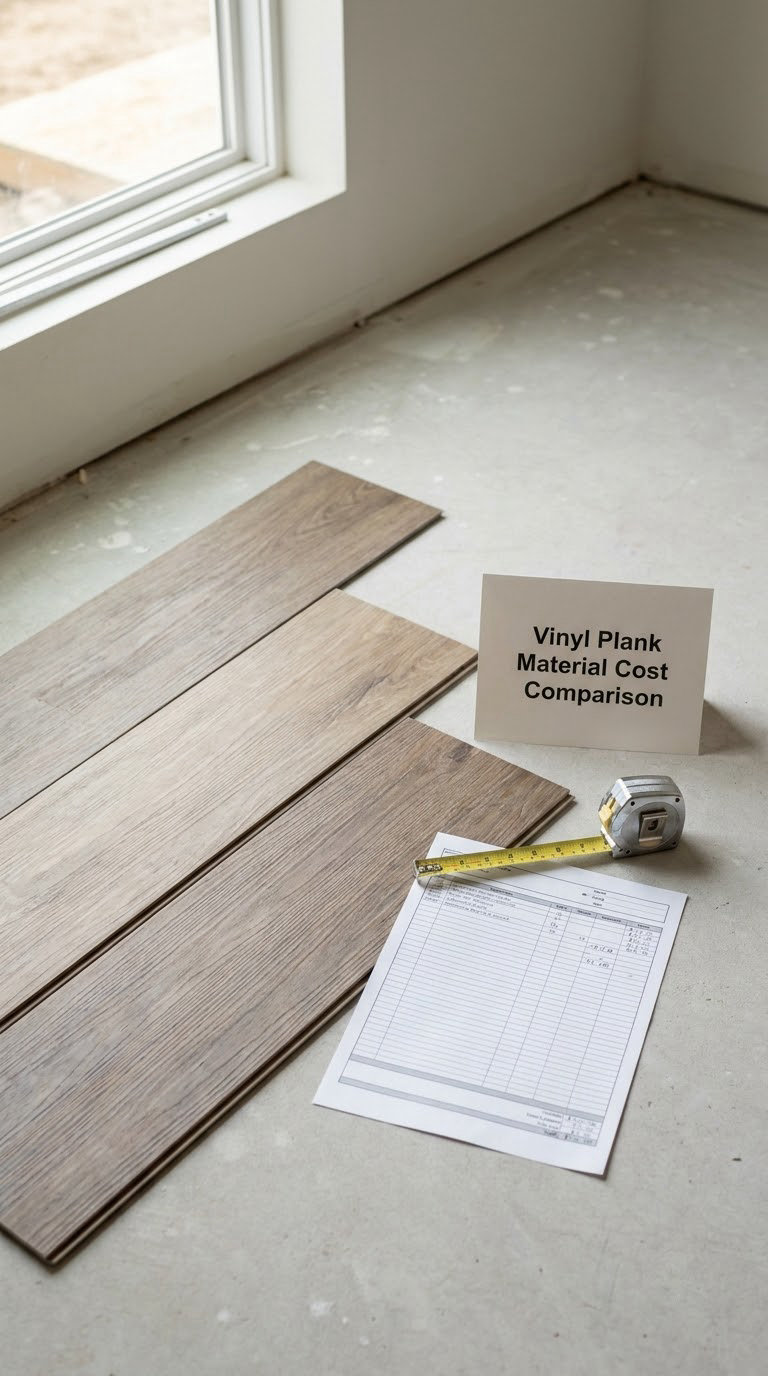
Material is the one line where you have real control. Everything else is labor, and labor is set by your local market. The three categories below cover almost everything sold as vinyl plank today.
| Material type | Cost per sq ft | Wear layer | Best for | Watch out for |
|---|---|---|---|---|
| Budget click-lock plank | $1.50 to $2.50 | 6 to 8 mil | Rentals, closets, low-traffic rooms | Scratches show fast; often only 2 to 5 planks per carton for a small closet |
| Mid-range rigid core (SPC or WPC) | $2.50 to $4.00 | 12 to 20 mil | Most living rooms, kitchens, rentals, pet homes | Attached pad means no extra underlayment; heavier to handle |
| Premium thick-core plank | $4.00 to $6.00 | 20 mil and up | Entryways, hallways, stairs, whole-home installs | Money you may not recoup; watch how the plank locks, not just the wear layer |
| Sheet vinyl | $1.50 to $3.00 | Not usually rated | Basements, laundry rooms, small baths | Seams in larger rooms, glue-down labor, harder to repair |
| Vinyl tile (LVT) | $2.00 to $3.50 | 10 to 20 mil | Patterned floors where you want flexibility | More grout lines and more cuts than plank |
Rigid core planks with a 12 mil or higher wear layer are the sweet spot for most residential conversions. Below 8 mil, plan on replacing in a decade or less in a busy room. Above 20 mil, the extra spend mostly buys appearance and locking strength, not a measurable lifespan jump in a normal home.
One more spec matters before you shop: the core thickness. A 6 mm core is a thin pad-grade product; 8 to 12 mm feels substantial underfoot and tolerates a slightly uneven subfloor. If you want a second opinion on specific products, our picks for the best vinyl plank flooring sets walk through the differences, and if your subfloor carries radiant heat, the best luxury vinyl plank rated for radiant heat covers which cores stay safe over a warm floor.
Vinyl Plank Advantages and Disadvantages
This is the honest version. Vinyl plank wins on durability and water resistance, and it loses on comfort and sound.
| Factor | Vinyl plank | Carpet |
|---|---|---|
| Installed cost per sq ft | $4 to $12 | $2 to $8 |
| Lifespan | 15 to 30 years | 5 to 10 years |
| Water and spills | Waterproof core, wipes clean | Stains and odors set in |
| Comfort underfoot | Hard, cooler, hollow sound | Soft, warm, quiet |
| Cleaning | Broom, damp mop, no specials | Vacuum often, periodic deep clean |
| Allergens | Non-porous, holds no dust | Traps dust mites and dander |
| Single plank repair | Straightforward if spare material is kept | Patch or re-seam the whole area |
| Resale perception | Read as an upgrade in most buyers’ eyes | Neutral; some buyers actively prefer it in bedrooms |
| Upstairs noise | Footsteps carry to the room below | Muffles them |
One honest note on resale: if you keep the spare planks and the original carton, you can replace a damaged board in five years and match the lot. Many homeowners skip this, then discover the discontinued color years later.
If you are still deciding, and the existing carpet is a low-pile type you like, our best carpet cleaners for low pile carpet may extend its life a few more years at a fraction of a conversion.
What Changes the Cost to Replace Carpet with Vinyl Plank?
Once you see two quotes that differ by thousands, the gap is usually in one of these seven places.
- Subfloor condition. Carpet hides dips, soft spots, water damage, and tack strip gouges. Self-leveling compound runs roughly $1 to $3 per sq ft to apply over a problem area, and plywood board repairs add more.
- Concrete slab versus plywood. A slab needs moisture testing before anything goes down, and often a moisture barrier membrane at $1 to $2 per sq ft. Plywood usually just needs screws filled and sanding.
- Carpet pad and tack strip removal. Many quotes fold demo into a single per-square-foot line and never itemize the pad. Ask for it separately; if it is buried, the rest of the quote may be too.
- Plank grade. The gap between a 6 mil and a 20 mil wear layer is roughly $2 per sq ft across the whole floor.
- Layout complexity. A 45-degree or herringbone layout adds $2 to $5 per sq ft in extra cutting and labor. Straight runs with the long dimension of the room cost least.
- Trim, transitions, and door clearance. Baseboards come off and go back on, thresholds need a transition strip at every carpet-to-vinyl junction, and interior doors may need planing after a thicker floor goes down. Budget $1 to $3 per linear foot for trim work.
- Stairs. Stair treads are priced per step, typically $40 to $100 or more each, because each one is measured, cut, and fitted separately.
Regional variance deserves its own note. High-cost metros such as San Francisco, New York, and Seattle can run roughly 20 percent above the national average on labor. Labor is normally half the bill, so that gap shows up quickly on a large floor area.
Homes built before 1980 deserve a caution. If old carpet comes up and you find vinyl tile or black sheeting underneath, stop and get it tested for asbestos before disturbing it further. Testing runs a couple hundred dollars and is far cheaper than remediation.
DIY Versus Hiring a Flooring Installer
Doing it yourself saves the labor line, which runs about $2.50 to $5 per sq ft. On a 500 sq ft room that is $1,250 to $2,500 in your pocket, and it is the single largest line in the estimate.
The catch is that the labor line includes judgment. A click-lock plank will bridge small gaps happily but will not tolerate a hump; the planks either click or they do not, and a bowed subfloor produces a floor that rocks. Glue-down LVT and sheet vinyl leave no room for error at all.
Tools for a click-lock install are modest: a table saw or angle grinder with a carbide blade, a tape measure, a straightedge, a square, spacers for the expansion gap, a pull bar, a rubber mallet, knee pads, and a shop vac. Many people start with the vinyl plank installation kits built for DIYers rather than buying pieces separately.
| Route | Best for | Main tradeoff |
|---|---|---|
| DIY click-lock | Flat plywood subfloor, rectangular rooms, click-lock plank | Time and tool rental; no workmanship warranty |
| Hire a pro, floating install | Most whole-home conversions | Highest labor share |
| Hire a pro, glue-down | Bathrooms, basements, rooms with heavy water risk | Longer cure time, higher skill requirement |
| Hire a pro, stairs or pattern layout | Stairs, herringbone, large open plans | Not a realistic DIY scope |
Hire someone when the subfloor is concrete, when any room has stairs, when you are above a finished room that noise would bother, or when the manufacturer warranty depends on professional installation. Some planks carry a limited lifetime residential warranty only with documented professional work, so check before you save the labor and lose the coverage.
How to Estimate Your Vinyl Plank Replacement Budget
Run the numbers yourself in seven steps before anyone shows up. It takes twenty minutes and it anchors the conversation when quotes arrive.
- Measure the room. Measure length and width at floor level in inches, then multiply to get square footage. Do it twice at different points.
- Add waste. Multiply by 1.10 for a straight layout, 1.15 for a room with odd angles, 1.20 for a pattern layout.
- Pick a material price. Choose the per-square-foot figure from the tier table above, then multiply by your waste-adjusted footage.
- Add underlayment or a moisture barrier. Planks with attached pad skip this. Add roughly $0.50 per sq ft for separate pad or foam, more for a slab.
- Add removal, disposal, and trim. Plan on about $1.50 per sq ft for carpet, pad, and tack strip haul-away, plus $1 to $3 per linear foot for baseboards and transitions.
- Add labor. $2.50 to $5 per sq ft for straight-run floating install; add 50 to 100 percent for stairs or a pattern layout.
- Add a 10 to 15 percent contingency. Something will be under the carpet. This line is not pessimism; it is the difference between a budget and a surprise.
Three written, line-itemed quotes will show you exactly where they disagree. Compare the lines, not the totals: if one quote is $3,000 lower, find out whether it is cheaper material, fewer included prep hours, or simply not mentioning the subfloor at all.
Frequently Asked Questions
Can you install vinyl plank over existing carpet?
You can, but most manufacturers and installers say not to. Carpet, pad, and tack strip must come up so the planks sit on a hard, flat subfloor. Floating a click-lock plank over carpet gives no flat surface, hides moisture, and locks in odors. Tear-out adds roughly $1.50 per sq ft and is worth the line item.
How smooth does the subfloor need to be for vinyl plank?
The standard spec is 3/16 inch of deviation across any 10 feet of floor, which you can check with a 10-foot straightedge. Rigid core planks tolerate small hollows because the locking system bridges them, but any high spot will rock the floor or stop a plank from clicking together. Fill dips and grind humps before you start laying.
Is carpet outdated for resale in 2026?
Carpet is not outdated, but buyers have shifted. Most now read durable plank flooring as an upgrade, especially in kitchens, bathrooms, and basements. In upstairs bedrooms, a good number still prefer carpet for comfort and quiet. If resale matters, plank in the main living areas and keep carpet in the bedrooms is a defensible split.
How much extra flooring should I buy for waste?
Buy 10 percent extra for straight layouts in simple rooms, 15 percent for rooms with angles or a lot of cuts, and 20 percent for herringbone or diagonal patterns. Keep the leftover planks and the carton label, because matching a replacement board years later depends on the same dye lot.
How long does a carpet to vinyl plank conversion take?
A 500 sq ft room usually takes a crew one to two days: a half day for tear-out and haul-away, a day for prep, underlayment, and plank installation. Add a day if the subfloor needs leveling or drying. Concrete slabs and pattern layouts stretch that to three days or more.
Conclusion
Start with the measurement, not the flooring aisle. Once you know your square footage, multiply by $8 to $11 as a working number, add 12 percent for contingency, and see whether that matches your plan. If it does not, the lever is almost always material tier rather than finding a better installer.
Then get three written quotes with the lines separated: demo, materials, underlayment, prep, labor, and trim. If they land within a few hundred dollars of your own estimate, sign with confidence. That step takes one afternoon and it is the cheapest insurance in the whole project.