
Cost to Install a Fence Per Foot: October 2026 Material Guide
The cost to install a fence per foot runs from roughly $8 for basic chain link to well over $100 for wrought iron, and most homeowners pay between $20 and $60 per linear foot for a standard residential job. That installed figure already includes materials, posts set in concrete, and labor for a run of ordinary flat ground.
It does not include everything. Gates, old-fence removal, steep lots, permit fees and small-job mobilization all sit outside that baseline, and they are the reason a quote can land far above the number you multiplied out on your own.
Contents
Below is a buyer-side reference: what each material costs per linear foot, which variables move the number, and what a real quote should say. Figures were checked in October 2026 and are US planning ranges, not quotes. Your market will differ.
If a wood fence is on your list at all, the maintenance side is worth reading early. Our picks for the best fence stains and paints cover the finishes that decide how long a cedar or pressure-treated run actually looks good.
Cost to Install a Fence Per Foot by Material
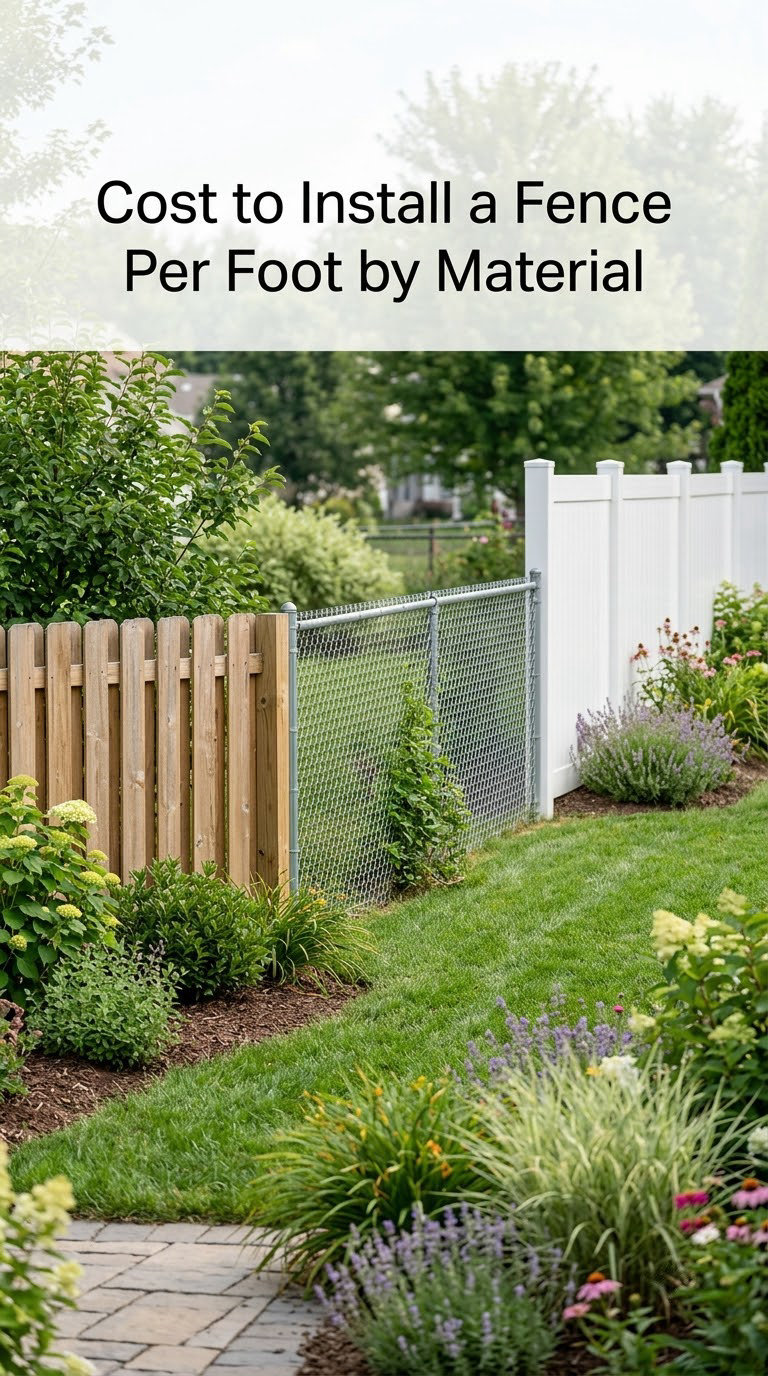
This table is the one to bookmark. It gives the installed cost per linear foot for the materials you will actually be choosing between, plus a rough lifespan and the situation each one suits.
| Fence material | Installed cost per linear foot | Typical lifespan | Best for |
|---|---|---|---|
| Chain link | $8 to $16 | 15 to 25 years | Large low-budget perimeters, pets, rental properties |
| Wire and farm fence | $10 to $20 | 10 to 20 years | Rural boundaries, gardens, livestock |
| Split rail | $14 to $28 | 15 to 25 years | Open front yards, acreage, decorative boundaries |
| Wood picket | $15 to $30 | 15 to 25 years | Front-yard curb appeal with light privacy |
| Wood privacy, pressure-treated | $22 to $45 | 15 to 25 years | Backyard privacy on a sensible budget |
| Cedar privacy | $30 to $60 | 20 to 30 years | Natural wood look that resists rot |
| Vinyl privacy | $28 to $55 | 20 to 30 years | Low upkeep, clean uniform appearance |
| Composite | $35 to $65 | 20 to 30 years | Wood color without staining or warping |
| Aluminum | $40 to $75 | 20 to 30 years | Decorative styles, wrought-look without rust |
| Steel | $45 to $80 | 20 to 40 years | High-security perimeters, anti-climb |
| Wrought iron, 4 foot | $55 to $85 | 40 years and up | Decorative frontage where privacy is not needed |
| Wrought iron, 6 foot | $85 to $150+ | 40 years and up | Security and durability over everything |
| Pool-code compliant | $60 to $120 | Varies | Enclosures that must meet local safety code |
| Invisible pet fence | $200 to $2,500 per system | 10 to 20 years | Containment without a visible barrier |
Two halves build that number. Materials typically account for about half the total, and labor for the other half. For a standard wood privacy fence, labor alone runs $10 to $20 per linear foot while materials add $15 to $35, which lands right in the $25 to $60 band most contractors quote for professional wood work.
Height moves the price more than most people expect. Taller fence means taller posts, deeper holes, more boards and more labor hours per foot, and it is the single largest line item difference between two quotes on the same property.
| Fence height | Typical adjustment | Permit notes |
|---|---|---|
| 4 foot | Baseline, roughly 30% below a 6 foot fence | Almost never triggers a permit |
| 5 foot | Roughly 10% to 15% below a 6 foot fence | Usually exempt |
| 6 foot | The standard planning baseline for privacy | Borderline in many jurisdictions, common permit threshold |
| 8 foot | Add 25% to 35% over a 6 foot fence | Permit and inspection commonly required |
A 4 foot fence is meaningfully cheaper than a 6 foot fence, mostly because posts get shorter and cheaper and the post count per foot stays the same but each hole is far less work.
Style changes price within a material too. Board-on-board uses more boards than dog-ear picket for the same coverage, and a decorative picket top adds labor per foot.
| Fence style | Relative cost | What changes |
|---|---|---|
| Picket | Lowest wood baseline | Gaps between boards, no privacy from the side |
| Dog-ear picket | Baseline | Decorative tops cut on site, slight labor adder |
| Stockade | Moderate | Rough-sawn boards, closes sight lines more than picket |
| Privacy, good neighbor | Moderate | Dog-ear boards on rails, the standard residential choice |
| Privacy, board-on-board | Highest wood style | Alternating boards offset, roughly 25% to 35% above baseline |
| Split rail | Low | Rails and posts only, decorative and rural |
Multiply your measured linear footage by the per-foot rate for a working total. Here is what a standard privacy fence looks like at four common yard sizes.
| Linear footage | Wood privacy at $30/ft | Vinyl privacy at $40/ft | Chain link at $12/ft |
|---|---|---|---|
| 100 ft | $3,000 | $4,000 | $1,200 |
| 150 ft | $4,500 | $6,000 | $1,800 |
| 200 ft | $6,000 | $8,000 | $2,400 |
| 300 ft | $9,000 | $12,000 | $3,600 |
Those totals exclude gates, removal, permits and grading. Most homeowners spending on a full backyard privacy enclosure land somewhere between $4,000 and $12,000, and the published average fencing job is around $6,300.
What homeowners actually paid
Published averages sit low against real receipts. These figures come from homeowner threads in r/homeowners and r/HomeImprovement and from Facebook fence-estimate groups, the same discussions Google surfaces for this query.
| Project | What was paid | Notes |
|---|---|---|
| 6 foot vinyl, metro Detroit | $52 per foot | Plus $1,500 for a 5 foot swing gate, old fence removed |
| Wood privacy, suburban | About $7,000 to $9,000 total | Quote that prompted the question of whether it was reasonable |
| About 400 ft aluminum | $15,000, $21,000 and $30,000 | Three quotes on the same lot, a wide spread |
| 270 linear feet | $9,500 to $15,000 quoted | Terrain and access drove the range |
| 336 ft, 4 foot cedar | $9,000 completed | Finished close to 5 foot |
| 5 ft residential metal | About $4,161 estimated | Short run, simple access |
| 160 ft, 6 ft wood picket | Roughly $7 to $8 per foot in materials | DIY build, materials only, no labor |
The DIY materials-only figure matters. Seven to eight dollars per foot is what the wood itself costs, which tells you labor is the majority of any installed quote on a wood job.
What three cost labels actually mean
Per linear foot is the standard way fences get priced, and it is a horizontal measure: the length of the run. Per square foot is the vertical face, so a 6 foot fence quoted per square foot can appear to double-count the surface you are actually paying to enclose. Confirm both quotes used linear feet before you compare them.
The second distinction matters even more: fully installed versus materials only. One homeowner in r/homeowners pointed out that 160 ft of 6 foot wood picket can be built for roughly $7 to $8 per foot in materials, about $7,500 worth, far below any published installed rate. That is not a contradiction. It is the labor component, priced separately.
A third label to watch is bundled. Some retail and service figures include delivery, haul-away, disposal and site prep inside the per-foot number, which is why they run high.
Why the published averages disagree
Search for this number and you will find at least four incompatible answers in the first page of results, which is genuinely confusing if you are budgeting.
- One calculator site puts it at $32 to $52 per linear foot for a basic install, dated September of last year, and states exactly what its scope covers.
- One contractor blog claims a $27 national average with a range of $8 to $46. That is a materials-weighted average across mostly simple jobs.
- Home Depot publishes $45 to $119 per linear foot for a 4 foot fence and $85 to $139 for a 6 foot fence. Those numbers sit far above every other published source and nobody explains why.
- One long-form guide gives $20 to $60 per linear foot fully installed and dates itself to early 2026.
The spread is mostly scope, not disagreement about materials. Some figures are materials only, some bundle mobilization and disposal, some are the retailer’s bundled-services number, and some average cheap chain link jobs in with expensive wrought iron work. General contractor overhead and markup typically adds 13% to 22% on top of the base trade price.
Where these numbers come from
Material pricing was checked against retail listings at Home Depot, Lowes, Menards and McCoys. Labor benchmarks draw on Bureau of Labor Statistics Occupational Employment and Wage Statistics for the relevant trade rates and on published installer pricing guides. Post depth, spacing and footing practice follow standard site work guidance including the HUD PATH rehab guide and International Residential Code practice. All figures were checked in October 2026 and are planning benchmarks rather than quotes for any specific property.
What Changes the Cost to Install a Fence Per Foot?
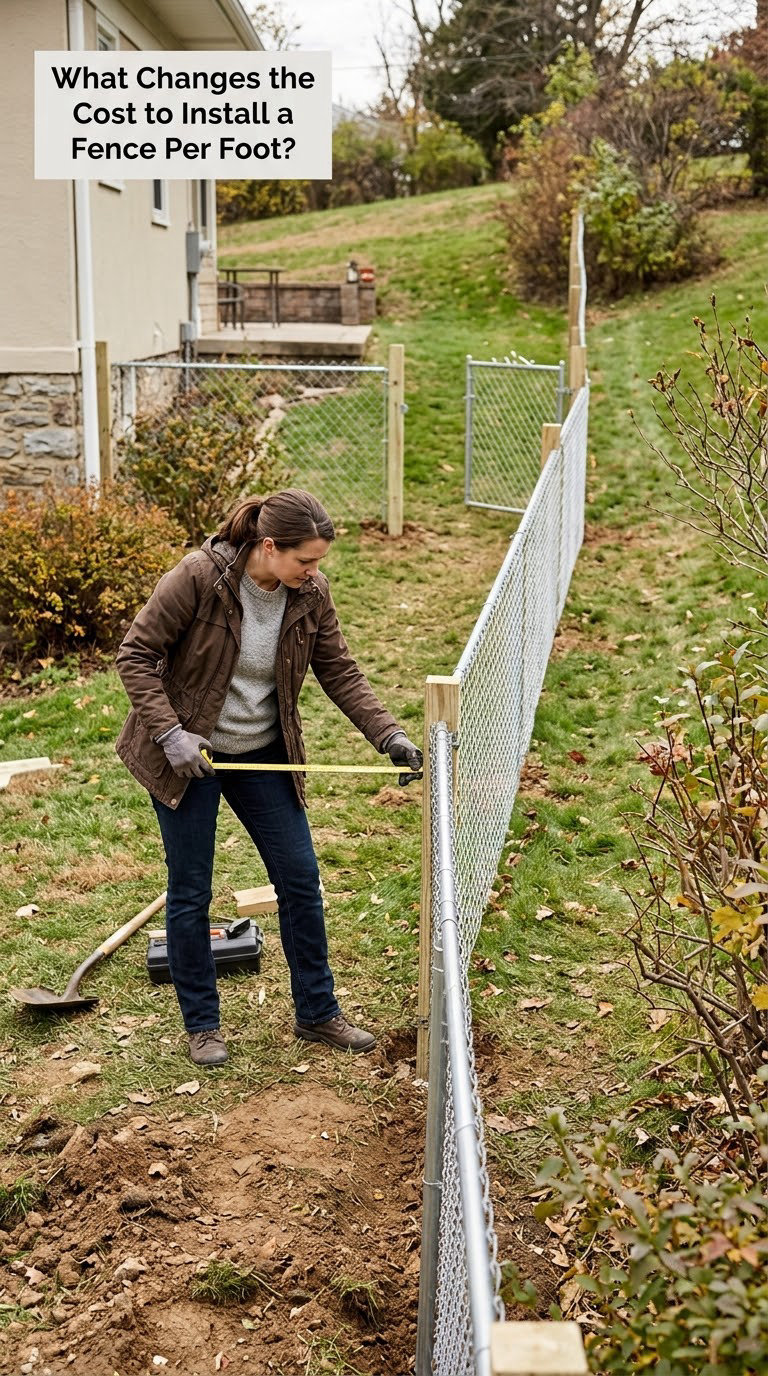
Once you have a baseline per-foot rate, these are the variables that move it. Each one is worth checking on your own property before you accept a number.
Fence height and how many posts it needs
Post count is the driver underneath almost everything else. Posts are spaced 8 feet on center, so a 100 foot run needs 14 posts rather than 13: 100 divided by 8 gives 12.5 bays, which rounds up to 13 bays and 14 posts once both ends are counted. Every extra 8 foot of fence adds one more hole to dig.
For a 6 foot fence, a post hole should go about 30 inches deep so roughly half the post sits below grade. That digging is usually billed separately by anyone charging per hole, and it is one of the line items most often missing from a quote.
Digging costs run roughly $25 to $60 per hole when a contractor brings a power auger, or you can rent a two-man auger and do it yourself. That rental detail is the single most repeated practical tip in the DIY forums, and almost nobody mentions it until after they have started.
Gates, corner posts and the line items people forget
Gates are where quote shock lives. A walk-through gate runs roughly $250 to $500 installed, a 5 foot swing gate around $1,000 to $1,500, and a double drive gate commonly runs $1,500 to $3,000. Wide gates also need heavier posts and extra bracing, which adds labor on top of the hardware.
Corner posts and end posts cost more than line posts because they carry weight in two directions. Concrete footings, corner braces and post caps are usually small amounts individually, but they add up across a long run.
Terrain, soil and site access
Slope is the most commonly underestimated adder. A fence on uneven ground has to be racked so the boards follow the grade, which slows the crew considerably. Contractors frequently quote this as a flat $800 to $4,000 rather than a percentage, so ask for it as a named line.
Rocky soil or clay changes hole-digging speed dramatically. Narrow side yards where a crew cannot drive a truck in add another mobilization charge. If the fence sits on a retaining wall edge or crosses a drainage swale, expect both extra digging and extra engineering judgment.
Permits, HOA rules and zoning
Most jurisdictions require a permit for fences over 6 feet, and typical fees run $50 to $200. Some cities check fence height against setback lines even below that threshold, and pool enclosures usually have their own stricter code.
HOA rules can force a specific height, which forces a specific price. Check your covenants before you plan, not after. If a permitted fence gets built at the wrong height, moving it later means tearing it down.
Region and timing
Region is the largest single variable after material. Named markets vary widely, and coastal cities with high labor participation sit at the top of the range.
| Region | Versus national average | Notes |
|---|---|---|
| Texas and the South | About 15% below | Lower state minimum wages keep labor down |
| Midwest | Near average | Recent annual increases in the low single digits |
| Northeast | 10% to 20% above | Season is short, so scheduling pushes prices up |
| California and the West Coast | About 25% above | Coastal markets have been climbing fastest |
| High-cost metros (Los Angeles, Boston, New York) | 30% or more above | Labor rates, permitting and access drive the spread |
| Florida | 10% to 15% above | Salt air makes aluminum and vinyl worth the premium |
Timing matters more than most people expect. Fall work often discounts 5% to 10%, and the shoulder season between winter and spring can bring 10% to 15%. A contractor with a full spring book will take a cheaper job in November than in April.
For rural acreage, fencing needs look different from a backyard. Barbed wire, woven wire and electric perimeter lines run well under residential privacy work per foot, and if you are weighing containment rather than privacy our electric fence charger picks cover the power side of that decision.
Hidden costs checklist
- Gates — $250 to $3,000 each depending on width and weight class
- Old fence removal — roughly $3 to $8 per linear foot of existing fence
- Debris disposal — a flat dump fee, often billed around $7 to $8 per 27 feet of removed fence
- Permits and inspections — $50 to $200
- Grading and clearing — brush, tree limbs and stump removal along the line
- Utility locate — required before digging, sometimes a separate trip charge
- Corner and gate posts — upgraded weight class, priced above line posts
- Sales tax on materials — applied on top of the material half
One question that comes up constantly in homeowner threads: should you buy the materials yourself and pay only a crew to install? It works when you have time to pick up and stage everything, but most crews price labor assuming they supply the material and they will discount or refuse a labor-only job. Get the answer in writing before you commit.
How to calculate your own number in three steps
- Measure the run. Walk the fence line and record total linear footage, including any returns and corners. Add 10% for waste on picket and privacy styles.
- Choose material and height, then use the table above. Multiply linear footage by the installed rate for that row. Add gate costs by count.
- Add the extras. Removal, disposal, permit and any slope or access surcharge. That total is your realistic budget number to hand to contractors.
Keep this number. When three quotes land, you can convert each total back to an effective per-foot rate including gates and removal, which is exactly what people do in the forums when they are trying to tell whether a high bid is justified.
DIY or hire a contractor
Doing it yourself means paying materials only, which for a 160 ft, 6 ft wood picket fence runs roughly $7 to $8 per foot. The catch is time. A single person commonly spends 4 to 8 days on a 150 ft privacy fence, versus 2 to 4 days for a crew of two or three. Racking on a slope and post hole digging are where that estimate breaks first.
Some things also change hands with labor. Vinyl warranties frequently require professional installation. Permit responsibility sits with the owner regardless. And a post hole that is too shallow shows up as a leaning fence eighteen months later.
My rule of thumb: hire the crew for anything over 100 linear feet, on any slope, or with more than one gate. Buy the materials yourself only for a short, flat, straight run where you already own an auger or have access to one.
What a written quote should include
Before you sign anything, check that the estimate has these items in writing. A quote without them cannot be compared against another quote fairly.
- Total linear footage and fence height
- Exact material, grade and board dimensions
- Post size, spacing and hole depth
- Whether posts are set in concrete, and how much
- Number and type of gates, with hardware specified
- Old fence removal and debris disposal as separate lines
- Permit responsibility and inspection fees
- Slope, racking or access charges stated in advance
If a contractor will not produce an itemized written quote, that is the deal breaker. Price pressure to sign immediately is the other one.
Fence Materials: Pros and Cons
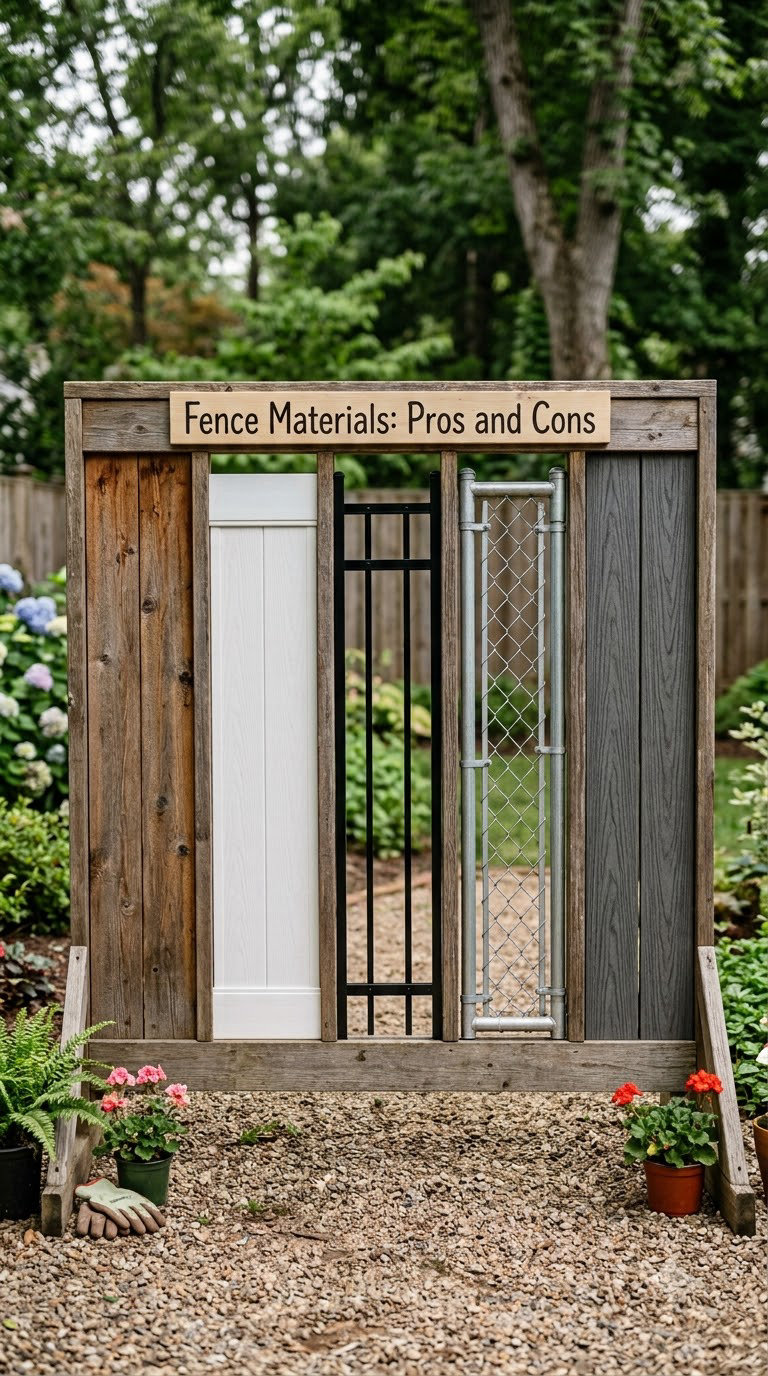
Price is only one input. The material you pick determines how much work it asks of you every year and whether you can fix a damaged section yourself.
| Material | Pros | Cons |
|---|---|---|
| Wood privacy (pressure-treated) | Lowest cost for real privacy, easy to repair, any style | Staining every 2 to 3 years, warping and rot at post bases |
| Cedar | Naturally rot resistant, warm look, ages well | Higher material cost, needs sealing, softer than pine |
| Vinyl | No staining, clean look, long service life | Can fade, brittle in deep cold, hard to repair, warranty tied to pro install |
| Composite | Wood color without maintenance, resists rot and insects | Highest material cost, can scratch and fade, limited repair options |
| Aluminum | Wrought-look styles, no rust, light to install | Bends under impact, dents hard to fix, less privacy for the money |
| Chain link | Cheapest per foot, long lasting, clear sight lines | No privacy, industrial look, needs tensioning every few years |
| Steel | Strongest common option, tall and rigid | Corrosion at ground contact, expensive, heavy to handle |
| Wrought iron | Decorative and secure, effectively permanent | Most expensive per foot, rust maintenance, needs expert fabrication |
Wood privacy fencing
Wood remains the default choice for a backyard privacy screen because nothing else delivers full privacy at that price. Pressure-treated pine is the budget version; cedar costs more up front and resists rot without treatment. The tradeoff is maintenance: a stain or sealer every two to three years, and post bases that can rot out over a decade if drainage is poor.
Vinyl and composite fencing
Vinyl is the low-maintenance answer, and for a lot of homeowners the appeal is simply never owning a paintbrush. Its weaknesses are physical rather than financial: panels fade unevenly in hard sun, and cold weather makes brittle panels crack when a board gets hit. Composite costs more and holds color better, but scratches.
Aluminum and steel
Aluminum gives you the decorative wrought-iron look without the rust problem, and it is light enough for a two-person crew. Steel is the choice when height and rigidity matter, such as an anti-climb perimeter or a pool enclosure. Neither offers privacy in the sense people usually mean, so they pair with plants or slats when screening matters.
Chain link
Chain link is the value answer by a wide margin and the right pick for long perimeters, pets and rental properties. It lasts a long time and repairs easily, but it gives you no privacy at all and does need the occasional tension adjustment.
20-year cost of ownership
Upfront price is misleading over two decades. Here is what the same 150 ft run costs to own, roughly, including maintenance and one partial rebuild allowance.
| Material | Install (150 ft) | 20-year upkeep | Approx. 20-year total |
|---|---|---|---|
| Chain link | $1,800 | $300 | $2,100 |
| Pressure-treated wood | $4,500 | $1,600 | $6,100 |
| Cedar | $6,750 | $900 | $7,650 |
| Vinyl | $6,000 | $400 | $6,400 |
| Composite | $7,500 | $300 | $7,800 |
| Aluminum | $8,600 | $500 | $9,100 |
Wood and vinyl land close together over 20 years even though the upfront numbers look very different. That is the whole argument for vinyl if you dislike staining, and the whole argument against it if you would rather patch a board than replace a panel.
Frequently Asked Questions
How much does it cost to install a fence per foot?
Most homeowners pay $20 to $60 per linear foot for a standard residential fence installed, including materials, posts set in concrete, and labor. Chain link starts near $8 to $16 per foot and wrought iron runs $85 to $150 or more. Height matters as much as material: a 4 foot fence costs roughly 30% less than a 6 foot fence, and an 8 foot fence adds 25% to 35%. Gates, removal and steep terrain sit outside these baselines.
What is the cheapest type of fence to install?
Chain link is the cheapest fully installed option, typically $8 to $16 per linear foot, followed by wire and farm fence at $10 to $20. Both work well for large perimeters, pet containment and rental properties, and neither gives you privacy. If privacy is the goal, a pressure-treated wood picket or privacy fence at $15 to $45 per foot is the cheapest route, and DIY wood materials alone can run $7 to $8 per foot.
Is fence installation labor usually charged per foot?
Yes. Labor is typically billed per linear foot and accounts for roughly half of an installed fence quote. On wood privacy fencing, labor alone commonly runs $10 to $20 per linear foot while materials add $15 to $35. Some contractors bill separately for post hole digging, often $25 to $60 per hole, and for gate installation. Contractors may also add 13% to 22% for general contractor overhead and markup on top of the base trade price.
How much do gates add to a fence installation?
Gates are the most common source of quote surprise. A standard walk-through gate runs roughly $250 to $500 installed, a 5 foot swing gate about $1,000 to $1,500, and a double drive gate commonly $1,500 to $3,000. Wide gates need heavier posts and extra bracing, so labor rises too. One metro Detroit homeowner reported $52 per foot for vinyl plus $1,500 for a single 5 foot swing gate, which is a very typical pattern.
How many fence posts are needed for 100 feet?
Posts are spaced 8 feet on center, so a 100 foot run needs 14 posts rather than 13. You get 12.5 theoretical bays, which rounds up to 13 bays and 14 posts once both ends are counted. Each additional 8 foot of fence adds one post hole to dig, which is why longer runs cost disproportionately more. For a 6 foot fence, holes should be about 30 inches deep so roughly half the post sits below grade.
Is it cheaper to install a fence yourself or hire a contractor?
DIY saves the labor half, which for a 160 ft wood picket fence means paying roughly $7 to $8 per foot in materials instead of $22 to $45 installed. The catch is time: one person typically spends 4 to 8 days on a 150 ft privacy fence versus 2 to 4 days for a crew. Renting a two-man auger for post holes is the most commonly missed practical step. Vinyl warranties often require professional installation, and permit duty stays with the owner either way.
Where to Start With Your Fence Budget
Measure your run, pick a material and a height, then multiply. That number plus gate costs is the figure worth handing to contractors.
When the quotes come back, convert each one to an effective per-foot rate including gates and removal. A bid that looks expensive next to a national average often makes sense once you see the scope behind it, and one that looks cheap usually is missing a line.
Get three written quotes, ask for the eight items listed above in each of them, and do not sign anything under time pressure. That is the whole job, and it takes an afternoon.
