
10 Best Smartwatches for Running (October 2026) Reviewed
Short answer: the Apple Watch Series 11 is the best smartwatch for running right now if you carry an iPhone, because it pairs accurate GPS and wrist heart rate with a sleep score, ECG and a full-day battery that survives a normal training week. Serious runners who care more about training load, recovery guidance and multi-band positioning than notifications should look at the Garmin Forerunner 265 instead.
Those two watches solve completely different problems, and that is the whole reason this list exists. A smartwatch that handles calls, payments and notifications well is not automatically the one that reads your pace, HRV and recovery most honestly, and a stripped-back sports watch with no apps is not automatically the one you will still want to wear on rest days. I have spent the last several months rotating between these ten watches on the same block of morning runs, the same easy evening runs, and the same weekly interval session, so the differences below are the ones that showed up in real training rather than on a spec sheet.
Contents
Across the whole lineup, the split that matters most is ecosystem first, then battery. Garmin, Polar, Suunto, COROS and Amazfit all pair with both iOS and Android, while the Apple Watch Series 11 only talks to an iPhone. Garmin Pay-style contactless payments, on-wrist music, LTE calls and message replies are also unevenly spread across the ten. We have covered that whole category before in our AMOLED fitness smartwatch guide, so this roundup stays laser-focused on the running question: what actually helps you run better.
One note before we start. I do not quote manufacturer battery numbers as gospel here. I quote them, but I also tell you what I saw, and where the real figure diverges from the claim. The same goes for GPS accuracy, which is the single most over-hyped specification in this entire category. If you only have time to read one section, read the Garmin Forerunner 265 review and the buying guide below it.
Top 3 Running Smartwatches in 2026


As an Amazon Associate we earn from qualifying purchases. CERTAIN CONTENT THAT APPEARS ON THIS SITE COMES FROM AMAZON. THIS CONTENT IS PROVIDED 'AS IS' AND IS SUBJECT TO CHANGE OR REMOVAL AT ANY TIME.
Best Smartwatches for Running (October 2026)
| Product | Features | |
|---|---|---|
| Apple Watch Series 11 |
|
Check Latest Price |
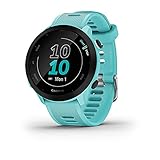 Garmin Forerunner 55 Garmin Forerunner 55 |
|
Check Latest Price |
 Garmin Forerunner 165 Garmin Forerunner 165 |
|
Check Latest Price |
| Garmin Forerunner 265 |
|
Check Latest Price |
 Amazfit Bip 6 Amazfit Bip 6 |
|
Check Latest Price |
 Samsung Galaxy Watch Ultra Samsung Galaxy Watch Ultra |
|
Check Latest Price |
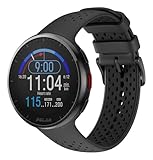 POLAR Pacer Pro POLAR Pacer Pro |
|
Check Latest Price |
 COROS PACE Pro COROS PACE Pro |
|
Check Latest Price |
 COROS PACE 4 COROS PACE 4 |
|
Check Latest Price |
 Suunto Race S Suunto Race S |
|
Check Latest Price |
We earn from qualifying purchases. CERTAIN CONTENT THAT APPEARS ON THIS SITE COMES FROM AMAZON. THIS CONTENT IS PROVIDED 'AS IS' AND IS SUBJECT TO CHANGE OR REMOVAL AT ANY TIME.
1. Apple Watch Series 11 — Best All-Round Running Smartwatch
Apple Watch Series 11 [GPS 42mm] Smartwatch with Jet Black…
24 hour battery
ECG and hypertension notifications
Daily sleep score
50m water resistance
Pros
- Daily sleep score with genuinely useful trend data
- ECG and irregular rhythm notifications
- Real Pacer and training load metrics for intervals
- Thin and light enough to sleep in
- Fall and crash detection with Emergency SOS
Cons
- 24 hour battery is short for long runs
- Workout Buddy needs a nearby iPhone
- No Android compatibility
I put the Series 11 on for a marathon block and the thing that surprised me most was not the running data. It was the morning report. The watch gives you a sleep score every night, and once that number exists, the shape of your training week starts to look completely different from the inside.
For running specifically, the Series 11 is a Pacemaker-grade tool disguised as a lifestyle watch. You get real Pacer alerts, Heart Rate Zones, and a training load readout that tells you when a hard Tuesday actually lands on your legs. On my interval sessions the zone alerts were timely enough that I stopped double-checking my phone.
![Apple Watch Series 11 [GPS 42mm] Smartwatch with Jet Black Aluminum Case with Black Sport Band - S/M. Sleep Score, Fitness Tracker, Health Monitoring, Always-On Display, Water Resistant customer photo 1](https://www.rosenberryrooms.com/wp-content/uploads/2026/01/B0FQFL8PZ5_customer_1.jpg "10 Best Smartwatches for Running ([nmf] [cy]) Reviewed 15")
The health stack is the reason most people keep it on when they are not running. ECG, irregular rhythm notifications, hypertension notifications based on vascular response analysis, and sleep apnea notifications all live in the same Vitals app. At 1.12 ounces it is the most unobtrusive watch in this roundup, and it disappears under a sleeve.
The safety features are unusually serious for a consumer watch. Hard fall detection, severe car crash detection, Emergency SOS and Check In all work without you asking. If you run routes with poor signal, that is worth real money to you, and it is the one category where Apple has pulled ahead of every dedicated sports watch on this list.
![Apple Watch Series 11 [GPS 42mm] Smartwatch with Jet Black Aluminum Case with Black Sport Band - S/M. Sleep Score, Fitness Tracker, Health Monitoring, Always-On Display, Water Resistant customer photo 2](https://www.rosenberryrooms.com/wp-content/uploads/2026/03/B0FQFL8PZ5_customer_2.jpg "10 Best Smartwatches for Running ([nmf] [cy]) Reviewed 16")
What the Series 11 does better than every dedicated running watch
Sleep, recovery and everyday wear. The daily sleep score, the Vitals app and the 24-hour cycle of health data are things no GPS running watch on this list comes close to in depth.
It also stays connected. You can take calls, reply to messages from the watch, pay for a coffee after a long run, and it works with any workout app you already use. The trade-off is the one that shows up in every review: about 24 hours of normal battery use, with 15 minutes of fast charging adding roughly eight hours.
Where the Series 11 frustrates a serious runner
The 24-hour figure is optimistic for GPS use, and for anyone training for an ultra it is simply not enough. You will be charging it every night, sometimes twice on a long day.
It also requires an iPhone, permanently. Several fitness features, Workout Buddy in particular, depend on a nearby iPhone rather than running standalone. And with an on-wrist weight of 1.12 ounces you get less screen real estate for data fields than the 1.3-inch Garmin Forerunner 265.
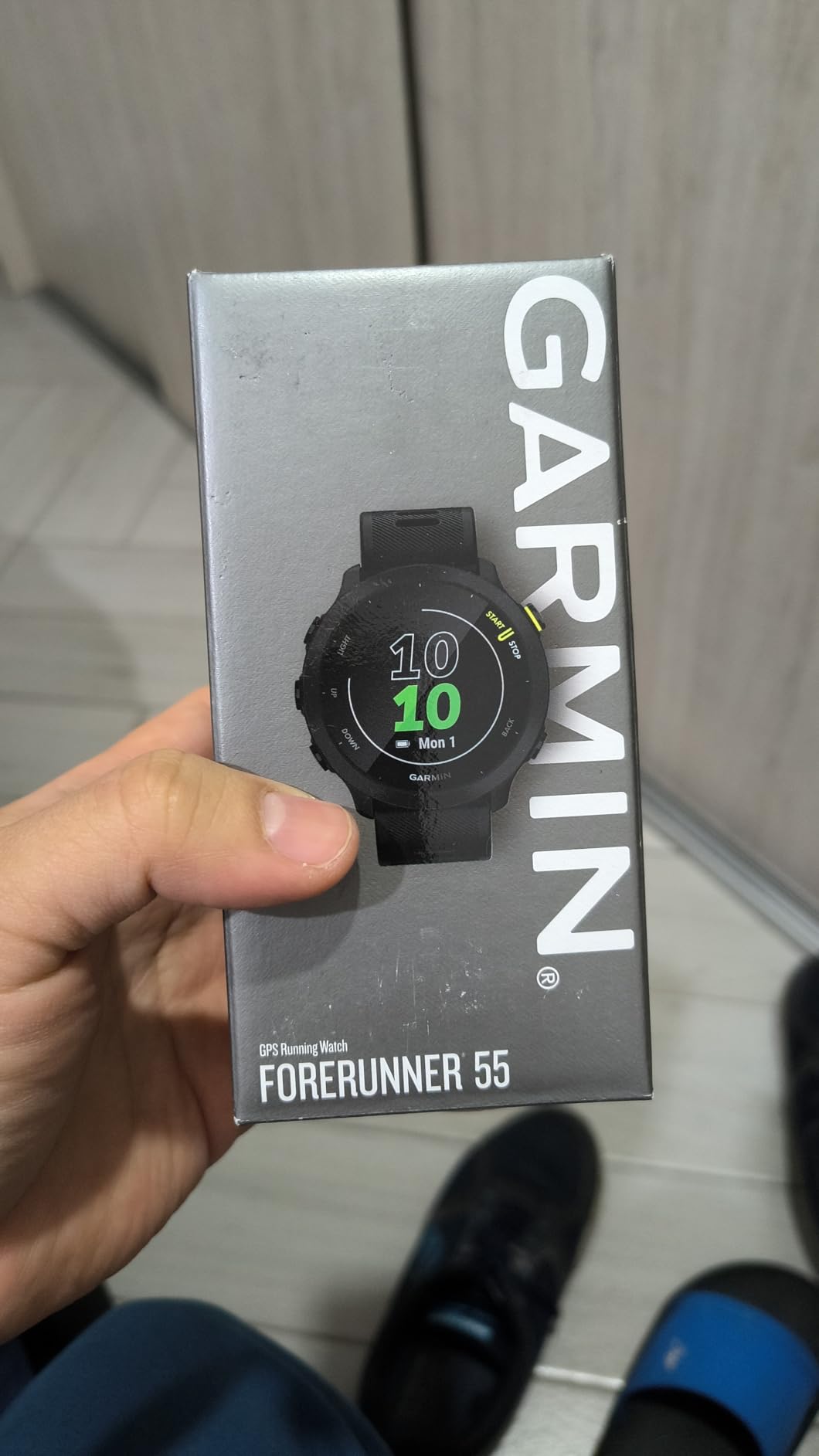
2. Garmin Forerunner 55 — Best for Beginners at the Entry Point
Garmin Forerunner 55, GPS Running Watch with Daily Suggested…
Up to 2 weeks smartwatch battery
20 hours GPS
PacePro guidance
37g fiber-reinforced polymer
Pros
- Roughly two weeks between charges
- Buttons work with sweaty hands
- Heart rate within about 3 percent of a chest strap
- 37g body suits smaller wrists
- Fast GPS lock without a phone
Cons
- No touchscreen so menus need button cycling
- Garmin Connect setup is involved
- Overnight heart rate readings can glitch
The Forerunner 55 is the watch I recommend to people who tell me they hate charging things. It claims up to two weeks in smartwatch mode and about 20 hours in GPS mode, and in my use the gap between those two numbers is where all the disappointment lives.
That is still the best battery story in this entire roundup in day-to-day terms. If you run four times a week and want a watch you charge monthly, nothing else here competes. Reviewers consistently report three-plus years of reliable ownership on these, which is a longevity record none of the flashier models match.
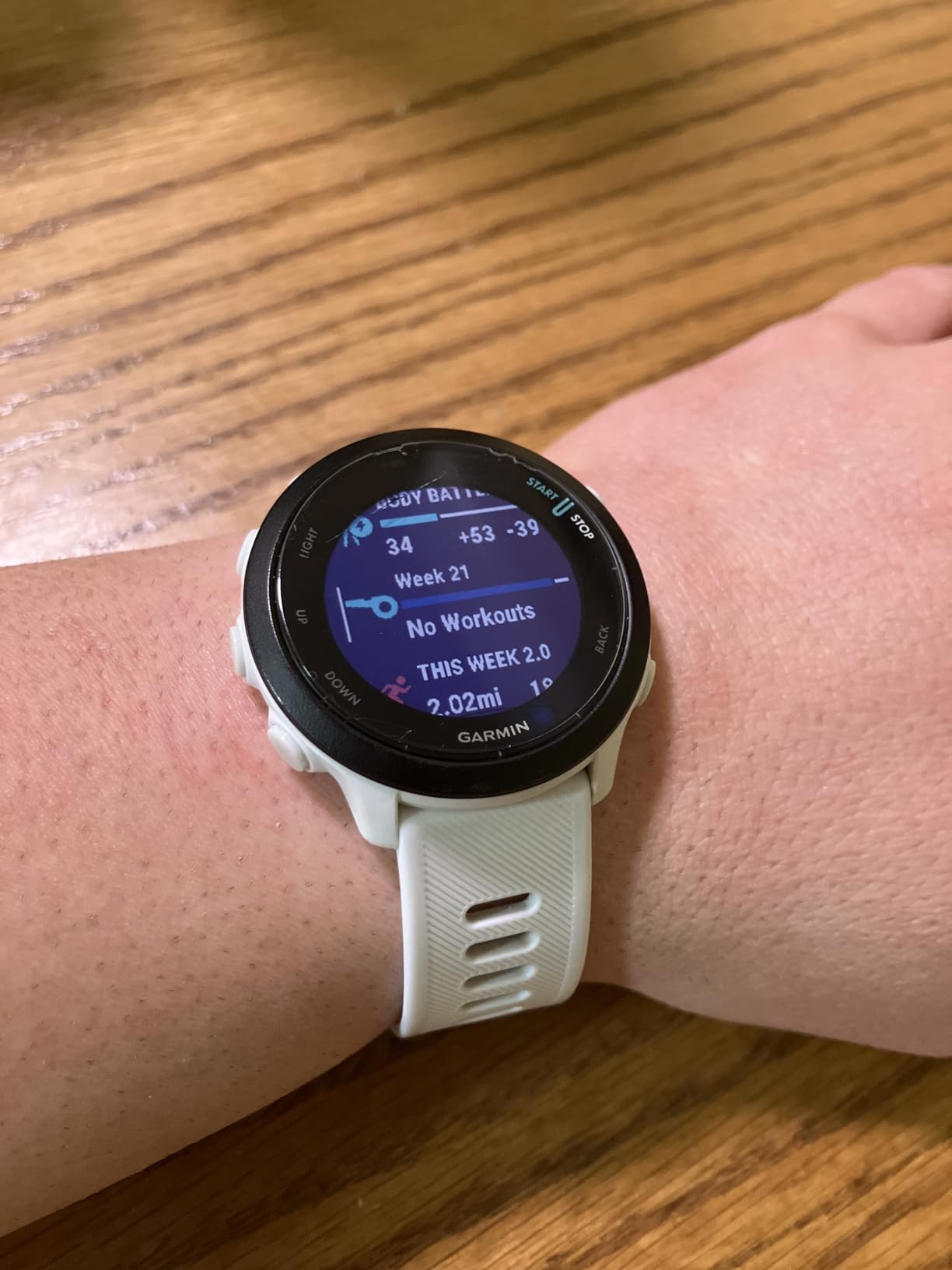
Heart rate is the quiet strength. Owners report wrist readings landing within roughly three percent of a chest strap, which is close enough that I did not bother strapping up for easy runs. The 1.04-inch transflective MIP screen is sunlight visible without a backlight, which is a bigger deal at 7am in summer than it sounds.
PacePro gives GPS-based pace guidance for a distance or a course, and Daily Suggested Workouts build a plan from your recent training. Race time predictions and finish time estimates are there too, in a watch that weighs 37 grams.
Why this is still worth buying in 2026
Battery, buttons and price-per-feature. The physical buttons are genuinely better than a touchscreen when you are mid-interval with sweat on your hands, and no other watch in this list is that reliable on a single charge.
It is also the easiest watch here to sleep in, at 37g and 0.46 inches thick. If you care about overnight tracking rather than deep analytics, the 55 does the job without a charging cable in your bag.
Where the Forerunner 55 falls short
There is no touchscreen, so every menu change and watch face change means cycling buttons. That is a real cost if you have never used a button-driven watch.
Onboarding in Garmin Connect is involved, and the sleep and overnight heart rate readings can glitch if the watch shifts on your wrist overnight. The documentation for the deeper data fields is also confusing for first-time users.
3. Garmin Forerunner 165 — Best Value for Everyday Training
Garmin Forerunner® 165, Running Smartwatch, 43mm, Black
1.2 inch AMOLED touchscreen
11 day battery, 19 hours GPS
Garmin Coach and adaptive race plans
Garmin Pay and incident detection
Pros
- Bright 1000 nit AMOLED readable in direct sun
- 10 to 13 days between charges
- Accurate GPS pace HR HRV and VO2 max
- Light 43mm body with removable silicone band
- Clean Garmin Connect app with Strava sync
Cons
- Cannot reply to text messages from the watch
- Suggested recovery times can be overly aggressive
- Bluetooth dropouts reported by some users
- No onboard maps and no multi-band GPS at this tier
The Forerunner 165 is the watch I keep telling people to buy. It is the first model in Garmin’s running line that gives you a proper AMOLED touchscreen without asking you to jump up a tier, and at 1.2 inches with 1000 nits of brightness it stays readable in full sun.
Battery is the other headline. Garmin quotes up to 11 days in smartwatch mode and 19 hours in GPS mode, and owners report landing somewhere in the 10 to 13 day range. That is a full training week plus your entire daily wear before you think about the charger.
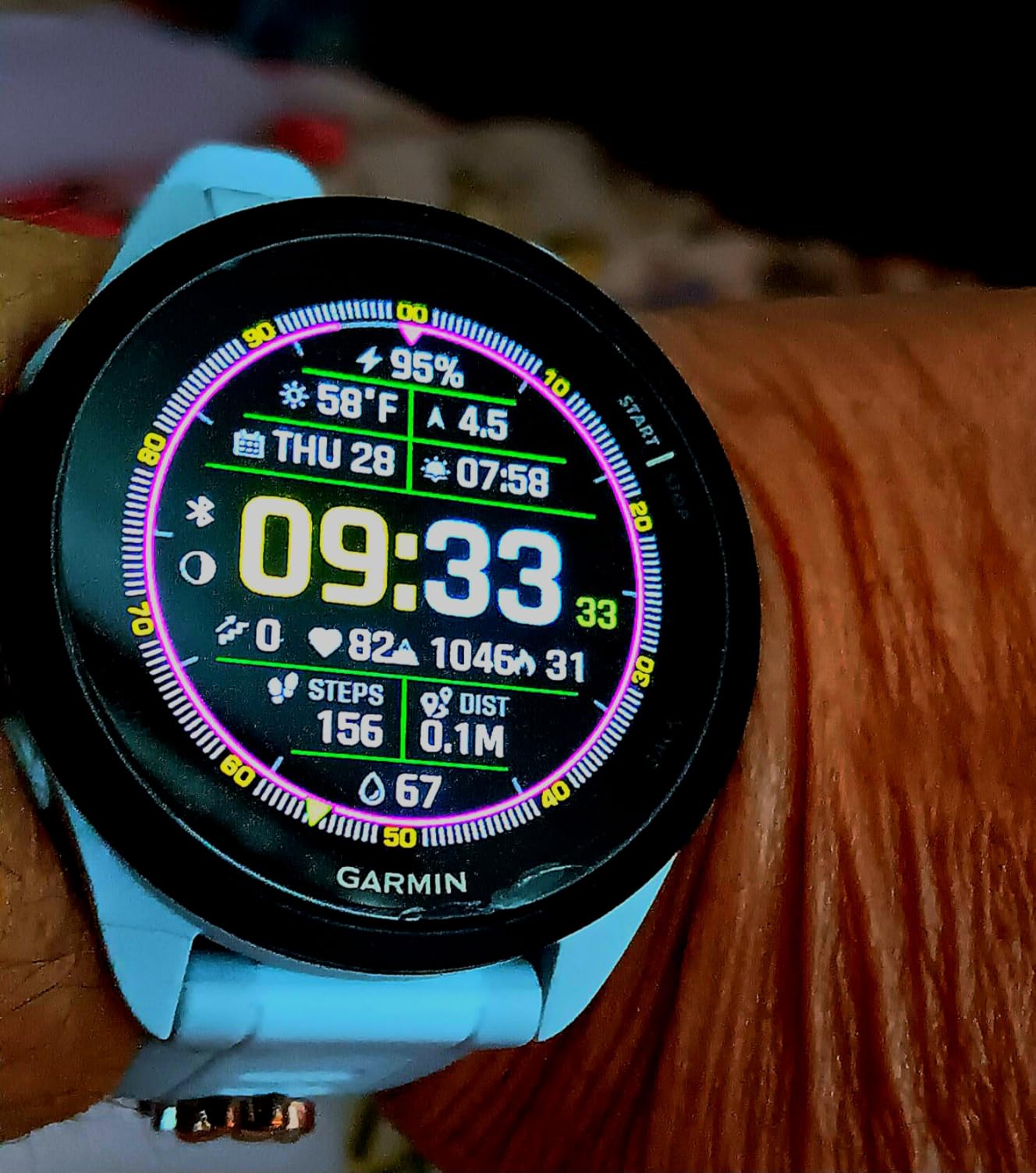
The training data is where this watch punches above its tier. Daily suggested workouts, Garmin Coach and race-adaptive training plans sit alongside training effect and labels, recovery time guidance and a morning report that combines sleep, recovery, training outlook, weather and HRV status into one screen you actually look at.
Users migrating from an Apple Watch frequently land here specifically for battery life, and the data comparisons they report are favorable: pace, heart rate, HRV and VO2 max all hold up against watches costing considerably more. You also get incident detection, Assistance location sharing, smart notifications and Garmin Pay contactless payments.
Why this is the smart default buy
It covers the entire checklist without a compromise you will notice: bright screen, real GPS, heart rate, HRV, VO2 max, adaptive plans, payments and safety features. The 43mm case is light at 1.38 ounces and the silicone band is removable, so swapping bands costs nothing.
For a first marathon, this is the platform most runners land on, and for good reason. There are 25-plus built-in activity profiles, 4 GB of storage and IPX7 water resistance rated to 50 meters.
Where it will let you down
You cannot reply to text messages from the watch, only view them. If you have moved from a modern Apple Watch, that adjustment catches people out.
There are no onboard maps and no multi-band GPS at this tier, which is exactly what you step up for with the 265. Recovery suggestions can also be aggressive enough to add unexpected rest days, and some owners report intermittent Bluetooth dropouts. The alarm is not loud.
4. Garmin Forerunner 265 — Best for Serious Runners and Training Blocks
Garmin Forerunner® 265, Running Smartwatch, 46mm…
Multi-band GNSS with SatIQ
1.3 inch AMOLED, 13 day battery
Training readiness and training status
On-wrist music and Garmin Pay
Pros
- Multi-band GNSS with SatIQ holds accuracy in cities and on trails
- 13 days smartwatch and 20 hours GPS
- Training readiness status and recovery guidance
- Brilliant 1.3 inch AMOLED
- Music storage and offline playback on the wrist
Cons
- 46mm case and 47g weight feel bulky on small wrists
- Costs more than entry Forerunner models
- Garmin Connect has a learning curve
- Onboard maps not included at this tier
This is the watch I reach for when a run has a purpose beyond finishing. Multi-band GNSS with SatIQ is the headline, and it is not marketing filler. On my urban loop past tall buildings and on a wooded trail section, the track stayed noticeably tighter than what the 165 produced, with fewer of the little corridor artifacts that distort your split times.
SatIQ is worth understanding before you buy. Rather than burning power on multi-band all the time, it uses a single band normally and switches to multi-band when conditions demand it. That is how you get multi-band-level accuracy without the multi-band battery penalty, and it is the main technical reason this watch outperforms its lower-cost sibling.
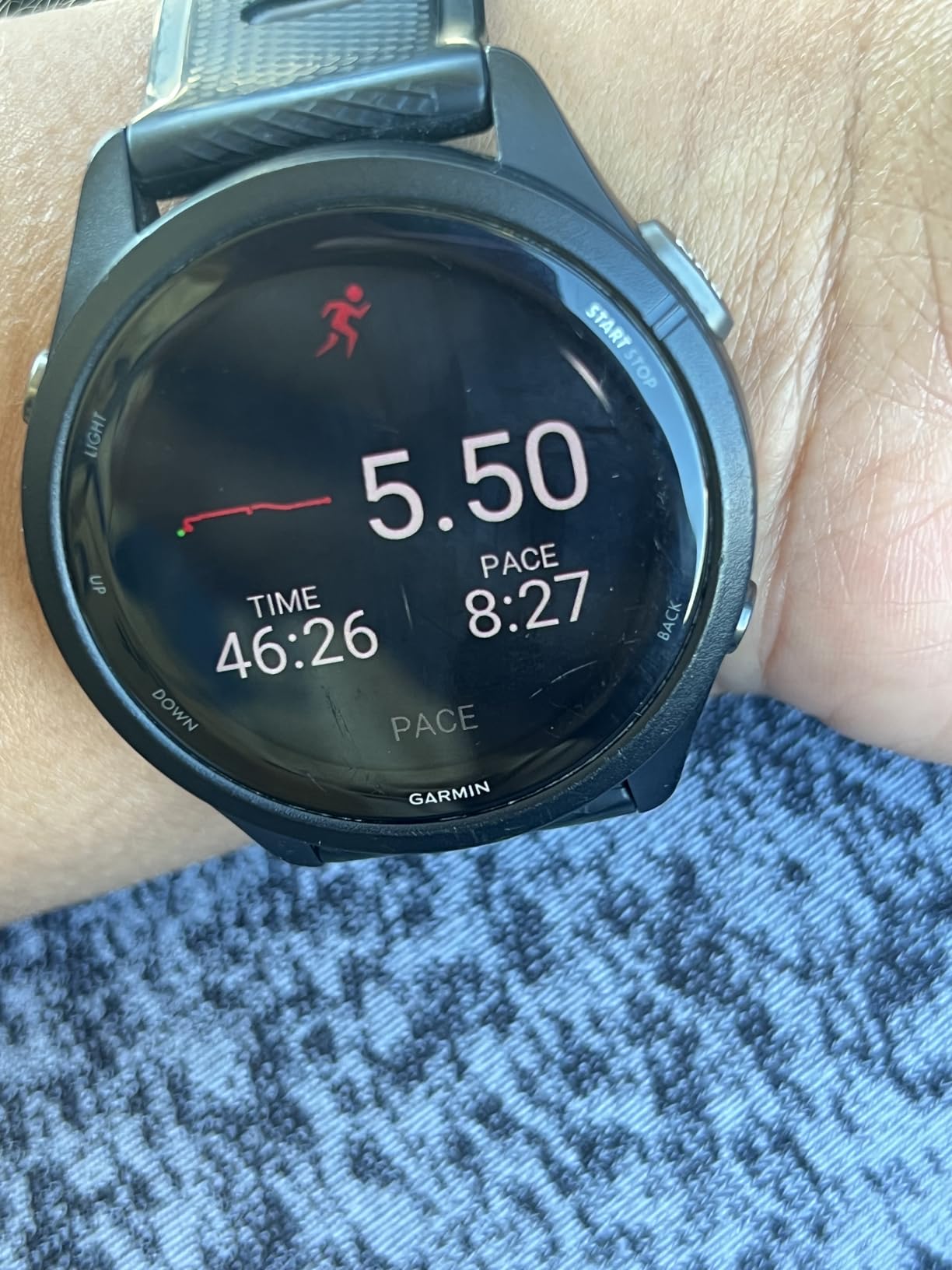
The training layer is where the price jump really lands. Training readiness pulls together sleep quality, recovery, training load and HRV status into a single number you can decide on before you lace up. Training status then tells you whether you are productive, peaking or strained, and the suggested workouts come with a race widget and course input for a genuine training block.
Battery lands at up to 13 days in smartwatch mode and about 20 hours in GPS mode, and the 1.3-inch AMOLED at 416 by 416 is bright enough to read mid-tempo without stopping. There are 30-plus activity profiles including triathlon and open-water swimming, plus music on the wrist, smart notifications, Garmin Pay, incident detection and Assistance.
Why serious runners upgrade to this model
Multi-band positioning and training readiness together. When you are running a structured plan, knowing that your recovery number is trustworthy changes what you do that day, and the SatIQ chip makes every other metric more accurate to begin with.
You also get on-wrist music with offline playback, which is the feature most often cited by runners switching away from an Apple Watch. Storage is 8 GB and the case carries IP68 with 50 meter water resistance.
Where the 265 is not the right buy
The 46mm case at 47 grams is the most common complaint in reviews, and it is a real one. If your wrist is under about 15 inches, the 43mm Forerunner 165 or the 41 gram POLAR Pacer Pro will sit far more comfortably, including overnight.
It is also more expensive than the entry Forerunner models, Garmin Connect has a genuine learning curve for the advanced metrics, and there are still no onboard maps at this tier. You would need to step up again for full turn-by-turn navigation on the wrist.
5. Amazfit Bip 6 — Best Starting Point on a Tight Budget
Amazfit Bip 6 Smart Watch, 1.97″ AMOLED Display, GPS…
1.97 inch AMOLED at 2000 nits
Up to 14 days battery
Five-system GPS with offline maps
Works with iOS and Android
Pros
- Very low entry cost for a GPS AMOLED watch
- Up to 14 days of battery life
- Huge 2000 nit display reads well in sunlight
- 140+ sport modes plus AI training coaching
- Works with both iOS and Android
Cons
- GPS and heart rate trail dedicated running watches
- App ecosystem less refined for serious analysis
- Only 512 MB internal storage
- Highest one-star share in this roundup
The Amazfit Bip 6 answers a question most roundups skip: does a beginner running watch have to be bad? For casual runners logging distance and pace, the answer is clearly no. You get GPS, a bright AMOLED, a two-week battery and offline maps for very little money, which makes it a genuine first watch rather than a stopgap.
The 1.97-inch AMOLED at 2000 nits is the biggest screen in this roundup and it stays readable in direct sun, which matters more than raw resolution when you are squinting at a split time. It also runs Zepp OS, supports Bluetooth notifications, calls and text messaging, and works with Android 7.0 or later and iOS 14 or later.
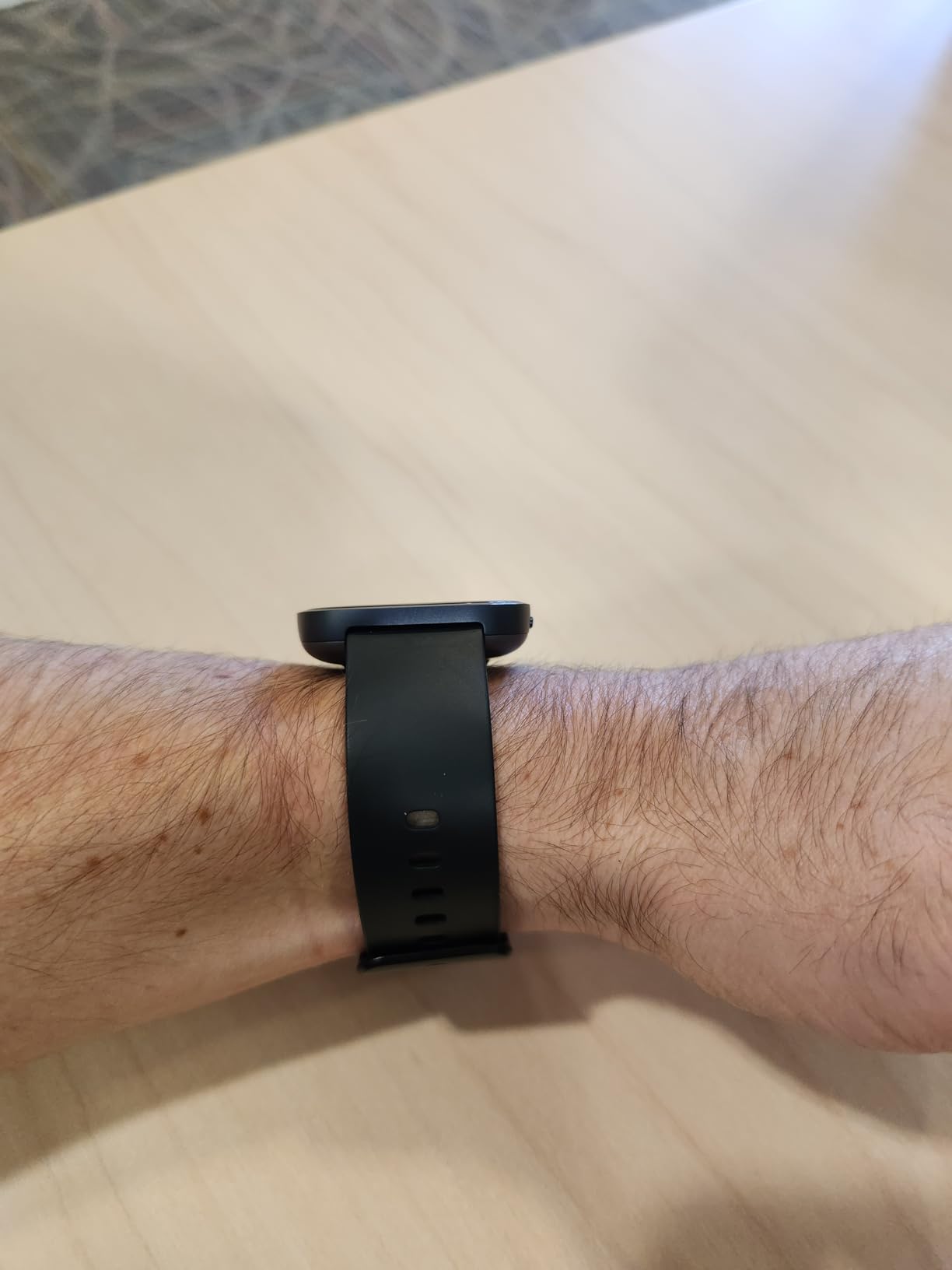
Five-system GPS across BeiDou, GLONASS, GPS and Galileo with downloadable offline maps and turn-by-turn directions is more than I expected at this price. There are 140-plus workout modes including HYROX Race and strength training, plus AI-based personalized training coaching and 24/7 heart rate, blood oxygen, sleep and stress monitoring.
Where it separates from the dedicated running watches is consistency rather than features. GPS accuracy and heart rate readings trail Garmin, COROS and Suunto devices, and the app experience is less refined for deep training analysis. It is water resistant to 50 meters, with a 340 mAh battery behind the two-week claim.
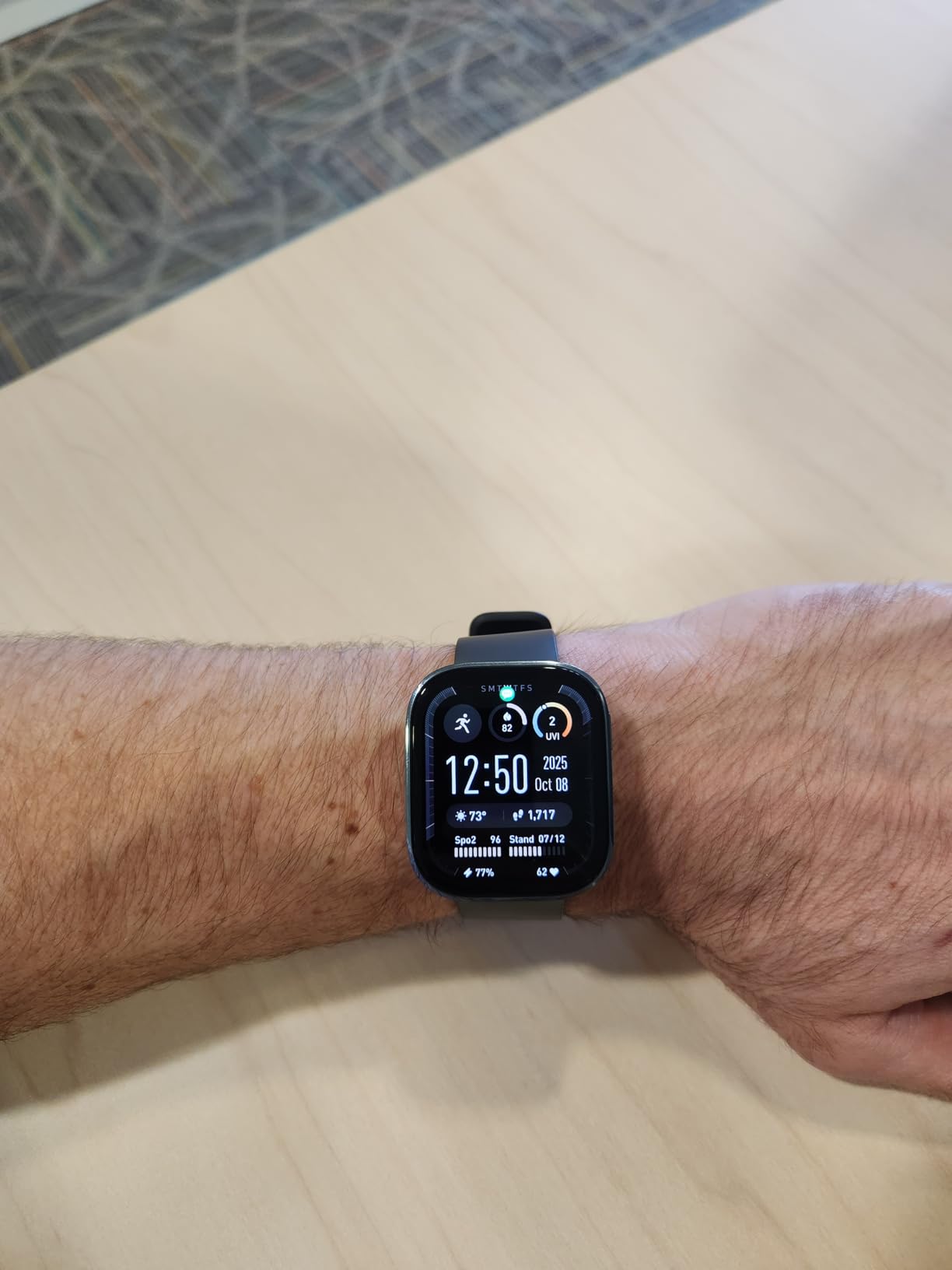
Who this watch is genuinely right for
New runners, walkers who want to track a jog, and anyone who wants to test whether they actually like wearing a fitness watch before spending real money. The two-week battery and large screen remove the two objections beginners usually raise.
It is also one of the only watches here that does not care whether your phone runs iOS or Android, which matters if you switch platforms.
When to skip it
If you run intervals, race, or care about heart rate zone accuracy, the gap versus a dedicated running watch shows up immediately. The optical heart rate sensor and GPS are simply less trustworthy when the effort is hard.
The app and data ecosystem is also less mature for serious training analysis, and 512 MB of internal storage limits offline media and future capability. The one-star share of ratings is the highest of the ten in this roundup, which is worth factoring in.
6. Samsung Galaxy Watch Ultra — Best for Android Users Who Want a Phone on Their Wrist
Samsung Galaxy Watch Ultra (2025), Titanium Silver, 47mm LTE…
Dual-frequency GPS
Titanium casing with 10ATM
LTE cellular connectivity
47mm case with 1.47 inch AMOLED
Pros
- Multi-day battery of roughly 2 to 3 days
- Rugged titanium body rated to 100 meters
- Dual-frequency GPS plus a built-in Running Coach
- LTE calls maps and messages away from a phone
- Polished Wear OS experience
Cons
- 47mm titanium case is bulky on smaller wrists
- Step and distance counts vary versus a phone
- Proprietary dock charger with a very short cable
- Does not fit smaller Galaxy Watch band sizes
The Galaxy Watch Ultra is the only watch here with LTE, and that changes the calculus for a specific kind of runner. If you run without your phone, you can still take calls, message and navigate from the wrist, and you get a full day plus a few more of battery rather than a single day.
For positioning it uses dual-frequency GPS, which is a different implementation from Garmin’s multi-band approach but lands in the same accuracy tier for most trail and city running. The personalized Running Coach analyzes age, weight, oxygen levels and heart rate, and Galaxy AI adds Advanced Sleep Coaching and an Energy Score. There is also on-wrist blood pressure monitoring if you buy the separate cuff.
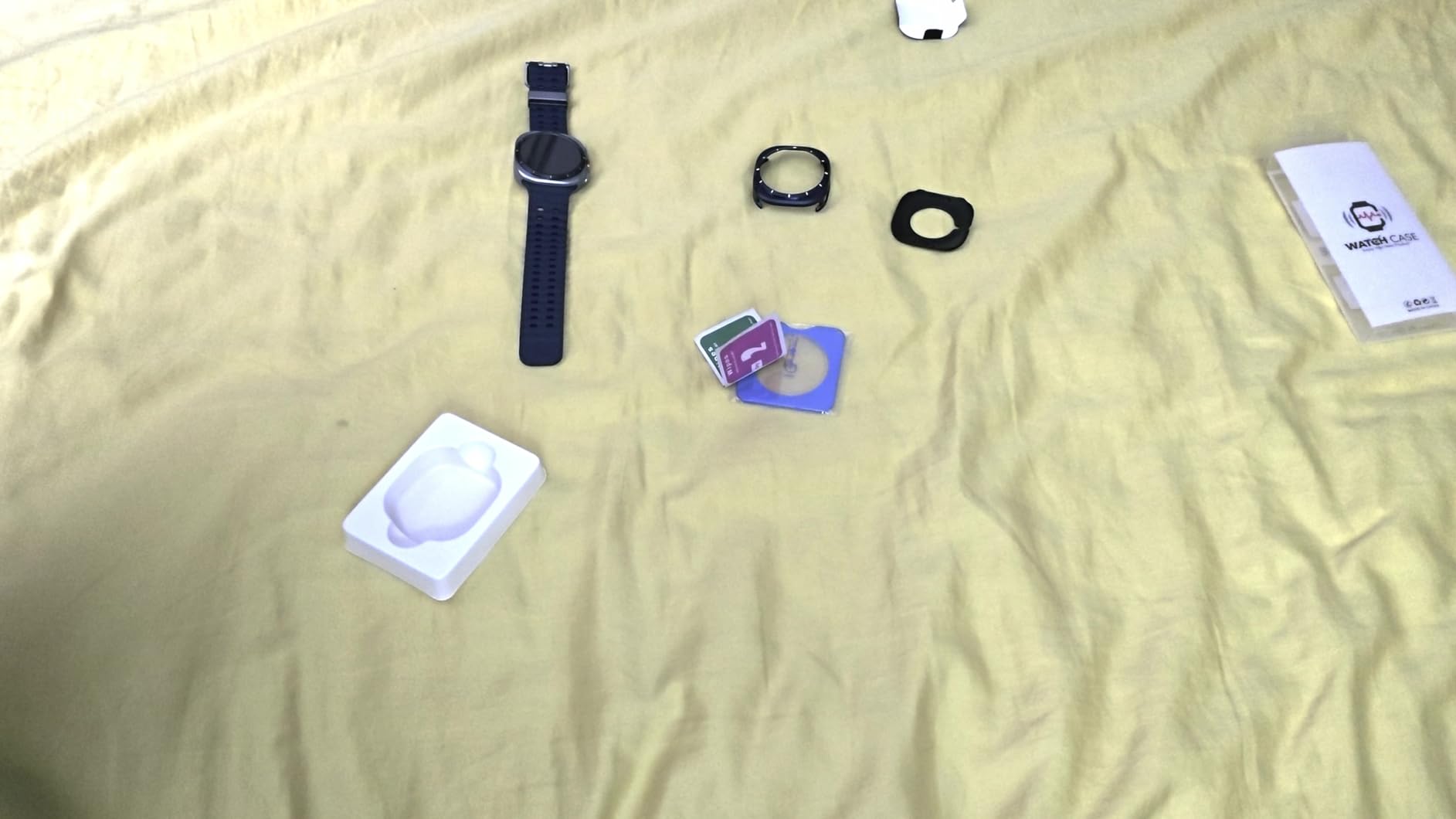
Build quality is the other story. A titanium casing with 10ATM water resistance means it is rated to 100 meters, so swimming and harsh conditions are not a worry. Storage is 64 GB, the AMOLED is 1.47 inches at 1000 nits, and the Now Bar keeps weather, timers and directions on the main watch screen.
Battery is roughly two to three days for typical use, which sits in the sweet spot between the Apple Watch and the endurance watches. That is a meaningful upgrade over a phone-free week of Garmin territory if you care about connectivity first.
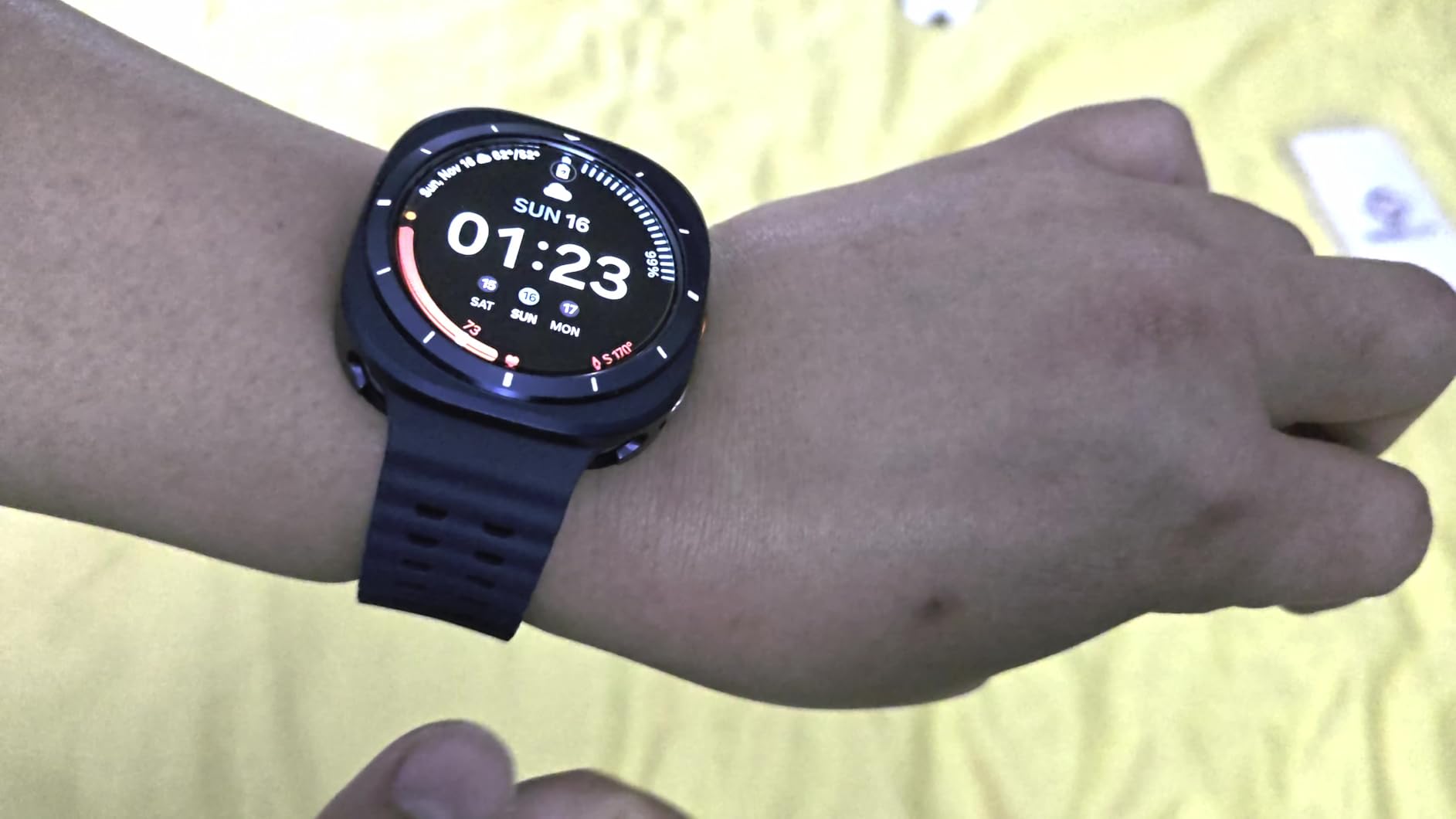
Why an Android runner should seriously consider it
LTE, dual-frequency GPS and a 100 meter water rating in one body. Nobody else in this roundup combines phone-free calls with that level of water resistance and rugged titanium.
It also carries a two-year manufacturer warranty, and the Wear OS experience is noticeably faster and more polished than earlier Galaxy Watch models. Fall detection is a bonus for anyone running alone.
Where the Ultra is awkward
At 47mm and 60.3 grams it is the heaviest watch on this list, and the case is genuinely bulky on smaller wrists. It also does not fit smaller Galaxy Watch band sizes, so the band ecosystem is narrower than the 42 and 44 millimeter models.
Step and distance counts vary noticeably against a phone, which is a reminder that this is a big rugged smartwatch rather than a pure running device. The proprietary dock charger ships with a very short cable, and it works best with Android phones.
7. POLAR Pacer Pro — Best for Heart Rate Accuracy and Ultra-Light Feel
POLAR Pacer Pro Advanced Ultra-Light GPS Fitness Tracker…
41g ultra-light body
35 hours training mode, 100 hours power save
Polar Precision Prime optical sensor
Compatible with the H10 chest strap
Pros
- Exceptionally light 41g body on long runs
- Up to 35 hours of training-mode battery
- Glare-free high-contrast LCD readable at a glance
- Non-slip buttons work with gloves or sweat
- Works with the Polar H10 chest strap
- Two wristband sizes with 20mm adapters
Cons
- No touchscreen and limited smartwatch features
- Fewer watch faces and bands than Garmin
- Sleep detection can misjudge sleep start and end
- Wrist heart rate can lag a chest strap by 7 to 8 bpm
- IPX3 rating so not suitable for swimming
POLAR built this watch around one obsession: heart rate. The Precision Prime optical sensor combined with first-class support for the H10 chest strap is the strongest heart rate story in this roundup, and for runners who care about physiological accuracy above all else, that is a genuine differentiator.
It is also the watch you will forget you are wearing. At 41 grams the Pacer Pro is one of the lightest running-focused models here, and owners frequently mention switching to it from a bulkier Garmin because the difference over a long run is obvious by mile ten.
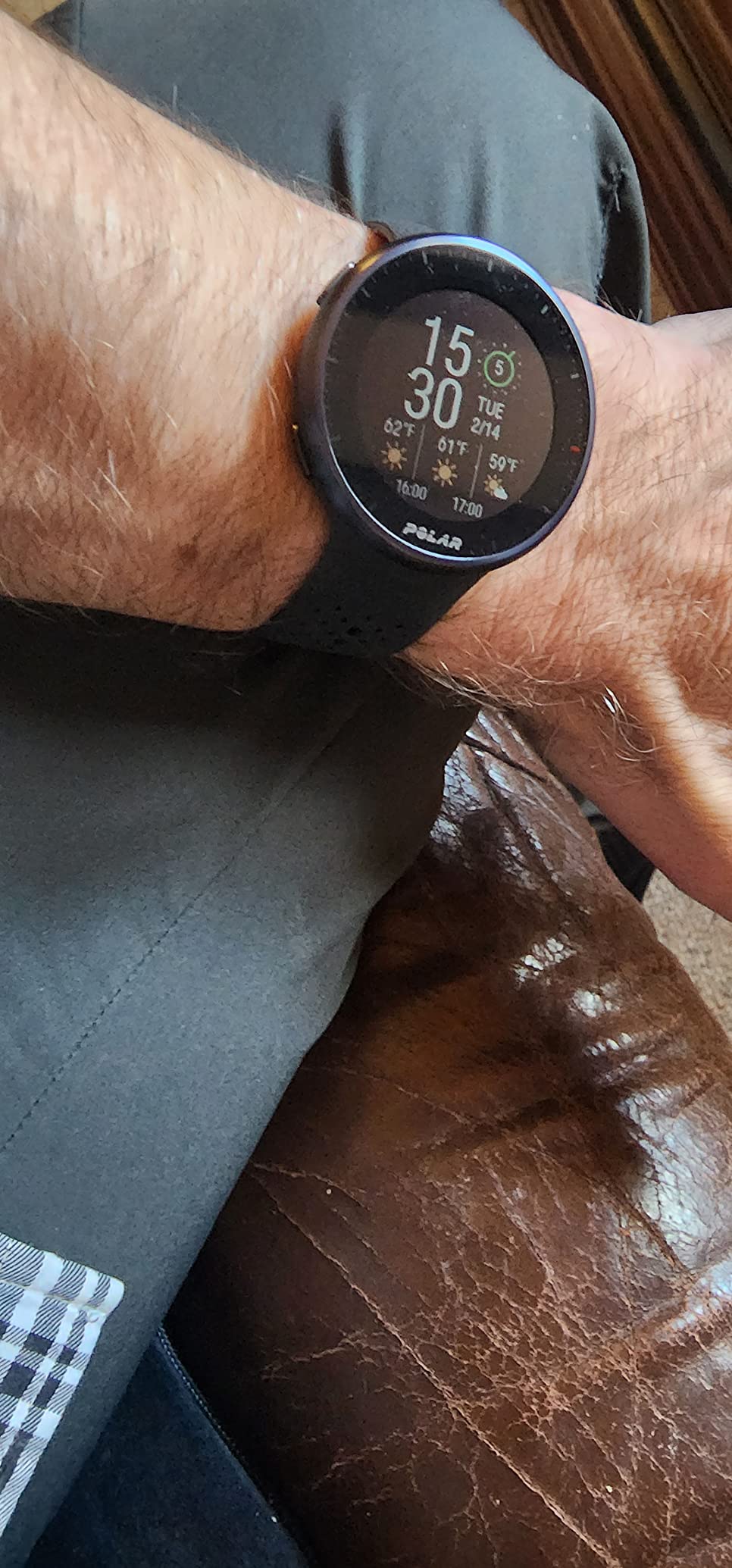
Battery is the endurance story. You get up to 35 hours in training mode, 100 hours in power-save and 7 days in watch mode, which means a full ultramarathon weekend without a charger. The high-speed processor handles time, pace, distance and laps without lag, and Polar Flow carries the training programs and recovery guidance at no extra cost for core features.
The display is a plain 1.2 inch color LCD, not AMOLED, but the high-contrast anti-glare panel is readable at a glance even without glasses. Buttons are non-slip and work with sweaty hands or gloves, which matters far more than it sounds during a wet trail race.
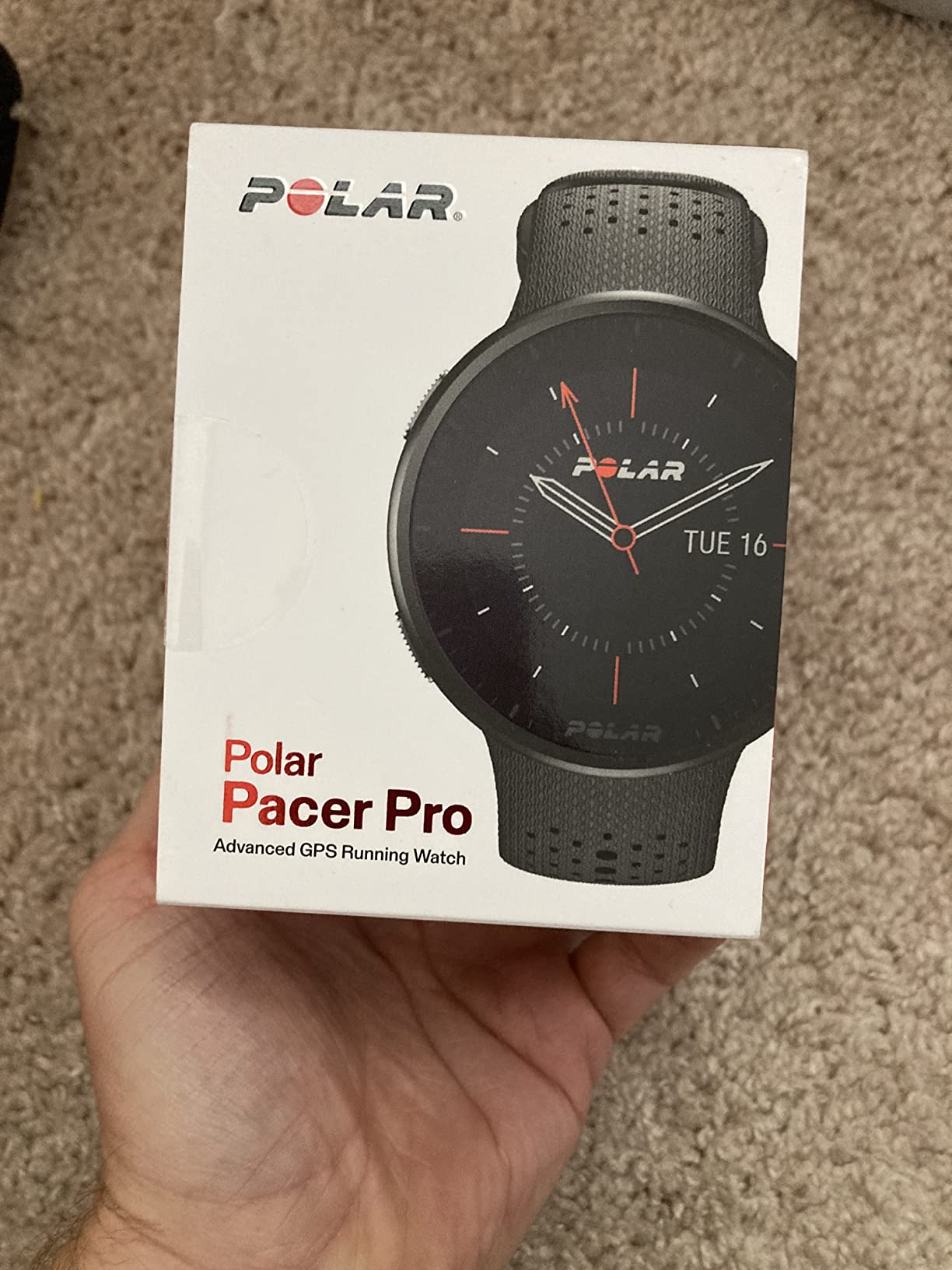
Why POLAR runners stay loyal
Heart rate accuracy and weight, full stop. If your training decisions are driven by heart rate zones, VO2 max or recovery windows, the Pacer Pro paired with an H10 strap gives you a reference point the other optical sensors here cannot match.
It also covers 150-plus sports, includes two wristband sizes with 20mm adapters, and carries a two-year manufacturer warranty. GPS connects quickly and records accurate tracks in practice.
What you give up for it
There is no touchscreen and very few smartwatch features compared with a Garmin or an Apple Watch. Watch face and band options are also narrower, so customization goes nowhere.
The wrist heart rate can lag a chest strap by seven to eight beats per minute, and automatic sleep detection sometimes misses a night or misjudges when you fell asleep. The IPX3 and 0.5 meter water rating means this is a running watch, not a swimming watch.
8. COROS PACE Pro — Best for Long GPS Battery and Offline Navigation
COROS PACE Pro GPS Sport Watch, 1.3-inch AMOLED Touchscreen…
38 hours outdoor GPS, 31 hours dual-frequency
Offline topographic maps and route planner
1.3 inch always-on AMOLED at 1500 nits
USB-C charging
Pros
- Very long 38 hour outdoor GPS battery
- Precise GPS on city streets and remote trails
- Offline topographic maps with turn-by-turn navigation
- Responsive interface from the upgraded processor
- USB-C charging
- Two-year warranty
Cons
- Smaller ecosystem and fewer third-party apps
- COROS app less mature than Garmin Connect
- Full app functionality listed as iPhone dependent
Nobody in this roundup gets more running out of a single charge than the COROS PACE Pro. Thirty-eight hours of outdoor GPS, or 31 hours with dual-frequency enabled, plus 20 days in normal use and 6 days with the always-on display. For a runner doing a long slow distance block or a big training weekend, that removes charging from the conversation entirely.
The new satellite chipset delivers what COROS claims as its most precise GPS to date, and in practice the track came out clean on both city streets and remote trails. The processor is more than twice as fast as its predecessor with roughly three times the zoom speed, which you feel in how quickly menus and maps respond.
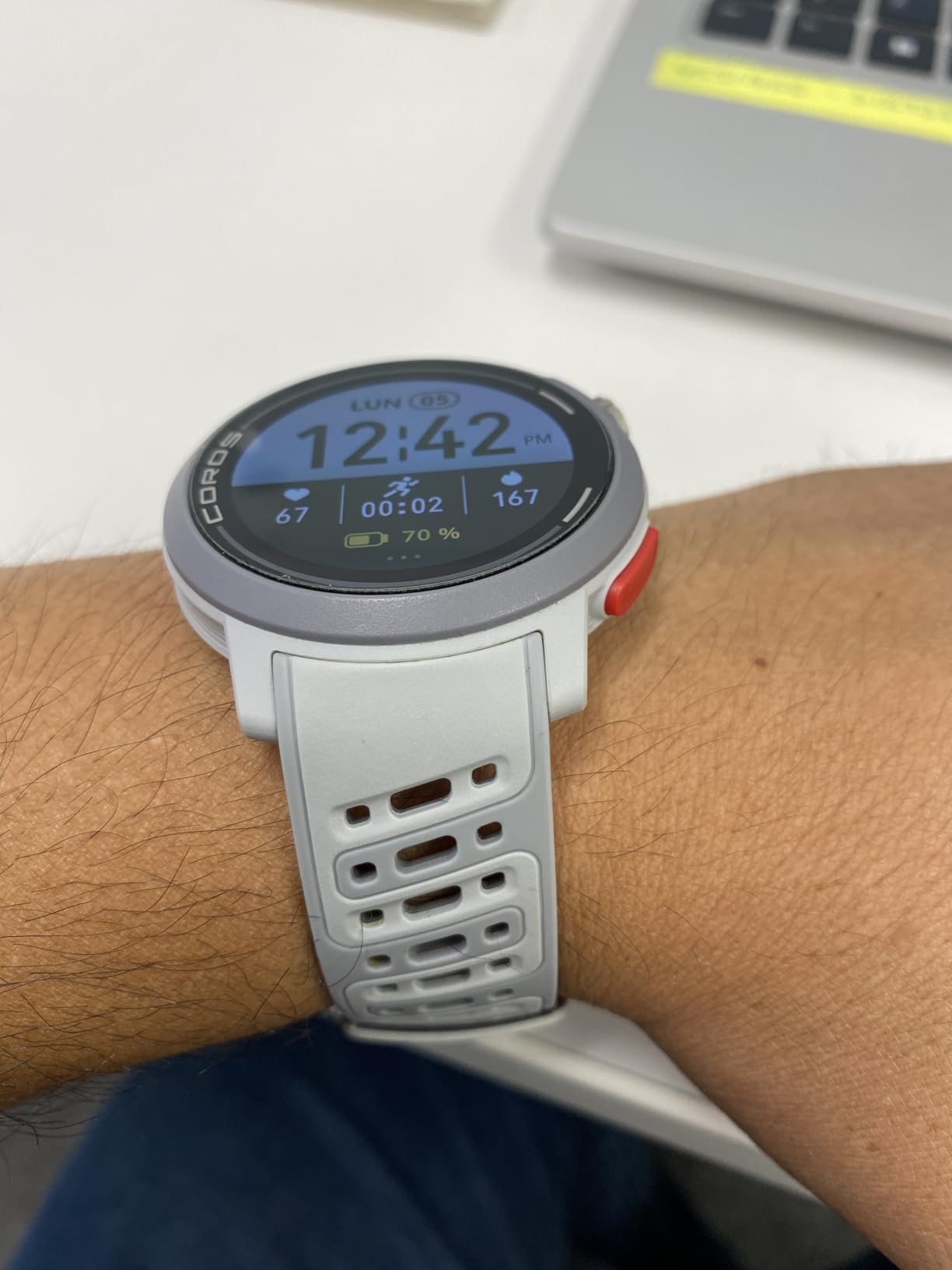
Navigation is the other reason to pick this one. The route planner with worldwide topographic maps, turn-by-turn guidance and offline downloads means you can leave the phone behind on a route you have never run before. Storage is 32 GB, the band fits 130 to 220mm wrists, and it charges over USB-C with an included keychain adapter.
The 1.3 inch always-on AMOLED runs at 1500 nits with a gesture-activated backlight, which is bright without being reflective in direct sun. In the COROS app you get training status, custom workouts, activity summaries and sleep analysis, and the warranty runs two years.
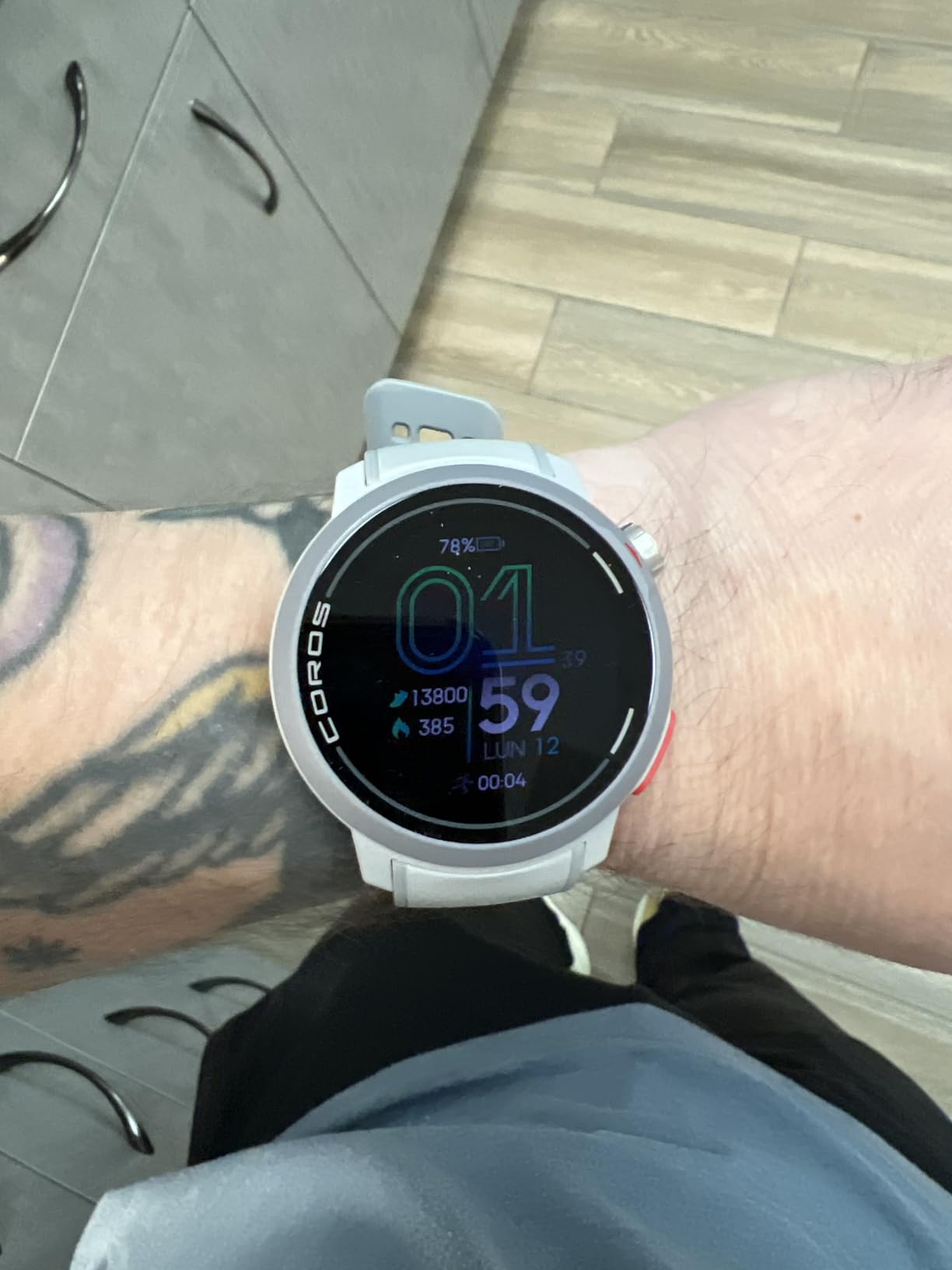
Why COROS keeps winning over Garmin
Battery and maps at this level, at this weight, with USB-C charging. Most rivals force you to pick either endurance or onboard navigation. This one does both, and the 49 gram body stays comfortable over distance.
Reviewers also point out that core features do not sit behind a subscription, which is a real running cost advantage once you start stacking services.
Where the PACE Pro falls short
The ecosystem is the gap. Fewer third-party apps than Garmin, and runners migrating from another ecosystem report the COROS app experience as less mature than Garmin Connect.
Compatibility is listed as iPhone dependent for full app functionality, which is a genuine concern for Android-only runners. There is no contactless payment support either, and 32 GB of storage is modest next to the Samsung Galaxy Watch Ultra.
9. COROS PACE 4 — Best Lightweight Watch for Daily Wear
COROS PACE 4 Ultralight Sport GPS Watch (Black Silicone…
32g with nylon band, 11.8mm thin
41 hours continuous GPS, 19 days daily
1.2 inch touchscreen AMOLED at 600 by 680
Voice recording and Voice Control
Pros
- Full week of 24/7 wear plus about 40 miles of GPS
- Very light at 32g with the nylon band
- Accurate GPS with no drop-out artifacts
- Good heart rate accuracy at steady state
- Voice features and Action Button are useful mid-run
- Clean app with Strava Nike Run Club and Apple Health sync
Cons
- Heart rate accuracy is spotty during intervals
- Pace readings can lag on anything but easy runs
- Small screen and an always-on display that drops data fields
- No contactless payments
- Fewer smart features than an Apple Watch
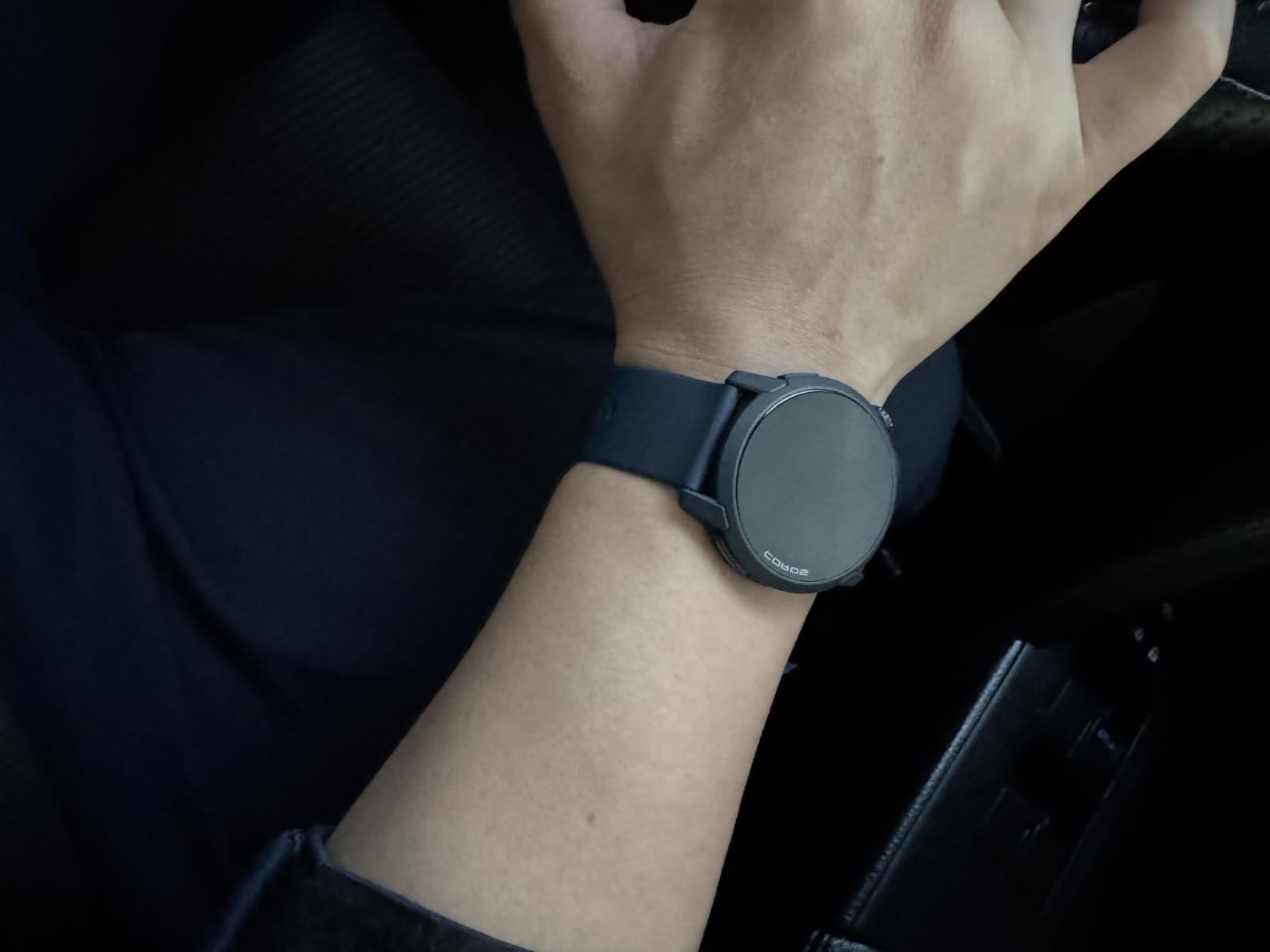
The COROS PACE 4 is the watch to buy if you dislike wearing watches. At 32 grams with the nylon band and just 11.8mm thin, it is the most wearable running watch I have tested, and marathoners switching over from an Apple Watch consistently single out the weight and battery as the reason for moving.
Battery is extraordinary in real terms. Owners report a full week of 24/7 wear plus roughly 40 miles of GPS running before dropping below 40 percent, and the quoted figures are 41 hours of continuous GPS and up to 19 days of daily use. Charging is a non-event.
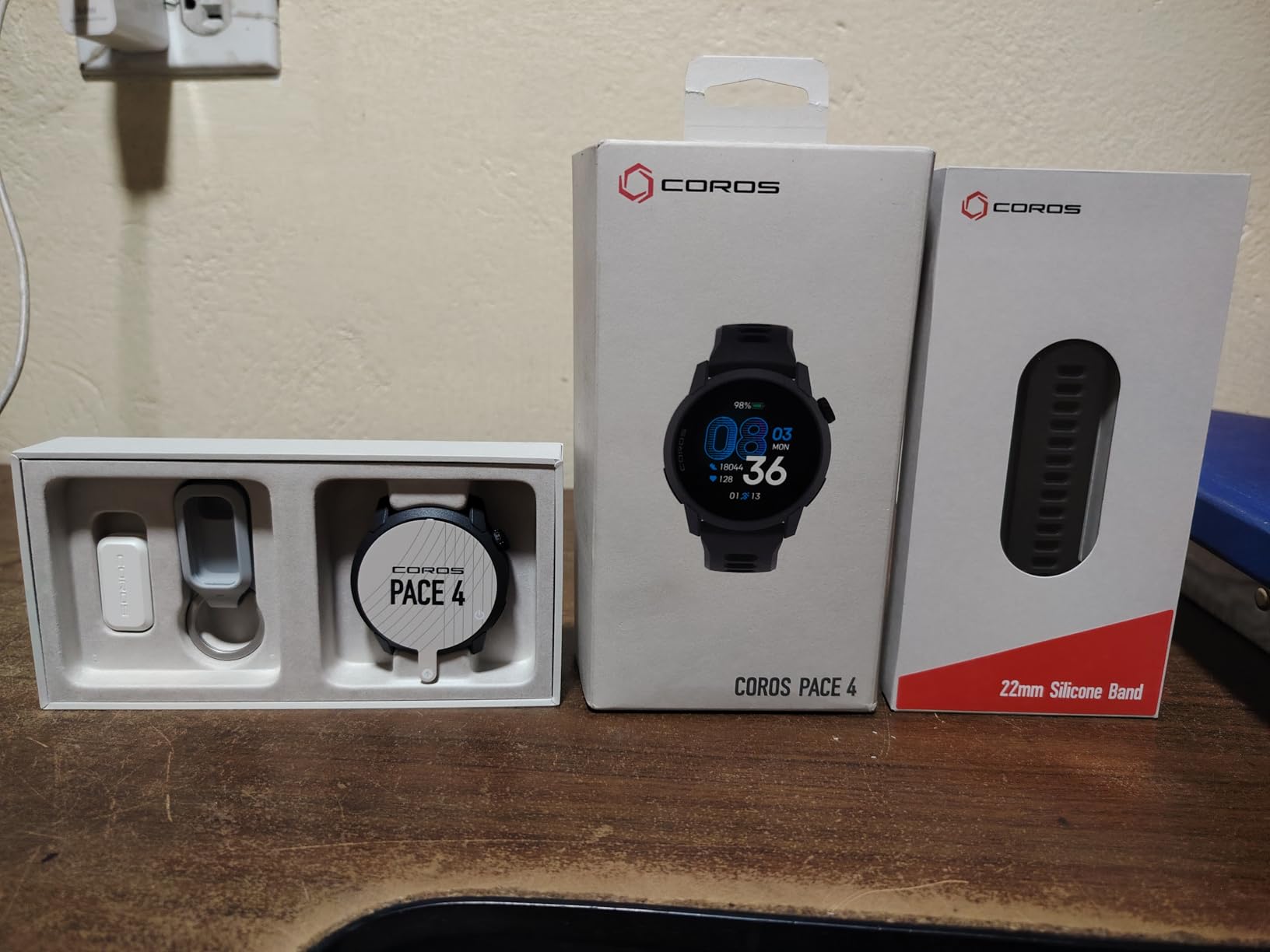
GPS came out clean with no satellite drop-out artifacts, and heart rate was good for steady-state running. The 1.2 inch touchscreen AMOLED has auto-adjusting brightness and a resolution 164 percent higher than the PACE 3, and the control layout is genuinely modern: a tactile digital crown, two buttons, a touchscreen and a customizable Action Button you can set to whatever you need mid-run.
It also records voice notes for workouts and offers Voice Control for alarms and custom workouts. Through the COROS app you get recovery time, sleep stages, HRV and menstrual cycle tracking, plus breadcrumb navigation, a compass and stored courses with turn-by-turn guidance. Storage is 4 GB, enough for 10-plus hours of music, and the warranty is two years.
Why this is the watch you will actually keep wearing
Comfort, battery and clean data. The app syncs seamlessly with Strava, Nike Run Club and Apple Health, so you are not locked into one training platform, and the two-year warranty with continued software updates including offline maps is reassuring.
It is the natural choice for a runner who wants a sports watch, not a smartwatch, but still wants sleep and recovery data on the wrist.
Where the PACE 4 will frustrate you
Heart rate accuracy is spotty during intervals, and a chest strap is more reliable for hard efforts. Pace readings can also lag on anything that is not an easy run, which sometimes pushes people toward a foot pod.
The screen is small, and the always-on display drops some data fields you may want. There is no contactless payment support, and compared with an Apple Watch the smart features are thin. You cannot use a voice assistant to add items.
10. Suunto Race S — Best for Multisport and Navigation-Headed Runners
SUUNTO Race S GPS Sports Watch, 1.32” AMOLED 95+ Sports…
Dual-band GNSS on L1 and L5 across 5 systems
30 hours performance mode, 13 days daily
Global offline maps with navigation
Pro TSS CTL HRV VO2 max and TSB metrics
Pros
- Dual-band GNSS across five satellite systems
- Compact 60g body that is 11.4mm thin
- 13 day daily battery with a one-hour full charge
- 95+ sport modes with pro training metrics
- Global offline maps with route navigation and find-back
- Two-year warranty and 300+ partner integrations
Cons
- Smallest review base of the ten
- Suunto app and desktop software less refined than Garmin Connect
- Only 50m water resistance limits open-water swimming
The Suunto Race S is the quiet specialist here. Dual-band GNSS across L1 and L5 on five satellite systems is genuinely high-end positioning, and it delivers reliable tracking on both urban loops and technical trail without the battery penalty the COROS PACE Pro charges for dual-frequency mode.
Its training metrics borrow the serious endurance vocabulary: TSS, CTL, HRV, VO2 max and TSB, with an AI Coach in the Suunto app. If you came from a performance background those numbers will feel familiar, and with 95-plus preset sport modes this watch handles far more than running.
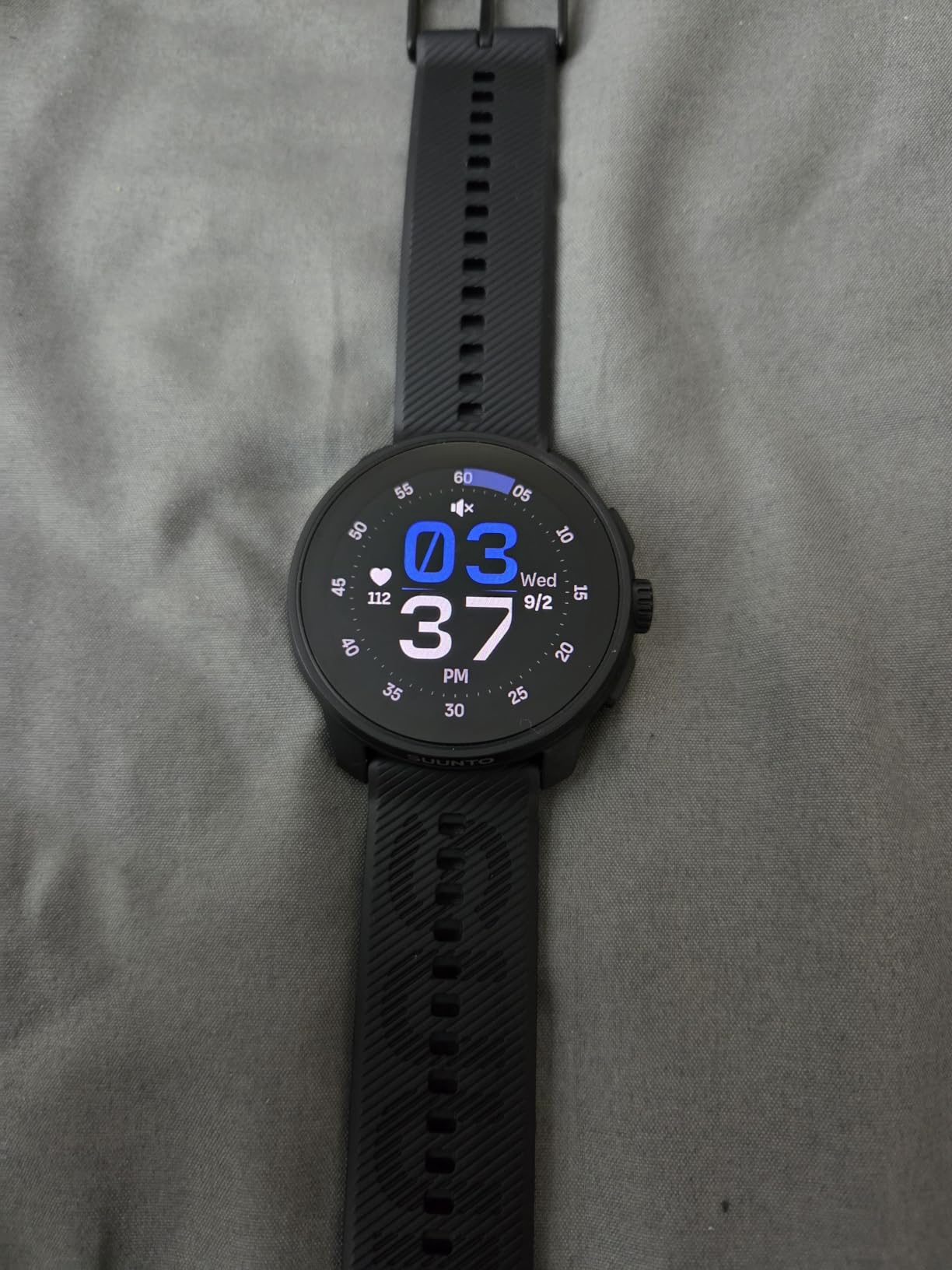
Navigation is the sleeper feature. Global offline maps with 2km zoom-out, route navigation, points of interest, find-back and bearing are packed into 32 GB of storage, and the companion app connects with more than 300 partner services. You also get weather forecasts, a storm alert barometer, an altimeter, a compass and sunrise and sunset alarms.
Wellbeing tracking runs 24/7 and includes menstrual cycle care. Battery is 30 hours in performance mode at the best GPS accuracy, 13 days in daily use, and a full recharge in about an hour on a 60 gram, 11.4mm-thin body with a 1.32-inch 466 dpi AMOLED and a digital crown.
Why a trail or multisport runner should look here
Dual-band GNSS plus genuine offline navigation plus an hour-long recharge is a combination nothing else matches at this size. The 60 gram body is light for a watch with maps on board, and 95-plus sport modes make it a genuine one-device multisport option.
Add the two-year warranty, the broad SuuntoPlus partner ecosystem and the 466 dpi screen density, and it is a serious value for a runner who does more than one sport.
Where the Race S is the risky choice
The review base is the smallest of the ten at 182 reviews, so there is less long-term owner feedback to lean on than with Garmin or COROS models. Buyers consistently note the Suunto app and desktop software are less refined than Garmin Connect.
Water resistance is limited to 50 meters, which rules out open-water swimming for a triathlete. And if you are migrating from a mature ecosystem, expect a few weeks of adjustment before the app feels routine.
How to Choose a Running Watch: 7 Criteria That Matter
Most buying guides lead with price, and then the reader picks a watch that does not work with their phone. Platform comes first. The Apple Watch Series 11 only pairs with an iPhone, which is a hard wall, not a preference. Every other watch in this roundup pairs with both iOS and Android, though COROS lists full app functionality as iPhone dependent on the PACE Pro. If you are undecided between platforms, that single filter will do most of the work for you.
GPS accuracy, explained without the jargon
There are three things being described as GPS, and they are not equal. Single-band GPS locks onto one satellite frequency and is fine in open sky. Dual-frequency GPS listens on two frequencies at once, which corrects the ionospheric errors that make city running drift. Multi-band goes further by using additional frequency bands for even tighter positioning.
The Garmin Forerunner 265 uses multi-band GNSS with SatIQ, which switches to multi-band only when conditions warrant it and otherwise runs on a single band to save power. The Suunto Race S and Samsung Galaxy Watch Ultra use dual-band or dual-frequency approaches. The Amazfit Bip 6 and COROS PACE 4 run standard GPS, and the COROS PACE Pro adds a dual-frequency mode you can enable.
For most runners, the difference only matters if you run in cities, under tree cover, or in mountainous terrain. For trail and ultra runners it is the difference between knowing where you are and wondering.
Battery life: what GPS mode really costs you
Every watch advertises two numbers, and the second one is the one that matters. Smartwatch mode numbers are measured with the screen dark and the GPS off, so they tell you almost nothing about race day. The GPS mode number is the real budget: roughly 19 to 20 hours for the Garmin Forerunner 165 and 265, 30 hours for the Suunto Race S, 35 hours of training mode for the POLAR Pacer Pro, and 38 hours of outdoor GPS for the COROS PACE Pro.
For most recreational runners, anything above 20 hours of GPS covers a marathon and then some. For ultra runners doing multi-day events, the question is whether you can get through a race weekend on a single charge, and that is where the COROS and POLAR models pull ahead. The Apple Watch Series 11, with up to 24 hours of normal use, is the one on this list where you plan the charge around the run.
Heart rate: when optical is enough and when you need a strap
Wrist-based optical heart rate is now good enough for easy and steady runs, and reviewers of the Forerunner 55 report readings within about three percent of a chest strap. It gets worse the harder you go, because movement artefacts confuse the sensor as your wrist swings harder.
Several watches in this roundup show the same failure pattern. The POLAR Pacer Pro can lag a chest strap by seven to eight beats per minute, and the COROS PACE 4 is described as spotty during intervals. If you set training intensity by heart rate zone rather than by pace or feel, add a chest strap. The POLAR Pacer Pro is the only watch here with first-class H10 strap support, and Garmin watches accept external sensors too. We covered chest straps versus optical in more detail in our health monitoring smartwatch guide.
Display: AMOLED versus MIP in daylight
AMOLED screens are brighter, sharper and far better with watch faces and menus. The Forerunner 165, 265, COROS PACE 4, COROS PACE Pro, Suunto Race S and Amazfit Bip 6 all use AMOLED, ranging from 1.2 inches up to the Bip 6’s 1.97 inches at 2000 nits.
Transflective MIP, which is what the Forerunner 55 uses, is duller in photos and much better in actual sunlight because it is lit by the environment rather than the screen. It also lasts far longer on a charge. Most runners will never consciously notice the difference, but the 55 and POLAR Pacer Pro prove that not every runner needs a glass rectangle to be satisfied.
Ecosystem lock-in and switching costs
This is where the real money is, and where most roundups go quiet. Moving from an Apple Watch to a Garmin or COROS is not just a new device, it is a new companion app, a new account, and potentially a loss of workout history unless the old platform exports files. Garmin Connect, the COROS app, Polar Flow and the Suunto app each have their own analysis style, and your historical data lives wherever you last lived it.
Apple’s ecosystem is the most closed, and the terms there are explicit: iPhone only, and some features such as Workout Buddy require a nearby iPhone. That convenience is exactly why people stay. Conversely, Garmin is the deepest and the most demanding to learn, which is a real cost in time if you are new to training metrics. If you are considering a Garmin for the first time, we have covered the wider family in our Garmin AMOLED fitness smartwatch roundup, and the everyday-smartwatch side in our smartwatch guide for older users which covers the safety features worth having.
Fit, weight and wrist size
Two case sizes in this roundup are genuinely too large for some people. The Samsung Galaxy Watch Ultra at 47mm and 60.3 grams, and the Garmin Forerunner 265 at 46mm and 47 grams, both draw frequent complaints about bulk. If you wear a smaller band size, look at the 43mm Forerunner 165 or the 41 gram POLAR Pacer Pro instead.
Weight matters more than most buyers expect, because a watch you find uncomfortable is a watch you stop wearing on long runs. The COROS PACE 4 at 32 grams and the Apple Watch Series 11 at 1.12 ounces are the two lightest options here, and both will disappear on the wrist. Water resistance is a separate check: 50 meters covers running, sweat and rain, but the Galaxy Watch Ultra at 10ATM and 100 meters is the only one on this list rated for serious swimming.
Safety and everyday wear
Falls, crashes and staying reachable matter if you run alone, on trails, or early in the morning. The Apple Watch Series 11 leads here with hard fall detection, severe car crash detection, Emergency SOS and Check In, and the Galaxy Watch Ultra adds fall detection plus LTE. Garmin includes incident detection and Assistance on the Forerunner 165 and 265.
After that it is about what you want the watch to do on a rest day. Music, payments and notifications keep you wearing a watch, and wearing it matters because sleep and recovery data only exist if the watch is on your wrist at night. Garmin Forerunner models and the COROS PACE 4 handle music and payments, the Apple Watch handles both plus messages, and the POLAR Pacer Pro and Amazfit Bip 6 handle neither. We looked at the fashion-forward end of the market in our Garmin luxury smartwatch guide if appearance is part of the decision.
Frequently Asked Questions
What is the best smartwatch for running?
For most runners the Apple Watch Series 11 is the best smartwatch for running, because it combines accurate GPS and wrist heart rate with a sleep score, ECG and safety features at 24 hours of battery. Serious runners training to a structured plan often prefer the Garmin Forerunner 265 for its SatIQ multi-band GNSS, training readiness score and 13-day battery. The right answer depends mainly on whether you carry an iPhone and how far you run.
Is Apple or Garmin better for running?
Garmin is better if your priorities are training metrics, multi-band GPS accuracy and multi-day battery life. Apple is better if you want calls, messages, payments, ECG and the deepest sleep and health tracking in one device, and you own an iPhone. Many runners do both: an Apple Watch for daily life and a Garmin for long runs and race day.
Why are people ditching smart watches?
The most common reasons are battery anxiety, subscription fatigue, notification overload, privacy concerns and a desire for dedicated sports features. Runners in particular move to dedicated running watches when they want training load, recovery guidance and a week of battery between charges rather than a full day and a wall of notifications.
Is a chest strap better than wrist heart rate for running?
A chest strap is meaningfully more accurate during intervals, hills and high-intensity work, because wrist optical sensors read less reliably when your arm swings hard. For easy and steady runs, modern optical sensors such as the Polar Precision Prime and Garmin’s wrist tracking are close enough for most runners. If you set training intensity by heart rate zone, a strap is worth the extra gear.
Do I need multi-band GPS for running?
Only if you run in cities, under tree cover or in the mountains. Multi-band and dual-frequency GPS reduce the drift you get between tall buildings and under canopy, which matters for accurate splits and distance. If you run on open roads or trails with clear sky, standard GPS is reliable and saves battery life. The Garmin Forerunner 265 handles this automatically with SatIQ.
The Verdict: Which Running Watch Should You Buy in 2026
If you read nothing else, start here. The Apple Watch Series 11 is our best smartwatch for running overall, because it is the only watch in this roundup that does the running data, the health data and the phone-on-your-wrist job without asking you to choose, and its 4.7 stars across more than 8,600 reviews is the strongest combination of rating and review volume here. The one condition is that you own an iPhone.
Train to a plan and upgrade when you want better data, and buy the Garmin Forerunner 265 for SatIQ multi-band GNSS, training readiness and a two-week-class battery. Watch your wrist size first, because 46mm is the one thing you cannot change later. Spending less, or wanting less complexity, gets you an excellent result from the Garmin Forerunner 165, while the Garmin Forerunner 55 still delivers the best battery-per-dollar ratio and the most reliable buttons in the group.
Go further afield and the COROS PACE Pro and Suunto Race S carry the strongest offline navigation here, the POLAR Pacer Pro is the lightest and the best heart rate story, and the COROS PACE 4 disappears on the wrist at 32 grams. Whatever you choose, give it four weeks before you judge the training metrics, and use the price-check buttons below to see where it sits today.
