
Cost to Replace a Water Heater: October 2026 Pricing Breakdown
The cost to replace a water heater runs most U.S. households between 1,800 and 3,200 dollars installed, and most people land closer to the middle of that band than the top of it. That total covers the new tank, removal and haul-away of the old one, a licensed plumber, the permit, and any venting or electrical work the site turns out to need.
It is also, almost without exception, about twice what the tank itself sells for. That gap is the single biggest source of confusion on this job, and it is why a 600 dollar unit in a hardware store aisle can turn into a 2,400 dollar line on a contractor’s invoice. Labor is roughly half the bill, and the advertised price never shows it.
Contents
Below is what each type costs installed, what moves a quote up or down, and how to read the itemized bid before you sign anything. All figures are U.S. ranges for 2026 and they vary by region; a coastal metro area and a rural county will not produce the same number. No brand endorsements here, just the cost math.
Water Heater Replacement Costs at a Glance
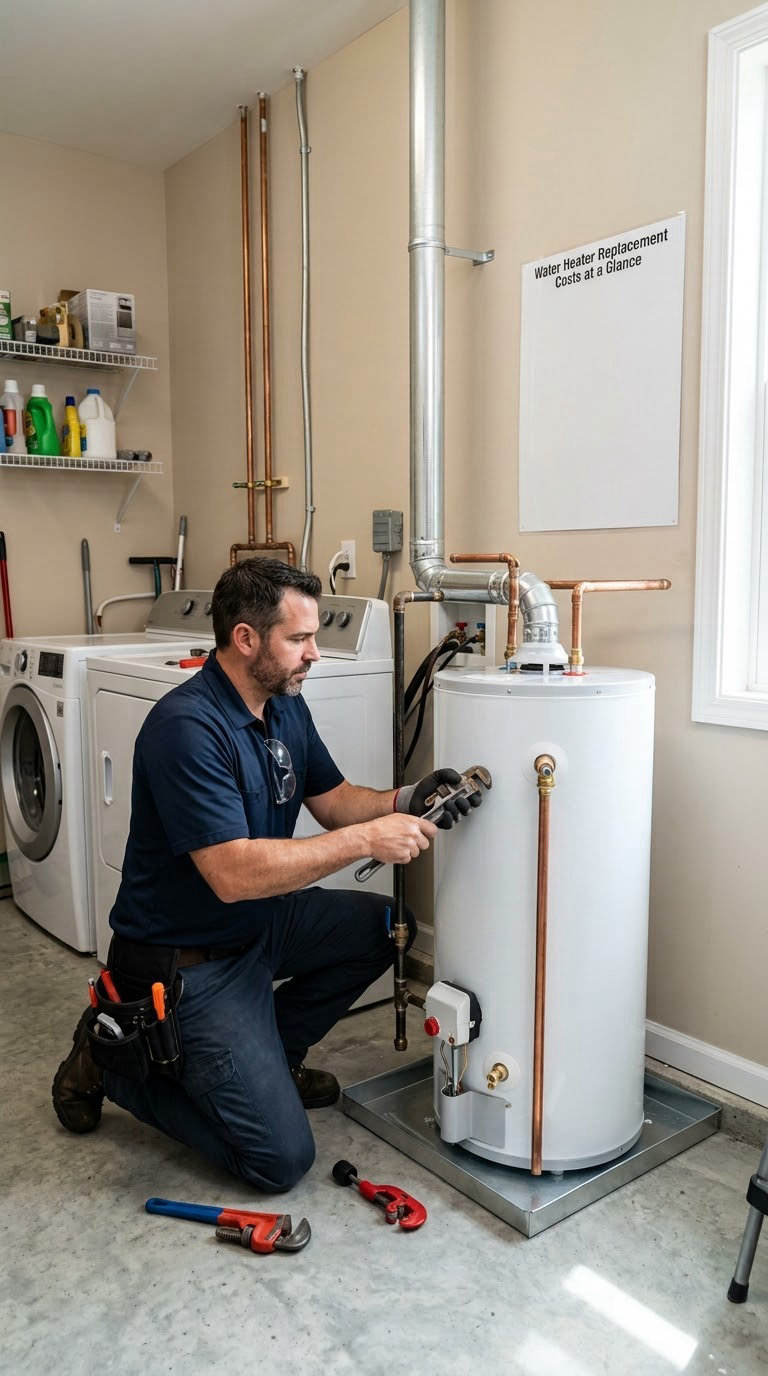
These are installed totals, not sticker prices. Labor and permit are priced as a one-for-one swap in a normal installation location with no relocation and no fuel conversion.
| Heater type | Equipment | Labor and permit | Total installed |
|---|---|---|---|
| Electric tank, 40 to 50 gallon | 400 to 1,200 | 700 to 1,800 | 1,100 to 3,000 |
| Gas tank, 40 to 50 gallon | 500 to 1,400 | 800 to 2,200 | 1,300 to 3,600 |
| Tankless, gas, whole house | 1,200 to 3,500 | 1,200 to 3,000 | 2,400 to 6,500 |
| Hybrid heat pump, 50 gallon | 2,500 to 5,000 | 900 to 2,200 | 3,400 to 7,200 |
Point-of-use electric tankless units are the exception to every row above. A single-fixture unit installed can land between 700 and 1,800 dollars all in, but they only serve one tap and are not a whole-house answer.
Why published ranges disagree so much
If you have been comparing pages, you have seen at least four different answers. One national retailer publishes 1,600 to 5,400 dollars. A cost calculator puts one heater at 1,632 to 1,895. A manufacturer’s guide says 600 to 4,500. An AI-generated search summary says 1,000 to 3,000, with most people paying 1,600 to 2,400.
None of them are wrong, they are measuring different things. The wide retail band spans the simplest possible swap and a full relocation with new venting and electrical service, which is two different jobs. The calculator under-scopes because it assumes one 40-gallon gas unit in a standard basement. The manufacturer’s low end is equipment-only pricing.
A regional plumbing company in the Twin Cities quotes 1,800 to 2,800 dollars for a standard 50-gallon gas replacement, which sits neatly inside the wide national band and is a useful reality check on where you are on that curve. The number to plan around is the middle of your local spread, not the national floor.
One more thing the published averages usually skip: sales tax on materials, and if a general contractor is supervising the plumbing, another 13 to 22 percent on top. Both are real, both are legitimate, and both are worth asking about before you compare two bids against each other.
What Changes the Cost to Replace a Water Heater?
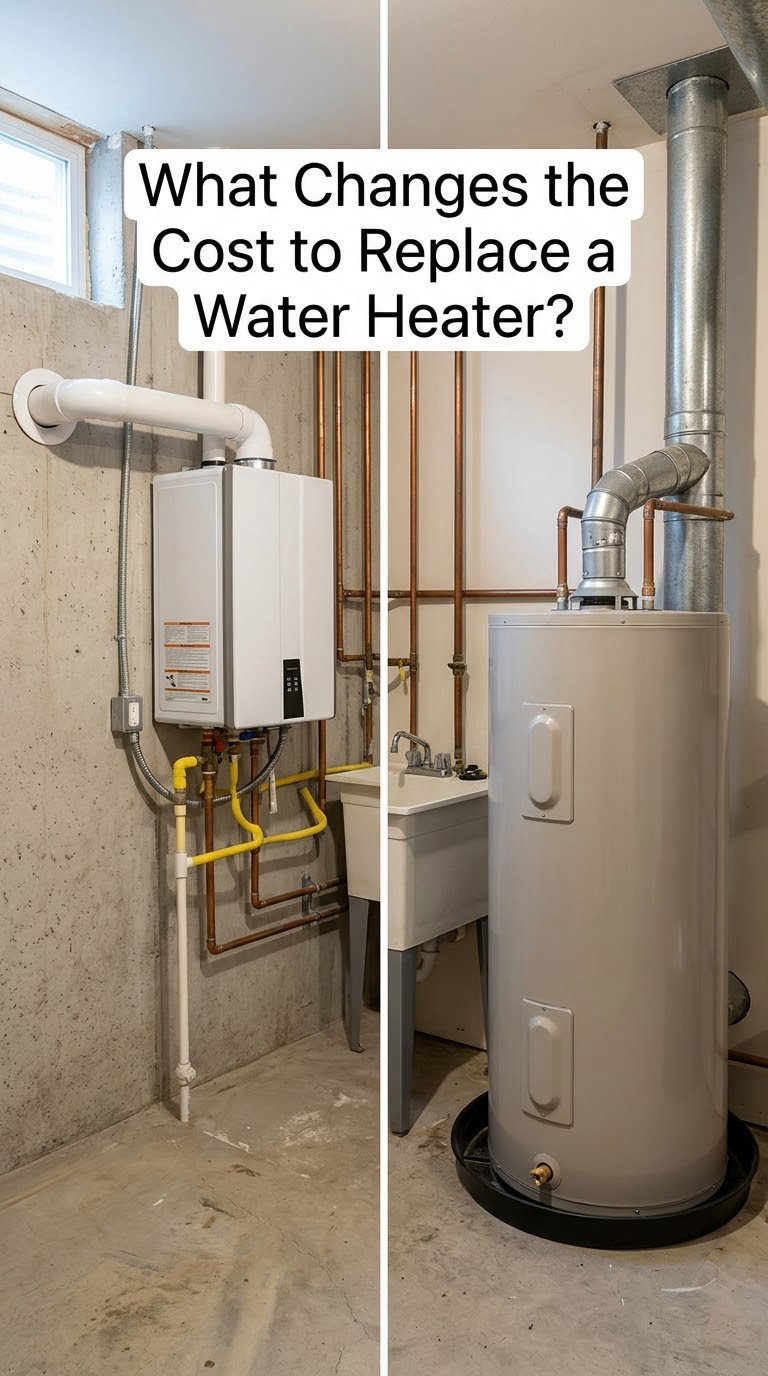
Type and size set the baseline. Everything after that is site conditions, and site conditions are where quotes diverge. Two identical tanks in two identical neighborhoods can be 900 dollars apart because one sits behind a finished wall and the other sits in an open utility room.
Where the unit lives and how hard it is to reach
The single biggest surprise in this trade is access. A tank in an open finished basement takes two hours. The same tank in a crawl space, an attic, a garage against an exterior wall, or a tight closet behind a door that has to come off its hinges can take all day, and some plumbers price the difficult version accordingly.
Moving a tank to a new location is a separate project entirely. New copper or PEX lines, new venting, patching the old hole, and possibly a new drain pan add 600 to 1,800 dollars. If your current location is workable, staying put is the cheapest efficiency decision available to you.
Fuel source and whether you are converting
Converting an electric home to a gas water heater means running a gas line, adding a gas meter if the house does not have one, and venting. That is commonly 1,000 to 2,500 dollars of work before the tank is even set. Converting from gas down to electric is usually cheaper, but a 50-gallon electric tank pulls 30 amps or more and older 100-amp panels may need a subpanel.
Propane is its own category with its own economics, and it only makes sense if the home is already off the natural gas grid.
Venting, electrical capacity and code-driven upgrades
Gas tanks vent through a flue. If your existing flue is the right size and in good shape, it is reused for free. If it needs replacing or a new penetration has to be cut, expect 500 to 1,000 dollars. Power-vented and direct-vent models add a powered blower and change the flue rules entirely.
Many jurisdictions now require a small expansion tank when a check valve or pressure-reducing valve is on the line. It is under 100 dollars to install, and the reason homeowners argue about it is that it is frequently missing from the original quote and appears as an add-on on the final invoice.
Regional labor rates and why they spread so far
Equipment is close to nationally priced because it ships from the same handful of manufacturers. Labor is not. The same tank in the same condition costs meaningfully less in a low-cost region than in a dense metro area where licensed plumbers carry higher wages, insurance, vehicle costs and call-out charges. Local labor rate, not tank capacity, is usually the strongest predictor of your actual invoice.
Two things move labor off the national median. After-hours and emergency work carries a premium, so if your tank failed at 9 p.m. on a Sunday, expect to pay for the timing. And if a general contractor is coordinating the work rather than a plumber dealing with you directly, another 13 to 22 percent of markup gets added on top of the plumbing subtotal. Ask who is actually billing you and whether anyone is standing on the job between them and you.
What a professional quote should itemize
Ask for these as separate lines. A lump sum tells you nothing, and itemization is what the community keeps asking for in homeowner forums when a number feels wrong.
- Removal and disposal of the old unit, including haul-away
- The new unit, with model number and capacity
- Licensed plumber labor, either as hours or a flat install fee
- New connectors, fittings, T&P relief valve, and any expansion tank
- Permit fee and inspection, if your jurisdiction requires them
- Any venting, gas line, or electrical work, priced separately from labor
One thread on r/homeowners tells the whole story: a homeowner paid 4,300 dollars for a unit the shop bought for 1,500. That is 2,650 of labor and materials, itemized by arithmetic rather than by quote. Legitimate, but you should have seen it written down beforehand. A separate thread shows the same 38-gallon electric job quoted at 1,600 dollars by a big-box retailer and 2,500 dollars by a local company for identical work, which is exactly why you compare like against like.
Traditional Tank Water Heater Replacement Costs
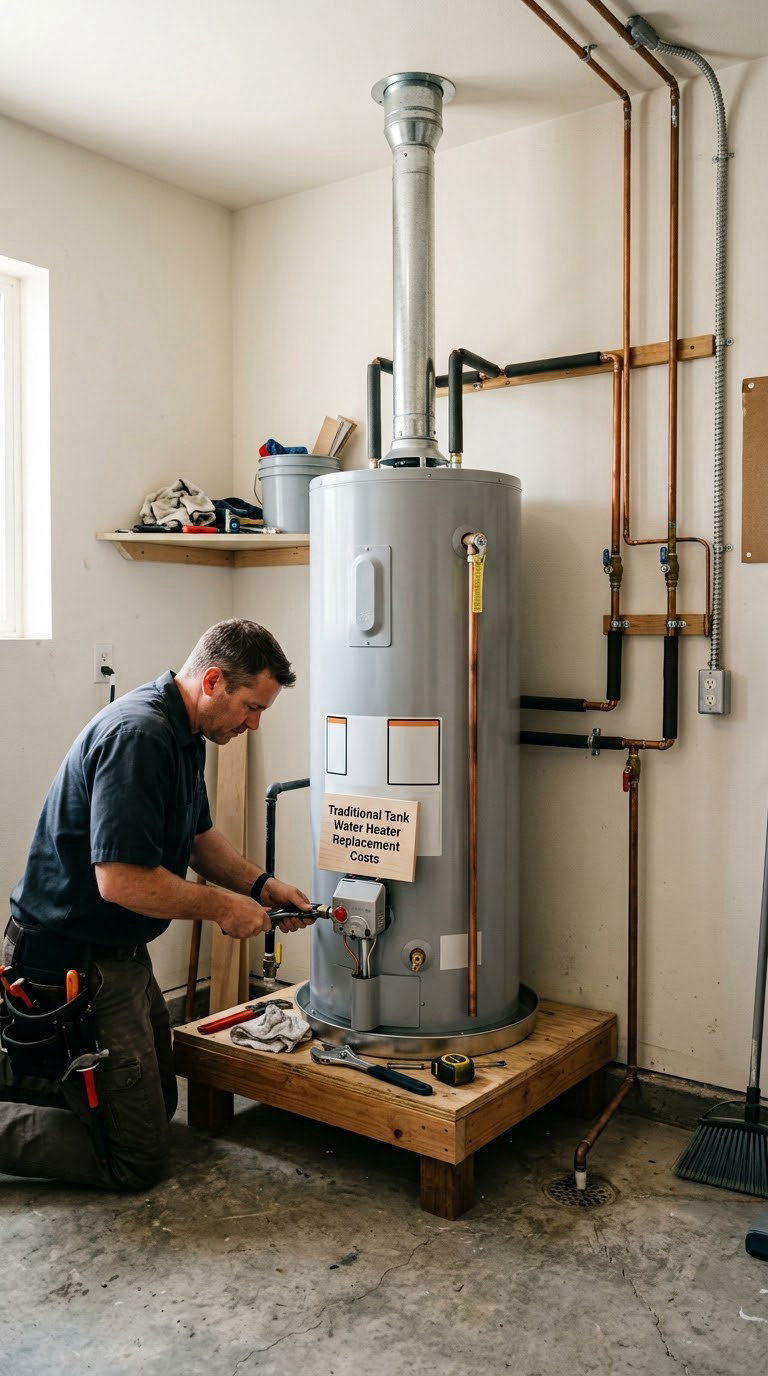
This is the bread-and-butter job and the cheapest real replacement, mostly because nothing changes. Same flue, same fuel, same location, same pipes.
What the total is made of
- Equipment: 400 to 1,200 dollars for electric, 500 to 1,400 for gas. Common brands at retail include Rheem Performance, Bradford White, Reliance, Ecosmart and Richmond.
- Removal and disposal: 100 to 400 dollars, more when the tank is full of water and concrete and getting it out of a crawl space.
- Labor: 200 to 400 dollars for a straightforward one-for-one swap in an accessible location, rising toward 1,000 dollars for complicated work.
- Permit and inspection: 50 to 300 dollars depending on your city or county.
- Add-ons: flex connectors, a new T&P valve, an anode rod, a sediment flush, an expansion tank. Individually small, collectively 100 to 350 dollars.
Does tank size change the price much?
Equipment, yes. Labor, a little. A 40-gallon electric swap typically lands between 1,100 and 2,400 dollars installed, while a 50-gallon electric lands between 1,300 and 2,800. The gas versions run roughly 200 to 400 dollars higher on both the equipment and the labor side because venting is involved.
Sizing is usually a short conversation rather than a design project. The first-hour rating on the label tells you how much hot water arrives in the first hour, and that number matters more than gallons. If your family runs the dishwasher and two showers back to back, a 40-gallon unit with a good first-hour rating will feel better than a 50-gallon unit with a weak one.
Repair or replace
This is the highest-leverage decision you make on this job, and most articles skip it. Component repairs, thermocouples, heating elements, valves, expansion tanks, run 150 to 700 dollars. Replacement runs 1,100 to 5,000 or more. If the tank is nine years old and the element is the only thing wrong, a repair is obviously the right call.
Once the tank itself starts weeping from the glass lining or the floor of the tank is visibly corroded, repair stops being economical. If your water has heavy sediment, the anode rod is the sacrificial component that is supposed to fail first, and there is a good primer on water heater elements for hard water if you want to know what that part looks like before a plumber starts talking about parts.
In areas with hard water, scale inside a tank cuts recovery capacity and burns fuel faster. Specifying gas water heaters built for hard water conditions at purchase costs nothing extra and buys you a longer useful life than a cheaper unit will give you.
Tankless Water Heater Replacement Costs
Tankless is a different purchase, not a like-for-like swap. There is no tank to replace, there is a wall unit, a venting decision, and often a bigger electrical conversation.
A gas tankless unit typically runs 1,200 to 3,500 dollars for the equipment and 1,200 to 3,000 dollars installed, so 2,400 to 6,500 all in. Electric whole-house units run 700 to 2,000 dollars for equipment and 800 to 2,500 dollars installed, so 1,500 to 5,000, with one important catch: most whole-house electric tankless models draw between 100 and 140 amps, which means a service panel upgrade or a new subpanel is frequently part of the quote.
Recirculation is the feature people miss and end up wanting. Without it, you wait for hot water every single time. A recirculation loop adds pump and loop installation, commonly 300 to 900 dollars on top, but it is much easier to add while the plumber is already in there than a year later.
Water demand sets the sizing. A gas unit at 199,000 BTU handles a busy household; a small 80,000 BTU unit does not. If you have hard water, scale on the heating elements is the failure mode that ends a tankless unit’s life early, so tankless units suited to hard water are worth a look before you commit. Scale-free or condensing models exist, and they cost more up front.
If you only want hot water at one bathroom and one laundry sink, a point-of-use electric unit at 700 to 1,800 dollars installed is a legitimate answer. It is not a whole-house replacement and it will not touch the existing tank, so many people end up doing both eventually.
Hybrid Water Heater Replacement Costs
A hybrid, or heat pump, water heater moves the heat from the surrounding air rather than burning fuel or running a resistance element. Equipment runs 2,500 to 5,000 dollars for a 50-gallon unit and installation adds 900 to 2,200, putting a typical installed price between 3,400 and 7,200 dollars. It is the most expensive category on this list and also the one with the largest offsetting savings.
Efficiency is where the payback comes from. A standard tank sits under a Uniform Energy Factor of 1.0; a hybrid commonly lands between 3.7 and 4.3. Against a standard gas tank that runs roughly 300 dollars a year in fuel, a hybrid is often closer to 170 dollars, and against a standard electric tank the gap is far wider. Your own utility rate decides whether that pays back in five years or fifteen.
Installations have requirements people are not warned about. The unit needs a serviceable airspace, so a finished closet often does not work without opening it up. It pulls air from and dumps cold exhaust into the room, which means a condensate drain line and adequate clearances. In a cold garage or unfinished basement, the heat pump mode performs poorly and the backup element carries the load.
Two offsets are worth asking about before you write the check. The federal residential clean energy credit has covered up to 2,000 dollars of qualifying heat pump water heater cost, and many local utilities offer rebates in the range of 300 to 850 dollars for the same equipment. Both are administered through your contractor or your utility, and both need documentation, so ask early rather than after installation.
DIY Versus Professional Water Heater Replacement
The honest answer: the parts of this job you can safely do yourself are the parts that cost nothing, and the parts that cost money are the parts that need a license.
Homeowners routinely handle the unglamorous prep work. Draining and disposing of the old tank is straightforward once you know how to shut off the supply, and a plumber will sometimes quote lower when the homeowner has already done it. Shutting off and disconnecting the water lines on an electric unit is reasonable if you are comfortable with it and you are not going to leave a live electrical panel open.
Everything involving gas, the flue, the electrical service, or the pressure relief valve should go to a licensed plumber. Gas work in most jurisdictions requires a permit and a licensed gas fitter. Venting has to meet code for the unit’s BTU rating and the flue’s draft. The T&P valve is the component that prevents a tank from exploding, and it is a code-required part of the installation, not an optional one. Get any of it wrong and you have a leak, a failed inspection, a voided manufacturer warranty, or a serious hazard.
On the numbers, the savings are real but smaller than they look. Doing the whole job yourself has been reported at roughly 600 dollars in parts and consumables, against professional quotes in the 1,200 to 2,600 dollar range for the same tank. In exchange you take on the permit, the code inspection, the gas and flue risk, and your own time on a Sunday.
If you want the savings without the risk, buy the unit yourself from a retailer and hire a plumber for labor only. Supply house and retail pricing differ, and some plumbers will not warranty work on a unit they did not sell. Confirm that in writing before you buy anything, because it is the most common way this plan falls apart mid-job.
Frequently Asked Questions
How much does it cost to replace a water heater?
Most households pay 1,800 to 3,200 dollars for a standard 40- or 50-gallon tank replacement installed, including the unit, removal of the old one, labor and permit. Straightforward electric swaps start near 1,100 dollars and gas swaps near 1,300. Tankless runs 2,400 to 6,500 and hybrids 3,400 to 7,200. Regional labor rates are the biggest variable.
Is it cheaper to replace a tank water heater with a tankless model?
Not on the install, no. Switching to tankless usually raises the installed price by 1,000 to 2,500 dollars compared with swapping in another tank, because the venting, gas or electrical work is different and recirculation is often added. You may still come out ahead over time on lower fuel bills and longer equipment life, so compare the total cost over ten years rather than the invoice.
Can I install a water heater myself?
You can usually drain, remove and dispose of the old tank yourself, and some plumbers will discount the job for that. Everything involving gas, the flue, the electrical service or the T and P relief valve needs a licensed contractor and, in most places, a permit and inspection. A full DIY job has been reported at about 600 dollars against professional quotes of 1,200 to 2,600.
What is the average cost to remove and dispose of an old water heater?
Removal, disposal and haul-away typically runs 100 to 400 dollars and is usually bundled into the installation quote rather than priced alone. Expect more at the top of that range when the tank is still full, sits in a crawl space or attic, or is strapped into a tight closet. Ask whether disposal is included, since it is occasionally quoted as a separate line.
Do I need a permit to replace a water heater?
In many jurisdictions you do, particularly for gas units, new venting, relocations and fuel conversions. Permit and inspection fees commonly run 50 to 300 dollars depending on your city or county. Electric like-for-like swaps are the most likely to be exempt, but rules vary widely, so check with your local building department before scheduling the work.
How long does a replacement water heater last?
A conventional tank usually lasts 8 to 12 years, shorter in hard water areas where scale and anode depletion eat into the life of the glass lining. Tankless units commonly run 15 to 20 years, and hybrid heat pump models about 15. Annual flushing of sediment and a periodic anode rod check extend all three, and skipping the flushes is the usual reason a tank fails early.
What to Do First
Get three written quotes and require each one to itemize the same six things: the unit, removal and disposal, labor, fittings, permit, and any venting or electrical work. Then compare them line against line rather than total against total, because the two bids that look most different are often quoting different scopes.
Last updated October 2026. Figures are U.S. averages for planning purposes; your local quote will be what it is, and it is worth asking three people.
