Cost to Install Hardwood Floors: 2026 Pricing Guide Updated
The cost to install hardwood floors usually lands between $6 and $25 per square foot once the wood and the labor are both counted. Most homeowners planning a mid-range room land somewhere in the middle of that band, and the spread comes down to material, preparation, layout and how much work the installer has to do before the first plank goes down.
That single number hides more than most people expect. A quote that looks cheap on paper can double once removal, subfloor repair, trim and stair work get added, so I would rather you budget from a written scope than from a per-square-foot headline. Here is how the pieces fit together.
Contents
Hardwood Floor Installation Costs at a Glance
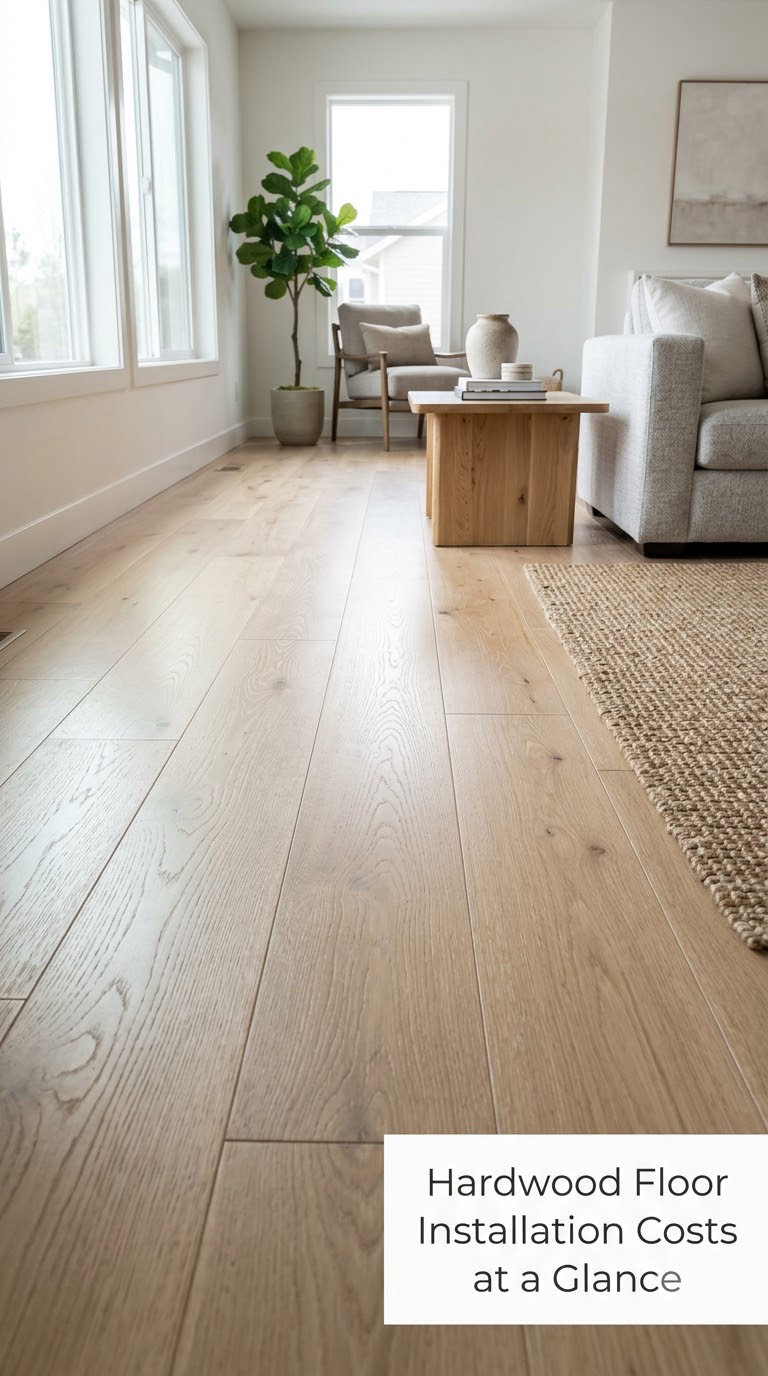
Most installers quote hardwood in two parts: the wood itself, then the labor to install it. Adding up the ranges homeowners see across the country, material runs roughly $3 to $15 per square foot and labor runs roughly $3 to $10 per square foot.
| Project tier | Material per sq ft | Labor per sq ft | Typical installed total |
|---|---|---|---|
| Budget (engineered, click-lock, domestic species) | $3 – $6 | $3 – $5 | $6 – $11 |
| Mid-range (solid oak or maple, nail-down) | $5 – $10 | $4 – $7 | $9 – $17 |
| Premium (wide-plank, site-finished or imported species) | $12 – $28 | $7 – $10 | $19 – $25+ |
Those are national reference ranges, not a quote for your house. Labor rates, material pricing and how much prep your floor needs change with every ZIP code, and homeowners in coastal metros routinely pay two to three times what the same project costs in the Midwest or South.
Two things move a quote more than anything else: what is already on the floor, and how the new wood gets laid. Removing glued tile and rebuilding a subfloor is a different job from laying engineered planks over a clean, level plywood deck.
Cost to Install Hardwood Floors by Room Size
Square footage is the easiest number to work with, so here is a straight table using the ranges above. These are the numbers to plan a budget around before anyone starts quoting.
| Room size | Materials | Installation labor | Likely installed total |
|---|---|---|---|
| 100 sq ft (small bedroom, 10 x 10) | $350 – $1,100 | $350 – $600 | $700 – $1,700 |
| 200 sq ft (12 x 16) | $700 – $2,200 | $650 – $1,200 | $1,400 – $3,400 |
| 300 sq ft (about 17 x 18) | $1,000 – $3,300 | $950 – $1,800 | $2,000 – $5,100 |
| 500 sq ft (open living and dining space) | $1,700 – $5,500 | $1,600 – $3,000 | $3,300 – $8,500 |
| 750 sq ft (large main-floor area) | $2,500 – $8,250 | $2,400 – $4,500 | $5,000 – $12,800 |
Total cost rises with square footage, but not evenly. Stairs, tight corners, alcoves and rooms that are not a clean rectangle add labor out of proportion to the area, because the installer is cutting pieces by hand instead of running long rows. A 300-square-foot L-shaped room can take a third more time than a square 300.
Small rooms also carry a minimum labor charge. Many contractors will not send a two-person crew for less than a half day, so a 100-square-foot bedroom is often priced as a day of labor, not as two hours of work.
Here is a worked example for a 300-square-foot living room with a level plywood subfloor and carpet to remove:
- Engineered oak at $7 per square foot for 330 square feet including the waste factor: $2,310
- Removal and disposal of the carpet: $300
- Underlayment and moisture barrier: $150
- Installation labor at $5 per square foot: $1,500
- Baseboard trim to cover the expansion gap: $250
That totals $4,510, or about $15 per square foot. Swap the engineered oak for a mid-grade solid white oak at $11 per square foot and the same room pushes past $6,000 with no change in labor.
Hardwood Flooring Costs by Material and Finish
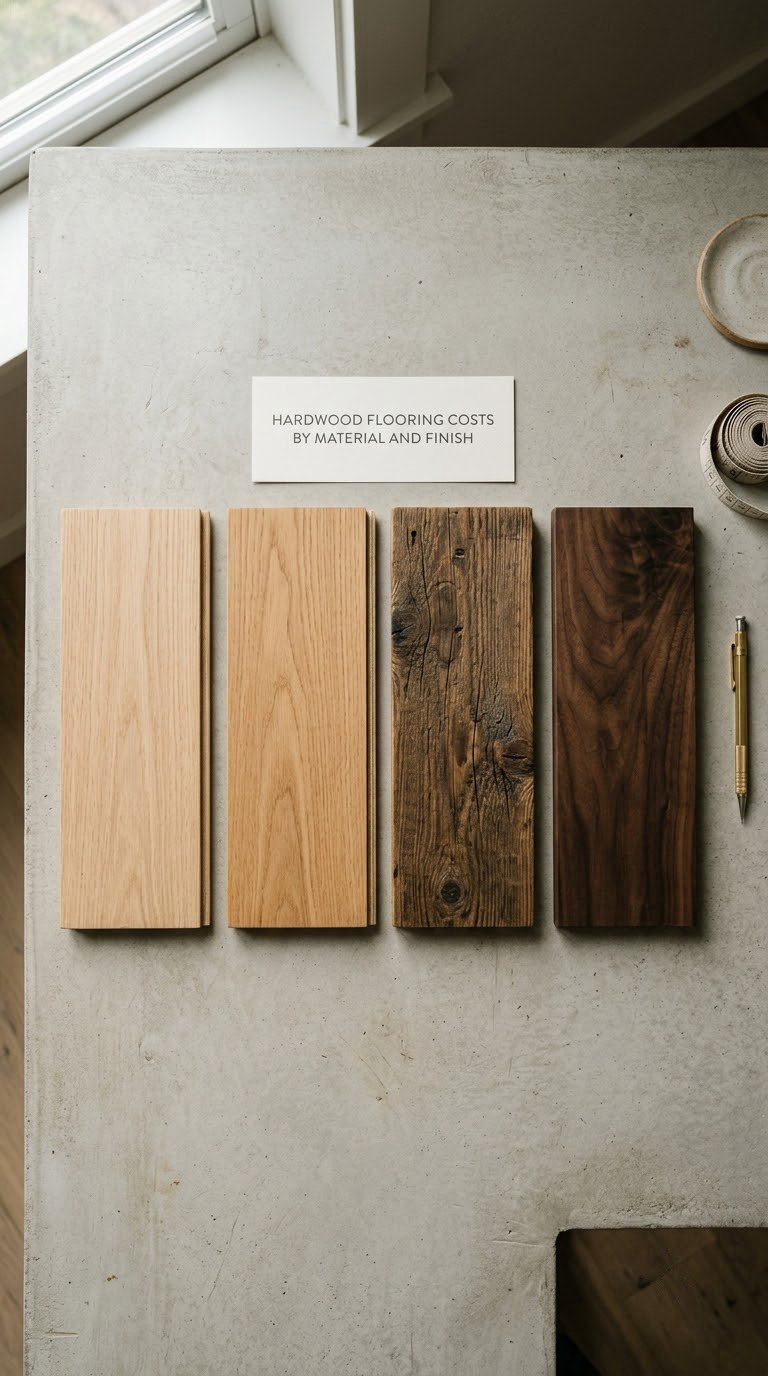
Material is where the range opens up fastest. Domestic hardwoods such as red oak, white oak, maple, birch and beech sit at the accessible end, while walnut, cherry, teak and imported species push the per-square-foot material cost well past $12.
| Material | Material cost per sq ft | Notes |
|---|---|---|
| Solid hardwood | $5 – $28+ | Can be sanded and refinished repeatedly; the widest price range of any option |
| Engineered hardwood | $3 – $14 | Cross-laminated core with a real wood veneer; stable over concrete and basements |
| Reclaimed wood | $9 – $30 | Salvaged planks, often wider and irregular; expect longer labor time |
| Flooring-grade plywood core | $2 – $5 | Not a visible finish, but it sets the cost floor of the engineered products built on it |
Several switches move the material line on a quote without changing the room size. Plank width is the big one: 3-inch strips cost less per square foot than 5-inch planks, and 7-inch or wider boards cost more again. Thickness matters for solid wood, where 3/4-inch stock is the standard and thinner millwork is priced lower.
Finish grade counts too. Select-grade boards have fewer knots and mineral streaks and cost more than a characteristic or rustic grade, where the figuring is the point. Hand-scraped and wire-brushed textures add labor at the factory and raise the price per square foot.
Prefinished versus site-finished is the other fork. Factory-finished planks arrive with an aluminum oxide or polyurethane coating already cured, which lowers the install-day labor by a day or two. Unfinished solid wood is sanded and finished on site and adds roughly $2 to $8 per square foot, plus a curing window before you can walk on it, typically three to seven days depending on the finish.
Stain and color are usually cheaper than the planks themselves. Toning white oak a shade darker is a per-square-foot service, not a per-square-foot material upgrade, though the two together move the total faster than people expect.
Solid vs. Engineered Hardwood: Costs, Pros, and Cons
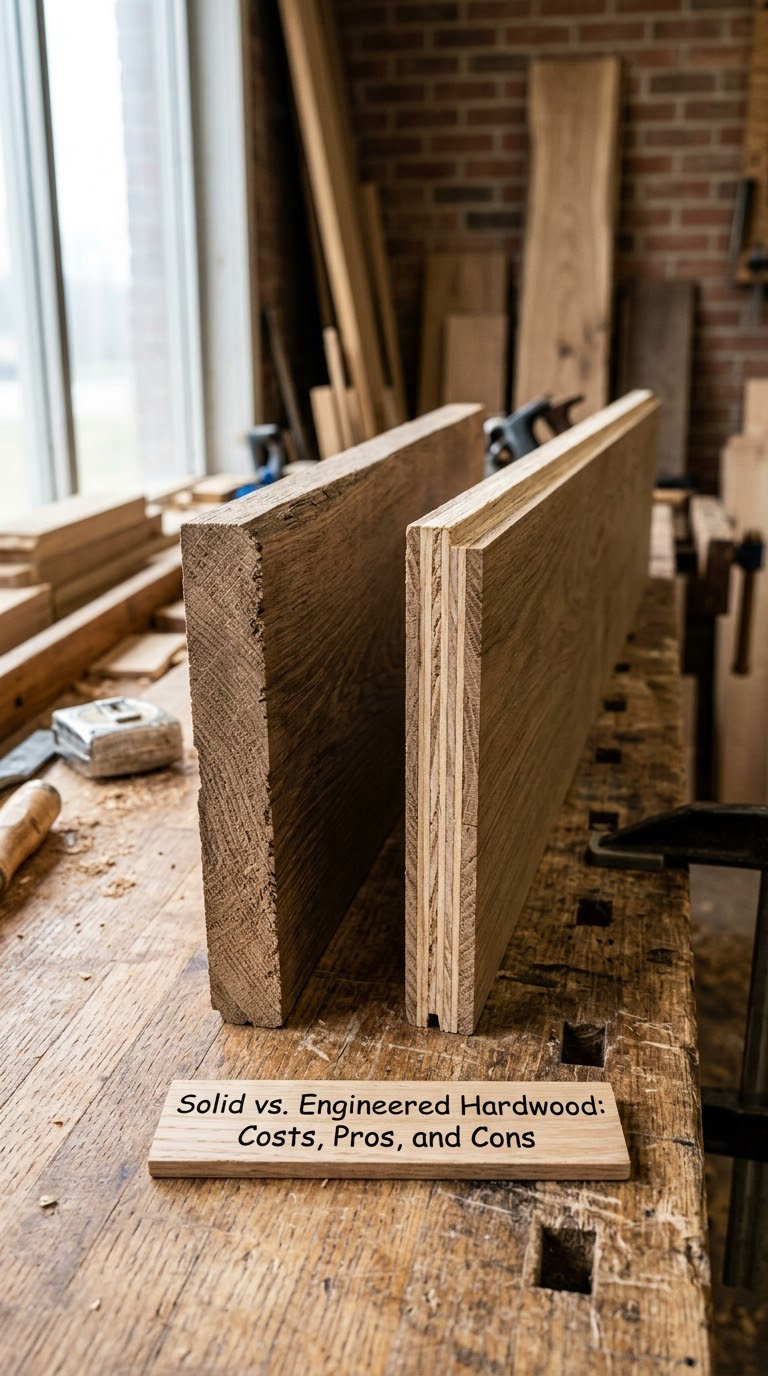
Engineered hardwood usually costs less to buy and sometimes less to install, and it handles moisture better. Solid wood costs more up front, sands and refinishes more times, and looks a certain way to buyers standing in a doorway. The table below is the honest comparison.
| Factor | Solid hardwood | Engineered hardwood |
|---|---|---|
| Material price per sq ft | $5 – $28+ | $3 – $14 |
| Typical installed total per sq ft | $9 – $25+ | $6 – $17 |
| Appearance | Full-depth grain that reads as real timber; the traditional choice | Thin veneer of real wood over a plywood core; very close in most rooms |
| Moisture resistance | Sensitive to swings, basements and slab installs | More dimensionally stable; a common choice over concrete |
| Where it can go | Stable, above-grade interiors | Above grade, and some below-grade setups when the manufacturer allows it |
| Refinishing | Can be refinished several times over its life | Usually one light refinishing at most, then it is replaced |
| Resale appeal | The listing people look for | Widely accepted, less of a talking point |
| Best fit | Main living spaces you plan to keep for decades | Kitchens, basements, rentals and over-slab installs |
That refinishing line is the one people skip and regret. A solid oak floor in a lived-in family room might be refinished two or three times across fifty years. An engineered floor with a 3mm veneer usually gets one, if the wear is shallow, so after the first sand-through you are shopping again rather than sanding again.
The counterargument is that the cheapest engineered floor is a false economy in a high-traffic room and the right call in a rental. Buy solid where the floor takes a beating and gets sanded; buy engineered where moisture or a concrete slab is the deciding problem.
What Changes the Cost to Install Hardwood Floors?
Square footage sets the base, then about a dozen things adjust it. Knowing which ones apply to your room before the contractor arrives keeps the conversation about scope instead of about the total.
Removal and demolition usually run $1 to $3 per square foot, and the old material sets the rate. Carpet tears up fast, tile and glue-down layers take longer, and a glued subfloor that has to be ripped out and replaced can add $2.75 to $4 per square foot on its own.
Subfloor preparation is the other variable nobody budgets for. A clean, flat plywood deck needs nothing. High spots, a sagging joist or a concrete slab that is out of level can add $1 to $4 per square foot, or a flat $100 to $500 for a small room. Moisture testing is worth paying for in older homes and below-grade spaces, because installing into a wet subfloor is what causes cupping and a callback later.
Then there is the layout itself. Straight rows in a rectangular room are the fastest install. A diagonal layout, a picture-frame border or a herringbone pattern adds hours per room, and herringbone or chevron needs 15 to 20 percent extra material instead of the standard 5 to 10 percent waste factor because of the angled cuts.
Stairs are almost always quoted as a separate line, frequently in the range of $200 or more per step, and they include the treads, the risers and the nosing. Trim, baseboards and transition strips at every doorway are another line that homeowners forget until the final walkthrough. Fasteners, underlayment, moisture barrier, job supplies and cleanup are smaller but should appear in writing.
A written quote should itemize material, labor, removal, disposal, subfloor work, trim, stairs and finish separately. If a quote gives you one number with no breakdown, you have no way to compare it against another quote that happens to include more. Getting three bids on the same written scope is the single most useful thing you can do before signing anything.
DIY vs. Hiring a Hardwood Floor Installer
Labor is commonly 30 to 50 percent of an installed hardwood bill, which is why the DIY math gets looked at so seriously. A 300-square-foot room in the worked example above carries $1,500 of labor. Do it yourself and you trade that for a rental, a long weekend per room, and the risk that a cupped subfloor shows up under the finished floor.
The realistic DIY cost is not just the materials. Add the flooring and underlayment you would buy anyway, then the tool list:
- Pneumatic or cordless flooring nailer, rented by the day
- Table saw or a good circular saw with a fine-finish blade for clean crosscuts
- Floor moisture meter and a hygrometer
- Tape measure, chalk line, spacers for the expansion gap, and a square
- Drill/driver, impact driver, and a variety of finish nails
- Shop vac, knee pads, safety glasses and hearing protection
Skills that decide whether DIY goes well: reading subflatness, cutting clean end joints that do not splinter, driving nails at the correct angle without visible dimples, and letting the wood acclimate to the room’s moisture level before the first board.
Professional installation earns its money in a few specific situations. Hire a flooring contractor when the subfloor is uneven or suspect, when you are working over a concrete slab, when the pattern is herringbone or a border, when stairs are involved, or when you want the installer’s warranty and their accountability if a board moves later.
Click-lock engineered is the most forgiving DIY path because the boards connect without a nailer and mistakes are cheaper to correct. A solid nail-down over a flat plywood deck is entirely doable if you have done trim work before. I would not have a first-time renovator attempt a site-finished install with an open schedule and a cure time attached.
Once the floor is down, protecting it matters. Felt pads under every leg, and a mat under a rolling office chair, save you from gouges, and there are good roundups for office chair mats that protect hardwood and for cordless vacuums that pick grit off hard floors without scratching the finish.
How to Budget and Avoid Hidden Costs
Budgeting is mostly about deciding the number in advance and forcing every quote to match it. Work through these steps in order.
Measure the room twice and write the number down. Length times width gives you the square footage, then add 10 to 15 percent extra material for the waste factor. For herringbone or chevron, go to 15 to 20 percent. Ordering the extra cartons is standard practice, not over-ordering, and most homeowners keep them for future repairs instead of returning them.
Decide the installation method before you price anything. Floating or click-lock engineered goes down over an underlayment and moves fast. Nail-down solid wood needs a wood subfloor and a nailer. Knowing which one you want keeps quotes comparable, because installers price them very differently.
Collect three written, itemized bids on identical scope. Make sure each one separately lists material, labor, removal, disposal, subfloor prep, trim, stair work and stain or finish. A general contractor supervising the work often adds a 13 to 22 percent markup, so if you are comparing a contractor quote against a direct flooring-company quote, account for that before declaring one a bargain.
Confirm in writing whether underlayment, moisture barrier, baseboards, transition strips and final cleanup are inside the number. These are the line items homeowners most often discover late.
Reserve 10 to 15 percent of your budget for preparation and unexpected damage. An old home with a bathroom-adjacent subfloor, an uneven slab or hidden water damage will use that reserve, and having it planned means it does not become a decision made in a panic.
Before install day, empty the room completely, remove or lift the baseboards if you want to reuse them, and photograph the subfloor. Ask the contractor to document moisture readings and the subfloor condition in writing, because that record protects both of you if a board lifts later.
One caution: do not let a moisture barrier go down over a wet subfloor, and keep the wood in the room where it will live for the acclimation period the manufacturer specifies, usually several days with the HVAC running. Skipping that step is the cheapest way to end up with gaps and cupping.
Frequently Asked Questions
How much does it cost to install hardwood floors in 2026?
Installed hardwood floors generally run $6 to $25 per square foot for both material and labor. Most mid-range projects settle between $9 and $17 per square foot. A 500-square-foot open room typically lands between $3,300 and $8,500 all in. Regional labor rates, the species you choose and how much subfloor prep the floor needs move the total more than the room size does.
Is installing hardwood flooring cheaper than hiring a professional?
It can be, and the gap is usually the labor line, which is commonly 30 to 50 percent of an installed bill. You still pay for the wood, the underlayment and a tool rental for a nailer, saw and moisture meter. DIY pays off in a straight rectangular room with a flat subfloor. Hire a flooring contractor for uneven subfloors, concrete slabs, stairs or herringbone patterns.
Is engineered hardwood cheaper to install than solid hardwood?
Usually yes on the material side. Solid hardwood runs about $5 to $28 or more per square foot, while engineered typically runs $3 to $14. Engineered also installs over concrete and handles moisture swings better, which can trim prep costs. The trade-off is refinishing: most engineered floors can only be refinished lightly once, while solid wood can be sanded several times across its life.
How much does hardwood floor installation cost on stairs?
Stairs are priced separately from the square footage, often in the range of $200 or more per step. The line usually covers the treads, the risers and the nosing, and it is worth asking whether the stair nosings are made or milled to match your floor. If a stair is oddly shaped or the run turns, expect the per-step number to climb.
What costs are usually excluded from a hardwood flooring quote?
The common exclusions are removal and disposal of the old floor, subfloor leveling or repair, moisture testing, baseboards and transition strips, stair work, site finishing and stain, sales tax on materials, and permit or inspection fees. General contractors may also add a 13 to 22 percent supervision markup. Ask for all of these as separate line items so two quotes can be compared fairly.
Conclusion
Start with a tape measure. Write down your square footage, add 10 to 15 percent for the waste factor, then decide between solid and engineered based on the room, the subfloor and how long you plan to keep the floor.
After that, gather three written itemized quotes on the same scope and compare the line items, not just the totals. The cost to install hardwood floors is decided by material, preparation, layout and labor, and a plan with a 10 to 15 percent reserve in it is what keeps a mid-range project from turning into an expensive surprise.
Once the boards are down, a pH-neutral cleaner made for wood finishes, not a generic one, and a vacuum that does not scratch will keep the floor looking new for years. Our picks for steam mops reviewed for hardwood floors are worth a look before you settle on a cleaning routine.