How Much Does a Handyman Cost per Hour? October 2026 Guide
If you have a short list of fixes that have been sitting around for months, the number most people want first is simple: how much does a handyman cost per hour? Across the U.S., independent self-employed handymen typically run 50 to 80 dollars an hour, while handymen working through a company or franchise charge 75 to 125 dollars an hour. Most homeowners land somewhere in the middle, and your real total often lands higher than the headline rate once minimum charges and materials are added.
That range is a starting point, not a quote. A handyman’s rate is set by three things: what they specialize in, what your local market pays, and how small the job is. A two-hour drywall patch in a rural county and a four-hour electrical-adjacent install in a coastal metro are priced very differently, even by the same person.
Contents
This guide covers typical rates, per-job cost ranges, the fees that catch people off guard, and a practical way to compare quotes before you book anything. Costs shown are realistic U.S. ranges and vary by region.
How Much Does a Handyman Cost per Hour?
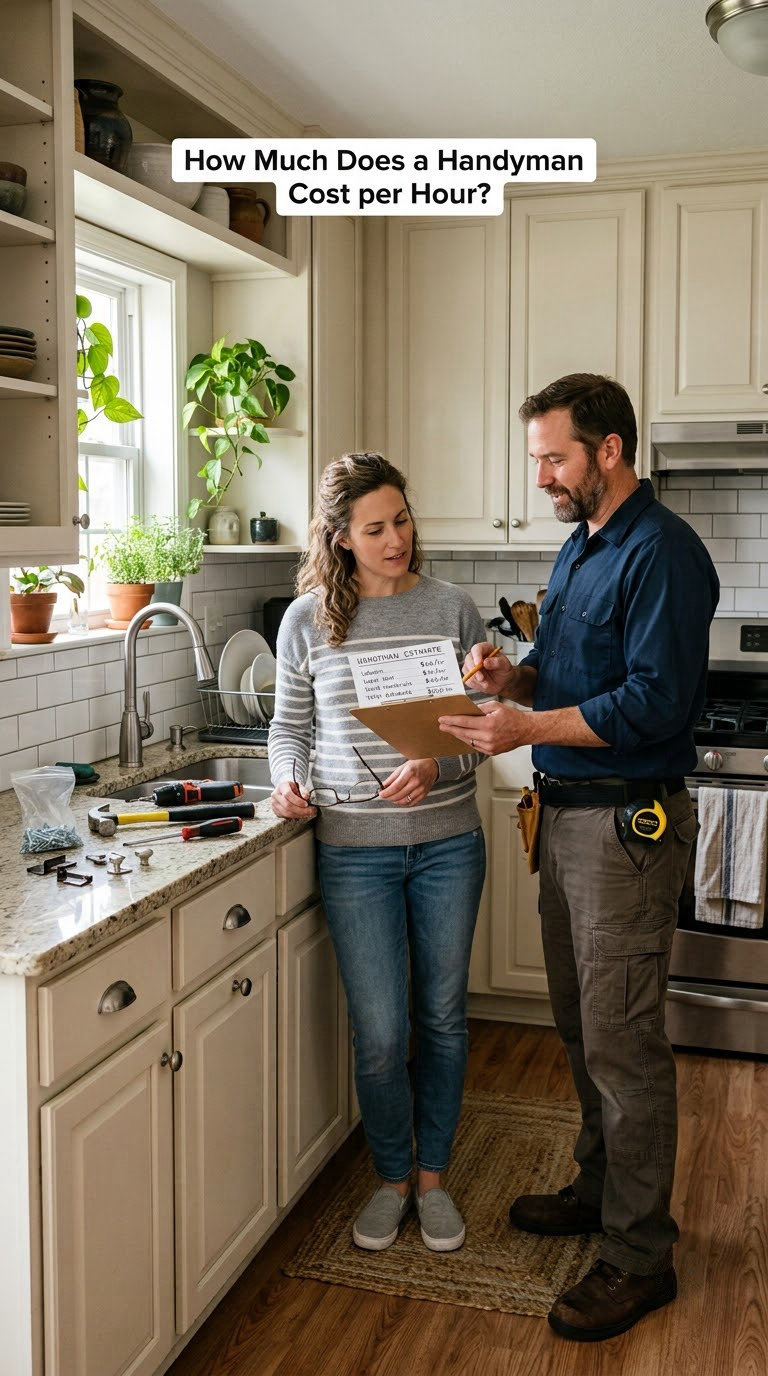
The short answer is 50 to 125 dollars an hour, with most independent tradespeople sitting in the 50 to 80 dollar band. Company and franchise handymen sit higher at 75 to 125 dollars because that rate covers insurance, licensing, a dispatch office, and a workmanship guarantee you can actually call on.
Almost nobody bills a flat hour, though. Small jobs carry a floor, materials are added on top, and travel gets charged in one form or another. A 90-minute job often becomes a 200 dollar invoice once you count the minimum service fee plus a faucet you did not have on hand.
Typical Handyman Hourly Rates by Service
Rates cluster by the type of work, not just the person doing it. The table below reflects the going rate for each trade in most U.S. markets.
| Type of Professional | Typical Hourly Rate | Common Jobs |
|---|---|---|
| Independent general handyman | 50 to 80 dollars | Assembly, drywall patches, painting touch-ups, shelving, minor repairs |
| Senior or master handyman | 75 to 110 dollars | Wainscoting, built-ins, complex trim and finish work |
| Company or franchise handyman | 75 to 125 dollars | Scheduled installs, multi-trade punch lists, guaranteed work |
| Specialty tradesperson | 90 to 175 dollars | Flooring installation, tile and grout, deck repair, window installation |
| Licensed contractor (not a handyman) | 100 to 200 dollars | Structural, electrical, plumbing, permitted work over a set dollar threshold |
Handymen posting their rates in trade forums like r/handyman commonly quote 75 to 150 dollars an hour, with construction and bid work at the top of that range. Older regional trade forums show anchor rates closer to 25 to 35 dollars, which is a useful reminder that these numbers have moved a long way in a short time.
Specialty work is where a cheap general rate becomes an expensive mistake. If your job needs a permit, a licensed trade, or a manufacturer’s warranty, you want the licensed person, not the fastest quote.
Flat-Fee and Minimum Charges
Minimum service fees exist because a handyman’s travel time, job setup, and paperwork are paid whether the job takes 20 minutes or three hours. A crew charging 90 dollars an hour still has to drive there, park, and haul tools up your steps. A floor of somewhere around 75 to 200 dollars keeps small jobs from being money-losers.
Here is what tends to sit on top of the hourly rate.
- Minimum service fee: a floor for the visit, often one to two hours of labor regardless of how long the work takes.
- Trip or call-out charge: a flat add-on for travel beyond a set distance from the business base.
- Mileage fee: billed per mile when the crew comes from far away.
- Material markup: typically 20 to 50 percent above what the part cost at retail, covering the pickup run.
- Emergency and after-hours surcharge: extra for evening, weekend, or same-day work.
- Disposal fee: charged when old material or debris has to be hauled away.
None of these are hidden charges if you ask early. They are just the part of the bill homeowners are least likely to predict. A one-hour faucet swap at 85 dollars an hour is really a two-hour visit with a 170 dollar minimum, plus roughly 20 to 40 dollars for the valve, so plan on about 210 to 240 dollars.
Buying the part yourself is one of the easiest ways to cut the total. The catch is that many handymen will not warranty a part they did not supply, and you have to know the exact model, which takes a call to the manufacturer.
Common Handyman Jobs and Realistic Cost Ranges
These totals include a typical minimum charge, labor at 60 to 100 dollars an hour, and average materials. Prices swing with your region, so treat the range as a budgeting number, not a promise.
| Job | Typical Total Cost | Notes |
|---|---|---|
| Flat-pack furniture assembly | 150 to 600 dollars | Built-ins and wardrobes take longest; simple chairs are often one hour |
| Mount a TV on a wall | 180 to 500 dollars | In-wall wiring or a masonry wall pushes toward the top |
| Drywall repair and patching | 200 to 700 dollars | Small holes hit the minimum; full-room damage gets quoted per patch |
| Interior painting, one room | 350 to 1,200 dollars | Two coats with prep; paint often costs more than the labor |
| Replace a faucet or sink | 200 to 600 dollars | Plumbing-adjacent work; some states require a licensed plumber |
| Install a ceiling fan | 200 to 550 dollars | Heavy ceilings, high ceilings, or a light kit add time |
| Replace a light fixture | 150 to 400 dollars | Most of this is the minimum charge, not the actual work |
| Hang doors, interior, per door | 150 to 350 dollars | Warped jambs turn this into a bigger job |
| Install shelving, per shelf | 80 to 250 dollars | Hanging into masonry anchors and adding a stud finder is worth it |
| Recaulk bathroom and kitchen | 200 to 900 dollars | Removal time on old caulk adds hours nobody prices in |
| Patch or stain a hardwood floor | 250 to 800 dollars | Board matching and finish selection drive the cost |
| Install laminate flooring, small room | 400 to 1,600 dollars | Includes underlayment and trim; stairs cost extra |
| Exterior caulking, door and window trim | 300 to 1,200 dollars | Height, ladder access, and scraping change everything |
| Minor exterior repair, gutter or downspout | 200 to 700 dollars | Roof-adjacent work is safer with a roofer or contractor |
Mounting one light fixture is the clearest example of why hourly pricing feels wrong to people. The actual labor might be 15 minutes, and you are still billed the minimum. If the fixture costs more than a few hundred dollars, swapping it for a new one often costs less than the service call.
Bundling jobs is the single most effective move a homeowner has. A crew that was already on site for the faucet can reset a strike plate, replace a doorstop, and hang a towel bar for a fraction of the rate. If you have a punch list, send it all at once.
Hourly Rate vs. Flat Fee vs. Day Rate

Hourly billing fits unpredictable work. Flat fees fit repeatable work. Day rates fit long punch lists with a scope that will not change. The table breaks down when each one works for you.
| Pricing Method | Best For | Upside | Downside |
|---|---|---|---|
| Hourly | Open-ended repairs, troubleshooting, anything with hidden damage | You only pay for the work that happens | The meter runs while you are at work, and the estimate is a guess |
| Flat fee | Assembly, mounting, fixture swaps, drywall patches, caulking | You know the number before it starts | Scope creep gets expensive once the crew is mid-project |
| Day rate | Multi-room punch lists, move-out repairs, rental turnovers | Cheapest per hour on a full day of work | You pay for unused time if the list shrinks |
| Hybrid | Most mixed jobs | Flat price per task plus a minimum service fee for the visit | Requires a clear written scope to work well |
Ask for a flat fee on any job you could describe in a sentence. If the description needs an “it depends,” the hourly meter is the honest way to bill it. A pro who pushes back and offers a range with a cap is telling you something good about how they handle surprises.
Watch how overtime is treated on flat-fee quotes. A firm fixed price is fixed. A fixed price plus an hourly rate for anything beyond the scope is really hourly work with a friendly label, and that clause should be written down.
What Changes the Price?
Two quotes for the same six-hour job can differ by more than 100 dollars, and it is rarely a mystery once you know what to look at.
- Location. Rates track cost of living closely. High-cost metros and dense coastal markets run well above national averages, while rural and small-town work prices lower because the same bills have to be covered with fewer jobs per day.
- Job complexity. A straight swap takes 30 minutes. The same swap in an inaccessible crawlspace with an unknown junction box can take four hours. Diagnostics are where hourly rates earn their keep.
- Travel distance. Crews serving a wide service area bake distance into the rate or charge per mile. Closer service areas price tighter.
- Materials and sourcing. Markups from 20 to 50 percent are normal, and specialty or discontinued parts run higher. Rare or discontinued parts take extra time to source.
- Licensing and insurance. Licensed and insured pros cost more because they carry liability coverage and workers’ comp. That cost shows up in the rate, and it buys you recourse if something breaks.
- Urgency and season. Same-day and weekend work carries a premium. Demand spikes after storms and at the start of a heating or cooling season, and rates creep up with it.
- Project size. A single small visit travels badly. Several days of work in one booking spreads travel and setup, so the effective hourly rate drops even at the same posted rate.
- Site conditions. Tight access, occupied spaces, pets, stairs without a landing, and asbestos-containing materials in older homes all add time and sometimes specialist handling.
One factor worth understanding is how the posted rate relates to what the pro actually takes home. Between travel, material runs, quoting, unpaid admin, and downtime between jobs, roughly half a work day goes unbilled. That is why 100 dollars an hour is not a padded number, and why pushing hard on the rate often costs you the person who answers the phone next time.
How to Compare Quotes and Avoid Surprises
Get three written estimates for anything over a few hundred dollars. Comparing three quotes is not about finding the cheapest one, it is about finding the market rate and spotting the outlier.
Before anyone starts work, put these in writing:
- The labor and materials split. A single blended number hides the markup. Ask for hours, rate, part cost, and markup separately.
- The minimum charge and the trip charge. Both should appear as line items before the job, not on the final invoice.
- Proof of insurance. Ask for a certificate of liability coverage. In many states, workers’ comp is on the same certificate.
- Change order terms. What triggers extra work, and who approves it? Nobody should change scope without your go-ahead.
- A workmanship warranty. A one-year labor guarantee is a reasonable ask. The invoice should be itemized and arrive after the work is done and accepted.
Red flags are pretty easy to spot. Pressure to pay a large deposit up front, a refusal to give references, a quote far below everyone else’s, no written contract, or an estimate that will not be itemized. Walk away from those, and the modest price difference elsewhere is worth it.
Nothing in a quote should change without your approval, and a good contractor will tell you what they found even when you did not ask. One job I priced turned out to be a 15-minute screw swap, and the handyman called me to say so and bill the minimum. That is the behavior you are paying for when you choose an insured, established pro over the cheapest bid.
You can also learn the numbers yourself. Our guide to what it costs to fix a car air conditioner covers a similar split between parts, labor, and shop overhead, and it is a good model for reading any repair quote line by line. For bigger equipment questions, see how much a hot tub weighs before scheduling any delivery or placement work, and how much electricity a sauna uses if you are planning to wire a new circuit for it.
Frequently Asked Questions
Should I hire a handyman by the hour or offer a flat-rate price?
Hire by the hour when the work is open-ended, such as a repair with hidden damage or a troubleshooting visit. Ask for a flat rate when you can describe the job in a sentence, like furniture assembly, TV mounting, or a drywall patch. A hybrid works well for mixed punch lists: a flat price per task plus a minimum service fee for the visit.
Why do some handymen charge a minimum service fee?
Because the visit costs the same whether the job takes 20 minutes or three hours. Travel, parking, tool setup, and paperwork are not billable hours, so a floor keeps small jobs from becoming money-losers. Typical minimums run from about 75 to 200 dollars, which is often two hours of labor. Ask for it in writing before the work starts.
Are materials included in a handyman’s hourly rate?
Almost never. The hourly rate covers labor only, and materials are usually added on top at retail cost plus a markup of roughly 20 to 50 percent to cover the pickup run. Many handymen will not warranty a part they did not supply, so buying it yourself saves money but can affect the workmanship guarantee. Ask for an itemized split before approving the work.
How much should I tip a handyman?
Tipping is customary but not expected, and it should never be quoted into an hourly rate. Around 10 percent is generous, 15 to 20 percent is a strong thank-you for a clean, on-time job, and a handwritten note counts for plenty. If a crew is already carrying a high rate and a minimum charge, skipping the tip is completely reasonable.
Does a handyman need a license for small home repairs?
It depends on your state. Many states exempt handymen from licensing below a dollar threshold that commonly falls somewhere between 500 and 10,000 dollars of work, and above that threshold a licensed contractor is required. Electrical, gas, plumbing, structural work, and roofing usually need a licensed trade and a permit regardless of price. Check your state rules before booking anything unusual.
Should I hire a handyman or a licensed contractor?
Hire a handyman for repairs and installs that stay under your state’s licensing threshold, involve no permits, and use no licensed trades. Hire a licensed contractor for electrical, plumbing, gas, structural, roofing, and permitted work, or anything touching your home’s systems. A handyman costs less per hour, but a contractor brings insurance, permits, inspection, and real recourse when something fails.
Conclusion
Most homeowners should budget 60 to 100 dollars an hour, with independent pros at the lower end and company or franchise crews at the upper end. The number on the flyer is rarely the number on the invoice, because minimum service fees, trip charges, and material markups sit on top of it.
Before you book, do three things: write out the scope of every task you want done, ask each pro for an itemized written estimate with the minimum charge and markup stated, and confirm liability insurance and a workmanship warranty. Get three estimates for anything substantial. That alone will tell you whether the quote in your hand is normal for your market, and knowing how much does a handyman cost per hour in your area is the whole ballgame.