Cost to Resurface a Driveway in October 2026 Explained
The cost to resurface a driveway runs roughly $1.50 to $5 per square foot for asphalt, $3 to $7 per square foot for a concrete overlay, and $7 to $14 per square foot when the whole slab comes out. For a standard two-car driveway of about 500 square feet, that lands somewhere between $750 and $7,000 depending on how much repair the surface needs first.
Fall is the smart time to get numbers. Contractors are quieter, asphalt plants run steady, and quotes in my experience run lower than the spring rush, when most people suddenly notice their cracks.
Contents
Resurfacing only works if the base underneath is still solid. That single fact decides whether you spend a few hundred dollars or several thousand, so it comes up again and again below.
Cost to Resurface a Driveway: Price by Size and Material
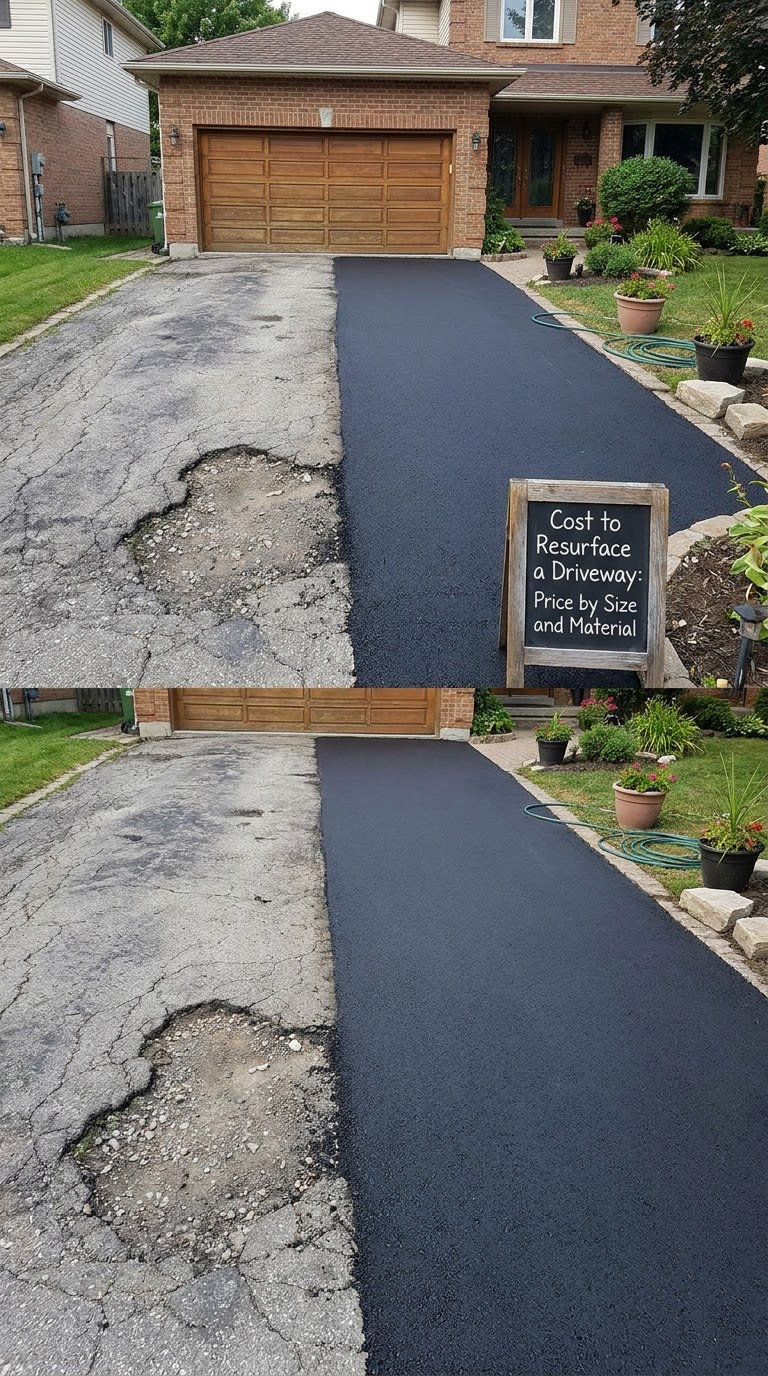
Most contractors quote asphalt resurfacing in the $3 to $5 per square foot range once prep and repairs are folded in. Strip out the repair line items and the raw material and labor figure sits closer to $1.50 to $3. Both numbers are honest: they just describe different scopes.
What each driveway size actually costs
| Driveway size | Approx. square feet | Asphalt resurfacing | Concrete overlay | Full replacement |
|---|---|---|---|---|
| Small, single-car | 240 to 400 | $700 to $1,800 | $1,100 to $2,800 | $2,400 to $5,500 |
| Medium, two-car | 480 to 720 | $1,400 to $3,400 | $2,200 to $5,000 | $4,500 to $10,000 |
| Large, three-car or RV | 800 to 1,200 | $2,400 to $5,800 | $3,600 to $8,400 | $7,500 to $16,500 |
Crack repair, pothole patching, and edge trimming add $2 to $8 per linear foot on top of these figures. A badly patched driveway can double the low end before a single foot of new asphalt goes down.
What each resurfacing system costs per square foot
| System | Cost per sq ft | Lifespan | Downtime | Best suited to |
|---|---|---|---|---|
| Asphalt overlay (1.5 to 2 inch) | $1.50 to $5 | 8 to 15 years | 2 to 4 days | Sound asphalt with surface wear |
| Asphalt sealcoat | $0.40 to $1.20 | 3 to 5 years | 1 day | Faded but uncracked surfaces |
| Concrete resurfacing or overlay | $3 to $7 | 10 to 20 years | 5 to 7 days | Cracked concrete with a stable base |
| Full slab removal and replacement | $7 to $14 | 20 to 30 years | 1 to 2 weeks | Failing base, sinking, alligator cracking |
These are US ranges and they move with region, season, and how much hand work your driveway needs. A rural driveway a long way from an asphalt plant can run 20 percent above a suburban one, while a driveway within a mile of a plant often gets a better delivered rate.
What Changes the Cost to Resurface a Driveway?
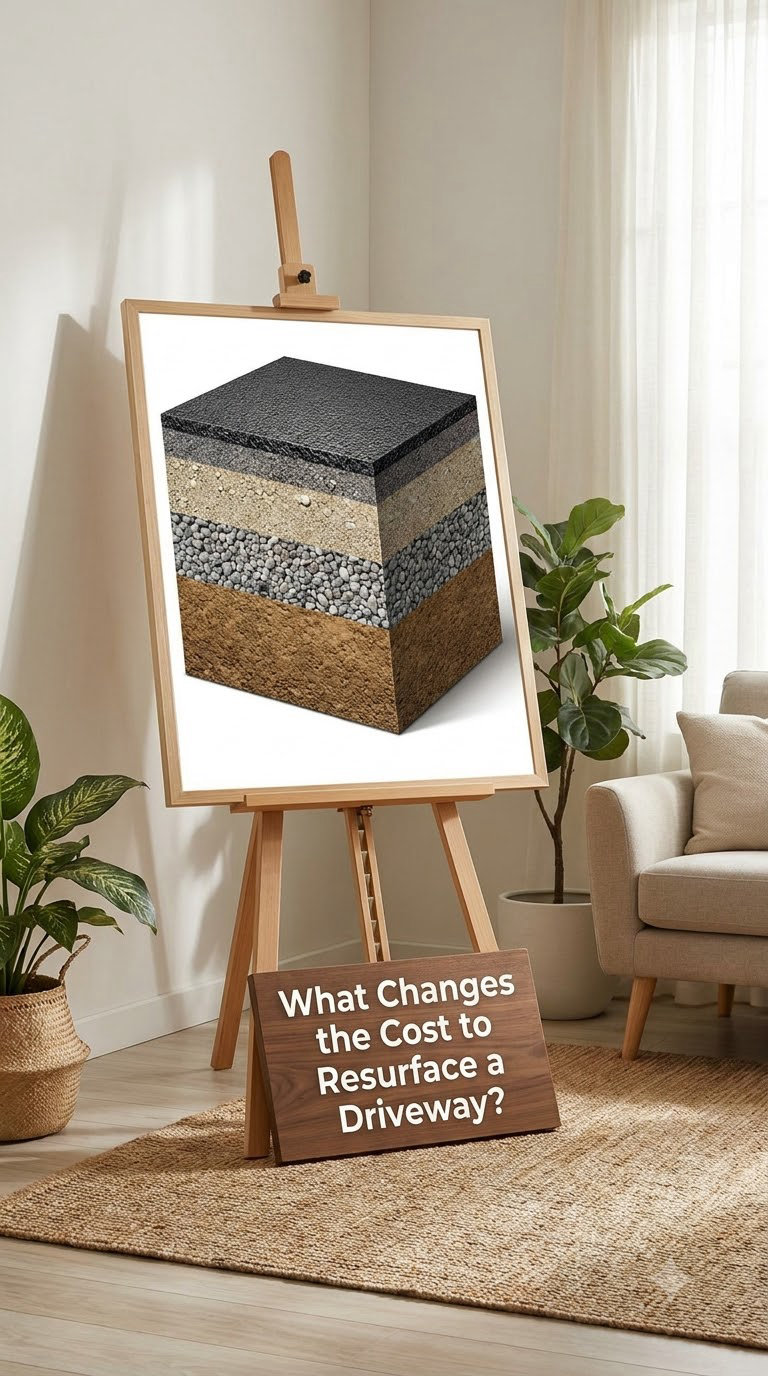
Two driveways of identical size can differ by thousands, and the gap almost always comes down to prep work and site conditions. Here is what contractors actually look at when they price a job.
How your region changes the cost to resurface a driveway
- Dimensions. Square footage is the base unit, but oddly shaped driveways with aprons, turnaround areas, or long narrow runs cost more per square foot because equipment moves slower.
- Existing surface condition. Surface wear alone is cheap. Alligator cracking, settled sections, and deep potholes mean cut-out-and-patch work at $3 to $8 per square foot before the overlay starts.
- Base repair. If the subgrade has soft spots, the contractor has to dig out and replace base material, then compact. This is the single biggest surprise on most quotes.
- Material choice. Hot mix costs more to deliver than local millings. Recycled asphalt pavement runs cheaper and is greener, but it is harder to find outside metropolitan areas.
- Labor rates. Trucking and paving labor runs well above the national average in the Northeast and on the West Coast, and below it across much of the South.
- Slope. Steep driveways need more material to hold a uniform thickness, and crews add a premium of roughly 15 to 30 percent.
- Drainage. A driveway that drains toward the house gets an extra wash, a lighter crown, or an added edge. Skipping this is why some new overlays fail in a few years.
- Access. A gate, a tight side yard, or a parked boat in the way can add a call-out fee or a hand-labor charge.
- Edging. Replacing or resetting a cracked curb or lip along the apron usually runs $5 to $15 per linear foot.
- Minimum service charge. Many companies have a floor of $300 to $600 for a visit. On a 200-square-foot driveway, that floor can exceed the material cost.
A quick rule of thumb: measure length times width, multiply by $3 to $5 for asphalt resurfacing, then add 10 to 15 percent for repairs and a contingency. That gets you close before anyone drives out to look.
Homeowners who have gone through this tend to ask the same questions at the estimate appointment. Here is a checklist worth printing.
- Is the quote per square foot or per ton, and how many tons did they measure for?
- What exactly is included in the prep scope, line by line?
- Are crack filling, pothole repair, and edge trimming separate line items?
- Will a tack coat be applied, and is it priced in?
- What overlay thickness is quoted, and how is it verified on site?
- Who pulls permits, and is that in the price?
- Will they provide mix tickets from the plant?
- What does the warranty cover, and what does it exclude?
- What is the payment schedule, and how much is due up front?
- How many days before vehicles can return to the driveway?
Mix tickets are the detail most people skip. Homeowners in forums like r/homeowners and r/asphalt repeatedly ask for them, because a ticket confirms the actual mix design and weight that went down.
Is Resurfacing Worth It Compared With Replacing the Driveway?
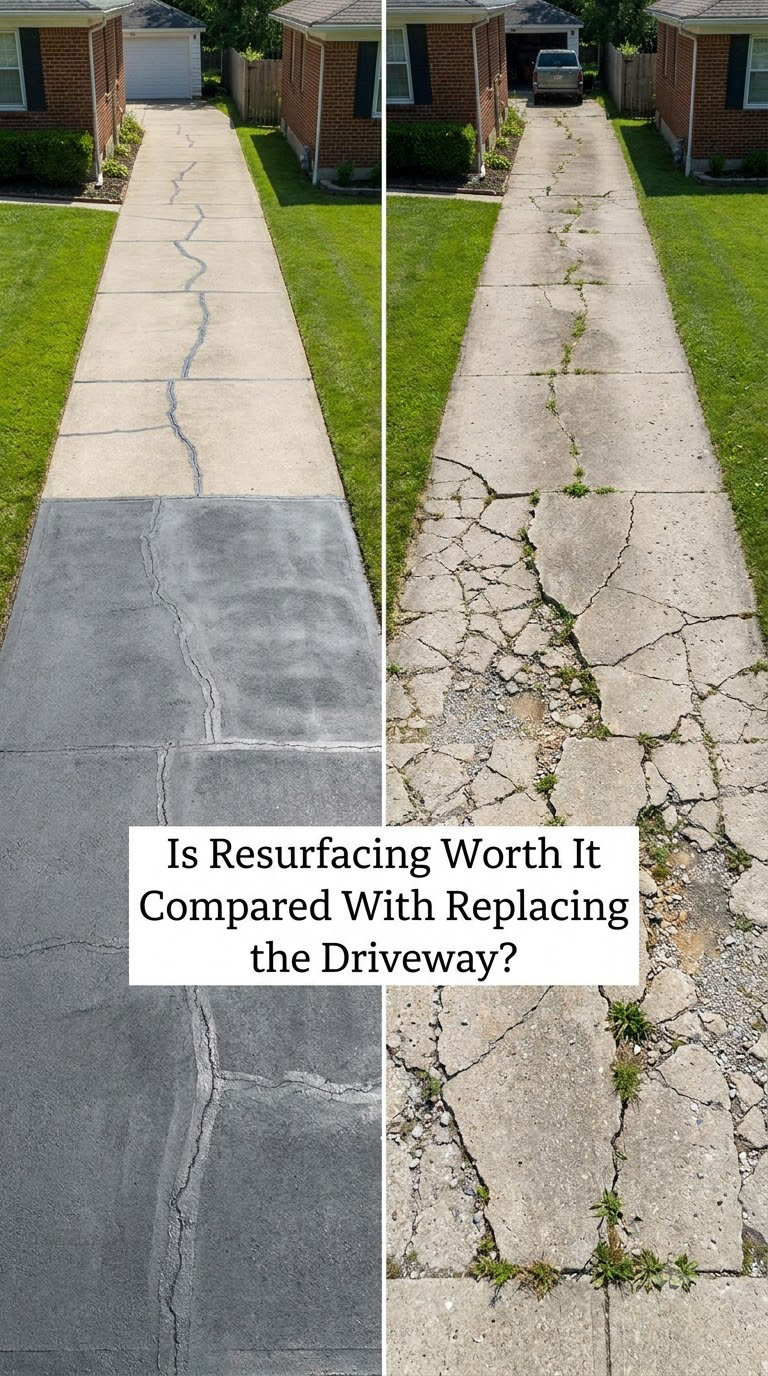
Resurfacing is worth it when the base holds up. Replacement is worth it when it does not. Everything else on this list is secondary.
| Factor | Resurfacing | Full replacement |
|---|---|---|
| Cost for a 600 sq ft driveway | $1,800 to $3,000 | $5,000 to $9,000 |
| Lifespan added | 8 to 15 years | 20 to 30 years |
| Appearance | Uniform dark surface, edges untouched | Fresh edges, shape, or pattern options |
| Disruption | Two to four days | One to two weeks |
| Drainage | Improves only if the crown is rebuilt | Can be fully redesigned |
| Ongoing maintenance | Sealcoat after 2 to 3 years | Sealcoat after 3 to 5 years |
| Resale value | Removes eyesores like patches and cracks | Strongest curb appeal signal |
These are the warning signs that point toward tearing it all out. Widespread alligator cracking, where cracks form a connected web of small blocks, means the surface layer is gone and the base is moving. Sinking or low spots that hold puddles point the same way, as does a driveway that flexes when you drive on it. Deep structural patching and a base that keeps washing out after repair are the clearest signals of all.
My rule: if more than roughly 30 percent of the surface needs repair, full replacement usually costs less per finished square foot. Below that, resurfacing wins on cost and on how long the job takes.
There is one wrinkle worth knowing. Previous sealcoat layers stop a new overlay from bonding properly, so a driveway that has been sealed two or three times may need the old layers ground off first. That grinding step, called milling, adds cost but still leaves you in the resurfacing column rather than the replacement column.
How to Estimate Your Driveway Resurfacing Budget
Budgeting goes faster when you do the arithmetic before the first phone call, so contractors quote against your numbers instead of theirs.
Step 1: Measure and calculate square footage
Measure the length from the curb to the garage and the width at the widest point, then multiply. A two-car driveway is usually 480 to 720 square feet. Add an extra 10 percent if there is a turnaround pad.
Step 2: Document the condition
Photograph every crack, pothole, and settled area before anyone arrives, and note whether water pools after rain. These photos are your defense against an upsell and your reference for comparing quotes.
Step 3: Decide on a system
Surface wear only means sealcoat at $0.40 to $1.20 per square foot. Uniform wear with minor cracking means an asphalt overlay. Concrete with surface cracks means a concrete overlay. Failing base means replacement, and no amount of patching changes that.
Step 4: Get itemized quotes
Ask three local contractors for written quotes that separate material, labor, prep, repair, and disposal. Forum homeowners regularly report the same job quoted anywhere from $5 to $15 per square foot, and the spread is almost always prep work and base repair hidden inside a single lump sum.
Step 5: Hold back a contingency
Reserve 10 to 15 percent on top of the quotes for whatever the inspection turns up. On a $3,000 job, that is $300 to $450 of breathing room, and most contractors will not nickel-and-dime it.
Some tasks suit an experienced DIYer: cleaning, weeding the edges, filling hairline cracks with a quality filler, and applying sealcoat with a rented sprayer. Everything else needs specialized equipment. Paving, milling, compaction, and base replacement require a roller or paver, and a poorly compacted overlay fails within a couple of seasons. Permits apply in some municipalities for new or widened aprons, and HOA approval often covers color and timing, so check both before scheduling.
If you want to handle prep work yourself, we covered driveway cleaning attachments and the tools that make that job faster.
How to Lower Driveway Resurfacing Costs Without Cutting Corners
The savings that work come from timing and prep, not from shaving the scope. A few that hold up:
- Fix small cracks early. A crack filled for $2 before it widens stays a $2 repair. The same crack after a freeze cycle becomes a cut-out-and-patch job.
- Keep water moving. Clear the drainage channel at the curb every spring and after storms, so water never sits on the surface and works into the base.
- Stay off fresh asphalt. Most contractors ask you to keep vehicles off for 48 to 72 hours, longer in hot weather. Park on the street and you avoid early tire indentations and tracking.
- Bundle adjacent work. If the walkway or the parking pad needs the same treatment, doing it in one mobilization usually earns a discount on the second area.
- Get quotes in the off season. Homeowners report 15 to 20 percent savings by scheduling in late fall or winter compared with a spring request.
- Compare three written quotes. Not three phone numbers. Written, itemized, comparable quotes are the only way to see the difference.
Then there are the shortcuts that cost more later. Skipping base repair and hoping the overlay hides it is the big one, because cracks reflect through within a year or two and the job gets paid for twice. Sealcoating a badly cracked surface is worse, since the coating sits on top of a problem and gives you a smooth surface that hides the damage while the base keeps going.
Watch the vague low quote too. If a bid comes in well under the others and does not name a thickness, a tack coat, or a repair scope, the missing work usually reappears as a change order halfway through. If you want to do the cosmetic part yourself after the overlay cures, a driveway sealer sprayer handles the sealcoat step without a contractor’s mobilization fee.
Frequently Asked Questions
How much does it cost to resurface a driveway?
Asphalt driveway resurfacing typically runs $1.50 to $5 per square foot, or about $700 to $3,400 for a standard two-car driveway. Concrete overlays land between $3 and $7 per square foot. The wide spread reflects prep work: a driveway needing crack repair, edge trimming, or base patches can double the material and labor figure.
Is it cheaper to resurface a driveway or replace it?
Resurfacing is cheaper whenever the base is still solid, usually by 40 to 60 percent. For a 600 square foot driveway, resurfacing runs $1,800 to $3,000 against $5,000 to $9,000 for removal and replacement. Once more than about 30 percent of the surface needs repair, or the base is sinking, replacement becomes the cheaper option.
How long does a resurfaced driveway last?
A well-prepared asphalt overlay lasts 8 to 15 years, with 10 to 12 being the most common outcome. Concrete overlays hold up longer, usually 10 to 20 years. Longevity depends heavily on the base, drainage, and whether you sealcoat on schedule. A driveway that pools water will fail sooner regardless of workmanship.
Can I resurface my driveway myself?
You can reasonably clean the surface, fill minor cracks, and apply sealcoat yourself with rented equipment. Laying an asphalt or concrete overlay is a different matter, since it needs hot material delivery, proper depth control, and compaction with heavy equipment. Poorly compacted paving fails within a couple of seasons, so the overlay itself is worth hiring out.
How long should I stay off a freshly resurfaced driveway?
Keep vehicles off freshly paved asphalt for at least 48 to 72 hours. In warm weather the surface softens as it cures, and parking on it too early leaves tire impressions that are hard to remove. Walking on it after a day is usually fine. Concrete overlays need closer to seven days before any vehicle load.
Does resurfacing fix cracks and potholes in a driveway?
Resurfacing covers cracks and potholes, but it does not repair the cause. Cracks get sealed and potholes get cut out and patched before the new layer goes down, so the surface looks new while the underlying movement continues. Expect cracks to reflect through within a year or two if the base is failing, which is why contractors inspect before quoting.
Conclusion
Most of the cost to resurface a driveway comes down to four things: square footage, the condition of the existing surface, how much base repair is needed, and your local labor rates. Get those four clear and the rest of the estimate writes itself.
Do not confuse the three options. Sealcoating refreshes color on a sound surface for a fraction of the money. Resurfacing adds a real 1.5 to 2 inch layer and buys 8 to 15 more years. Replacement rebuilds everything and only makes sense when the base has already failed.
Start by measuring your driveway, photographing every crack and low spot, and collecting at least three itemized quotes from qualified local contractors. Ask for mix tickets and check the warranty exclusions before anyone signs. And if cold weather is where you are headed, get the quotes now and schedule the work for the slower months.
Budgeting the rest of your outdoor project? Our guides to heated driveway mats cover the other half of the winter problem.