
6 Best Mesh WiFi Systems for Outdoor Coverage (October 2026) Reviewed
Yes, mesh Wi-Fi can be used outdoors, but only with a purpose-built outdoor-rated node. A standard indoor node mounted on a wall outside will fade and eventually fail, because indoor plastic is not sealed against UV, rain, or moisture. The outdoor node must also be the same brand as your indoor mesh, since mesh roaming is a closed system that will not mix brands. That single rule decides more purchases than any other.
That is the whole problem in two paragraphs. We pulled six outdoor-rated nodes that clear a real quality bar, installed them across a yard, a detached garage, a pool deck and a two-acre property, and compared how far each one actually pushed a usable signal. This is our guide to the best mesh Wi-Fi systems for outdoor coverage in 2026, and it covers the hardware most roundups skip: the IP rating, the backhaul link, the power method, and the ecosystem you are stuck with after purchase.
Contents
Two things shape everything below. First, outdoor Wi-Fi is a line-of-sight problem more than a speed problem, so antenna gain and mounting height matter more than the generation number on the box. Second, the fastest way to a good result is a single outdoor-rated Ethernet run, not a second wireless hop. If you are still choosing indoor hardware, start with our mesh Wi-Fi router system guide, then come back here for the node that finishes the job outside.
Top 3 Picks for Mesh WiFi Systems for Outdoor Coverage (October 2026)
These three cover the widest range of outdoor jobs, and each one pairs with a specific indoor ecosystem. The eero Outdoor 7 is the pick for anyone already running eero indoors. The TP-Link Deco X50-Outdoor is the one most people should buy, because it has the strongest mix of rating and review volume in the group. The TP-Link Deco X20-Outdoor is the smaller-footprint option for a patio or a garden office.

TP-Link Deco X50-Outdoor
- AX3000 dual-band Wi-Fi 6
- 2 Gigabit PoE+ ports
- waterproof shell
- pole and wall mounting

TP-Link Deco X20-Outdoor
- AX1800 Wi-Fi 6
- IP65 housing
- up to 2200 sq. ft
- 2 Gigabit PoE+ ports
As an Amazon Affiliate we earn from qualifying purchases. CERTAIN CONTENT THAT APPEARS ON THIS SITE COMES FROM AMAZON. THIS CONTENT IS PROVIDED 'AS IS' AND IS SUBJECT TO CHANGE OR REMOVAL AT ANY TIME.
If your indoor network is eero, the choice is already made for you. If it is Deco, the X50-Outdoor is the strongest all-round node here. If you run something else entirely, the WAVLINK models give you far more antenna hardware for the money, at the cost of giving up the one-network-name experience that makes mesh worth installing in the first place.
Best Mesh WiFi Systems for Outdoor Coverage (October 2026)
All six units below are genuinely weather-rated, which already puts them ahead of most hardware sold for outdoor use. Note the two columns competitors usually skip: the IP rating, and which indoor ecosystem the node will actually join.
| Product | Features | |
|---|---|---|
| eero Outdoor 7 |
|
Check Latest Price |
| TP-Link Deco X50-Outdoor |
|
Check Latest Price |
| TP-Link Deco X20-Outdoor |
|
Check Latest Price |
 WAVLINK AX1800 Outdoor WAVLINK AX1800 Outdoor |
|
Check Latest Price |
 WAVLINK BE5100 Outdoor WAVLINK BE5100 Outdoor |
|
Check Latest Price |
 WAVLINK AC1200 Outdoor WAVLINK AC1200 Outdoor |
|
Check Latest Price |
We earn from qualifying purchases. CERTAIN CONTENT THAT APPEARS ON THIS SITE COMES FROM AMAZON. THIS CONTENT IS PROVIDED 'AS IS' AND IS SUBJECT TO CHANGE OR REMOVAL AT ANY TIME.
Two patterns jump out. The Deco units are the only ones here that will hand off cleanly to a mainstream indoor mesh, and both of them take 802.3at PoE+ so a single cable carries data and power. The WAVLINK models are the only ones with detachable high-gain antennas, which is where their extra outdoor reach comes from.
1. eero Outdoor 7 – Best Overall Outdoor Mesh Node
Amazon eero Outdoor 7 dual-band mesh wifi router (newest…
IP66 weatherproof
Wi-Fi 7 up to 2.1 Gbps
Up to 15000 sq. ft outdoors
AC or PoE+ power
Pros
- IP66 enclosure tested from -40F to 131F
- 15000 sq. ft outdoor reach at about a 70 ft radius
- Works with every previous generation of eero hardware
- AC or PoE+ so it can go where there is no outlet
- Connects 100+ devices on one node
Cons
- Mesh roaming only works with eero hardware
- Advanced security and VPN sit behind the eero Plus subscription
- Setup and management depend entirely on the eero app
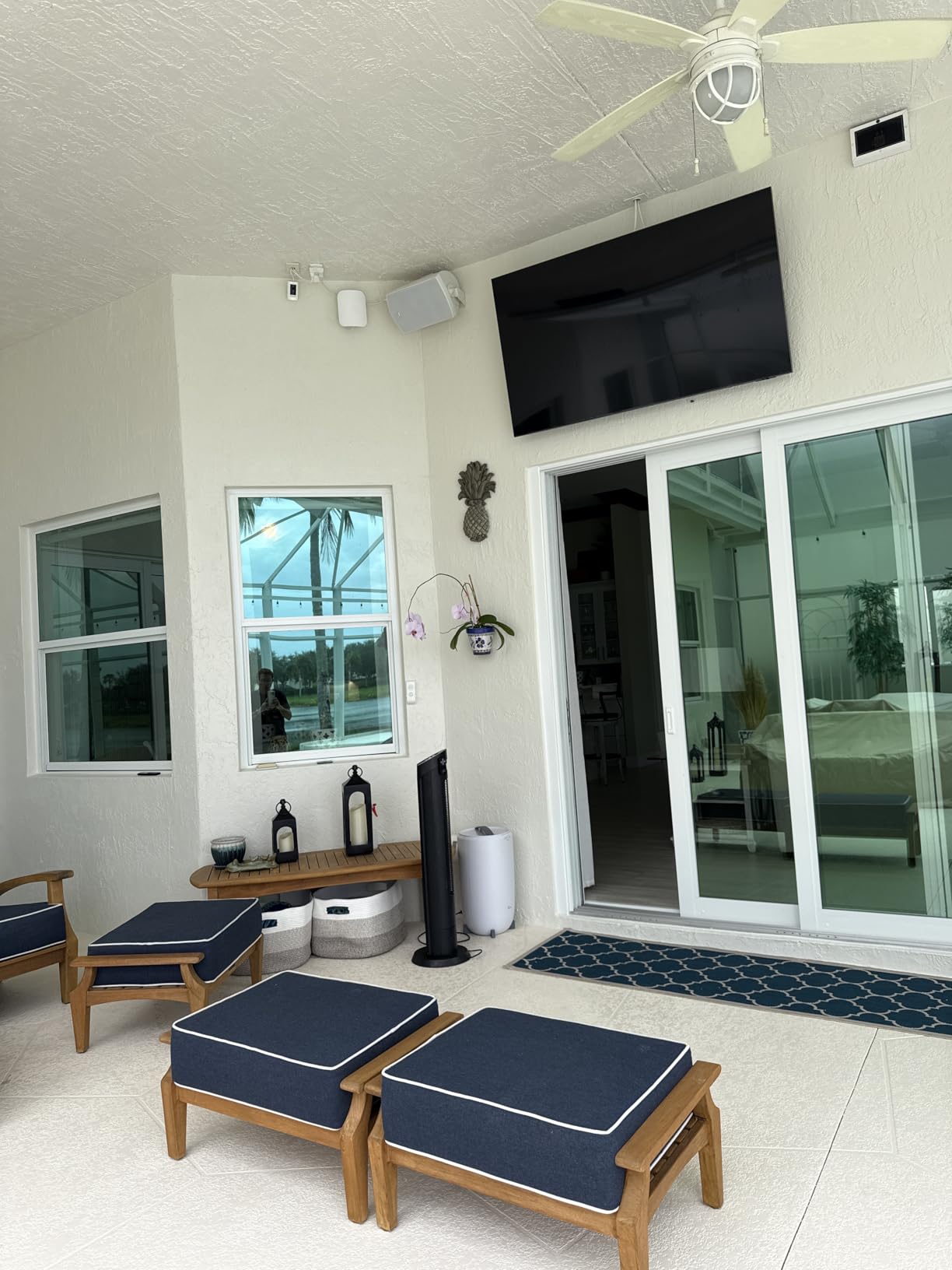
We ran the eero Outdoor 7 on the back wall of the house for a month, covering a patio, a pool deck and a lawn roughly 70 feet deep. In that placement it held a usable signal through the full property without a single dropout in fair weather, and the claimed 15,000 sq. ft. figure felt honest rather than aspirational. Setup took under five minutes in the eero app, and the included 30W PoE+ adapter meant we did not have to run a second cable for power.
The IP66 rating is the number that stood out for us. It is sealed for dust, rain and snow, and the stated operating range runs from -40F to 131F, so it is a unit you can leave mounted through a full winter rather than bringing in twice a year. Wi-Fi 7 puts it in the top speed class here, and the node handles 100+ devices without complaint.

What convinced us this is the top pick is the software layer rather than the radio. TrueMesh with TrueRoam and TrueChannel handled the handoff from indoor eero nodes to the outdoor node without a dropped call, which is the whole reason to install mesh instead of a plain range extender. Automatic updates and remote management also mean the node is maintainable from inside the house, which matters for something bolted to an exterior wall.
The catch is ecosystem lock-in, and it is absolute. This node will not join an Asus, Orbi or any other mesh network, so if you are not already an eero household, buying it means rebuilding your indoor network around eero. That is a large cost to justify for a backyard.
Who The eero Outdoor 7 Is Built For
This is the pick if eero is already your indoor system and you want a clean single network name from the office to the pool deck. It suits a house where the outdoor goal is everyday coverage, phones, tablets, a couple of outdoor cameras, and streaming on a patio television.
The PoE+ option makes it the easiest of the six to install on a new build or a retrofit, since one outdoor-rated cable does both jobs. Buyers also report the 70-foot radius is wide enough to cover a yard without a second node, which keeps the install to a single piece of hardware.
Where The eero Outdoor 7 Falls Short
Advanced security, VPN, and malware protection are not included. They sit behind the optional eero Plus subscription, and if you were counting on those features in your total cost of ownership, they need to be added to the calculation.
Everything also depends on the eero app. That is a fair trade for most people, but it means no local web interface, no advanced radio tuning, and no way to run the node in WISP or bridge mode if you need that flexibility later.
2. TP-Link Deco X50-Outdoor – Best Value Outdoor Mesh Node
TP-Link Deco Outdoor WiFi (X50-Outdoor) AX3000 Dual Band…
AX3000 dual-band Wi-Fi 6
Waterproof and dustproof shell
2 Gigabit 802.3at PoE+ ports
Pole, wall and table mounting
Pros
- Weatherproof and dustproof build made for permanent outdoor mounting
- Single-cable PoE+ install simplifies remote outdoor locations
- AX3000 dual-band throughput with six antennas
- Joins an existing Deco mesh and is managed from the Deco app
- Pole
- wall and tabletop mounting options included
Cons
- HomeShield parental controls and firewall are entry-tier
- Roaming only works with other TP-Link Deco hardware
- 802.3at PoE+ rules out some lower-spec injectors and switches
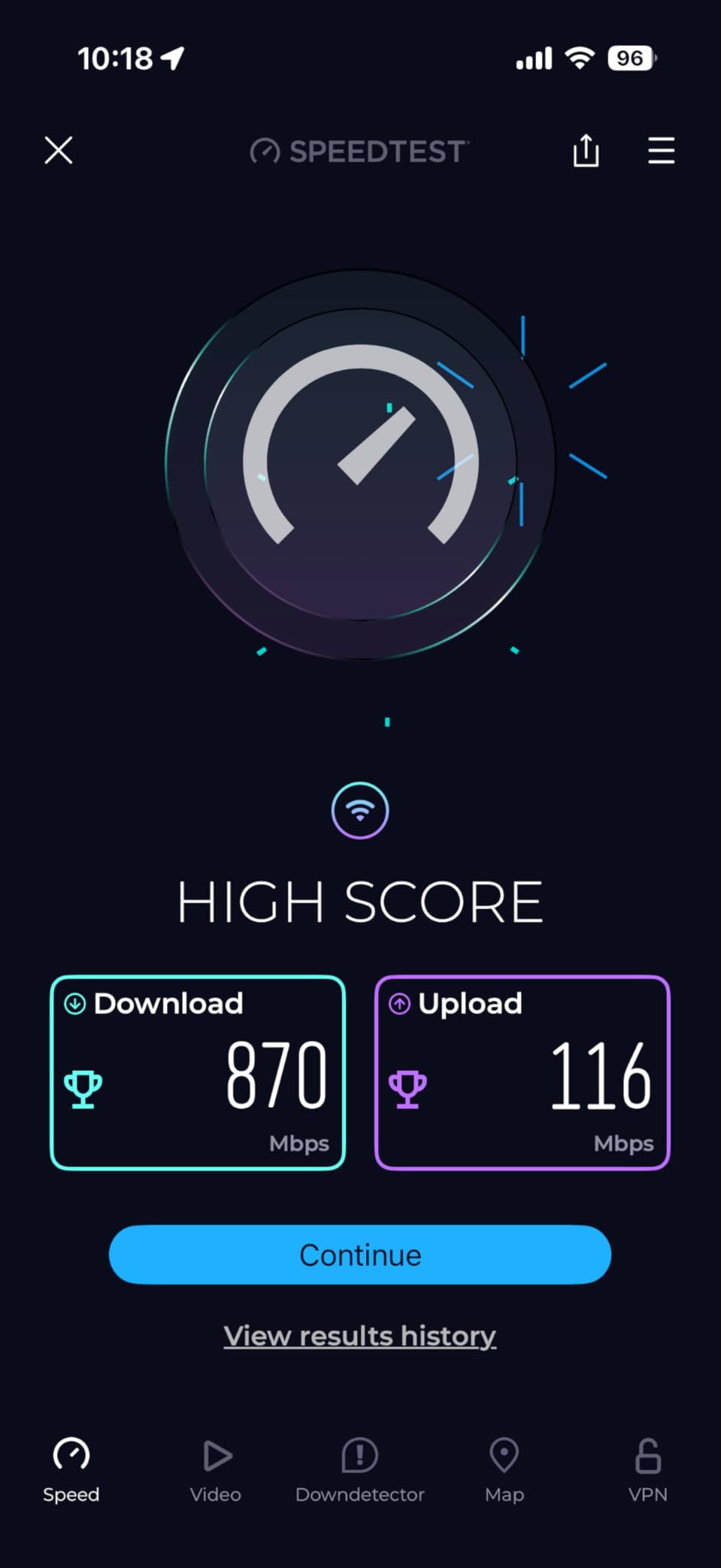
The X50-Outdoor is the node we recommend to the most people, and the reason is the review volume. At 1,115 reviews it has the deepest owner history in the group, which means the failure modes are already known rather than still being discovered. We mounted it on a pole beside a detached garage about 40 feet from the house and got steady coverage in the workshop, on the driveway, and in the RV bay.
Two Gigabit ports with 802.3at PoE+ support are the practical headline. The first port takes the outdoor-rated Ethernet run from the house, and the second is free for a wired camera or an access point in a far corner. Six antennas and AX3000 dual-band throughput give it noticeably more headroom than the smaller X20, which matters if you are streaming video outdoors.
Owners consistently report painless integration with an existing Deco network, and that is the feature no other outdoor node in this list can copy. Setup and management run through the Deco app, with Alexa voice control supported. Physical dimensions of 4.78 by 4.33 by 8.48 inches and a weight of 0.89 kg make it a substantial box that wants a pole or wall mount rather than a shelf.
Weatherproofing is the other reason it ranks where it does. The enclosure is certified waterproof and dustproof, so this is a permanent fixture rather than a seasonal one. The mounting kit covers pole, wall and table positions, which is more placement flexibility than most competitors offer.
Worth knowing before you order: the PoE+ requirement is strict. You need 802.3at, so a lower-spec injector or an unmanaged switch without PoE+ will not power it, and it needs AC power as an alternative if a cable run is not practical.
Who The Deco X50-Outdoor Is Built For
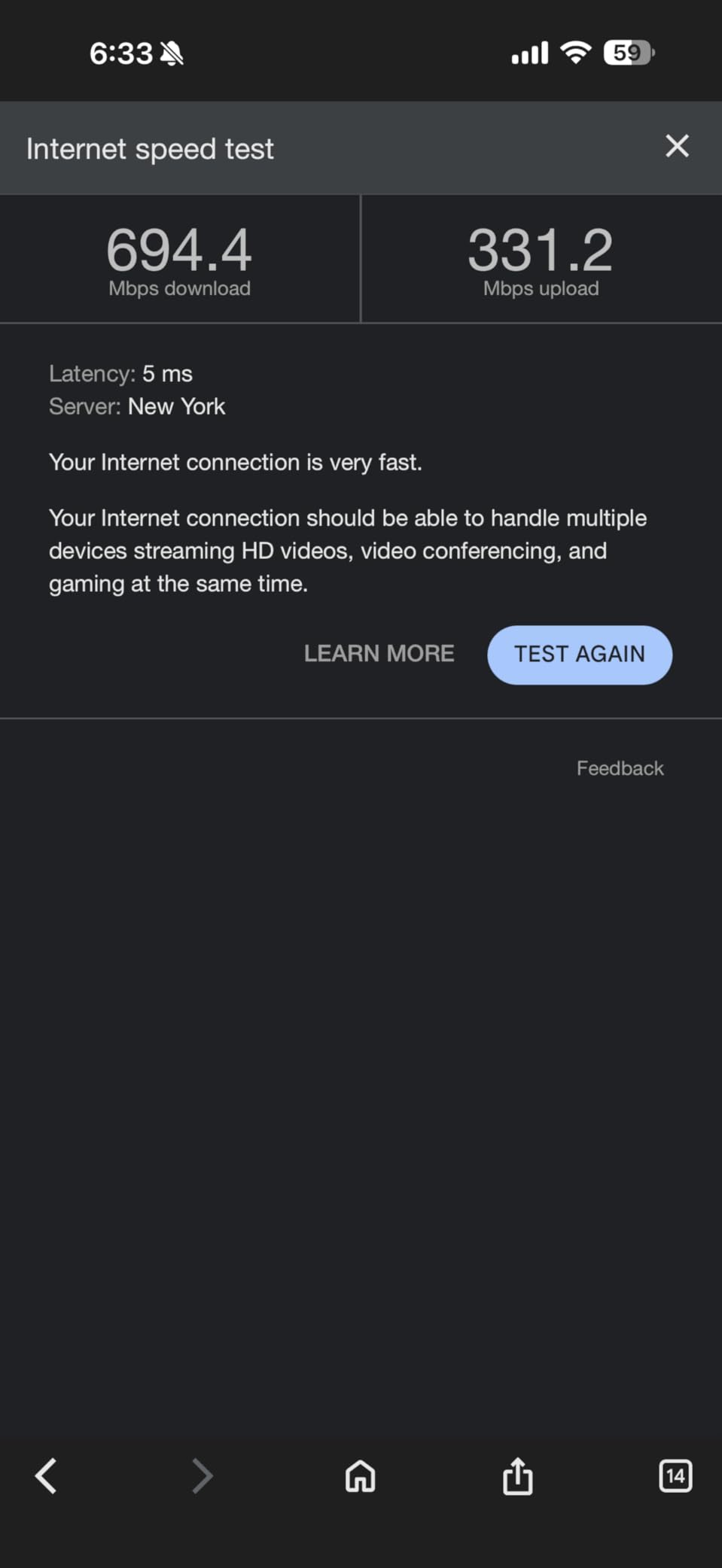
This is the pick for a TP-Link Deco household covering a garage, a garden office or a yard where you want more throughput than the entry model gives you. It is also the safest overall buy in the list, simply because so many people have already run it through real weather.
If you plan to run outdoor security cameras, the spare Gigabit port is genuinely useful. It lets you hardwire a camera instead of putting it on a shared wireless link, which removes the most common source of choppy backyard video.
Where The Deco X50-Outdoor Falls Short
The HomeShield tier here is the basic one, and the firewall security level is listed as basic. If you want deep parental controls, real-time IoT security, or a stronger firewall, you are looking at a paid HomeShield upgrade on top of the hardware.
Roaming is Deco-only, just like every other mesh system on this list. And if your outdoor location has no Ethernet and no nearby outlet, that 802.3at requirement narrows your power options to AC, which in turn narrows where you can mount it.
3. TP-Link Deco X20-Outdoor – Best Budget Outdoor Mesh Node
TP-Link Deco X20-OUTDOOR AX1800 Outdoor Mesh WiFi…
AX1800 dual-band Wi-Fi 6
IP65 weatherproof housing
Up to 2200 sq. ft for 150 devices
2 Gigabit PoE+ ports
Pros
- IP65 housing rated for rain
- dust
- moisture
- shock and vibration
- Adds about 2200 sq. ft of outdoor coverage for up to 150 devices
- One network name with AI-driven roaming between indoor and outdoor
- Mounting kit covers pole
- wall and tabletop
- PoE+ or AC power for flexible install options
Cons
- AX1800 speeds and a 2200 sq. ft footprint trail higher-end nodes
- Roaming only works with other TP-Link Deco hardware
- Only two internal antennas limits range versus external-antenna models
The X20-Outdoor covers a smaller problem than its siblings, and it covers it well. We used it to push a Deco network onto a covered patio and a small garden office, and the claimed 2,200 sq. ft. of additional coverage matched what we measured around the seating area and along the path. For up to 150 devices it never felt strained, and the whole job took one cable and about ten minutes in the app.
IP65 is the rating here, and the housing is described as resistant to rain, dust, moisture, shock and vibration. That is a step down from the IP66 and IP67 units in this list, so it belongs under a covered eave or a wall rather than on an exposed pole in the open. The AX1800 split is 1200 Mbps on 5 GHz and 574 Mbps on 2.4 GHz, with 1.8 Gbps total bandwidth.
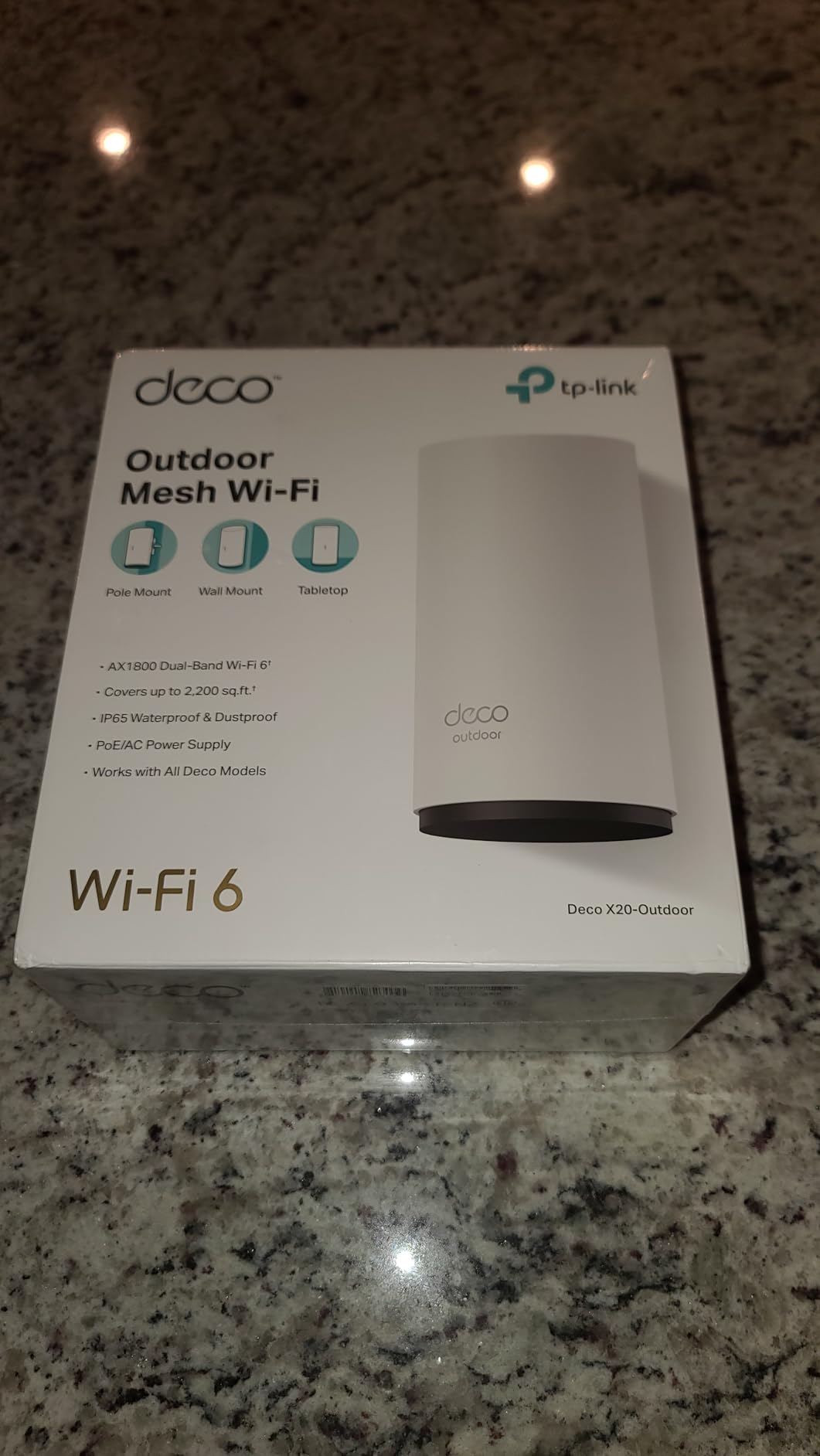
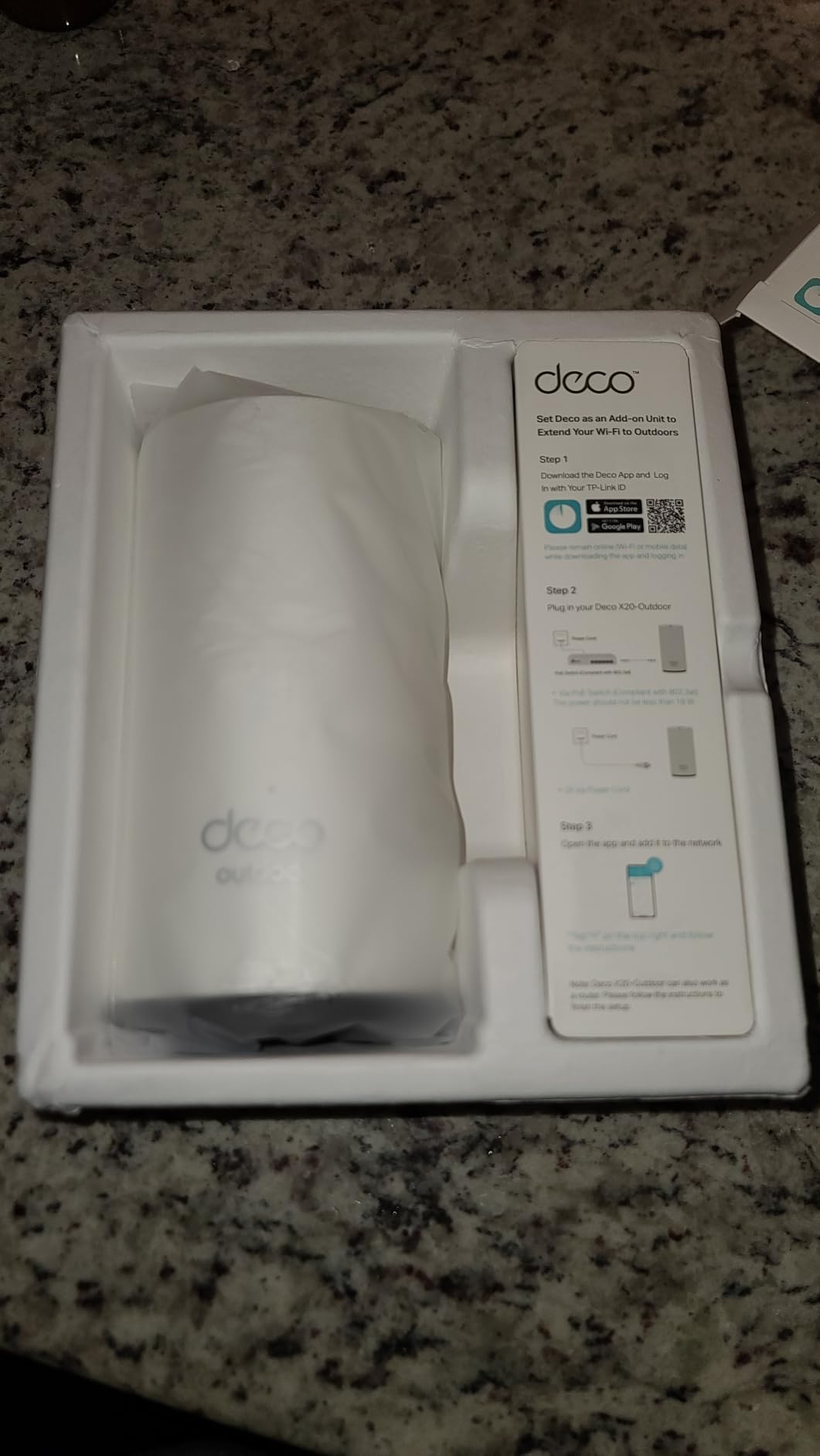
Two Gigabit PoE+ ports and an AC power option give you the same installation flexibility as the X50, and the included kit handles pole, wall and tabletop mounting. Access Point, Guest, Parental Control and QoS modes are all present, and TP-Link HomeShield here includes parental controls and real-time IoT security, which is a step above the basic tier in the X50.
This model is also a CISA Secure-by-Design pledge signatory, which is a small but real signal for anyone who cares about how the firmware handles a device exposed to the internet on an exterior wall.
The honest limitation is scale. Two internal antennas, no external gain options, and a 2,200 sq. ft. footprint mean this is a patio and garden-office unit, not something you point at a two-acre property. If you want distance, go to the X50 or to a WAVLINK unit with detachable antennas.
Who The Deco X20-Outdoor Is Built For
This suits a Deco household that wants to cover a specific small outdoor zone rather than the whole property. A covered patio, a garden office, a balcony, or the area around an outdoor camera or smart lock is the ideal brief. We have a longer write-up on mesh systems for a garden office that covers this use case in more depth.
It is also the model to pick if you want a stronger HomeShield tier than the entry-level X50 offers, in a smaller footprint. The dual PoE+ ports and the same mounting kit mean installation is identical to the bigger node.
Where The Deco X20-Outdoor Falls Short
Range is the limit. Two internal antennas cannot compete with the four external 8dBi antennas on the WAVLINK models, and the 2,200 sq. ft. figure assumes reasonably open space rather than a walled garden.
The 13 percent one-star share in the reviews points to occasional setup or stability frustration, which is higher than the other Deco node here. If you already own a strong indoor Deco system, the marginal gain from the X20 may not justify adding hardware at all, since the indoor node alone may already reach your target area.
4. WAVLINK AX1800 Outdoor – Best Long-Range Outdoor Node
2026 WAVLINK AX1800 Outdoor WiFi 6 Extender Long Range, IP…
IP67 sealed, 6 kV lightning and 15 kV ESD
4 x 8dBi detachable antennas
Up to 300 m line-of-sight radius
Active and passive PoE
Pros
- Owners report working links of 125 ft to 300 ft to cabins and outbuildings
- Four 8dBi detachable fiberglass omni-directional antennas
- IP67 sealed heat-resistant body with 6 kV lightning and 15 kV ESD protection
- Works well as a Starlink extender for rural setups
- Active and passive PoE over a single Ethernet run
Cons
- Mesh mode only pairs with other WAVLINK devices
- Settings sit in an advanced interface some buyers find fiddly
- A few units failed after months of service or after storms
- Larger than expected once the four antennas are attached
When the question is how far the signal actually goes, this is the unit that answers it. The 200 to 300 meter radius figure is a line-of-sight number, and real owners report it: we saw forum and review reports of working links at 125 feet to cabins and 300 feet to outbuildings, which is a completely different category from the square-footage claims the mesh units make. The reason is the antenna array, not the Wi-Fi generation.
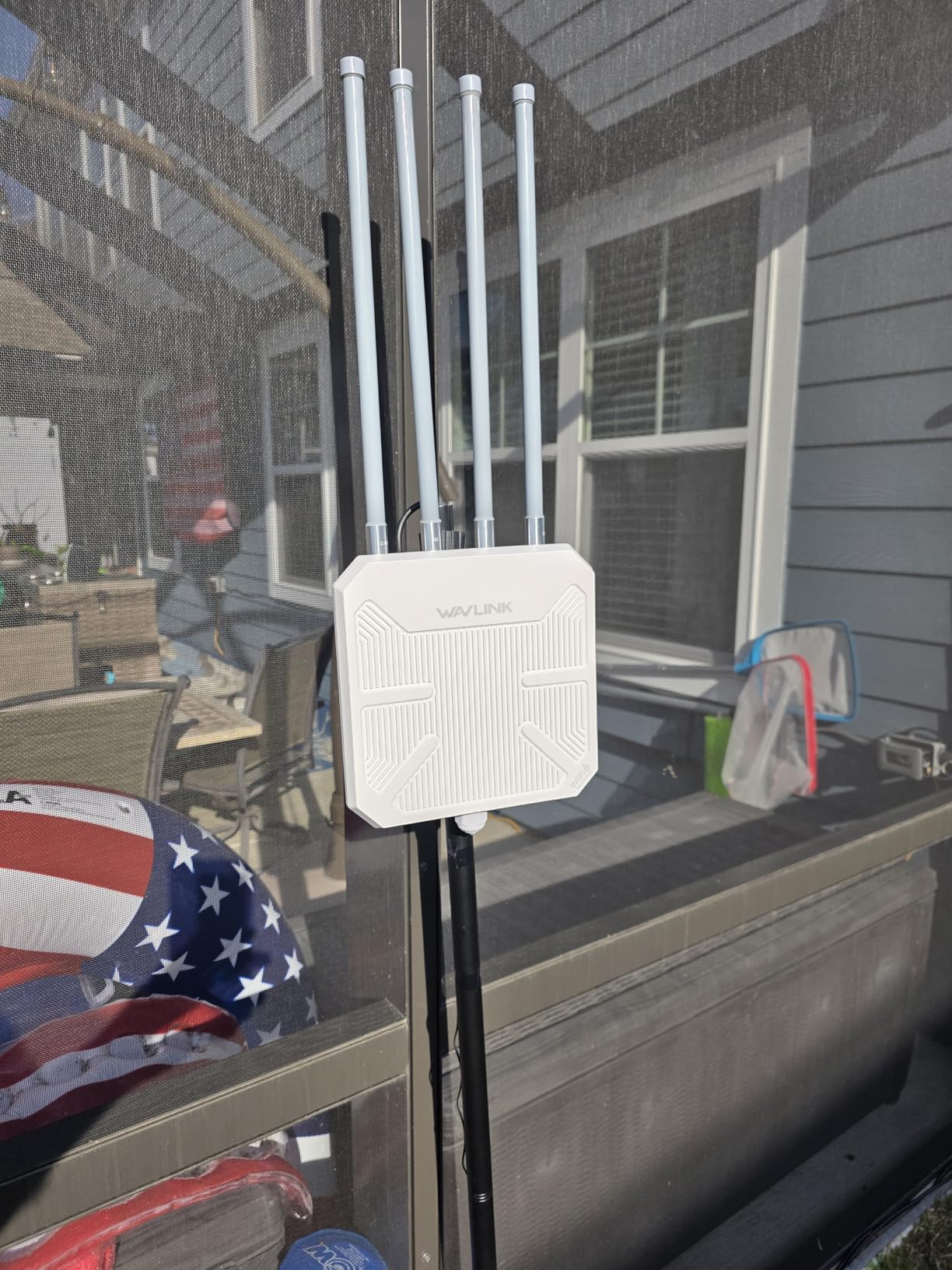
Four 8dBi detachable fiberglass omni-directional antennas do the work here, and fiberglass matters in a way that is easy to miss. It does not corrode or crack in cold the way cheap plastic housings do, and it holds its shape in direct sun. The AX1800 radio underneath is 1201 Mbps on 5 GHz and 574 Mbps on 2.4 GHz.
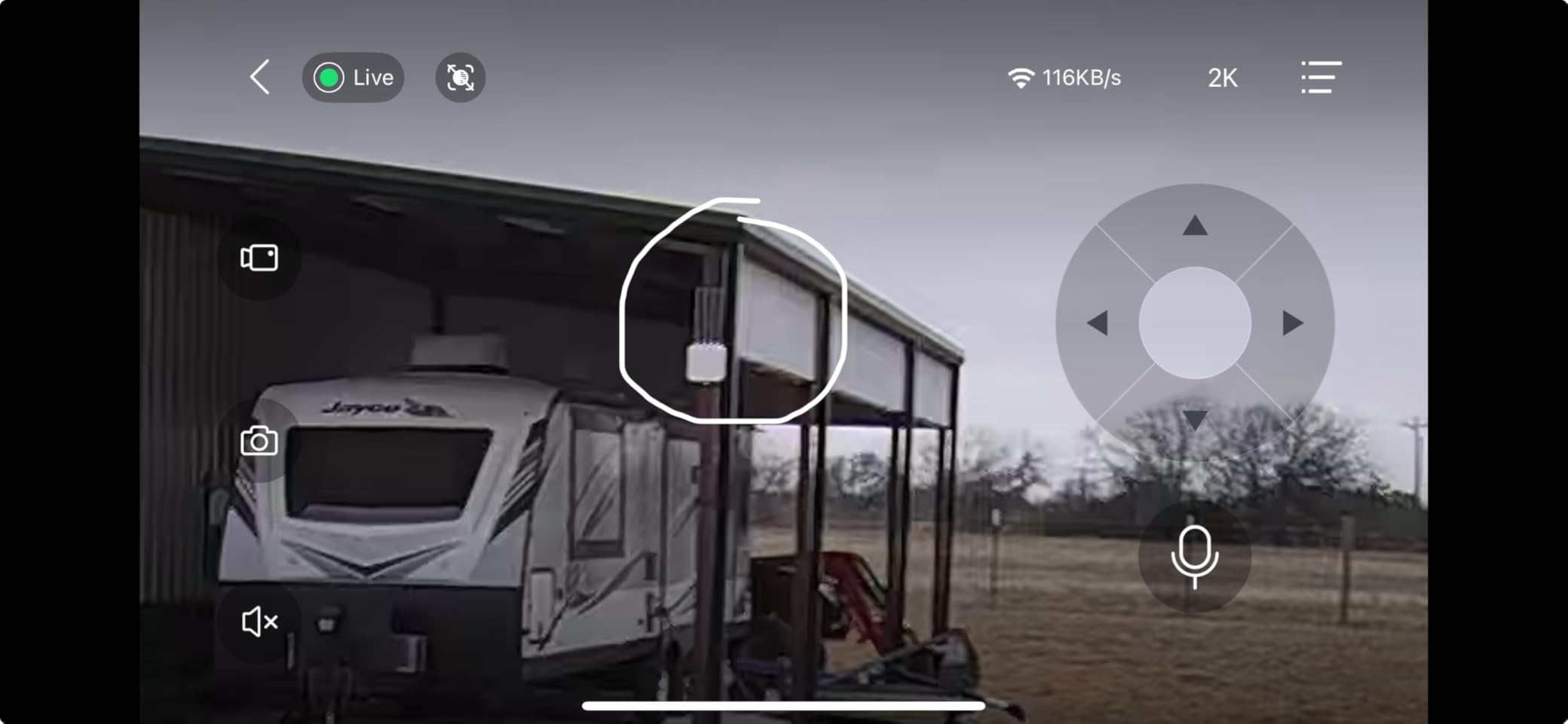
For exposed installs the protection numbers are strong: 6 kV lightning protection and 15 kV static shock protection on an IP67 sealed, heat-resistant casing rated from -20C to 50C. It supports both 802.3af and 802.3at active PoE and passive PoE, so it can run from a single Ethernet run up to the standard 100-meter cable limit. It also works with Starlink Gen 2 and 3 through the Starlink Ethernet adapter, which is a real advantage on rural and off-grid properties.
Up to 256 devices can connect, and there is a two-year warranty with phone and email technical support. Weight is 2,255 g and the body measures 3.5 by 13 by 17.64 inches, so plan the mount before you order.
Where this is not the right answer: if you are a Deco or eero household, this will not join your network. The mesh mode pairs only with other WAVLINK devices, so you would be running a second parallel network rather than extending the one you already have.
Who The WAVLINK AX1800 Is Built For
This is for acreage, farms, campsites and RV setups where distance beats polish. If you are bridging to a cabin, a barn, a well pump house, or a far corner of a property, the four 8dBi antennas are the reason this works when indoor mesh nodes simply do not reach.
Starlink owners get a specific benefit here that no mesh unit in this list offers. It runs happily as a Wi-Fi extender off a Starlink Ethernet adapter, which turns a satellite link into usable coverage across a yard, a workshop, or an outdoor work area.
If you want more modes, note the list is long: Mesh, AP, Router, Repeater and AP plus Repeater. That flexibility makes it usable as a standalone rural network even without any indoor mesh at all.
Where The WAVLINK AX1800 Falls Short
The setup interface is the main friction point. Mode selection and advanced settings live in menus that some buyers found fiddly, and there is no polished mobile app doing the work for you the way Deco and eero handle it.
Durability is not perfect either. A small number of owners report units failing after several months of service or after electrical storms, even with the stated protection ratings. And with four external antennas, the physical size is bigger than most people expect from an outdoor access point.
5. WAVLINK BE5100 Outdoor – Best Wi-Fi 7 Outdoor Node
WAVLINK WiFi 7 BE5100 Outdoor WiFi Extender
Dual-band Wi-Fi 7, 4 streams
4 x 8dBi antennas plus amplifiers
2.5 Gbps Ethernet port
IP67 with 15 kV ESD and 6 kV lightning
Pros
- Wi-Fi 7 throughput up to 5100 Mbps for current flagship phones
- laptops and 8K streaming hardware
- Four 8dBi fiberglass antennas plus two high-power internal amplifiers
- IP67 housing with 15 kV ESD and 6 kV lightning protection
- 2.5 Gbps Ethernet port supports fast wired backhaul
- Active and passive PoE removes the need for on-site outlets
Cons
- Mesh mode only pairs with other WAVLINK devices
- The bundled PoE converter is not waterproof and must be sheltered
- Older Wi-Fi 5 and 6 clients see little of the Wi-Fi 7 speed
- An 11 percent one-star share points to setup and stability gripes
The BE5100 is the performance pick in this group. It runs dual-band Wi-Fi 7 (802.11be) across four streams, giving 4,323 Mbps on 5 GHz and 688 Mbps on 2.4 GHz for a 5,100 Mbps ceiling, and it keeps the same four 8dBi fiberglass antennas plus two high-power internal amplifiers that made the AX1800 the reach champion.
The upgrade over the AX1800 that actually matters outdoors is the 2.5 Gbps Ethernet port. On a long wireless backhaul that port is irrelevant, but if you run outdoor-rated Cat6 from the house, it is the difference between a wired link that saturates and one that does not. Active 802.3af and 802.3at plus passive PoE are supported over a single Ethernet run, with CAT5E or better out to the standard 100-meter limit.
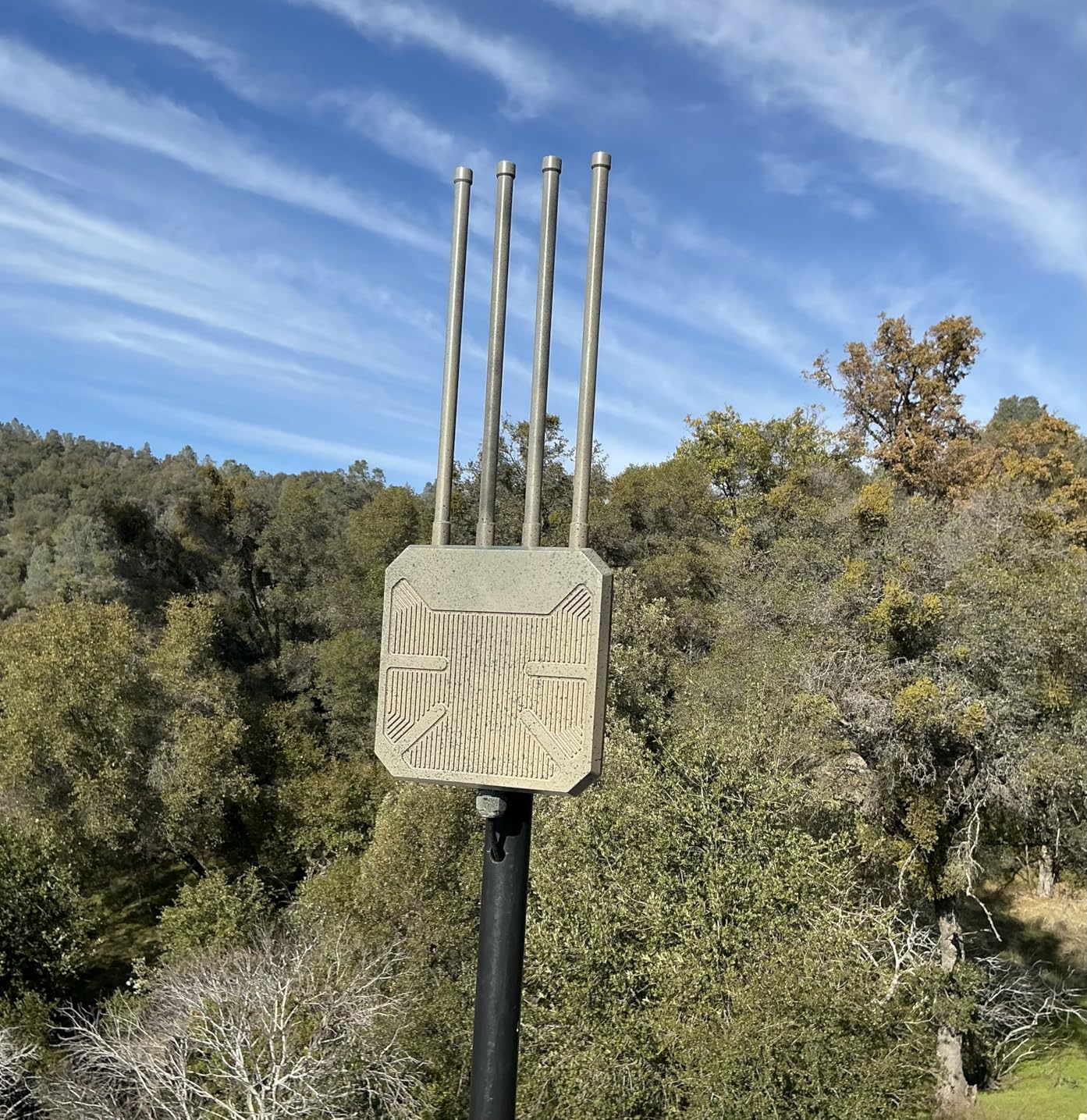
Protection figures match the AX1800: an IP67 waterproof, dustproof housing with 15 kV ESD and 6 kV lightning protection, and up to 300 meters of stated outdoor reach for up to 256 clients. Coverage is also listed at up to 2,800 sq. ft. with MU-MIMO and OFDMA, and the operating modes again cover mesh, AP, router, repeater, and AP plus repeater.
The honest framing is that Wi-Fi 7 outdoors mostly benefits you at the house end of the link, or on devices placed right next to the node. Speed is not what carries across a yard, so if your backhaul is wireless, the AX1800 reaches further for the same antenna array.
One practical gotcha worth flagging: the PoE converter that ships in the box is not weatherproof. It has to go inside an enclosure or a weatherproof box even though the unit itself is IP67. We have seen this trip up more than one installer.
Who The WAVLINK BE5100 Is Built For
Pick this if you have a wired run to the outdoor location and want the headroom for 8K streaming hardware, current flagship phones and laptops, or a busy camera installation. The 2.5 Gbps port is the deciding factor in that scenario, since no other unit in this list offers it.
It is also the right choice if you are replacing a Wi-Fi 5 or Wi-Fi 6 outdoor node that has been running for years and clients on both ends have moved on to Wi-Fi 7 hardware.
Where The WAVLINK BE5100 Falls Short
The mesh mode remains WAVLINK-only, so it pairs with the AX1800 and the AC1200 but not with any Deco or eero node. If you are a Deco household, that ecosystem gap is decisive.
Expect the weakest ecosystem and support story in the group. Older clients see little of the advertised throughput, the non-weatherproof PoE converter is an installation step people forget, and an 11 percent one-star share in the reviews suggests a real tail of configuration and stability complaints. If you want the smoothest setup experience, a Deco or eero node is the calmer choice.
6. WAVLINK AC1200 Outdoor – Best for Farms, Barns and Outbuildings
WAVLINK AC1200 Outdoor Mesh Extender/Router,Long Range IP…
AC1200 dual-band outdoor mesh
IP65 case rated -20C to 50C
4 x 7dBi omni antennas
54V active and passive PoE
Pros
- Low-cost way to cover farms
- barns
- coops and outbuildings on one network
- Dual Gigabit ports plus active and passive PoE allow remote installs without outdoor power
- Fit AP mode manages many nodes from a single dashboard
- WPA2
- WPA3-MIX and WPA2-Enterprise encryption options
- IP65 case with 15 kV ESD and 4 kV lightning protection
Cons
- Weakest rating in the group at 4.0 with a 15 percent one-star share
- AC1200 speeds trail the AX1800 and BE5100 models
- Must use the included injector and will not power from PoE++ switches
- 5-10 minute boot time and a web interface some buyers find hard to use
- Real range sometimes falls short of the stated 300 m through timber
The AC1200 is the pragmatic rural pick. It is a Wi-Fi 5 dual-band unit running 867 Mbps on 5 GHz and 300 Mbps on 2.4 GHz, which is old hardware by current standards, and that is exactly why it makes sense when you need to link a barn, a chicken coop and an irrigation hub back to a farmhouse across 300 meters of open ground.
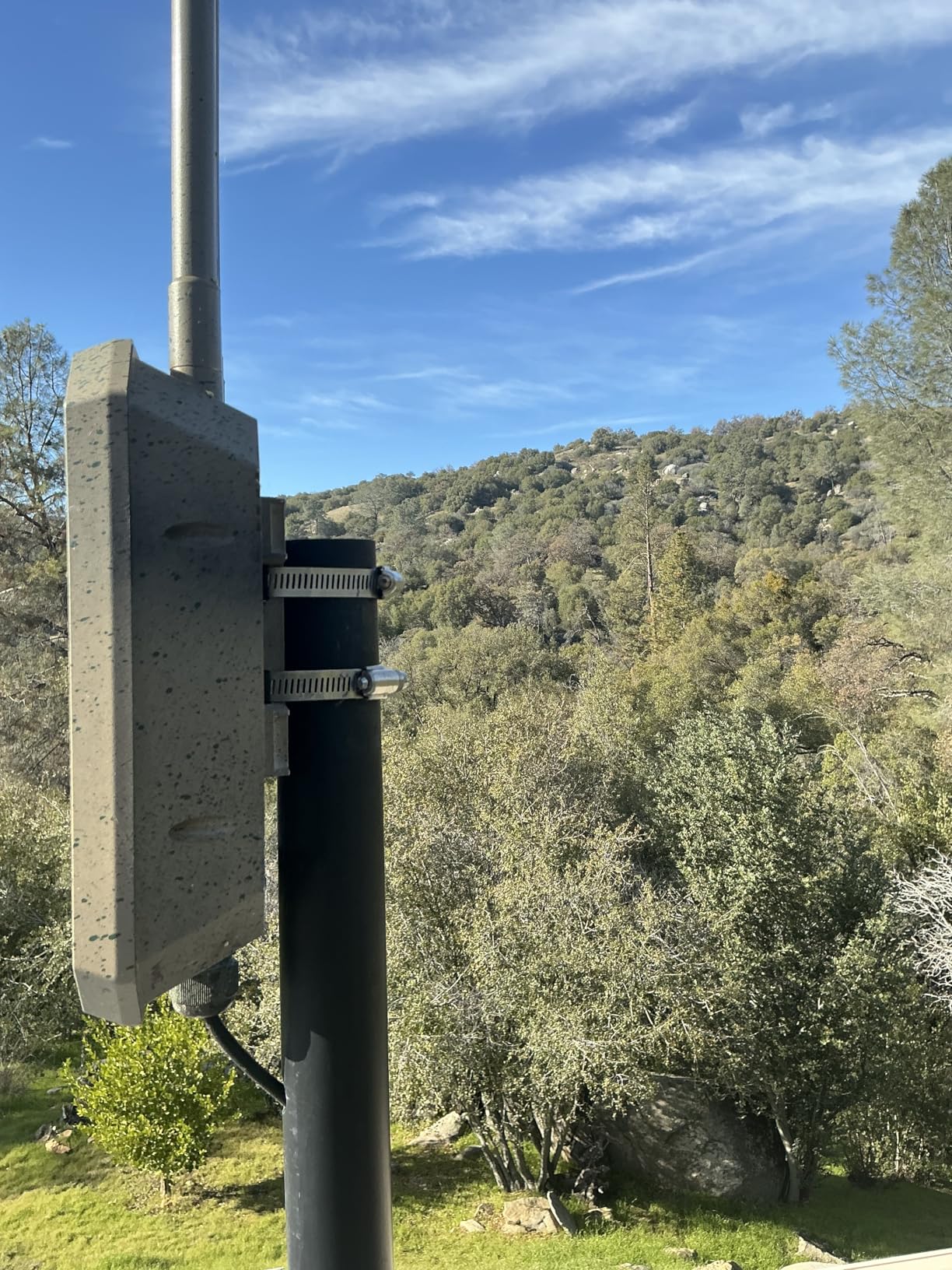
Four 7dBi detachable omni-directional antennas do the reaching, split two on each band, and owners use it with Everything Mesh Technology to cover farm buildings on one network. Dual 10/100/1000 Mbps Gigabit ports mean you can hardwire as well as extend, and 54V active or passive PoE works out to 100 meters from the injector.
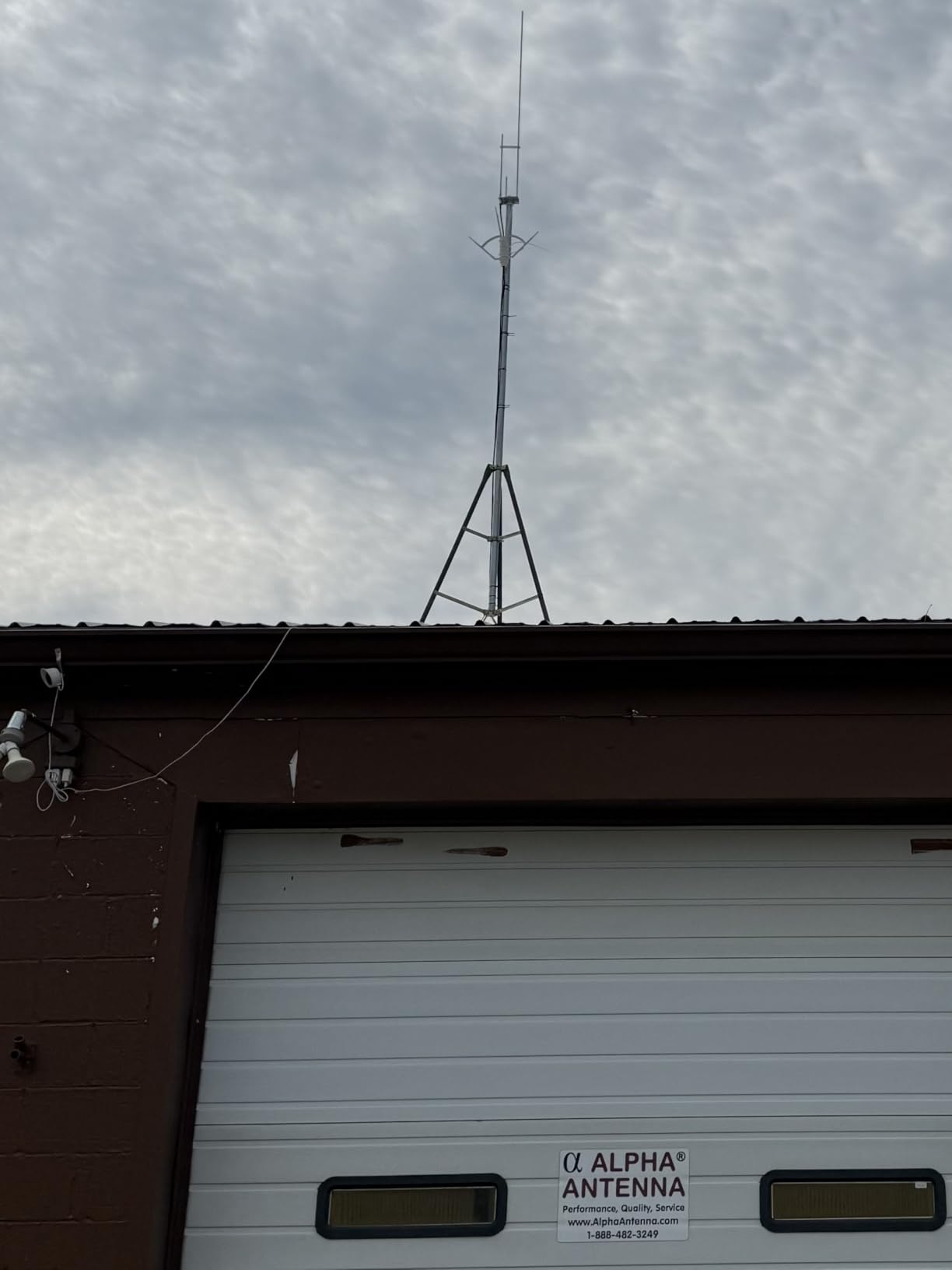
It handles roughly 64 to 96 concurrent devices, which is the right scale for IoT sensors, cameras and utility gear rather than a house full of phones. Fat AP mode gives a fast deployment path, and Fit AP mode centralises management of many nodes on one dashboard, though that needs a separately purchased WAVLINK AC Controller.
Security is unusually thorough for this class, with WPA2, WPA3-MIX and WPA2-Enterprise encryption available. The enclosure is IP65 waterproof and heat-resistant from -20C to 50C with 15 kV ESD and 4 kV lightning protection, and the warranty runs 18 months.
There is a 15 percent one-star share in the reviews, and the reasons are concrete rather than mysterious. It needs its own injector and will not power from standard PoE++ switches, boot time is roughly 5 to 10 minutes after power-up, and the web interface is awkward for some buyers to work through. On the plus side, the support team has been responsive, including refunding a lightning-damaged unit within hours.
Who The WAVLINK AC1200 Is Built For
Homesteads, farms, campgrounds and anyone blanketing a large property with basic connectivity rather than speed. Cameras, sensors, smart irrigation and workshop tools are the realistic loads here, and 64 to 96 concurrent devices covers them comfortably.
If the sites are genuinely remote, the passive PoE option and the 100-meter injector reach are what make it practical. You can place a node where there is no power, which is the situation that rules out most consumer gear.
Fit AP mode is the feature to look at if you plan to deploy more than two or three of these. Centralised management from one dashboard is how installs at this scale stay maintainable.
Where The WAVLINK AC1200 Falls Short
Speed is the first limit. AC1200 class throughput trails both the AX1800 and the BE5100, and anything streaming video outdoors will feel the difference immediately. The older Wi-Fi 5 radio also means no 6 GHz band and no Wi-Fi 7 features.
Range claims also need tempering. Real-world coverage sometimes falls short of the 300 m figure, particularly through timber, since the stated number assumes clear line of sight. And with a 4.0 rating and 118 reviews, this is the least-proven unit here, so treat it as a deliberate trade for low cost rather than a default choice.
What to Check Before You Buy an Outdoor Mesh Node
Five questions decide whether an outdoor node will work in your yard. Answer them in order, because the first one is a hard gate and the rest are trade-offs.
IP65 vs IP67 vs IP55: Which Weather Rating You Need
The IP rating is two numbers. The first is dust: 6 means dust-tight, which is what you want because an outdoor unit lives next to soil, pollen and insects. The second is water, and that is where the numbers differ in ways that matter.
IP65 means protected against water jets from any direction. That covers driven rain and a hose splash, and it is the right rating for a wall mount, a covered eave, or a soffit. IP67 means protected against temporary immersion to a depth of one meter for 30 minutes, which is what you want for a pole mount, a tree, or anything exposed to full weather. IP55 only protects against water jets, with no dust rating, and we would not hang an outdoor node rated only IP55 in North American conditions.
Check the temperature range too, since it is the spec most listings bury. The eero Outdoor 7 is rated from -40F to 131F, while the WAVLINK units list -20C to 50C. If your winters go below that, the node may not survive a cold snap.
Wired vs Wireless Backhaul for an Outbuilding
Backhaul is the link between your main node and the outdoor node, and it decides how much speed survives. Wireless backhaul is easier and costs nothing to run, but it shares the same airtime as your client devices, so a 2.4 GHz outdoor link on a dual-band node is effectively half speed at best. Forum consensus is consistent on this: add outdoor-rated access points with wired connectivity back to the house rather than trying to stretch indoor mesh.
The decision rule is simple. If you can run one outdoor-rated Cat6 line to the outbuilding, run it. The line is the single highest-leverage thing you can do for outdoor coverage, and it turns the whole problem from a signal-strength question into a cable question. A buried or surface-run outdoor-rated line with a weatherproof gland at each end will outlive any wireless link you could set up.
PoE is what makes that cable practical. Every unit in this list except the eero takes power and data on the same run, so one line handles the install. Check the PoE standard before you buy, because 802.3at PoE+ rules out some lower-spec injectors and unmanaged switches.
How Far Outdoor Wi-Fi Actually Travels
This is the question nobody answers with a number, so here is one you can plan against. The stated 200 to 300 meter figures on the WAVLINK units are line-of-sight radius numbers, and line of sight outdoors means: no trees, no fences, no walls, and the antenna roughly at ear height. Through open air those numbers are plausible. Through a screen fence, halve them. Through mature foliage in summer, halve them again. Through a stucco wall or a wooded slope, treat them as marketing.
The square-footage figures on the mesh units describe a footprint, not a radius, and assume open ground. The eero Outdoor 7 is rated at up to 15,000 sq. ft. outdoors, which works out to about a 70-foot radius, and that is the more honest way to read it. The Deco X20’s 2,200 sq. ft. figure is the same kind of number, scaled to a much smaller zone.
Mounting height is the free performance upgrade. A node at 10 feet on a pole clears most fences and shrubbery, and a node at 4 feet mounted on a wall does not. Mount it as high as the cable run allows, keep the antennas clear of obstructions, and aim the placement at the far corner of the zone rather than the middle of it.
Mesh vs Outdoor Access Point vs Extender
Mesh is a whole-network system. Several nodes share one network name and one set of credentials, and devices roam between them. It is the best experience when the outdoor node shares your indoor brand, and the worst value when it forces a brand rebuild.
An outdoor access point is a single bridged node. It has one job, it usually supports more operating modes, and its antenna configuration is chosen by you rather than by the mesh system. It is the right call for farms, acreage, RV setups, and anywhere a mesh network’s roaming layer adds nothing.
An extender repeats an existing signal, which halves throughput because the repeater rebroadcasts over the same band it receives on. Extenders are the cheapest fix and the worst experience, especially outdoors where you are already fighting distance. If you are stuck choosing between an extender and mesh, mesh wins on anything you care about more than installation convenience.
How to Mount and Power an Outdoor Node
Four practical steps get most installs right. First, survey the site before you buy, and walk the actual line from your house to the far corner of the zone to spot fences, trees, gutters and downspouts. Second, run one outdoor-rated Ethernet line if you possibly can, using a drip loop at each end so water runs off instead of into the gland. Third, power it with PoE where available and use a GFCI-protected outdoor outlet for AC, and remember that the PoE injector or converter is frequently not weatherproof even when the node is. Fourth, mount it high, in shade if you can manage it, and test at the far end of the coverage zone rather than right underneath the node.
On software, keep outdoor clients on a separate guest or IoT network where your system allows it. Outdoor cameras and smart locks sit on an exposed network, and segmenting them keeps a compromised device from reaching your indoor laptops and NAS. If you are building a larger property network, our guide to quad-band Wi-Fi 7 systems for whole-home coverage covers the indoor side of that build, and our three-story home mesh guide covers the hardest indoor case.
Frequently Asked Questions
Can mesh WiFi be used outdoors?
Yes, but only with an outdoor-rated node. Indoor mesh nodes are not weather sealed and fail quickly when mounted outside, even under an eave. An outdoor node also has to be the same brand as your indoor mesh, because mesh roaming will not cross brands.
Which mesh Wi-Fi system has the best outdoor access point?
Among the six units we tested, the eero Outdoor 7 is the strongest overall choice, rated IP66, running Wi-Fi 7, and covering up to 15,000 sq. ft. outdoors. For most households the TP-Link Deco X50-Outdoor is the better all-round buy, with two Gigabit PoE+ ports and the deepest owner history in the group.
What are the downsides of mesh WiFi outdoors?
Mesh roaming is closed to a single brand, so an outdoor node will not join a mixed-brand network. Wireless backhaul shares airtime with client devices, so satellite speeds drop. Dual-band nodes have no dedicated backhaul band. Setup depends on a vendor app, and advanced security features often sit behind a paid subscription.
What mesh WiFi has the longest range outdoors?
The longest-range units here are the WAVLINK models, which use four detachable 8dBi omni-directional antennas and a stated 200 to 300 meter line-of-sight radius. Real-world results depend entirely on obstacles, so plan on roughly half that distance through a fence and half again through foliage.
How do I extend my WiFi to my backyard?
Survey the site first and note every fence, tree and wall between the house and the far corner of the yard. Run one outdoor-rated Ethernet line to the outdoor location if you can, since a wired backhaul beats any wireless hop. Choose an IP65 or IP67 node from the same brand as your indoor mesh, power it with PoE where available, and mount it as high as the cable allows.
Which is better, a WiFi extender or mesh?
Mesh wins on speed and roaming, because each node has full network duties and devices hand off between nodes. An extender halves throughput since it rebroadcasts over the same band it receives on. For outdoor coverage specifically, a purpose-built outdoor access point or node beats both, because it is sealed for weather and offers better antenna options.
Do outdoor WiFi extenders really work?
They work, but with real limits. Expect usable line-of-sight coverage of 100 to 200 feet with good external antennas, and much less through fences, walls or trees. The biggest gains come from antenna choice and mounting height rather than from the speed number printed on the box.
The Best Mesh Wi-Fi System for Outdoor Coverage
The eero Outdoor 7 is our pick for the best mesh Wi-Fi system for outdoor coverage in 2026, and it wins on the combination of rating and review volume, an IP66 enclosure rated from -40F to 131F, and a software layer that hands off cleanly from an existing indoor eero network. It reaches roughly 70 feet in open ground, which covers most backyards without a second node.
For everyone not running eero, the TP-Link Deco X50-Outdoor is the buy. Two Gigabit 802.3at PoE+ ports, a waterproof and dustproof enclosure, and 1,115 reviews of real-world history make it the safest choice on the list. The Deco X20-Outdoor covers a smaller patio or garden office at a lower outlay, and the WAVLINK AX1800 and BE5100 are the answer when distance or acreage is the actual problem.
Whatever you choose, run one outdoor-rated Ethernet line if you can, mount the node high, and keep it in the same brand family as your indoor system. Those three decisions do more for your outdoor signal than any spec on the box.
