
Marble vs Quartz Countertops: October 2026 Guide
Marble and quartz both make beautiful countertops, but they behave very differently once installed. Marble is a quarried natural stone prized for its veining and patina, while quartz is an engineered surface made from roughly 90 percent ground quartz bound with resin. Marble vs quartz countertops comes down to how much care you want to give a surface, how much heat and acid it will see, and what look you actually want to live with for the next 15 years.
This guide walks through the real differences—composition, appearance, durability, maintenance, and the total installed cost of each—so you can make the call with your eyes open. If you want a fast verdict first, jump to the How to Decide section at the end.
Contents
Marble vs Quartz Countertops at a Glance
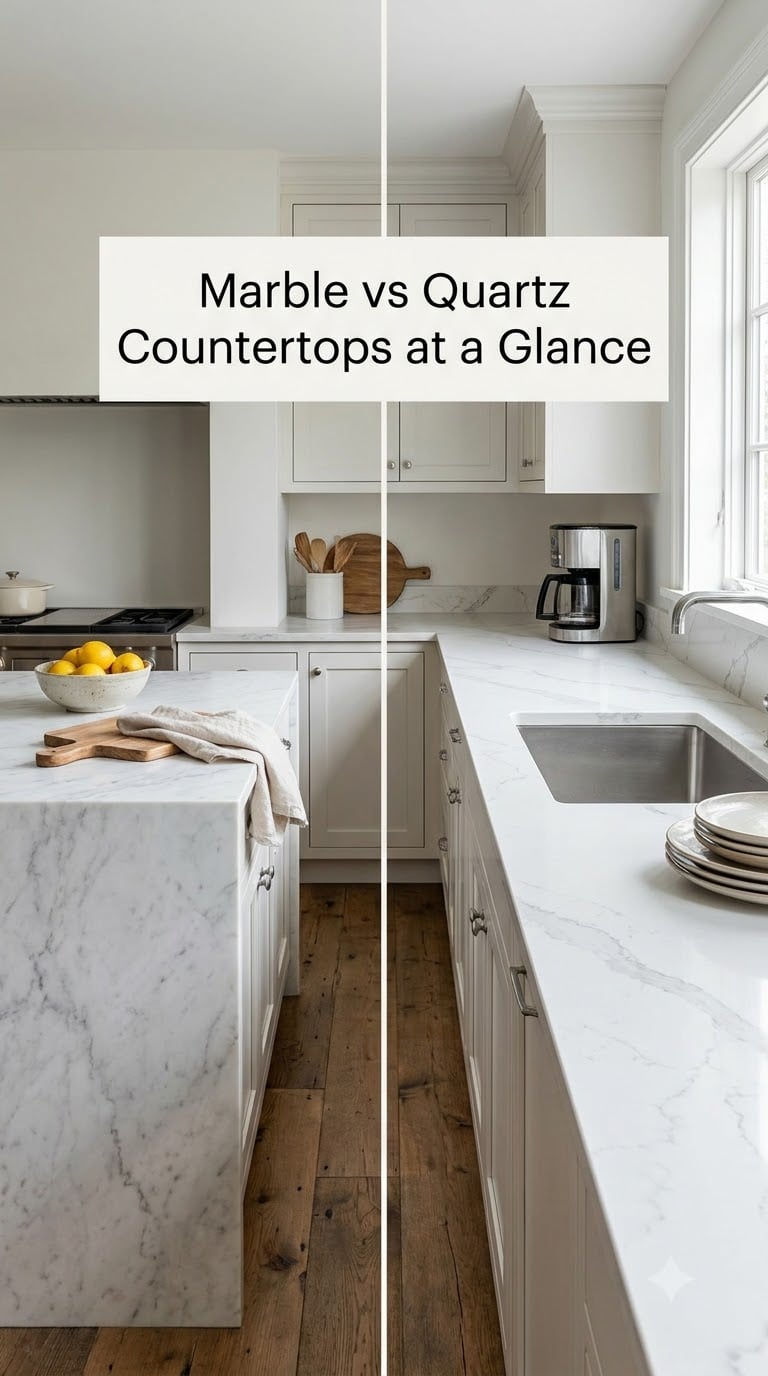
Marble is a natural metamorphic rock cut into slabs from the earth. Quartz is a manufactured slab made from crushed quartz, polymer resin, and pigments pressed into sheets. The two start in different places, age differently, and ask for different care. Here is the side-by-side at a glance.
- Material type: Marble is natural stone; quartz is engineered stone.
- Typical installed cost per square foot: Marble runs about 50 to 150 per square foot installed; quartz runs about 40 to 100 per square foot installed for most styles, with premium designer quartz climbing higher.
- Durability (Mohs hardness): Marble sits around 3 to 5; quartz sits around 7 out of 10.
- Heat resistance: Marble handles hot pans well; quartz can discolor or crack under sustained heat above roughly 300 degrees Fahrenheit.
- Stain resistance: Marble is porous and needs sealing; quartz is non-porous and resists stains without sealing.
- Maintenance: Marble needs sealing every 6 to 12 months and pH-neutral cleaners; quartz wipes clean with soap and water.
- Best for: Marble suits bakers, low-traffic baths, and statement islands; quartz suits busy kitchens, rentals, and family spaces.
What They Are and How They Are Made
Marble starts as limestone buried deep in the earth, then transforms over millions of years under heat and pressure into the crystalline stone we recognize by its soft veining. Quarries cut blocks from the mountain, and fabricators slice them into slabs before polishing or honing the surface. Every slab is one of a kind, which is part of the appeal and part of the unpredictability.
Quartz countertops start as one of the hardest minerals on earth. Manufacturers grind natural quartzite into a fine aggregate, mix it with about 10 percent polymer resin and color pigments, then press the blend into slabs under heat and vibration. The result is a uniform, dense surface with controlled patterns and consistent color from batch to batch.
The recipe matters because resin is what makes quartz non-porous. That same resin is also why quartz cannot tolerate the same heat a slab of marble can shrug off.
Appearance and Design Options
Marble has movement. Veins wander across the slab, no two pieces match, and the depth you see in real Calacatta or Carrara is something a photograph only hints at. Common looks include soft white Carrara, dramatic Calacatta Gold with thick grey and gold veining, and Crema Marfil in warm cream tones. Honed marble has a soft, matte feel that hides light etching; polished marble looks glossier and shows more drama but also shows etching more clearly.
Quartz gives you control. Because it is engineered, brands can mimic marble veining, pour concrete-look slabs, or ship solid colors that never appear in nature. Slab-to-slab consistency is one of its biggest selling points, especially on large islands where seams would otherwise interrupt a pattern. Edge profiles are limited only by what your fabricator owns, from a simple eased edge to a fancy ogee or dupont.
If you want a one-of-a-kind slab and a surface that ages, marble is the choice. If you want a repeatable look across a big kitchen and no surprises, quartz is the choice.
Durability, Heat, and Stain Resistance Compared
Quartz is harder than marble. On the Mohs scale, quartz sits around 7, while marble sits around 3 to 5 depending on the variety. That gap shows up in real life: a knife dragged across marble will leave a faint scratch, while the same drag on quartz usually leaves nothing.
Heat is the one place marble beats quartz. Marble can take a hot pan straight from a 400 degree oven without a mark. Quartz cannot. The resin binder in quartz begins to discolor around 300 degrees Fahrenheit, and a sustained hot pot or a slow cooker can leave a permanent yellow or brown mark called a scorch. Trivets are not optional on quartz.
Acids are marble’s weak spot. Lemon juice, red wine, tomato sauce, and vinegar will etch the polished surface, leaving a dull ring that even resealing will not fix. Quartz is essentially acid-proof because the resin shields the stone from contact.
For everyday stain resistance, quartz wins clearly. Coffee, olive oil, and beet juice wipe off a quartz surface. The same spills on unsealed or aging marble can leave a shadow that needs a poultice to draw out.
Maintenance and Daily Care
Marble asks for a routine. Plan to seal a honed or polished marble surface every 6 to 12 months with a penetrating stone sealer, more often in a kitchen that sees heavy cooking. Clean only with a pH-neutral stone cleaner or warm water and a soft cloth. Skip vinegar, lemon sprays, bleach, and most off-the-shelf bathroom cleaners; they will etch the polish within seconds.
Quartz asks for very little. Soap and water handle 95 percent of messes. There is no sealing schedule, no special polish, and no annual reseal. The trade-off is that you have to protect it from heat and from prolonged exposure to strong chemicals like paint stripper or oven cleaner, which can break down the resin and cause permanent white marks.
If you have ever wanted a countertop you can ignore, quartz is it. If you are the type who enjoys oiling a butcher block or waxing a soapstone sink, marble is a similar commitment that pays you back in character.
Cost Comparison: Marble vs Quartz Countertops
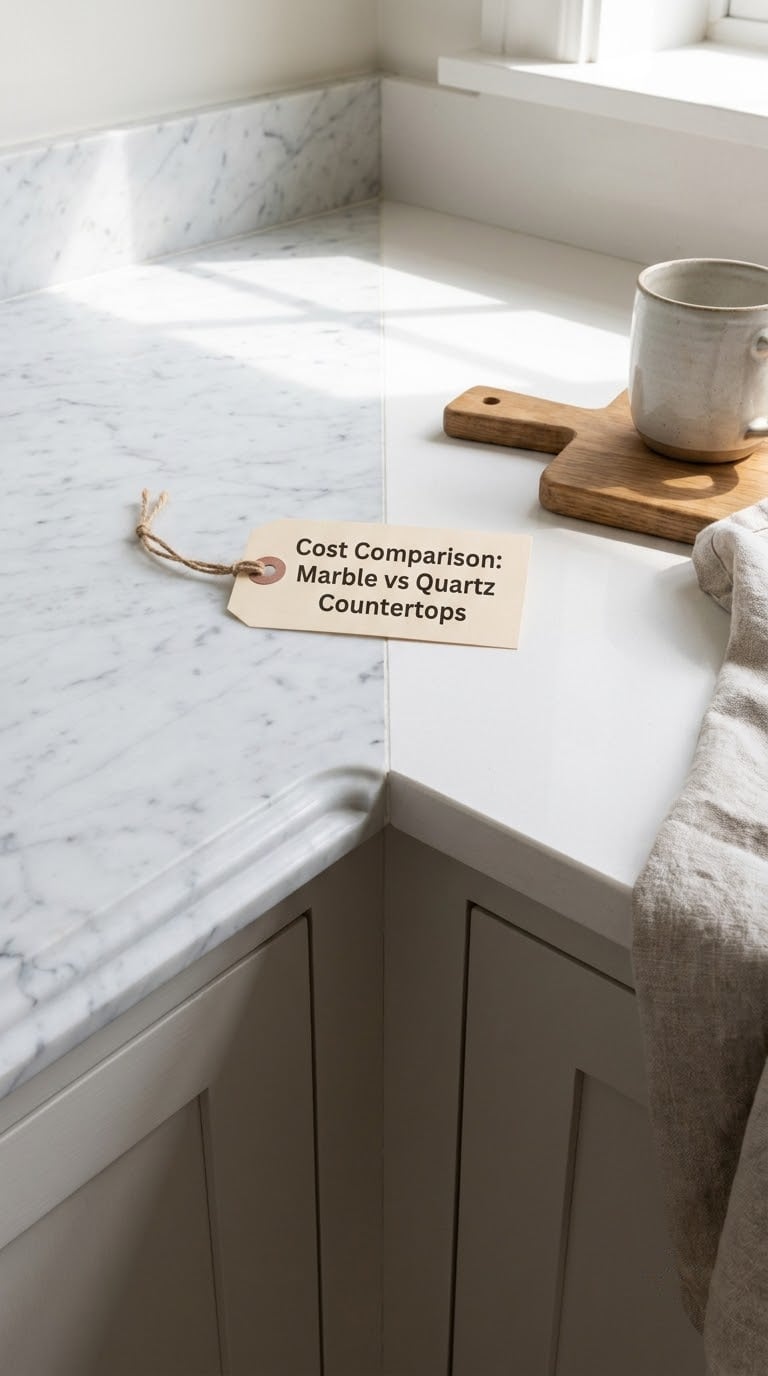
Quartz often lands cheaper than marble for the slab itself, but installation, edge work, and cutouts can swing the totals in either direction. Here are the realistic US installed ranges most homeowners see in 2026.
- Entry-level marble (Carrara, basic grades): about 50 to 75 per square foot installed.
- Mid to high-grade marble (Calacatta, Statuario, exotic): about 100 to 150 per square foot installed.
- Entry-level quartz (builder-grade white and gray patterns): about 40 to 70 per square foot installed.
- Designer quartz (marble-look, premium brands, deep colors): about 75 to 100+ per square foot installed.
For a 50 square foot kitchen, expect somewhere between 2,500 and 7,500 for either material, with marble more often landing on the higher end and entry quartz on the lower. For a 30 square foot bath vanity, the project usually runs between 1,200 and 4,500 depending on the slab and edge.
What Changes the Price
A few variables move the final number more than the slab choice itself. Slab grade and rarity push marble up fast: a Calacatta Gold with book-matched veining costs more than a common Carrara. Edge profile matters, too. A simple eased edge is standard; ogee, dupont, or waterfall ends add fabrication time. Cutouts for sinks and cooktops are typically charged per cutout, and a farmhouse apron sink needs more structural support underneath, which can add several hundred to the final bill.
Region plays a role as well. Coastal metros and the West Coast tend to price higher than the Midwest because shipping, labor, and showroom overhead are all higher. If you are also replacing the sink, faucet, or cooktop, see our Cost to Install New Kitchen Countertops: Guide for the line items that usually surprise homeowners on estimate day.
Best Rooms and Lifestyles for Each Material
Marble shines in spaces where someone is paying attention. A pastry island in a kitchen where the cook bakes often benefits from marble’s naturally cool surface, which keeps butter firm while you work. A powder room vanity, a coffee bar, or a primary bath where traffic is light gives marble a chance to age gracefully without constant wipe-ups.
Quartz is the workhorse choice. A family kitchen with kids, a rental property, a basement bar, or a secondary bath with daily use will all stay looking new for years on quartz with almost no effort. Quartz also makes sense in a vacation home that sits empty for stretches, since there is no sealer to forget before guests arrive.
Most homeowners who mix the two put quartz on the perimeter counters where most cooking happens, and marble on a baking station or an island that does double duty as a serving area. That pairing gives you the look of marble where it matters and the durability of quartz where messes happen.
Installation, Lead Time, and What to Ask the Fabricator
Both materials follow a similar install path. A template is made from your finished cabinets, the slab is cut on a CNC or by hand at the shop, and the crew returns to set, seam, and seal the counters in place. Most kitchens take 2 to 4 hours to install once the slab is ready. Seams in quartz can be nearly invisible if the color is consistent; seams in marble are usually tighter because the fabricator can align veining.
Lead times vary by region and material. Quartz from a major brand is often ready to template within 1 to 3 weeks. Marble may need 3 to 6 weeks because slabs are imported and selected slab-by-slab. Add a week or two if you are doing custom edge work, a mitered apron, or a book-matched feature wall.
Before you sign a quote, ask these questions. Who measures the final template, the salesperson or an installer? What edge profiles are included and which cost extra? How many seams will my layout need, and where will they fall? Is the sink undermount, top-mount, or farmhouse, and what support does the farmhouse need? What is the warranty on the slab and the installation, and is it transferable if you sell?
If you are replacing counters in place, also check out our guide on How to Remove Old Caulk from Kitchen Countertops to handle the seam between the counter and backsplash before the new install day.
Resale Value and Long-Term Considerations
Both materials signal quality to buyers, but in different ways. Marble reads as classic and high-end, which can be a real draw in a luxury listing. The catch is that some buyers walk away from marble because they have heard the horror stories about stains. Quartz reads as move-in ready, low maintenance, and modern, which appeals to the largest pool of buyers in most markets.
Quartz typically lasts 15 to 25 years without losing its finish, and many brands offer 10 to 15 year transferable warranties. Marble can last a lifetime if you care for it; many European homes still have original marble counters from 50 or more years ago. The patina that bothers one owner is the character another is buying on purpose.
If you expect to sell within 5 to 7 years, quartz is the safer bet for broad appeal. If you plan to stay and want a surface that ages with the house, marble rewards that commitment.
How to Decide Between Marble and Quartz
The shortest path through this decision is to ask three honest questions. How often do I actually cook, and what do I cook? If you cook daily with tomatoes, wine, lemons, and the kids are pouring juice, marble will frustrate you inside a year. Pick quartz and save the marble dream for a bathroom or an island where traffic is light.
Second, do I want a surface that looks the same in 15 years, or one that looks better? Quartz holds its finish. Marble develops a patina that some owners love and others cannot tolerate. Decide which one you are before you sign the contract.
Third, what does my budget actually allow after edge work and cutouts? Both materials are within reach of most mid-range remodels, but exotic marble and designer quartz both climb fast. Get an installed quote for each before you fall in love with a slab in the showroom.
For a typical family kitchen where cooking happens every night, quartz is the right call almost every time. For a baking island, a low-traffic bath, or a homeowner who wants the patina, marble is the right call. Many of our readers end up using both, quartz where messes happen and marble where the surface is the star.
Frequently Asked Questions
Which is more durable, marble or quartz countertops?
Quartz is harder and more chip-resistant than marble. On the Mohs scale, quartz scores about 7 out of 10, while most marble scores between 3 and 5. Quartz also resists stains because the resin binder makes it non-porous. Marble can scratch, etch from acids like lemon or wine, and chip more easily if a heavy pot hits an edge.
Do quartz countertops stain less than marble?
Yes, by a wide margin. Quartz is non-porous, so coffee, red wine, olive oil, and beet juice wipe off without leaving a mark. Marble is porous even after sealing, and spills can soak in and leave a shadow that needs a poultice to lift. If your kitchen sees heavy cooking, quartz will look new far longer than marble.
How much more expensive is marble than quartz?
In most US markets in 2026, marble runs about 50 to 150 per square foot installed, and quartz runs about 40 to 100. Exotic Calacatta or Statuario marble can climb past 150, while designer marble-look quartz often lands in the 75 to 100 range. The total project cost depends more on edge profile, cutouts, and region than on the slab itself.
Do marble countertops need to be sealed?
Yes, marble should be sealed at install and resealed every 6 to 12 months in a typical kitchen. A penetrating stone sealer slows staining but does not stop etching from acids. Quartz never needs sealing because the resin binder makes it non-porous, which is one of the main reasons busy households pick quartz over marble.
Can you put a hot pan on quartz or marble?
Marble handles a hot pan from a 400 degree oven with no problem. Quartz cannot. The resin in quartz begins to discolor or scorch around 300 degrees Fahrenheit, and a slow cooker or electric griddle sitting in one spot can leave a permanent mark. Always use a trivet on quartz, and you will avoid most heat damage.
Which countertop is better for a kitchen with kids and lots of cooking?
Quartz is the safer pick for a busy family kitchen. It resists stains, wipes clean with soap and water, never needs sealing, and holds up to years of juice spills, craft projects, and homework sessions. Marble is beautiful in a low-traffic space, a baking island, or a powder room, but in a heavy-use kitchen the patina and etching arrive faster than most owners expect.
