Engineered Hardwood vs Solid Hardwood: October 2026 Guide
Picking between engineered hardwood vs solid hardwood is one of the first big decisions you make when you redo a floor. The short version: solid hardwood is a single piece of milled lumber, usually 3/4 inch thick, and can be sanded and refinished many times over decades. Engineered hardwood is a real wood veneer (the species you actually see) bonded over layers of plywood or high-density fiberboard, which makes it more stable in moisture, humidity, and over concrete slabs. Both look identical once installed. The right choice comes down to where the floor is going, your subfloor, your climate, and how long you plan to stay in the home.
I’ve walked homeowners through this choice for years, and the floor that wins is almost always the one that matches the room, not the one with the longer spec sheet. Below is a side-by-side look at cost, durability, refinishing, installation, and resale, plus a quick decision guide for common scenarios like basements, beach houses, and forever homes. If you want the full install cost picture before you decide, the hardwood floor install pricing guide lays it out by room size and region.
Contents
Engineered Hardwood vs Solid Hardwood at a Glance
Both floors are real wood on the surface. The difference is what sits beneath that top layer and how that changes durability, refinishing, and where you can install it. Here’s a side-by-side comparison of the features that matter most to a homeowner.
| Feature | Engineered Hardwood | Solid Hardwood |
|---|---|---|
| Construction | Real wood veneer over plywood or HDF core | One solid piece of milled lumber |
| Typical thickness | 3/8 inch to 1/2 inch (some 5/8 inch) | 3/4 inch (standard) |
| Wear layer | 0.6 mm to 6 mm veneer on top | Full plank thickness, all wood |
| Moisture tolerance | Higher; handles basements and slabs | Lower; above-grade only |
| Refinishing passes | 1 to 3 (depends on wear layer) | 5 to 10 over the life of the floor |
| Install methods | Float, glue, staple, nail | Nail or staple (usually) |
| Typical lifespan | 20 to 30 years (quality builds 40+) | 30 to 100+ years |
| Best rooms | Basements, kitchens, over radiant heat, concrete slabs | Living rooms, bedrooms, hallways, above-grade |
If you only have a minute, that table is your answer. Everything below unpacks why each line matters and what it costs.
What Is Engineered Hardwood?
Engineered hardwood is a layered flooring product with a real hardwood top layer (the part you see and walk on) bonded to a backing of plywood, high-density fiberboard (HDF), or sometimes a softwood core. The layers are stacked in alternating directions, which is called cross-grain construction. That cross-grain setup is the whole engineering trick: it cancels out much of the natural expansion and contraction that wood does with humidity, so the plank stays flat.
The visible top layer is called the wear layer or veneer. It ranges from a thin 0.6 mm on budget products up to 4 mm to 6 mm on premium lines. That number matters because it controls how many times the floor can be sanded and refinished. A 2 mm wear layer can usually take one light refinish. A 4 mm or thicker wear layer can take two or three before you hit the plywood underneath.
Visually, an engineered plank looks identical to solid once it’s installed. You see the same oak grain, the same maple figuring, the same hickory variation. From the side, you’d spot the layered core, but on the floor, no one can tell.
What Is Solid Hardwood?
Solid hardwood is exactly what it sounds like: one piece of milled lumber, top to bottom, end to end. The most common thickness is 3/4 inch, and the planks come in widths from 2 1/4 inch (the classic strip look) up to 5 inch or wider for a modern wide-plank feel.
The way the log is cut changes the look and stability of the plank. Plain-sawn (also called flat-sawn) is the most common and shows the cathedral grain pattern. Quarter-sawn cuts the log at a different angle and produces straighter grain with less cupping. Rift-sawn is the most stable cut but also the most expensive, with a tight, linear grain. Most homeowners go with plain-sawn because the look is what they expect from a hardwood floor.
Because the plank is solid all the way through, you can sand it down and refinish it many times over its life. A 3/4 inch solid oak floor can take five to ten full refinishes if you maintain it well, which is why older homes still have original hardwood from the 1950s and 60s.
Cost Comparison
For materials only, both floors cover a wide range depending on species, grade, plank width, and brand. As of 2026, the realistic US ranges per square foot of materials are:
- Engineered hardwood: $4 to $16 per sq ft for materials
- Solid hardwood: $5 to $15 per sq ft for materials
Installed labor runs about $3 to $8 per sq ft on top of materials for either floor, depending on your region, subfloor prep, and the install method. Engineered can actually be a little cheaper to install in some cases because click-lock floating systems go down faster than nail-down solid.
Here’s what that looks like for common room sizes, including both materials and labor:
| Room Size | Engineered Installed Range | Solid Installed Range |
|---|---|---|
| 250 sq ft (small bedroom) | $1,750 to $6,000 | $2,000 to $5,750 |
| 500 sq ft (living room) | $3,500 to $12,000 | $4,000 to $11,500 |
| 1,000 sq ft (open floor plan) | $7,000 to $24,000 | $8,000 to $23,000 |
What Changes the Price
Five things push the price up or down on either floor type. First, species: domestic oak and maple sit at the lower end, walnut, cherry, and hickory run higher, and exotic species like Brazilian cherry or teak sit at the top. Second, grade: select and prime grades have fewer knots and color variation, common and rustic grades cost less. Third, plank width: wider planks (5 inch and up) cost more than narrow strips because the milling is more precise. Fourth, finish: a factory-applied aluminum oxide finish holds up longer than a site-finished poly and is standard on most engineered and prefinished solid planks. Fifth, underlayment and subfloor prep: a concrete slab that needs moisture testing, a leveling compound, or a vapor barrier adds a few dollars per square foot. Region matters too. Coastal cities and the West Coast run 20% to 30% higher than the national average.
One thing to budget that people forget: furniture moving and old floor removal. If you have carpet or tile coming out first, that adds $1 to $3 per square foot in demo.
Durability and Lifespan
Both floors handle daily life well, but they age differently. Solid hardwood is one piece of dense wood all the way through, so it can take dents and scratches in stride, and those marks can be sanded out. Engineered hardwood has a softer plywood or HDF core under the veneer, which can dent more easily if something heavy drops, but the top wear layer is the same wood species as a solid floor.
For scratch resistance, the factory finish matters more than the floor type. Aluminum oxide finishes on prefinished planks hold up better than site-finished poly on either floor, and matte finishes hide scratches better than high-gloss.
Lifespan is where the two diverge:
- Engineered hardwood: 20 to 30 years on a typical build, 40+ on a quality product with a thick wear layer and a stable core
- Solid hardwood: 30 to 100+ years, depending on species, traffic, and how many times it’s refinished
For high-traffic homes with pets and kids, both work. Solid oak or hickory takes dents and can be refinished; engineered with an aluminum oxide finish and a 3 mm or thicker wear layer resists surface scratches well. The deciding factor usually comes down to moisture and subfloor, not raw durability. If you want the long-term resale story, solid wins on lifespan. If you want stability in a basement or over a slab, engineered wins.
Moisture, Humidity and Heat Performance
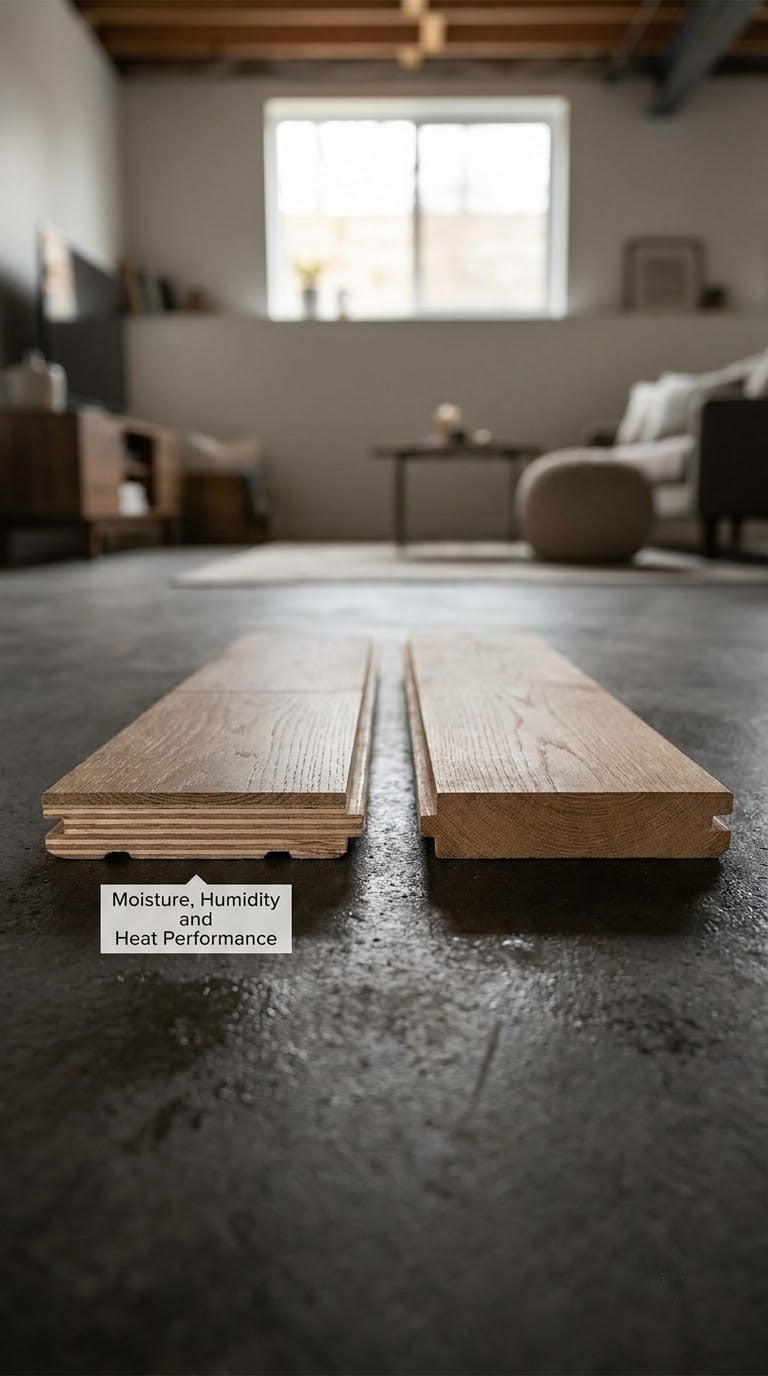
This is the section that decides the choice for most homeowners. Wood moves with moisture. It swells when humidity rises, shrinks when it drops, and cups or gaps if the change is sudden. Solid hardwood, being one piece of wood, moves a lot. Engineered, with its cross-grain layers, moves much less.
That difference is why engineered hardwood is the right call for basements, concrete slabs, bathrooms (with proper care), kitchens, and over radiant heating systems. The cross-grain core resists the dimensional changes that would make a solid plank cup, crown, or gap in those conditions.
Solid hardwood wants a stable, dry, above-grade environment. It performs best in living rooms, bedrooms, hallways, and dining rooms on a plywood or OSB subfloor. Most manufacturers will not warranty solid hardwood below grade, in a bathroom, or over a concrete slab without a special subfloor system.
On radiant heat, engineered is usually the safe choice because solid can gap and shift as the heating cycles on and off. A few solid species (mainly quarter-sawn white oak) are rated for radiant, but engineered is the simpler, lower-risk option for most installs.
Humidity matters for both. Keep the home between 30% and 50% relative humidity year-round, run a humidifier in winter and a dehumidifier in summer, and either floor will stay flat. Letting the indoor humidity swing from 20% in January to 70% in July will gap a solid floor every time and stress even an engineered one.
Refinishing and Long-Term Maintenance
Refinishing is the long-term care story, and it’s where solid hardwood has the bigger advantage. A 3/4 inch solid plank can be sanded down to bare wood and refinished five to ten times over its life, which means a scratch, a water stain, or a color change can be erased. A professional refinish runs $3 to $8 per square foot, depending on your region and how much repair the floor needs. For more on the cost side, the hardwood refinishing pricing breakdown covers it by floor size and condition.
Engineered can also be refinished, but the number of passes depends entirely on the wear layer. A 0.6 mm veneer can’t be sanded at all. A 2 mm veneer can usually take one light buff-and-coat. A 3 mm to 4 mm veneer can take one full refinish. A 6 mm wear layer (rare, mostly on premium products) can take two or three. After that, the veneer is gone and you’d be sanding into the plywood core, which destroys the floor.
Routine care is the same for both. Sweep or vacuum with a hard-floor attachment weekly, mop with a barely damp microfiber mop and a wood-safe cleaner (never a steam mop, never a wet mop), and put felt pads under furniture legs. Wipe up spills within a few minutes. For small surface scratches that don’t go through the finish, a touch-up marker or a buff-and-coat is usually enough. The no-sanding scratch repair guide walks through the common fixes for either floor type.
Plan to recoat the finish every 7 to 10 years on a high-traffic floor. That’s a light abrasion and a fresh topcoat, not a full sand, and it costs a fraction of a refinish.
Installation Methods
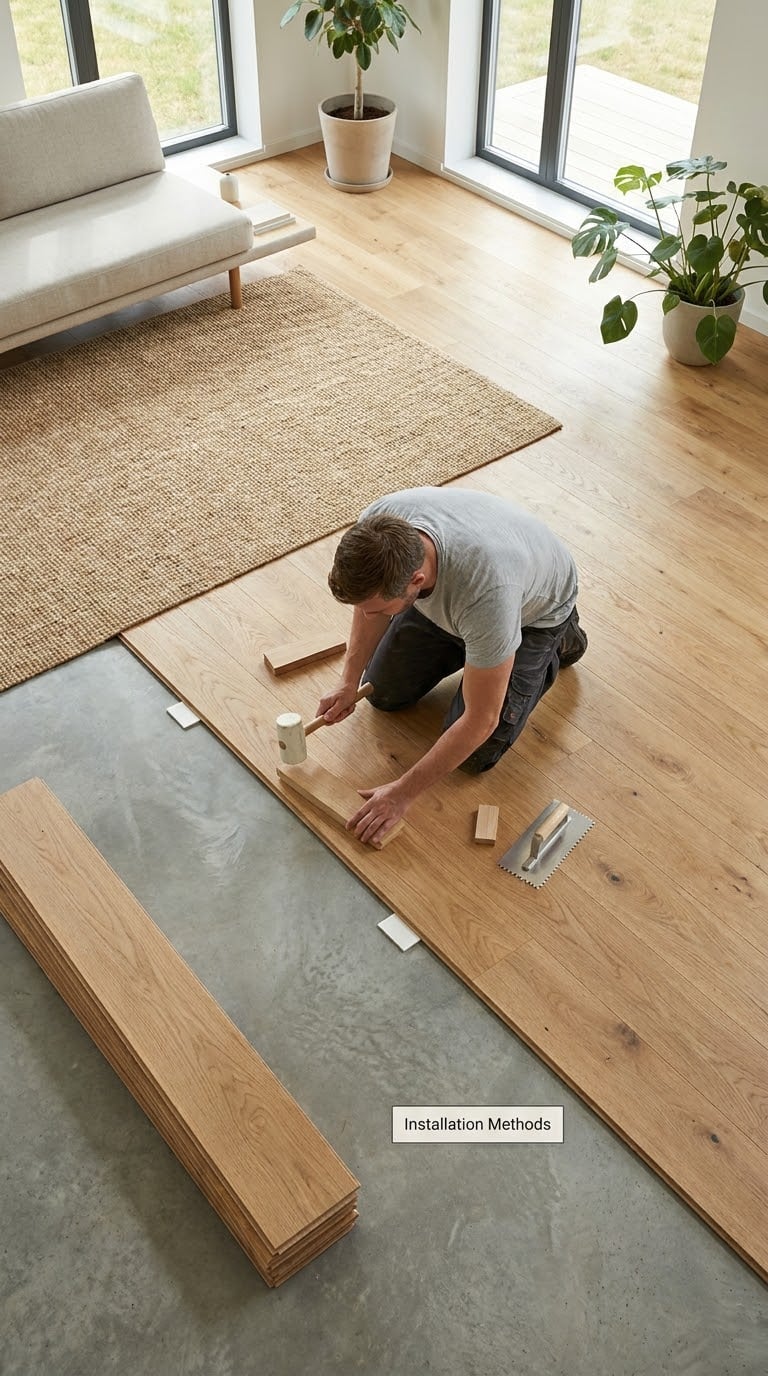
The install method is another place where engineered hardwood pulls ahead. Engineered planks can be installed four ways, and you pick the one that matches your subfloor and skill level:
- Click-lock floating: Planks snap together and sit over an underlayment. No glue, no nails. The fastest method, very DIY-friendly, and it works over concrete, plywood, or even existing vinyl. The floor expands and contracts as one unit, so you leave a 1/2 inch gap at the walls.
- Glue-down: Adhesive is troweled onto the subfloor and the planks are pressed in. Very stable, very quiet underfoot, and the right choice for radiant heat or a concrete slab where you don’t want a hollow floating floor. More skill required, and you can’t walk on it for 12 to 24 hours.
- Nail or staple-down: A flooring nailer drives cleats through the tongue into a plywood or OSB subfloor. Standard for solid hardwood, also works for engineered. Needs a wood subfloor and a compressor or manual nailer.
- Peel-and-stick (less common): Adhesive backing on the plank. Mostly used for thinner engineered products in light-traffic rooms.
Solid hardwood is almost always nail-down or staple-down over a plywood or OSB subfloor. Glue-down is possible but messier and usually reserved for pros. Floating is not recommended for most solid planks because the wood wants to move and the floating system doesn’t hold it as tightly.
For DIY skill level, a click-lock engineered install in a 200 sq ft bedroom is a doable weekend project for someone comfortable with a tape measure, a miter saw, and a tapping block. A nail-down solid install in the same room is harder. The flooring nailer is a learning curve, and a bad nail angle will leave squeaks for years.
Resale Value and Buyer Appeal
Real estate agents I’ve worked with generally agree that buyers prefer hardwood floors over carpet, vinyl, or laminate, and they’re willing to pay more for a home that has them. The species and condition matter more than the construction type. A clean, well-maintained engineered oak floor in good condition appraises the same as a solid oak floor in similar condition for most buyers.
That said, solid hardwood carries a slight edge on resale in markets where buyers know to ask. Older buyers who remember their parents’ original hardwood from the 1970s and 80s tend to value solid. Younger first-time buyers are usually fine with either, especially if the engineered floor is a higher-end product with a thick wear layer.
Species matters for resale too. Oak (both red and white) is the safe, broadly appealing choice. Maple and hickory are popular in the Midwest and East Coast. Walnut reads as upscale but shows scratches more easily. Exotic species like Brazilian cherry or tigerwood are polarizing: some buyers love them, others see them as dated or too dark. If resale is the priority, white oak in a 5 inch to 7 inch wide plank in a neutral stain is the safe 2026 bet.
Keep records of the install, the brand, the lot number, and any finish warranty. Buyers and their inspectors will ask.
Pros and Cons Summary
For a quick side-by-side at a glance, here are the pros and cons of each floor type.
| Engineered Hardwood Pros | Engineered Hardwood Cons |
|---|---|
| Handles basements, slabs, and humid climates | Limited refinishing (1 to 3 passes) |
| Works over radiant heat | Thin wear layers can’t be sanded at all |
| Multiple install methods, including DIY-friendly click-lock | Quality varies widely; cheap cores can delaminate |
| More dimensionally stable, fewer gaps and cupping | Lower-end products can sound hollow underfoot |
| Wider plank options without the warping risk | Lower resale premium than solid in some markets |
| Solid Hardwood Pros | Solid Hardwood Cons |
|---|---|
| Can be refinished 5 to 10 times over its life | Not for basements, bathrooms, or below-grade rooms |
| 30 to 100+ year lifespan with proper care | More sensitive to humidity swings, gaps seasonally |
| Higher resale appeal in markets that know to ask | Nail-down install, not as DIY-friendly |
| One solid piece of wood, no delamination risk | Limited plank widths without warping risk |
| Can be screened and recoated many times | Cannot be installed over most radiant heat systems |
Which One Should You Choose?
The right floor depends on the room, the subfloor, and how long you plan to stay. Here are the common scenarios and what I usually recommend for each.
Basement remodel or below-grade room: Engineered, installed as a floating floor over a moisture barrier. Solid will void the warranty in most basements.
Concrete slab on grade (no basement): Engineered, glue-down for stability and sound. Solid needs a plywood subfloor over the slab, which adds cost and height.
Beach house or humid climate: Engineered. The cross-grain construction handles the seasonal humidity swings without cupping or gapping the way solid will.
Forever home with the plan to stay 30+ years: Solid hardwood in a classic species. The refinishing ability and lifespan pay off over decades.
Rental property or first home you may sell in 5 to 10 years: Engineered with a 3 mm or thicker wear layer. Lower upfront cost, good durability, and broad buyer appeal.
Budget reno with a tight install window: Engineered click-lock. Fastest install, lowest labor cost, and forgiving on imperfect subfloors.
Over radiant heating: Engineered, glue-down, in a species rated for radiant. Solid can gap and shift with the temperature cycles.
Pick the floor that matches the room and the climate, and you’ll be happy with it for the next 20 to 30 years. Order 10% extra material for cuts and waste, and let the planks acclimate in the room for 3 to 7 days before install.
Frequently Asked Questions
How long does engineered hardwood last compared to solid hardwood?
Engineered hardwood typically lasts 20 to 30 years, with quality builds reaching 40 or more. Solid hardwood lasts 30 to 100+ years because it can be refinished 5 to 10 times. The lifespan gap mostly comes from refinishing capacity, since both floors use the same real wood species on the surface and wear at similar rates under daily use.
Can you refinish engineered hardwood floors?
Yes, but the number of passes depends on the wear layer thickness. A 0.6 mm veneer cannot be sanded at all. A 2 mm veneer takes one light buff-and-coat. A 3 to 4 mm veneer takes one full refinish. A 6 mm wear layer takes two or three. Always have a pro check the wear layer before scheduling a refinish so you do not sand into the plywood core.
Is engineered hardwood better for basements than solid hardwood?
Yes. Engineered hardwood’s cross-grain plywood or HDF core resists the moisture and humidity swings that cause solid planks to cup, crown, and gap. Most solid hardwood manufacturers will not warranty their product below grade, while engineered is specifically built for basement and concrete slab installs when paired with a proper moisture barrier.
Which type of hardwood is best for homes with pets and kids?
Both work, but engineered with a factory aluminum oxide finish and a 3 mm or thicker wear layer is the most scratch-resistant option. For solid, harder species like hickory, white oak, and maple take dents better than walnut or cherry. Keep pet nails trimmed, use felt pads on furniture, and plan a buff-and-coat every 7 to 10 years on either floor.
Can I install engineered hardwood over concrete myself?
Yes, if you go with a click-lock floating engineered floor. The planks snap together over a foam underlayment and a 6 mil vapor barrier, and the job is doable for a homeowner comfortable with a tape measure, a miter saw, and a tapping block. Glue-down over concrete is more secure but messier and usually better left to a pro.
Does engineered hardwood hurt home resale value compared to solid hardwood?
Not usually, when the engineered floor is a quality product in good condition. Buyers care more about the species, the finish, and whether the floor looks new than whether the core is solid or layered. In markets where buyers know to ask, solid has a slight edge. In most markets, a well-maintained engineered oak floor appraises the same as a comparable solid one.
Engineered hardwood vs solid hardwood comes down to room, subfloor, and how long you want the floor to last. Engineered wins anywhere moisture, concrete, or radiant heat is in play, and it installs faster with more options. Solid wins on refinishing capacity and lifespan if you have a stable, above-grade, dry space. Match the floor to the room, keep the indoor humidity steady, and either one will look good for decades.