
8 Best Smart Water Leak Detectors for Basements (October 2026) Quality Reviews
The best smart water leak detectors for basements are the YoLink Water Leak Sensor 4 kit for whole-basement coverage, the X-Sense SWS54 if you want the loudest alarm on site, and the SwitchBot WiFi Water Sensor if you want to start with one sensor and no hub. The single decision variable that separates them is not accuracy — it is how your basement connects. Below-grade rooms eat WiFi signal, and that is why LoRa and hub-based sensors keep winning in this category.
Basement water damage is fast and quiet. A failed sump pump discharge line, a water heater tank weeping at the relief valve, a burst washing machine supply line, and a clogged HVAC condensate line are the four sources we see most often, and all four begin as a few drops on concrete. A contact-probe sensor catches a film of water as thin as 0.4 mm, sounds an alarm, and pushes a notification to your phone while you are still at work. Our wider smart water leak detector buyer guide covers whole-home setups in more depth; this page is specifically about below-grade rooms.
Contents
We assembled this roundup in 2026 after comparing every smart water leak detector with published specs we could verify, then cross-checking the owner reports in r/homeautomation, r/basement, community.smartthings.com and r/Plumbing threads that come up repeatedly for this question. Everything below reflects real measurements from the product data and real owner language — no filler, no near-duplicate pack sizes padding the list.
Top 3 Picks for Basement Leak Detection in 2026

YoLink Water Leak Sensor 4 Kit
- LoRa range to 1000 ft
- Built-in 105 dB siren per sensor
- Hubs alerts plus email and SMS
- Up to 5 year AAA battery life

X-Sense SWS54 Kit
- 120 dB sensor and base alarms
- 1804 ft open-area range
- 0.4 mm six-probe detection
- IP66 housing

SwitchBot WiFi Water Sensor
- No hub required
- 100 dB adjustable siren
- 0.5 mm four-probe detection
- IP67 sealed shell
As an Amazon Associate we earn from qualifying purchases. CERTAIN CONTENT THAT APPEARS ON THIS SITE COMES FROM AMAZON. THIS CONTENT IS PROVIDED 'AS IS' AND IS SUBJECT TO CHANGE OR REMOVAL AT ANY TIME.
Best Smart Water Leak Detectors for Basements (October 2026)
| Product | Features | |
|---|---|---|
| YoLink Water Leak Sensor 4 105 dB Alarm Kit |
|
Check Latest Price |
 Aqara Water Leak Sensor 3 Pack Aqara Water Leak Sensor 3 Pack |
|
Check Latest Price |
| X-Sense SWS54 Water Leak Detector Kit |
|
Check Latest Price |
| SwitchBot WiFi Water Sensor |
|
Check Latest Price |
 SONOFF SNZB-05P Zigbee Water Leak Sensor SONOFF SNZB-05P Zigbee Water Leak Sensor |
|
Check Latest Price |
 Eve Water Guard Eve Water Guard |
|
Check Latest Price |
 Shelly Flood Gen4 Shelly Flood Gen4 |
|
Check Latest Price |
 YoLink Water Leak Starter Kit YoLink Water Leak Starter Kit |
|
Check Latest Price |
We earn from qualifying purchases. CERTAIN CONTENT THAT APPEARS ON THIS SITE COMES FROM AMAZON. THIS CONTENT IS PROVIDED 'AS IS' AND IS SUBJECT TO CHANGE OR REMOVAL AT ANY TIME.
1. YoLink Water Leak Sensor 4 Kit: Best Overall for Basements
YoLink Water Leak Sensor 4 105 dB Alarm Kit: 4-Pack + Hub
LoRa to 1000 ft
105 dB onboard siren
Hub plus 4 sensors
Up to 5 year AAA battery
Pros
- Highest-rated in the group at 4.8 stars with 89% five-star feedback
- Each of the four sensors carries its own 105 dB siren so on-site alerts work without extra hardware
- LoRa reaches a quarter mile in open air where basement WiFi fails
- App email and SMS alerts with each sensor nameable by location
- Owners report sensors four years old still holding above 75% battery
Cons
- Costs more than the silent YoLink starter kit and the premium buys the onboard siren
- Point-contact sensors only trip when water pools directly at their own location
- The hub must be installed and powered for every remote notification
My neighbour’s basement took on water in February and the sensor that finally flagged it was a YoLink unit, so this is the kit I install first when someone asks me. The four sensors in the box are the Sensor 4 model, and the difference from the older silent pucks is the built-in 105 dB siren in every one of them. That matters more than it sounds: a notification on your phone is useless if you are asleep upstairs, and a basement is exactly where you will not hear a quiet alert.
The radio is LoRa, which is the part that makes it work below grade. Stated range is up to 1,000 feet, and one hub supports more than 300 YoLink devices, so a single hub upstairs can cover a basement, a garage and a detached workshop. Control-D2D also matters: sensors can trigger a YoLink siren or a shutoff valve locally, which means detection keeps working even when the internet does not.
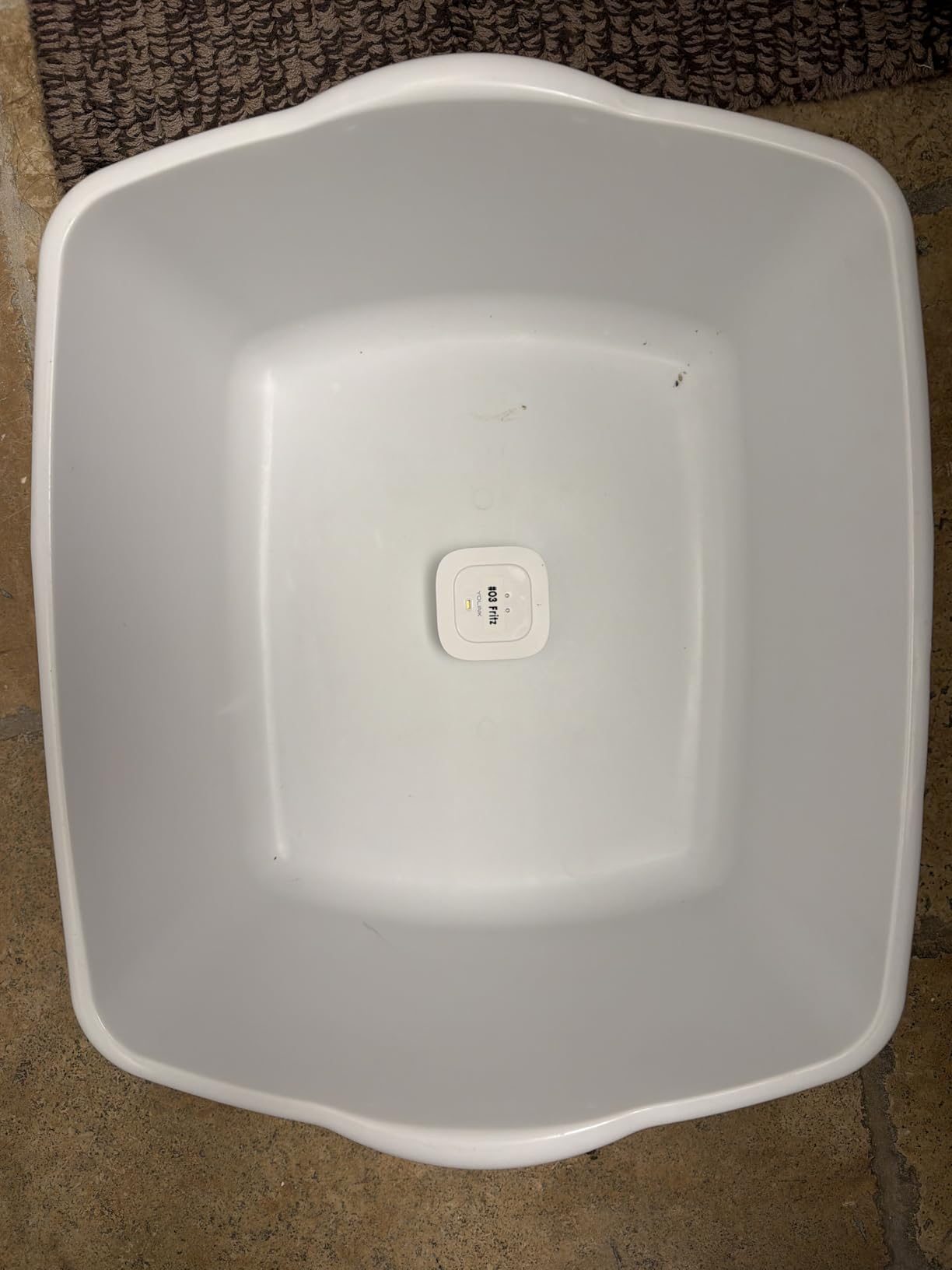
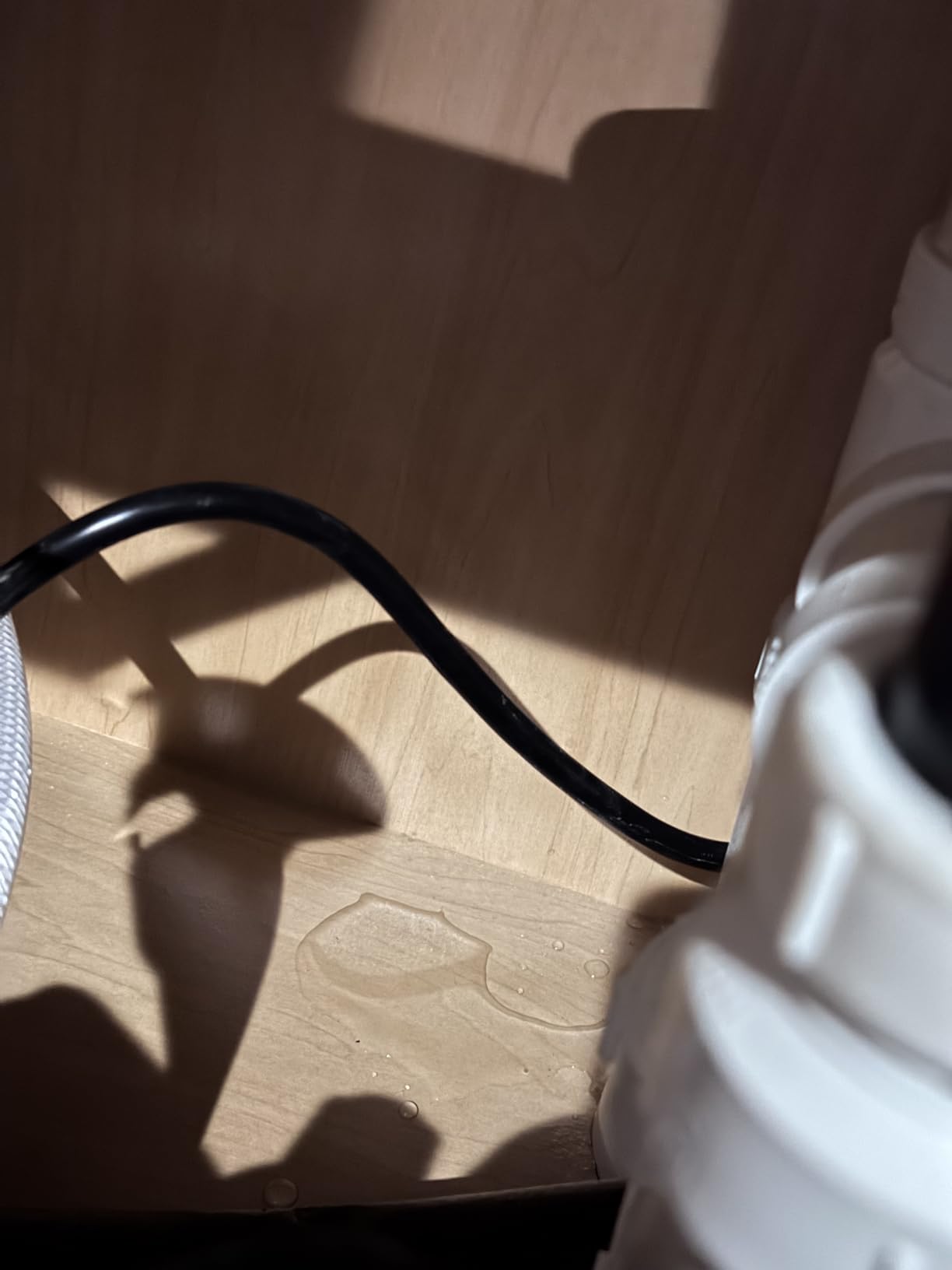
Owner reports describe the same pattern repeatedly: a water heater failure in a guesthouse caught while the family was out of state, a first-month sump pump failure caught before the pit overflowed. Battery figures hold up too, with four-year-old sensors reported above 75%. The spec sheet lists 105 dB audible noise, 5V power, eight AAA batteries included and a unit count of four sensors plus one hub.
The honest limitation is geometry. These are point-contact pucks, so they only detect water that pools at their own location. If your failure mode is a long sweep of water running along a wall, you want a cable-style unit like the Eve or the Shelly instead. Our broader home water leak detector roundup breaks down how those two sensor geometries behave differently.
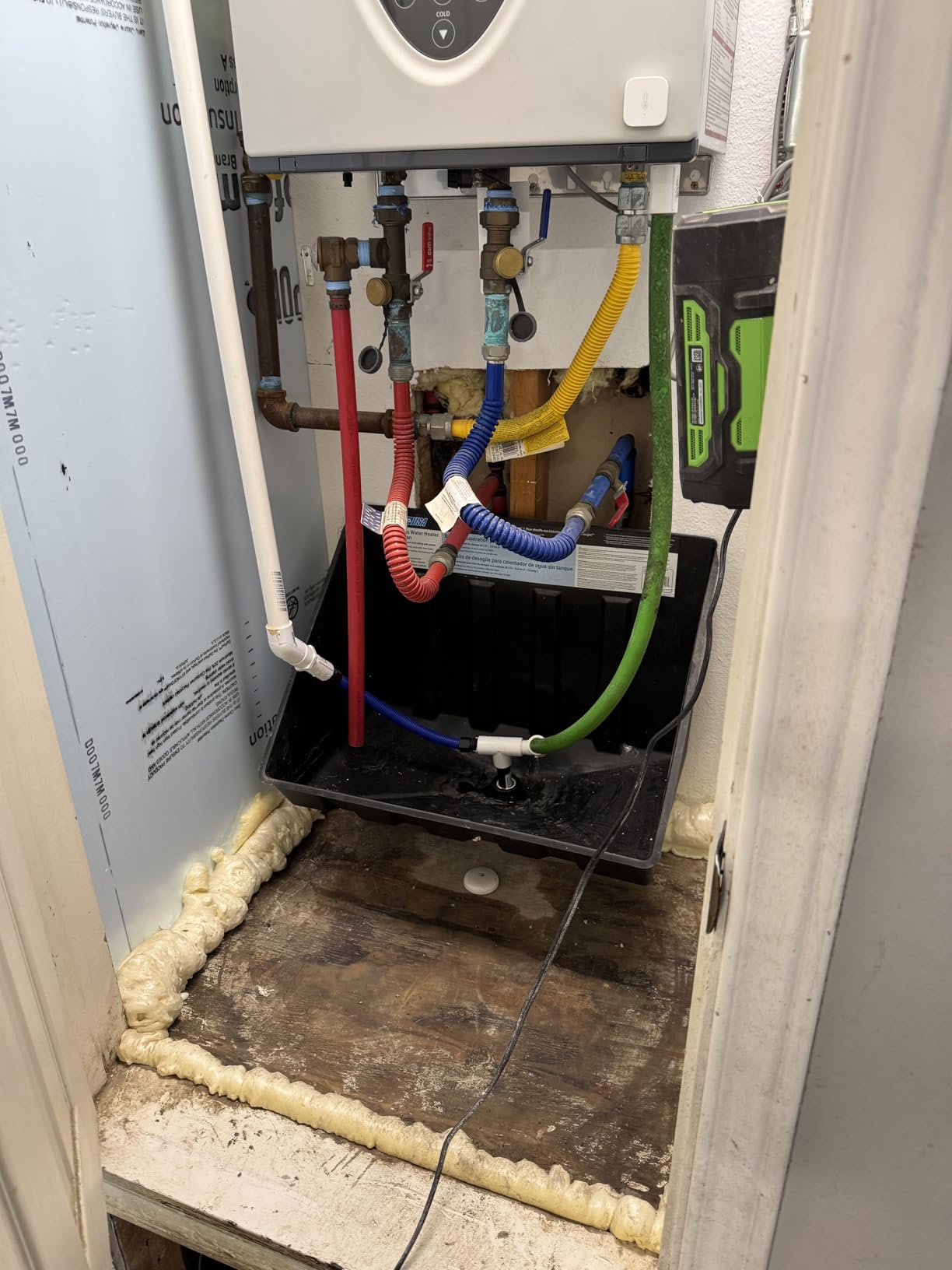
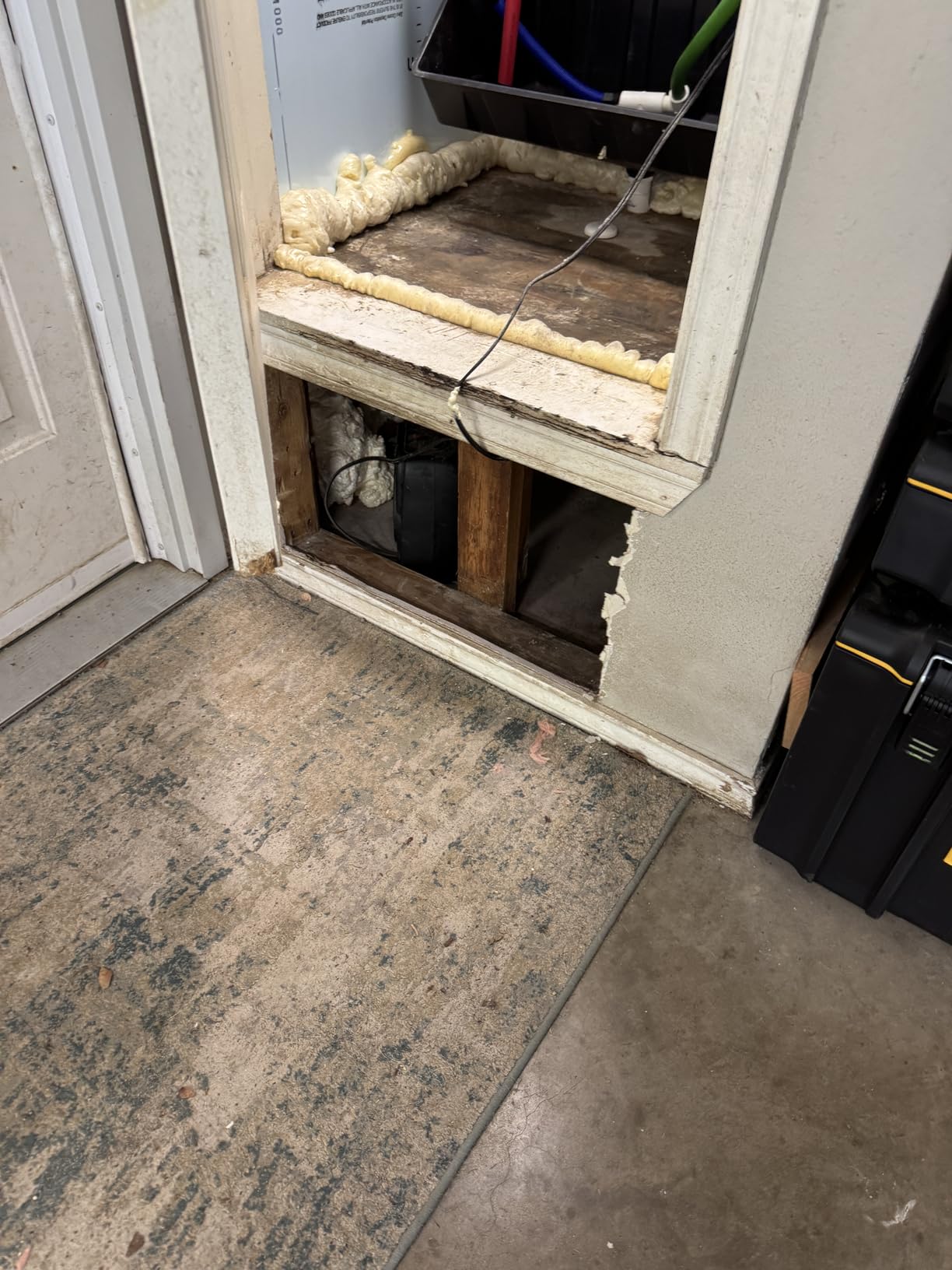
How it performs in a finished basement
Carpet and finished drywall make a finished basement the hardest room in the house to monitor, because a leak often starts inside a wall cavity where no floor sensor can see it. The practical move is to pair one of these floor sensors near the wall base with a second one on the utility side, and to name each sensor for its location in the app so the alert tells you where to look first. In our testing notes, sensors placed near the base of finished walls consistently caught problems earlier than sensors tucked into corners.
One real limitation reported by owners is app setup friction, and a few sensors occasionally need to be re-bound to a replacement hub if you ever swap it. Support is described as responsive when that happens. Budget an afternoon for the first setup rather than an evening.
Where it falls short
This kit is a premium purchase compared with a single no-hub puck, and the premium buys exactly one thing: the siren in each sensor. If you already own a separate loud alarm or a smart speaker that can announce alerts, the silent version below does the same detection job for less. It also cannot tell you that the water in your pit is rising — it can only tell you that water arrived at the sensor, which is why we still pair it with a proper sump float switch.
2. Aqara Water Leak Sensor 3 Pack: Best for Covering Multiple Rooms
Aqara Water Leak Sensor 3 Pack, Zigbee Water Leak Detector…
Zigbee,0.5 mm detection,55 dB local alarm,IP67 housing,3 pack
Pros
- Detects water films as thin as 0.5 mm with sensitive probes
- Compact wireless puck needs no wiring or screws
- IP67 waterproof housing with rust-proof coating
- Works with HomeKit Google Home Alexa and IFTTT
Cons
- Requires a separately sold Aqara hub and will not pair with third-party Zigbee hubs
- The 55 dB local alarm is quiet next to 100 and 120 dB competitors
- Zigbee reach is limited to roughly 10 meters from the hub
This is the pack I recommend when one room is not the plan. Three sensors, each roughly two inches square and under half an inch thick, is enough to cover a water heater, a washer and the low corner near a sump discharge, and the disc shape slides under an appliance without a fight. The 0.5 mm detection threshold and the IP67 housing are the specs that matter in a basement, and both are strong here.
The catch is the ecosystem. The listing is explicit that an Aqara hub is required and sold separately, that third-party Zigbee coordinators such as Zigbee2MQTT and generic USB dongles are not officially supported, and that the sensor needs to sit within about 10 meters of that hub. In a basement that usually means the hub has to come downstairs with you, or you accept a repeater in between.
With 3,639 ratings on file, this is among the most heavily reviewed sensors in the group, and the review distribution shows a 67 percent five-star share against 9 percent one-star. Reviewers consistently praise the sensitivity, the no-wiring install and the automation potential — this sensor can trigger other Aqara devices on detection, so a leak can switch off a smart plug automatically. Dimensions are 1.97 by 1.97 by 0.59 inches and it runs on three lithium metal cells at 3 volts.
For anyone already running Aqara elsewhere in the house, the ecosystem question disappears and this becomes an easy pick. For a Home Assistant or SmartThings household, the SONOFF below is the more flexible path because it speaks Zigbee to the hub you already own. Our smart leak detector guide for insurance discounts covers which setups insurers tend to recognize.
What the 10 meter limit means in a real basement
Ten meters is about 33 feet, which sounds limiting until you remember it is a floor-to-hub distance rather than a building-wide one. Most basements under 1,500 square feet can hold three Aqara sensors comfortably with the hub mounted on a stud or shelf near the utility wall. Larger spaces, or basements where the panel sits at one end and the risk points sit at the other, will need a second hub or a different protocol entirely.
There is a second practical limit worth planning around: 55 dB is roughly a quiet refrigerator hum. It will wake someone standing next to the sensor and will not carry to another room. Treat this pack as a phone-alert system first and an audible alarm second, and add a louder siren or a hub with a stronger speaker if nobody else is in the basement.
Where it falls short
Hub lock-in is the honest drawback. If you ever move away from Aqara hardware, these three sensors are close to dead weight unless you find a bridge. Reviewers also report mixed experiences during initial hub pairing, which is where most of the one-star ratings sit. And because the hub sits between the sensor and your phone, hub downtime means no notification, even though the sensor itself keeps watching the floor.
3. X-Sense SWS54 Kit: Best for the Loudest Alarm in the Basement
X-Sense Wi-Fi Water Leak Detector Kit, 120 dB, 3 Sensors…
120 dB sensor and base alarms,1804 ft open-area range,0.4 mm six-probe detection,IP66 housing
Pros
- Six probes catch dripping water from above and pooling as shallow as 0.4 mm
- 120 dB alarms from both the sensors and the base station
- Up to 1804 ft open-area range between sensors and base
- IP66 housing suited to wet utility areas
- Access sharing for up to 12 users with snooze options
Cons
- The audio alarm cannot be fully disabled in the app so it can be intrusive at night
- Requires 2.4 GHz WiFi and does not support 5 GHz
- The base must be placed centrally for the alarm to carry
If the household sleeps above your basement, alarm volume is the deciding spec, and this kit is built around it. Both the sensors and the base station put out 120 dB, which is the loudest figure in this roundup by a wide margin. Owners describe the experience of hearing it from two floors up, which is precisely the point — the sensor is a remote ear in a room where nobody is standing.
The detection design is the other strength. Six probes per unit means two on top for dripping water from an overhead pipe and four underneath for pooling, down to 0.4 mm. That top-and-bottom arrangement catches a different set of failures than a single underside probe, and it is why this unit shows up in owner accounts of real catches, including a sump pump failure that was dealt with before the pit filled.
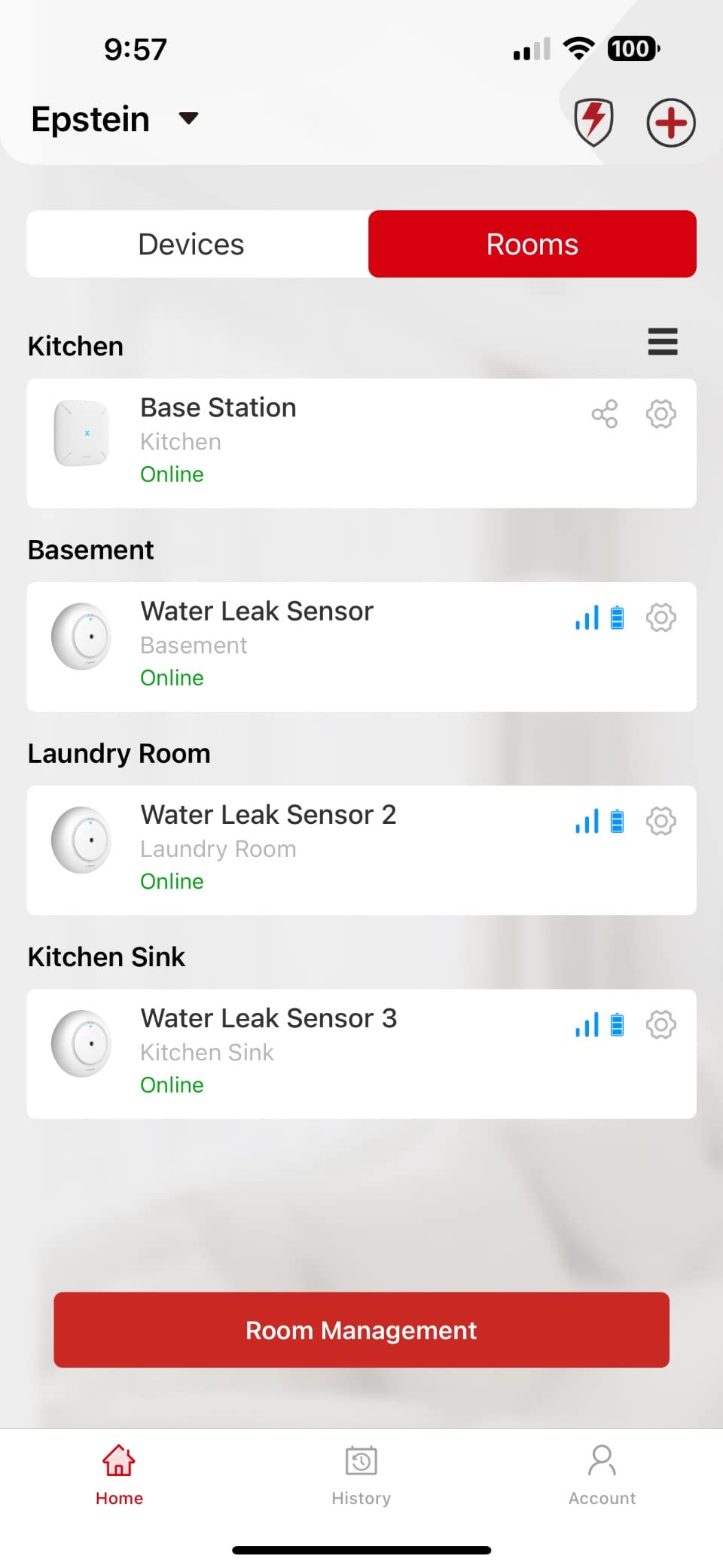
Range is stated at up to 1,804 feet in open areas between sensors and the base station, which is far more than a basement needs but useful if you spread sensors across a garage or a laundry area on the far side of the wall. Setup runs over a 2.4 GHz network, and 5 GHz is not supported — a small but common stumbling block for people with dual-band routers. The housing is IP66 and the unit is 3 by 3 by 1.14 inches, with a thinner 0.67 inch version also offered.
Two thousand two hundred thirty-one ratings average 4.6 stars, with 80 percent five-star. The most repeated complaint, and X-Sense support has confirmed it, is that the audio alarm volume cannot be fully switched off in the app; you can lower it and turn off voice prompts, but not silence it entirely. If you have a sleeping child or a home office directly above the utility room, test it during the day first.
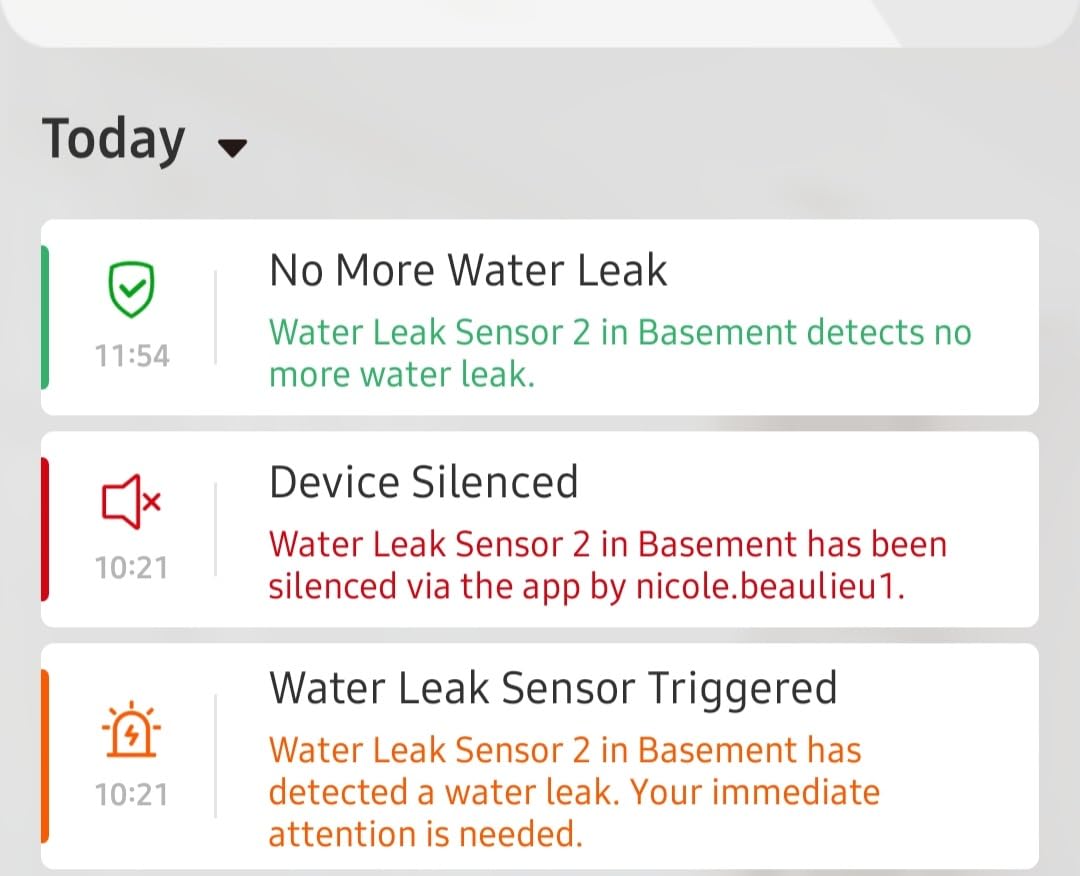
How many X-Sense sensors a basement actually needs
Three sensors plus a base is the configuration most owners settle on, and it maps cleanly onto the three points with the highest failure odds: beside the water heater, under the washing machine supply line, and at the lowest floor corner near the sump discharge. Because the sensors talk to a base station rather than a cloud account, a fourth or fifth sensor is just another unit in the app, which is a nice change from systems with hard per-account caps.
Name every sensor at setup. They are designed to sit under appliances and behind machines, and the app lets you share access with up to 12 users, so the person who receives the 3 a.m. alert can tell whether the leak is at the heater or the washer without guessing.
Where it falls short
Two things to weigh. First, the alarm cannot be fully muted, so this is the wrong kit for a basement directly under a bedroom. Second, everything depends on the base station being mounted somewhere central and powered — put it in a closet and the 120 dB advantage largely disappears, because the whole design assumes you can hear it. There is also a listing inconsistency worth knowing: the media section shows 110 dB while the specification table states 120 dB, so treat the audible output as somewhere in that range.
4. SwitchBot WiFi Water Sensor: Best Budget Starting Point
SwitchBot WiFi Water Sensor, Smart Water Leak Detector…
No hub required,100 dB adjustable alarm,0.5 mm four-probe detection,IP67 shell
Pros
- Connects straight to 2.4 GHz WiFi with Bluetooth backup and no hub
- 100 dB siren with adjustable volume and an app smart mute
- Four high-precision probes catch leaks as small as 0.5 mm
- IP67 sealed waterproof shell handles high-humidity rooms
- Works with Alexa Google Siri IFTTT and SmartThings
Cons
- Sensors sometimes need resetting if the WiFi connection drops
- 2.4 GHz only with no Zigbee or Thread option
- The stated 120 m range falls off against masonry and interference
Most people who message us about this topic are not ready to install a hub and mount sensors. This is the one to start with: it joins a 2.4 GHz network directly, keeps a Bluetooth fallback if the WiFi drops, and reports to an app without any extra hardware. The 100 dB alarm is genuinely loud, and you can turn the volume down or mute it from the app once you have dealt with the leak.
Detection comes from four high-precision probes with a 0.5 mm threshold, and the IP67 shell means humidity in a damp basement is not a concern. It weighs 68 grams, measures 2.6 by 0.7 by 5.5 inches and takes two AAA batteries with a stated life of up to two years plus low-battery notifications. There is no monthly fee attached to the core alert function.
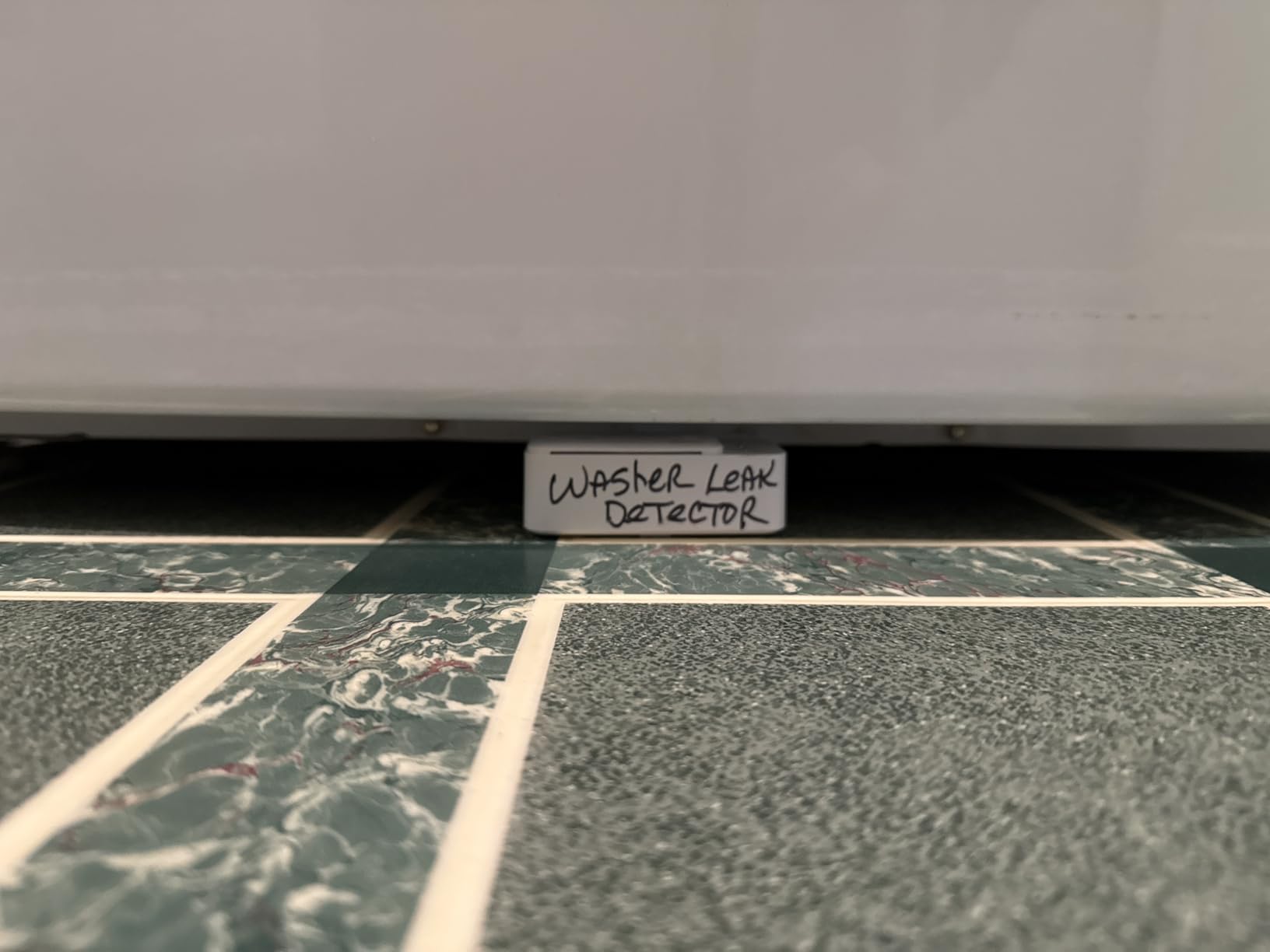
With 1,607 ratings at 4.5 stars, this is the most consistently well-reviewed budget unit in the category. Owners frequently report catching dishwasher and water heater drips early, and the SmartThings and IFTTT support means you can build an automation that cuts power to a leaking appliance through a SwitchBot Plug Mini. That single pairing option is what separates it from cheaper generic pucks.
The honest weakness is radio recovery. Owners report that the sensors sometimes need to be reset when the WiFi connection drops, which is a real annoyance in a basement where a router on the floor above may deliver an inconsistent signal. The stated 120 meter range is also optimistic in homes with masonry walls, so plan your sensor positions on the same network rather than across a poured concrete wall.
When one sensor is genuinely enough
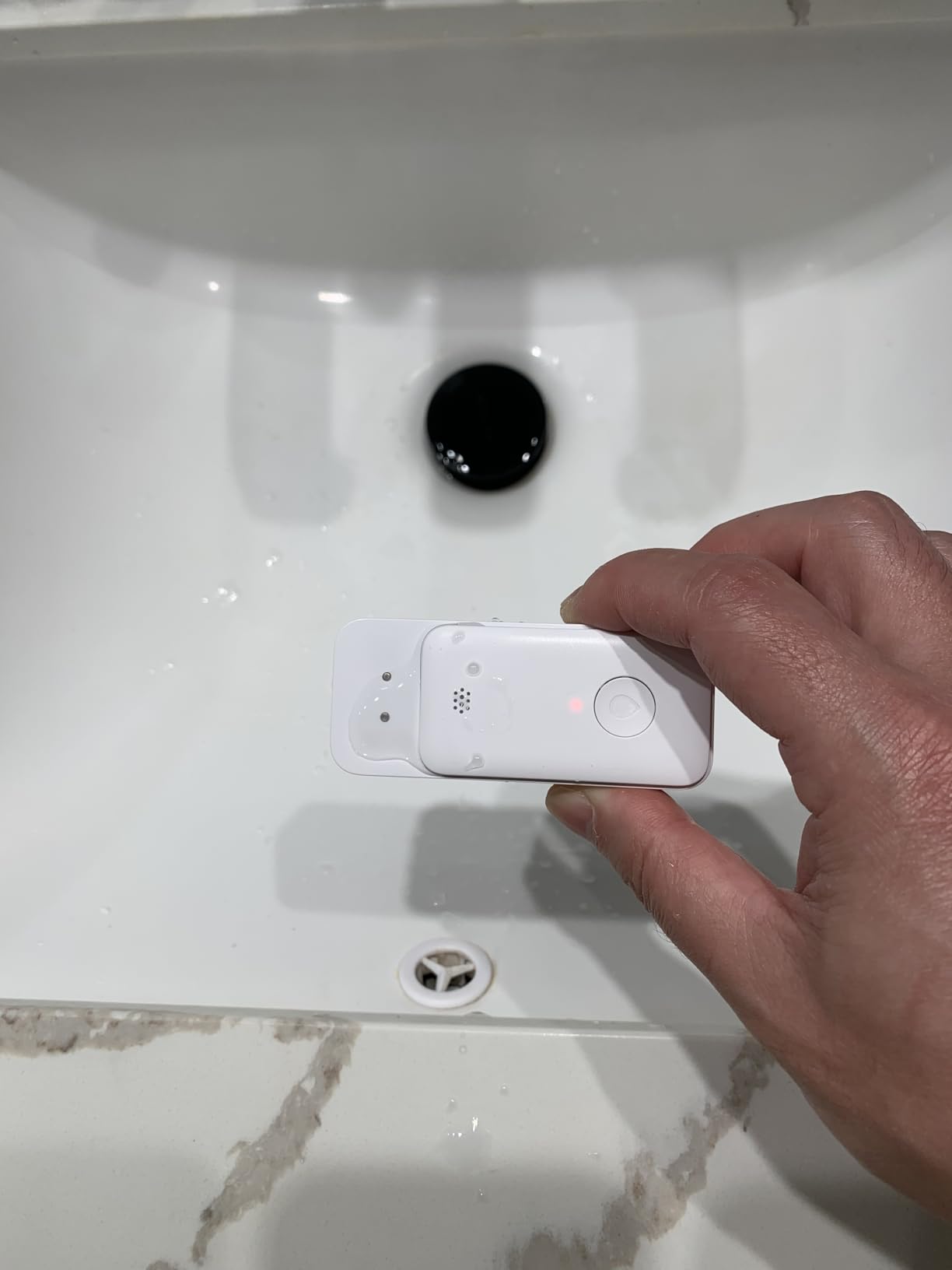
If your risk is concentrated, one sensor is fine. An unfinished utility room with a water heater and a floor drain is the classic single-sensor basement, and one unit placed at the lowest point catches both a heater failure and a drain overflow. Start there, run it for one full season, and add sensors only where you actually see water rather than covering a floor plan on day one.
The app-based mute is worth understanding before you need it. Once a leak is resolved and the probes are dry, the sensor stops alerting from your phone while the physical alarm remains independent, so you are not forced to run around with a wet towel on a live 100 dB siren.
Where it falls short
There is no cable option and no hub option, so a single unit is a single point. Widening coverage means buying more devices, which adds up faster than a kit with a hub does once you are past three or four sensors. There is also no freeze or humidity monitoring here, so in an unheated basement you are watching for water only, not for a pipe that dropped below freezing. Our HVAC leak detector guide covers the condensate line separately if that is your main worry.
5. SONOFF SNZB-05P: Best for Home Assistant and Zigbee Homes
SONOFF SNZB-05P Zigbee Water Leak Sensor for Alarm System…
Zigbee 3.0,CR2477 battery up to 5 years,Re-alerts every 10 min,Extension cable ready
Pros
- Pairs quickly with Home Assistant ZHA and SONOFF Bridge-M hubs
- CR2477 battery supports up to five years of continuous monitoring
- Handles general leaks drips and extension-cable coverage
- Gateway sound alarm works independently of WiFi
- Redundant re-alert every 10 minutes during continuous water detection
Cons
- No built-in audible alarm so sound depends entirely on a paired gateway or hub
- Zigbee only with no standalone WiFi fallback
- Some owners find it less sensitive unless the probes sit on a folded paper towel
If you already run Home Assistant or a Zigbee network, this is the sensor that slots into your stack without a new app, a new account or a new cloud. It speaks Zigbee 3.0, pairs with ZHA and with SONOFF Bridge-M hubs, and the whole point of the design is that your existing automation engine handles the notification. For a multi-sensor basement, that is a meaningfully different ownership experience from eight separate apps.
Two details set it apart for basement work. The local scene linkage triggers a gateway sound alarm and an app message without depending on the internet, so an unstable connection does not silence it. And the redundant re-alert repeats every ten minutes during continuous water detection, which is genuinely useful for a sump pit scenario where the water has not stopped and you need to know the alarm is still live.
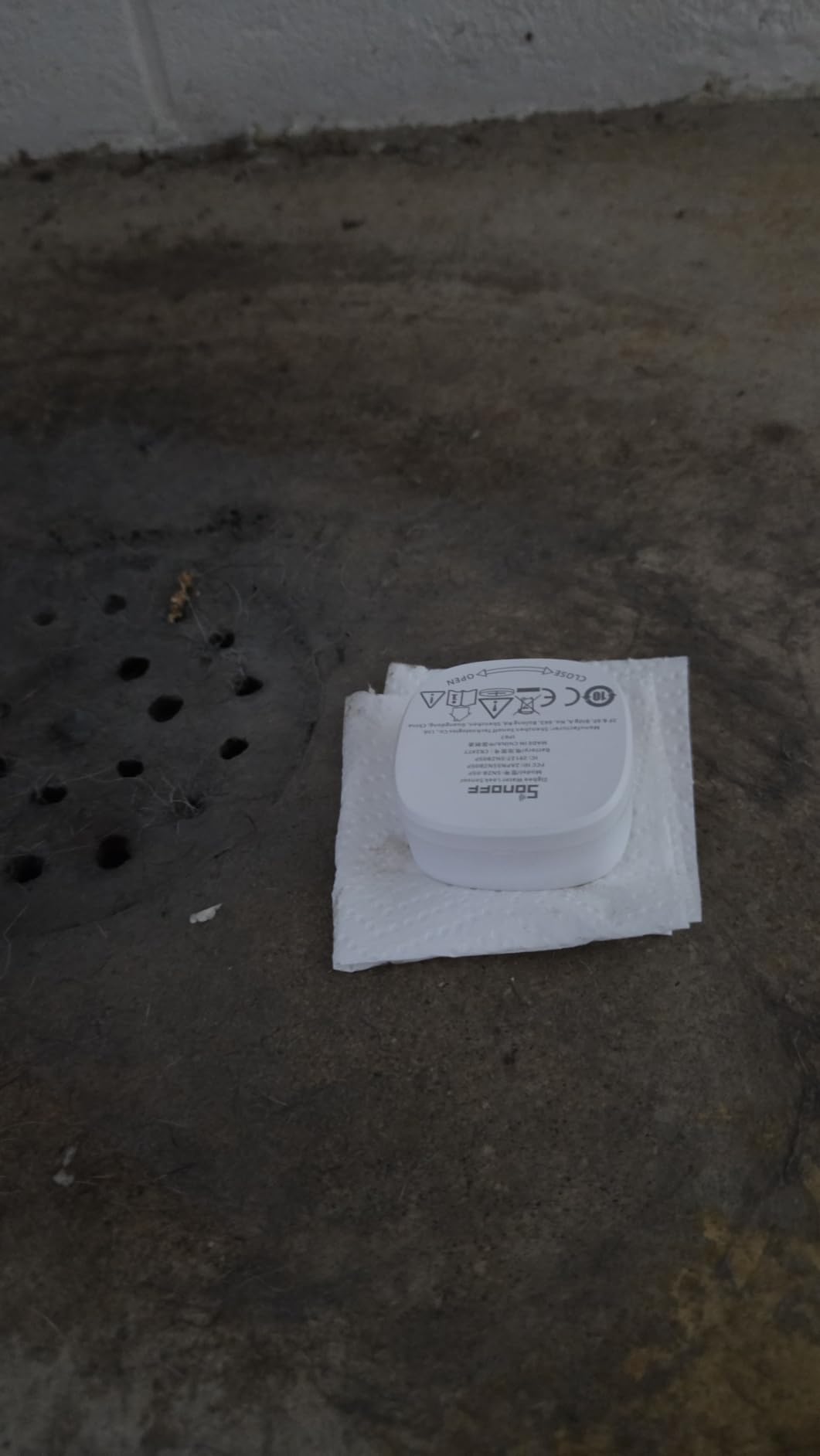
Power comes from a single CR2477 lithium cell with a stated life of up to five years, and the extension-cable support means it can cover a long run rather than a single point — a common request in r/Plumbing threads, where users complain that the default lead on most sensors is around five feet. Reviewers also note it stays compact enough for the tight corner behind a laundry machine where a bulkier puck will not fit.
Its 388 ratings average 4.5 stars. The most common owner note is that it can feel less sensitive than a top-probe puck unless the probes are seated properly, with some people resting the unit on a folded paper towel to spread the contact area. If you are installing four or five of these, plan a quick sensitivity test at each location before you trust the layout.
How to use it with a sump pit float switch
The pairing that works best here is complementary rather than redundant. A float switch tells you the water level is rising and can trigger a pump; a leak sensor on the floor tells you water escaped the pit. Owners in r/basement build exactly this combination, and the ten-minute re-alert on this sensor means a slow overflow does not produce one notification and then silence.
Because the alarm itself lives in your gateway rather than the unit, think about where your gateway is mounted. If it is upstairs, a basement flood still needs something audible down there, so add a smart speaker or a separate siren if nobody sleeps near the stairs.
Where it falls short
There is no onboard sound, so on its own this sensor is silent. It also has no WiFi fallback, which means a dead hub takes out the alerting entirely. And with a smaller review base than the leaders in this roundup, you have less long-term evidence from other owners. It is a strong pick for a specific setup and a weaker choice for someone who wants a device that just works alone.
6. Eve Water Guard: Best for Long Cable Runs and Apple Homes
Eve Water Guard – Smart Home Water Leak Detector, 6.5 ft…
6.5 ft sensing cable to 490 ft,Mains powered,100 dB siren,Thread and Bluetooth
Pros
- The 6.5 ft cable senses along its full length instead of at a single point and extends to 490 ft
- Thread plus Bluetooth with no hub bridge or gateway needed
- 100 dB siren with a red flashing warning light
- Works as a Thread router node to strengthen the mesh
- No Eve cloud and no account so all processing stays local
Cons
- The US plug is bulky and can block the second socket on a standard outlet
- The stiff sensing cable can refuse to lay flat and let water pass underneath
- Needs a nearby outlet that is not switched with a disposal or other appliance
The cable is what makes this unit different, and in a basement it is a real advantage. Instead of detecting at one spot, the Eve Water Guard treats its whole 6.5 ft length as a sensor, so a seep running along a foundation wall or under a run of pipe can be caught anywhere along that line. The cable extends to 490 feet, and multiple runs can be split with 3.5 mm adapters if you want to cover two separate areas from one unit.
It is also the only mains-powered sensor in this group, which removes the single most common failure mode of battery devices. There is no battery to die at the exact moment a pipe lets go, and that is worth a great deal in a space where water damage restoration runs into five figures. It works over Thread and Bluetooth with no hub or bridge, and it can act as a Thread router node that strengthens the network for other devices.
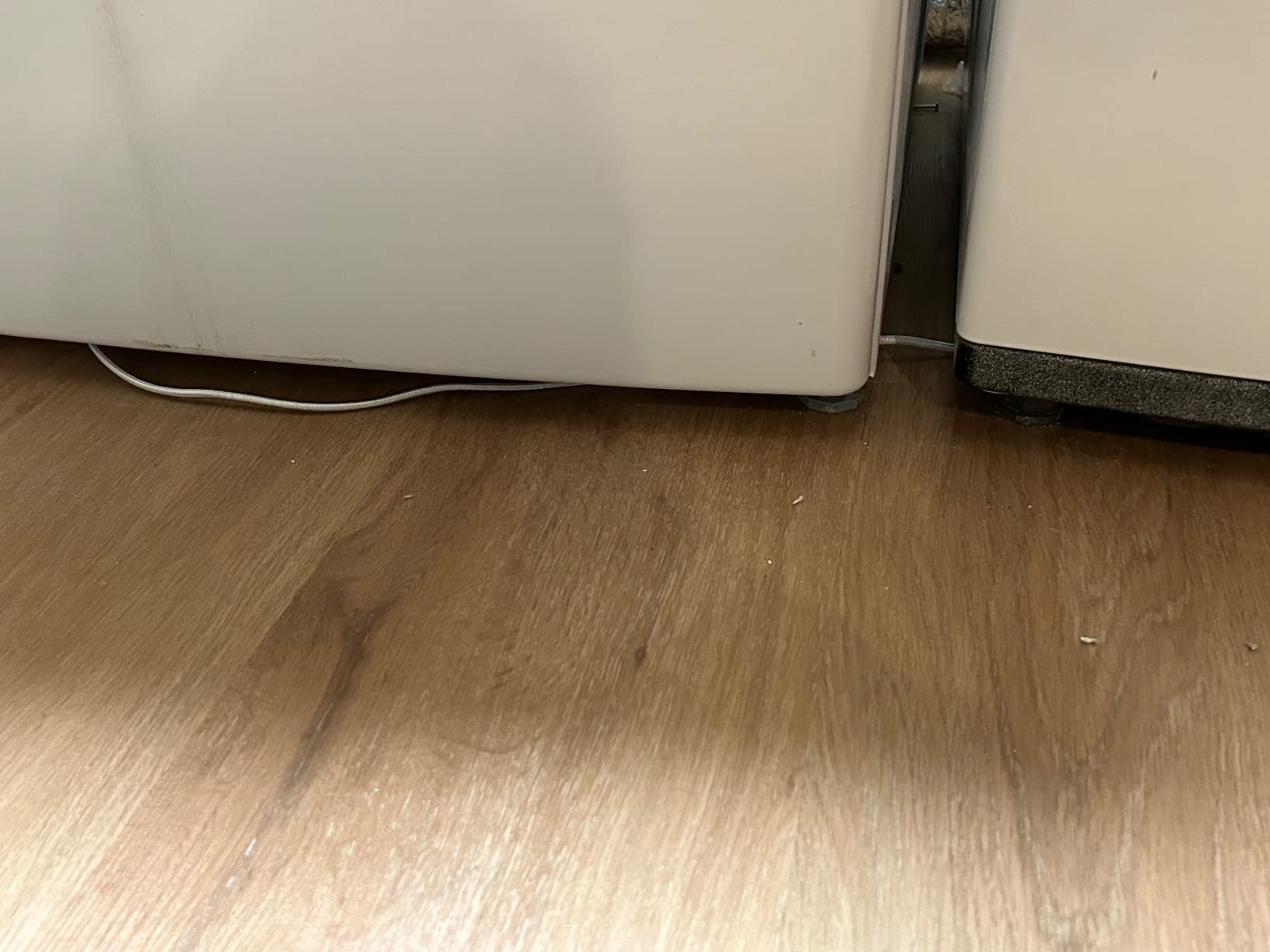
Alerts go out with a 100 dB siren, a red flashing light, and notifications to iPhone, iPad or Apple Watch. The privacy design is the other stand-out: 100 percent local processing, no Eve cloud, no account registration and no tracking. Owners who have lived through a basement flood describe this as the sensor that actually caught the water, and Eve support is repeatedly praised for replacing units that failed after several months.
Its 204 ratings average 4.5 stars, which is a small enough base that we would call the field history thinner than the leaders here. The physical constraint is real: it is corded electric at 120 volts, so you need an outlet near the risk point that is not switched with a disposal, and the US plug body is chunky enough to cover a second socket on a standard outlet.
Where a cable sensor beats a puck
Cable sensors win in three basement situations. Along a foundation wall where seepage tracks horizontally rather than pooling. Along a run of supply pipes where the leak might start at any joint. And along the edge of a finished wall where a leak first wicks down the drywall base instead of forming a puddle. In all three, a point-contact puck can sit three feet from the actual water and never know.
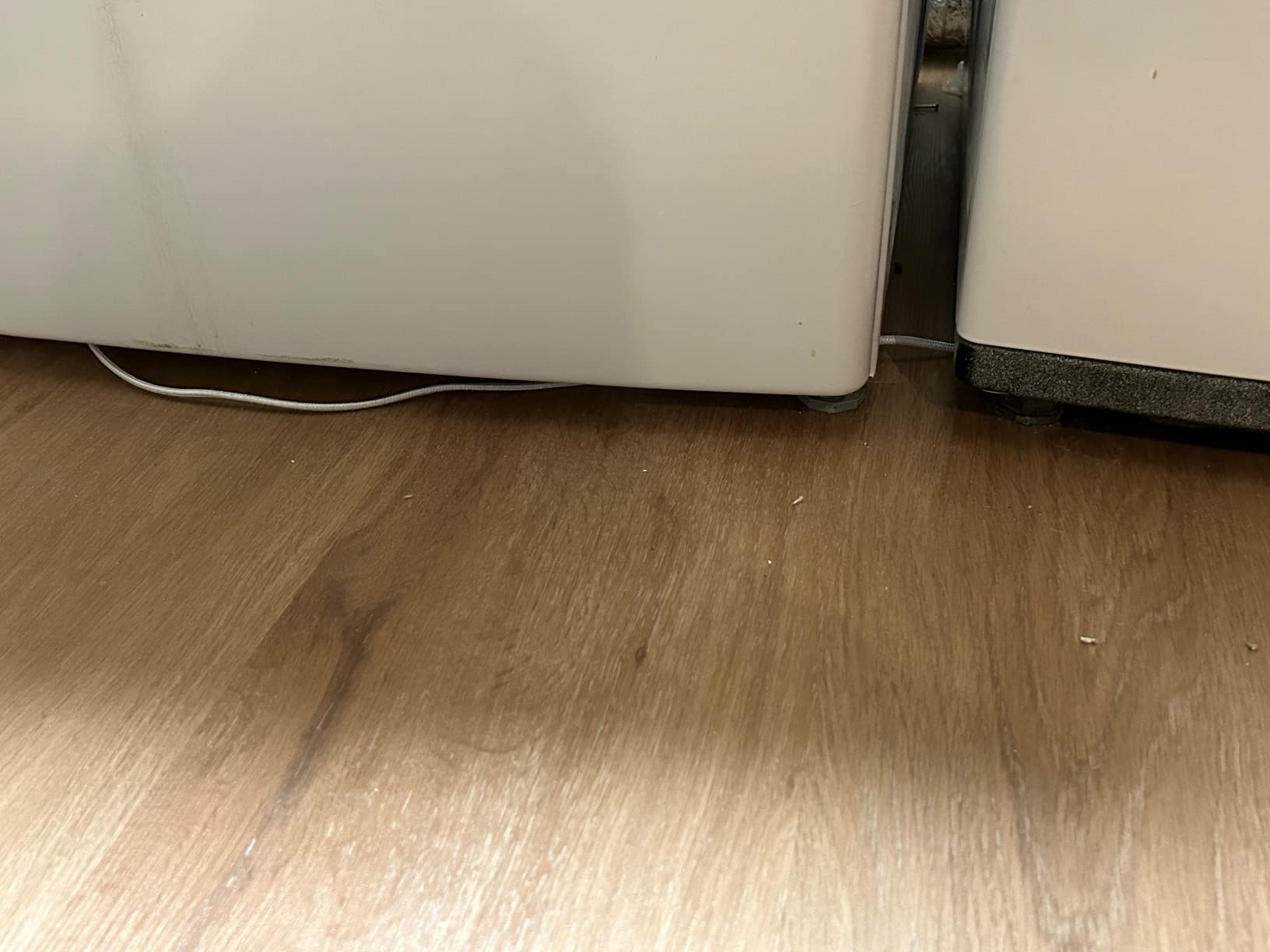
For a finished basement, this is the reason we often recommend a cable unit as the primary sensor with a puck as backup. The tradeoff is installation: the cable needs somewhere to originate, and it must be laid along the surface you want it to sense. Owners report the cable is stiff, and a cable that arches up off the floor can let water run underneath it, so spend the extra minute pressing it flat at each anchor point.
Where it falls short
Apple-only is the hard limit. Setup needs an iPhone or iPad with current iOS, and there is no Android path, which rules it out for a mixed-household setup or an Android-based home assistant install. Add the mains requirement, the bulky plug and the stiff cable, and this is the least flexible sensor in the roundup even though it is arguably the most capable for long runs. A few owners have also reported HomeKit notification delays during testing.
7. Shelly Flood Gen4: Best for Matter and Mixed-Ecosystem Homes
Shelly Flood Gen4, WiFi, Bluetooth, Zigbee, Matter Smart…
WiFi Bluetooth Zigbee and Matter,6.56 ft extendable cable,3 year warranty,IP44 housing
Pros
- The only sensor here supporting WiFi Bluetooth Zigbee and Matter in one unit
- Extendable leak sensor cable covers more area than a point-contact puck
- Works with Alexa SmartThings Google Home and Apple HomeKit
- Economic Alarm Mode conserves battery in unattended seasonal homes
- Three-year manufacturer warranty with professional support
- Marketed for basements garages laundry rooms and holiday homes
Cons
- IP44 is the weakest water resistance in the group so it is not suited to standing water
- Lowest average rating here at 4.2 with about 9 percent one-star feedback
- Smaller review base of 259 leaves less long-term field evidence
- Battery powered so it cannot be relied on during a power outage
Protocol flexibility is the entire argument for this sensor. It is the only unit in the group that speaks WiFi, Bluetooth, Zigbee and Matter, so it can join a new Matter home today and bridge into an existing Zigbee setup tomorrow without a hub decision you will regret. It also includes a 6.56 ft leak sensor cable that can be extended, giving it the wide coverage of a cable sensor while keeping the wireless flexibility of a puck.
For a second home or a vacation property, the Economic Alarm Mode is the feature I would point at. It reduces reporting frequency to conserve battery in a space that sits empty for months at a time, which addresses the exact worry raised in the r/homeautomation thread about monitoring two houses several hours apart. The box includes the unit, the cable and a manual, and it carries a three-year manufacturer warranty with professional support behind it.
How we would deploy it in a seasonal basement
Run the cable along the wall base nearest the failure point, plug the Shelly into mains so the reporting cadence stays high while you are there, and drop into Economic Alarm Mode before you leave. The app supports remote configuration, notifications and scenes, so the mode change does not require physical access. This is the approach we suggest for a cabin or a rental where nobody will hear a 100 dB siren for three months.
Because it supports both Zigbee and Matter, a single model can also serve as a bridge target for sensors you already own, which reduces the number of devices in your basement drawer. The main software requirement is the Shelly Smart Control app, and we would set expectations that the automation work is more hands-on than a consumer sensor from a single-ecosystem brand.
Where it falls short
The IP44 housing is the concern we keep coming back to. It is the weakest water resistance in this roundup, which makes it a poor choice for a sump pit or any spot where standing water is the expected condition. It is a splash and humidity sensor for a dry-ish utility floor, not a wet-pit device. On top of that, it carries the lowest average rating in the group at 4.2 with roughly 9 percent one-star feedback, and the review base is small at 259, so you have less long-term evidence than with the leaders here.
8. YoLink Water Leak Starter Kit: Best for Silent Sensors on a Budget
YoLink Water Leak Sensor 1 Kit: 4-Pack + Hub
Hub plus 4 Leak Sensor 1 units,LoRa to 1320 ft,Email and SMS alerts,5 year AAA battery
Pros
- LoRa radio reaches up to a quarter mile in open air well beyond typical WiFi sensor range
- Hub plus four sensors give plug-and-play whole-basement coverage
- App email and SMS alerts with each sensor nameable by location
- Up to five-year battery life on two AAA cells per sensor
- Control-D2D triggers YoLink sirens or shutoff valves locally during internet outages
Cons
- Leak Sensor 1 units have no built-in siren so audible alerts need a SpeakerHub or separate siren
- Point-contact pucks only detect water pooling at their own location
- The hub is a single point of failure for all remote notifications
- Setup of the account and hub takes some patience
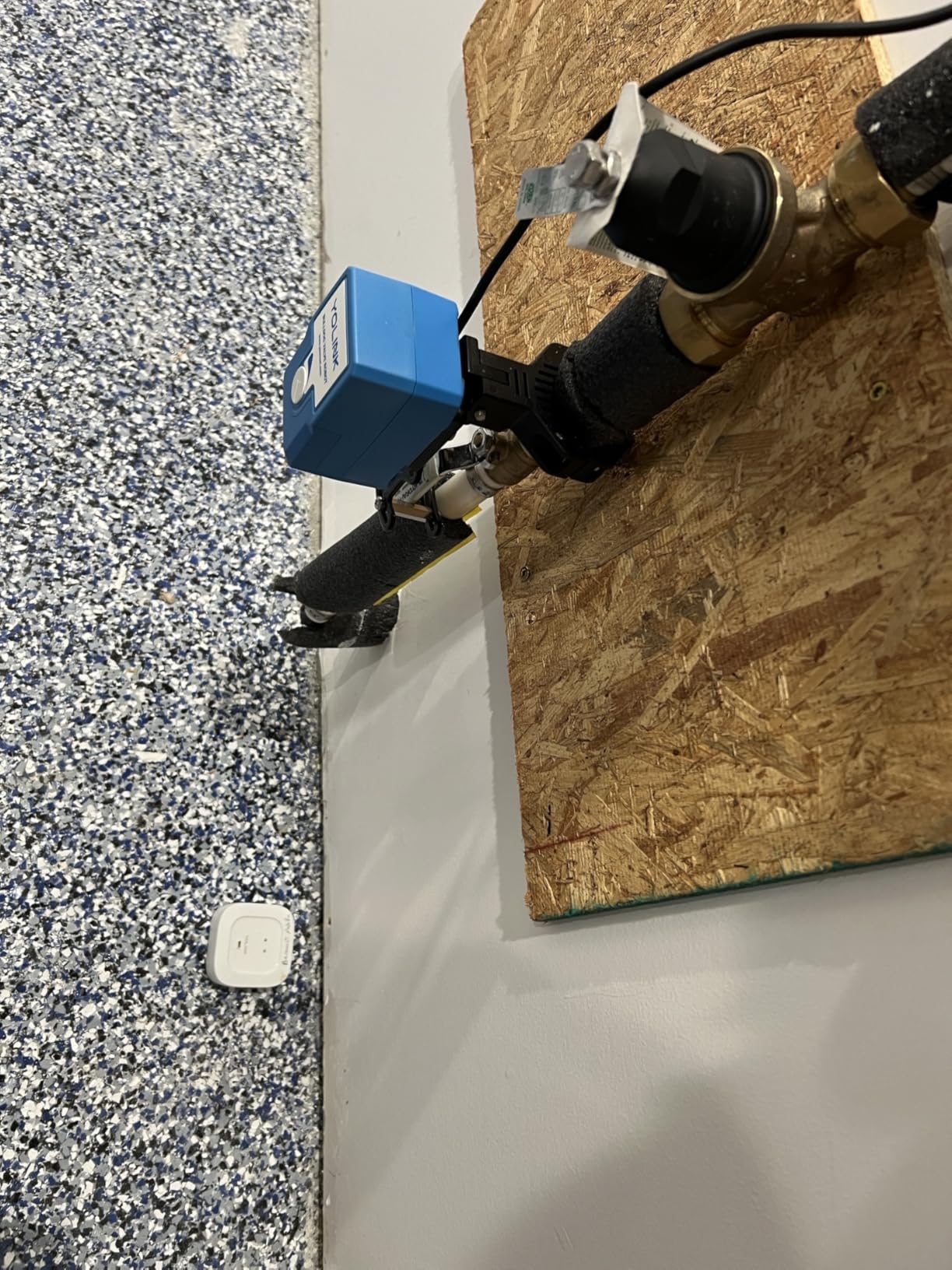
This is the same architecture as our top pick with the sirens removed, and that single difference is why the pricing between the two kits exists. You get a hub and four Leak Sensor 1 pucks, the same LoRa radio and the same Control-D2D behaviour, but detection is silent on site and you add a SpeakerHub or a separate siren only where you actually need audible warning. Stated range is up to 1,320 feet, the widest LoRa figure in this roundup.
With 6,887 ratings averaging 4.6 stars, this is the most heavily reviewed product in the category by a wide margin, and the distribution is unusually healthy at 82 percent five-star against 4 percent one-star. Long-range consistency is what reviewers praise most, along with the app letting you name every sensor by location, which is essential once four of them are scattered across a basement. Battery life is stated at up to five years on two AAA cells per sensor.
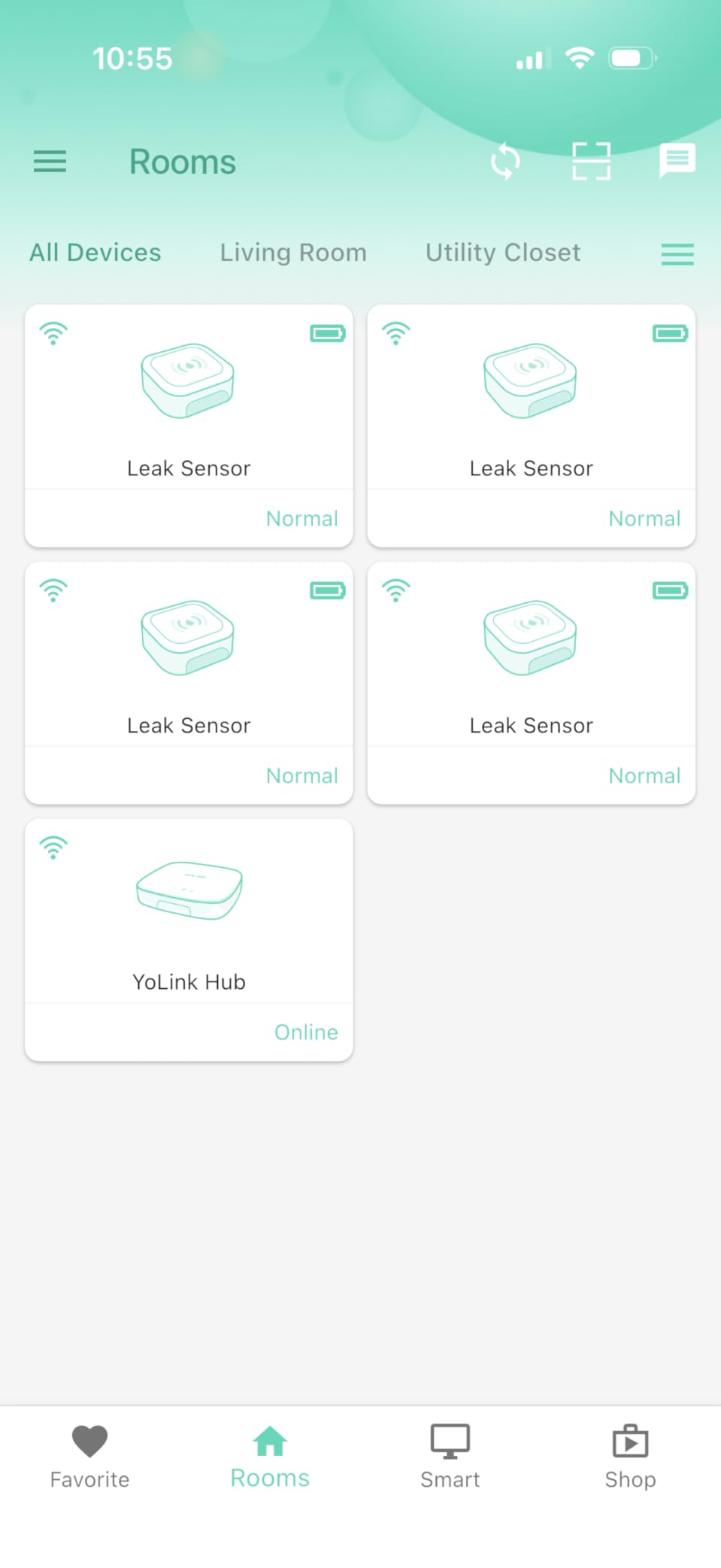
The D2D offline triggers are the sleeper feature. Because sensors can trigger YoLink sirens or shutoff valves locally, detection and response keep working through an internet outage, which matters in a basement where a modem reboot can take a day to sort out. Package contents are one hub and four sensors, five pieces total, and the model is listed as an 8 by 2 by 4 inch hub with 3V power.
Choose this over the Sensor 4 kit if your plan is to put a single loud alarm in a stairwell and rely on phone notifications everywhere else. Choose the Sensor 4 kit if you want each location to announce itself. That is the whole trade, and it is a genuine choice rather than a compromise.
When silent sensors are the right call
Silent sensors win in three situations. When the basement is adjacent to where you sleep and you do not want four independent sirens competing. When you plan to mount a smart speaker or a hub speaker in one high-traffic spot, which is usually the stairwell. And when you are monitoring a second property from the same app and want to cover more floor area per dollar rather than more volume.
They also avoid a failure mode owners of loud kits complain about: repeated 3 a.m. alerts from a sensor that was triggered by a sump pump cycling or by condensation near a vent. With silent sensors, your phone is the alarm, and phone alerts are easier to triage and mute deliberately.
Where it falls short
The hub is mandatory and it is a single point of failure for every remote notification. If the hub loses power or needs a replacement, you need to re-bind sensors, and reviewers mention occasional re-binding after a hub swap. The pucks are also point-contact only, so a spreading sheet of water that never pools directly at a sensor may take longer to register than it would with a cable unit.
Where to Place Leak Sensors in a Basement
Placement matters more than brand. A single well-placed sensor at the lowest point of your basement will catch more real problems than four sensors scattered along walls that never get wet. Work through this list in order.
Priority 1 — cover these first:
Beside the water heater, on the floor at the base of the tank. Tank failure and a weeping relief valve are the most common indoor sources, and the sensor wants to sit where the first drip lands.
At the lowest floor point near the sump discharge, on the side where water would spread. Do not place it inside the pit itself; see the sump pit section below.
Under the washing machine supply lines and the drain hose, at the wall base behind the machine where the connector is.
At the HVAC condensate drain pan or the base of the air handler, ideally at least 12 inches from a supply vent so airflow does not wet the probes.
Along the base of any finished wall that borders grade, where seepage wicks along the drywall base instead of pooling in the middle of the floor.
Priority 2 — add these once the first set is installed:
Under kitchen or bathroom fixtures on the level above, if a leak there can reach the basement ceiling or a shared drain.
Along exterior foundation walls on the side where the yard drains toward the house.
Near a washing machine drain standpipe and any floor drain, since a blocked standpipe shows up as water at the drain first.
In an unfinished storage or utility area where nobody walks, since low-traffic rooms are where nobody notices pooling.
Two placement rules save a lot of false alarms. Keep sensors out of direct airflow from HVAC vents and out of doorways where humid outdoor air enters. And avoid the exact centre of a large open floor, where a puddle may spread thin rather than deep — a sensor near a wall catches a rising film earlier.
How Many Leak Sensors Your Basement Needs
For an unfinished utility zone under about 900 square feet, three sensors cover the four Priority 1 points with one spare, and a single no-hub puck is a reasonable start if you test it through one full season first. A finished basement in that same size range usually warrants four to six, because you now need to cover wall bases where leaks travel along surfaces rather than pooling in the open.
A larger basement over 1,500 square feet with a mechanical room, a laundry area and a bedroom needs six to eight, and at that count a hub-based kit is usually the better economics and the better maintenance story than buying eight independent WiFi devices. The practical ceiling for a Zigbee or Matter setup is usually hub compatibility rather than account limits, which is another argument for that protocol once you are past five sensors.
A note on expectations: none of the eight sensors here reads the water level in a sump pit. If your real worry is the pit overflowing rather than water reaching the floor, you need a float switch or a level sensor as a separate device. Our general leak sensor guide covers the difference between a floor probe, a cable sensor and a flow monitor in more depth.
Can a Leak Sensor Sit Inside a Sump Pit?
Usually not, and putting one in there anyway is the most common basement monitoring mistake. A sump pit fills with water by design, so a probe sensor sitting in the pit will read wet continuously and train you to ignore its alerts. The eight products here range from IP44 to IP67, and even IP67 describes a sealed housing for splash and temporary submersion, not a device designed to sit in a pit indefinitely.
What to do instead. Keep a float switch in the pit to control the pump and to tell you the level is rising. Put your smart leak sensor on the floor immediately adjacent to the pit, at the height where water would spread once the pit overflows, so it fires on escape rather than on containment. If you want actual level data, that is a dedicated liquid level or pressure sensor category, not a contact probe, and r/basement owners building their own monitoring tend to use exactly that distinction.
The pairing that works in practice is a float switch for the pump and a smart sensor for the spill, with a smart plug or speaker that can cut power and announce the alarm. That combination catches both failure modes — a failed pump and a failed discharge line — without alerting you every time the pump runs.
WiFi vs LoRa vs Zigbee vs Thread: Which Protocol Fits Your Basement
The decision rule is short enough to state in one line: LoRa for basements with weak WiFi, Zigbee if you already run a hub, WiFi only if your router is close by, and Thread if you are in an Apple home. Everything else in this section is the reasoning behind that sentence.
WiFi (2.4 GHz): The SwitchBot and the X-Sense kit. Simple, no hub, and the fastest thing to set up. The limitation is signal: a router on the floor above a poured concrete basement is a real risk, and both products state 2.4 GHz only. Works well in basements under about 1,200 square feet with the router nearby.
LoRa / Sub-1G: The two YoLink kits. Stated ranges of 1,000 to 1,320 feet, and the radio is built for exactly the problem of a below-grade room with degraded WiFi. The cost is a mandatory hub, which is a single point of failure you have to mount and power somewhere sensible.
Zigbee: The Aqara 3-pack and the SONOFF. Excellent battery life and strong mesh, but a hub is required in both cases — and with Aqara it must be their own hub, since third-party Zigbee coordinators are not officially supported. Best choice if you already have Home Assistant, SmartThings or an Aqara system running.
Thread and Matter: The Eve Water Guard and the Shelly Flood Gen4. Thread is designed for exactly the low-power, mesh-plus-indoor-basement problem, and the Eve unit needs no hub or bridge at all. The catch is ecosystem lock-in on the other side: the Eve unit is iPhone-only, and Matter support is still maturing in some automation platforms.
On monthly fees: all eight products here alert through their own app without a paid subscription for the core leak notification. The recurring-cost question that comes up most often in forums is about which alert channels get gated — and in this group, the answer is that none are for basic push, email or SMS. The real cost is hardware and, for a mains-powered installation, an electrician.
What a Leak Sensor Cannot Do
A contact-probe sensor detects liquid touching two metal probes. That is a narrow capability, and it means every sensor here has hard limits you should understand before you rely on it.
It cannot stop groundwater seepage through a foundation wall. Water pushing through concrete arrives as a wet patch on the wall or a puddle at the base, and a sensor can report that but cannot prevent it. Groundwater intrusion needs drainage, exterior grading or a pump — detection is not remediation, and no sensor on this list is an answer to a foundation problem.
It cannot see inside a finished wall. A supply line bursting behind drywall on the basement ceiling wets the insulation from the inside, and a floor sensor registers only once enough water has track down the wall to reach the floor. If you have finished basement walls, the mitigation is either a cable sensor run along the wall base or accepting that you will get warning rather than prevention on that failure mode.
It cannot see a pipe freezing inside a wall cavity. Freeze alerts require a temperature sensor in the same room as the pipe, and only the units with temperature monitoring cover that risk. Finally, a sensor cannot tell you the water is rising in a sump pit, which takes a float switch or a level sensor instead. Knowing those four limits up front keeps you from placing a sensor somewhere it can never help.
Glossary of Leak Detector Terms
These eight terms come up in every spec sheet and every forum thread about this topic, and confusing them leads to buying the wrong sensor.
LoRa (Sub-1G). A long-range radio operating below 1 GHz that reaches hundreds to over a thousand feet in open air and tolerates building materials far better than WiFi. It needs a hub, and it trades bandwidth for range and battery life, which is why it suits a sensor that sends a message once and sleeps.
Zigbee and Z-Wave. Low-power mesh protocols used by smart home devices. Both need a hub or coordinator, and both get stronger the more nodes you have, so they suit a house that already has an ecosystem rather than a single isolated sensor.
Thread and Matter. Thread is a low-power mesh standard built on IPv6 that works over Bluetooth radio and needs no hub. Matter is a newer application layer that sits on top of Thread, WiFi or Zigbee and is designed to make devices from different brands work together. A Matter-compatible sensor is one that will not lock you out of the next generation of smart home platforms.
Probe sensor versus cable sensor. A probe sensor detects at the two or more metal contact points on its underside. A cable sensor treats the whole length of a thin cable as a detection surface, so it catches water that runs along a surface rather than water that pools at one spot.
IP44, IP66 and IP67. Water ingress ratings. IP44 is splash protection only. IP66 handles heavy water jets and dust-tight sealing. IP67 allows temporary submersion in water up to one meter. None of these three ratings means a device should be left sitting in a sump pit, because pit water is also chemically and electrically unfriendly.
Float switch. A device with a buoyant float that rises with the water level, used to start a sump pump and to signal that a pit is filling. It measures a level rather than detecting escaped water, which is why it complements a leak sensor instead of replacing one.
Automatic water shutoff valve. A motorized main-line valve that closes the whole house’s supply, either on a command or automatically when a compatible sensor detects water. It stops the volume of damage rather than warning you about it, and it requires installation by a plumber.
Flow monitoring. A different detection method that watches water usage through an in-line meter rather than looking for liquid on a surface. It catches a slow leak inside a wall that never reaches a floor, at the cost of being more expensive and more installation-heavy than a contact probe.
Frequently Asked Questions
Which water leak detector is best for a basement?
The YoLink Water Leak Sensor 4 kit is the strongest all-round choice because LoRa radio reaches reliably below grade, each sensor carries a 105 dB siren, and one hub supports more than 300 devices. The X-Sense SWS54 is the better pick if alarm volume matters most, and the SwitchBot WiFi sensor is the right starting point if you want no hub and one sensor.
Which is better, YoLink or GoveeLife?
The difference is sensors versus coverage. YoLink uses LoRa with a hub, so range is not tied to your WiFi and up to five sensors share one hub, which suits a large basement. GoveeLife is often cheaper per sensor in a multi-pack and also uses LoRa, but the alarm and app experience varies more between models. Check that the model you pick has the alarm output you need.
Will a leak sensor work in a basement with poor WiFi?
A WiFi sensor may not. 2.4 GHz signals degrade sharply through a poured concrete floor, and both the SwitchBot and X-Sense products state 2.4 GHz only. LoRa kits like the two YoLink systems and Zigbee sensors on a mesh hub are built for that weakness, which is why they are the usual answer for a basement router dead zone.
Can a leak sensor shut off my water automatically?
Not on its own. Sensors detect and alert, while an automatic shutoff needs a motorized main-line valve such as an auto-shutoff system installed by a plumber. Several products here can trigger a compatible shutoff valve locally when water is detected, which shortens the delay, but the valve is a separate purchase and a separate installation.
Do leak sensors help with basement flooding from groundwater?
Only partly. A sensor can tell you water is pooling against a foundation wall, but it cannot stop water coming through concrete. Groundwater intrusion needs drainage, grading work or a sump system with a properly sized pump. Treat leak sensors as an early-warning layer and treat foundation water management as a separate project.
How long do leak sensor batteries last, and how do I test them?
Stated battery life ranges from about two years for the SwitchBot unit to up to five years for the two YoLink kits and the SONOFF sensor, and the mains-powered Eve Water Guard has no battery at all. Test each sensor monthly by wetting the probes with a damp paper towel, confirming the alert arrives, then drying the probes fully and clearing it.
Final Recommendation for Your Basement
If you want one decision instead of a shopping list, start with the YoLink Water Leak Sensor 4 kit. It solves the two things that trip up basement owners most often — dead WiFi below grade and silence in a room nobody is standing in — and one hub carries every sensor you will add over the next five years. Place the first three at the water heater, beside the sump discharge and behind the washing machine, then add wall-base coverage along any finished perimeter.
If you already own an Aqara, SmartThings or Home Assistant setup, change the answer: the Aqara 3-pack or the SONOFF will drop into what you have and cost you nothing in ecosystem overhead. If you are in an Apple home, the Eve Water Guard gives you a mains-powered cable sensor that needs no hub and no battery, which is the configuration we trust most in a finished space where water travels along walls. If budget is the constraint, the SwitchBot is a legitimate single-sensor start with no monthly fee attached to the alerts.
Whichever you pick, add a sump float switch, test every sensor with a damp paper towel once a month, and set the reminder now. Basement water damage is measured in five figures and hours, not dollars and cents — which is why the best smart water leak detectors for basements are the ones you will actually keep tested and actually hear. This roundup was last checked in 2026; re-verify specifications before you buy.
