
10 Best Tripods for Videographers (August 2026) Reviewed
The best tripods for videographers do more than hold a camera still: they make a slow pan feel deliberate, keep a horizon level, and carry the camera rig without a worrying flex. For this guide, we compared 10 fluid-head systems using the published payload, height, weight, quick-release, spreader, bowl, and damping details that affect real shooting.
A photo tripod with a ball head is fine for a locked-off still, but video asks the head to move at a controlled, repeatable pace. A fluid head adds resistance through the pan-and-tilt movement, which is why it is the first feature I check for interviews, ceremonies, documentary B-roll, and product videos.
Contents
Each pick below has a fluid head, but they are not interchangeable. A compact setup with a phone or small mirrorless camera has very different needs from a loaded camera, monitor, microphone, and long lens; payload margin, leg design, and the plate system matter just as much as maximum height.
Top 3 picks for Best Tripods for Videographers (August 2026)
These three give the clearest choices for a stable all-round system, a tall and accessible video support, and a head with advanced balancing controls. The cards below summarize the verified strengths, while the full reviews explain the trade-offs.

As an Amazon Associate we earn from qualifying purchases.
Best Tripods for Videographers in 2026
The comparison concentrates on published, shoot-relevant facts rather than broad claims. Payload is a ceiling, not a target, so leave room for accessories and front-heavy lenses when matching a camera kit to any video tripod.
| Product | Features | |
|---|---|---|
| NEEWER TP74 |
|
Check Latest Price |
 K&F CONCEPT VA3+BV70 K&F CONCEPT VA3+BV70 |
|
Check Latest Price |
 SmallRig AD-100 FreeBlazer SmallRig AD-100 FreeBlazer |
|
Check Latest Price |
 K&F CONCEPT KF09.172 K&F CONCEPT KF09.172 |
|
Check Latest Price |
 NEEWER LL37 NEEWER LL37 |
|
Check Latest Price |
 Victiv VTH7 Victiv VTH7 |
|
Check Latest Price |
 SmallRig FreeSpeed 5443 SmallRig FreeSpeed 5443 |
|
Check Latest Price |
 CAMBOFOTO SM294+TA46 CAMBOFOTO SM294+TA46 |
|
Check Latest Price |
 Sirui AVT-12 Sirui AVT-12 |
|
Check Latest Price |
 Sirui SQ75+VHS10 Sirui SQ75+VHS10 |
|
Check Latest Price |
We earn from qualifying purchases.
1. NEEWER TP74 is the strongest all-round choice for stable video work
NEEWER 74" Video Tripod with Fluid Head, QR Plate , Aluminum...
74 inch height
17.6 lb payload
Fluid drag pan head
Pros
- 17.6 lb payload
- Smooth 360 degree pan
- DJI and Manfrotto plate support
- 74 inch height
Cons
- Aluminum is heavier
- Mid-level spreader adds setup
The TP74 earns the all-round spot because its specifications line up with the normal demands of a mirrorless or DSLR video kit. Its 17.6-pound payload, double-tandem aluminum legs, and mid-level spreader point to a support made for a camera that stays mounted for a full interview or ceremony.
The published fluid-drag head pans through 360 degrees and tilts from negative 75 to positive 90 degrees. That range gives a videographer room to follow a subject moving down a hallway, tilt from a product to a presenter, or set a conventional locked-off frame without fighting a ball head.
I also like the stated quick-release compatibility with DJI RS2, RS3, and RS3 Pro gimbals plus Manfrotto 501PL and 504PL plates. Plate compatibility is not a minor detail: forum users repeatedly flag mismatched release systems as an avoidable delay when a camera must move from gimbal to tripod.
At 35 to 74 inches high and with three leg sections, this is a practical working-height design rather than a tiny travel stand. The trade-off is carry weight from aluminum construction, and the spreader takes a little more attention than simply dropping three legs on the floor.
The NEEWER TP74 suits interviews, events, and mirrorless video rigs
Choose this one for a camera-and-lens package that needs a settled base, especially for corporate interviews, wedding ceremonies, or studio content. The stated 17.6-pound limit leaves usable headroom for a camera cage, wireless receiver, and small monitor when the entire build is weighed first.
It is also a sound fit for a shooter who already uses DJI RS-series gear or Manfrotto-style video plates. Keeping one plate family across support tools reduces changes during a tight shooting day.
The NEEWER TP74 is less suited to minimal carry-on travel
The 36-inch folded size and aluminum build make this a better vehicle-to-location tripod than a pack-all-day choice. A creator hiking with a light camera will feel the difference compared with the lighter travel options here.
Use the mid-level spreader deliberately on uneven floors and check each flip lock before rolling. That small routine answers a common forum complaint about slipping leg locks and makes long-lens footage more dependable.
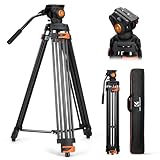
2. K&F CONCEPT VA3+BV70 is the tall value-focused tripod for standing shots
K&F CONCEPT 80" Video Tripod with Fluid Head, Aluminum Heavy...
79.5 inch height
17.6 lb payload
Fluid head with fast lock
Pros
- Very tall working height
- 17.6 lb capacity
- One-second camera installation
- Triangle spreader
Cons
- Shorter pan handle
- Not for heavier cinema rigs
The VA3+BV70 offers a 79.5-inch maximum height, the tallest published figure in this group. That extra reach is useful when a videographer needs to shoot over a seated crowd, frame a standing instructor at eye level, or look slightly down on a demonstration table without extending a center column to an uneasy position.
Its aluminum legs and triangle mid spreader pair with a 17.6-pound stated payload. That makes this a reasonable professional video tripod for DSLR and mirrorless bodies, while the manufacturer’s own compatibility notes include cameras such as the Sony FX3 and Canon C200.
The fluid head supplies 360-degree panning and negative 70 to positive 90 degrees of tilt. Its fast-installation feature is especially useful between takes, though the review feedback notes that some users would prefer a longer handle for finer movement control.
Three-section legs and a 36.2-inch folded length favor stability and working height over compact packing. I would treat it as a dependable location tripod for indoor shoots, school programs, and event coverage rather than a travel-first support.
The K&F CONCEPT VA3+BV70 works best when extra height matters
This is the straightforward choice for tall operators, elevated angles, and presenter-led video. Set the legs wide before raising the head, then level the camera before beginning a pan; height without a stable footprint does not improve footage.
Its 17.6-pound rated capacity suits many built-out mirrorless packages. Keep a safety margin if you add a large cine lens, teleprompter, battery plate, or a heavy external monitor.
The K&F CONCEPT VA3+BV70 is not the pick for cinema-rig expansion
The manufacturer says it may not suit heavier professional cinema cameras, and that limitation should guide the purchase. Do not select it on maximum height alone if the intended rig is near its stated payload.
For follow moves, the shorter handle is the detail to think about. A longer handle can give more delicate control at slow pan speeds, so operators who make many deliberate moves may prefer a model with adjustable damping.
3. SmallRig AD-100 FreeBlazer is the carbon-fiber choice for gimbal workflows
SmallRig AD-100 FreeBlazer Heavy-Duty Carbon Fiber Tripod...
Carbon fiber
22 lb payload
One-step locks
Pros
- 22 lb capacity
- Carbon fiber legs
- Adjustable damping
- DJI-ready dual QR plate
Cons
- Dual plate takes practice
- Long 41 inch folded size
The SmallRig AD-100 FreeBlazer combines carbon-fiber legs with a stated 22-pound payload, a useful pairing for videographers who want less mass in the support but still need capacity for a properly accessorized camera. It reaches 78 inches and weighs 11 pounds according to the listing.
Its one-step locking design is the headline workflow feature. On a documentary day, reducing the number of individual leg-lock actions can help when moving between a quick stand-up interview and an exterior B-roll position.
The video head has adjustable damping, 360-degree pan, and positive 90 to negative 60 degrees of tilt. This does not replace the more detailed counterbalance controls on the Sirui SQ75, but it gives a shooter a way to tune movement resistance to a lighter or heavier camera.
SmallRig also specifies a dual-mode plate compatible with DJI RS 2, RS 3, and RS 4 systems. That is a welcome option for hybrid teams that move a camera from stabilized walking footage to a static angle, although every operator should rehearse the release procedure before a paid shoot.
The SmallRig AD-100 FreeBlazer fits gimbal users with medium-weight camera builds
Pick this model if fast deployment and a gimbal-friendly plate system sit high on the checklist. A Sony, Canon, or Blackmagic-style mirrorless build with cage, lens, and audio accessories is the kind of kit that can benefit from its 22-pound stated limit.
Carbon fiber is helpful when the tripod is carried between locations, but it is not a license to skip proper setup. Fully seat the feet, level the head, and apply only the amount of drag needed for the shot.
The SmallRig AD-100 FreeBlazer asks for plate-system familiarity
The dual-mode release is more involved than a basic plate, according to the product feedback. If several people will operate the tripod, agree on a mounting sequence and verify the camera is locked before letting go.
At 41 inches folded, it is not the smallest option for airline or backpack use. The design suits vehicle-based production days better than a creator who needs a compact travel video tripod.
4. K&F CONCEPT KF09.172 is the lightweight choice for compact cameras and travel
K&F CONCEPT 73” Camera Tripod with Fluid Head, Aluminum...
2.9 lb weight
73 inch height
6.6 lb payload
Pros
- Very light
- 20 inch folded size
- Phone holder included
- Smooth fluid head
Cons
- 6.6 lb payload
- Five-section legs flex more
The K&F CONCEPT KF09.172 weighs 2.9 pounds, folds to 20 inches, and reaches 73 inches. Those numbers make it the logical travel pick among these videography tripods when a camera kit is light and baggage space is limited.
Its fluid head provides 360-degree panoramic rotation and positive 90 to negative 85 degrees of tilt. A phone and tablet holder plus a cold-shoe mount widen its use for vertical social clips, livestreaming, a compact mirrorless camera, or a simple two-device setup.
The important boundary is the 6.6-pound load limit. This is not a heavy-duty camera tripod for a large lens, a caged camera, a monitor, and audio hardware; keeping below its rated capacity is especially wise because the legs use a five-section design.
Five sections create the compact folded length, but each extension can introduce more vibration than a three-section system. I would extend the thickest leg sections first and avoid raising the center column when shooting at long focal lengths.
The K&F CONCEPT KF09.172 is best for travel vlogs and lightweight livestreaming
Choose it for a phone, action camera, compact camcorder, or a small mirrorless camera with a short lens. It can cover a hotel-room presentation, a travel diary, or a quick creator setup without asking you to carry a large case.
For the smoothest move, start and stop the pan gently rather than forcing the handle. The fluid head helps, but technique still determines whether the final motion looks natural.
The K&F CONCEPT KF09.172 is not for top-heavy video rigs
Do not use its travel convenience to justify mounting a camera package near or beyond 6.6 pounds. A front-heavy lens can make a modest rig feel less controlled during tilt, even when the bare camera seems light enough.
This is also the model where wind deserves extra attention. Keep the legs low and wide outdoors, and move to a stronger tripod if the shot requires a long lens or repeated camera moves.
5. NEEWER LL37 is the high-capacity rapid-setup option for video crews
NEEWER 78" Video Camera Tripod Carbon Fiber with Damping...
78 inch height
22 lb payload
Adjustable-damping head
Pros
- 22 lb capacity
- One-step height lock
- DJI dual QR modes
- 360 degree fluid pan
Cons
- Newer with fewer reviews
- Spreader adds steps
The NEEWER LL37 is built around a stated 22-pound capacity, a 37-to-78-inch height range, and one-step quick locking. Those specifications make it a serious option for videographers who need a larger safety margin than entry-level tripods offer.
Its fluid head has adjustable damping, 360-degree panning, and positive 90 to negative 75 degrees of tilt. The ability to adjust damping matters when switching from a stripped-down mirrorless body to a camera with a longer lens, because the same drag setting will not feel right on both.
NEEWER lists dual quick-release modes compatible with DJI RS4, RS4 Pro, RS2, RS3, and RS3 Pro gimbals. Multiple accessory threads also make it easier to place a monitor arm or other light accessory without improvising a mounting point on the camera.
The listing calls out carbon fiber in its feature set, while its product-detail material field reads aluminum; that inconsistency means I would verify the exact purchased variant before making a material-based decision. The published 38-inch folded length also makes clear that this is not a tiny travel system.
The NEEWER LL37 suits heavier mirrorless builds and fast location changes
Its 22-pound stated capacity gives it room for a camera, lens, cage, microphone, and monitor that would overmatch a lightweight tripod. It makes sense for commercial shoots, interviews, and event video where a crew changes setup height often.
Use the one-step locks as a speed benefit, not a reason to rush the final check. Confirm all legs are seated, the spreader is stable, and the plate latch is fully engaged before rolling.
The NEEWER LL37 is not the most proven choice by review volume
This model has a smaller review sample than several other picks in the guide. That does not invalidate its specifications, but it is sensible to inspect the return policy and check the supplied plate and head action upon arrival.
Its mid-level spreader can make the support steadier, yet it adds another piece to position. Shooters working in cramped rooms should think about the footprint before selecting it.
6. Victiv VTH7 is the flexible tripod for video and occasional monopod use
Victiv Camera Tripod, 72" Video Tripod with Fluid Head...
72 inch height
20 lb payload
Tripod to monopod conversion
Pros
- 20 lb capacity
- Monopod conversion
- Hydraulic head damping
- Carry bag included
Cons
- Not for very heavy rigs
- No weather resistance rating
The Victiv VTH7 stands out because it converts from tripod to monopod by combining the center column with a detachable leg. That flexibility is meaningful for wedding videography and event coverage, where a locked-off ceremony angle can turn into a moving reception angle in minutes.
Its 72-inch maximum height and 20-pound stated payload cover a broad range of DSLR, camcorder, and mirrorless setups. The hydraulic-damping fluid head offers 360-degree panning and positive 90 to negative 70 degrees of tilt, giving it the movement range expected from a video support.
The quick-release plate includes standard quarter-inch and three-eighths-inch screws, while a weight hook allows a bag to be hung for added stability. The carry bag is a useful practical inclusion for a shooter who transports support gear between venues.
Review data shows a 4.4 rating across 923 reviews, the largest review count in this group. The recurring positive points are smooth head movement and the monopod feature, while the 20-pound stated ceiling remains the main limitation for very heavy professional equipment.
The Victiv VTH7 works well for wedding and event video coverage
Pick this model if one support needs to handle static shots and a mobile monopod role. That combination can save space in a kit for a solo operator moving from ceremony to speeches.
The best use is a moderate-weight camera package. Before converting it, remove or secure accessories that could catch while the rig is carried through a crowd.
The Victiv VTH7 is less suitable for oversized cinema packages
A 20-pound rating is substantial for common cameras, but professional accessories accumulate quickly. Add up the actual body, lens, cage, monitor, batteries, receiver, and any teleprompter before relying on the stated maximum.
The listing gives no water-resistance rating. Dry and wipe the leg locks and head after damp outdoor work, since grit or moisture can make any pan-and-tilt mechanism feel rough over time.
7. SmallRig FreeSpeed 5443 is the 75 mm bowl pick for rapid leveling
SmallRig FreeSpeed Heavy Duty Carbon Fiber Video Tripod...
75 mm bowl
22 lb payload
7.5 lb weight
Pros
- 75 mm bowl base
- One-knob deployment
- 22 lb capacity
- Manfrotto plate support
Cons
- 22 lb limit for larger cinema rigs
- 35 inch folded length
The SmallRig FreeSpeed 5443 brings a 75 mm bowl base into a relatively light 7.5-pound package. A bowl lets you level the head by loosening the bowl handle and making one quick correction, rather than repeatedly changing the length of individual legs on a slightly uneven surface.
It reaches 73 inches, folds to 35 inches, and has a stated 22-pound capacity. Its carbon-fiber construction and one-knob leg deployment aim at the shooter who wants less carrying weight and less time spent opening separate locks.
The fluid head includes damping adjustment, 360-degree panning, and positive 90 to negative 70 degrees of tilt. The plate system works with Manfrotto quick-release plates, which can be a practical advantage for a camera team already using that standard.
Swivel feet with an anti-detachment design are another useful field feature. On uneven ground, they can help each leg find contact, though no tripod is immune to vibration if the feet are placed on a loose surface or the center column is pushed too high.
The SmallRig FreeSpeed 5443 is best when rapid leveling is part of the workflow
Documentary shooters, small crews, and operators filming outdoors can benefit from the 75 mm bowl. It is especially helpful when the tripod must move repeatedly between pavement, grass, and interior floors while maintaining a level horizon.
The 22-pound stated limit fits many mirrorless and compact cinema packages. It is a sensible middle ground between lightweight travel gear and a much larger studio support.
The SmallRig FreeSpeed 5443 is not a substitute for a larger cinema system
Although the published capacity is 22 pounds, heavier cinema builds can need more support and more advanced counterbalance. Forum advice about using at least a 75 mm bowl for heavy rigs is useful, but bowl size alone does not determine safe payload.
Measure the assembled kit and think about the forward weight of the lens. If the head must be locked to stop the camera from dipping, move to a system with dedicated counterbalance controls.
8. CAMBOFOTO SM294+TA46 is the compact fluid-head option for light travel kits
CAMBOFOTO 68" Fluid-Head-Camera-Tripod, Professional Travel...
2.88 lb weight
68 inch height
8.8 lb payload
Pros
- 2.88 lb carry weight
- Dual bubble levels
- Reversible center column
- Phone holder included
Cons
- 8.8 lb capacity
- Best with compact cameras
The CAMBOFOTO SM294+TA46 weighs 2.88 pounds and reaches 68 inches, making it a practical travel video tripod for a modest camera kit. It supports up to 8.8 pounds according to its listing, so its strengths are portability and simple video work rather than oversized rigs.
Its hydraulic-damping fluid head pans through 360 degrees and tilts from negative 55 to positive 90 degrees. Dual bubble levels give the operator a quick visual reference for leveling, a welcome feature when setting a shot on an uneven sidewalk or a small indoor table.
The reversible center column expands its low-angle possibilities, and the box includes a phone holder, Arca-style quarter-inch quick-release plate, and travel bag. That collection makes it friendly for a creator mixing smartphone clips with compact-camera footage.
Its reported packed dimensions describe a compact form, while the detailed listing gives a 21.25-inch folded height. Either way, verify the exact packed dimensions of the selected configuration if carry-on fit is a deciding factor.
The CAMBOFOTO SM294+TA46 suits phone video and compact mirrorless setups
Choose it for travel videos, tabletop demonstrations, low-angle product footage, and a lightweight camera with a short lens. The dual levels and fluid head provide more control than a basic phone stand.
Its reversible column also gives a route to creative low shots. Keep the camera light and use the self-timer or remote start so pressing record does not shake the setup.
The CAMBOFOTO SM294+TA46 is not meant for long lenses or large rigs
The 8.8-pound stated payload sets a firm boundary. A compact camera may fit easily, but adding a long telephoto lens or external monitor can change both total weight and the balance point.
For telephoto video, leg stiffness and wind resistance become more important than a small packed size. Move to a heavier three-section support if the shot needs sustained reach or repeated panning.
9. Sirui AVT-12 is the lightweight high-payload support for serious camera kits
SIRUI Quick Release Carbon Fiber Video Tripod, 73" Heavy...
33 lb payload
7.3 lb carbon fiber
One-step plate lock
Pros
- 33 lb payload
- Light 7.3 lb build
- Six-year warranty
- DJI-compatible QR
Cons
- Limited review volume
- No rush-delivery eligibility
The Sirui AVT-12 has the highest stated payload in the roundup at 33 pounds while weighing 7.3 pounds. That capacity-to-weight ratio is the core reason to consider it for a camera package that is too demanding for a small travel tripod but still needs to move between locations.
Its carbon-fiber legs use flip locks, and the tripod reaches 73 inches with a 35.4-inch folded length. The listed one-step plate locking system helps speed camera changes, while dual-mode quick release compatibility covers several DJI RS-series gimbal models.
The fluid head pans 360 degrees and tilts from negative 60 to positive 90 degrees. A published six-year manufacturer warranty is also notable for a support tool that will see repeated lock, transport, and setup cycles.
The 39-review sample is smaller than many products in this guide, so I would place more weight on the verified specifications and warranty than on broad user-volume conclusions. The published payload is impressive, but smooth movement still depends on balancing the actual rig on the head.
The Sirui AVT-12 is best for high-payload kits that still need portability
This is the model to examine for a larger mirrorless or camcorder setup with accessories, particularly when carrying a 13-pound support would be a burden. Its 33-pound stated ceiling gives more room than the 22-pound systems listed above.
It can also make sense for a creator building toward more demanding work. Buying enough payload headroom now can prevent a quick upgrade when a monitor, heavier lens, or audio kit enters the workflow.
The Sirui AVT-12 needs a careful first setup check
The limited review count means hands-on inspection matters. Work the flip locks, test the plate latch with the intended camera, and check the head action at both slow and medium pan speeds during the return period.
Do not confuse payload with counterbalance. A head can hold a camera safely but still need more drag or a different balance point for hands-free tilts, so test the full rig before an important shoot.
10. Sirui SQ75+VHS10 is the advanced-control choice for deliberate camera movement
SIRUI SQ75+VHS10 Carbon Fiber Tripod, 71.7” Video Tripod...
7-step counterbalance
4-step pan tilt drag
75 mm half-ball
Pros
- Seven-step counterbalance
- Four-step drag control
- 75 mm half-ball
- Side-loading plate
Cons
- Heavier 13 lb system
- Smaller payload than AVT-12
The Sirui SQ75+VHS10 is the most control-focused system in the list. Its professional fluid head provides a seven-step counterbalance system and four-step adjustments for both pan and tilt damping, features that matter when you want a camera movement to start, travel, and stop with a consistent feel.
The listing specifies a 75 mm half-ball, side-loading quick-release plate, ground spreader, and dual adjustable handles. This is a genuine video-oriented arrangement: the bowl speeds leveling, the spreader establishes the stance, and the side-loading plate helps with mounting a camera where space is tight.
It reaches 71.7 inches, weighs 13 pounds, and has a published tripod weight limit of 39.7 pounds. The head’s counterbalance specification is stated for a 0-to-10-kilogram range, so check that detail against the fully built camera rather than treating the leg rating as the head’s balancing range.
The larger weight and ground spreader make this more of a planned-shoot tripod than a casual grab-and-go support. For corporate video, interviews, studio production, or narrative work, that extra setup is often a fair exchange for controlled movement.
The Sirui SQ75+VHS10 is best for controlled pans, tilts, and balanced camera rigs
Choose this system when drag and counterbalance adjustment are more important than minimal carrying weight. Its separate settings let an operator tailor the head to a camera’s mass and the speed of the planned move.
Counterbalance means the head helps offset the camera’s tendency to tip forward or backward. When adjusted correctly, the camera remains near its chosen tilt without needing a locked tilt mechanism, which makes reframing calmer and smoother.
The Sirui SQ75+VHS10 is less suited to all-day walking shoots
At 13 pounds, this is not the model I would choose for a long hike or a one-bag flight setup. Its ground spreader also needs more open floor area than a compact travel tripod.
It is best for a crew or a solo operator who can dedicate time to placement. Keep the spreader clean and free of sand, then store the head with its locks lightly secured rather than overtightened.
A good video tripod starts with a fluid head, safe payload, and stable legs
Start with three checks: the head must give controlled pan-and-tilt movement, the stated payload must exceed the complete rig, and the legs must match the way you travel. That simple filter removes many photo-first supports that look capable but make video pans sticky or unstable.
Forum discussions from videographers repeatedly make the same point: a ball head is quick for stills but does not provide the predictable horizontal move needed for video. They also warn that cheap legs can vibrate at telephoto focal lengths, which is why a compact tripod should not be pressed into work beyond its rating.
A fluid head is better than a ball head for smooth video movement
A fluid head uses damping to resist pan and tilt in a controlled direction. The result is a smoother move than a ball head, which releases in many directions at once and is designed to be repositioned rather than slowly tracked.
For an interview, lock both axes after framing. For B-roll, adjust the drag, practice the full motion before recording, then use a gentle push on the pan handle rather than a sharp wrist movement.
A payload rating should exceed the weight of the fully assembled rig
Weigh the camera body, lens, cage, battery, monitor, microphone, receiver, and plate together. Select a tripod whose published limit sits clearly above that total, then confirm the head can balance the front-to-back shape of the rig as well as carry its mass.
A short camera with a large lens may be front-heavy even at a modest total weight. That is where counterbalance and adjustable drag become more useful than a simple maximum-capacity number.
A 75 mm bowl speeds level setup on uneven ground
A bowl mount lets you level the head independently of the legs. For a 75 mm system such as the SmallRig FreeSpeed 5443 or Sirui SQ75+VHS10, you set a stable leg stance first, loosen the bowl, level the head, and tighten it.
Small lightweight rigs often work well without a bowl. A 75 mm bowl becomes more compelling when the camera is heavier, the ground is uneven, or a crew must reset level framing repeatedly during documentary or event work.
Carbon fiber favors carrying comfort while aluminum favors a lower-complexity build
Carbon fiber can reduce carry weight and is appealing for location shoots, as shown by the SmallRig and Sirui options here. Aluminum is common in stable systems such as the NEEWER TP74 and K&F VA3+BV70, and it can be a sensible choice when the tripod moves short distances from a vehicle.
Material alone does not decide the purchase. Compare folded length, leg sections, locks, payload, head controls, and the surface where you will work; a stiffer three-section aluminum system can be more suitable than a very compact multi-section travel model for a long-lens shot.
Camera style should determine the tripod category before brand does
For YouTube content and interviews, favor a stable fluid head, practical working height, and a plate system you already use. For wedding work, fast locks and a monopod conversion such as the Victiv VTH7 can be more helpful than a large ground spreader.
For documentary filmmaking, a 75 mm bowl and one-step legs shorten resets on irregular ground. For travel and smartphone footage, keep the camera light and select the K&F KF09.172 or CAMBOFOTO within their published payload limits.
Tripod care preserves smooth movement and dependable locks
After a dusty or wet job, wipe the legs, feet, and spreader before packing. Check that leg locks close firmly, remove grit from the plate area, and keep the head away from loose sand that can make a fluid movement feel rough.
Do not force stiff locks or overtighten pan-and-tilt controls. A quick pre-shoot check of the plate latch, the leg locks, and the level takes less time than recovering a ruined take.
Frequently asked questions give direct video-tripod answers
What makes a good video tripod?
A good video tripod combines a fluid head for controlled pan and tilt movement, a payload rating above the fully assembled camera rig, stiff legs, reliable locks, and a quick-release plate that works with the rest of the camera support system. For uneven locations or frequent resets, a 75 mm bowl also speeds leveling.
What is the difference between a fluid head and a ball head for video?
A fluid head adds controlled resistance to panning and tilting, helping a camera move smoothly at a steady pace. A ball head is designed for fast still-photo positioning and releases in multiple directions, so it is much harder to use for a clean, level video pan.
What is counterbalance in a video tripod?
Counterbalance offsets the camera rig’s front or rear weight so the head can hold a chosen tilt angle with less locking force. It is especially useful with long lenses, monitors, or other accessories that make a rig front-heavy.
What size bowl mount do I need for my video tripod?
A lightweight mirrorless setup can work without a bowl mount. A 75 mm bowl is a useful step up for heavier rigs, uneven ground, and fast level adjustments because the head can be leveled without changing each leg length.
Should I get carbon fiber or aluminum tripod legs?
Choose carbon fiber when carry weight is a major concern, especially for location work. Choose aluminum when a heavier support is acceptable and you want a stable, straightforward system; in either material, check payload, leg sections, locks, and folded length before deciding.
The best choice is the tripod that matches the camera rig and shooting day
For the most balanced recommendation, I would start with the NEEWER TP74; it pairs a 17.6-pound published capacity with a fluid-drag head and useful plate compatibility. The K&F CONCEPT VA3+BV70 is compelling when standing height matters, while the Sirui SQ75+VHS10 is the advanced pick for operators who need counterbalance and separate drag settings.
The best tripods for videographers in 2026 are the ones that leave room for the complete camera build and help you make smoother footage without slowing the shoot. Pick the support that fits your plate system, carry plan, shooting style, and payload needs, then practice its head controls before the camera is pointed at anything important.
