
10 Best Laser Projectors for Living Rooms (October 2026) Verified Reviews
Most people do not want a projector. They want a TV-sized picture that still works when the curtains are open and somebody turns the lamp on. That is exactly the problem a laser projector solves, and it is why the best laser projectors for living rooms are a different category from the home theater models people argue about on forums.
A laser light engine holds its brightness for a decade instead of slowly fading, starts instantly, and never needs a bulb swapped in a ceiling. Pair one with a proper ambient light rejecting screen and you can put a 100 to 150 inch image in a room that can never be fully darkened.
Contents
We went through the specs, the owner reviews and the recurring complaints for ten of the most talked-about units in this category, from compact short-throw models to a 6000 ANSI lumen triple laser flagship. Below you will find the short answer first, then the full list, then the buying logic behind it. If you are still deciding between formats, our ultra short throw laser projector guide covers the installation angle in more depth.
Top 3 Laser Projectors for Living Rooms in 2026

As an Amazon Associate we earn from qualifying purchases. CERTAIN CONTENT THAT APPEARS ON THIS SITE COMES FROM AMAZON. THIS CONTENT IS PROVIDED 'AS IS' AND IS SUBJECT TO CHANGE OR REMOVAL AT ANY TIME.
Best Laser Projectors for Living Rooms (October 2026)
| Product | Features | |
|---|---|---|
| Valerion VisionMaster Pro |
|
Check Latest Price |
| AWOL VISION LTV-3000 Pro |
|
Check Latest Price |
 Hisense PL2 Hisense PL2 |
|
Check Latest Price |
 XGIMI HORIZON 20 XGIMI HORIZON 20 |
|
Check Latest Price |
 Hisense XR10 Hisense XR10 |
|
Check Latest Price |
 ViewSonic LS740HD ViewSonic LS740HD |
|
Check Latest Price |
 Dangbei MP1 MAX Dangbei MP1 MAX |
|
Check Latest Price |
 ViewSonic LX700-4K ViewSonic LX700-4K |
|
Check Latest Price |
 Optoma GT2000HDR Optoma GT2000HDR |
|
Check Latest Price |
 Epson Home Cinema LS11000 Epson Home Cinema LS11000 |
|
Check Latest Price |
We earn from qualifying purchases. CERTAIN CONTENT THAT APPEARS ON THIS SITE COMES FROM AMAZON. THIS CONTENT IS PROVIDED 'AS IS' AND IS SUBJECT TO CHANGE OR REMOVAL AT ANY TIME.
1. Valerion VisionMaster Pro – Best Overall 4K Laser Projector
Valerion VisionMaster Pro 4K Laser Projector — 240Hz/4ms…
2500 ISO lumens
15000:1 contrast
4K UHD
240Hz and 4ms input lag
Pros
- Sharp 4K image with strong HDR brightness and deep blacks
- No rainbow artifacts reported by owners
- Auto focus and auto keystone make setup quick
- 4ms input lag at 240Hz for gaming
Cons
- No horizontal lens shift so placement must be precise
- Single ceiling-mount thread is awkward to secure
- Audible high-pitched noise from the rainbow-effect reduction
This is the unit we kept coming back to while assembling this list. It puts out 2500 ISO lumens, runs true 3840 x 2160, and holds 15000:1 contrast through an Enhanced Black Level feature that suppresses the grey haze most projectors show in a semi-lit room. It weighs 15.4 pounds and measures 7.3 by 9.2 by 10.2 inches, which is compact enough for a shelf or a side table rather than a dedicated cabinet.
Owners rate it 4.6 out of 5 across 535 reviews, and that volume matters here. It is the most heavily reviewed projector in our group, and the picture complaints that do appear are about placement rather than image quality. Several buyers describe upgrading from an older Epson or an older projector and finding the jump in sharpness and contrast to be substantial rather than marginal.

The gaming numbers are the reason it took the top slot. Four millisecond input lag at 240Hz is a real advantage over the 60Hz panels most of this list runs, and the HDMI, S/PDIF and USB 3.0 ports cover the usual sources. A two-year-plus-one-year warranty comes with it, and the Al-SoC MT9618 chipset with 4GB of RAM keeps the Google TV interface responsive rather than the stutter some budget platforms show.
What it does not have is horizontal lens shift. There is vertical flexibility through the 0.9 to 1.5 optical zoom, but if the unit is not close to dead centre, you are relying on keystone correction, and reviewers who pushed it noted some loss of sharpness. There is also a single quarter-inch ceiling-mount thread, which makes overhead mounting fussier than it should be.

Is it bright enough for a room you cannot darken?
For a normally lit living room with lamps on and curtains drawn, 2500 ISO lumens is workable but not generous. You want a decent ambient light rejecting screen, because that pairing is what turns a merely acceptable image into something that reads like daytime television. In a room with a large window facing the screen, step up to one of the higher-lumen models further down this list.
Reviewers are also split on the high-pitched noise the rainbow-effect reduction system produces. Several owners simply do not hear it. Others describe it as noticeable in a quiet room at night, and if your living room is quiet at night, that is worth knowing before you commit.
Who should skip it?
If you plan to ceiling mount and your room needs horizontal lens shift to line up, this is not the one. If you are sensitive to video noise artifacts or you watch 3D, note that owners describe 3D playback as functional but choppy at times. And if you sit close and scrutinise, there is no laser convergence adjustment, so alignment can show.
For everyone else, the combination of rating, review volume and a 240Hz gaming path makes it the safest all-round buy in this category. If you want the more general history of how we cover these, our best laser projectors overview is a good companion read.
2. AWOL VISION LTV-3000 Pro – Best Ultra Short Throw Laser TV
AWOL VISION LTV-3000 Pro 4K 3D Ultra Short Throw Triple…
3000 ANSI lumens
150 inch ultra short throw
Triple laser
Dolby Vision and Atmos
Pros
- 150 inch image from roughly 13 inches of throw distance
- 107 percent BT.2020 and 147 percent DCI-P3 coverage
- Built-in center channel speaker for dialogue
- PJ Link IP control for Control4 automation
Cons
- Fixed throw ratio demands adequate cabinet depth
- Needs a proper ALR screen in a bright room
- 28 pound chassis is large and heavy
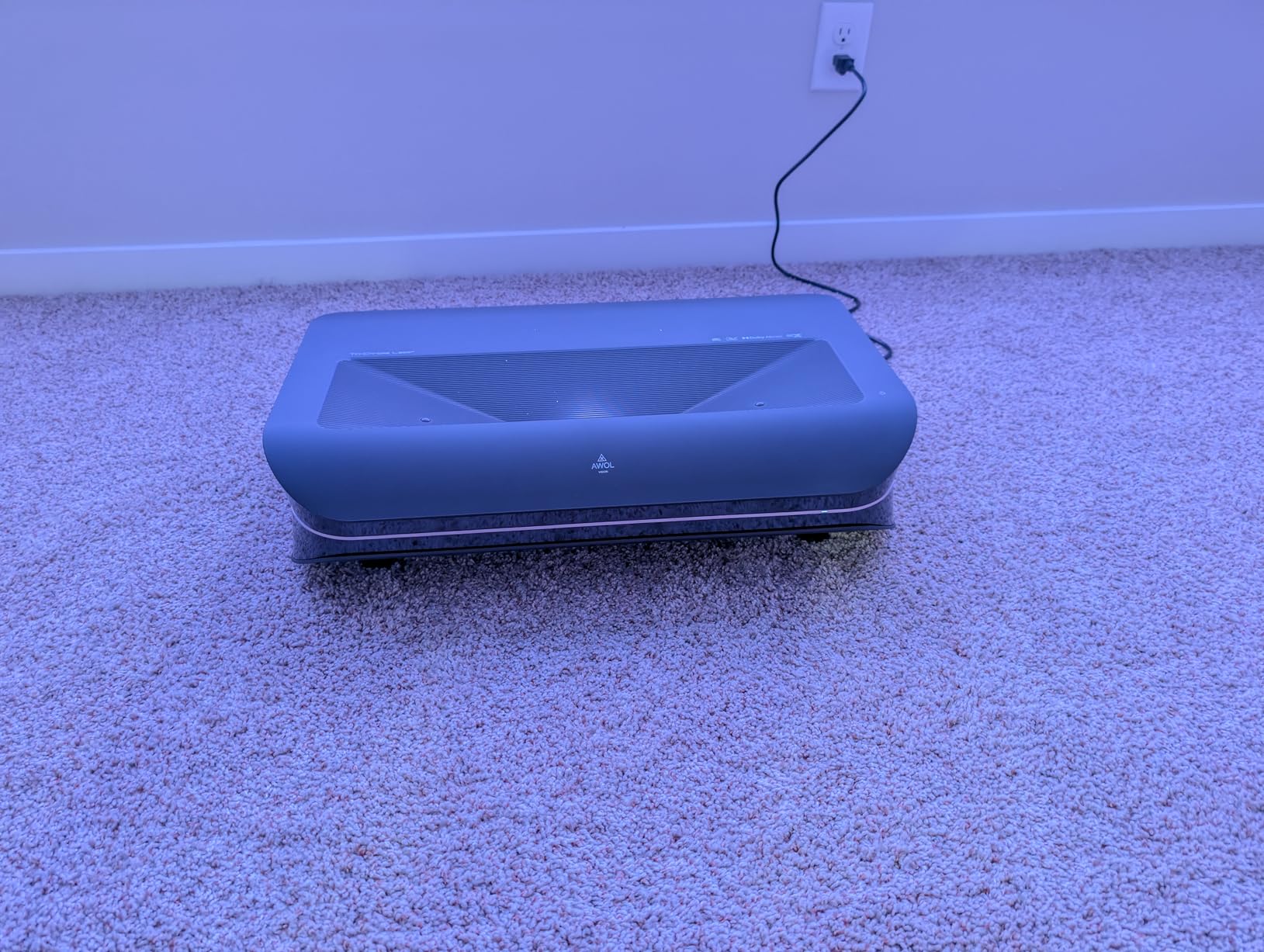
This is the classic laser TV shape: a wide, shallow box that sits directly under the screen and throws a 150 inch image from about 13 inches away. Rated at 3000 ANSI lumens, it is bright enough to hold a picture in a lit room, and the triple laser engine covers 107 percent of BT.2020 and 147 percent of DCI-P3 with no color wheel in the path.
Owners give it 4.5 out of 5 across 209 reviews. The praise clusters around colour accuracy, the convenience of the throw, and the fact that Dolby Vision, Dolby Atmos and active-shutter 3D are all present. A built-in center channel speaker is a genuinely thoughtful touch for a living room, because it gives dialogue a home without forcing an immediate soundbar purchase.
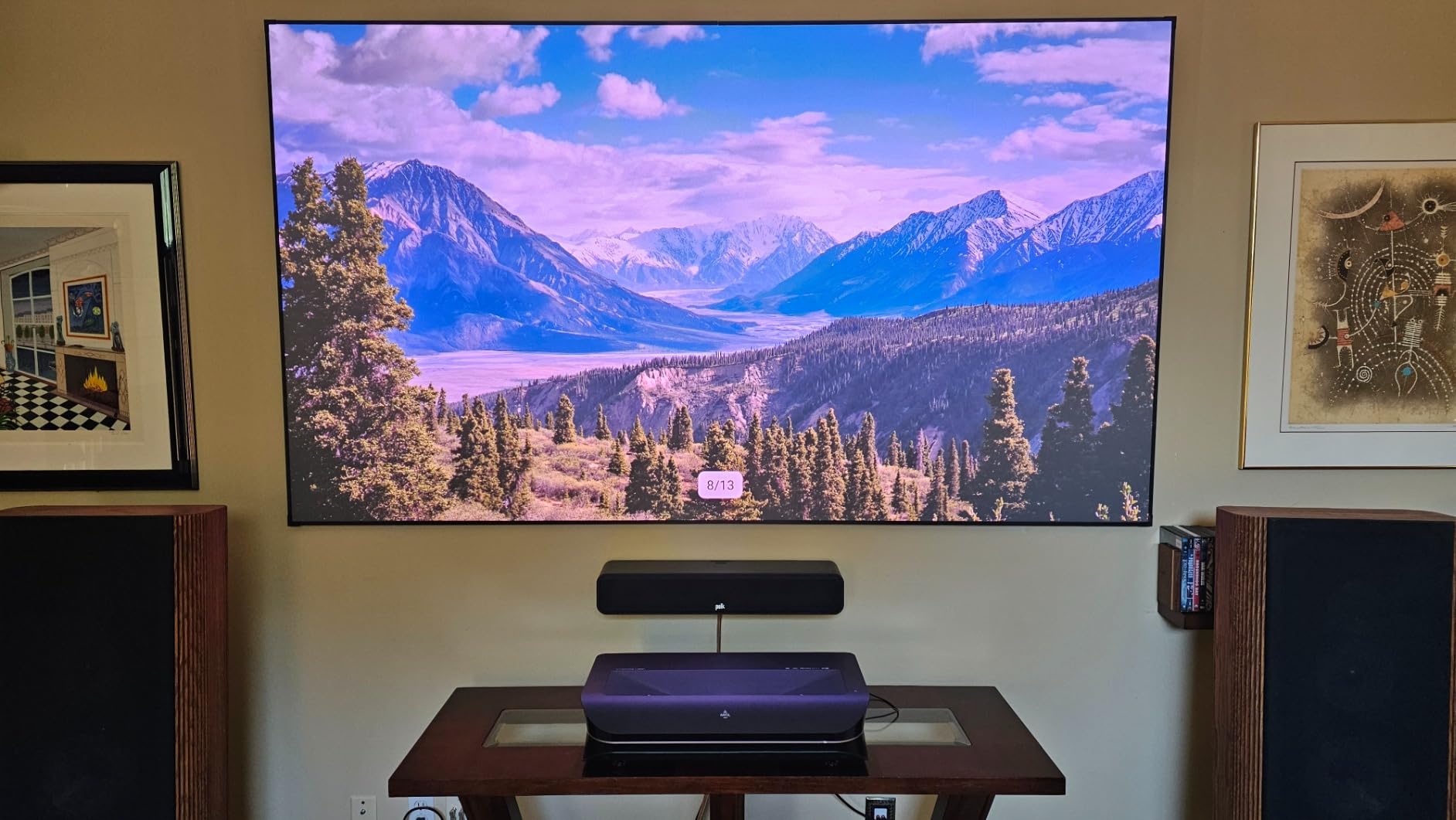
The 25,000 hour laser light source and two-year warranty are both solid, and PJ Link IP control means it drops into Control4 or similar automation without fuss. Dimensions are 23.6 by 21.5 by 5.5 inches, so plan your furniture around it before it arrives rather than after.
The catch is that ultra short throw is a fixed arrangement. With a 0.25:1 ratio, the unit has to sit a set distance from the wall, and if your media cabinet is shallow you either need a deeper unit or a motorized slider. Reviewers also point out it performs best in a darker room, and that pairing it with a generic screen leaves a lot of its capability unused. Buyers report a dramatic jump in perceived quality once a proper ALR screen is involved.
Is a laser TV setup better than a ceiling-mounted projector?
For a rental, a flat apartment, or any room where drilling into the ceiling is not an option, the laser TV wins. It sits on a stand, needs about 13 inches of depth, and casts upward and forward with nobody walking through the beam. The trade is real though: you give up the room to the furniture footprint, and the fixed throw means furniture depth now matters more than ceiling height.
Long throw buys back the room and lets you project onto a blank wall from across the room, which is why our dedicated-room pick further down still uses a much larger chassis. Neither is universally better; it is a function of the ceiling and the cabinet depth you actually have.
Who should skip it?
Skip it if your media cabinet is shallow, since the fixed 0.25:1 ratio has no adjustment to compensate. Skip it if you need a genuinely bright daytime picture and are not going to buy an ALR screen, because 3000 ANSI lumens on a plain wall under daylight is not enough. And skip it if weight matters to you; at 28 pounds it is not a unit you move around casually.
3. Hisense PL2 – Best for Renters and Compact Rooms
Hisense PL2, Ultra Short Throw Home Theater Laser Projector…
2700 ANSI lumens
80 to 150 inch image
Google TV with Wi-Fi 6E
Dolby Vision and Atmos
Pros
- Stunning 4K clarity on a plain wall with minimal setup
- Ultra short throw frees up floor space
- Brightness improves noticeably with an ALR screen
- Fast Google TV interface
Cons
- Rainbow effect reported by sensitive viewers
- Auto keystone workflow is clunky and web-based
- Floor-based placement complicates AV cabinets
The Hisense PL2 fills an 80 to 150 inch image from a floor-standing position, which makes it the most forgiving unit here for a room you do not own or cannot rewire. It puts out 2700 ANSI lumens, carries 3000:1 contrast, and the X-Fusion laser light source is rated at 25,000 hours.
At 4.4 out of 5 across 138 reviews, the recurring owner note is a big step up in image quality over a television. The DLP system uses 2.07 million micro-mirrors with a 4K AI upscaler, and Dolby Vision plus Dolby Atmos are both supported. Google TV runs on Wi-Fi 6E with Bluetooth 5 and voice control, and owners generally find it fast.

It is also 18.7 pounds and 20.9 by 13.2 by 4.7 inches, so it is a substantial object to sit on a floor stand next to a media console. The built-in speakers are described as usable when no soundbar is present, which tells you exactly what that means at 100 inches.
Two caveats show up repeatedly. Rainbow effect is reported by some viewers sensitive to it, which is the usual single-laser DLP behavior. And the automatic keystone process is genuinely awkward; owners describe having to upload a phone photo to a web page to complete it, and some settings are split between the Settings menu and the remote’s Menu button.
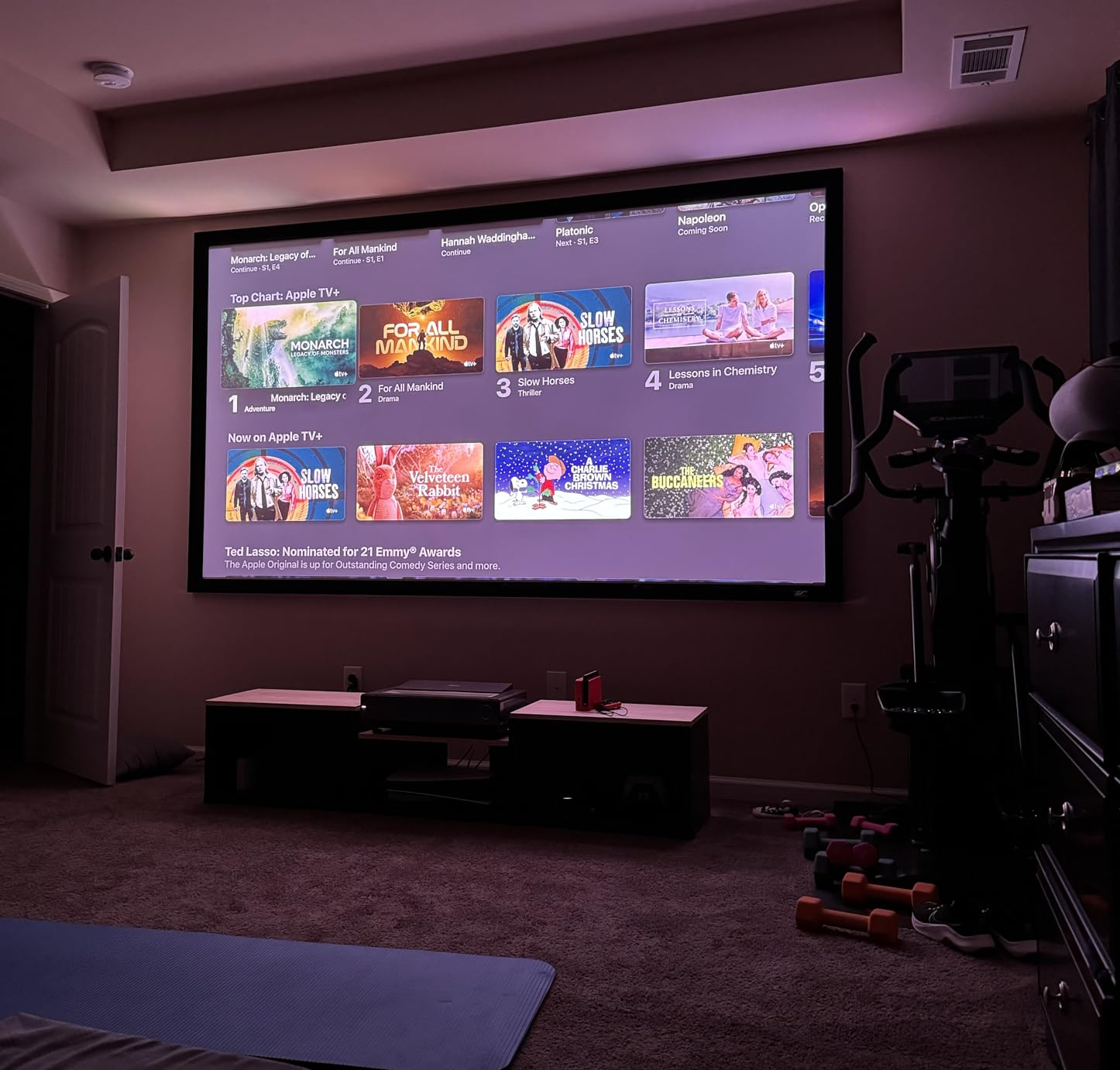
Will it work without any drilling or cabling?
Yes. It needs a power outlet and an HDMI or streaming source, but no ceiling mount, no chase-the-wire work and no permanent wall fixing. The digital lens focus and auto keystone handle the geometry, and while the workflow is clunky, it does get you to a square image without a technician. For a rental or a flat where alteration is not possible, that is the deciding factor.
One practical warning from owners: the placement is floor-based, which complicates fitting it into a proper AV cabinet and raises the obvious child-safety point around a unit that throws light horizontally across a room at standing height.
Who should skip it?
If you are one of the people who can see rainbow fringing, look at a triple laser model instead, since those have no color wheel at all. If you hate fiddling with setup routines, the Hisense models that automate this better are worth a look. And if you need a lot of image brightness, 2700 ANSI lumens is a mid-band figure, so plan on an ALR screen or accept a dimmer daytime picture.
4. XGIMI HORIZON 20 – Brightest Portable-Friendly Triple Laser
XGIMI HORIZON 20 4K RGB Triple Laser Home Projector…
3200 ISO lumens
100000:1 contrast
240Hz and 1ms response
Harman Kardon audio
Pros
- Crisp 4K image with vibrant RGB triple laser color
- Auto keystone
- auto focus and obstacle avoidance
- Optical zoom and flexible lens shift simplify placement
- Harman Kardon speakers good enough to skip a soundbar
Cons
- Laser speckle visible on gain-based and gray screens
- Firmware update reportedly bricked some units
- Included travel case is not durable
At 3200 ISO lumens with an X-Master RGB triple laser engine, the HORIZON 20 puts more light on a wall than anything else in the mid-range of this list, and the 100000:1 contrast figure is the highest published number among the models we covered. It handles images from 40 to 300 inches and supports IMAX Enhanced, Dolby Vision, HDR10+ and Filmmaker Mode.
Owners give it 4.3 out of 5 across 131 reviews. The setup automation gets the most credit: auto keystone, auto focus, screen alignment and obstacle avoidance all work quickly, and the combination of optical zoom with flexible lens shift means it will go on a ceiling or a shelf without the guesswork that plagues most long-throw units. It also runs quietly and boots fast.
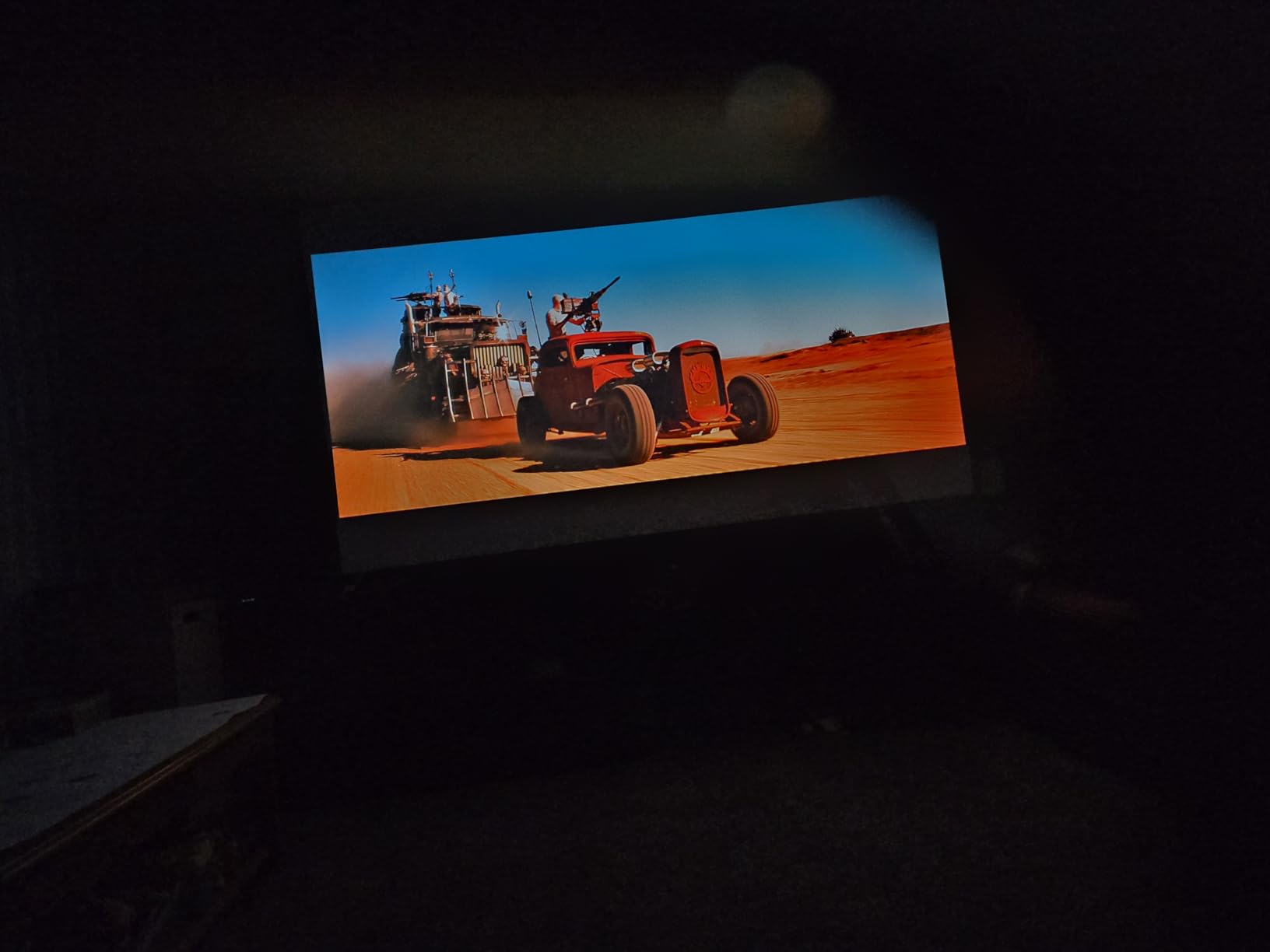
For a shared room, the Harman Kardon speakers are the practical standout. Multiple reviewers say the built-in audio is good enough to skip a soundbar, which is unusual at this size and saves a real expense in a living room that already has furniture in it.
Laser speckle is the issue owners raise most, and it tracks directly with the screen. It shows on gain-based surfaces and gray walls and is much less visible on a properly treated screen, so this model pairs especially well with the ALR screen we keep recommending. There is also a report of a firmware update bricking units alongside slow support response, which is worth factoring into any brand-new purchase decision.
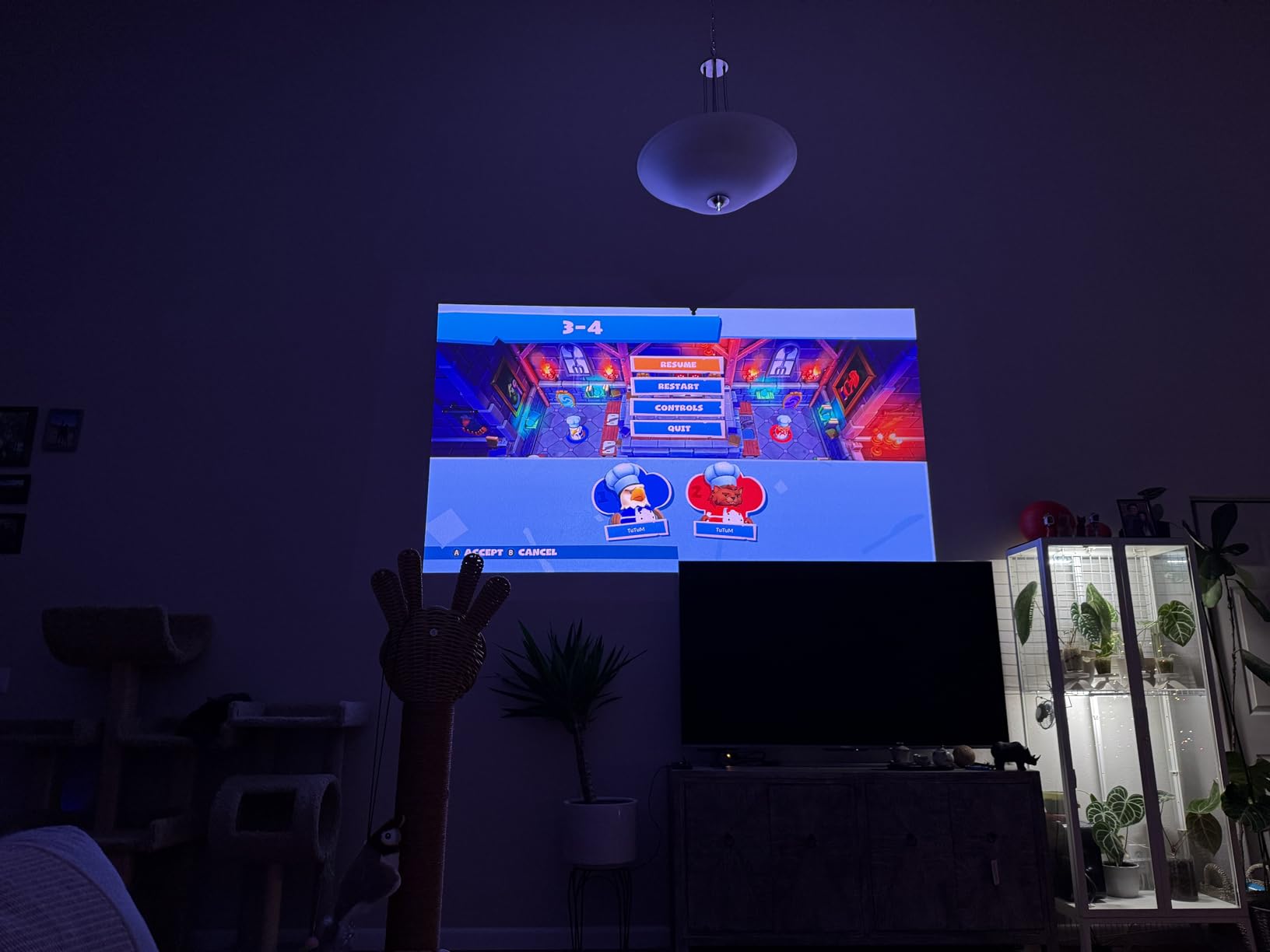
Can it move between the living room and the backyard?
Better than most. At 4.9 kg with a built-in Google TV and integrated stand, it is a genuinely movable unit rather than a shelf fixture, and owners use it for both indoor and outdoor viewing. Two things work against it: the included styrofoam travel case is not durable for frequent transport, and the triple laser engine is heavier than the LED portables it will be compared against, so it is a two-person lift in practice.
Outdoor use also needs a surface, and a bright backyard in the afternoon will exceed what any consumer projector here can do without a screen and shade. Plan for evening use outdoors rather than midday.
Who should skip it?
If you are speckle-sensitive, particularly on a pale wall or a high-gain screen, look elsewhere; this is the most commonly mentioned speckle complaint in our review set. If you are not comfortable with a brand whose firmware support has produced reported failures, factor that in. And if you need native 4K sharpness from a lens rather than processing, note that white imagery can show brief color fringing during motion.
5. Hisense XR10 – Best for Big Bright Rooms
Hisense XR10 Triple Laser 4K Projector, 6000 ANSI Lumens…
6000 ANSI lumens
17-element all-glass lens
0.84-2.0:1 optical zoom
7-level iris
Pros
- Very high brightness with a sharp image in larger rooms
- Optical zoom and lens shift hold 4K at any throw distance
- 7-level iris tunes black level to the room
- 17-element all-glass lens resists fading and warping
Cons
- Premium-tier price point
- Only a 1-year manufacturer warranty
- Reported brightness falls short in strong ambient light
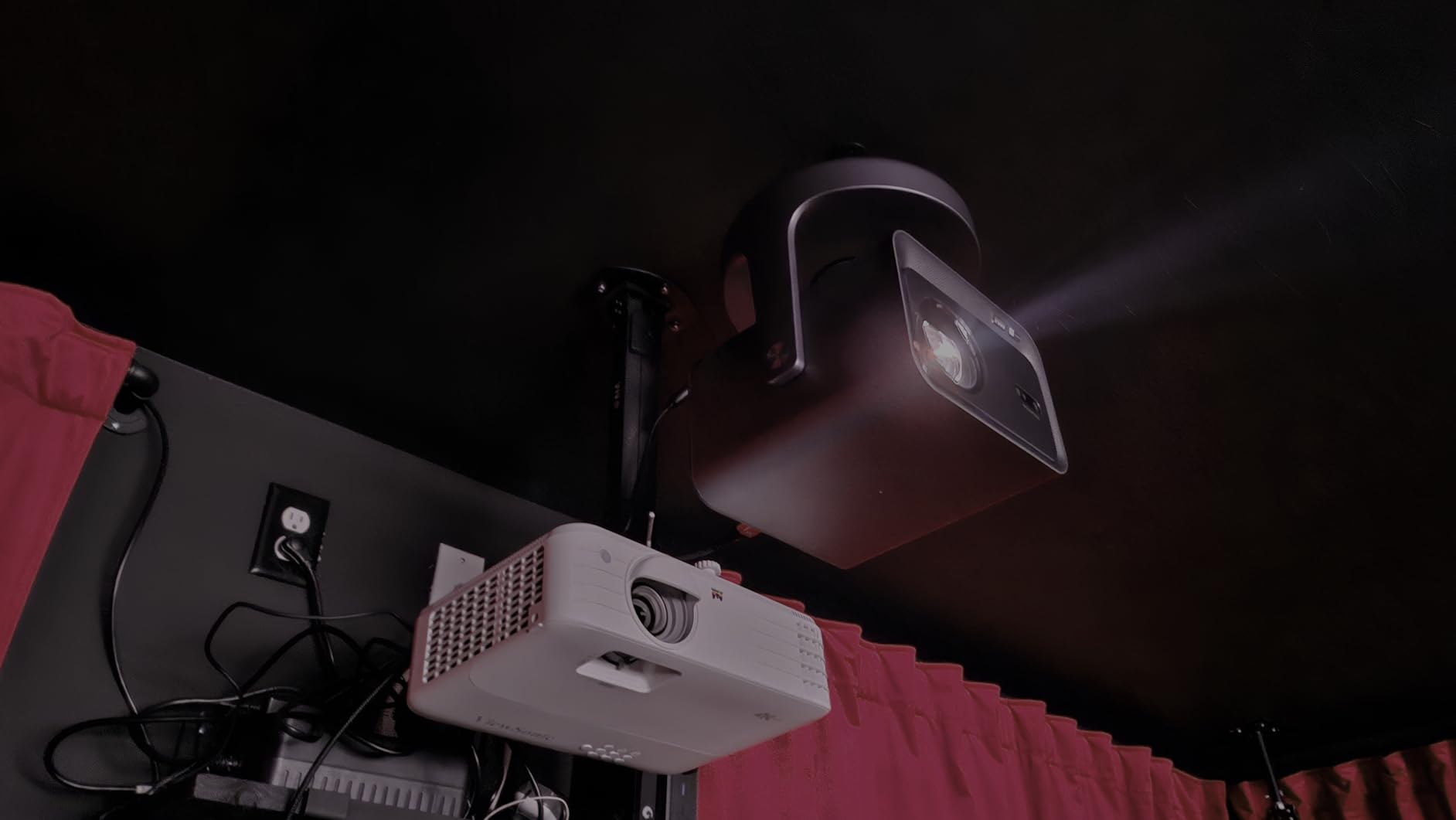
The XR10 is the brightness answer. 6000 ANSI lumens peak from a pure triple laser source covers 65 to 300 inches, and it is the only unit here that can project a genuinely large image into a room that fights back with daylight. Owners who swapped out far more expensive cinema projectors report the image rivals or beats units costing considerably more.
Its optical zoom range of 0.84 to 2.0:1 with lens shift is the real installation story, because it preserves 4K sharpness at any throw distance rather than relying on digital scaling. The 17-element all-glass lens resists fading, warping and discoloration over time, and a 7-level iris lets you trade brightness against black level to suit the room. Liquid cooling supports long gaming and movie sessions.
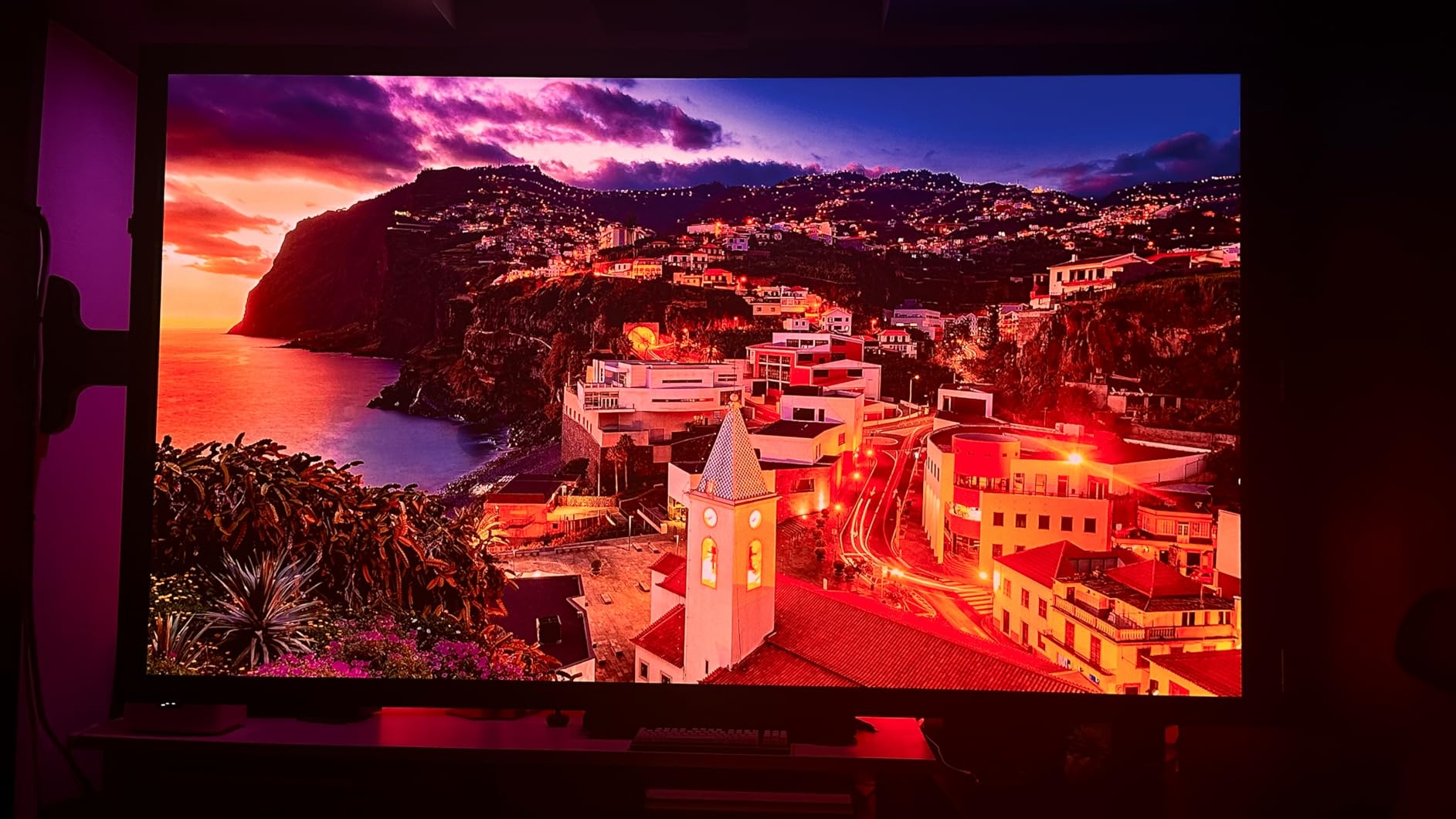
Smart platform is VIDAA with more than 1,200 apps, voice control, cloud gaming and audio tuned by Devialet. The built-in speakers are described by owners as loud and room-filling, and IMAX Enhanced expands the picture area by up to 26 percent with DTS:X sound.
At 4.2 out of 5 across 187 reviews, the feedback is broadly about value for the tier rather than celebration. The reported downsides are the premium price, active 3D needing extra glasses, speckle depending on screen choice, and a brightness figure that some buyers measured as short of claim in strong ambient light. The 1-year manufacturer warranty is also notably shorter than most here.
How much room do you need to justify it?
Treat it as a large-room tool. At 23.4 pounds and 11.53 by 10.74 by 8.38 inches it is a substantial desktop unit, and the optics are designed to throw long. A small or average living room will not extract value from 6000 lumens, because a very bright projector on a small screen just looks overexposed.
The 0.84 ratio at the short end means it can also sit fairly close to a wall, which helps in awkward rooms. The lens shift means you are not forced into a dead-centre ceiling mount to keep the image clean.
Who should skip it?
Skip it if your room is medium sized; the brightness is wasted and a mid-range model will look better. Skip it if a 1-year warranty makes you nervous, because that is half the coverage of most units on this list. And if you are highly speckle-sensitive, an RGB triple laser engine of this type is one of the configurations where speckle shows most clearly on the wrong screen material.
6. ViewSonic LS740HD – Best Value for Brightness
ViewSonic LS740HD 1080P Laser Projector, 5500 Lumens, Full…
5500 ANSI lumens
1080p native
1.3x optical zoom
20000 hour laser
Pros
- Very high brightness for the money in ambient light
- Runs cool and quietly with a 20000 hour laser
- 1.3x optical zoom plus four-corner adjustment
- 360 degree and portrait projection
Cons
- Native 1080p only so 4K sources are downscaled
- Some units report random orange flashing glitches
- No lens shift and muffled built-in speakers
The LS740HD answers a narrow question well: how do you get usable light in a bright room without spending near the top of the range. 5500 ANSI lumens is the second-highest figure in this group, the laser light source is rated at 20,000 hours, and the contrast ratio is listed at 3000000:1.
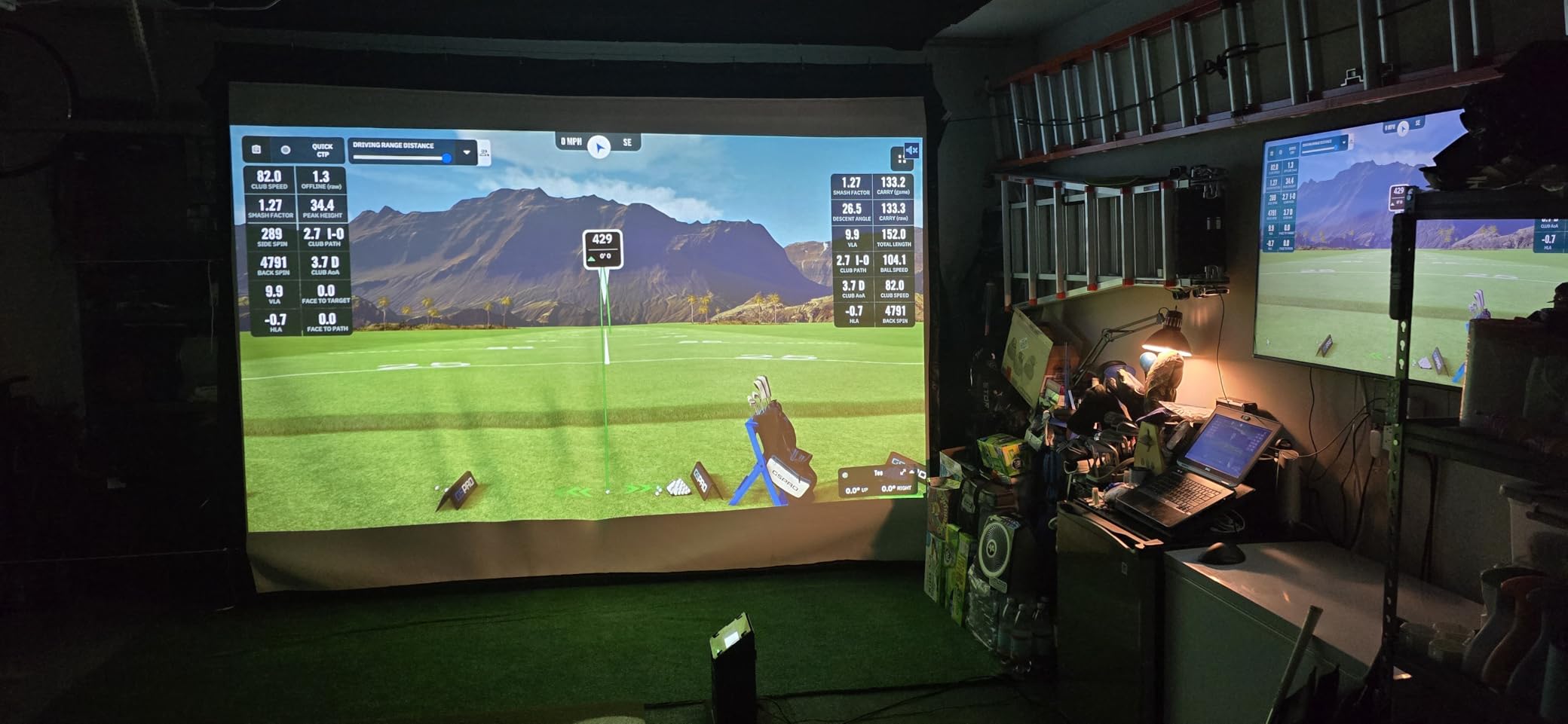
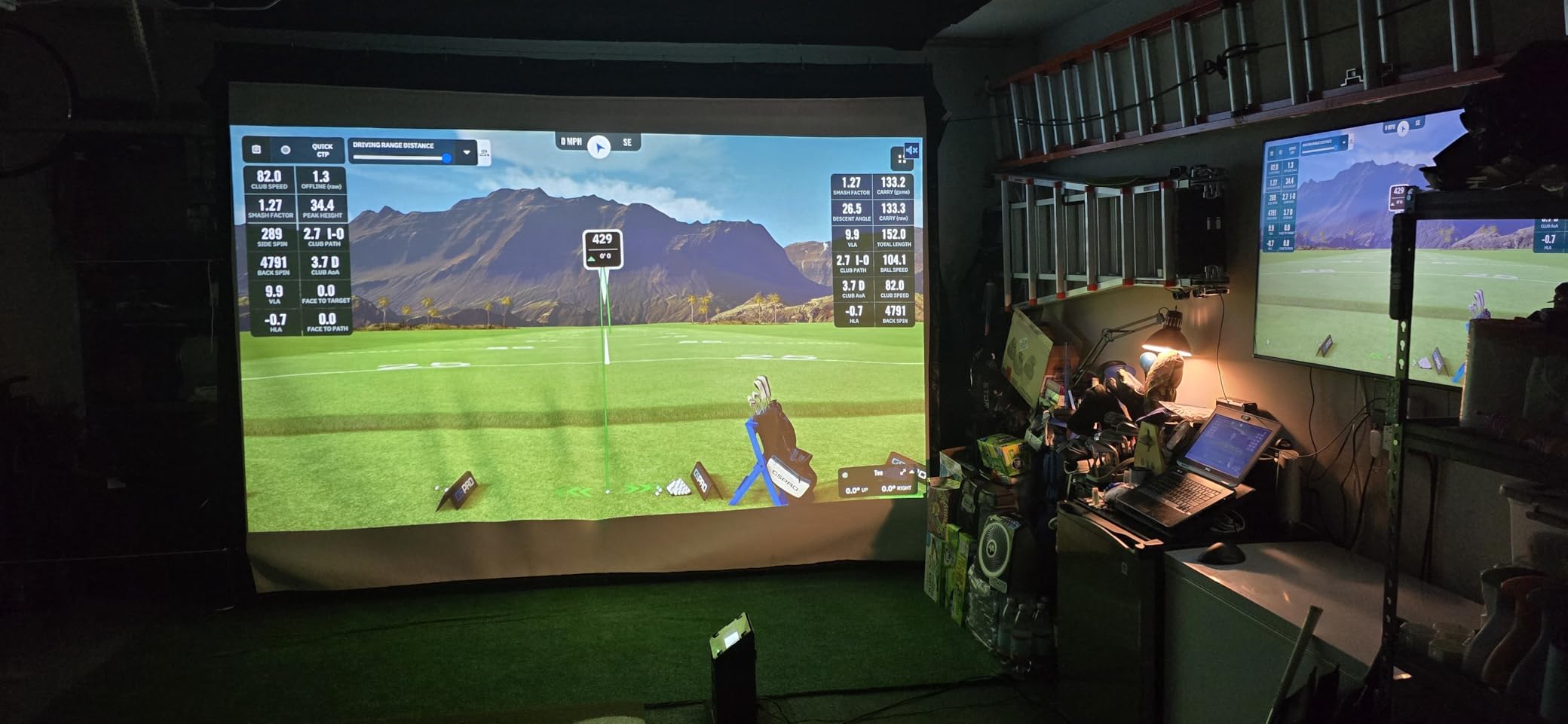
At 4.3 out of 5 across 162 reviews, owners consistently single out brightness and value, and many are using it outdoors, for golf simulation, or in bright-room projection where higher-tier 4K machines make no sense. It weighs 6.6 pounds, which is also the lightest in this list by a wide margin, and supports 360 degree and portrait projection alongside ceiling mounting.
The warranty is the best on this list by some distance: three years on parts and labor with a first-year free Express Exchange service. That matters more for a bright-room unit than a dark-room one, because it is the one you will actually leave running during the day.
The compromise is resolution. This is native 1920 x 1080, so 4K sources get downscaled, and at normal seating distances on a large image that difference is visible next to a native or pixel-shifted 4K unit. There is also an intermittent orange-flash fault reported by some units, no lens shift to help with placement, and built-in speakers that reviewers describe as muffled and blown out at higher volume.
Is 1080p still acceptable on a big screen?
For most content, yes, at 100 to 120 inches. The perceived sharpness gap between 1080p and 4K narrows as you sit back, and on a 150 inch image viewed from a normal sofa distance a lot of buyers stop noticing it. Where it shows is fine text, sports jerseys and anything heavily shot in 4K, where downscaling softens detail.
Given the brightness you get for the money, this is often the right trade in a lit living room. A dimmer 4K projector loses to a bright 1080p one every single time the room has light in it.
Who should skip it?
Skip it if your room is dark and you care about image quality more than brightness, because a native 4K model in a controlled room will look meaningfully better. Skip it if you are near-sighted about 4K sources or read subtitles at a distance. And if you have had flickering hardware before, note the reported orange-flash issue and check the warranty terms carefully.
7. Dangbei MP1 MAX – Best Built-In Audio and Streaming
Dangbei MP1 MAX Triple Laser Projector 4K – 3100 ISO Lumens…
3100 ISO lumens
110 percent BT.2020
Licensed Netflix on Google TV
Dual 12W Dolby Audio
Pros
- Hybrid triple laser and LED engine handles daytime viewing
- 110 percent BT.2020 with sub-1 Delta E claimed accuracy
- Dual 12W speakers in a 750cc chamber with DTS:X
- Built-in adjustable stand removes mounting cost
Cons
- Contrast is not given as a numeric ratio
- Requires a 2 meter minimum throw distance
- Bulkier than most at 7.52 kg
The MP1 MAX is the most complete living room package here if you are starting from nothing. It has Google TV with officially licensed Netflix, Google Assistant and casting, plus more than 10,000 apps, on a hybrid triple laser and LED engine rated at 3100 ISO lumens covering 110 percent of BT.2020.
At 4.4 out of 5 across 92 reviews, this is the smallest review base in our group, and that is worth keeping in mind when weighing the score. What owners do highlight is audio: dual 12W speakers in a 750cc acoustic chamber with bass reflex down to 45Hz, plus Dolby Audio and DTS:X. At this image size that is an unusually serious built-in system and it may remove the soundbar line item entirely.
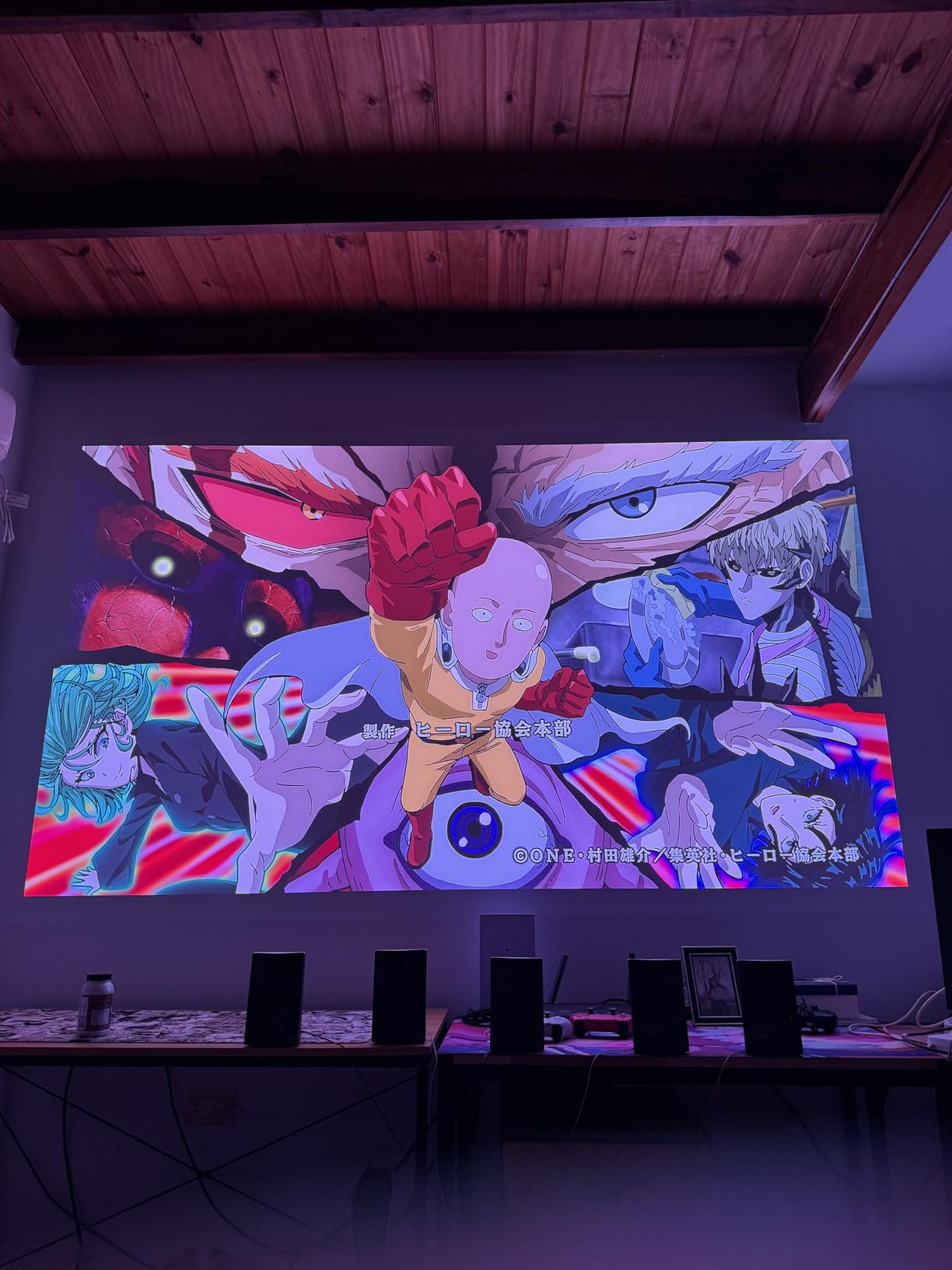
The InstanPro AI suite handles auto focus, auto keystone, screen fit, obstacle avoidance and AI ambient brightness adjustment, which matters in a room that changes brightness through the day. The built-in adjustable stand with 360 degree rotation and 135 degree tilt is another cost you do not have to spend, and it is what makes the unit placement-flexible without a mount. Connectivity is HDMI 2.1 with eARC, USB, Bluetooth 5.2 and Wi-Fi 6.
Two things temper this. The contrast figure is not given as a number, which makes it hard to compare directly against everything else here, and it needs a 2 metre minimum throw distance, so it will not sit right up against the wall the way an ultra short throw unit does. It is also 7.52 kg, which is bulky for its class.

Does it replace a soundbar and a streaming box?
Mostly, yes. The licensed Netflix app removes the most common reason people add a streaming dongle, and the dual 12W system with a proper acoustic chamber is closer to a small soundbar than to a projector speaker. What you still need is a way to get 5.1 and Atmos audio, which no projector in this list provides, so a soundbar remains the upgrade if you care about surround.
The adjustable stand is the other quiet win. Most living rooms end up with a dedicated mount or a furniture modification, and this unit is designed to be angled and rotated into place instead.
Who should skip it?
Skip it if you have under two metres of throw space, or if you want the unit to vanish against a wall like an ultra short throw laser TV. Skip it if you need a hard contrast number to compare against other projectors, because the manufacturer does not publish one. And given the 92-review base, be aware you are buying into a less established support ecosystem than the established brands here.
8. ViewSonic LX700-4K – Best for Console Gamers
ViewSonic LX700-4K 4K UHD Laser Gaming Projector 3500 Lumens…
3500 ANSI lumens
240Hz refresh
4.2ms input lag
1.3x optical zoom
Pros
- 240Hz refresh with 4.2ms input lag tuned for Xbox
- Bright 3500 lumen 4K image in medium room lighting
- Very quiet especially on Eco mode
- Optical zoom
- vertical lens shift and four-corner adjustment
Cons
- Black level is dark grey rather than true black
- Basic mono speaker and no smart OS
- Resolution is pixel-shift rather than native 4K
The LX700-4K is built around one number: 240Hz with 4.2ms input lag, tuned explicitly for Xbox. It is 3500 ANSI lumens of 3840 x 2160 laser output, so the picture holds up in a medium-lit room rather than demanding darkness, and the laser source draws far less power than the lamp projectors it replaces.
At 4.1 out of 5 across 120 reviews, gamers who paired it with an Xbox or PlayStation rate it highly for smoothness and lag. Non-gamers reviewing the same unit are less enthusiastic, which tells you the rating is doing exactly what the product intends: it is optimised for one use case. It throws 80 to 150 inch images, with 100 inch from 7.7 feet, and the 1.3x optical zoom, vertical lens shift and four-corner adjustment make it forgiving to install.
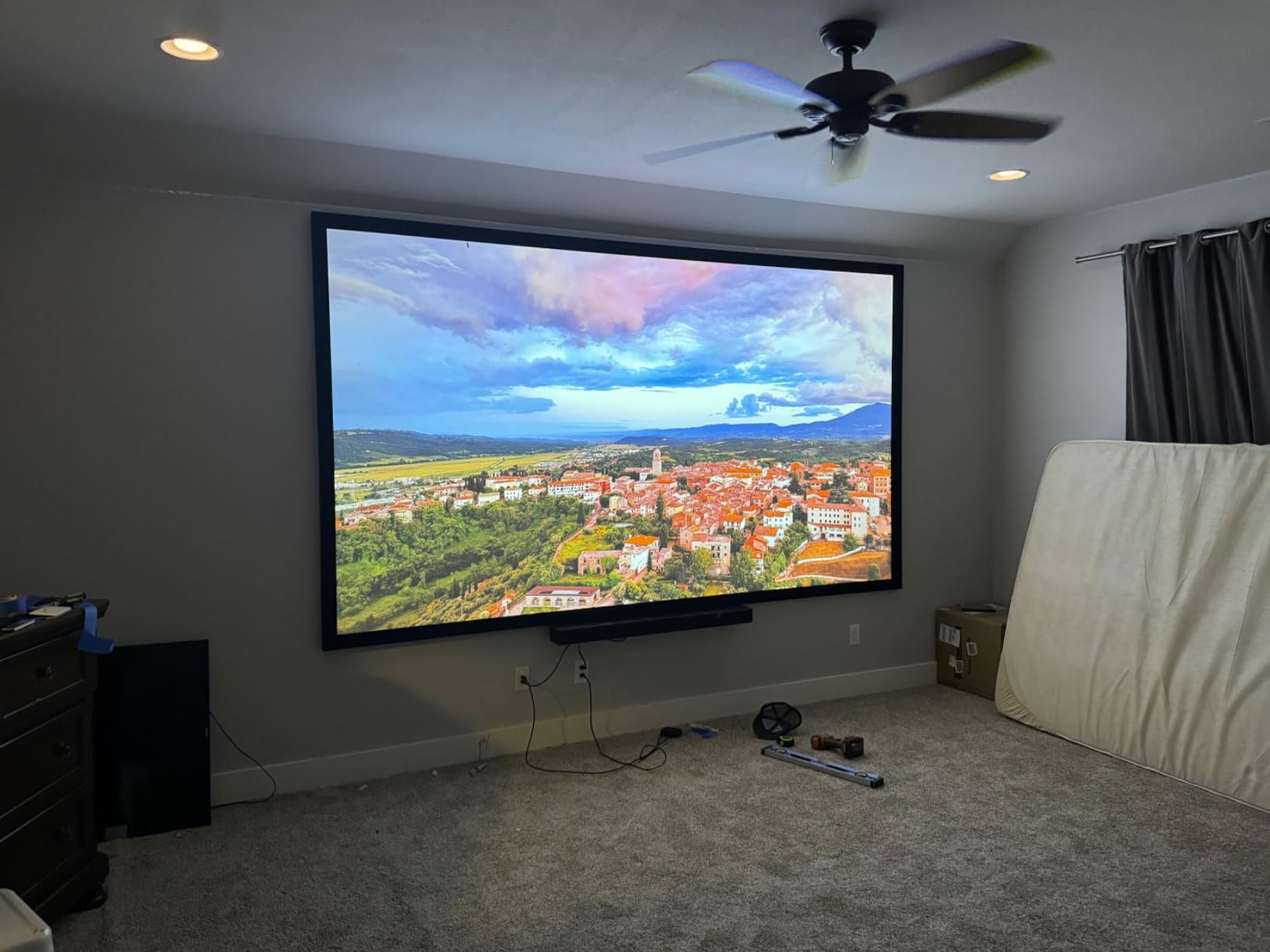
Contrast is listed at 3000000:1 but the practical result is what owners describe: a black level that reads as dark grey rather than true black, which matters in a dark room and much less in a lit one. It supports HDR and HLG, includes a golf simulation mode, and handles 360 degree and curved-screen projection.
The compromises are clear. There is no smart OS and no built-in streaming, so an external source is required, and the mono speaker is described as a placeholder. The 4K advantage over 1080p is not obvious at normal seating distances, and some rainbow effect is visible with rapid eye movement.
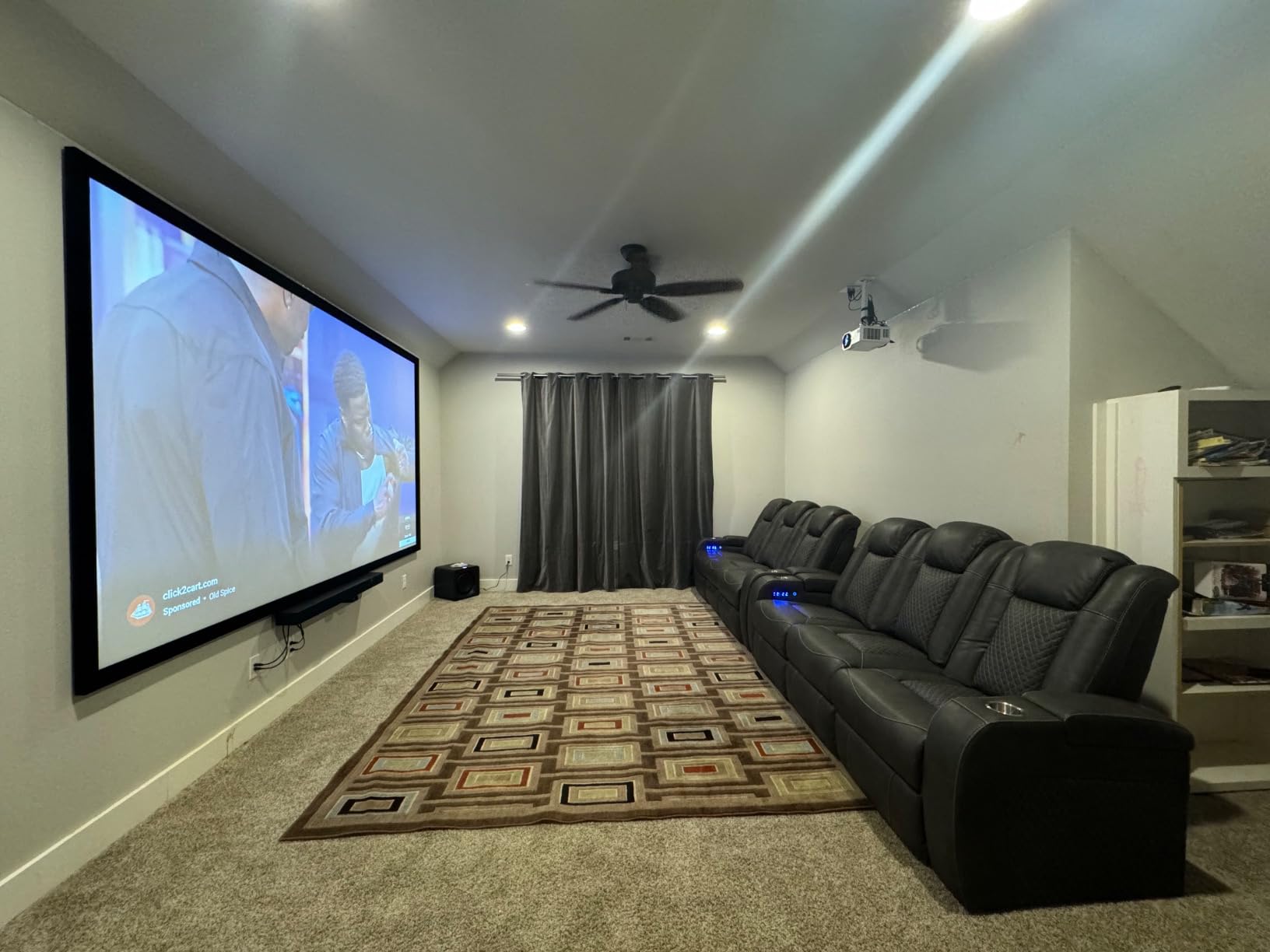
Is 240Hz worth it on a projector?
On a 100 inch screen at sofa distance, it is noticeable in fast motion, which is why it matters for shooters, racing and sports. Most streaming content is not 240Hz, so if your main source is a streaming box the benefit shrinks considerably. It becomes a real advantage the moment a console is the main source.
Also worth weighing: at 7.3 pounds this is a genuinely portable-feeling unit compared with the 20-plus-pound machines, and it mounts on a tabletop or the ceiling. If you want one device for console gaming and occasional daytime TV, the compromises are the smart platform rather than the image.
Who should skip it?
Skip it if you want to cut cables and stream from the projector itself; there is nothing built in for that. Skip it if you sit in a fully dark room and black level is the thing you notice most, since that is where the grey blacks show. And if you are sensitive to rainbow artifacts, note that this is a color-wheel DLP design.
9. Optoma GT2000HDR – Budget Short-Throw Laser
Optoma GT2000HDR Ultra-Compact Short Throw Full HD Home…
3500 ANSI lumens
30000 hour laser
9.6 pounds
5-year light source warranty
Pros
- Compact chassis that fits close to the screen or wall
- 3500 lumens is ample for typical living room viewing
- 30000 hour laser with a 5-year 12000 hour light source warranty
- 98 watt power draw thanks to the external power supply
Cons
- Native 1080p resolution only
- DLP rainbow effect reported by some viewers
- No smart OS so an external source is required
The GT2000HDR is the simplest machine on this list and that is the point. It delivers 3500 ANSI lumens of 1920 x 1080 laser light from a chassis that weighs 9.6 pounds and measures 4.49 by 10.79 by 8.5 inches, small enough to tuck against a wall or into a shallow cabinet.
Owners give it 4.1 out of 5 across 126 reviews and the feedback is consistent: brightness and footprint are the standouts, and the laser source is rated at 30,000 hours, the longest figure here. The warranty is unusually generous for the money, with five years or 12,000 hours on the light source, and the external power supply keeps both the size and the internal heat down.
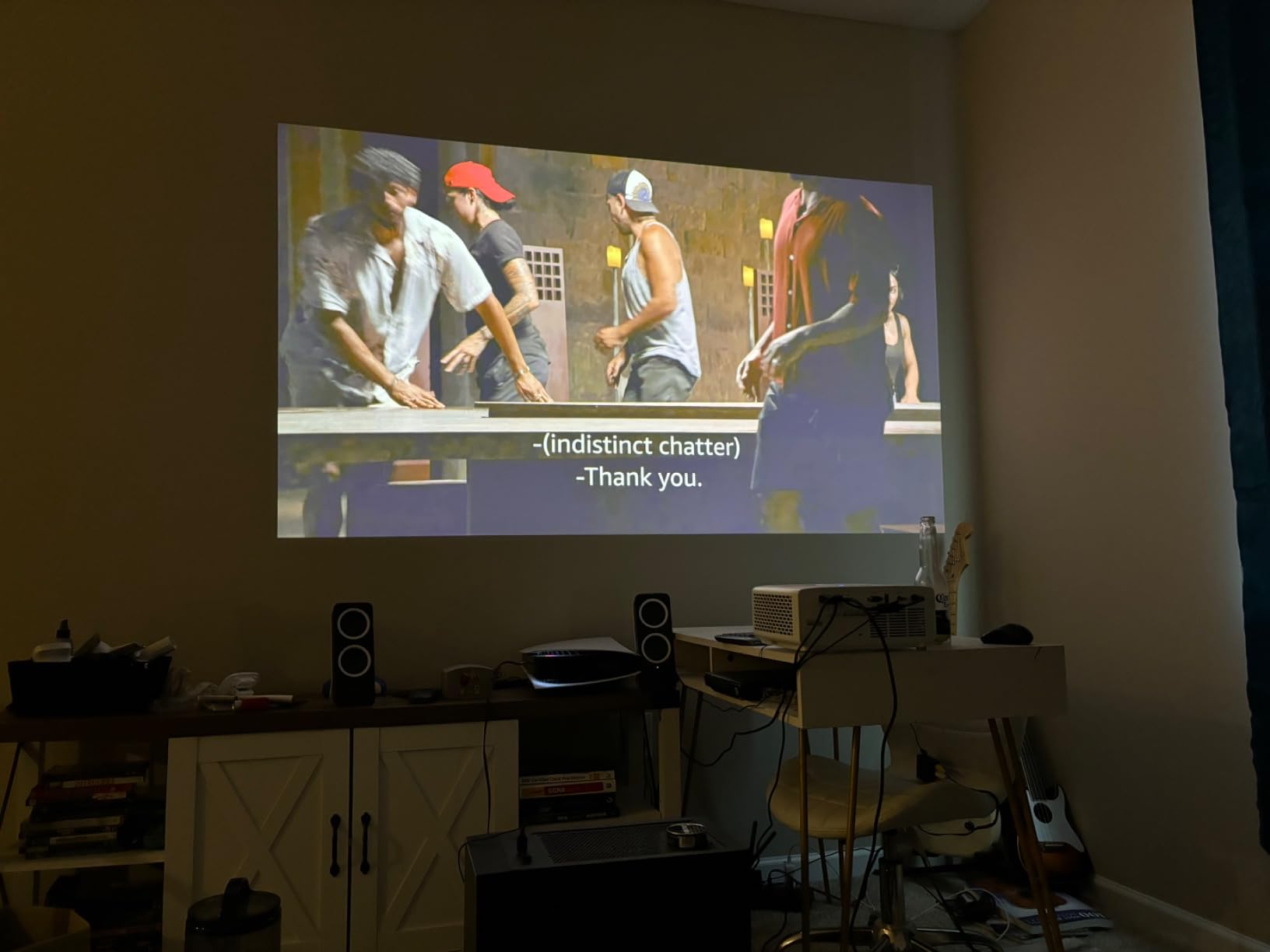
It can produce very large images, up to 300 inches, from a short throw distance, which is genuinely unusual in a body this compact. The one-year parts and labor warranty on the projector itself is thinner than the light source cover, so the balance is worth understanding.
It is also a bare projector. There is no smart OS and no built-in streaming, so you need a streaming stick or a console, and at 3500 ANSI lumens with 1080p it is a brightness-led purchase rather than a quality-led one. Rainbow effect is reported by some viewers with rapid eye movement, which is again the color wheel speaking.
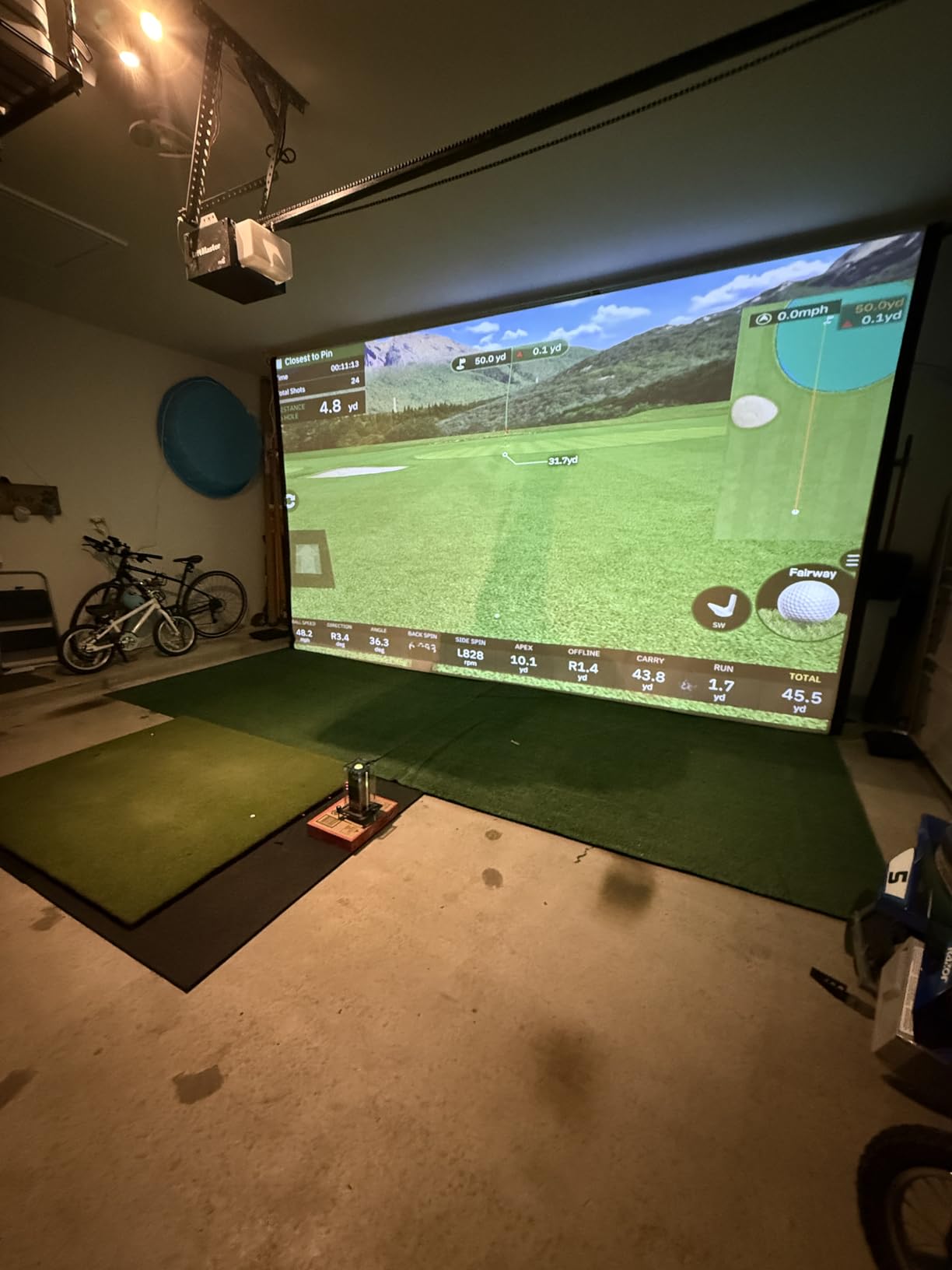
Is a bare projector still worth buying?
More than it used to be. The laser engine changes the economics: 30,000 rated hours and a five-year light source warranty mean no bulb budget and no ceiling visit, which is where lamp-based budget projectors fell apart. Everything the machine does not do, it does at a price that leaves room for a screen or a streaming box in the same budget.
For a secondary room, a bedroom wall, or a first projector where simplicity matters more than polish, that is a sensible starting point. It is also the lightest-per-inch option if you need something to move between rooms.
Who should skip it?
Skip it if you want Netflix and apps without another device, because there is nothing built in. Skip it if 4K sources matter to you, since this is 1080p only. And skip it if you are rainbow-sensitive or want the widest colour gamut, because a single-laser DLP engine gives up both compared with a triple laser.
10. Epson Home Cinema LS11000 – Best for a Dedicated Media Room
Epson Home Cinema LS11000 4K PRO-UHD Laser Projector with…
2500 ANSI lumens
3-chip 3LCD laser engine
Motorized lens shift
120Hz refresh
Pros
- Exceptional 4K sharpness with deep colors and impressive black levels
- True 3-chip 3LCD engine avoids rainbow artifacts entirely
- Motorized lens zoom
- focus and lens shift make alignment easy
- Quiet operation with instant laser power-on
Cons
- Highest price in this group
- No 3D support
- Picture degrades in heavy ambient light
The LS11000 is the one to buy if you have a room you can control the light in. It uses a laser array driving a three-chip 3LCD engine, which produces 2500 ANSI lumens with a dynamic contrast ratio over 1200000:1, and the 3LCD approach means no color wheel anywhere in the light path, so no rainbow artifacts for anyone at all.
At 4.3 out of 5 across 131 reviews, owners with large screens and dedicated spaces call the picture reference-class. The motorized cinema lens handles focus, zoom and lens shift, which is the single biggest quality-of-life feature in a ceiling-mounted install because you can dial it in from the ceiling without a ladder. Full 10-bit HDR with 16-step real-time curve adjustment, HDR10+ and HLG support, and 120Hz refresh with frame interpolation round out the picture side.
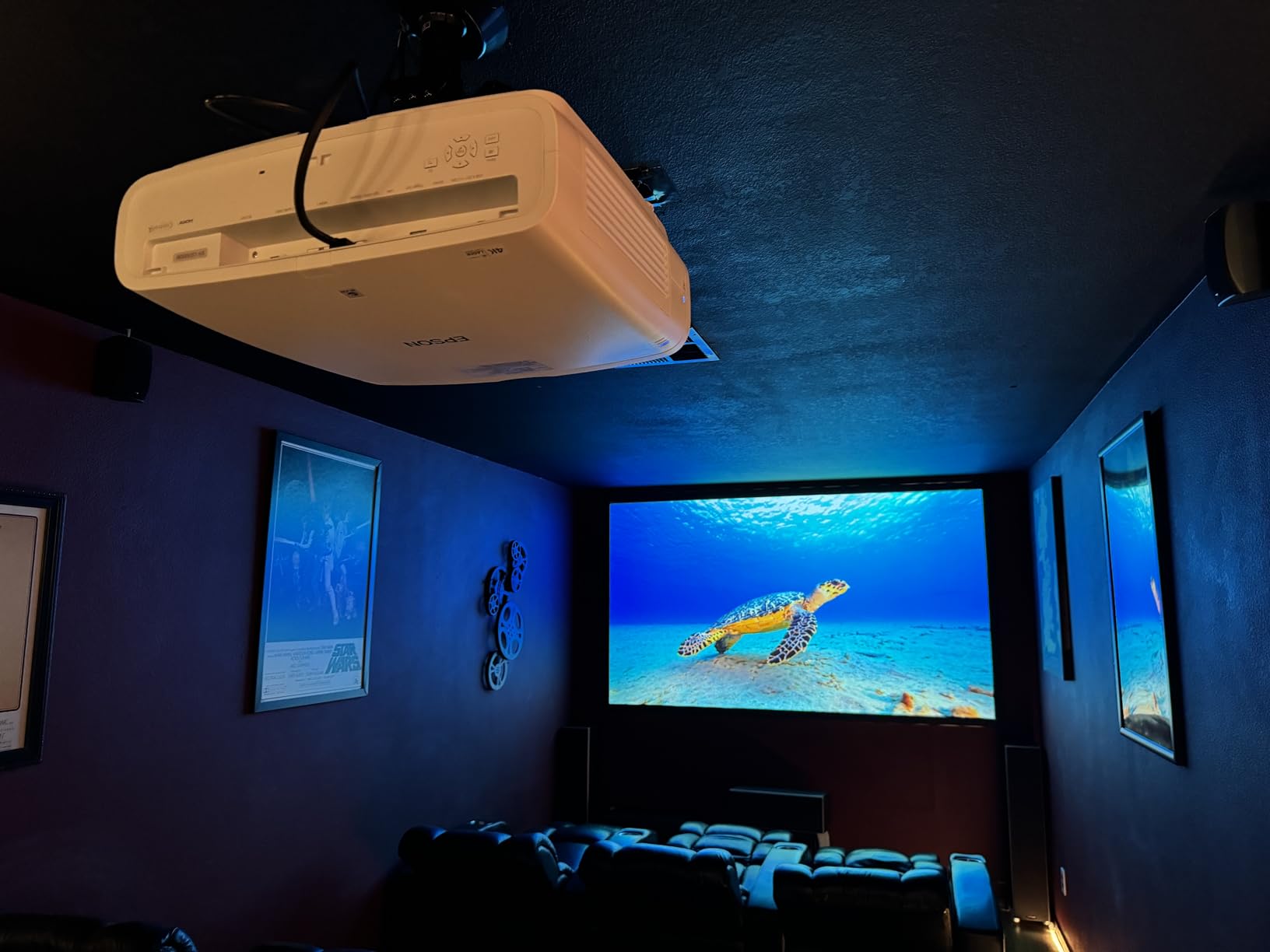
Two practical details matter more than the spec sheet here. It supports ARC and eARC audio return, which owners call a major practical benefit over cheaper models because it lets your soundbar do the work. And the laser powers on instantly with no warm-up, quietly, which is a daily-use quality of life that lamp projectors never offered.
The 1,200,000:1 contrast figure is a dynamic number, so treat it as marketing shorthand rather than a native contrast measurement. At 28 pounds and 17.6 by 20.5 by 7.6 inches, it is a ceiling-mount unit, not a shelf unit. There is no 3D support, which is unusual at this tier, and the 2-year limited warranty is shorter than some cheaper units offer.

Why pay more for a room you can darken?
Because in a controlled room the brightness race stops mattering and image quality takes over. 2500 lumens is more than enough once the curtains are closed, and at that point the differences that separate this from a mid-range unit are the ones you cannot buy back with a brighter image: 3LCD has no color wheel, the motorized lens gets the geometry perfect, and the 10-bit processing holds up on dark scenes.
Owners also note the contrast reads better in a moderately lit room than a fully dark one, which is unusual and worth experiencing before you commit. For a room you genuinely cannot darken, go back up the list to a brighter unit instead.
Who should skip it?
Skip it for a shared living room with windows. Picture quality degrades in heavy ambient light and 2500 ANSI lumens is not enough to fight that, so you would be paying for an engine you never see at its best. Skip it if 3D matters at all. And skip it if your ceiling cannot take a 28-pound unit or you are not comfortable with a lens that has to be aligned rather than plugged in.
Our dedicated-room laser projector guide covers more of the install side if this is the direction you are heading.
The Real Downsides of Laser Projectors
Laser projectors trade one set of problems for another. Lamp models have a bulb that fades and a replacement to plan for; laser models have speckle, noise and a fixed optical path. Here is what the owners in our review set actually report, and what you can do about each.
Laser speckle is the one that generates the most debate. It shows on bright uniform fields, which is exactly what a daytime living room presents, and it is strongly tied to the screen surface. Reviewers report it as highly personal: many do not perceive it during normal viewing, while others see it clearly on pale walls and high-gain screens. A properly treated screen reduces it, so screen choice is the mitigation, not the projector.
Rainbow artifacts are the second laser-adjacent issue, and the fix is a light engine choice rather than a screen choice. Single-laser DLP units with a color wheel produce faint rainbow fringing, which sensitive viewers report on the Hisense PL2, the ViewSonic LX700-4K and the Optoma GT2000HDR. Triple laser RGB engines have no color wheel at all, and 3LCD engines like the Epson’s never had one.
Fan noise is the third, and it is linked to brightness mode more than to the model. Owners report that raising laser power to compensate for ambient light is what drives the noise, so managing brightness mode matters more than raw lumen count. The Valerion’s rainbow-effect reduction system also adds a high-pitched whine in a quiet room, which some listeners do not hear at all.
Lastly, repairability. Long-term owners report that in laser projectors the laser is rarely the first thing to fail. Fans, power supplies and streaming dongles tend to go first. The practical implication is that you should judge support and warranty as carefully as picture quality, and the ViewSonic LS740HD’s three-year parts and labor cover is worth more to a buyer than a spec point.
How to Choose a Laser Projector for a Living Room
Match the light engine to the room, not to the spec sheet
Decide first whether you are living-room or theater. Long throw with a ceiling mount gives you the best picture and hides the hardware, but it commits the room. Ultra short throw puts a laser TV on a console, works without drilling, and accepts a worse image on a plain wall. Renters and flats usually have to take the second option; homeowners with a blank wall and a proper mount can have the first.
Within each, the light engine matters. Triple laser RGB gives the widest gamut and no color wheel. Single-laser with phosphor is the value route and carries a color wheel. Laser-LED hybrids sit between them. 3LCD with a laser array, as on the Epson, avoids the color wheel entirely and rewards you with no rainbow artifacts at all.
Budget the screen before the projector
Users report consistently that a capable UST laser paired with a generic screen leaves most of its capability unused, and that the jump to a proper ALR screen moves the image from unwatchable in daylight to TV-like. Treat the screen as part of the system, not an accessory, and budget for it before the projector so the total does not surprise you later.
There is a trade-off to know about: ALR screens narrow the viewing angle and dim the image off-axis, which matters on a sofa that is not perfectly centred. If your seating is scattered, a lower-gain screen is a better fit than a high-gain one.
Work out the screen size from your seating distance
A common rule of thumb for 4K is roughly 10 inches of image width per foot of seating distance, so a sofa 10 feet from the wall sits well with a 100 inch screen and a sofa 12 feet back wants closer to 120. Very wide seating spreads force you to accept either a smaller image or off-axis brightness loss on a high-gain screen. Measure before you buy.
Check throw distance against your furniture
Long-throw units are forgiving of wall distance and unforgiving of room depth, since the unit must sit back from the screen and often from the seating. Ultra short throw reverses this: the unit sits under the screen, but its cabinet depth must match a fixed ratio, and a shallow media console is the most common reason these installs go wrong. Measure the console before you pick a laser TV.
Do not trust light source lumens
Use ANSI or ISO lumens only, and treat them as a ceiling rather than a guarantee. Forum buyers comparing published figures against their own screens report measured output regularly landing below the claim. Cross-reference any figure against the same standard from another brand before you decide, since mixing standards is how people end up disappointed.
Plan for lifespan and what actually fails
Rated life across this list runs 20,000 to 30,000 hours, which is a decade or more of normal home viewing and removes the lamp-replacement budget entirely. The more useful question is what fails first, and owners say it is rarely the laser: fans, power supplies and streaming dongles are the usual casualties. Weight warranty length and support access accordingly, and remember that a 2-year cover is the norm while a 1-year one is a real downgrade.
Set the brightness mode to fit the room rather than the marketing, and the fans will thank you.
Frequently Asked Questions
Are laser projectors worth it for a living room?
Yes, when the room cannot be fully darkened. Laser light sources hold brightness for 20,000 to 30,000 rated hours, start instantly and need no bulb replacement, so a unit that competes with daylight in the afternoon is one that will still do so in five years. The catch is that the screen matters as much as the projector, and a capable unit on a plain wall wastes much of what you paid for.
What are the downsides of using a laser projector?
The main ones are laser speckle on bright uniform surfaces, which is closely tied to screen material; rainbow artifacts on single-laser DLP units that use a color wheel; and fan noise, which owners report rises when laser power is raised to fight ambient light. Repairability is another: the laser rarely fails first, but fans, power supplies and streaming dongles do, and there is no user-serviceable bulb.
How many lumens do I need for a living room projector?
Around 1,500 to 2,000 ANSI lumens suits a darkened media room, 2,500 to 3,500 handles a typical family room with lamps on, and 5,000 ANSI lumens or more is needed for a room with a large window fighting you all afternoon. Use ANSI or ISO lumens only, and remember that brightness figures apply at full output, so a mixed-use room may need a screen with good ambient light rejection rather than simply more lumens.
Do I need an ALR screen with a UST laser projector?
Practically, yes if the room has ambient light. Users report a dramatic jump in perceived quality when a capable UST laser is paired with a proper ALR screen, going from unwatchable in daylight to TV-like. The trade-off is a narrower viewing angle and dimmer off-axis image, which matters if your sofa is not centred. In a dark room, a standard screen is fine.
How long does a laser projector last?
Rated light source life across the models we reviewed runs 20,000 to 30,000 hours, which is a decade or more of typical home viewing. In practice the laser is rarely the first component to fail; owners more commonly lose fans, power supplies or a streaming dongle. Check warranty length alongside the light source rating, since it varies from one to three years.
Why is my projector fan making a loud noise?
Usually brightness mode. Raising laser power to compensate for ambient light is what drives fan speed up, and owners report that managing the brightness setting matters more than the raw lumen count. Some units also add a high-pitched whine from rainbow-effect reduction circuitry, which is a separate noise from the fans. Running the projector in its quieter Eco mode is the first thing to try.
Conclusion: Our Top Laser Projector Picks for 2026
For most people replacing a TV in a shared room, the Valerion VisionMaster Pro is the pick. It is the most reviewed unit in our group at 535 reviews, holds a 4.6 rating, delivers true 4K at 2500 ISO lumens, and adds a 240Hz gaming path that most rivals cannot match.
If your room is bright and you want the biggest possible image with no ceiling mount, the AWOL VISION LTV-3000 Pro gives you 150 inches from a console. If you rent, the Hisense PL2 is the version that asks nothing of your walls. For a room you can actually darken, the Epson Home Cinema LS11000 is where picture quality finally gets to speak.
Whichever you choose, budget for the screen before the projector and set the brightness mode to match the room rather than the marketing. If you are still mapping out the room itself, our living room colour and layout ideas is a useful next step before the install, and pink living room inspiration covers the lighter alternative.
