
10 Best Fish Finders for Pontoon Boats (October 2026) In-Depth Reviews
The Garmin STRIKER 4 is the best fish finder for most pontoon boats, because it does the three things that actually matter on a pontoon: CHIRP sonar, a built-in GPS with waypoint marking, and a transducer in the box. The screen is only 3.5 inches, so if you sit far back from the helm or fish in open sun, step up to the 5-inch Garmin STRIKER 5CV reviewed below.
Pontoons are not bass boats, and the electronics that work on one often disappoint on the other. A bass boat driver leans forward, close to a small screen, and a pontoon driver sits back, upright, and often much further away. Add twin or triple aluminum logs with no clean transom, and you have a different installation problem entirely.
Contents
Our team compared the ten fish finders below across screen size, sonar type, GPS and mapping, transducer mounting, and what happens to the picture at 12 to 15 mph. We picked every one that a pontoon owner can physically mount, power, and read from a seated position. Nothing here needs a second battery bank beyond a fused 12V run.
We also broke down the mounting and speed problems in the buying guide, because transducer placement decides whether a good unit performs badly. If you are still working out basics, start with our depth finder guide for pontoon boats, and if your boat is smaller, see our picks for fish finders for small boats.
Top 3 Picks for Pontoon Boat Fish Finders (October 2026)


Garmin STRIKER Vivid 4cv
- Vivid color palettes
- ClearVu scanning sonar
- Quickdraw Contours
- GT20 transducer

Humminbird PiranhaMAX 4
- Dual beam sonar
- XNT 9 28 T transducer
- Tilt and swivel mount
- 600 ft depth
As an Amazon Associate we earn from qualifying purchases. CERTAIN CONTENT THAT APPEARS ON THIS SITE COMES FROM AMAZON. THIS CONTENT IS PROVIDED 'AS IS' AND IS SUBJECT TO CHANGE OR REMOVAL AT ANY TIME.
Best Fish Finders for Pontoon Boats in 2026
Every unit below ships with or supports a bundled transducer and mounts on a bracket or surface. Ratings and review counts come from the listing data we verified before writing.
| Product | Features | |
|---|---|---|
| Garmin STRIKER 4 |
|
Check Latest Price |
| Garmin STRIKER Vivid 4cv |
|
Check Latest Price |
| Humminbird PiranhaMAX 4 |
|
Check Latest Price |
 Garmin STRIKER 5CV Garmin STRIKER 5CV |
|
Check Latest Price |
 Humminbird Helix 5 Chirp GPS G3 Humminbird Helix 5 Chirp GPS G3 |
|
Check Latest Price |
 Lowrance Elite FS 10 inch Lowrance Elite FS 10 inch |
|
Check Latest Price |
 Lowrance HOOK Reveal 5 SplitShot Lowrance HOOK Reveal 5 SplitShot |
|
Check Latest Price |
 Lowrance Eagle Eye 9 Live Lowrance Eagle Eye 9 Live |
|
Check Latest Price |
 Simrad GO 9 inch Simrad GO 9 inch |
|
Check Latest Price |
 Humminbird Helix 7 Chirp SI G4 Humminbird Helix 7 Chirp SI G4 |
|
Check Latest Price |
We earn from qualifying purchases. CERTAIN CONTENT THAT APPEARS ON THIS SITE COMES FROM AMAZON. THIS CONTENT IS PROVIDED 'AS IS' AND IS SUBJECT TO CHANGE OR REMOVAL AT ANY TIME.
1. Garmin STRIKER 4 – The Best Fish Finder for Most Pontoon Boats
Garmin 010-01550-00 Striker 4 with Transducer, 3.5″ GPS…
3.5 inch LCD
CHIRP and ClearVu scanning
Built-in GPS
1600 ft depth
IPX7
Pros
- Largest review base in this roundup
- Accurate depth readings
- Built-in GPS with waypoint marking
- Transducer and both mounts in the box
Cons
- Thin fragile power cable
- No preloaded maps
- Screen is small from a seated helm
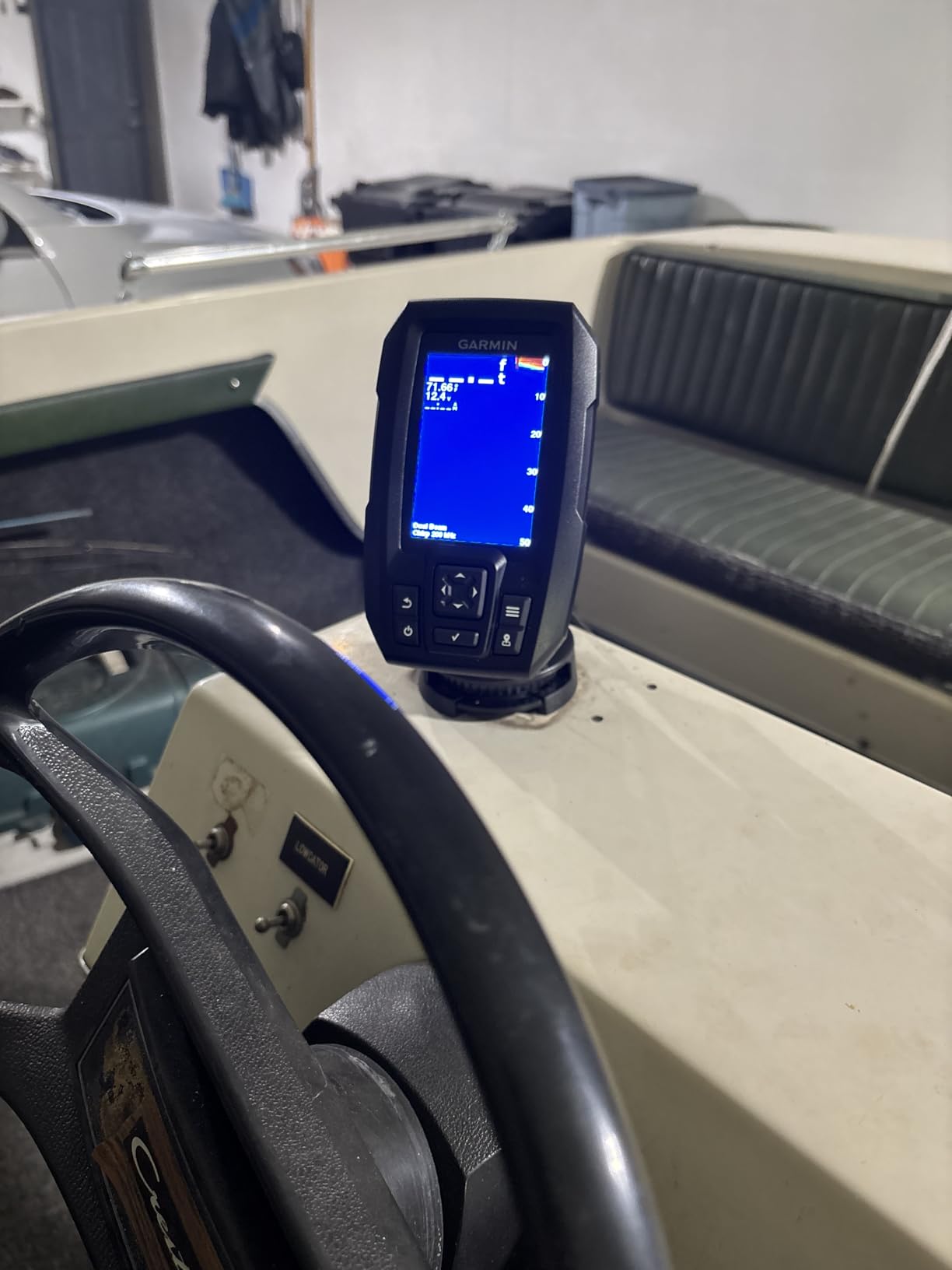
The Garmin STRIKER 4 is the unit we fit first when a pontoon owner asks for a simple upgrade over a basic depth gauge. It weighs 8 ounces, draws 0.23 amps at 12 volts, and carries a 1-year limited warranty, so it is an easy install on a boat that has never had a networked display.
It does more than most people expect at this size. You get CHIRP traditional sonar, ClearVu scanning sonar, built-in GPS, waypoint mapping, and a built-in flasher for ice. The box includes the tilt and swivel mount plus transom and motor mounts, which matters on a pontoon because you will move the unit between the log and the trolling motor.
The 3.5-inch LCD is the one compromise. It reads fine under a bimini and at low sun angles, but a driver sitting upright and back from the helm will strain at it. The maximum measuring depth of 1600 feet covers any lake or reservoir you will fish.
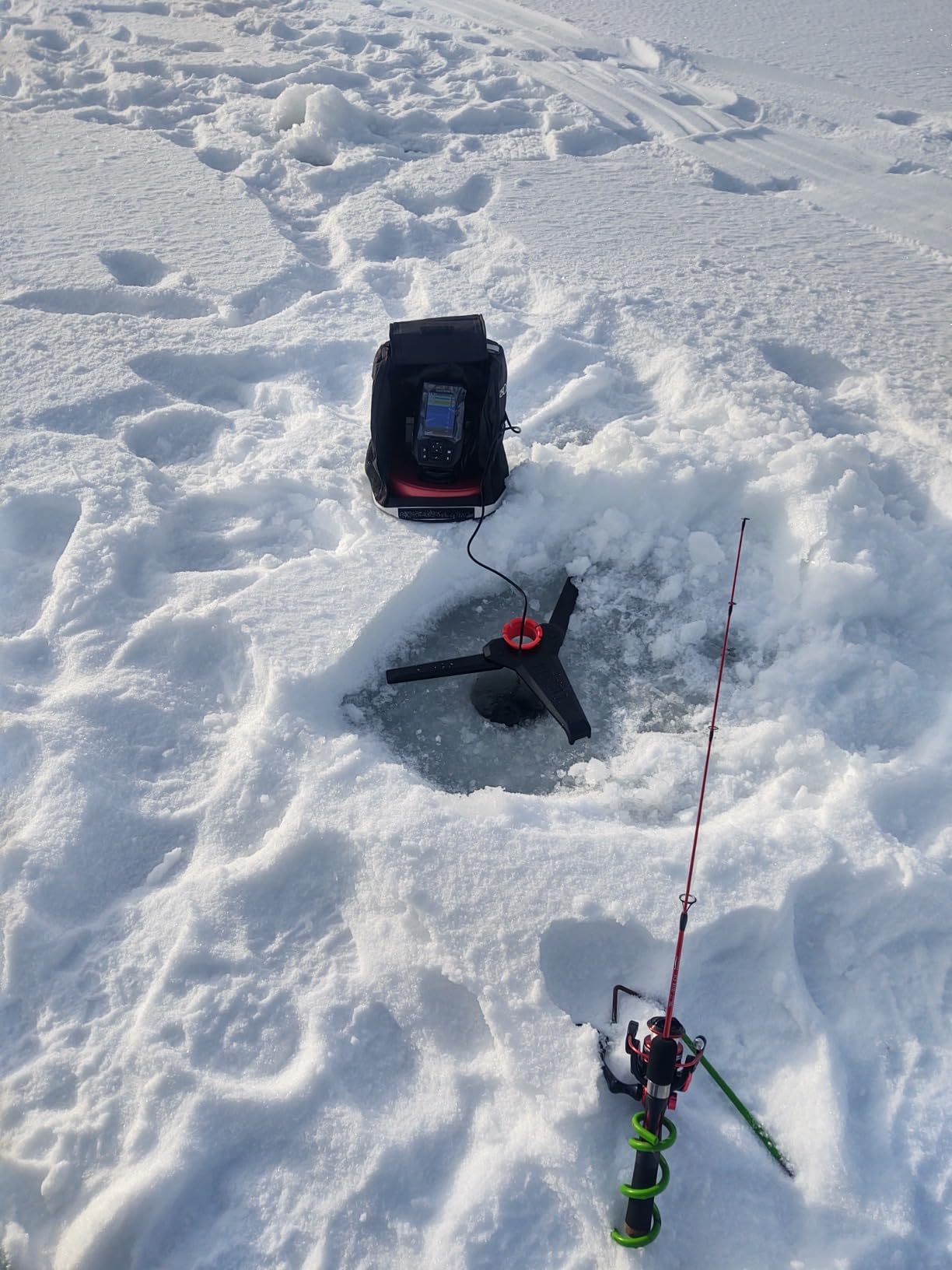
Buyers consistently report accurate depth readings and clear display in sunlight, and the 9312 reviews make this the most proven unit in the category. Installation is described as easy, with accurate CHIRP performance holding steady once the transducer is mounted correctly.
Two details get repeated in the negative feedback. The power and data cable is thin, so plan your run before you crimp anything, and there are no preloaded charts, only Quickdraw Contours. If you want out-of-the-box mapping, this is not the box.
What to check before you buy
Measure the sight line from your seated position at the helm, not standing. Hold a 3.5-inch screen at arm’s length from where your head will be and see whether you would fish a split screen at that size.
Check that your console has a flat spot for the panel mount. The STRIKER 4 is a panel-mount unit, and a curved pontoon helm may need the included tilt and swivel bracket instead.
Who should skip it
Skip it if you fish from a second helm seat more than a few feet away, or if you want a chart you can navigate by on a lake you do not know. Those two needs push you to a 5-inch or larger unit with preloaded mapping.
Skip it if your boat already has a working chartplotter and you only need a sonar picture. In that case the display is the wrong thing to spend money on, and a larger side imaging unit on the same helm does more for you.
2. Garmin STRIKER Vivid 4cv – Best Color Picture for the Money
Garmin Striker Vivid 4cv Fishfinder with Transducer – 4-inch…
4 inch color LCD
Vivid scanning palettes
CHIRP and ClearVu
Quickdraw Contours
GT20 transducer
Pros
- Vivid color palettes separate fish from structure easily
- ClearVu scanning sonar included
- Quickdraw Contours built in
- GT20 transducer in the box
Cons
- 4 inch screen limits split-screen layouts
- No SideVu capability
The Garmin STRIKER Vivid 4cv is the best color picture you can get on a pontoon helm without stepping up a size. At 4 inches it adds roughly half an inch of screen over the STRIKER 4, and that extra space matters more than the spec sheet suggests when you are reading bottom structure at speed.
The headline feature is Vivid scanning sonar color palettes. Instead of a fixed blue-on-blue scheme, you get a set of high-contrast palettes that make fish arches and drop-offs visually separate. The hardware underneath is CHIRP traditional plus CHIRP ClearVu scanning sonar, with high-sensitivity GPS and Quickdraw Contours mapping.
It is a bail mount with a 2-year limited warranty, and the box carries the GT20-TM transducer, power and data cable, tilt and swivel mount, and hardware. That transducer is the piece you want on a log bracket, since it handles both transom and motor mounting.
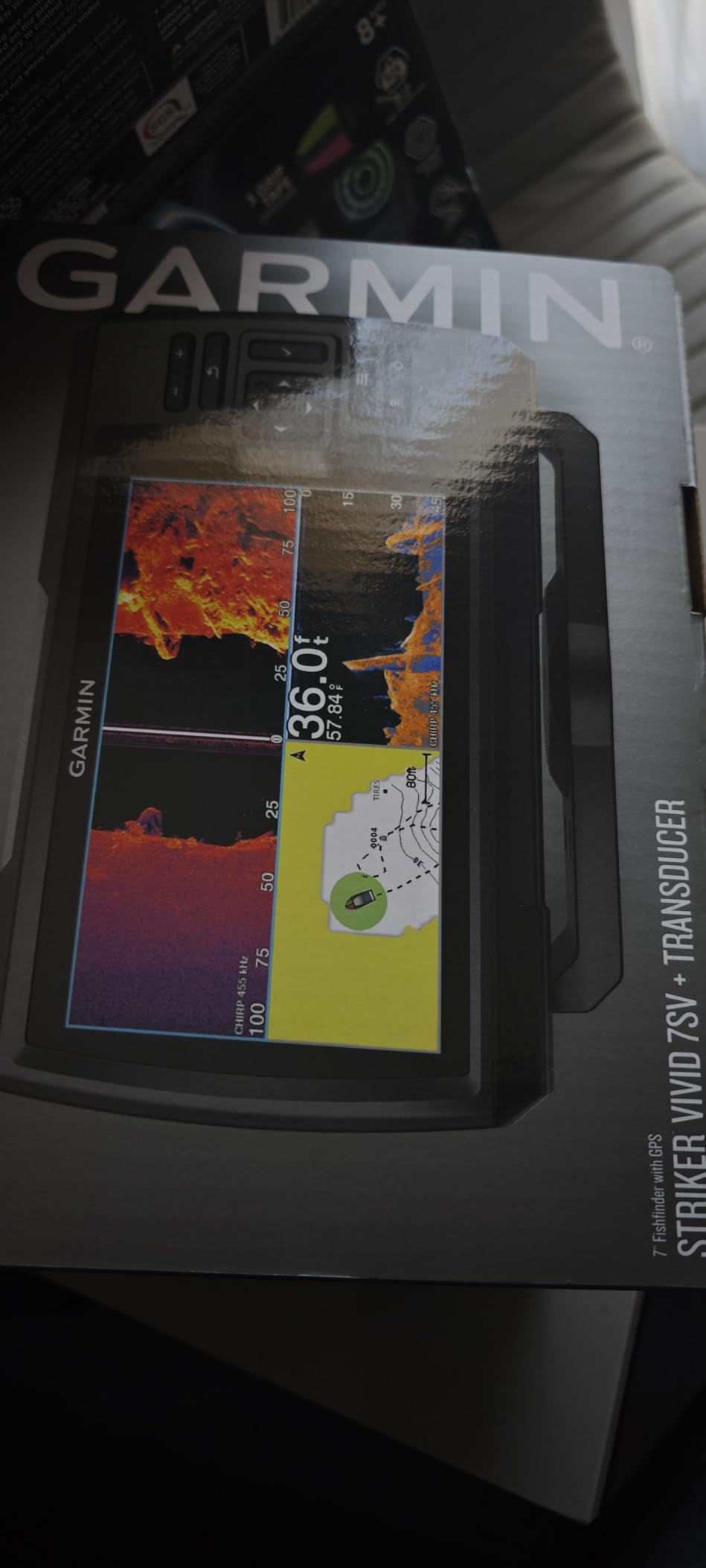
Reviewers call out how much easier the Vivid colors make it to tell fish from structure, and the 4.7 rating across 1861 reviews reflects that. GPS functionality and the simple interface come up just as often, which is why this unit works well for a first-time electronics buyer.
The complaint that comes back most is simply the screen size, and the second is the absence of SideVu. Side imaging is what lets you scan wide to either side of the boat, and without it you are still working a cone directly under and behind the hull.
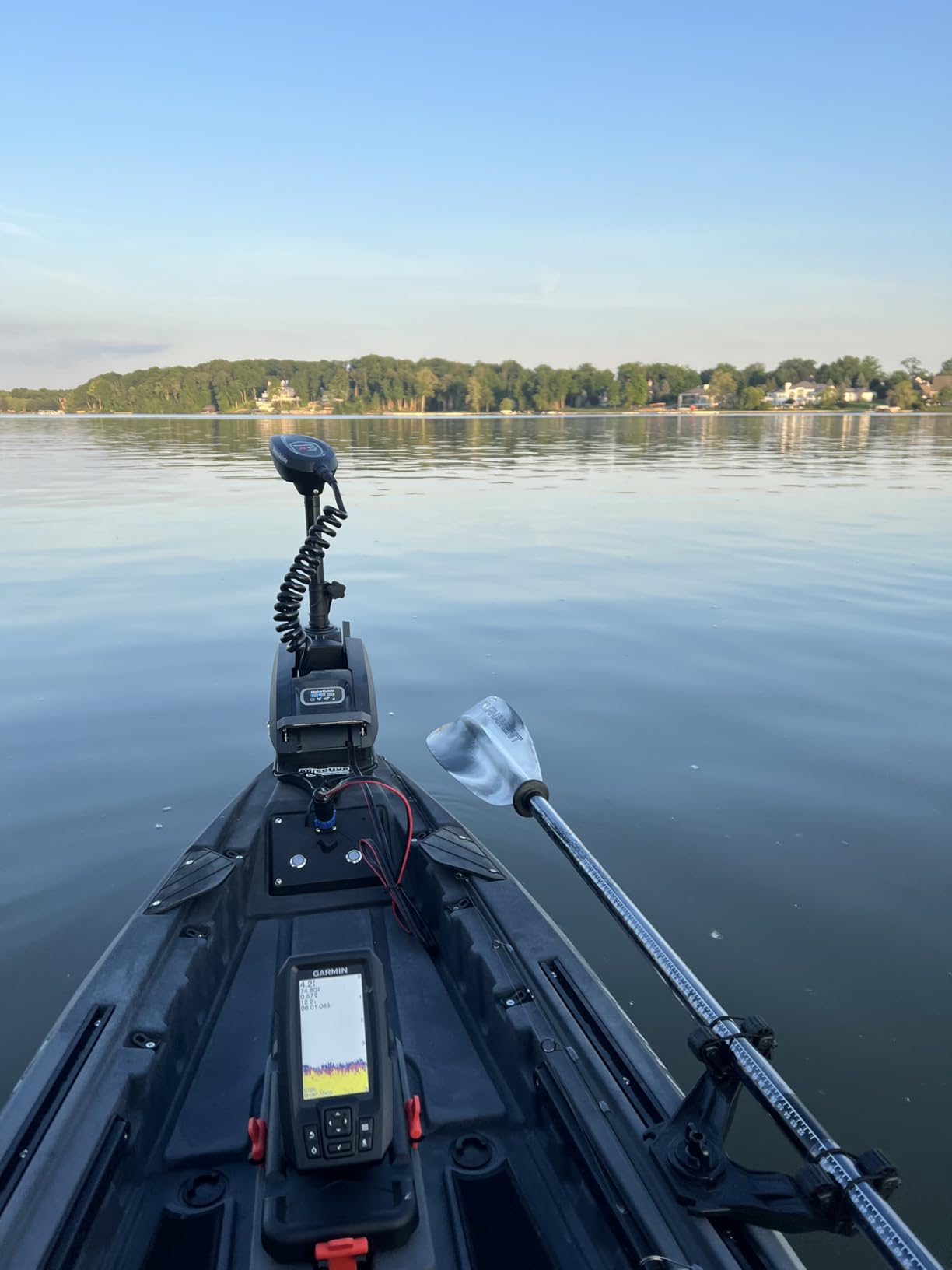
How it performs in bright sun
The 4-inch color screen is noticeably easier to read than a monochrome unit in open sun, and the Vivid palettes hold their contrast better at an angle. On a pontoon with no console shade, that difference is what decides whether you can fish at noon.
Split-screen sonar and mapping gets tight at 4 inches, so plan to run sonar full screen and pull the map up only when you are marking a waypoint. Owners of larger units tend to make the same adjustment.
Who should skip it
Skip it if you are strictly a side-scan angler. The Helix 7 Chirp SI G4 in this lineup gives you true side imaging, and the Lowrance Elite FS gives you both sides and down imaging in one transducer.
Skip it if your helm is more than about 30 inches from your seated head position. At that distance a 4-inch screen is a compromise rather than a solution, and a 5-inch or 7-inch unit costs little more relative to the boat’s total electronics spend.
3. Humminbird PiranhaMAX 4 – The Simplest Sonar Install
Humminbird PiranhaMAX 4 Fish Finder with Transducer, Dual…
4.3 inch LCD
Dual beam sonar
XNT 9 28 T transducer
600 ft depth
Tilt and swivel mount
Pros
- Dual beam sonar gives you a wide and narrow view
- Simple intuitive keypad interface
- Transducer included
- Low draw on a small battery bank
Cons
- No GPS at all
- Basic monochrome display
- Limited to 600 ft depth
The Humminbird PiranhaMAX 4 is the simplest way to put a real sonar picture on a pontoon that has never had one. It weighs 2 pounds, mounts with the included tilt and swivel bracket, and the XNT 9 28 T transom-mount transducer is in the box.
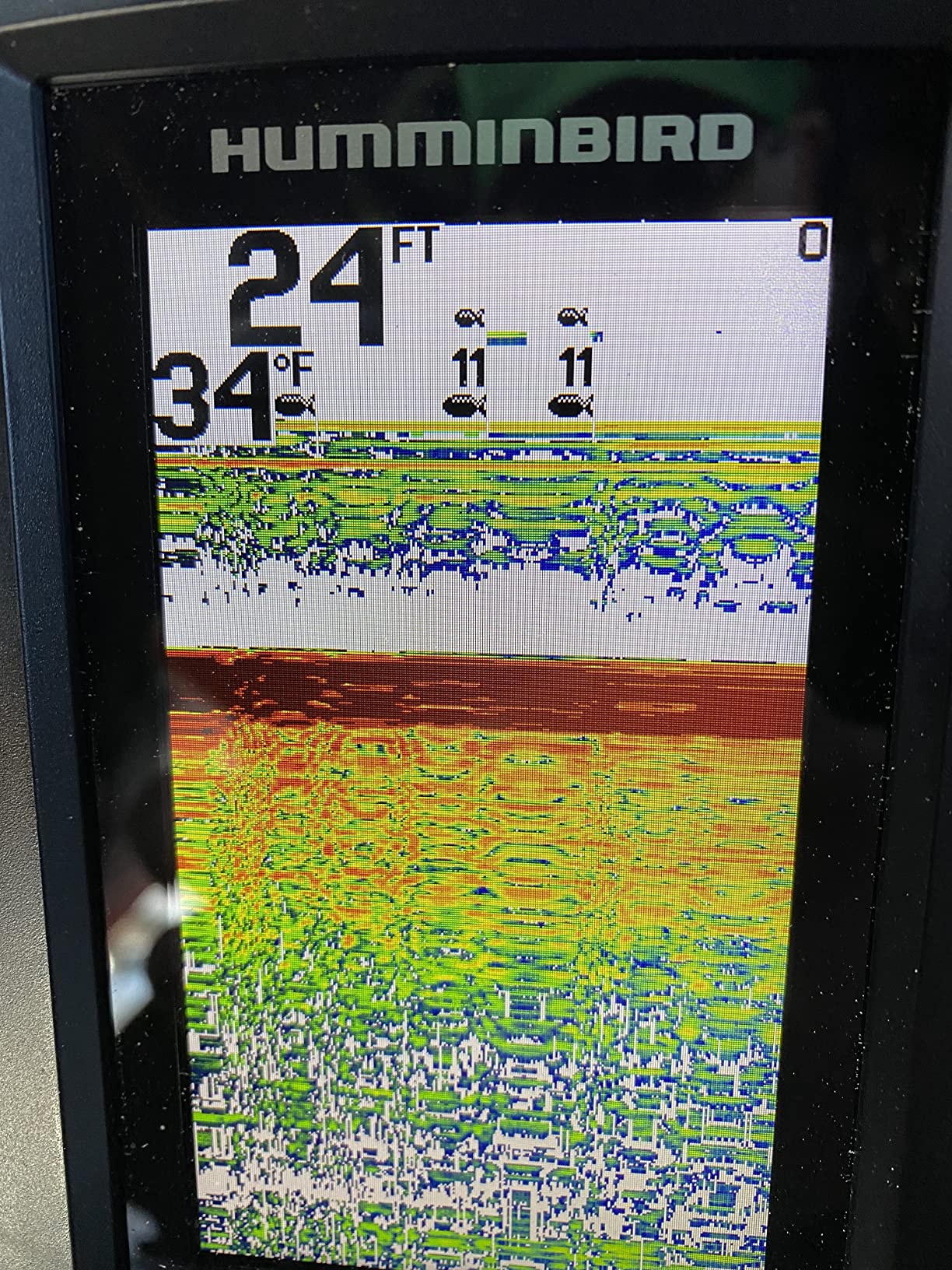
Dual beam sonar gives you a choice of narrow and wide beams from the same transducer. The wide beam finds fish, the narrow beam separates targets and reads depth more precisely, and switching between them is a single keypad press. That is genuinely useful when you are deciding whether an arch is a fish or a stump.
The tradeoffs are structural. There is no GPS, so no waypoints and no position, and the display is a basic monochrome LCD with a 600-foot depth limit, which rules out most western reservoirs and offshore water.
Owners rate it highly for depth accuracy, simple installation, and a straightforward interface that needs no manual. Dual beam flexibility is the word that comes up most, and the 4.6 rating across 1328 reviews reflects a unit that does one job well.
The negative feedback is consistent and easy to plan around. No GPS and no mapping means you are casting blind and finding your way back by landmarks or phone, which on a large winding lake is a genuine problem rather than a minor one.
Where it fits on a pontoon
Because there is no GPS, this unit mounts and hides easily, which makes it a good choice for a swim platform, a secondary helm, or a boat where the wiring run is short. The tilt and swivel bracket lets you aim the screen toward the driver rather than the console.
Keep the transducer bracket as far off the logs as the hardware allows, and check the reading while running at your usual cruising speed before you trust it. A 600-foot range is plenty for shallow lakes and rivers, and thin for everything else.
Who should skip it
Skip it if you fish the same spots repeatedly. Without waypoints you are re-finding structure every trip, which is exactly the problem a mounted GPS unit solves for very little more money.
Skip it if you want to see fish holding beside structure rather than directly under the hull. Dual beam is a cone, not a picture, and there is no side or down imaging to widen it.
4. Garmin STRIKER 5CV – Best Readability for a Seated Helm
Garmin 010-01872-00 STRIKER 5CV with Transducer, 5″ GPS…
5 inch WVGA color
CHIRP and ClearVu
Quickdraw Contours
CV20-TM transducer
2300 ft depth
Pros
- 5 inch sunlight-readable WVGA color display
- Quickdraw Contours builds your own maps
- 2300 ft depth handles deep water
- Transducer and both mounts included
Cons
- No preloaded maps
- No Wi-Fi or SD card slot
- No side imaging
The Garmin STRIKER 5CV is the point in this lineup where screen size finally matches the typical pontoon helm. At 5 inches with a WVGA color panel, it is the first unit here that most seated drivers can read without leaning forward, and that is the whole point.
Sonar is CHIRP traditional plus CHIRP ClearVu scanning, with built-in GPS and Quickdraw Contours for recording your own mapping. The 2300-foot maximum depth means it works on deep reservoirs and rivers where the 4-inch units stop making sense.
It is a surface mount and the box carries a CV20-TM transducer, transom and trolling motor mounts, a power and data cable, and a tilt and swivel mount. The 1-year limited warranty is the shortest in this roundup, which is worth noting if you keep a boat in hard water.
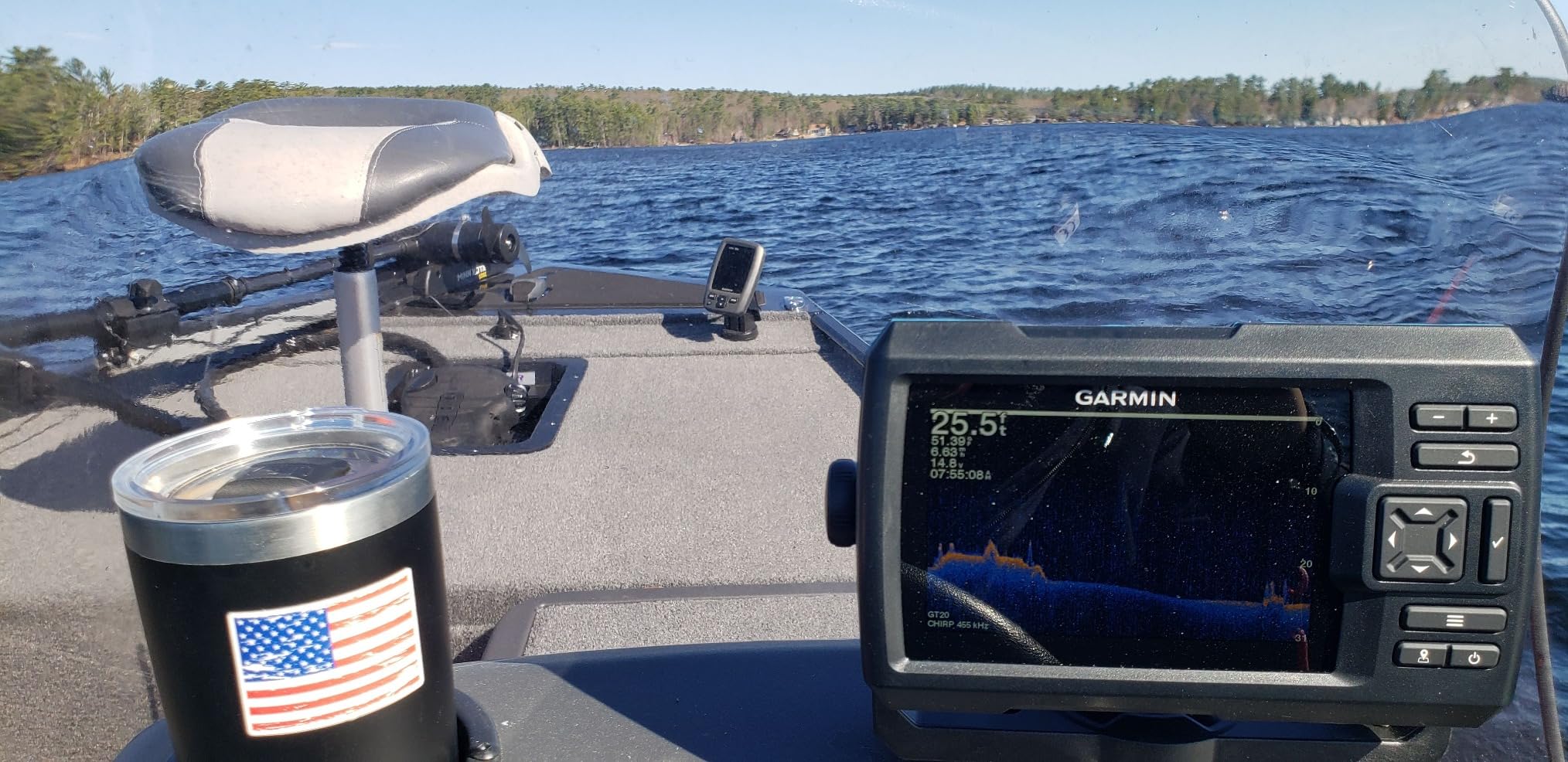
Reviews highlight the bright sunlight-readable display and how well Quickdraw Contours replaces paper charts on a familiar lake. Owners also praise the build quality and the value of getting CHIRP, ClearVu, and GPS together in one box.
What you give up is the map that comes preloaded. There is no Wi-Fi, no ActiveCaptain, and no SD card slot, so all charting is drawn by hand. Side imaging is also absent, so this stays a forward-looking sonar unit.
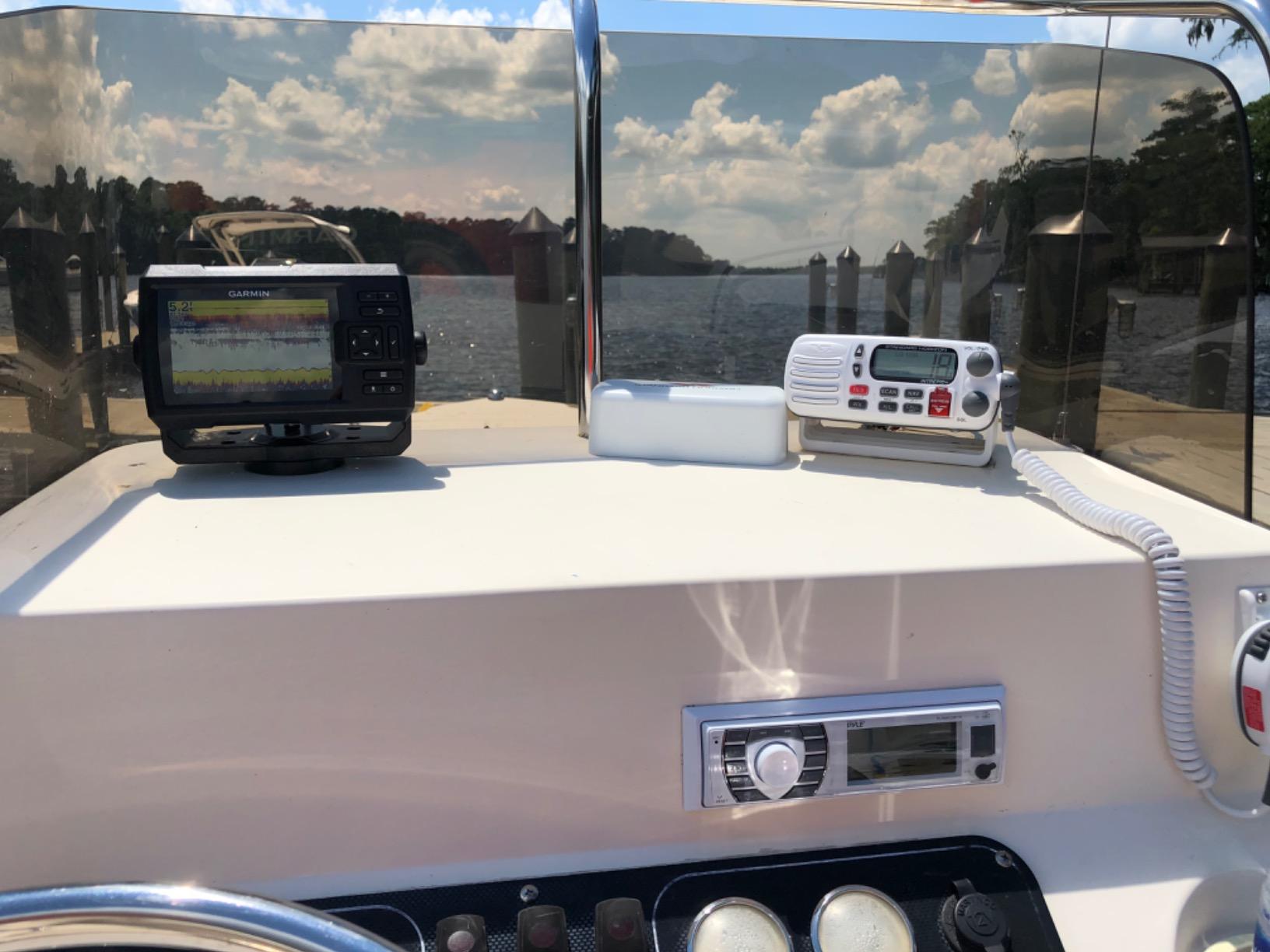
Why 5 inches is the pontoon sweet spot
On a bass boat, 4 inches is workable. On a pontoon, the driver sits upright and further back, and often twists around in a seat, which pushes your viewing distance past 30 inches. At that range a 5-inch WVGA panel is the smallest screen that stays legible in direct sun.
A 5-inch screen also finally gives you usable split screen. Sonar on one side and your recorded contours on the other stops being a guessing game, which matters when you are marking a spot you want to fish again next month.
Who should skip it
Skip it if you never leave one lake and do not need a chart. Quickdraw Contours on its own is enough once the boat is home, and spending more does not change the sonar picture.
Skip it if you want to see structure beside the boat. Without side imaging you are working a single cone, and the Helix 7 Chirp SI G4 in this lineup does that for a similar spend.
5. Humminbird Helix 5 Chirp GPS G3 – Best for Mapping on the Water
Humminbird Helix 5 G3 GPS Fish Finder with Transducer & Dual…
5 inch color TFT
Dual Spectrum CHIRP
Humminbird Basemap
AutoChart Live
XNT 9 HW T transducer
Pros
- Basemap with 10000 plus lakes already loaded
- AutoChart Live records your own contours
- Dual Spectrum CHIRP wide and narrow modes
- Softkeys work with wet hands
Cons
- Power cable may be too short for a pontoon run
- No side or down imaging
- Keypad only with no touchscreen
The Humminbird Helix 5 Chirp GPS G3 is the mid-range choice for an owner who cares more about mapping than about side imaging. The Humminbird Basemap already carries more than 10,000 lakes, so you can navigate unfamiliar water on day one instead of drawing contours from scratch.
Dual Spectrum CHIRP gives you both wide and narrow traditional sonar modes, and AutoChart Live records about 8 hours of live contour data. The unit is also compatible with LakeMaster, CoastMaster, and Navionics cards if you subscribe to anything more detailed.
The controls are a keypad with softkeys rather than a touchscreen. In a boat with wet hands and a fishing rod in the other hand, that is an advantage, not a limitation, and owners tend to come around to it quickly.
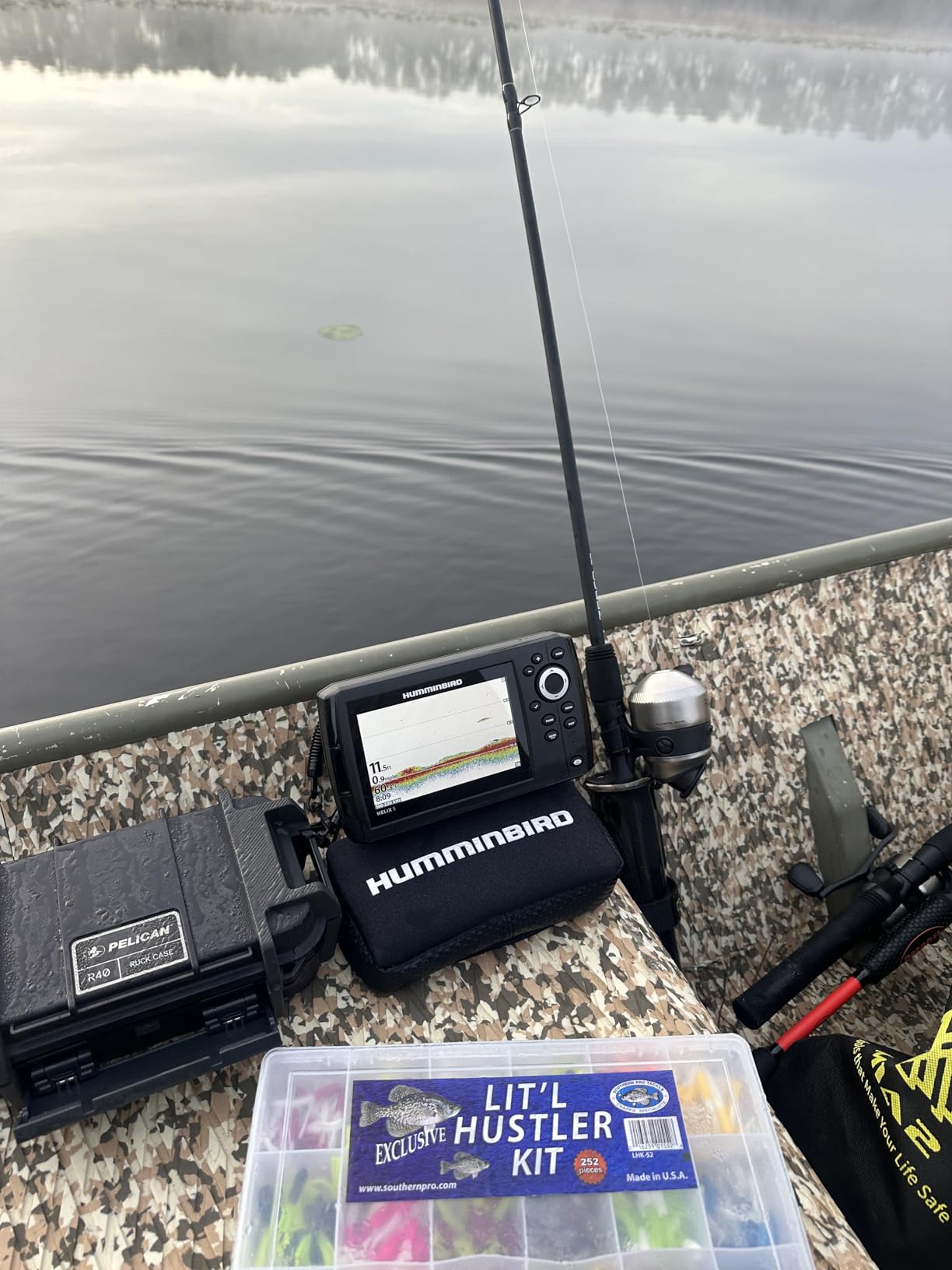
Reviewers point to the preloaded basemap and AutoChart Live as the deciding features, plus good sunlight visibility and simple installation. At 4.4 across 488 reviews it sits slightly below the Garmin units on consistency, and the reason shows up in the wiring complaints.
The most common negative feedback is installation hardware rather than performance. The power cable can be short for a full run under pontoon decking, and some owners report that a fuse and extra wiring are not in the box, so budget for those two parts before the install day.
Mapping versus recording your own contours
Preloaded maps tell you where you are. Recorded contours tell you the shape of the bottom, which is how you find a ledge, a channel, or a drop-off that is not near a named feature. The Helix 5 does both, and AutoChart Live records about 8 hours before you stop.
The catch is resolution. An 8-hour recording at trolling motor speed covers a few miles, and you will record more usefully on one lake than five. Fish the same water you fish, and let the unit build depth in the places you return to.
Who should skip it
Skip it if you already know your lake and fish it weekly. The mapping is the premium here, and on a familiar lake you will use maybe a tenth of it.
Skip it if you want to know what is beside the boat. There is no side imaging and no down imaging in this box, so you get a forward cone and a chart, and nothing between them.
6. Lowrance Elite FS 10 Inch – Best for a Large Shared Helm
Lowrance Elite FS 9 Fish Finder with Active Imaging 3-in…
10 inch touchscreen
Active Imaging 3-in-1
ActiveTarget 2 live sonar ready
C-MAP charts
NMEA 2000
Pros
- Active Imaging 3-in-1 covers sides and down in one transducer
- 10 inch touchscreen readable from a distance
- Live sonar compatible through ActiveTarget 2
- C-MAP charting and screen mirroring included
Cons
- Steep learning curve on the advanced menus
- Cable routing under the deck takes planning
- Large unit needs a real mounting surface
The Lowrance Elite FS is the unit for a pontoon with a wide helm, a second driver, or a tri-toon layout where one person is often standing well away from the console. At 10 inches with an LCD touchscreen, the display is readable from the back of the deck, which no other unit in this roundup manages.
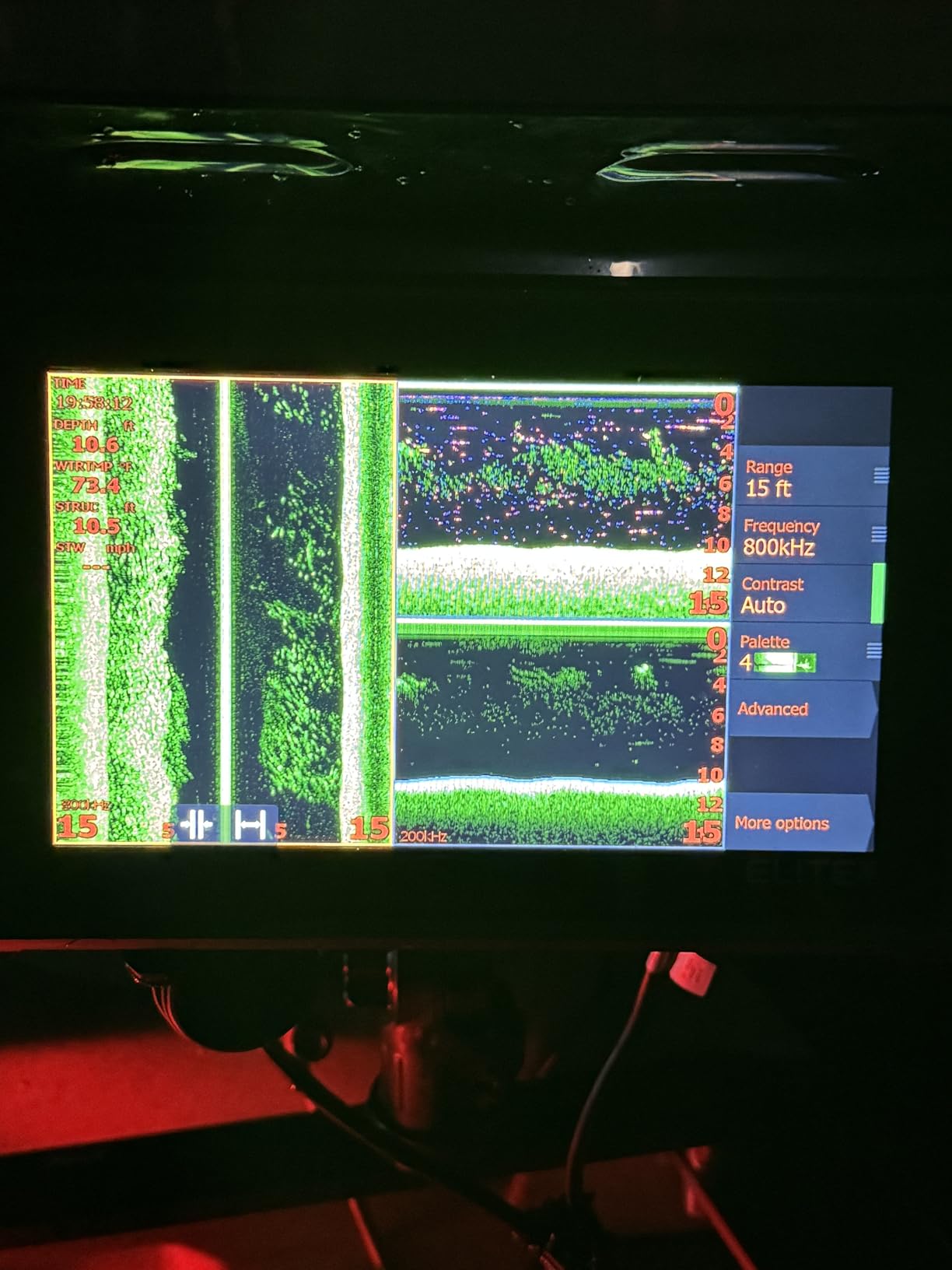
The Active Imaging 3-in-1 transducer is the reason to stretch here. It gives you CHIRP traditional, SideScan, and DownScan from a single element, so you can watch fish beside the boat and directly beneath it without buying a second sensor. FishReveal processing cleans up the down view enough that you can pick fish out of structure.
It is also the networking option in this group. NMEA 2000 connectivity, C-MAP charting, and screen mirroring to a phone mean it can share data with other displays later. The box includes the display, the 3-in-1 transducer, a suncover, fuse and holder, corner clips, a mounting bracket with knobs, and a power cable, with a 2-year warranty.
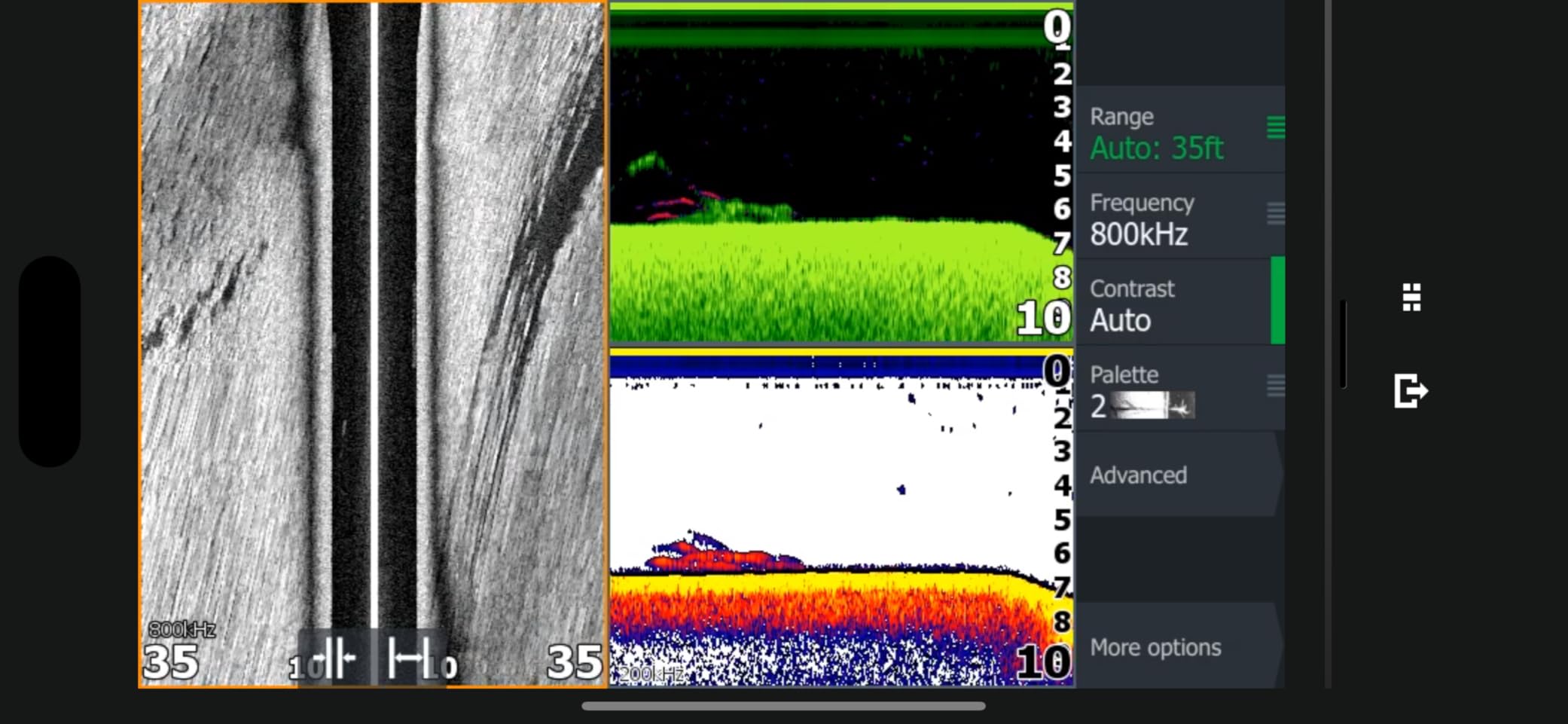
Owners single out the SideScan and DownScan quality and the touchscreen, and several note that the feature set compares well against Lowrance’s higher-end displays. At 4.6 across 511 reviews it holds a solid position, and screen mirroring is mentioned often as a genuine everyday convenience.
The negatives are consistent. There is a real learning curve in the menus, and routing the transducer cable from a log bracket to a helm at the opposite end of the deck is a job that takes planning rather than luck. The 1000-foot depth rating also stops short of the 2300 feet the STRIKER 5CV reaches.
Fitting a 10 inch display on a pontoon
A 10-inch unit is a dashboard part, not an accessory. Measure the flat area above the console before you commit, and check that the bracket does not eat into the windshield sight line. A suncover helps, and this one includes it.
On a tri-toon, the cable run is the real work. Plan the path from the log bracket to the helm before you drill anything, secure it to the deck structure rather than to the carpet, and leave slack at both ends so the boat can flex as you take a wake.
Who should skip it
Skip it if you fish one lake and never share the boat. You would be paying for networking capacity and screen size you do not use, and a 5-inch unit covers the same sonar work.
Skip it if your console is a curved pedestal with no flat mounting surface. Forcing a 10-inch unit onto a spot mount puts it in your sight line and rattles, which is worse than a smaller display mounted cleanly.
7. Lowrance HOOK Reveal 5 SplitShot – Best Down Imaging Per Dollar
Lowrance HOOK Reveal 5 SplitShot – 5-inch Fish Finder with…
5 inch SolarMAX display
FishReveal CHIRP and DownScan
SplitShot transducer
Preloaded C-MAP inland maps
Pros
- Preloaded C-MAP maps for about 4000 lakes
- DownScan finds fish directly below the boat
- Autotuning sonar removes manual gain settings
- Genesis live mapping on top of preloaded charts
Cons
- Some units arrive with transducer communication faults
- 5 inch screen is small for split-screen work
- Cable routing is awkward on a log bracket
The Lowrance HOOK Reveal 5 SplitShot is the least expensive unit in this roundup that gives you true down imaging, which shows you fish holding directly beneath the boat rather than out ahead of it. That view is what separates a school from a single cruising fish.
FishReveal combines CHIRP and DownScan into one display, and the SplitShot transducer supplies high CHIRP plus DownScan from a single element. Unlike the 4-inch units, it also arrives with preloaded C-MAP US Inland mapping covering roughly 4,000 lakes, and Genesis lets you record on top of it.
It is a flush mount with a 1-year warranty, and the SolarMAX display is rated for sunlight readability. The 5-inch screen and autotuning sonar make it the least fiddly unit here, since the sonar adjusts itself rather than waiting for you to chase the gain bar.
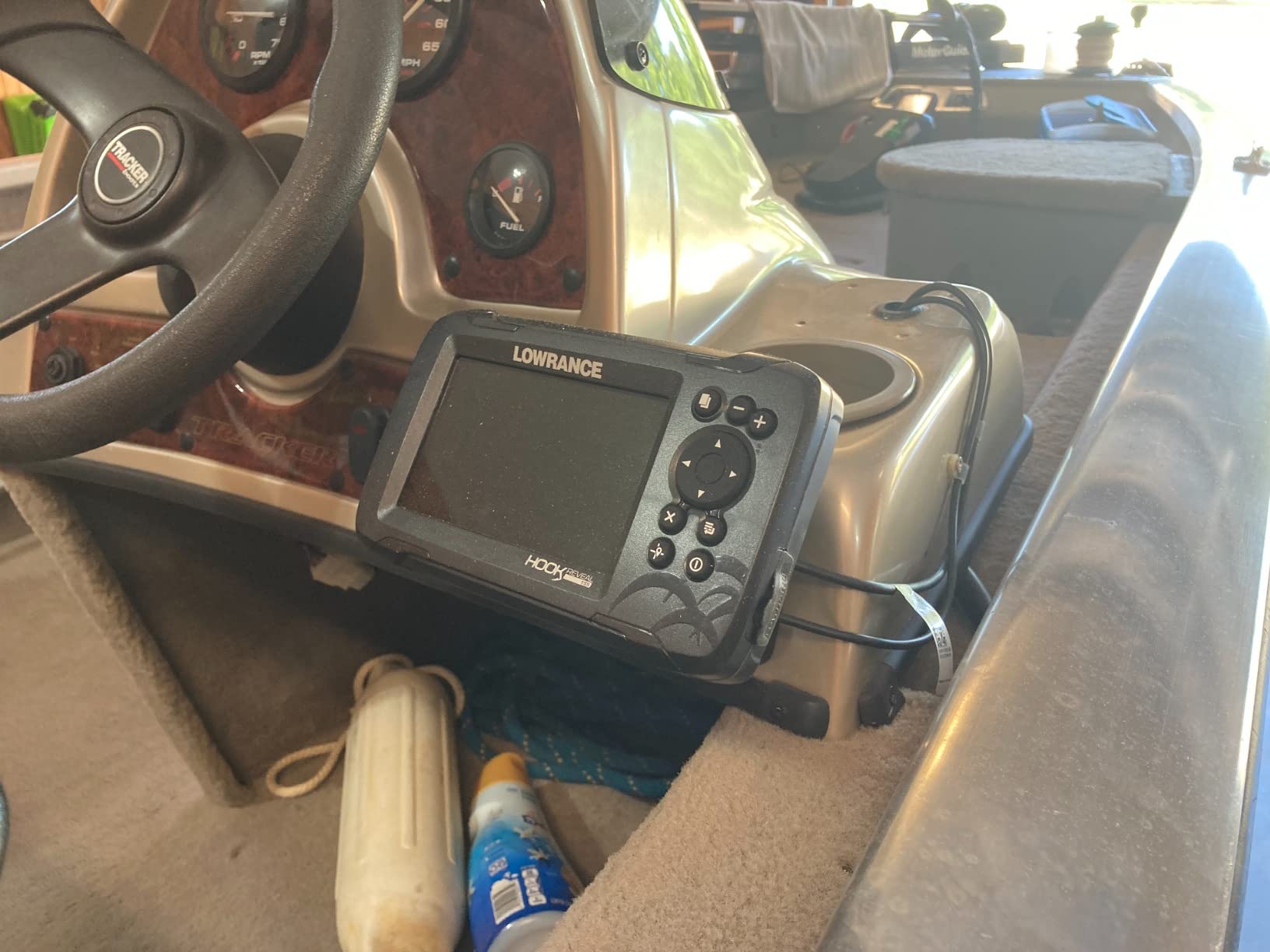
Reviews like the preloaded map count, the FishReveal picture, and how well the display holds up in sun. The 4.2 rating across 424 reviews is the lowest in the group, and the reason is almost always quality control rather than the design.
Owners report that some units arrived with transducer communication issues, and cable routing to a log bracket is called out as awkward on this model specifically. Test the transducer at the dock before you run the cable under the deck.
Down imaging versus side imaging
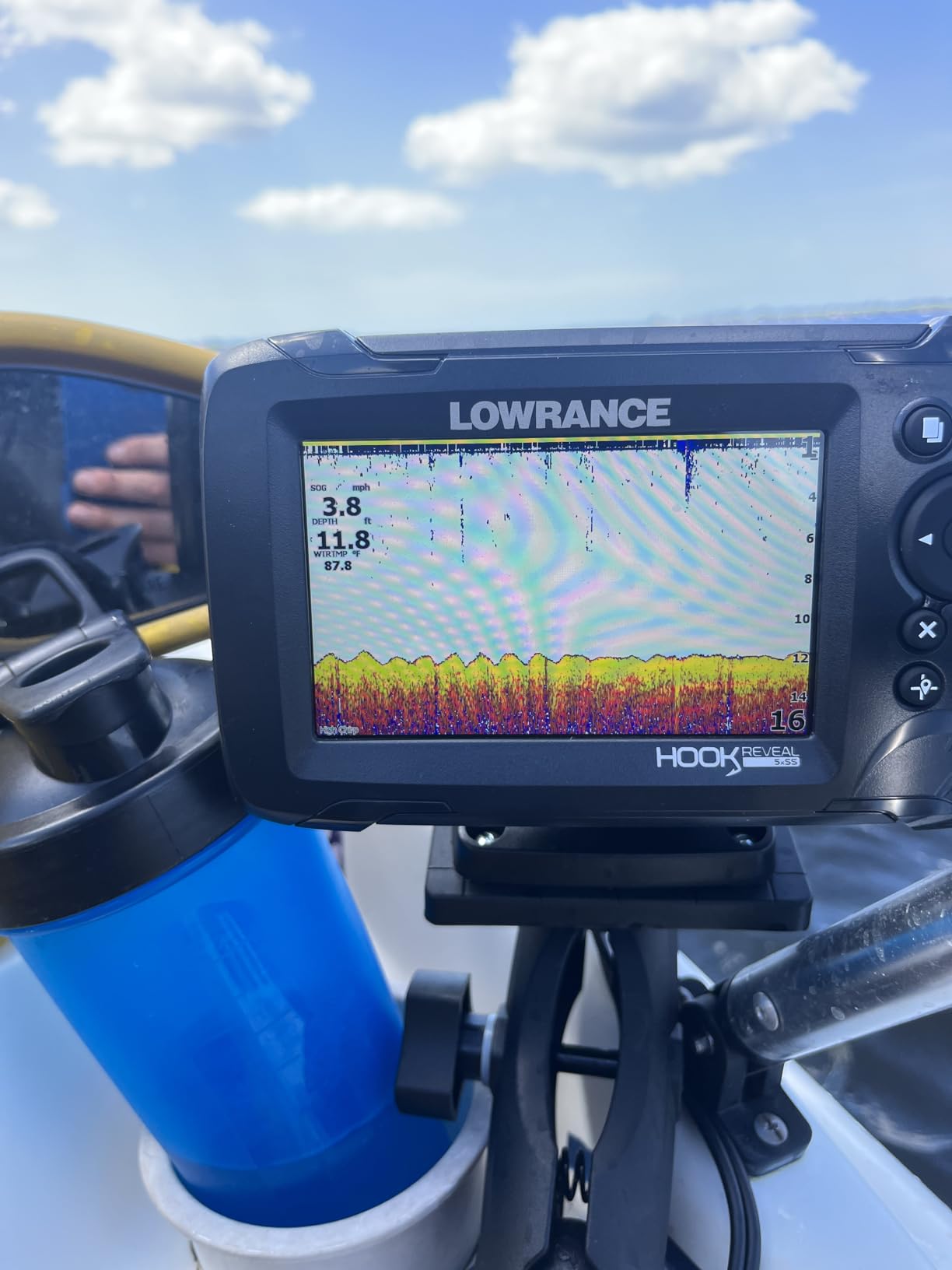
Down imaging looks straight down and tells you what is under the boat. Side imaging looks to either side and tells you what is beside it. On a pontoon drifting at trolling motor speed, down imaging is what finds you the school you can then cast to.
The limitation here is that DownScan alone covers a narrow strip. Once you find a school, you still turn and work it with the CHIRP forward view. Owners who fish structure-heavy water tend to move up to a unit with both.
Who should skip it
Skip it if you have had reliability problems with Lowrance transducers before, since the communication faults in the feedback come from the factory rather than from installation. A Helix unit removes that variable for the same money range.
Skip it if your fishing is mostly along steep banks and channel edges. DownScan sees under the boat, and a unit with SideScan sees the drop-off before you arrive at it.
8. Lowrance Eagle Eye 9 Live Sonar – Best Entry Point to Live Sonar
Lowrance Eagle Eye 9 Live Sonar Fish Finder with C-MAP US…
9 inch IPS display
Live Forward and Live Down sonar
CHIRP with DownScan
Preloaded C-MAP charts
Pros
- Live Forward and Live Down sonar in the box
- Transducer connects directly with no extra module
- Preloaded C-MAP charts for 17000 plus lakes
- 9 inch IPS panel is bright and readable
Cons
- Depth limited to 500 feet
- No side imaging
- Some GPS reliability complaints
The Lowrance Eagle Eye 9 Live is the straightforward way to own live sonar without buying a separate live module. Live Forward and Live Down sonar both run from an all-in-one transducer that plugs straight into the display, which removes the box and extra cable that a modular live system needs.
Traditional CHIRP and DownScan with FishReveal are there as well, so you get live imagery, a forward view, and a down view from one installation. Preloaded C-MAP US Inland charts cover more than 17,000 lakes, and Genesis live mapping records your own detail on top.
The 9-inch IPS LCD is bright enough to read in open sun and wide enough that a passenger standing behind the helm can see it. The box carries the display, power cable, gimbal bracket, replacement twist locks, corner clips, and the live transducer pack, with a 2-year warranty.
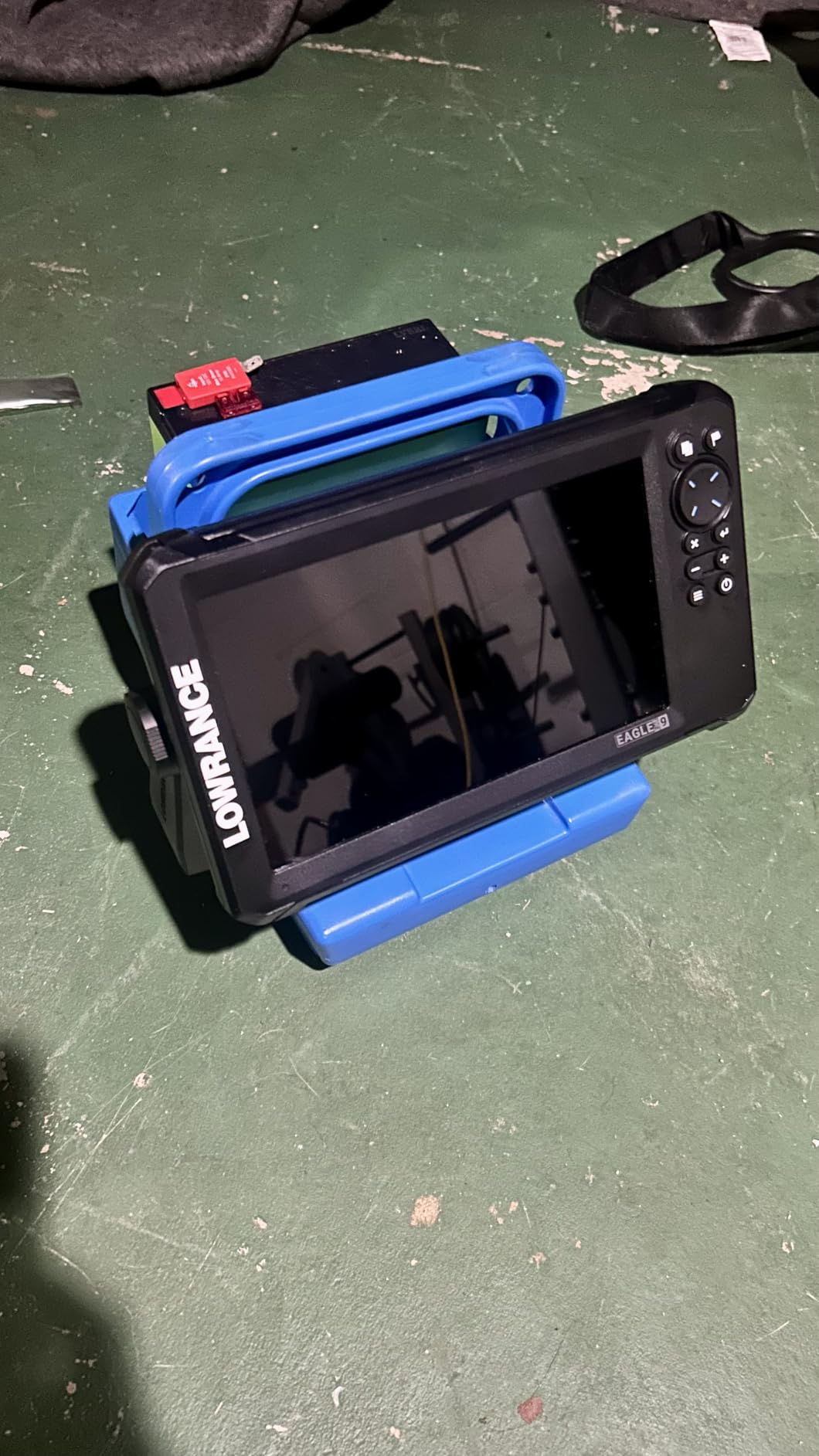
At 4.5 across 225 reviews, the owner feedback centers on getting live sonar without the extra hardware and on the size of the preloaded chart library. The 9-inch IPS display gets mentioned as easy to read from a standing position, which suits a pontoon deck.
Two limits are worth planning around. Depth capability stops at 500 feet, and there is no side imaging at all. Some owners also report GPS reliability concerns, so confirm your position locks before you run out to a spot and trust the track.
Who should buy live sonar on a pontoon
Live sonar earns its place when you fish slow. Watching a live forward view while the boat sits still or drifts at a knot tells you whether a shape is a fish, a rock, or a snag, before you drop anchor to commit.
It earns less when you are running at speed or fishing a river where the boat never stops. At pace, traditional CHIRP and a down image are more useful than any live view, and cheaper units handle that work fine.
Who should skip it
Skip it if you fish deep water regularly. A 500-foot limit rules out most western reservoirs, and the Elite FS in this lineup goes deeper with side imaging included.
Skip it if scanning to either side is your priority. Live sonar looks forward and down, not left or right, so you would be buying it and then still needing a side imaging unit.
9. Simrad GO 9 Inch – Best for Charting and Networking
Simrad GO9 XSE Chartplotter and Fishfinder with…
9 inch touchscreen
C-MAP DISCOVER chart card
HDI CHIRP and DownScan transducer
Wi-Fi, Bluetooth, NMEA 2000
Pros
- C-MAP DISCOVER charting with depth shading and tides
- Wi-Fi plus Bluetooth plus NMEA 2000 built in
- Radar ready for later upgrade
- Screen mirrors to a phone or tablet
Cons
- Transducer cable can be too short for a pontoon run
- Some units lost waypoints and tracks over time
- Reported GPS failures on early units
The Simrad GO is the pick for a pontoon owner who treats the display as a navigation hub rather than just a sonar screen. It arrives with a C-MAP DISCOVER chart card, and the card covers vector charts with depth shading, tides, and bathymetric detail rather than a simple outline basemap.
The connectivity is the strongest in this group. Built-in GPS with Wi-Fi, Bluetooth, Ethernet, and NMEA 2000 means it can network with other instruments, mirror its screen to a phone or tablet, and accept a radar dome later through HALO compatibility. The box includes the 9-inch MFD, an HDI transducer with CHIRP and DownScan, a suncover, the chart card, a gimbal bracket, and a power cable.
It is a 9-inch touchscreen at 3 pounds with a 2-year warranty, and it mounts by dashboard, panel, or bracket, which makes it easier to fit to a curved pontoon helm than a flush-only unit.
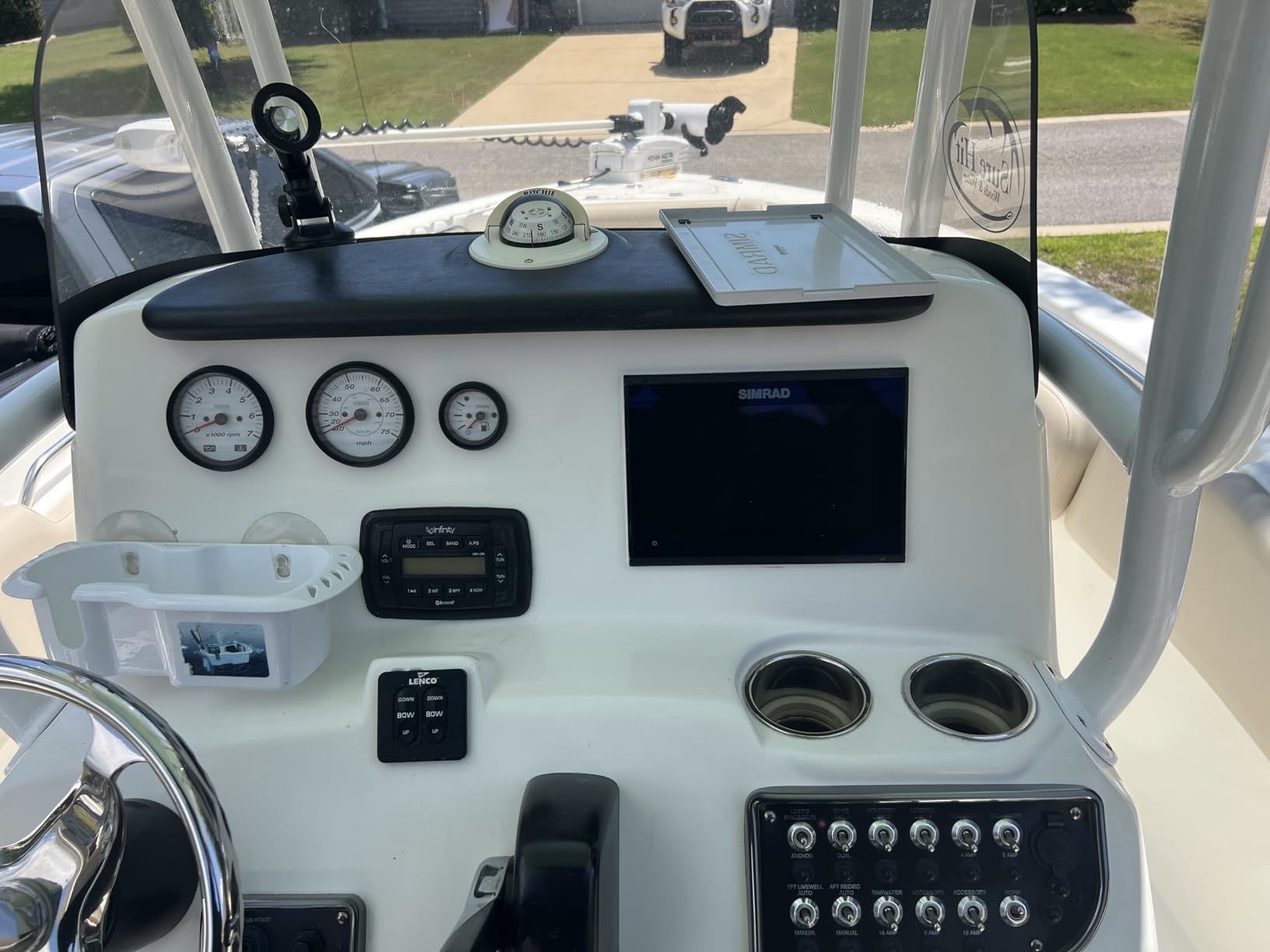
Owners praise the charting that comes in the box, the bright readable 9-inch display, and the intuitive touchscreen. The 4.4 rating across 148 reviews is the smallest review base here, so treat the feedback as direction rather than a settled record.
The negative reports are worth taking seriously. Several owners mention losing waypoints and tracks after a few months, and there are reports of GPS failures and side scan not working with the included transducer. Test GPS lock and confirm your transducer type at the dock.
Why the chart card matters more than the screen
A 10-inch screen showing an outline basemap is a bigger version of a small mistake. C-MAP DISCOVER adds depth shading, tide information, and bathymetric detail, and those layers are what let you pick a route around a shallow bar rather than discovering it at speed.
Screen mirroring is the quieter feature. Owners mirror the display to a phone or tablet, which is useful on a pontoon where a second person fishes off the swim platform and cannot see the console.
Who should skip it
Skip it if you never leave lakes you already know. The chart card and the networking are premium features for a boat that will be used on unfamiliar water or shared between two people.
Skip it if reliability history is your main concern. The waypoint and GPS complaints in the feedback are worth weighing against a simpler unit that does only sonar and GPS, with fewer things to fail.
10. Humminbird Helix 7 Chirp SI G4 – Best Side Imaging Value
Humminbird 411590-1 Helix 7 Chirp SI GPS G4
7 inch color TFT
CHIRP side and down imaging
Dual Spectrum 2D sonar
Basemap and AutoChart Live
Pros
- CHIRP side imaging and down imaging in one box
- 7 inch screen is easy to read from a pontoon helm
- Dual Spectrum CHIRP for target separation
- Basemap with 10000 plus lakes and AutoChart Live
Cons
- Keypad only with no touchscreen
- Box labeling can be confusing between SI and DI+SI versions
The Humminbird Helix 7 Chirp SI G4 is the best way to get true side imaging on a pontoon without moving into networked multi-function territory. Side imaging is the view that shows you fish holding beside the boat, along a bank or a weed edge, which a forward cone alone will never show you.
Down Imaging comes with it, so you have sides, down, and a Dual Spectrum CHIRP 2D forward view. The preloaded Humminbird Basemap covers more than 10,000 lakes, AutoChart Live records about 8 hours, and the unit accepts LakeMaster, CoastMaster, and Navionics cards for anything more detailed.
At 7 inches with a color TFT panel, the screen is the right size for a pontoon helm, and the keypad with softkeys is usable with wet hands. The box carries the control head, power cable, XNT 9 HW SI T transom-mount transducer, mounting hardware, and a gimbal bracket.
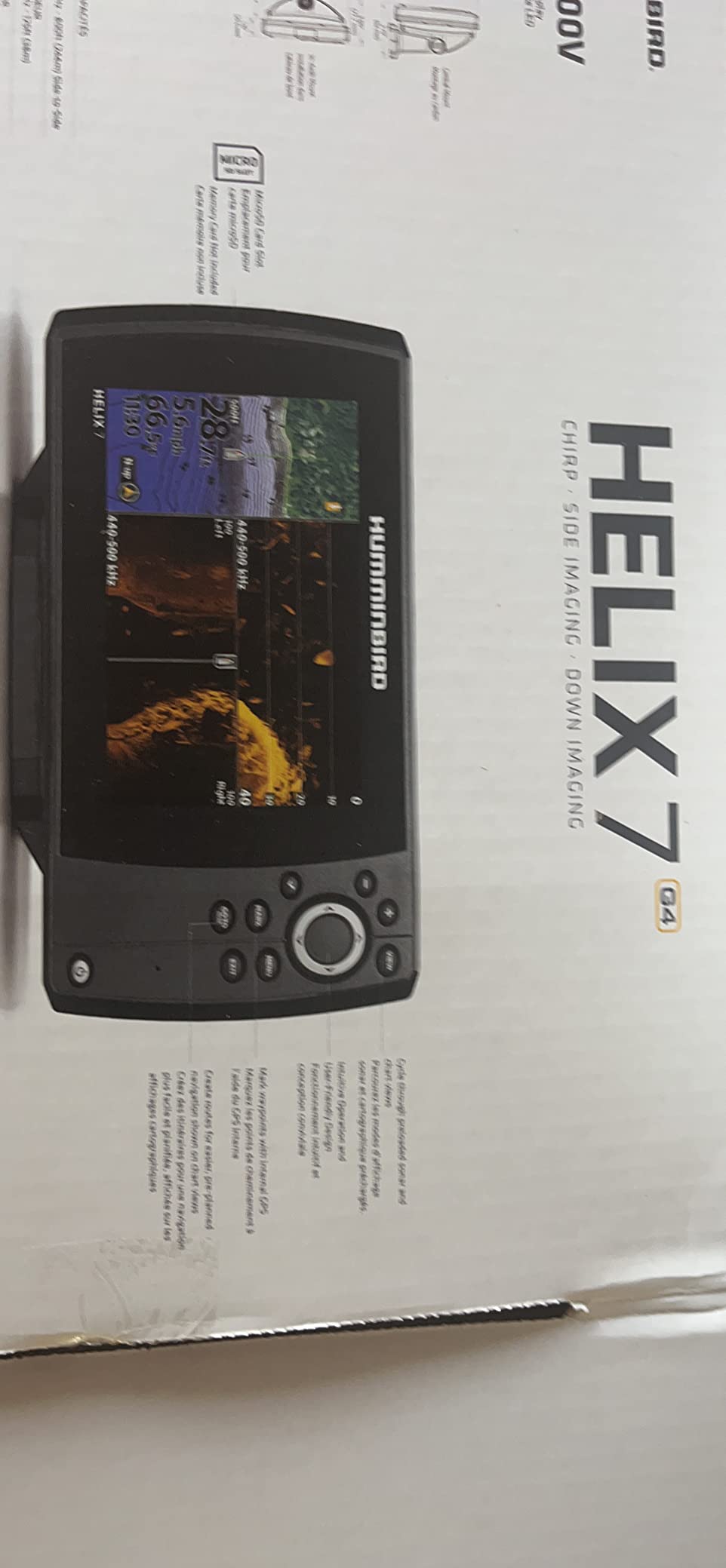
Reviewers call the imaging quality and the value for side imaging capability the standout points, and the 4.6 rating across 179 reviews is strong for a unit in this bracket. Ease of use and installation come up often as well.
The complaints are about packaging rather than performance. Owners report confusion over box labeling between the SI and DI plus SI versions, so confirm the model number 411590-1 on the box before you leave the counter.
How far off the logs to mount
Side imaging works by reading a narrow beam out to either side, and it hates being blocked. On a twin or tri-toon, mount the bracket on the outboard-facing log, away from the other logs, and as far from the drive and propeller as the hardware allows.
Run a pass at your normal cruising speed with side imaging on. If the picture breaks up or the range collapses as you accelerate, move the transducer up the log and repeat. It is the same fix that helps traditional sonar hold a bottom.
Who should skip it
Skip it if you fish from a swim platform or the back of the deck, since the side view from the helm does not help there. A wireless or castable sonar covers that use better.
Skip it if you want live imagery or future networking. This unit has no touchscreen and no NMEA 2000, so it is a standalone sonar and chartplotter rather than a hub for other instruments.
How to Choose a Fish Finder for a Pontoon Boat
Six decisions account for almost every difference between these units. Work through them in order, because each one narrows the next. Skipping to the last one and picking a screen size is how owners end up with a unit they cannot read from their own seat.
Screen size and viewing distance from a pontoon helm
Measure from your seated eye position at the helm, not from a standing position at the console. Pontoon drivers sit upright and back, and often reach a seat a few feet from the display, so the useful viewing distance is longer than on a bass boat of the same length.
Under about 4 inches, a 3.5-inch unit works only for a driver sitting close to the console. A 4-inch screen is the practical floor. A 5-inch panel is the sweet spot for most pontoons, and 7 inches or more is for a wide helm, a second helm, or a tri-toon where the display has to be read from further away.
Always check sunlight readability, not brightness. A color display with a sunlight-readable rating beats a higher-resolution panel that washes out at a low sun angle, which is a common condition on open water in the afternoon.
Which sonar type you actually need
Traditional CHIRP sonar sends a swept frequency and returns crisper arches and better target separation than a fixed-frequency unit. It is the baseline on most of the units here, and it is what you use while running to a spot.
Scanning sonar widens the picture. ClearVu on the Garmin units and FishReveal on the Lowrance units give you down and near-forward structure in color, which makes it easier to tell a fish from a rock. Side imaging goes further and scans out to either side of the hull.
Live sonar, such as the ActiveTarget 2 compatible Lowrance Elite FS and the Eagle Eye 9’s built-in live view, shows you a real-time image. It is worth it if you fish slowly, and it is not worth much if you cover a lot of water at speed.
GPS, waypoints and mapping
GPS turns a sonar into a tool you can navigate with. Waypoint marking lets you tag a ledge or a channel and come back to it, which on a lake with no landmarks is the difference between a good day and a wasted one.
Preloaded mapping arrives in different sizes here. The Humminbird Helix units carry a basemap with more than 10,000 lakes, the Lowrance HOOK Reveal 5 ships with C-MAP US Inland charts covering roughly 4,000 lakes, the Eagle Eye 9 covers more than 17,000, and the Simrad GO includes a C-MAP DISCOVER card with depth shading and tides.
Garmin units in this group rely on Quickdraw Contours instead, which means you record your own mapping. That is excellent on your home lake and useless the first time you tow the boat somewhere new.
Where to mount the transducer on an aluminum log
Pontoons rarely have a clean transom, so the transducer bracket location decides whether the unit works at all. The bracket goes on the log that the sonar beam can see past, which is the outboard-facing log on a twin or tri-toon, positioned as far from the other logs and from the drive as the hardware allows.
Mount it as high on the log as the bracket allows and as far off the bottom as possible. Too low and you pick up bubbles, turbulence, and your own wake, and the picture falls apart exactly when you are moving. Owners describe the difference bluntly: mount it cleanly and it holds a reading, strap it on badly and it will not.
Route the cable under the pontoon deck, secured to the deck structure and away from the carpet, with slack at both ends so the hull can flex over a wake. Plan the full run from log bracket to helm before you start, because the run is what decides whether a 10-inch unit is a weekend job or a weekend.
Keep transducers apart. Two units mounted within a few feet of each other on the same log will read each other’s returns, and a trolling motor transducer and a hull transducer are close together by design, so switch one off when you are testing the other.
Pairing a fish finder with a trolling motor
Most spot-lock trolling motors are the same across brands, so pairing is about wiring and display rather than compatibility charts. What you are really matching is the transducer on the motor and the one on the hull, so you can switch between them from the console.
Run the trolling motor transducer as a second unit on the helm if your display supports it, or accept that switching means unplugging at the battery and moving the plug, which is the setup many pontoon owners settle into. A longer battery cable set to the trolling motor is what makes the swap quick.
Check the cable length in the box before you buy, because that is the single most common install complaint across this group. A cable that is a few feet short turns a job into a return trip for parts.
Fixing a readout that flashes at 12 to 15 mph
This is the most common pontoon-specific complaint, and it is usually installation rather than electronics. A picture that reads fine while drifting and turns to flashing bands at speed almost always means the transducer is picking up turbulence, bubbles, or a beam that is clipping the bottom too shallowly.
Raise the transducer on the log first. Then reduce the gain until the bottom stops breaking into stripes, and switch the forward channel to CHIRP traditional, which tolerates a weaker bottom better than high-frequency settings. If it still breaks up, slow down and check whether you are running in a wake or over a shallow drop.
On a tri-toon, a beam clipped by a second log also creates dead zones that come and go with heading. Test a slow 360 at trolling speed and note where the picture drops, because that tells you whether the log geometry or the bracket height is the cause.
Frequently Asked Questions
Is Garmin better than Humminbird?
Garmin units are generally easier to learn and its Quickdraw Contours mapping is a smooth way to chart your own lake, while Humminbird ships more preloaded mapping and gives you side imaging at a lower spend. For a pontoon owner starting fresh, Garmin is the easier first boat, and for finding structure along a bank, Humminbird often costs less for the same view.
What fish finder is better, Garmin or Lowrance?
Garmin wins on ease of use and a cleaner menu, and its scanning sonar packages are simpler to configure. Lowrance wins on included mapping and on value when you want side imaging and down imaging from one transducer, as the Elite FS does. Pick Garmin if a passenger will use the unit, and pick Lowrance if you want the most picture per dollar.
What is the best fish depth finder for a pontoon boat?
The Garmin STRIKER 4 is the best fit for most pontoon boats because it combines CHIRP sonar, ClearVu scanning, and built-in GPS with waypoint marking, and it weighs 8 ounces with a transducer in the box. If your driver sits far from the helm or you fish in open sun, move up to the 5-inch Garmin STRIKER 5CV for readable screen size.
Where is the best place to mount a fish finder transducer on a pontoon boat?
Mount it on the outboard-facing log on a twin or tri-toon, as far from the other logs and the drive as the hardware allows, and as high up the log as the bracket permits. Route the cable under the pontoon deck, secured to the deck structure, and leave slack at both ends so the hull can flex over a wake.
Can you mount a transducer too low?
Yes, and it is the most common reason a good unit performs badly. A transducer mounted too low picks up bubbles, turbulence, and the boat’s own wake, so the picture flashes or loses the bottom once you reach cruising speed. Raise it on the log and lower the gain until the bottom stops breaking into stripes.
What is the best fish finder and trolling motor combo?
Pairing is mostly about wiring, since spot-lock trolling motors work across brands. Run the trolling motor transducer to the helm as a second unit, or keep a long battery cable to the motor so you can swap between the hull and motor transducers quickly. Check the transducer cable length in the box first, since a short cable is the most common install problem.
The Verdict for 2026
Our pick for the best fish finders for pontoon boats is the Garmin STRIKER 4, because CHIRP sonar, built-in GPS, waypoint marking, and a bundled transducer cover the core job at a size that suits a close-in helm. Readability at a seated helm is where most decisions go wrong, and the Garmin STRIKER 5CV answers that at 5 inches.
When you want to see fish beside the boat rather than ahead of it, the Humminbird Helix 7 Chirp SI G4 gives you side imaging and down imaging without moving into networked gear. The Lowrance Elite FS is the step up for a wide helm, a tri-toon, or a boat that will grow into autopilot and radar later.
Whatever you pick, mount the transducer high on the outboard-facing log and route the cable under the deck before anything else. Installation is what decides whether the unit performs, and it costs nothing to plan first. For shade and seating upgrades while you are working on the boat, our guides to pontoon biminis and pontoon speakers cover the rest of the helm build-out.
