
12 Best Band Saws for Resawing (July 2026) Tested Reviews
The best band saws for resawing give you enough cutting height for the board in front of you, a fence you can set with confidence, and a blade setup that resists drift. Resawing means slicing lumber along its grain to make thinner boards, book-matched pieces, or veneer, so the useful measurement is cutting height rather than the saw’s marketing size alone.
I approached this list by comparing the verified listing details for all 12 selected saws: stated cutting height, throat width, motor information, blade range where supplied, table, fence, guide, stand, and dust-collection details. That matters because a 10-inch label does not tell us whether a saw can pass a 6-inch board, and a strong motor alone does not correct a poorly aligned fence or a dull blade.
Contents
For 2026, my short answer is simple: choose a floor-standing 14-inch model when thick hardwood, repeated book matching, or taller stock is central to your work; choose a smaller saw when its stated cutting height matches your material and your shop has limited room. The forum discussions behind this guide repeatedly point to the same practical lesson: blade width, tension, guide adjustment, and fence alignment often decide the cut as much as the name on the cabinet.
The top 3 picks for Best Band Saws for Resawing (July 2026)
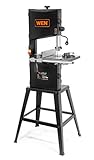
The QD-KYOHO 14-Inch has the largest stated cutting height in this group at 13 inches and pairs it with a 2 HP motor, so it is my overall choice when capacity is the first requirement. The WEN BA1487 follows closely for woodworkers who need up to 8.85 inches of height and compatibility with blades up to 1 inch wide, while the WEN BA3962 is the compact stand model I would look at for a stated 6-inch cut in a smaller workshop.
Those choices are not a claim that one saw fits every board. A narrow benchtop machine can be a sensible match for thin stock and small parts, but its stated height places a hard boundary on the lumber it can resaw.


As an Amazon Associate we earn from qualifying purchases.
12 Best Band Saws for Resawing In 2026
Use this overview as a capacity-first shortlist. “Throat” describes the clearance from blade to frame for the width of a workpiece, while cutting height is the resaw limit that determines how tall a board can pass beneath the upper guides.
The comparison also shows why a 14-inch frame is not automatically the right answer. The listed 10-inch models span from 4.75 to 6 inches of cutting height, and their included stands, lights, blade ranges, and adjustment hardware change how well they fit a particular work area.
| Product | Features | |
|---|---|---|
| QD-KYOHO 14-Inch Band Saw |
|
Check Latest Price |
| WEN BA1487 14-Inch |
|
Check Latest Price |
| WEN BA3962 10-Inch |
|
Check Latest Price |
 WEN BA1411 Industrial WEN BA1411 Industrial |
|
Check Latest Price |
 VEVOR HBS250 10-Inch VEVOR HBS250 10-Inch |
|
Check Latest Price |
 Woodskil 10-Inch Woodskil 10-Inch |
|
Check Latest Price |
 Hoteche 12-Inch Hoteche 12-Inch |
|
Check Latest Price |
 RIKON 10-310 RIKON 10-310 |
|
Check Latest Price |
 QD-KYOHO 10-Inch QD-KYOHO 10-Inch |
|
Check Latest Price |
 Seesii 8-Inch Seesii 8-Inch |
|
Check Latest Price |
 SKIL BW9501-00 SKIL BW9501-00 |
|
Check Latest Price |
 VEVOR HBS230 9-Inch VEVOR HBS230 9-Inch |
|
Check Latest Price |
We earn from qualifying purchases.
1. QD-KYOHO 14-Inch is the best overall for tall resaw cuts
QD-KYOHO Band Saw, 14 Inch Bandsaw for Woodworking...
13 inch height
2 HP motor
13.625 inch throat
Pros
- 13 inch cutting height
- 2 HP motor
- Dual speed
- Cast iron table
- Overload protection
Cons
- Tall 74 inch cabinet
- Limited warranty
I put the QD-KYOHO 14-Inch first because its stated 13-inch cutting height is the clearest capacity advantage in this set. For a woodworker who regularly breaks down tall rough lumber or wants room for ambitious book-matched panels, that figure is more meaningful than a generic “14-inch” label.
The listing pairs that height with a 13-5/8-inch throat and a 2 HP, 14-amp motor. It also lists two blade speeds, 1,445 FPM for hardwoods and 2,950 FPM for softwoods, which gives a documented adjustment route for different material types.
I also like that the working surface is a 21-1/2 by 15-3/4-inch cast-iron table rather than a tiny benchtop surface. A broad table gives more support as a tall board starts and exits a rip cut, and the machine’s welded steel construction and dynamically balanced cast-aluminum wheels speak directly to the stability that forum users want when drift is a concern.
The table tilts 45 degrees right and 5 degrees left, although a square, vertical cut is the setting that matters most for resawing. Overload protection and a work-light socket round out a package aimed at a dedicated shop rather than a portable setup.
A 13-inch height makes this the choice for the tallest stock here
A stated 13-inch clearance lets this saw cover far more than the 3.125- to 6-inch limits of the smaller machines in this roundup. I would select it when the actual boards on my rack regularly exceed 6 inches tall, not merely because a larger machine looks more capable.
The 111-inch blade specification also separates it from the short-blade benchtop class. Before ordering any resaw blade, I would confirm its length and width against the saw documentation, then set the guides and fence with a scrap board before feeding prized hardwood.
A 74-inch-tall machine calls for a permanent, measured shop location
The published overall height is 74 inches, so this is not the model I would plan to move between benches. Allow room for the infeed and outfeed path, the fence, and the dust hose rather than judging placement from the cabinet footprint alone.
The listing includes a 2.5-inch dust-extraction port. That is useful information for planning a connection, but dust control at the blade still deserves attention; community feedback consistently treats it as a setup issue worth checking after the first cuts.
2. WEN BA1487 is the best for a wide resaw blade range
WEN (BA1487) Band Saw with Stand,Two-Speed,Black,14-Inch
8.85 inch height
1 inch blade range
Two speeds
Pros
- 8.85 inch cutting height
- Accepts blades to 1 inch
- Large work table
- Blade tension gauge
- Work light
Cons
- 138.89 pound weight
- 4.2 rating
The WEN BA1487 earns its place near the top because it lists an 8.85-inch maximum cutting depth and accepts 100-3/4-inch blades from 1/8 to 1 inch wide. That upper blade-width figure makes it the standout option here for the reader who wants the stated ability to fit a wide resaw bandsaw blade.
Its 9.5-amp motor and two speeds of 1,480 or 3,280 FPM offer a different combination of power and speed options than the QD-KYOHO. The published throat width is 13-3/8 inches, so both the workpiece’s height and its width have meaningful clearance on this floor-standing machine.
I would also put real weight on the 21-1/2 by 15-3/4-inch work table. Long boards benefit from support, but even a large table does not replace slow, even feeding and a fence checked for parallel alignment.
The listing includes a blade-tension gauge, a circle-cutting guide, a flexible work light, a fence, a miter gauge, a 3-in-1 dust port, and a 1/2-inch blade. That is a notably complete starting package, although I would still examine the supplied blade’s condition and suitability before judging resaw quality.
A 1-inch maximum blade range supports a purpose-built resaw setup
Forum users repeatedly recommend a 1/2-inch or wider blade to lessen drift during resawing, provided the saw is rated for it and properly tensioned. This WEN’s documented range reaches 1 inch, giving an owner more stated flexibility than the models with a 1/2-inch maximum blade range.
Width is not a substitute for setup. I would install a blade that matches the cut, set tracking and guides, verify that the table is square, and make a trial pass before relying on the fence for a tall hardwood board.
A 138.89-pound weight favors a fixed shop rather than frequent moves
The BA1487 is listed at 138.89 pounds, a figure that helps explain why it belongs in a planned location. The upside is that a heavy floor machine does not ask a light bench to absorb the forces of a long rip.
The caution is simple: assemble and position it with its material path in mind. A resaw cut needs clearance before and after the blade, and the extra work light does not eliminate the need to see the fence and blade line clearly.
3. WEN BA3962 is the best compact floor model with six-inch capacity
WEN Band Saw with Stand, 10-Inch, 3.5-Amp, Two-Speed...
6 inch height
Two speeds
72 inch blades
Pros
- 6 inch cutting height
- Two speeds
- Blade range to 1/2 inch
- Stand included
- Work light and fence
Cons
- 3.5 amp motor
- 9.75 inch throat
The WEN BA3962 is the compact floor model I would shortlist when a stated 6-inch cutting height covers the lumber you actually use. It has a 3.5-amp motor, cuts up to 9-3/4 inches wide, and comes with a stand, which gives it a more settled shop presence than a saw that needs a separate bench.
Its two speed settings of 1,520 and 2,620 FPM are helpful for a reader who alternates between hardwood and softwood. The saw uses 72-inch blades from 1/8 to 1/2 inch wide, so the documented blade range is broad enough for curves and general cutting while still reaching the 1/2-inch width frequently discussed for modest resaw work.
The 14-1/8 by 12-1/2-inch cast-aluminum table bevels up to 45 degrees. For resawing, I would keep the table square and focus on the fence, blade tracking, and a steady feed rate; bevel capacity is useful, but it is not the deciding specification for thin, parallel slices.
The listing includes a work light, 3-in-1 dust port, fence, miter gauge, and a 3/8-inch 6-TPI blade. That makes the BA3962 especially approachable for a woodworker who wants the major accessories documented at the start.
A six-inch cut is a practical dividing line for compact-shop lumber
The six-inch rating puts this WEN above the 3.125- to 5.125-inch class of smaller machines in this guide. I would measure boards at their tallest point before deciding that it is enough, leaving room for the blade and normal setup rather than treating the maximum as casual headroom.
It is still not a replacement for the 8.85- or 13-inch capacity of the leading 14-inch saws. If tall hardwood is the regular project, beginning with more vertical clearance reduces the number of projects ruled out by the machine.
A supplied 3/8-inch 6-TPI blade is a start rather than a final resaw answer
The listed included blade gives a new owner a known starting point, but blade choice is a major factor in surface quality and drift. Community discussions favor a blade chosen for the material and cut, with tension and guides correctly set, instead of assuming the included blade is ideal for every board.
I would keep a clean, sharp blade for straight resaw work and reserve very narrow blades for tighter curves. The available range up to 1/2 inch is the published limit that should guide that decision.
4. WEN BA1411 is the best dual-voltage 14-inch alternative
WEN Industrial Band Saw, 14-Inch, 1 HP Dual-Voltage...
6 inch height
1 HP motor
120V or 240V
Pros
- Dual-voltage motor
- Two speeds
- Cast iron frame
- T-fence
- 4 inch dust port
Cons
- 6 inch cutting height
- 12 reviews
The WEN BA1411 is a 14-inch industrial model with a stated 6-inch cutting depth, 13.5-inch cutting width, and 11-amp 1 HP motor. Its key distinction in this group is dual-voltage operation at 120V or 240V, a feature worth considering only after confirming the electrical service available in the shop.
For the reader who needs to use both hardwood and softwood settings, the listing supplies two speeds: 1,700 and 3,000 FPM. It also includes a blade-tension gauge, which is relevant because wide resaw blades need appropriate tension to track predictably.
I find the cast-iron frame, ball-bearing blade guides, thrust bearings, and heavy-duty steel stand more relevant to resawing than decorative extras. These are the parts that support blade guidance and machine stability while a board moves through the cut.
The BA1411 has a 14 by 14-inch cast-iron table that bevels 15 degrees left and 45 degrees right, a T-fence, sliding miter gauge, and a 4-inch dust port. The larger dust port is a useful stated advantage for a shop already arranged around standard dust-collection hose sizes.
A dual-voltage motor fits shops with an electrical plan
This saw gives buyers a documented 120V or 240V choice, rather than assuming a single supply. I would regard that as a shop-planning feature, not a reason to alter electrical work without proper guidance.
The 1 HP motor is less than the QD-KYOHO 14-Inch’s listed 2 HP, while the BA1411 has the same six-inch maximum depth as the WEN BA3962. Matching the saw to the stock height remains the first filter before comparing these electrical details.
A four-inch dust port makes collection planning more straightforward
Dust collection is a recurring concern in woodworking forums, particularly around bandsaw lower cabinets. A documented 4-inch port is easier to match to many collection systems than the smaller ports found on several compact saws.
Collection still needs a real check at the machine. I would clear accumulated dust, inspect the hose path for restrictions, and never let a clean-looking port substitute for normal blade and guide maintenance.
5. VEVOR HBS250 is the best compact option with a stated six-inch height
VEVOR Band Saw with Stand, 10-Inch, 560 & 1100 RPM Two-Speed...
6 inch height
1/2 HP motor
9.65 inch throat
Pros
- 6 inch cutting height
- Overheat protection
- Stand storage
- Work light
- Fence and miter gauge
Cons
- 3.7 rating
- 9.65 inch throat
The VEVOR HBS250 is another 10-inch candidate with a stated 6-inch maximum cutting height, but it packages that capacity with a 1/2 HP, 370W motor and overheat protection. For a small woodworking area, its stand with storage, work light, fence, and miter gauge make the intended setup clear.
Its published throat width is 9.65 inches and the steel table measures 13.39 by 13.19 inches. Those dimensions make it a practical match for boards within the six-inch-height limit, not a substitute for the wider throat and much taller clearance of the 14-inch class.
The HBS250 offers two speed settings listed as 560 and 1,100 RPM, a tilting table from 0 to 45 degrees, and a 72.13-inch blade length. The listing also says it can cut wood, metal, copper, aluminum, and plastic, so the blade installed should always match the material being cut.
I would be measured about this selection because its listed rating is 3.7 from 71 reviews, below the higher-rated models above. The published six-inch clearance is useful, but reviews and careful setup should carry more weight when the purchase is meant for repeated hardwood resawing.
A six-inch capacity gives this saw a defined small-shop role
The HBS250 can be considered when your work stays at or below its documented six-inch maximum height. That is a meaningful step up from 3.5-inch benchtop choices, yet it does not make room for a board that needs 8.85 or 13 inches of vertical clearance.
I would measure rough stock before milling and leave an honest margin. The board’s cup, a sled, and the upper guide position can all make a theoretical maximum feel smaller in a real shop.
An overheat-protected half-horsepower motor suits deliberate feed rates
The product details identify a half-horsepower motor and overheat protection, not a high-horsepower production motor. That makes feed discipline especially important: let the blade cut without forcing it, and pause if the cut quality or sound signals trouble.
The listing does include a dust-collector connection, but it does not state a port diameter in the supplied details. I would verify the actual connection requirement before buying hose or adapters.
6. Woodskil 10-Inch is the best for quick blade-access adjustments
Woodskil 10 Inch Dual Speed Band Saw with Stand, 3.4A...
5.125 inch height
10 inch throat
Quick tension
Pros
- Quick tension system
- Tool-free doors
- Six bearing guides
- Stand included
- Two speeds
Cons
- 5.125 inch height
- 1.875 inch dust port
The Woodskil 10-Inch makes its strongest case through adjustment features: a quick-tension system, quick tool-free doors, and six ball-bearing guides. For resawing, access matters because tracking, tension, and guide spacing are not set-once details; they need attention whenever the blade or job changes.
Its stated cutting height is 5-1/8 inches, with a 10-inch throat depth. That puts it in the middle of the compact group: more stated vertical room than the RIKON 10-310 and QD-KYOHO 10-Inch, but less than the six-inch WEN BA3962 and VEVOR HBS250.
The model has two speeds of 2,360 and 3,000 FPM, a 0- to 45-degree tilting cast-aluminum table, a rip fence, miter gauge, and metal stand. I would treat the combination of fence and bearing guides as the selling point for straight work, then check their alignment with a scrap cut.
The listing reports 506 reviews and a 4.4 rating, the highest review count in this group of products. That volume is useful context, but I still would not choose it for stock taller than its clearly stated 5-1/8-inch limit.
Quick-access doors support routine blade and guide checks
Tool-free doors and a quick tension system can reduce the friction of doing basic setup instead of skipping it. I see that as especially helpful for a newer woodworker who is learning that a blade change should be followed by tracking, tension, and guide adjustment.
The six ball-bearing guides are listed as part of the design. Their presence does not guarantee a drift-free cut, but it gives the owner documented guide hardware to set carefully before feeding a board.
A 1-7/8-inch port needs a deliberate dust-hose plan
The dust port measures 1-7/8 inches according to the listing. That differs from the 2.5- and 4-inch connections on other machines, so I would confirm hose compatibility before treating the stand as a fully finished dust-collection solution.
The metal stand should give the saw a dedicated base. I would still level the machine and check that it does not rock, because stability at the table affects the confidence of a long, narrow resaw pass.
7. Hoteche 12-Inch is the best for a large compact work table
Hoteche 12-Inch Band Saw 7-Amp Two-Speed Benchtop with Stand...
5 inch height
7 amp motor
19.3 by 15.3 table
Pros
- Large work table
- Two speed blade
- 4 TPI blade included
- Stand included
- 12 inch cutting width
Cons
- 3.8 rating
- 130 pound weight
The Hoteche 12-Inch stands out for its 19.3 by 15.3-inch table, a notably generous stated work surface for a saw with a five-inch maximum cutting depth. That larger table can make it easier to support a workpiece at the start of a rip, though it does not change the five-inch height ceiling.
The supplied details list a 7-amp, 120V motor, two blade speeds from 7.6 to 15.8 meters per second, and a 2,320mm blade with 4 TPI. A 4-TPI blade is explicitly included, which makes this one of the few listings here with a clear low-tooth-count blade detail for a resaw-focused buyer.
The saw has a 12-inch cutting width, a durable stand, and a table that tilts from 0 to 45 degrees. At 130 pounds, it is also a substantial machine, so it needs a stable location rather than an improvised bench.
Its listed rating is 3.8 from 70 reviews. I would weigh that rating alongside the published table size and blade details, and I would make sample cuts before committing figured or costly boards to any new bandsaw setup.
A 19.3-inch table gives broad support for a five-inch-tall board
The table is the unusual strength of this model. A wide work surface can help a user keep stock supported and flat, which is valuable when the aim is consistent thin slices rather than freehand curves.
It does not remove the need for outfeed support on long lumber. I would arrange support so the board cannot drop or twist after it passes the blade, then keep hands away from the blade path.
A supplied 4-TPI blade directly addresses coarse resaw cutting
The product details identify the included blade as 1/2 inch wide with 4 TPI. That is a specific starting specification, unlike listings that only give a general blade length or tooth count without connecting it to a supplied blade.
Forum discussion favors matching TPI to the material and cut rather than chasing a single universal number. For any saw, I would replace a dull or inappropriate blade before blaming the fence for rough surfaces or drift.
8. RIKON 10-310 is the best compact saw with an explicit resaw rating
Rikon Power Tools 10-310 10" Bandsaw with Cast Iron Table...
4.625 inch resaw
Cast iron table
Steel stand
Pros
- Explicit resaw capacity
- Cast iron table
- Tool-less guides
- Quick-release tension
- Steel stand
Cons
- 4.625 inch capacity
- No motor detail supplied
The RIKON 10-310 is refreshingly direct about its 4-5/8-inch resaw capacity. That number makes it easy to place: it is a compact woodworking bandsaw for boards within that height, not a vague choice that asks you to infer resaw ability from the frame size.
I like the listed combination of a rugged steel frame, balanced cast-aluminum wheels, cast-iron table, and included steel stand. The table tilts from 0 to 45 degrees, but the components most connected to a controlled straight cut are the rigid work surface, wheels, fence setup, and properly set blade guides.
Tool-less blade guides, a quick-release tension lever, and a large tension knob are meaningful convenience features for regular maintenance. The 2-1/2-inch dust port is also a common size for a shop vacuum connection, according to the listing.
The supplied product data does not state motor horsepower or amperage, so I would not invent a motor comparison for it. Its 4.5 rating from 16 reviews is positive context, but the clear capacity limit should remain the purchase decision’s anchor.
An explicit 4-5/8-inch resaw figure prevents capacity guesswork
For smaller projects, a 4-5/8-inch maximum may be enough for thin-panel work, smaller hardwood blanks, and book matching within that range. I would write down the tallest stock I expect to use and compare that measurement directly with this published number.
That simple check prevents the common disappointment of buying a compact saw for a board it physically cannot pass. A 14-inch saw may be unnecessary for thin stock, but a smaller machine cannot be stretched past its vertical clearance.
Tool-less guides reward a careful setup habit
The 10-310 lists tool-less guides and a quick-release tension lever, which can make blade changes less cumbersome. I would use that access to set the guides close to the blade without contact, then confirm that the blade tracks correctly before a resaw cut.
The safety paddle switch and stand are also listed. Those features support a more settled workstation, but a push stick and an unobstructed outfeed path are still part of a responsible cut plan.
9. QD-KYOHO 10-Inch is the best 4.75-inch-capacity cast-iron-table choice
QD-KYOHO Band Saw, 10-Inch Bandsaw for Woodworking...
4.75 inch height
1/2 HP motor
Dual speed
Pros
- Dual speed
- Cast iron table
- Double-sided fence
- Quick-release tension
- 2.5 inch dust port
Cons
- 4.75 inch height
- Limited warranty
The QD-KYOHO 10-Inch combines a stated 4-3/4-inch cutting height with a 9-5/8-inch throat, 1/2 HP 5.3-amp motor, and a precision-ground cast-iron table. I see it as a focused compact choice for a user whose boards stay below that height but who values a documented heavy work surface.
It has two listed speeds: 1,515 FPM for hardwoods and 3,280 FPM for softwoods. The listing also identifies a 70-1/2-inch blade, quick-release tension, a detachable double-sided fence assembly, and a 2.5-inch dust-extraction port.
The 20.5 by 17.5-inch tabletop is broad for this capacity class, and it tilts 45 degrees right and 5 degrees left. I would use its size to support the workpiece square to the fence, not assume that table tilt has a direct benefit for a vertical resaw cut.
The product data reports a 4.8 rating from 97 reviews. That is strong feedback for the listing, but the right question is still whether 4.75 inches handles your rough lumber after allowing for the blade and guide clearance.
A cast-iron table gives compact resaw work a stable reference surface
A flat, stable table is one piece of the alignment system. The QD-KYOHO specifically lists a precision-ground cast-iron table, which is a useful specification for someone who is trying to keep the board planted during a straight feed.
In my selection process, I would pair that table with a fence check using a straight scrap board. If the cut drifts, I would inspect the blade, tension, and guides before deciding the table or fence is at fault.
A detachable double-sided fence needs verification before a long rip
The double-sided fence assembly is a documented feature that can help organize a straight-cut setup. The key is not the number of sides but whether the fence is secured, parallel to the blade’s intended cut path, and tall enough to guide the material safely.
Its 2.5-inch dust port is sized for a shop-vac-style connection. I would test airflow with a few cuts and clean the lower cabinet area as part of regular maintenance.
10. Seesii 8-Inch is the best small benchtop starter for thin stock
SEESII Benchtop Band Saw for Woodworking: 3A-120V Bandsaw...
3.125 inch height
8 inch throat
350 watt motor
Pros
- Tool-free height adjustment
- Double-sided fence
- Steel table
- Includes miter gauge
- Dust port
Cons
- 3.125 inch height
- Small 12 inch table
The Seesii 8-Inch is a small benchtop bandsaw with an 8-inch throat and 3-1/8-inch maximum cutting height. I would look at it for thinner stock, small cabinet parts, and a shop that cannot give up floor space, while treating its height specification as a firm limit for resawing.
The 350W motor is listed at 1,800 RPM, and the height adjustment is tool-free. Its 12 by 12-inch steel work table has laser-etched grids and tilts from 0 to 45 degrees with rack-and-pinion adjustment.
Seesii includes a miter gauge, double-sided fence, carbon brush, magnetic angle guide, and dust port with brush attachment. The package gives a beginner several useful components, but a small table and lower height demand more attention to material support and safe hand placement.
The listing reports a 4.5 rating from 17 reviews. That is promising but limited feedback, and it does not change the fact that boards higher than 3-1/8 inches belong on a saw with more stated capacity.
A 3-1/8-inch maximum makes this a thin-stock resaw saw
This is the narrowest vertical window among the models positioned for wood resawing here, apart from the SKIL listing that does not supply a cutting-height figure. I would choose it only when most of my material is clearly under 3 inches tall.
For a beginner, that limitation can be useful rather than frustrating if it keeps the first projects small and controllable. Trying to force tall lumber through a compact saw is not a productive workaround.
A benchtop footprint requires a stable supporting surface
The Seesii dimensions are listed as 17 by 12 by 27 inches. Before using it, I would secure the saw on a stable bench and leave enough space for both ends of a board to remain supported through the cut.
The dual power buttons are listed as a safety feature. They belong beside, not instead of, good setup habits such as disconnecting power before blade changes and keeping the upper guide close to the workpiece.
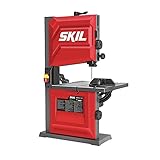
11. SKIL BW9501-00 is the best compact model for tracking visibility
SKIL 2.8 Amp 9 In. 2-Speed Benchtop Band Saw for Woodworking...
2.8 amp motor
Two speed drive
Tracking window
Pros
- Blade-tracking sight window
- Ball bearing guides
- Quick tension
- 2.5 inch dust port
- Three-year warranty
Cons
- No cutting-height figure supplied
- No stand listed
The SKIL BW9501-00 is a 9-inch, two-speed benchtop bandsaw that puts useful setup features at the center of its listing. It has a 2.8-amp induction motor, tool-free belt tensioning, quick blade tension, and a blade-tracking sight window, all features that encourage the checks a resaw blade needs.
Precision ball-bearing and lower blade guides, rack-and-pinion table adjustment, a steel base, and a miter gauge are also listed. I would regard those as good foundations for careful straight cuts, while remembering that the supplied data does not state a maximum cutting height.
The absence of a published resaw height is the reason I rank it below models with a clear number. A shopper searching specifically for a bandsaw for resawing should be able to compare the tallest planned board to a verified cutting-height specification before choosing.
The dust port accepts standard 2-1/2-inch vacuum hoses, and the product has a three-year limited warranty. Its 4.4 rating from 295 reviews adds useful ownership context, but it cannot fill the missing capacity detail.
A tracking sight window makes blade setup easier to inspect
The tracking sight window is the feature I find most compelling here. It gives the user a direct way to observe blade tracking while making adjustments, which is preferable to treating tracking as an invisible setting.
I would still adjust with the saw disconnected whenever the task requires contact near the blade, then follow the manufacturer’s operating instructions. Good tracking is only one step; guide adjustment and fence alignment still matter before resawing.
A missing height specification means buyers should verify before ordering
None of the supplied product details give the maximum cutting height or resaw capacity for this SKIL. That is not a minor omission for this topic, since vertical clearance is the primary limit on the thickness of lumber you can slice.
I would verify that figure from the current manufacturer documentation before putting this model ahead of one with an explicit 3.125-, 3.5-, 4.625-, or 6-inch rating. It may be a capable compact saw, but the data here does not support a precise resaw claim.
12. VEVOR HBS230 is the best light-duty option for 3.5-inch stock
VEVOR Band Saw, 9-Inch, Woodworking Benchtop Bandsaw with...
3.5 inch height
1/2 HP motor
9 inch width
Pros
- 1/2 HP motor
- 3.5 inch cutting height
- Fence and miter gauge
- Dual security switch
- 40.79 pound weight
Cons
- 3.9 rating
- Limited review count
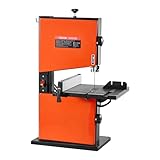
The VEVOR HBS230 is a 9-inch benchtop saw with a stated 3.5-inch maximum cutting height and 9-inch cutting width. Its 1/2 HP, 373W motor gives it a published power figure that is easy to compare with other compact models, but the height rating defines its role for resawing.
It has an 11.8 by 11.8-inch cast-aluminum table that tilts 5 degrees left and 45 degrees right, plus a fence and miter gauge. At 40.79 pounds, it is lighter than floor-standing machines but still needs a bench that does not shift during use.
The listing includes a dual security switch with detachable key and a 60-inch blade. It also says the cast-aluminum table is designed to minimize vibration, yet actual cut quality will still depend on blade condition, tracking, guide setup, feed rate, and how the bench supports the saw.
I place it last because the listing reports a 3.9 rating from 14 reviews and customer feedback notes mixed views, including vibration concerns. Its capacity can fit light-duty thin-stock work, but the stronger evidence-led picks above are better starting points for frequent hardwood resawing.
A 3.5-inch height keeps this saw in the light-duty resaw category
The HBS230 has slightly more stated height than the 3-1/8-inch Seesii, but far less than the six-inch compact models. I would use it for pieces well within its rating and choose a larger machine as soon as my lumber plan includes thicker stock.
That is not a criticism of benchtop tools. A machine that fits the material and has a stable base can be much more useful than an oversized saw that the shop cannot accommodate safely.
A 40.79-pound benchtop saw needs a secured, level base
The listed weight is manageable compared with the floor models, but it is substantial enough that a loose bench is not a sensible support. I would secure the saw, check the table for square, and prepare outfeed support before a long workpiece reaches the blade.
The product data includes fence and miter gauge accessories. For resawing, I would set the fence for the cut and reserve the miter gauge for crosscut-style operations rather than trying to combine both in one pass.
The right resaw bandsaw starts with cutting height and ends with setup
What size bandsaw do you need for resawing? Choose one with a stated cutting height greater than the tallest board you intend to slice, with enough margin to position the upper guide correctly. In this group, the practical categories are 3.125 to 3.5 inches for thin stock, about 4.625 to 5.125 inches for moderate stock, six inches for larger compact-shop work, 8.85 inches for taller work, and 13 inches for the broadest capacity.
Throat depth answers a different question. It is the distance from the blade to the frame and limits how far into a wide panel the blade can reach; it does not tell you how tall a board can stand under the upper guides.
A 14-inch bandsaw is enough when its stated height matches your lumber
A 14-inch frame is a common woodworking size, but the models here demonstrate why the frame label alone is incomplete. The QD-KYOHO 14-Inch lists 13 inches of height, the WEN BA1487 lists 8.85 inches, and the WEN BA1411 lists six inches, so compare the actual capacity line by line.
For production work with very tall stock, forum contributors prefer dedicated 16-inch-and-larger resaw machines. That is helpful context, but this guide only ranks the products supported by the supplied listings, and capacity remains the first test.
A wider blade is useful only when the saw supports and tensions it
For straight resaw cuts, users often recommend a 1/2-inch or wider blade to reduce drift. The WEN BA1487 lists compatibility up to 1 inch wide, the WEN BA3962 lists 1/8 to 1/2 inch, and the Hoteche includes a 1/2-inch blade; do not exceed the width range stated for your own saw.
What TPI is best for resawing wood? Lower tooth counts such as the Hoteche’s included 4-TPI blade or the WEN BA3962’s included 6-TPI blade are the concrete examples in this product data. Treat them as starting points: choose a sharp blade suitable for the wood and thickness, then test on scrap rather than assuming one TPI suits every board.
A strong motor helps, but feed rate and blade condition remain decisive
The QD-KYOHO 14-Inch lists 2 HP, the WEN BA1411 lists 1 HP, and several compact machines list 1/2 HP or wattage figures. More published power can be relevant with tall hardwood, yet forcing stock through a blade is a fast way to invite rough cuts, heat, and drift.
I would let the saw set the feed pace. If the cut slows, wanders, burns, or leaves a poor surface, stop and inspect the blade sharpness, tension, tracking, guides, fence, and material support instead of pushing harder.
A fence and guides should be tuned before the first valuable board
Forum users frequently cite fence accuracy and blade drift as the frustrating parts of resawing. Start with a clean blade installed at the correct tension, adjust the upper and lower guides according to the saw’s instructions, square the table, and make a straight test cut in scrap.
Then set the fence to the blade’s actual cut path and use a steady feed. A resaw fence, a straight auxiliary fence, or a drift-aware alignment method may help, but none replaces a sharp blade and careful setup.
A dust port is only the beginning of a clean resaw station
The listed ports range from 1-7/8 inches on the Woodskil to four inches on the WEN BA1411, with several 2.5-inch ports. Match the hose to the port, avoid sharp restrictions, and look for accumulation in the lower cabinet after a few cuts.
Keep the table and fence clear of offcuts, and support long work before beginning. A clean line of travel makes it easier to maintain a controlled feed without reaching across the blade.
A simple first-cut routine produces safer, more useful results
First, measure the board and confirm that it is below the saw’s stated cutting height. Second, choose an appropriate sharp blade within the listed width range, check its tension and tracking, and set the guides close to the workpiece without touching it.
Third, square the table, check the fence with scrap, connect collection, and provide infeed and outfeed support. Finally, feed at a steady pace with hands out of the blade path; stop if the cut begins to wander instead of correcting it by force.
FAQs
What is the best bandsaw for resawing?
The QD-KYOHO 14-Inch is the strongest overall pick in this group because it lists a 13-inch cutting height, 13-5/8-inch throat, 2 HP motor, dual speeds, cast-iron table, and overload protection. Choose it only if its tall floor-standing format and capacity fit the boards and space in your shop.
What size bandsaw do you need for resawing?
Choose by cutting height, not frame label alone. Thin stock can fit a 3.125- to 3.5-inch saw, moderate stock fits the 4.625- to 5.125-inch class, compact six-inch models fit larger boards, and the leading 14-inch options here list 8.85 or 13 inches of height.
What is the difference between a band saw and a resaw saw?
A bandsaw is the machine; resawing is the operation of slicing a board along its grain into thinner pieces. A bandsaw suited to resawing has enough stated cutting height for the board, a compatible blade-width range, stable guidance, and a fence setup for straight cuts.
What TPI is best for resawing wood?
Use a sharp blade with a tooth count suited to the material and cut. The concrete resaw-oriented examples in these listings are a 4-TPI blade supplied with the Hoteche and a 6-TPI blade supplied with the WEN BA3962; test on scrap and follow the blade and saw guidance for your stock.
The best choice is the saw that clears your boards with room to spare
For the best band saws for resawing, I would start with the QD-KYOHO 14-Inch when maximum 13-inch capacity is needed, the WEN BA1487 when a blade range up to 1 inch and 8.85 inches of height are the better match, and the WEN BA3962 when six-inch capacity works in a more compact floor-model setup.
Smaller saws still have a place: choose them for stock that stays within their stated clearance, secure them on a stable surface, and give blade setup the same attention as the machine itself. In 2026, measuring your material first is the simplest way to turn a long comparison into a satisfying purchase.
