
8 Best Table Saws for Beginners (September 2026) Reviewed
Choosing among the best table saws for beginners comes down to a short list of things: a fence that stays parallel, guards you will actually keep installed, enough capacity for your projects, and a size you can place safely in your shop. A table saw can make straight, repeatable rip cuts far more easily than a handheld saw, but it asks for disciplined setup and use.
I would not send a first-time woodworker looking only for the largest motor or the biggest blade. The product data and community feedback point to fence accuracy, a riving knife, anti-kickback pawls, a push stick, and a stable working position as the features that shape the first experience more than headline power does.
Contents
For most home projects, a portable jobsite table saw is the practical first category because it can be stored between projects and still handle plywood, shelving, trim, and furniture parts. A contractor saw makes more sense for someone building a permanent shop, while a benchtop saw suits occasional smaller stock when its limits match the work.
This guide reviews all eight selected saws without treating every one as the same kind of tool. I compare the specifications, included safety equipment, recorded review feedback, capacity, and setup tradeoffs, then explain the habits that matter before the first cut in 2026.
Top 3 Picks for Best Table Saws for Beginners (September 2026)
The DEWALT DWE7485 is my compact overall choice because its 24.5-inch capacity, rack-and-pinion fence, modular guard system, and power-loss reset address the core needs of a new user. The SKIL TS6307-00 is a strong folding-stand alternative, while the DEWALT DWE7491RS is the step up for people who regularly cut wider shelving and sheet material.

As an Amazon Associate we earn from qualifying purchases. CERTAIN CONTENT THAT APPEARS ON THIS SITE COMES FROM AMAZON. THIS CONTENT IS PROVIDED 'AS IS' AND IS SUBJECT TO CHANGE OR REMOVAL AT ANY TIME.
There is a separate safety-led choice here, too. The SawStop contractor saw has a system specified to stop the blade in less than five milliseconds on skin contact, but it is a 362-pound contractor saw with a 52-inch fence, so it belongs in a committed workshop rather than a casual portable-tool setup.
8 Best Table Saws for Beginners 2026
The comparison below is a starting point, not a replacement for checking the saw’s manual, current availability, and workspace measurements before you buy. Capacity figures tell you what can fit between the blade and fence; they do not remove the need for outfeed support when handling a full sheet.
| Product | Features | |
|---|---|---|
| DEWALT DWE7485 |
|
View Product Details |
 Bosch GTS15-10 Bosch GTS15-10 |
|
View Product Details |
 DEWALT DWE7491RS DEWALT DWE7491RS |
|
View Product Details |
 SKIL TS6307-00 SKIL TS6307-00 |
|
View Product Details |
 SawStop CNS175-TGP252 SawStop CNS175-TGP252 |
|
View Product Details |
 MarvTool MJT255VC1 MarvTool MJT255VC1 |
|
View Product Details |
 Evolution R8MTS Evolution R8MTS |
|
View Product Details |
 WEN TT0811 WEN TT0811 |
|
View Product Details |
We earn from qualifying purchases. CERTAIN CONTENT THAT APPEARS ON THIS SITE COMES FROM AMAZON. THIS CONTENT IS PROVIDED 'AS IS' AND IS SUBJECT TO CHANGE OR REMOVAL AT ANY TIME.
Read the individual sections with your work in mind. A fence that moves quickly and locks predictably is especially useful for repeated rip cuts, while a folding or wheeled stand matters only if you will move the saw often.
The DEWALT DWE7485 is the best compact overall beginner table saw.
DEWALT 15 Amp 8-1/4 in. Compact Portable Jobsite Table Saw…
15 amp
8-1/4 inch blade
24.5 inch rip capacity
Pros
- Accurate rack-and-pinion fence
- Compact 54 pound format
- Tool-free modular guard
- Power-loss reset
Cons
- 8-1/4 inch blade
- 48 degree bevel limit
The DWE7485 earns the lead spot because it keeps the decision simple without omitting the parts a beginner needs to learn. Its 15-amp motor, 8-1/4-inch blade, and 24.5-inch rip capacity cover common shelving, plywood, OSB, and framing tasks, while its 54-pound body is realistic to transport and store.
The recorded user feedback is unusually consistent on one point: the rack-and-pinion telescoping fence is accurate and easy to adjust. That aligns with what beginner woodworking communities repeatedly stress, because a fence that stays parallel to the blade helps prevent frustrating, uneven cuts and reduces the temptation to force material through.
DEWALT includes anti-kickback pawls, a push stick, a miter gauge, a non-through-cut riving knife, blade wrenches, and its Site-Pro Modular Guarding System. I like that the guard system is specified for tool-free adjustment, since a guard that is awkward to reinstall is a guard many new users wrongly leave off.
The power-loss reset is another sensible feature for a first table saw. It prevents an accidental restart after a power interruption when the tool was left switched on, which is a small detail that supports a calmer setup routine.
The DWE7485 is the right fit for a small shop and mobile projects.
This is the saw I would choose for a beginner who needs a capable portable table saw rather than a permanent furniture-making station. The metal roll-cage base and compact dimensions suit a garage bay, driveway work session, or a workshop where every tool must return to a shelf.
The 24.5-inch rip capacity is meaningful for cutting sheet goods, though long panels still need a supported path before and after the blade. Set up a level auxiliary outfeed surface before attempting a large panel, rather than trying to catch the board after it passes the blade.
The DWE7485 asks you to accept an 8-1/4-inch platform.
The smaller blade is the principal tradeoff. It does not make the saw unsuitable for first projects, but people who expect to use a full 10-inch blade format, wider capacities, or a built-in stand may prefer one of the larger jobsite choices below.
The listed bevel range reaches 48 degrees, which covers typical bevel work, but it is a published limit rather than a reason to buy it for specialty angled cuts. Confirm the required blade height and cut depth against each project plan before committing to stock thickness.
The Bosch GTS15-10 is the best wheeled jobsite saw for a beginner who moves tools.
BOSCH GTS15-10 10 Inch Portable Jobsite Table Saw with Rise…
15 amp
10 inch blade
32-1/8 inch rip capacity
Pros
- Gravity-rise wheeled stand
- Three-second brake
- Soft-start circuitry
- Smart guard system
Cons
- Temporarily out of stock
- 46.7 kilogram listed weight
The Bosch GTS15-10 pairs a 10-inch blade with a 32-1/8-inch rip capacity, putting it in a more spacious class than compact saws. Its recorded 4.8 rating comes from 184 reviews, a much smaller pool than the two high-volume DEWALT listings, so I would treat the strong score as encouraging rather than as the entire decision.
For a beginner, the compelling features are practical rather than flashy. Bosch lists a rack-and-pinion rip fence with color-coded index pins, a Smart Guard system with a riving knife and anti-kickback pawls, and a convenience brake that stops the blade in approximately three seconds.
The soft-start circuitry also deserves attention in a home workshop. The specification says it manages motor start-up intensity, which may help avoid circuit-breaker trips when the saw is used on a typical household circuit.
The Gravity-Rise wheeled stand changes how this saw lives between projects. A stand that rolls instead of needs to be carried can make a larger capacity saw approachable for someone who works in a shared garage, provided there is room to unfold it and feed long boards safely.
The GTS15-10 is best when sheet goods and mobility both matter.
I would point a beginner toward this Bosch when wide rip capacity is important but the tool still has to roll out of the way after a weekend build. The 10-inch format also makes it easier to follow the common blade-size standard used by many jobsite saws.
Its 3,800 RPM listing is tied to rip-cutting and cross-cutting fine and hard wood materials. Technique still matters more than speed alone: use a sharp blade appropriate to the task, keep the stock flat to the table, and let the saw cut at a controlled feed rate.
The GTS15-10 requires a stock and workspace check before planning around it.
The recorded product status was temporarily out of stock, so availability needs checking before it becomes the center of a project plan. The listed weight is 46.7 kilograms, which also calls for a realistic assessment of thresholds, vehicle loading, and the route into your workspace.
Like every portable saw, it needs support beyond its tabletop for large panels. The wheeled base makes transport easier; it does not turn a cramped or uneven cutting area into a safe work zone.
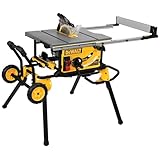
The DEWALT DWE7491RS is the best beginner choice for wide boards and sheet goods.
DEWALT Table Saw 10 Inch with Foldable Rolling Table Saw…
15 amp
10 inch blade
32.5 inch rip capacity
Pros
- Wide rip capacity
- Rolling stand
- Rack-and-pinion fence
- 2.5 inch dust port
Cons
- 110 pound weight
- Large footprint when deployed
The DWE7491RS is the DEWALT I would consider when a first project list includes bookcases, cabinet parts, wide shelves, and repeated plywood work. Its 32-1/2-inch rip capacity is the key number, and the 10-inch blade provides a 3-1/8-inch depth of cut at 90 degrees and 2-1/4 inches at 45 degrees.
It uses DEWALT’s rack-and-pinion telescoping fence system, which is designed for fast, smooth, accurate adjustments. That fence style is one reason community advice so often steers beginners toward DEWALT and SKIL: repeatable fence position is more useful day to day than chasing the largest motor claim.
The package includes a rolling stand, blade guard assembly, push stick, miter gauge, rip fence, blade wrenches, and a 24-tooth carbide blade. Onboard storage holds the safety and adjustment pieces, reducing the chance that a riving knife or push stick ends up lost in a drawer.
Its 2-1/2-inch dust-collection port is a useful starting point for connecting compatible extraction. Dust control remains a frequent complaint among table-saw owners across brands, so view the port as an invitation to set up a shop vacuum or dust collector, not as a promise of a dust-free floor.
The DWE7491RS is the direct answer for a beginner cutting wider material often.
This is the more fitting table saw for woodworking when your projects use larger casework parts instead of mostly narrow trim. The patented material support for narrow rip cuts also gives the fence system a clearer role across both wide sheets and smaller strips.
The rolling stand is designed for setup and breakdown, so it can serve a garage workshop that cannot remain permanent. I would still make a marked floor area for the saw, infeed, and outfeed space; being able to roll the tool does not reduce the clearance a long board needs.
The DWE7491RS is less suitable when carrying and storage are the first concerns.
At 110 pounds, this is not the saw to casually lift onto a high shelf or carry alone up stairs. The rolling stand helps on level ground, but it does not change the mass when loading it into a vehicle or moving across steps.
The included blade is a 24-tooth carbide blade, a useful ripping starting point rather than a universal finish-cut solution. Plan for a different blade when clean crosscuts in plywood or hardwood face material become a regular part of the work.
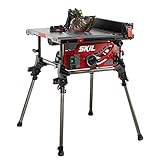
The SKIL TS6307-00 is the best folding-stand value for beginning woodworkers.
SKIL 15 Amp 10-Inch Jobsite Table Saw with Folding…
15 amp
10 inch blade
25.5 inch rip capacity
Pros
- Integrated folding stand
- Rack-and-pinion fence
- Blade micro-adjustment
- Dust port elbow
Cons
- 25.5 inch rip capacity
- Reported speed specification needs checking
The SKIL TS6307-00 makes a persuasive first-tool case because it combines a 10-inch blade, 15-amp motor, rack-and-pinion fence rails, and an integrated folding stand. Its 4.7 rating is based on 2,871 reviews, and the research from woodworking forums repeatedly identifies this exact model as an entry-level favorite for fence quality.
The feature that matters most is not the stand, though the stand is convenient. SKIL says its rack-and-pinion rails keep the fence parallel to the blade, and it adds parallel blade alignment with micro-adjustment, features that speak directly to the alignment worries beginners raise most often.
The saw is specified for 4×4 cutting capacity at 90 degrees and a 2- to 47-degree bevel range with a quick-release lever. It also includes a blade guard, push stick, miter gauge, anti-kickback pawl, riving knife, dust-port elbow, 24-tooth blade, and the tools needed for adjustments.
I appreciate the integrated folding stand for a first workshop because it gives the saw a defined working height without asking the owner to build a base first. It is a practical answer for someone who needs to fold the setup after each project.
The TS6307-00 is the best fit when a beginner wants fence control and a stand together.
This SKIL is a sensible entry level table saw for DIY furniture, home repairs, and general woodworking where portability matters. It offers a 25-1/2-inch rip capacity, enough for many panel cuts, while staying at 51.15 pounds according to the listing.
The dust-port elbow is a thoughtful detail because it redirects dust into a container. Connect collection where possible, wear appropriate respiratory protection for the material being cut, and clean accumulated dust only with the saw unplugged and the blade fully stopped.
The TS6307-00 needs a careful check of its published speed data.
The listing reports a speed of 15 RPM, which is inconsistent with how a table-saw blade normally operates and should be verified in the manual or with the manufacturer. I would not base a buying decision on that single field when the listing’s more useful information is the fence design, capacity, stand, and supplied safety gear.
Its 24-tooth included blade targets general ripping. If your goal is fine plywood edging or clean crosscuts, add a higher-tooth-count blade after you have learned the stock blade’s behavior and the saw’s alignment procedure.
The SawStop CNS175-TGP252 is the safety-led contractor saw for a permanent workshop.
SAWSTOP 10-Inch Contractor Saw, 1.75-HP, 52-Inch…
1.75 HP
10 inch blade
52 inch T-Glide fence
Pros
- Skin-contact safety system
- Heavy-gauge T-Glide fence
- Low-vibration belt drive
- Precision trunnion and arbor
Cons
- 362 pound weight
- One-year listed warranty
The SawStop contractor saw is unlike the jobsite saws in this guide. Its patented system is specified to stop the spinning blade in less than five milliseconds on contact with skin, and that documented safety feature is why it is the model many families and serious hobbyists consider when the tool will have a long-term home.
Its basic construction also signals a permanent-shop tool: a 1.75-horsepower contractor saw, 362-pound weight, precision trunnion and arbor, poly V-ribbed belts intended to reduce vibration, and a heavy-gauge steel 52-inch T-Glide fence. The large 52-inch fence supports a very different scope of work from a compact portable unit.
Safety technology does not replace the blade guard, riving knife, hearing protection, eye protection, push sticks, or attentive technique. It is an extra layer for an event nobody wants, while the ordinary daily habits still do the most to keep hands and material out of a dangerous position.
The review count is only 18 even though the recorded rating is 4.7, so there is far less feedback volume than for the DEWALT and SKIL options. The recorded review summary still describes it as a high-end saw for serious woodworkers, which fits its construction and configuration range.
The SawStop contractor saw is the right answer when safety and permanent-shop precision lead.
I would consider this saw for a beginner only if that beginner has a dedicated, level workshop, adequate room around a 52-inch fence, and a genuine plan to grow into furniture work. The T-Glide fence, stable build, and vibration-reducing belt arrangement are meant for repeatable precision rather than rapid jobsite setup.
The control box holds the on-off switch, power paddle, and onboard computer. That design belongs to a machine a user studies carefully before operating, including the manual’s guidance for the safety system and all blade-change, adjustment, and maintenance procedures.
The SawStop contractor saw is not the portable first saw for a small or shared space.
Its 362-pound listed weight and 85.25-inch listed length make this a poor match for someone who needs to carry a saw to a driveway or pack it away after each weekend. Moving and assembling a machine of this size needs a planned path, enough help, and a permanent place to work.
The product listing describes more than 150 unique configurations, which is useful for a long-term shop but can make the initial decision more involved. Start by measuring the space and deciding what width of panel you will cut, then select only the configuration that supports that work.
The MarvTool MJT255VC1 is the most compact 10-inch option for light DIY work.
MarvTool 15Amp Portable Table Saw 10 inch, 4600RPM Compact…
15 amp
10 inch blade
4600 RPM
28.3 pounds
Pros
- 28.3 pound portable body
- Adjustable height and angle
- Transparent blade guard
- Dust port
Cons
- 75 recorded reviews
- No stand is listed
The MarvTool MJT255VC1 is a compact 10-inch benchtop-style choice with a 15-amp motor, 4,600 RPM, and a listed weight of 28.3 pounds. For a beginner who has only a workbench and needs the saw to be easy to lift into storage, that low weight is its clearest advantage.
The listing says the blade height and angle adjust for 90-degree crosscuts and 0- to 45-degree miter cuts, with a stated maximum cut of 3.4 inches at 90 degrees and 2.1 inches at 45 degrees. A transparent blade guard allows visibility of the cutting area, and the dust port can connect to a vacuum.
The available feedback is more limited: 75 reviews at a 4.4 rating. That does not make the saw unusable, but it gives a buyer fewer owner reports to weigh against the thousands attached to several jobsite models above.
I would treat this one as a compact tool for straightforward DIY furniture parts and workshop tasks, not as the automatic answer for full-sheet plywood. The provided data does not state a rip-capacity measurement, so confirm that figure, the fence travel, and the table support before buying for panel-heavy work.
The MarvTool is a direct fit for a beginner with a sturdy bench and short storage space.
A 28.3-pound tool is easier to place on a solid work surface than a larger saw with a stand. The work surface must be rigid, level, and clamped or fastened according to the manufacturer’s instructions; a light saw does not excuse an unstable base.
The 10-inch blade format may appeal to a buyer who wants the familiar full-size diameter in a small footprint. Match that convenience with extra care about support, because small benchtop tables give less natural support for wide boards.
The MarvTool needs more pre-purchase specification checking than the higher-volume choices.
The lower review count means I would read the manual before ordering and confirm the fence setup, rip capacity, replacement-blade compatibility, included accessories, and support arrangement. These are basic questions for any saw, but they matter even more where the public review record is short.
The listing names a dust port but gives no collection diameter in the available product data. Check the port sizing and required adapter before planning a vacuum connection, then use collection as part of a broader cleanup routine rather than depending on it alone.
The Evolution R8MTS is the beginner pick for convertible miter and table-saw tasks.
Evolution R8MTS 8-1/4″ Convertible Miter/Table Saw…
12 amp
8-1/4 inch blade
Convertible miter and table saw
Pros
- Two-in-one configuration
- Wood plastic and metal cutting
- 0-45 degree bevel
- Riving knife and guard
Cons
- 1.5 inch table-mode rip capacity
- 4.0 rating from 85 reviews
The Evolution R8MTS is not a conventional jobsite table saw, and that distinction matters. It converts between miter-saw and table-saw modes, uses an 8-1/4-inch tungsten-carbide-tipped blade, and is listed for wood, plastic, mild steel, and aluminum cutting.
Its 12-amp motor, compact 28.6-pound weight, cast-aluminum tabletop, 0- to 45-degree bevel, and plus-or-minus 45-degree miter range make it a versatile option for a person whose work alternates between crosscuts and small material tasks. The supplied data lists preset stops, a blade guard, a riving knife, and dust-extraction ports.
The tradeoff is pronounced in table mode: the stated rip capacity is only 1-1/2 inches. That is far too restrictive for a beginner whose primary reason for shopping is ripping boards or breaking down sheet goods, which is the central task that makes a traditional table saw so useful.
The 4.0 rating from 85 reviews also deserves direct attention, including the recorded 15 percent one-star share. I would see the R8MTS as a specialized compact multi-function tool, not as a substitute for a DEWALT, Bosch, or SKIL jobsite saw when rip capacity and fence use lead the project list.
The R8MTS is the best answer for mixed-material jobs with limited room.
This saw can make sense for a DIYer doing compact tasks in wood, plastic, mild steel, and aluminum who values the ability to convert between two tool modes. It is especially relevant when a workshop cannot hold separate miter and table saws.
Follow the manufacturer’s material and blade guidance closely. A multi-material claim is not a reason to cut every stock type with the same setup, and the workpiece must be held and supported correctly for the mode being used.
The R8MTS is the wrong answer for standard furniture rip cuts.
The 1-1/2-inch table-mode rip capacity is the deciding limitation. It prevents the wide, fence-guided cuts that a beginner usually expects from a table saw for cabinet sides, shelves, and many furniture components.
The compact design also has a listed crosscut capacity of 4-3/4 by 2-3/16 inches. Measure project stock first, then choose it only if those capacity limits match the actual work rather than the hoped-for future work.
The WEN TT0811 is a compact benchtop option with a wide listed rip capacity.
WEN TT0811 11-Amp 8.25-Inch Compact Benchtop Jobsite Table…
11 amp
8.25 inch blade
25 inch rip capacity
Pros
- 25 inch rip capacity
- 4500 RPM motor
- Onboard carrying handle
- Guard and riving knife included
Cons
- 3.8 rating from 96 reviews
- 37.6 pound benchtop format
The WEN TT0811 offers an unusual specification mix for its compact 8.25-inch format: an 11-amp motor listed at 4,500 RPM and 25 inches of rip capacity for 4-by-8 plywood and OSB sheets. It weighs 37.6 pounds, includes an onboard carrying handle, and is designed as a compact benchtop jobsite saw.
The available feature list is reassuringly complete for a basic setup. It names an adjustable rip fence, auxiliary fence, miter gauge, push stick, dust-port adapter, tool-free blade guard, riving knife, onboard storage, and two-year warranty.
The key caution is the lower review record: 96 reviews at a 3.8 average, with the source reporting 12 percent one-star reviews. I would not ignore that signal, especially when a table saw’s fence and adjustment quality affect both cut quality and user confidence.
Its listed cut depth is 2.75 inches at 90 degrees and 2 inches at 45 degrees. Those numbers can handle common board thicknesses, but the 8.25-inch blade and benchtop body set different expectations from a heavy jobsite saw with a full stand.
The WEN TT0811 is useful for a beginner who needs compact storage and measured panel capacity.
The 25-inch capacity and carrying handle are appealing when a saw must come out only for a project and then return to a closet or shelf. Build a stable, level station at a comfortable height before operating, with clear space to support the material on both sides of the blade.
The tool-free blade guard can make correct reinstallation less burdensome after a blade change. Keep the guard and riving knife fitted for through cuts whenever the manual permits; convenience should support safe habits, not replace them.
The WEN TT0811 needs more alignment scrutiny before it becomes a first-saw recommendation.
With a 3.8 rating and comparatively small review pool, I would inspect the fence operation, blade-to-miter-slot relationship, guard function, and bevel adjustment immediately on arrival according to the manual. Do not start a project until the saw is stable and the safety parts operate as intended.
The listed 8.25-inch blade can be perfectly appropriate for the stated cut depths, yet it has less capacity than a 10-inch setup. Let the thickest stock and widest panels in your planned work decide whether compactness is the right trade.
The right beginner table saw choice starts with work type, fence quality, and safe space.
The best first question is not “which brand is best?” but “what cuts will I make in the next several projects?” A portable jobsite saw is usually the most balanced category for a beginner because it offers a fence and adequate rip capacity while still being movable; a contractor saw is for a dedicated shop, and a small benchtop saw is for limited material and limited space.
A table saw works by spinning a blade through a flat table while you guide a workpiece against either the rip fence or the miter gauge. Use the fence for rip cuts along the grain and the miter gauge for crosscuts; do not trap a board by using both as fixed guides on the same cut unless the manual describes an approved setup.
A stable and accurate fence is the first feature a beginner should inspect.
The fence controls the width of a rip cut, so it must lock securely and remain parallel to the blade. Rack-and-pinion systems on the DEWALT, Bosch, and SKIL models are prominent in this guide because the product data and forum feedback both focus on their quick, repeatable adjustment.
Before every serious session, verify fence alignment using the procedure in the manual. A poorly aligned fence can cause a rough cut, burning, binding, or stock movement that makes the operation unpredictable.
A jobsite saw is the most practical first type for most home workshops.
Jobsite saws are built to move, often with a folding or rolling stand, and typically use direct-drive motors. They are suitable for cutting plywood, OSB, shelving, trim, framing lumber, and many furniture components when the stock is properly supported.
Benchtop saws occupy less floor space but need a secure bench or stand and may give less tabletop support. Contractor saws are larger, heavier machines that reward a permanent shop; the SawStop here is a clear example at 362 pounds with a 52-inch fence.
A riving knife, blade guard, pawls, and push stick are the core safety kit.
A riving knife sits behind the blade and helps keep the kerf from closing on it, reducing a major cause of kickback. Anti-kickback pawls add another layer by biting into stock that begins to travel back toward the operator, while the blade guard helps keep hands and loose items away from the teeth.
Use a push stick or push block whenever your hands would approach the blade area, and follow the manual’s specific guidance on when each accessory applies. Stand slightly to one side of the blade’s line, not directly behind the workpiece, so a kickback path is not aimed at your body.
Wear eye and hearing protection, keep cords and offcuts out of the work area, and never reach over or behind a moving blade. Unplug the saw before blade changes, cleaning near the blade, alignment work, or any adjustment that brings your hands close to the teeth.
A 24-tooth blade is for ripping while a higher tooth count suits cleaner crosscuts.
The DEWALT DWE7491RS and SKIL TS6307-00 include 24-tooth blades, which are common general ripping blades. Fewer teeth leave more room to clear chips during a rip cut, while a higher-tooth-count blade usually gives a cleaner finish in plywood and crosscuts at the cost of a slower feed.
For a beginner, a combination blade is often the simplest second blade because it can cover mixed project work without a swap for every operation. Choose blade diameter, arbor compatibility, maximum RPM rating, kerf, and tooth style exactly as specified by the saw manufacturer.
A 10-inch blade offers more depth while an 8-1/4-inch saw can save space.
A 10-inch jobsite saw is common in the stronger all-around options here and generally offers more cut depth. The 8-1/4-inch DEWALT DWE7485 and WEN TT0811 show that a smaller blade can still suit many beginner projects when portability and compact storage come first.
Do not treat blade diameter as a safety ranking. The right size is the one that handles the stock you plan to cut, works with a stable machine, and is operated with its guard, riving knife, proper blade, and correct support.
Outfeed support and dust collection turn a small saw into a safer work station.
A full sheet or long board can tip as it leaves a compact table saw, pulling your attention away from the fence and blade. Use an outfeed table, roller support set according to the manufacturer’s guidance, or another stable support that keeps the stock level without requiring a helper to pull the board.
Several saws list dust ports, including the DWE7491RS with a 2-1/2-inch port, the SKIL with a dust-port elbow, and the MarvTool with a vacuum connection. Collection reduces the mess, but you should still clear dust safely only after the saw is off, unplugged, and stopped.
A measuring setup and a few basic accessories matter more than a long add-on list.
Start with eye protection, hearing protection, push sticks or blocks, a square, a reliable tape measure, a straightedge, and a blade suited to the cut. Add outfeed support before buying decorative extras, because stable support affects control on nearly every long-board cut.
A crosscut sled, featherboard, and zero-clearance insert can be useful later, but build or buy them only after learning the saw’s manual and using them in an approved way. Keep material flat and free of nails, screws, wet spots, or severe warp before it approaches the blade.
These common beginner mistakes are avoidable with a slower setup routine.
First, do not cut freehand: guide rip cuts against the fence and crosscuts with the miter gauge or an approved sled. Second, do not force stock when it binds; stop, switch off, and find the cause after the blade comes to a complete stop.
Third, do not remove the riving knife or guard just because it feels inconvenient, and do not use a dull or incorrect blade. Fourth, do not start with a large unsupported sheet on a cramped floor; practice on manageable stock and add support before moving to panels.
Finally, do not buy a machine solely by motor rating or assume a used saw needs no inspection. Community discussions repeatedly favor fence quality, and a used saw should be checked for fence alignment, blade tilt and height function, guard and riving-knife availability, arbor condition, table flatness, cord condition, and a secure switch before use.
FAQs
A table saw with a stable fence is the best saw for cutting wood for beginners.
For straight, repeatable rip cuts, a beginner-friendly table saw with a stable fence, riving knife, guard, anti-kickback pawls, and push stick is a strong starting point. A portable jobsite saw fits many home shops; choose capacity based on the widest material you expect to cut.
The SKIL TS6307-00 is a good accessible table saw option for many beginners.
Its listed 15-amp motor, 10-inch blade, integrated folding stand, rack-and-pinion fence, 25-1/2-inch rip capacity, riving knife, guard, and push stick make it a well-rounded entry choice. Check that its capacity suits your projects and verify the published speed figure in the manual.
DEWALT and Bosch are better choices for different beginner needs.
Choose the DEWALT DWE7485 for a compact 24.5-inch-capacity format, or the DWE7491RS for 32-1/2-inch capacity and a rolling stand. Choose the Bosch GTS15-10 when its 32-1/8-inch capacity, Gravity-Rise wheeled stand, soft start, approximately three-second brake, and Smart Guard system suit the workspace.
A 24-tooth blade rips well and a higher tooth count makes cleaner crosscuts.
A 24-tooth blade is a common choice for ripping because it clears chips efficiently. Use a higher-tooth-count or appropriate combination blade for cleaner plywood and crosscuts, but always match the blade diameter, arbor, and RPM rating to the saw manual.
The best beginner table saw is the one that matches your material and safe workspace.
For most people, the DEWALT DWE7485 is the balanced compact choice, the SKIL TS6307-00 is the folding-stand option with a well-regarded fence, and the DEWALT DWE7491RS fits wider material. The Bosch is compelling for wheeled mobility, while the SawStop belongs with a permanent workshop and a safety-first plan.
Choose from these best table saws for beginners only after measuring your work area, reading the manual, and planning where every board will enter and leave the cut. In 2026, the smartest first upgrade is not another accessory; it is a safe, level station and the habit of checking setup before every cut.
