
How Long Does It Take to Install New Flooring? October 2026
If you have been wondering how long does it take to install new flooring, the honest answer is anywhere from one day to more than a week. Carpet in a single bedroom can be down before dinner. Solid hardwood, tile, or a full re-floor of a two-thousand-square-foot house run considerably longer, and that is before you count acclimation and curing time. Updated for October 2026.
Most people only budget for the install day, which is where projects go sideways. Three separate buckets add up: the material sitting in the room to acclimate, the preparation work, and the actual laying plus drying. Add prep to install, then add acclimation in front, and that is your real calendar window.
Contents
I have watched homeowners book a contractor for two days and then spend the following week walking carefully around a floor nobody was allowed to touch. A little planning before the first day does more for your schedule than anything else. The numbers below are typical US residential figures, and regional labour rates shift them noticeably.
How Long Does It Take to Install New Flooring?
For most residential flooring, plan on one to three days of hands-on installation. Larger rooms, difficult preparation, patterned layouts, and cure time stretch that, and hardwood adds several days of acclimation before anyone can start.
Think of the project as a timeline with four stops rather than a single number:
- Acclimation — the material sits in the actual room and equalises with its moisture and temperature.
- Preparation — removing the old floor, cleaning, patching, and levelling the subfloor.
- Installation — the laying itself, plus trim, transitions, and clean-up.
- Cure and dry — thinset, grout, and adhesive finishing before you can put furniture back.
Installers usually quote stop three. Homeowners budget for stop three, then discover stops one, two, and four on the calendar. That mismatch is where most schedule surprises come from.
Installation Time by Flooring Type
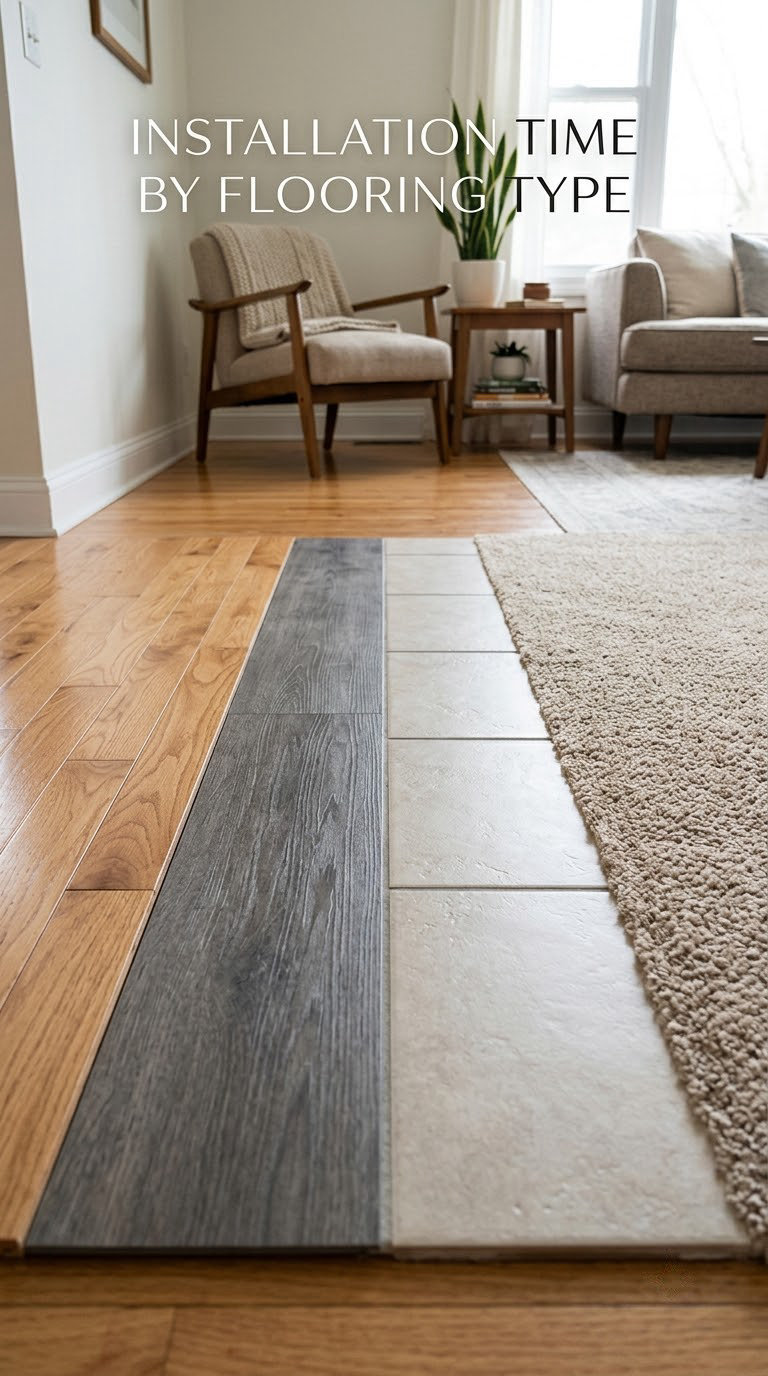
Two installers working together typically cover 500 to 1,000 square feet per day on a straightforward layout. Complex patterns cut that to 200 or 300 square feet per day. The table below assumes a medium room of roughly 300 square feet with a clean, level subfloor.
| Flooring type | Install time | Acclimation | Cure or dry | Total elapsed |
|---|---|---|---|---|
| Carpet | 4 to 6 hours | None | None | Same day |
| Luxury vinyl plank (LVP) | 4 to 6 hours | 24 to 48 hours | 24 hours for adhesive | 1 to 3 days |
| Laminate | 4 to 6 hours | 48 hours | 24 hours | 2 to 3 days |
| Engineered hardwood | 1 to 2 days | 5 to 10 days | None | 1 to 2 weeks |
| Solid hardwood | 2 to 4 days | 7 to 14 days | None | 2 to 3 weeks |
| Ceramic or porcelain tile | 2 to 4 days | None | 24 hours thin-set, 24 hours grout | 3 to 6 days |
| Cork | 1 to 2 days | 48 to 72 hours | 48 hours for adhesive | 3 to 5 days |
How long does it take to install laminate flooring?
About four to six hours for a 300 square foot room with four straight walls and no prep needed. Laminate is a click-lock floating floor, so there is no adhesive and no grout, which keeps the install day short. Budget 48 hours of acclimation beforehand or the boards will be too stiff and you will end up with gaps at the walls.
How long does hardwood acclimation take?
Five to ten days is the standard window for hardwood in a normal climate, and up to two weeks in humid conditions. This is not optional and it is not counted in most install quotes. Solid wood and some engineered boards arrive with a particleboard core that expands and contracts as it takes on or gives up moisture in the room. Lay it too soon and you get gaps in January. Lay it too late and the same thing happens in July.
How long does it take to install tile flooring?
Tile feels fast until the drying starts. Large-format tile over 400 square feet takes longer to set than the cutting does. Add two full days of cure time before foot traffic: 24 hours for the thin-set adhesive, then 24 hours for grout before anyone walks on it. Keep people off grout for the full 48 hours to avoid haze and smudges that take a week to buff out.
Carpet is the fastest install of the lot
Carpet needs no acclimation and no cure, so a bedroom goes from bare subfloor to finished floor in a single morning, tack strip to stretched edge. Stretching is the skill that matters here, and a badly stretched carpet that bumps and ridges underfoot will not improve on its own.
How Long Does Flooring Installation Take by Room Size?
Square footage is the single biggest driver. Most of the search traffic on this topic asks for a specific number, so here are real ranges for a two-person crew on materials with average complexity. Add your own prep time on top.
| Project size | Square feet | LVP or laminate | Hardwood | Tile | Carpet |
|---|---|---|---|---|---|
| Powder room or hallway | under 100 | 2 to 3 hours | 3 to 5 hours | 4 to 6 hours | 1 to 2 hours |
| Single bedroom | 120 to 180 | 3 to 5 hours | 5 to 8 hours | 1 day | 2 to 3 hours |
| Standard living room | 300 to 400 | 4 to 6 hours | 1 day | 1 to 2 days | 3 to 4 hours |
| Standard room | 500 | 1 day | 1 to 2 days | 2 days | half a day |
| Whole first floor | 1,000 | 1 to 2 days | 2 to 3 days | 3 to 5 days | 1 day |
| Full house re-floor | 2,000 to 3,000 | 2 to 4 days | 5 to 8 days | 1 to 2 weeks | 2 to 3 days |
For 1,000 square feet of LVP, a crew of two usually lands on one to two days of laying time once the room is prepped. People asking this question in flooring forums tend to be pleasantly surprised by the square four-wall case: installers put 350 square feet of LVP in a simple rectangular room at four to five hours.
Stairs deserve their own line item
Stairs are where flooring budgets and flooring schedules both break. Each tread and riser is a separate cut, and each cut needs to fit around a nosing that is never quite square. Two installers reported spending nine hours on eight of fourteen stairs plus a small landing with demo already done. Price stairs per step, in both materials and labour, and never accept a per-square-foot quote that quietly includes them.
Whole-home projects need sequencing, not speed
Putting flooring into a new 3,000 square foot house is not a longer version of a bedroom job, it is a different project. The crew works room by room in a sequence that keeps walkable routes open, and you factor in material delivery, acclimation rooms, and the fact that one slow room holds up the transition strips at every doorway after it. Two weeks of elapsed time is realistic for solid hardwood, three to four days for carpet, and closer to two weeks for tile with full cure between rooms.
Flooring Installation Cost by Material and Size
Time and cost track each other closely, because labour is usually half to two-thirds of an installed flooring quote. Materials with long cure times are the expensive ones in both ways, since you pay for crew time while the floor is off limits. Installed prices vary a lot by region, so treat these as planning ranges rather than quotes.
| Material | Installed cost per sq ft | Typical project total |
|---|---|---|
| Carpet | two to five dollars | eight hundred to three thousand dollars |
| Luxury vinyl plank | three to seven dollars | two thousand to six thousand dollars |
| Laminate | three to six dollars | one thousand five hundred to five thousand dollars |
| Engineered hardwood | six to twelve dollars | four thousand to nine thousand dollars |
| Solid hardwood | eight to sixteen dollars | seven thousand to eighteen thousand dollars |
| Ceramic or porcelain tile | eight to eighteen dollars | five thousand to sixteen thousand dollars |
| Cork | six to twelve dollars | three thousand to seven thousand dollars |
Square footage moves these numbers up quickly because of fixed costs. A one-day minimum charge is common, so a small bathroom of premium porcelain tile can cost nearly as much per square foot as a large great room of the same tile. Ask whether the quote includes removal and haul-away of the old floor, underlayment or moisture barrier, stair work, transition strips, and any subfloor repair. Quotes that omit those line items are where the surprises live.
One practical money-saving move: hire out the demo and the levelling, and do the laying yourself if the layout is straightforward. Prep labour is the most expensive part of the trade and the least fun to DIY. It also does not shrink your timeline by much, since the prep has to happen either way.
Pros and Cons of DIY Flooring Installation
A fifty square foot closet and a three hundred square foot living room are very different DIY projects. The first is a Saturday afternoon. The second is a week of evenings and a strong back.
| DIY | Hired crew | |
|---|---|---|
| Elapsed time, 300 sq ft | two to four days, spread out | one day |
| Labor cost | your time | roughly one to three dollars per sq ft |
| Tool needs | table saw or angle grinder, floor nailer, tape measure, spacers, knee pads | included |
| Skill required | moderate to high, especially tile and stairs | none from you |
| Risk | gaps, mis-cuts, uneven seams, damaged material | warranty and rework on workmanship |
DIY wins on small, square, uncomplicated rooms, especially LVP or laminate with a click-lock floating system. You also get to stage the work a room at a time and keep living in the house, which is the reason most people attempt it at all.
Hiring out makes more sense the moment stairs, tile, a patterned layout, or a large open plan area enter the picture. Manufacturers and some installers honour workmanship warranties only on professional work, and a badly acclimated floor will not fail loudly. It will just develop gaps and cupped edges over the following year, after everyone has moved on.
If your deadline is fixed — a lease ending, a closing date, a booked flight — hire the crew. A slipped weekend is a nuisance, but a slipped closing is expensive.
What Changes the Price and Timeline?
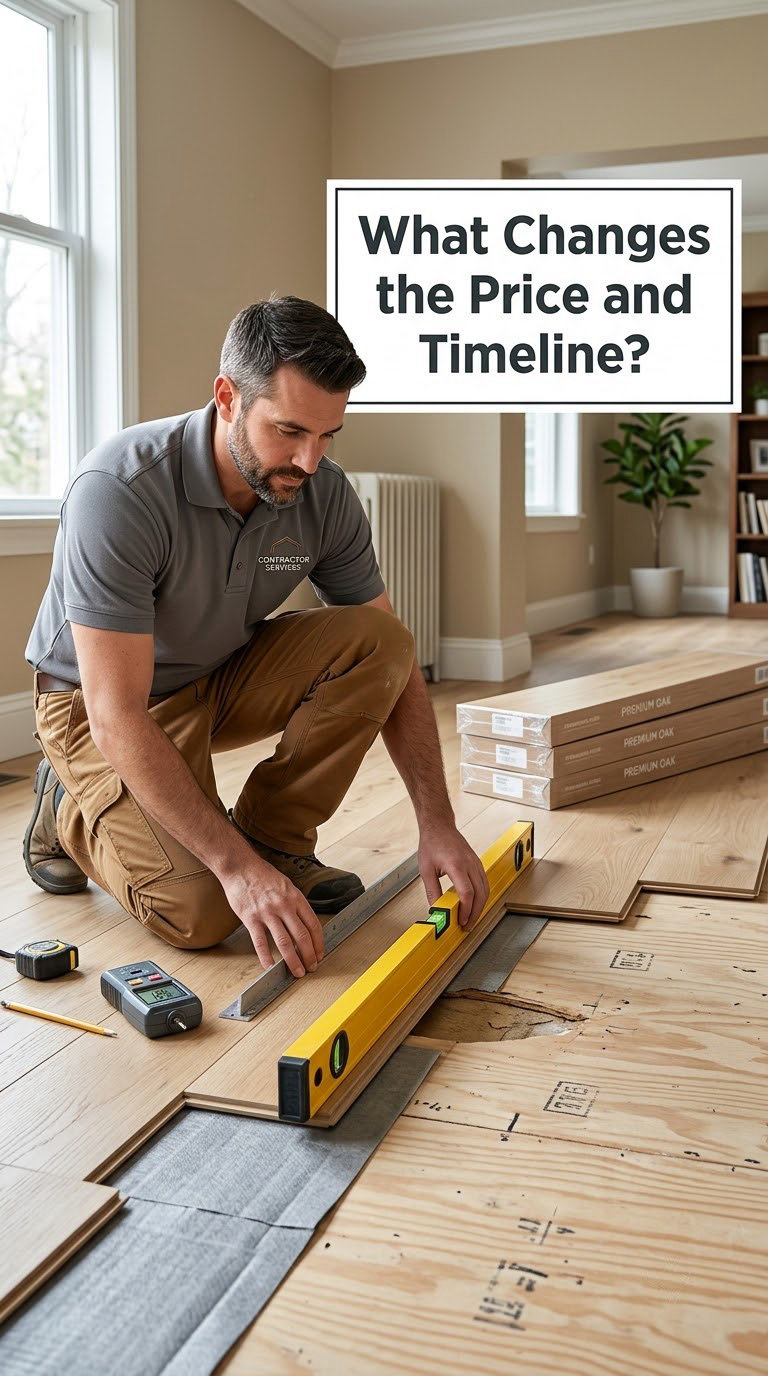
Every estimate is built on assumptions about the floor underneath and the room around it. These are the assumptions that blow schedules most often.
- Uneven or damaged subfloor — levelling compound needs to dry before anything goes down, and that drying time is part of the calendar.
- Moisture in a slab or basement — test first. A concrete slab that reads damp changes the whole prep plan.
- Old adhesive removal — glued-down tile and vinyl are the worst offenders and add hours per room.
- Stairs and landings — budget hours, not square feet.
- Diagonal, herringbone, or parquet layouts — two to three times the baseline time, and more waste.
- Cabinets, appliances, and built-ins — sometimes more work than the flooring.
- Furniture and pets — moving a sectional out and back is not a flooring task but lands on your calendar.
- An occupied home — dust control, noise limits, and daily foot traffic all slow a crew down.
A few DIY mistakes reliably add a full day, and most of them are the same ones every year. Installing laminate before the 48 hours is up. Forgetting the expansion gap at the perimeter. Mixing plank batches from two different cartons across the same room. Pulling the underlayment tight instead of butting the seams. Clicking a plank down over a piece of debris. Skipping a moisture test on a slab. Ordering 10 percent extra and not keeping the leftover boards for future repairs.
These are all quick to avoid and slow to undo. Talking your way through a similar timeline helps too — our guides on how long bathroom paint takes to dry and how long a sauna takes to heat up cover the same kind of waiting that most people underestimate.
Can you stay in the house while floors are replaced?
Yes, with a plan. Most people room-by-room rather than out entirely. Clear one room completely, have it installed, keep sleeping and cooking somewhere else in the house, and move on to the next room. Two things make this work: a clear path from the front door to the kitchen and bathroom that never crosses unfinished floor, and a place to stage the removed furniture. If you cannot keep a walkable path, plan on being out of the home for the working days of the install.
How long to stay off the new floor
Laminate and click-lock LVP can usually be walked on after 12 to 24 hours. Carpet is walkable immediately. Adhesive-backed vinyl needs 24 hours before foot traffic and 48 to 72 hours before you drag furniture back. Tile needs 24 hours before walking and 48 hours after grouting. Hardwood is different again — it is walkable quickly, but keep rugs and runners off for the first two weeks so the finish cures evenly. Dragging furniture across a cured floor leaves scratches that no polish fixes.
Frequently Asked Questions
How long does it take to install 1,000 sq ft of vinyl plank flooring?
A crew of two usually lays 1,000 square feet of LVP in one to two days once the room is cleared and the subfloor is level. Add a day or two for removing the old floor and patching, plus 24 to 48 hours of acclimation before the first plank. Budget three to four days of elapsed time for a straightforward layout with no stairs and no cabinets to work around.
How long does flooring installation usually take?
Most residential flooring takes one to three days of installation. Carpet and click-lock LVP sit at the short end, laminate adds a 48-hour acclimation period, engineered and solid hardwood add five to fourteen days of acclimation on top of one to four days of laying, and tile adds two full days of cure after grouting.
Can I stay in my house while floors are replaced?
Yes, most homeowners do. Clear one room completely, have it installed, and keep sleeping and cooking elsewhere in the house while you move room by room. Keep a walkable path from the door to the kitchen and bathroom that never crosses an unfinished floor. If you cannot maintain that path, plan to be out for the working days.
How long do you have to stay off hardwood floors after installation?
Hardwood is walkable within 12 to 24 hours, but keep rugs, runners, and area rugs off for two weeks while the finish cures. Do not drag furniture across the floor during that period. Lift and place it instead, ideally with felt pads underneath. Walking is fine sooner; sunlight and trapped moisture under rugs are what cause the colour difference.
Do I need to remove existing flooring before installing new flooring?
It depends on the material and the condition of what’s there. Laminate and engineered hardwood can often go over an existing clean, level, firmly attached floor if the manufacturer allows it. Glue-down tile and solid hardwood almost always need the old floor removed. Carpet and cushioned vinyl going over carpet traps moisture and must come up, and any floor with water damage, squeaks, or soft spots comes up regardless.
How long does it take to remove old flooring?
Removal is roughly a quarter to a half of the total project time. Glue-down tile and sheet vinyl with hardened adhesive are the slowest and often need a scraper, heat gun, or chemical remover. Floating laminate and click-lock vinyl pull up fast. Add disposal and haul-away time on top, and remember that removing the baseboards is a separate fifteen minutes per linear foot that people constantly forget.
Conclusion
Measure the room, know exactly which flooring you are buying, and look at the subfloor before anyone quotes you a number. Then add a two-day buffer to whatever estimate you were given, because the prep always takes longer than the estimate assumes. If you have a fixed date, work backwards from it and subtract the acclimation and cure time first, since those cannot be compressed.
