
5 Best Welders for Beginners (August 2026) Pro Reviews
The best welders for beginners make the first lessons feel manageable: plug in, set a sensible starting point, feed the wire, and practice on clean scrap steel. A complicated machine can be rewarding later, but a first welder should make it easier to see what changes when you adjust speed, voltage, travel angle, and distance from the work.
For most home projects, I would start with flux-core wire feed. It avoids the extra cylinder and regulator required for gas MIG, works outdoors better than gas-shielded welding, and lets a new owner concentrate on puddle control. It does create slag and more cleanup, so a wire brush, chipping tool, and patient prep still matter.
Contents
Our five picks cover a straightforward 120V flux-core machine, compact starter kits, and multiprocess machines that can grow into gas MIG, stick, or Lift TIG work. I based the recommendations on the analyzed listings’ published output, inputs, included gear, controls, ratings, and recurring buyer priorities such as wire-feed consistency and usable home power.
Top 3 Picks for Best Welders for Beginners (August 2026)
Choose the Lincoln if you want the least distracting route into small flux-core jobs, the Bestarc if dual-voltage flexibility matters, and the BESTMIG if receiving basic protective gear with the machine helps you begin practicing sooner. None replaces safe setup and practice, but each offers a sensible first route.

The Best Welders for Beginners in 2026 at a Glance
This overview separates the models by learning path rather than treating every amp rating as interchangeable. Output, input power, included modes, and stated material capacity are the useful first filters; a machine’s highest setting does not make thin sheet metal easier to weld.
| Product | Specs | Action |
|---|---|---|
| Lincoln Electric WELD-PAK 90i FC |
|
Check Latest Price |
 Bestarc MIG 145A Bestarc MIG 145A |
|
Check Latest Price |
 BESTMIG 135A BESTMIG 135A |
|
Check Latest Price |
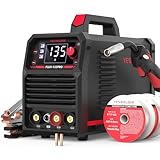 YESWELDER 135A YESWELDER 135A |
|
Check Latest Price |
 YESWELDER 160A YESWELDER 160A |
|
Check Latest Price |
1. Lincoln Electric WELD-PAK 90i FC Is the Simplest Dedicated Flux-Core Starter
Lincoln Electric 90i FC Flux Core Wire Feed Weld-PAK Welder…
120V flux-core
15 lb inverter
Up to 1/4 inch
Pros
- 15 lb portable design
- Simple two knob control
- Welds up to 1/4 inch
- Shoulder strap and metal case
- Full accessory list
Cons
- 120V input only
- For small jobs rather than heavy work
The Lincoln Electric WELD-PAK 90i FC is my clearest recommendation for someone who wants a first machine devoted to small repair and fabrication work. Its flux-cored setup removes the shielding-gas decision from day one, while the two-knob layout keeps the learning task focused on voltage and wire speed rather than menu settings.
Lincoln lists a 120V input and welding capacity up to 1/4 inch, which puts it in the home-garage category for brackets, gates, small equipment repairs, and thicker practice coupons. The inverter design, shoulder strap, protective metal case, welding gun, nozzle, contact tip, work cable, and clamp form a useful basic package.
I especially like the physical simplicity here because it gives feedback a beginner can understand. If the wire is stubbing into the plate, change wire speed; if the arc feels harsh or the bead sits cold, make a measured voltage adjustment and try again on scrap of the same thickness.
The trade-off is deliberate: this is not the right machine for a buyer who already knows they need gas MIG, dual-voltage input, or routine heavy fabrication. Its 120V-only design and small-job focus are limitations, not defects, and they keep the choice honest for a first workshop setup.
This Machine Fits Small Home Repairs and a Focused First Learning Plan
Choose this Lincoln for mild-steel fixes where portability and a straightforward control panel matter more than process variety. A homeowner repairing a lawn trailer tab, making a tool stand, or joining small steel brackets has a clear use case.
The listing’s 15-pound weight and shoulder strap are meaningful if your work surface is not permanently set up. I would still place it on a stable, dry bench with enough clearance around the vents rather than welding while carrying it.
This Machine Needs a Different Buyer for Thick or Multi-Process Work
Skip this model if your first project is a large trailer rebuild, continuous structural work, or a task that needs a 220V circuit. A dedicated flux-core unit is less flexible than a multiprocess machine, even though it is easier to approach.
It also asks the user to supply personal protective equipment if it is not already on hand. At minimum, use an approved welding helmet, leather gloves, non-synthetic clothing, closed-toe boots, and a space with suitable ventilation and fire control.
2. Bestarc MIG 145A Is the Best Value Choice for More Ways to Learn
Bestarc 145A MIG Welder 110V 220V, 4 in 1 Gasless Flux Core…
145A 4-in-1
110V and 220V
Synergic control
Pros
- Gas and gasless MIG
- Dual-voltage input
- Synergic automatic matching
- Large LED display
- Lift TIG and stick modes
Cons
- 145A maximum output
- Fine tuning range may feel limited
The Bestarc MIG 145A offers the broadest learning path at this level: gas MIG, gasless flux-core MIG, Lift TIG, and stick welding. That range is useful only if the early controls remain approachable, and the listing’s synergic control is intended to match voltage automatically as you set the wire diameter and amperage.
It accepts 110V and 220V power with automatic detection, so it can begin on a typical home outlet and later move to a suitable higher-voltage circuit. The large LED display gives the user a visible reference point instead of relying on a vague dial position.
For a beginner, I would run flux-core wire first and keep the settings near the recommended starting range for the material. Once bead shape and travel speed become predictable, gas MIG is the logical next step for cleaner indoor work; it requires the proper gas supply, regulator, and safe cylinder handling.
The listing also states compatibility with E71T-GS flux-core wire and ER70S-6 solid wire. That is a practical detail, because solid wire and flux-core wire solve different problems; buying the correct consumable for the selected process prevents an avoidable first-day failure.
This Machine Fits Beginners Who Expect Their Projects to Expand
Pick the Bestarc if you are starting with light fabrication but expect to tackle a mix of garage repairs, hobby work, and occasional stick-welding jobs later. Dual voltage gives the machine a longer useful runway when a proper 220V outlet is available.
Its synergic mode is appealing to learners who do not want every variable thrown at them at once. The listed manual voltage trim of minus 3V to plus 3V still leaves room to see how a small correction changes the arc.
This Machine Needs Deliberate Setup Before Changing Processes
Do not assume that four modes mean four complete setups are included. Lift TIG requires a compatible torch, and every process needs the right consumables, connections, polarity, and settings before striking an arc.
Forum discussions repeatedly flag poor wire feed as the deal-breaker on inexpensive wire-feed welders. I would inspect the drive-roll groove, use a clean contact tip in the correct size, keep the cable as straight as practical, and set just enough drive-roll tension to feed wire without crushing it.
3. BESTMIG 135A Is the Ready-to-Start Kit for Basic Garage Practice
BESTMIG 135A MIG Welder – 3-in-1 Flux Core Welder, MIG/Lift…
135A 3-in-1
110V flux-core
Helmet and gloves included
Pros
- Helmet and gloves included
- Digital auto-adjusting settings
- 135A output
- Full-color LED display
- Gasless wire support
Cons
- 110V only
- TIG torch not included
The BESTMIG 135A makes sense for the person who has no welding gear yet and wants a package built around first practice sessions. The analyzed listing includes a welding machine, flux-core wire, 14AK torch, electrode holder, earth clamp, wire brush, gloves, auto-darkening welding glasses, and a welding helmet.
That inclusion list reduces the number of missing pieces, which is a real advantage for a first purchase. It is still sensible to inspect the helmet fit and lens function, check glove coverage, and treat the included protection as a starting point rather than permission to ignore clothing, footwear, ventilation, or fire safety.
The machine has 135A output, runs on 110V, and is stated to weld material up to 1/8 inch thick. Its digital technology auto-adjusts parameters and the full-color LED display shows the current working setting, both of which can help a new user repeat a practice setting after a pause.
It offers MIG, Lift TIG, and stick modes, but gasless flux-core is the direct path to the first bead. The TIG torch is not included, so I would not buy this package solely for TIG plans; choose it for basic steel projects and a more complete day-one bundle.
This Machine Fits First-Time Owners Who Need Core Gear in One Package
This is a reasonable starter welder for small home repairs, hobby welds, and practice on 1/8-inch mild steel or thinner material. The supplied helmet and gloves help remove the common pause between buying a machine and having enough equipment to begin.
I would make a simple first project such as a square practice frame from clean mild-steel coupons. It teaches tack placement, corner fit-up, bead starts, stops, and cleanup without asking the machine to handle a safety-critical repair.
This Machine Needs Another Option for 220V Power or Complete TIG Work
Look elsewhere if you have a 220V circuit and plan to use it, because this model is 110V only. More input capacity is useful for projects that demand more output, though technique and joint preparation still matter as much as amp rating.
Lift TIG is available as a mode but not as an immediately complete package because the TIG torch is absent. Buyers should confirm every required accessory before selecting a multiprocess welder for a specific process.
4. YESWELDER 135A Is the Popular Gasless Flux-Core Starter
YESWELDER 135A MIG Welder, 110V Flux Core Gasless MIG/Lift…
135A gasless MIG
110V 3-in-1
Synergic LED controls
Pros
- Strong review volume
- Synergic voltage matching
- Bonus flux-core wire
- Portable carrying handle
- Digital current display
Cons
- 110V input only
- TIG torch required separately
- Stick adjustments are mode-specific
The YESWELDER 135A is the familiar gasless option for a beginner who wants a compact 110V machine with a substantial review history. Its analyzed listing shows a 4.5 rating across 2.9k+ reviews and a top rank in MIG Welding Equipment, which gives more broad buyer feedback than the other models here.
Functionally, it is a 3-in-1 machine for gasless flux-core MIG, stick, and Lift TIG. The synergic control automatically matches voltage as wire-feed speed changes, while the LED screen displays current, so a learner has a clearer starting point and can make small, traceable adjustments.
The published 135A capacity is for mild steel up to 3/32 inch, and the package includes E71T-GS flux-core wire. That points it toward light steel repairs, basic home projects, and learning passes on clean coupons, rather than long welds on thick material.
I would not confuse a large review count with a guarantee that every setup works perfectly out of the box. Check the work clamp’s contact, choose the correct polarity for the wire, clean rust and paint from the weld area, and practice on offcuts before judging the arc.
This Machine Fits Home Users Who Want Gasless MIG With Guided Settings
Choose the YESWELDER 135A for a first machine that can plug into a 110V outlet and begin with the included flux-core wire. It is especially practical when welding outdoors or in a drafty garage, where gas shielding can be disturbed.
The listing gives wire-feed ranges for both 0.030-inch and 0.035-inch wire, plus voltage trim from minus 3V to plus 3V. Once you can produce consistent beads, those controls let you learn why a small tweak can improve a bead’s sound, wetting, and profile.
This Machine Needs a 120V-Friendly Project Scope
Do not select this model for regular thick-section fabrication or for a buyer who needs dual-voltage input from the start. It is a 110V machine, and its stated mild-steel capacity of 3/32 inch provides a better planning guide than its headline amperage alone.
Its Lift TIG mode also requires a separate 10-25 compatible TIG torch. Hot Start and Arc Force adjustments apply only in stick mode, so read the controls by process instead of expecting every setting to apply in flux-core MIG.
5. YESWELDER 160A Is the Room-to-Grow Dual-Voltage Multiprocess Pick
YESWELDER 160A MIG Welder, 110V/220V Dual Voltage, 4 in…
160A 4-in-1
110V and 220V
Synergic and manual control
Pros
- 160A output
- Dual-voltage input
- Gas MIG and flux-core
- Manual adjustment option
- Works with 2 lb and 10 lb spools
Cons
- Heavier than compact choices
- TIG torch sold separately
The YESWELDER 160A is the pick for a beginner who wants to learn on flux-core but does not want to outgrow the power options quickly. It combines 110V and 220V input, 160A output, gas MIG, flux-core MIG, stick, and Lift TIG in one listed package.
Smart synergic control supplies a guided starting point, while manual control becomes available when you know why you want to override the match. That pairing is more useful than a complicated panel with no reference point: start assisted, record the settings that work, then make one adjustment at a time.
It takes both 2-pound and 10-pound spools of 0.030-inch and 0.035-inch wire. That spool flexibility is relevant for a home welder who begins with small rolls of flux-core wire but later wants longer runs of a frequently used wire type.
There is more weight and setup involved than with the smallest 120V machines, so I would choose it for a dedicated garage space rather than a tool that must be carried to every quick repair. The listing also includes a 220V-to-110V adapter, gas hose and drive roller, clamp, electrode holder, MIG torch, tips, and leads.
This Machine Fits Learners Who Plan for Gas MIG or a 220V Circuit
Choose the 160A if your projects may grow from small brackets to broader repair work and you expect access to a correctly installed 220V circuit. The additional input option and 160A output provide more headroom, while gas MIG can offer cleaner indoor beads after you add the proper gas equipment.
It also supports common stick electrodes including 6010, 6011, 6013, and 7018 according to the listing. Stick mode is useful for certain outdoor repair situations, though it is generally less forgiving than wire-feed welding for a person learning basic puddle control.
This Machine Needs a Dedicated Space and a Separate TIG Torch
This is not the most grab-and-go choice if portability is the top priority. The published listing describes it as heavier than the smaller models, even though it has a carrying handle, and its physical footprint favors a stable work area.
As with the other multiprocess choices, Lift TIG capability does not include a TIG torch. Buy it for its dual-voltage wire-feed and stick potential first, then add process-specific equipment only when a project calls for it.
MIG and Flux-Core Are Easier Starting Processes Than TIG or Stick
MIG is usually better than TIG for beginners because the gun continuously feeds filler wire, so the learner can focus on moving the gun and watching the puddle. Gas MIG uses a shielding gas to protect the weld and can produce clean beads with little slag, but drafts and extra gas gear add setup tasks.
Flux-core is a wire-feed process too, but the wire’s flux creates shielding at the weld. It is a practical beginner choice for outdoor or basic garage work because it does not require a gas cylinder, although it creates slag that must be removed and does not produce the same clean finish as good gas MIG.
Arc welding, commonly called stick welding, uses a flux-covered electrode rather than continuous wire. It is useful outdoors and on some repair work, but managing electrode length, arc distance, and restarts is usually harder for a first-time welder than flux-core or MIG.
TIG can make very precise, attractive welds, but it demands coordinated control of a torch and filler rod, plus careful cleanliness and gas coverage. I would learn basic weld-puddle control with flux-core or MIG first, then try TIG when the project needs its precision.
The Buying Guide Starts With Your Project, Power, and Safe Work Area
Buy for the material and joint you actually expect to weld, not for a number on the front panel. Thin sheet metal for automotive rust repair needs low, controllable heat and short welds; thicker brackets and repairs need enough output, good fit-up, and the correct joint design.
A 120V Welder Fits Many First Projects When Material Thickness Is Modest
A 120V or 110V machine can work from a normal household outlet, provided the circuit, extension cord, and outlet condition meet the welder’s manual requirements. It is a practical choice for learning, small brackets, garden repairs, and light fabrication.
Do not run a welder through a thin, damaged, or overloaded extension cord. Voltage drop can make the arc erratic, which feels like a machine fault even when the wiring is the real issue.
A Dual-Voltage Welder Gives You a Better Upgrade Path
A dual-voltage machine can start at home on lower-voltage power and use a suitable 220V circuit later. This does not make every weld better automatically, but it expands the range for jobs that need more output and longer welding time.
Have higher-voltage wiring installed or checked by a qualified electrician where needed. Never improvise adapters, circuits, or grounding for a welding machine.
A Stable Wire Feed Matters More Than Extra Modes on Day One
Forum users repeatedly identify wire-feed trouble as the fastest way to turn beginner practice into frustration. Before blaming the machine, match drive-roll groove, wire size, contact-tip size, polarity, and tension to the wire you are using.
Keep the wire dry and clean, avoid sharp bends in the torch lead, and make sure the spool turns freely without overrunning. Use scrap steel to establish a repeatable baseline, then label the wire type and settings that worked.
A Flux-Core Setup Is the Most Direct First Route for Many Home Garages
Start with gasless flux-core when you want fewer pieces of equipment and may weld outside. It is a sensible route for gates, small repairs, brackets, and practice steel, provided you remove paint, rust, oil, and galvanizing from the weld zone.
Move to gas MIG when you have an indoor space, a secure cylinder setup, and a project where a cleaner weld appearance is important. Gas MIG is not inherently harder at the puddle, but the cylinder, regulator, hose, and wind sensitivity add responsibilities.
A First Project Should Teach Control Without Carrying Structural Risk
Make overlapping beads on flat scrap, butt joints, lap joints, and T-joints before repairing anything that carries a person or vehicle load. I favor a small tool rack, practice cube, or non-critical garden bracket because you can cut it apart and inspect penetration without consequences.
Avoid structural, pressure-containing, fuel-system, or safety-critical repairs while learning. If a vehicle, trailer, railing, or lifting point must hold a load, seek qualified guidance and follow applicable repair standards.
Safety Gear and Fire Control Belong in Every First-Welder Plan
Wear a properly rated auto-darkening helmet or welding helmet, leather gloves, flame-resistant non-synthetic clothing, boots, eye protection for grinding, and hearing protection when required. Keep combustible materials away, keep a suitable extinguisher nearby, and check the area for smoldering material after finishing.
Ventilation matters because welding fumes can be hazardous, especially from coatings, oils, paint, and galvanized metal. Milk is not a treatment for fume exposure; leave the area, get fresh air, and seek medical advice promptly if you feel unwell or have concerning exposure symptoms.
Frequently Asked Questions Give Direct First-Welder Answers
Is MIG or TIG better for beginners?
MIG is usually better for beginners because the gun feeds wire continuously, leaving the user to focus on gun angle, travel speed, and the weld puddle. TIG offers precision but requires more hand coordination and careful gas coverage.
Why do welders drink milk after welding?
Milk is a common folk remedy associated with metal fume exposure, but it is not a treatment or protective measure. Use ventilation, avoid welding contaminated or coated metal, leave the exposure area if symptoms occur, and seek medical advice for concerning symptoms.
What is the easiest welder to use at home?
A 120V flux-core wire-feed welder is often the easiest home choice because it uses a standard-style household power source and does not need shielding gas. The Lincoln Electric WELD-PAK 90i FC is the simplest dedicated flux-core option in this guide, while the YESWELDER 135A adds guided synergic settings.
Is a MIG or ARC welder better for beginners?
MIG or flux-core wire-feed welding is generally better for beginners than ARC or stick welding. Continuous wire feed makes it easier to maintain a working arc, while stick welding asks the learner to manage electrode length, arc distance, slag, and restarts.
The Right Beginner Welder Depends on Your First Project
For the simplest route into small flux-core repairs, choose the Lincoln Electric WELD-PAK 90i FC. Choose the Bestarc MIG 145A or YESWELDER 160A when dual voltage and extra processes are part of the plan; choose the BESTMIG 135A when a starter gear bundle matters; and choose the YESWELDER 135A for a proven, compact gasless option.
The best welders for beginners in 2026 are not the ones with the most settings on paper. They are the machines that fit your power, material, workspace, and first project, then leave you time and confidence to practice safe, repeatable beads.
