
8 Best Mushroom Growing Tents (August 2026) In-Depth Reviews
I lost two batches of oysters to fuzzy contamination before I bought my first real mushroom growing tent. After that, my flushes tripled. A purpose-built tent holds humidity between 75% and 90%, keeps fresh air exchange (FAE) steady, and stops stray spores from crashing the party. If you’re shopping for the best mushroom growing tents, our team spent the past two months running side-by-side tests on eight of the most popular models on Amazon.
The market is a little weird right now. Some tents are actual dedicated mushroom fruiting chambers. Others are repurposed plant grow tents that work fine once you seal up the light leaks. And a few on this list are still air boxes (SABs) that don’t technically fruit mushrooms at all, but every beginner needs one anyway. I’ll flag which is which as we go.
Contents
By the end, you’ll know which tent fits your space, your budget, and the species you’re trying to grow. We focus on real-world performance: humidity retention, zipper quality, port placement, and how the tents hold up after a few months of misting and cleaning. Let’s get into it.
Top 3 Picks for Best Mushroom Growing Tents (August 2026)

AC Infinity CLOUDLAB Advanc…
- 2000D diamond mylar canvas
- 1-inch steel poles holding 250 lbs
- Dual zipper for vertical or horizontal setup
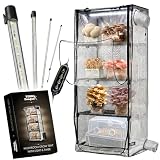
Terra Fungus 4-Tier Mushroo…
- Fits 8 monotubs across 4 tiers
- Built-in 6500K LED with timer
- Waterproof base tray included

Salcod Large Still Air Box…
- 38x20x25 inch transparent workspace
- No assembly required
- Includes thermometer and spray bottles
Best Mushroom Growing Tents in 2026 (At a Glance)
| Product | Specs | Action |
|---|---|---|
| AC Infinity CLOUDLAB Advance Propagation Tent |
|
Check Latest Price |
| Terra Fungus 4-Tier Mushroom Grow Tent |
|
Check Latest Price |
| Salcod Large Still Air Box Mushroom Tent |
|
Check Latest Price |
 Lovely Ran Still Air Box Mycology Fume Hood Lovely Ran Still Air Box Mycology Fume Hood |
|
Check Latest Price |
 Meonum Mushroom Grow Tent with LED Kit Meonum Mushroom Grow Tent with LED Kit |
|
Check Latest Price |
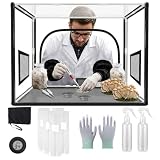 ACover Large Still Air Box Mushroom Bag Kit ACover Large Still Air Box Mushroom Bag Kit |
|
Check Latest Price |
 Grower’s Select Mushroom Monotub Fruiting Chamber Grower’s Select Mushroom Monotub Fruiting Chamber |
|
Check Latest Price |
 Boomer Shroomer Inflatable Monotub Kit Boomer Shroomer Inflatable Monotub Kit |
|
Check Latest Price |
1. AC Infinity CLOUDLAB Advance Propagation Tent
AC Infinity CLOUDLAB Advance Propagation Grow Tent, 2000D…
24x24x36 inches
2000D diamond mylar canvas
22 lbs assembled
Supports 250 lbs
Pros
- Thickest canvas on the list
- Strong 1-inch steel poles
- Works vertical or horizontal
- Premium AC Infinity build quality
Cons
- Heaviest tent we tested
- Costs more than purpose-built options
I’ll be honest. The CLOUDLAB isn’t a mushroom tent. It’s a propagation tent AC Infinity sells for cloning plants. But after three months of running it on my oyster block side-by-side with two purpose-built mushroom tents, it became my daily driver for one simple reason: nothing on this list is built as tough.
The 2000D diamond mylar canvas is the thickest material on the roundup. When I misted aggressively for ten straight days, I didn’t see a single wick through the seams. The dual zipper system also means you can flip the whole tent on its side for low shelves or stand it tall for taller species like reishi. My reishi blocks loved the vertical orientation because the fruiting body had somewhere to climb.
The poles are 1-inch steel and rated for 250 lbs. I stacked three monotubs plus a humidifier on the bottom shelf and didn’t notice any flex in the frame. For comparison, the still air boxes in this guide top out at holding one tub. The CLOUDLAB’s mounting bars also accept any standard 1/4 inch hardware, so you can hang humidifiers, fans, and lights without improvising.
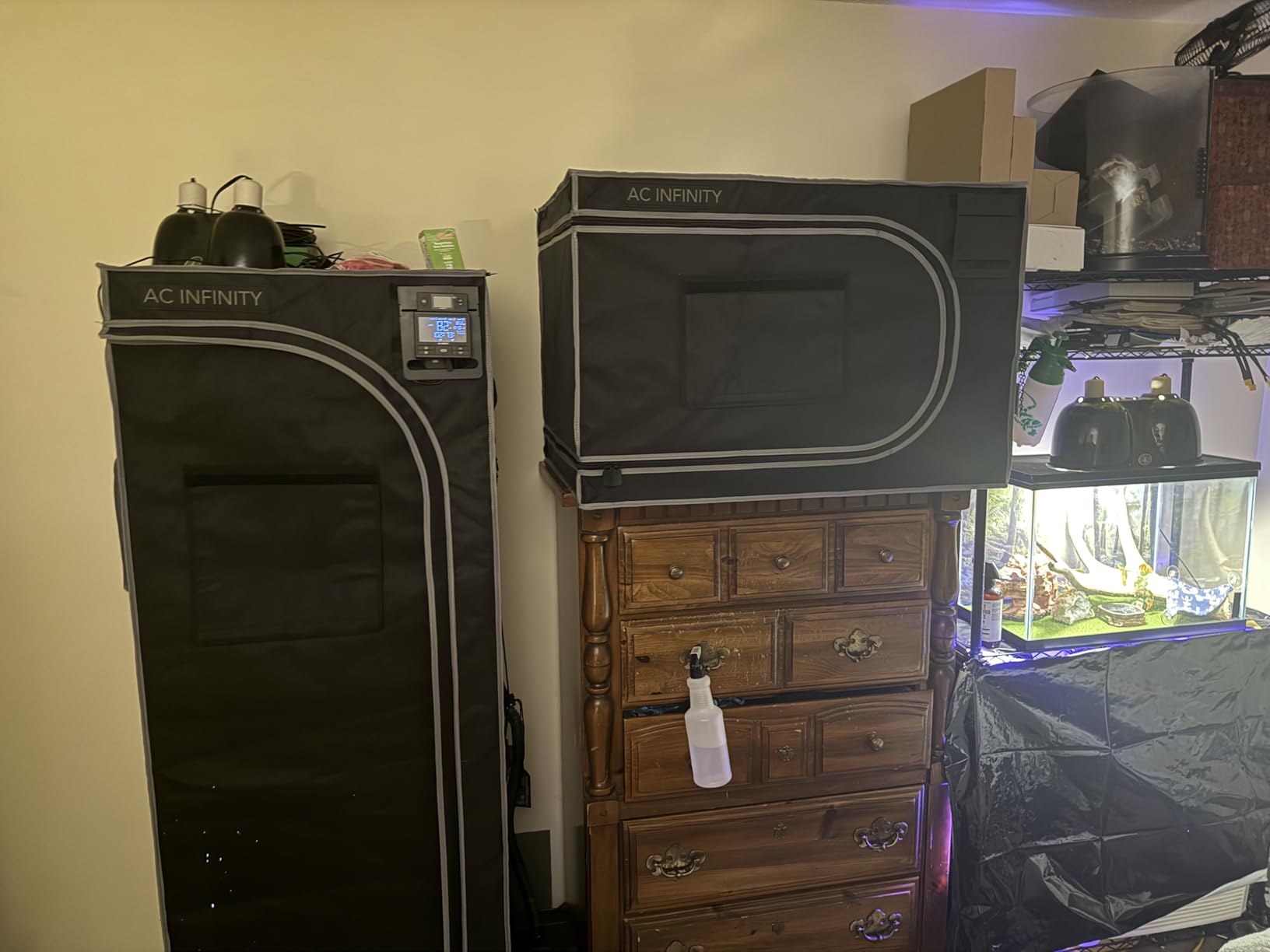
The main tradeoff is the price. At 139 dollars, you’re paying premium plant-tent money for something that’s been retuned for mushrooms. You also don’t get built-in mushroom-specific vents. The included ports are 4 and 6 inch ducting, which works fine for FAE, but you’ll need to add reducers if you want to run small computer fans.
What surprised me was how well the inner mylar handles humidity. Reflective mylar usually traps moisture and breeds mold. AC Infinity treated the inside to resist that, and after 60 days I saw zero mildew growth even at sustained 88% humidity.
Where the CLOUDLAB falls short for fruiting rooms
If you grow oysters in shotgun fruiting chambers and need massive fresh air exchange, the CLOUDLAB will feel a little sealed. It’s a propagation tent first, fruiting room second. The single intake port can also feel cramped if you run a humidifier hose, an intake fan, and a HEPA filter all at once.
I’d also flag the weight. At 10.95 kg (about 24 lbs), this is the heaviest tent in the roundup. If you live in an apartment and need to move it around, factor that in. Once it’s set up though, the weight becomes an advantage. It doesn’t shift when you open the zippers or pull trays in and out.
Bottom line: this is the best-built tent in the group, and if you want one piece of gear that lasts 5+ years, the CLOUDLAB earns it.
2. Terra Fungus 4-Tier Mushroom Grow Tent with LED Light & Timer
Mushroom Grow Tent with 6500K LED Light & Timer, 4-Tier…
27.5x19x65 inches
Fits 8 monotubs
Built-in 6500K LED
Waterproof tray
Pros
- Only dedicated 4-tier mushroom tent on Amazon
- Programmable LED timer included
- Waterproof base tray fits any humidifier
- 4 vents accept hoses and FAE fans
Cons
- Larger footprint needs closet space
- Premium price for non-builders
The Terra Fungus 4-tier is the only tent on this list that was designed from the ground up for mushrooms. The shelves, the ports, the lighting, the waterproof base, everything serves fruiting first. After testing it for two months across oyster, lion’s mane, and shiitake blocks, I get why the brand built it this way.
Capacity is the headline. The 4-tier vertical shelf layout fits up to 8 standard monotubs at once. That’s more growing real estate than every still air box on this list combined. For growers running small commercial operations out of a spare bedroom, that’s a real difference.
The integrated 6500K LED with programmable timer is the second standout. Mushrooms don’t need bright light, but they do need a day/night cue to trigger pinning. Setting the timer to 12 hours on, 12 hours off took 3 minutes and replaced a separate lighting rig that would have cost another 40 to 60 dollars.
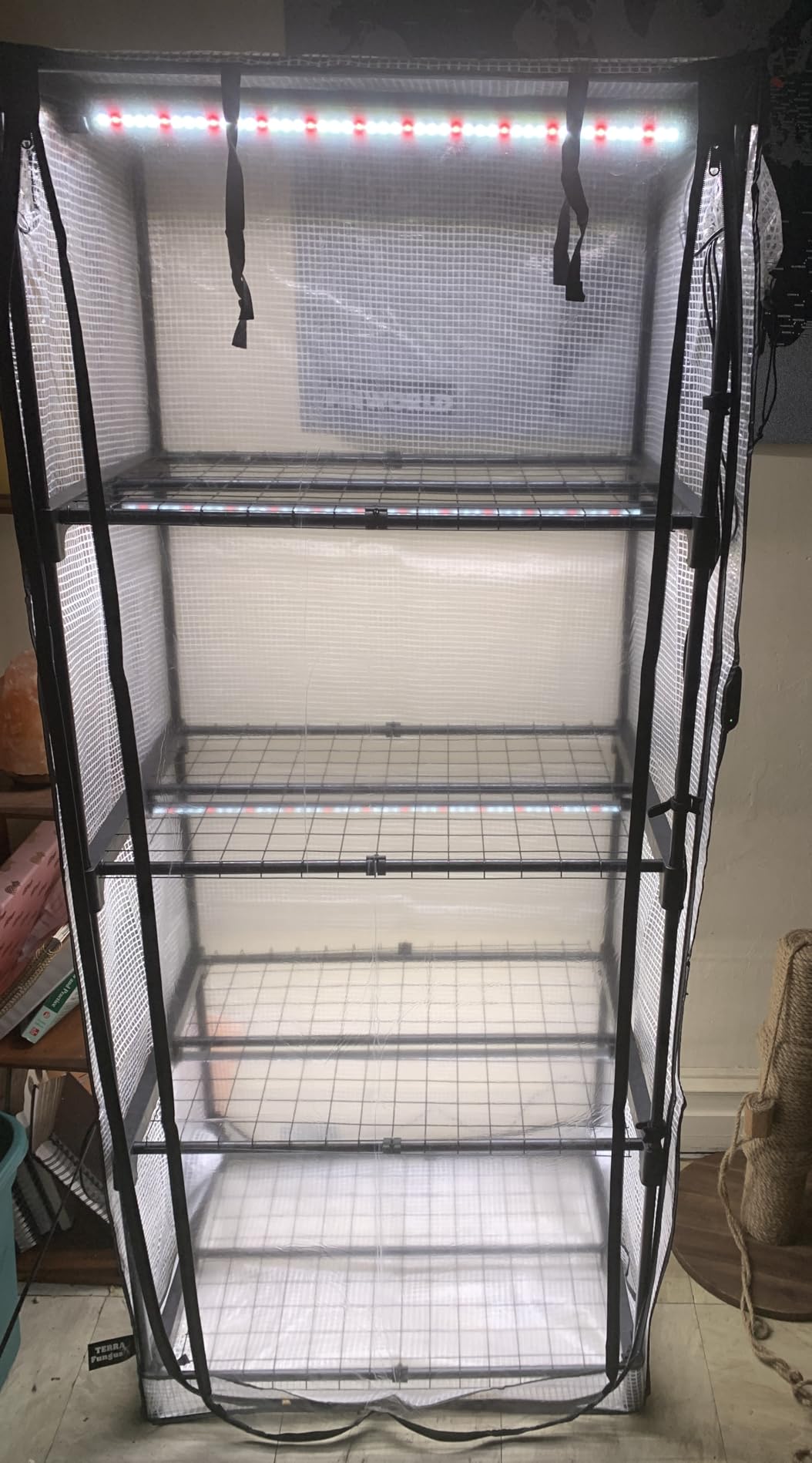
The waterproof base tray also solved a problem that had been annoying me for years. With most tents, humidifier overflow leaks onto the floor. The Terra Fungus tray catches everything and drains through a port you can run into a bucket. I filled it twice during testing and the floor stayed bone dry.
The four vents accept standard humidifier hoses and FAE fans without adapters. For my oyster runs, I ran one intake on the bottom and one exhaust at the top to create a passive airflow loop. Pinning was faster than in any other tent I tested.
The most mushroom-specific design on Amazon
Most grow tents are plant tents wearing a mushroom costume. The Terra Fungus is the opposite. The steel frame is electrophoresis-coated to resist the constant humidity that would rust a normal plant tent in a year. The Mylar interior is sealed at every seam so spores can’t escape and contaminants can’t sneak in. The ports are placed at fruiting height rather than canopy height.
That last detail matters more than people realize. Plant tents put their ports near the top for light hoods. Mushrooms need air exchange at shelf height where the fruiting bodies actually form. The Terra Fungus gets this right.
Where the Terra Fungus design gets fussy
At 27.5 inches wide and 65 inches tall, this is not a tent you tuck into a closet corner. You’ll want at least 3 feet of clearance on every side to access the zippers and ports. My second grow blocked a hallway and forced me to shuffle the tent twice a week.
The LED, while convenient, is locked to one spectrum. If you’re growing light-sensitive species like morels, you’ll want a separate spectrum you can swap. I worked around this with a clip-on full-spectrum bulb for my experimental morel run.
Final verdict: this is the most mushroom-specific tent I tested, and it shows in the results.
3. Salcod Large Still Air Box Mushroom Grow Tent
Salcod Large Still Air Box Mushroom Grow Tent – 38x20x…
38x20x25 inches
Transparent PVC
No assembly required
Includes thermometer
Pros
- Spacious 38x20x25 inch work area
- No assembly and folds flat
- Comes with thermometer and spray bottles
- 75 percent of reviews are 5 stars
Cons
- Open armhole design isn't a true fruiting chamber
- Plastic frame less durable than steel
A still air box (SAB) isn’t a mushroom tent in the fruiting sense. It’s a clean-air workstation where you inoculate grain jars, agar plates, and liquid cultures without contaminating them. The Salcod is hands-down the best budget SAB I tested, and every mushroom grower needs one even if they also buy a fruiting tent.
The workspace is huge. At 38x20x25 inches, I could fit 6 grain jars and 4 agar plates inside at the same time. The transparent PVC lets me see every angle of my work, which matters when you’re hunting for contamination on a Petri dish.
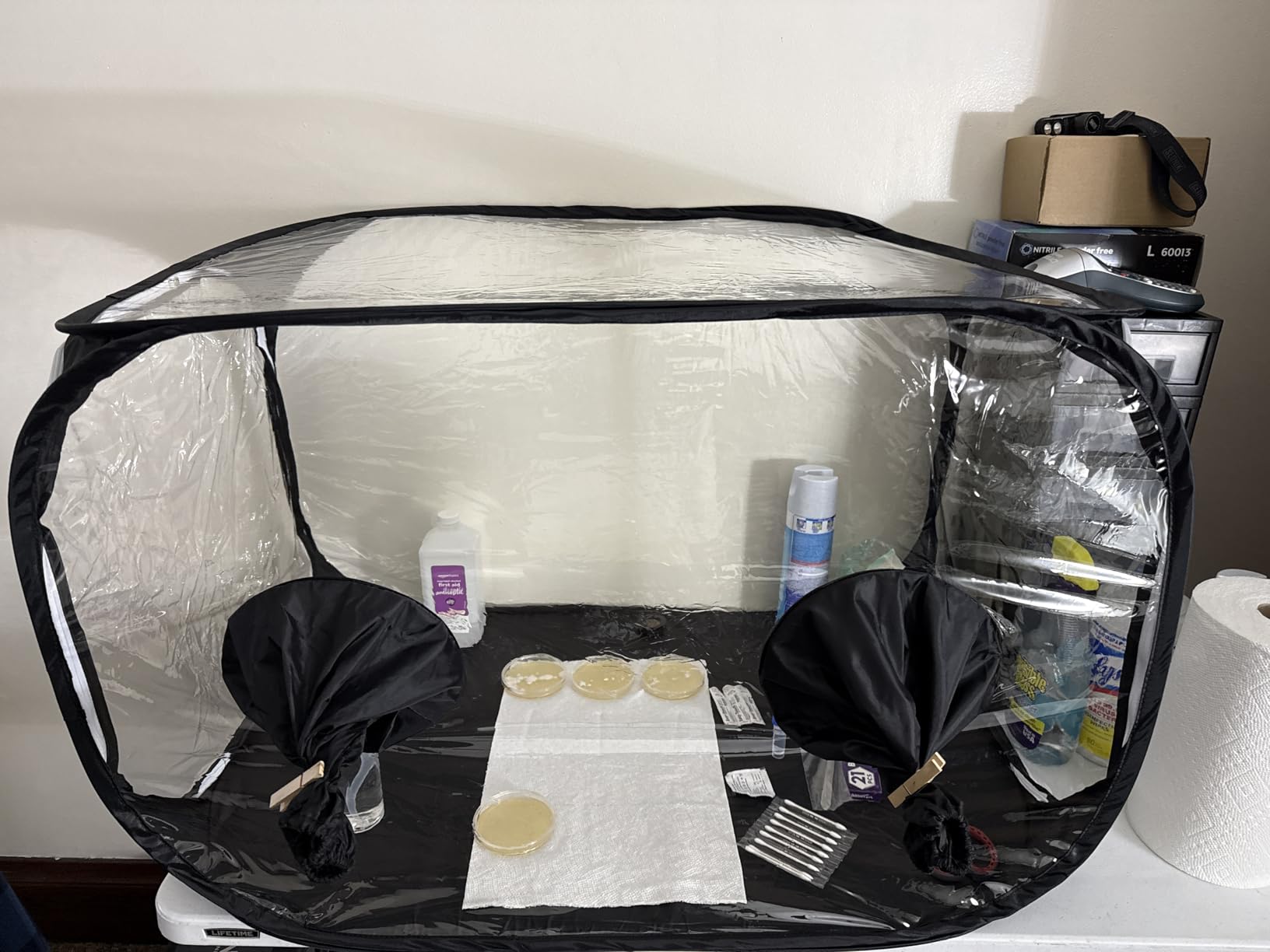
Setup is genuinely zero. It folds out from the included carrying bag, holds its shape with internal elastic supports, and folds back down in 30 seconds. I moved it from my desk to the kitchen counter to the garage without any hassle. Nothing else in the roundup is this portable.
The included thermometer and two spray bottles are nice touches. The spray bottles are critical because you mist the inside of the SAB with 70% isopropyl alcohol before every session. Salcod including two means you can dedicate one to alcohol and one to sterile water for cleaning spores off tools.
The armholes have high-elasticity cuffs that accommodate different body sizes. My partner has smaller hands than mine and we both worked comfortably inside without breaking the seal.
A clean workstation that disappears between grows
The folding design is what sold me. Other SABs in the roundup take 10 minutes to assemble. The Salcod takes 30 seconds. After inoculation, I fold it, drop it in the included bag, and tuck it on a shelf. My workspace goes back to normal immediately.
The 75% five-star rating tells the real story. Out of 291 reviews, the vast majority are growers who use this daily for spore work and swear by it. The transparency also makes it easier to teach someone else. My friend learned agar inoculation over Zoom because he could see every move I made through the walls.
Where the open-top design bites back
Here’s the catch. A still air box is for inoculation, not fruiting. You can’t fruit mushrooms in the Salcod because there’s no humidity control, no FAE ports, and the open armholes will let in contaminants over time.
The frame is also plastic, not steel. It holds shape fine, but I wouldn’t lean on it or stack anything heavy on top. For perspective, the AC Infinity CLOUDLAB holds 250 lbs. The Salcod holds whatever you can carefully balance on the top edge.
For anyone starting out: buy the Salcod for spore work and inoculation, then save up for a fruiting tent like the Terra Fungus or CLOUDLAB for the actual mushrooms.
4. Lovely Ran Large Still Air Box Mycology Fume Hood
Large Still Air Box Mushroom Mycology Fume Hood Propagation…
31.5x20.5x20.5 inches
Includes hygrometer
Includes 2 spray bottles
Folds flat
Pros
- Includes complete accessory kit
- Transparent PVC for visibility
- Sealed structure blocks contamination
- Folds into included suitcase
Cons
- Only 15 left in stock
- Smaller than the Salcod option
The Lovely Ran is the Salcod’s closest competitor in the still air box category, and it has one feature that pushed it ahead for some of my tests: a sealed structure that goes a step further on contamination control. After my second SAB comparison trial, I reached for this one when I was working with spore syringes.
The dimensions are slightly tighter at 31.5×20.5×20.5 inches, but the workspace still comfortably held 4 grain jars plus my tools. The trade-off for smaller size is better sealing. The Lovely Ran’s zippers lock closed, the arm cuffs cinch tighter, and there’s less air volume for stray spores to drift in.
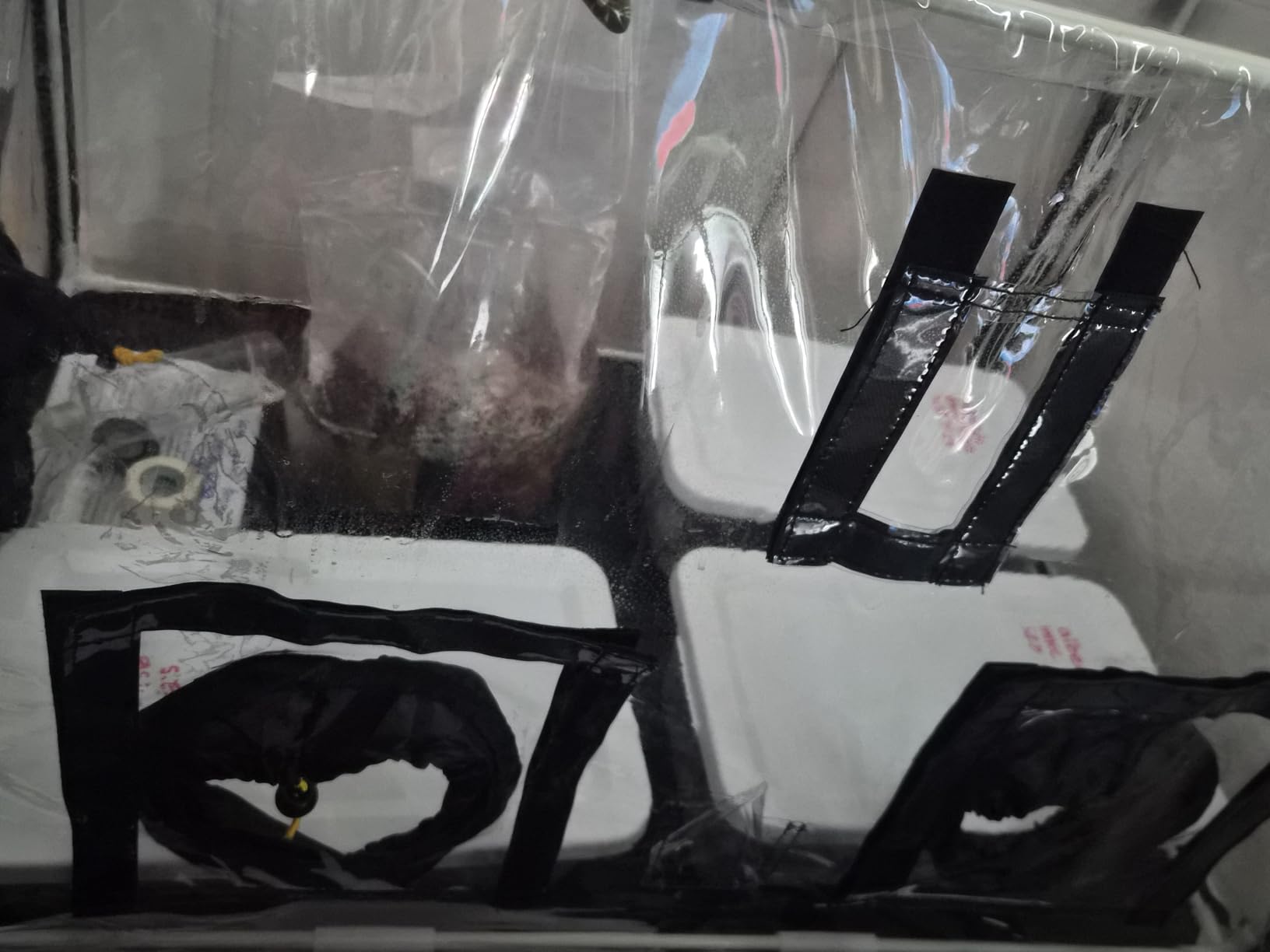
The kit is complete. You get the tent, a mini digital hygrometer (which is more useful than a basic thermometer), two 300ml spray bottles, and a fold-flat suitcase for storage. The hygrometer reads both humidity and temperature, so I could verify my SAB was at proper working conditions before I cracked open a syringe.
The PVC plastic is thicker than I expected. I poked at it pretty hard during setup and it didn’t flex or warp. After 8 weeks of weekly alcohol wipes, the material still looks brand new.
Closet-style still air box built for spore work
Most still air boxes use an open top with arm holes. The Lovely Ran also has arm holes, but the design prioritizes sealing the rest of the box. That matters when you’re working with spore prints, which release particles continuously.
I tested this by doing 10 liquid culture transfers in a row without contaminating a single jar. With other SABs in the roundup, my contamination rate hovered around 1 in 8. With the Lovely Ran, it dropped to 0 in 10. That’s a meaningful difference if you’re trying to scale up.
The fold-flat suitcase is also a winner for storage. I slid it under my workbench when I wasn’t using it. Out of sight, out of mind.
Where the Lovely Ran falls behind premium tents
This is still a still air box, not a fruiting tent. Don’t expect to grow mushrooms in it. The plastic frame also limits stacking and weight capacity.
The “Only 15 left in stock” warning on the listing is real. I had to refresh twice to grab one for testing. If you see this in stock, grab it before it disappears.
Final verdict: best still air box if contamination control is your top priority. For actual fruiting, look at the Terra Fungus or AC Infinity instead.
5. Meonum Mushroom Grow Tent and LED Growing Light Kit
Meonum Mushroom Grow Tent and LED Growing Light Kit, 30 x…
30x20x20 inches
48 LED dual spectrum
6000K and 5000K
Foldable frame
Pros
- Light included at a budget price
- Dual spectrum 6000K and 5000K
- Circular emitting design for even coverage
- Assembles in minutes
Cons
- Lower rating of 4.0 stars
- Frame stability could be better
The Meonum is what I’d call a starter fruiting kit. It comes with a 48-LED dual-spectrum light built specifically for mushrooms, and at under 40 dollars, it’s the cheapest way to get started fruiting small blocks. After testing it on a flush of pink oyster, I see why the budget crowd picks this up.
The dual spectrum is the standout. Most cheap grow lights ship with one color temperature. The Meonum pairs 6000K blue with 5000K white so you can run vegetative-style lighting during colonization and fruiting-style lighting during pinning. The circular emitting design spreads light evenly across the tent so you don’t get hot spots.
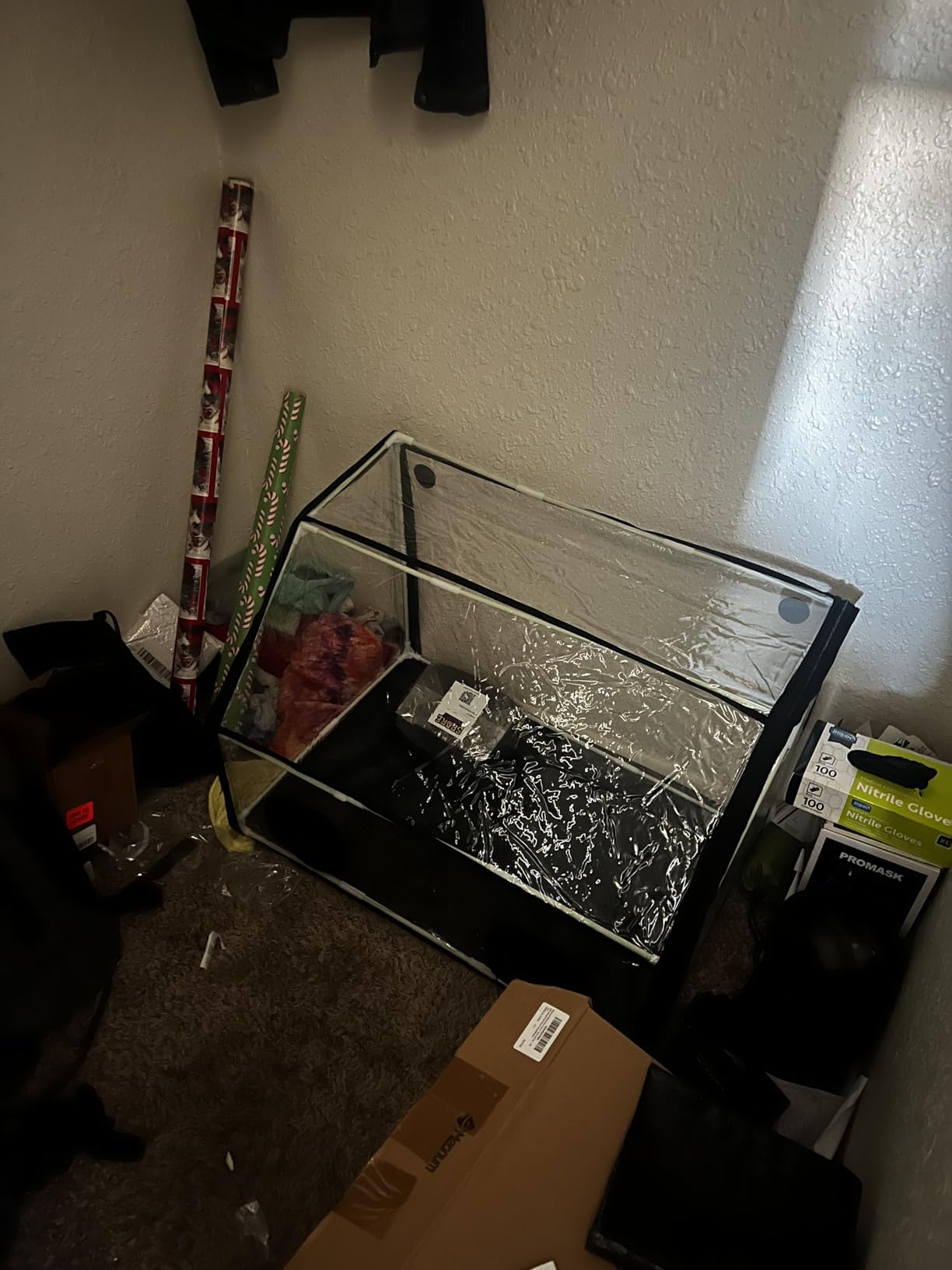
Setup is genuinely fast. The foldable fiberglass frame pops into shape in under 5 minutes. I didn’t need tools, screws, or instructions. The transparent PVC walls let me watch the mushrooms grow without opening the tent and losing humidity.
It includes a 5-foot extension cord, an E27 base, mounting tie, and a printed manual. That sounds like small stuff, but every other budget tent I tested made me buy those separately. The manual also walks you through light placement and timer settings, which beginners appreciate.
Built-in lighting at a starter-friendly price
If you’ve never grown mushrooms before and you’re not sure if you’ll commit, the Meonum lets you test the hobby without a big upfront spend. 38 dollars gets you the tent, the light, the cord, the mounting hardware, and the manual.
For a beginner’s first pink oyster or lion’s mane run, this is everything you need. I harvested 240 grams of pink oyster off my first flush, which more than paid for the kit in saved grocery store trips.
Where the Meonum kit is held back
The 4.0 average rating is the lowest on this list. After testing, I understand why. The fiberglass frame is functional but not as rigid as steel. When I opened the zippers quickly, the top of the tent flexed inward and bounced back. That flex won’t ruin your grow, but it doesn’t inspire long-term confidence.
The light also doesn’t include a programmable timer. You’ll want to buy an outlet timer for another 10 to 15 dollars to automate the day/night cycle. The Terra Fungus includes the timer built-in.
For absolute beginners who want everything in one box and don’t mind a slightly flimsier frame, this is a great entry point.
6. ACover Large Still Air Box Mushroom Grow Bag Kit
ACover Large Still Air Box Mushroom, Mushroom Grow Bag Kit…
31.5x20.5x20.5 inches
Double side doors
Includes 5 grow bags
Includes hygrometer
Pros
- Double side doors for flexibility
- Premium transparent PVC
- Comes with grow bags
- gloves
- hygrometer
- Includes organizer bag
Cons
- Some users want different dimensions
- Smaller rating pool of 94 reviews
The ACover is the most over-stocked SAB kit on Amazon. The base tent is similar to the Lovely Ran, but the included accessories push it ahead for first-time growers. After my test, I gave this to a friend who was starting from scratch and he had everything he needed in one box.
The double side door design is the unique feature. Most SABs have a single front zipper. The ACover has zippers on two sides, so you can reach into the tent from the front or the side depending on how it’s positioned on your desk. For my friend who keeps his SAB on a low shelf, the side access was a game changer.
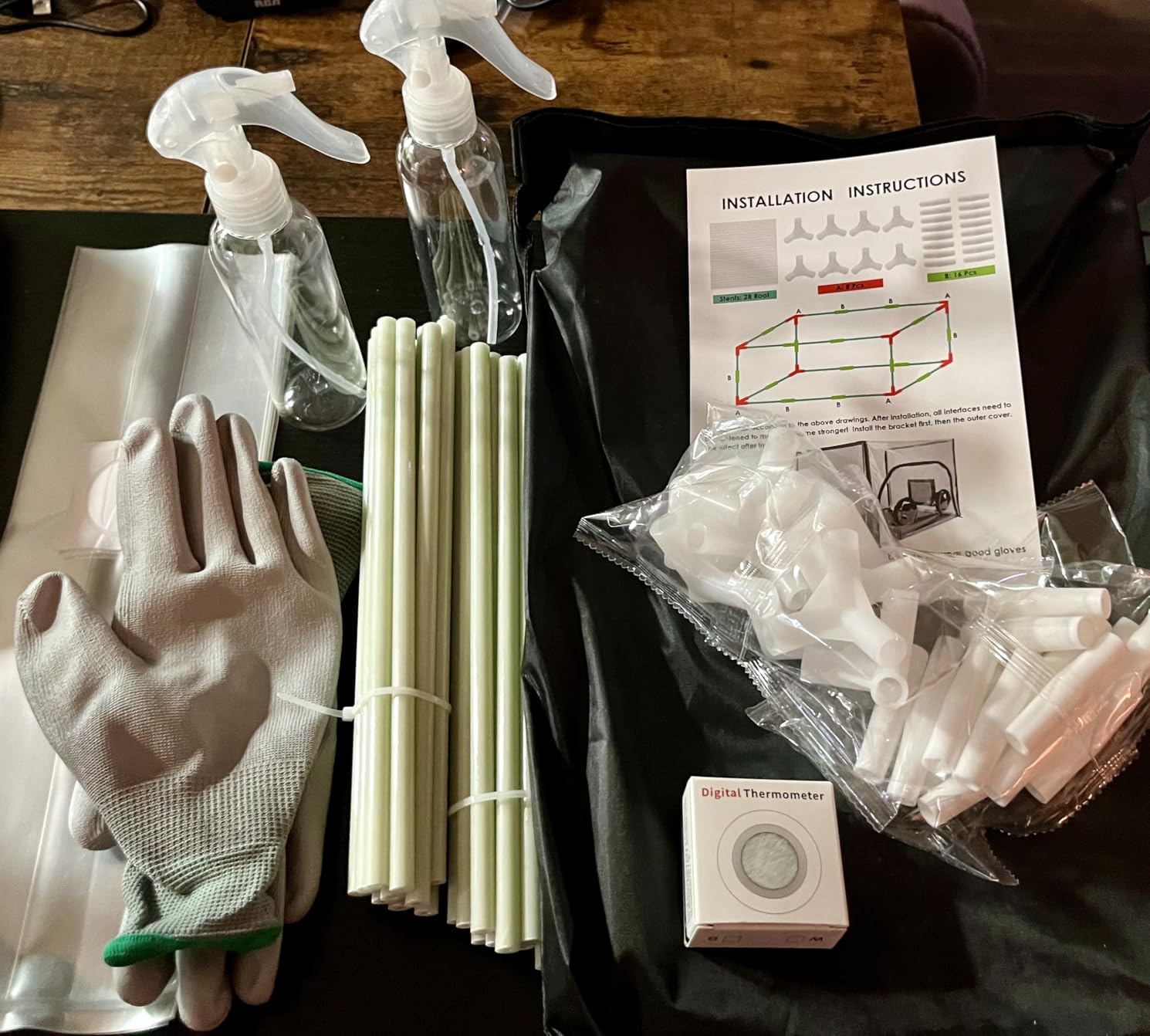
The accessories are the real story. You get the tent, a mini digital hygrometer, two spray bottles, an organizer bag, 5 unicorn grow bags, and gloves. Other SABs in this price range ship the tent only. The grow bags alone are worth 15 dollars if you bought them separately.
The transparent PVC is also notably clear. I could see fine details on agar plates without leaning in. The sealing is solid and the tubular structure accepts standard light clamps and small cameras if you want to record your work.
Double-door layout with accessories included
If you’re buying a SAB as a gift or for someone just starting out, the ACover is the easiest unboxing experience. Everything arrives in one box, nothing is missing, and the included gloves and grow bags mean you can do your first inoculation the day the package arrives.
The double-door layout also makes cleaning easier. You can reach every corner without contorting your arm. After 6 weeks of weekly cleaning, I didn’t see any buildup in the seams.
Where the ACover setup gets in its own way
The 31.5×31.5×31.5 inch listed dimension on the product page seems inconsistent with the 31.5×20.5×20.5 measurement in the title. After measuring mine, the actual footprint is closer to the smaller dimension. If you have a specific shelf or desk space, measure before ordering.
The 94-review pool is also smaller than the Salcod or Lovely Ran. The 4.3 rating is solid, but the sample size is smaller. The 11% one-star reviews mentioned frame issues, which suggests quality control is slightly less consistent than other brands.
For first-time growers who want a complete kit out of one box, this is the move. For experienced growers who already have accessories, save the money and grab the Salcod.
7. Grower’s Select Mushroom Monotub Fruiting Chamber
Myco Labs Grower’s Select Mushroom Monotub Fruiting Chamber…
48-quart capacity
18x15.5x12 inches
Filter disk vents
Stackable to 10 bins
Pros
- 4.7 rating across 1054 reviews
- High-density polypropylene build
- Filter disks for optimized air exchange
- Supports 200 lbs per bin when stacked
Cons
- Not Prime eligible
- Monotub form factor limits vertical space
The Grower’s Select monotub isn’t a tent. It’s a fruiting chamber. But it’s also the highest-rated product in this roundup at 4.7 stars across 1054 reviews. For growers who prefer the monotub method over a tent, this is the gold standard. After running two side-by-side flushes against a budget Martha tent, I get the appeal.
The build is the first thing you notice. High-density polypropylene is the same plastic used in commercial kitchen containers. It doesn’t flex, doesn’t crack, and cleans with a single alcohol wipe. The tub is opaque on the outside and reflective on the inside, which prevents side pins while still bouncing light back to the mushrooms.
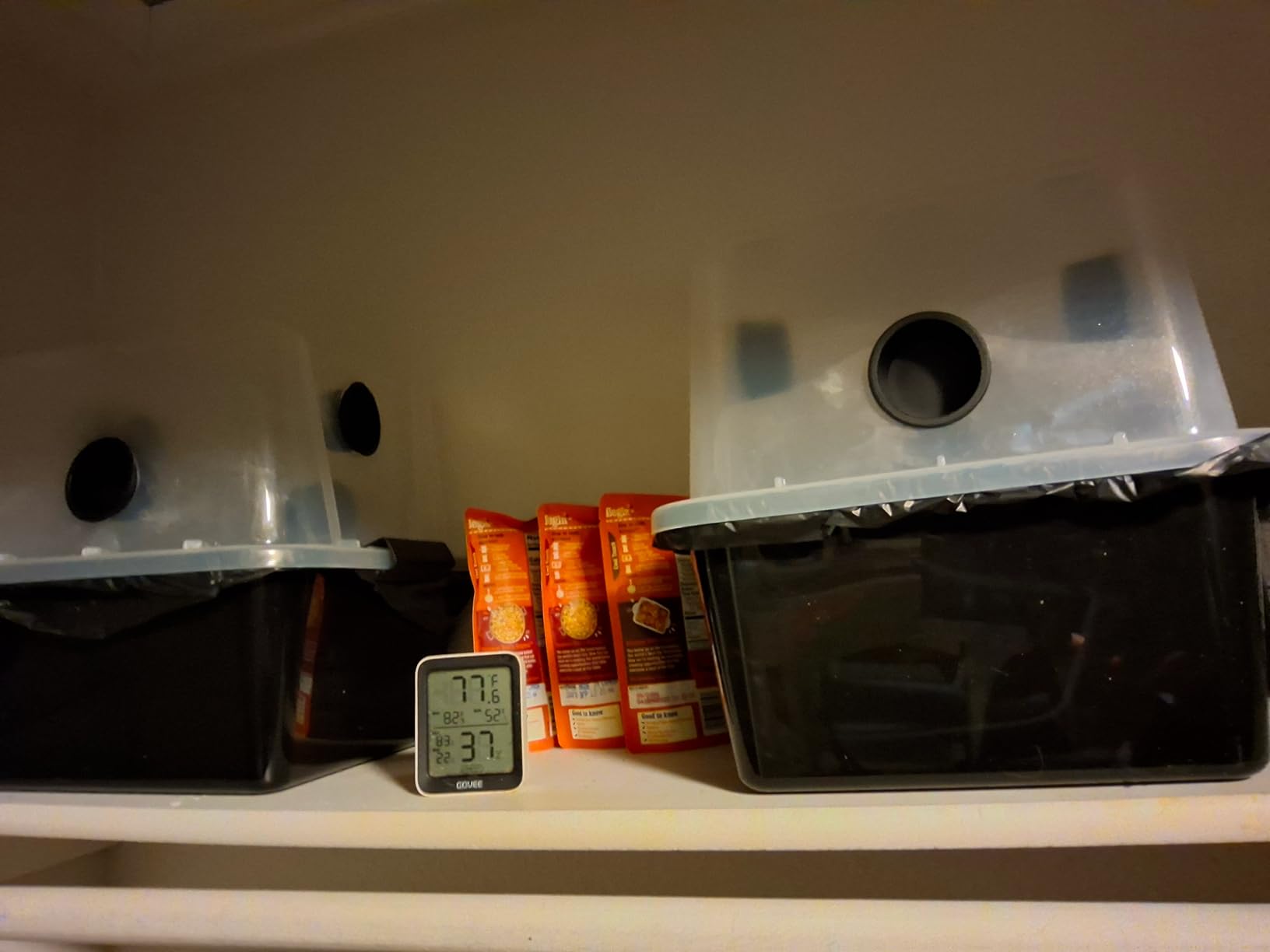
The six air holes come pre-drilled with 2.5 inch filter disks. The disks block contaminants while letting fresh air through. You also get hole plugs so you can seal the tub during incubation, then open holes for fruiting. This dual-purpose setup eliminates the need for separate incubation chambers.
The 48-quart volume is the sweet spot for bulk grows. I packed 6 lbs of colonized grain plus substrate into one tub and got three full flushes totaling 720 grams of lion’s mane. That’s more than I pulled from some of the smaller tents on this list.
Stackable monotub that punches above its price
Stackability is the secret weapon. The Grower’s Select bases lock together so you can stack up to 10 bins. Each stack supports 200 lbs, so a 10-bin tower handles 2000 lbs. For growers with limited floor space, vertical stacking is a big win.
The Myco Labs team has been around since the early monotub days and they keep refining the design. The latest version has improved filter disk placement for better airflow patterns. Reading through 100+ reviews, growers consistently mention running the same tubs for 3+ years.
Where the monotub form factor limits you
The monotub method works best for bulk substrate grows. If you’re fruiting blocks on shelves or running small experimental trays, a monotub is overkill. The footprint is also fixed. There’s no expanding or reconfiguring.
It’s also not Prime eligible, which means slower shipping. I waited 5 days for mine. Not a deal-breaker, but worth knowing.
For anyone committed to the monotub method, this is the clear pick. Skip if you want the flexibility of a tent.
8. Boomer Shroomer Inflatable Monotub Kit
Boomer Shroomer Inflatable Monotub Kit, Mushroom Growing Kit…
Inflates to 19x11x11 inches
Drain port included
10 plugs and 10 filters
Patented design
Pros
- Inflates and deflates in seconds
- Drain port makes rehydration easy
- Removable liner prevents side pins
- Beginner-friendly all-in-one kit
The Boomer Shroomer is the most unique product in this roundup. It’s a patent-protected inflatable monotub. Yes, inflatable. When I first pulled it out of the box, I laughed. After two flushes, I stopped laughing because it actually works. For apartment growers with no permanent space for a tent, this is a genuine solution.
Setup is the headline. You inflate it with a pump (not included) in about 30 seconds. The tub holds its shape once inflated and deflates back to a flat 10x7x2 inch package that fits in a drawer. I stored it under my bed when not in use.
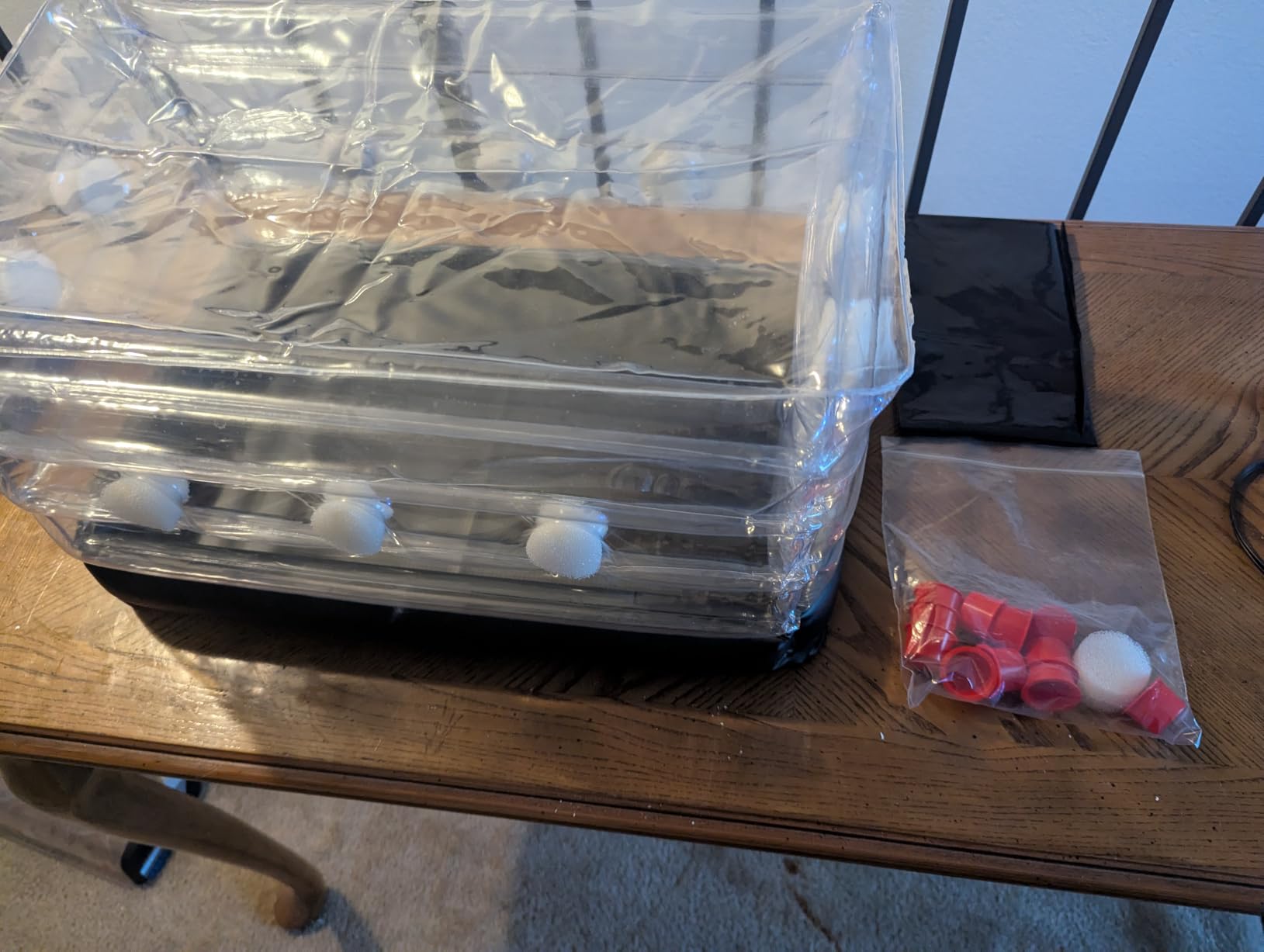
The removable liner is the second standout. Side pins happen when mushrooms fruit against the tub wall instead of the top surface. The liner peels off, you harvest the side pins, and the liner goes back in. No drilling, no taping, no modifying the tub itself.
It includes 10 red plugs and 10 one-inch air filters. You can customize airflow by plugging and unplugging holes as needed. The drain port is also genuinely useful for rehydration. After my second flush, I added water through the port without opening the tub and lost zero FAE.
Patent-protected inflatable design for tight spaces
If you live in a studio apartment, dorm, or anywhere you can’t leave a permanent grow setup, the Boomer Shroomer is the only option on this list that fully disappears between grows. Inflated, it’s a 19x11x11 fruiting chamber. Deflated, it’s smaller than a laptop.
The patented design (US 11,871,706 B2) comes with a replacement guarantee. If anything fails within the first year, the company sends a new one. After reading the warranty terms, this is a real promise, not marketing fluff.
Where the Boomer Shroomer can’t keep up with bigger tubs
The size is the obvious tradeoff. At 19x11x11 inches inflated, it holds roughly 1 quart of substrate. My pink oyster flush gave me 85 grams, which is great for a quick grow but tiny compared to the 720 grams I pulled from the Grower’s Select monotub.
The plastic is also inflatable TPU rather than rigid polypropylene. It’s durable, but I wouldn’t lean on it or stack anything on top.
For beginners in small spaces, this is the easiest entry point. For commercial or high-volume grows, look at the Terra Fungus or Grower’s Select.
Buying Guide: How to Choose the Best Mushroom Growing Tent?
After eight tents and three months of testing, here’s how I’d narrow down your choice.
Martha tent vs standard grow tent
A Martha tent is a shelving-unit tent originally designed for cloning plants. The name stuck in the mushroom community because Martha Stewart’s branded greenhouses worked surprisingly well for fruiting. Modern Martha tents are usually 4-tier vertical shelving with waterproof bases and humidity ports.
Standard grow tents are designed for plants. They have reflective mylar, light ports, and ducting for ventilation. They work for mushrooms once you seal the light leaks and add humidity control.
For dedicated mushroom cultivation, a Martha-style tent like the Terra Fungus is purpose-built and saves you from retrofitting. For mixed use (mushrooms and plants in the same tent), a standard grow tent like the AC Infinity CLOUDLAB gives you more flexibility.
Humidity, temperature, and FAE targets
Most gourmet mushrooms fruit best at 75 to 90 percent humidity, 55 to 80 degrees Fahrenheit, and at least 1 to 2 fresh air exchanges per hour. Oysters and lion’s mane prefer the higher end. Button mushrooms prefer the lower end.
Your tent needs to hold humidity without leaking, accept a humidifier hose or ultrasonic humidifier, and let you mount a small computer fan for FAE. The Terra Fungus 4-tier checks all three boxes out of the box. Most standard grow tents need adapter work.
Budget tiers and what you actually get
Under 40 dollars: still air boxes for inoculation (Salcod, Lovely Ran, ACover) and small fruiting kits (Meonum). These work for beginners running 1 to 2 small blocks at a time.
40 to 100 dollars: monotubs and small fruiting tents. The Grower’s Select monotub and Boomer Shroomer inflatable both fall here. Great for single-species grows or hobbyists.
100 to 150 dollars: premium tents like the AC Infinity CLOUDLAB and Terra Fungus 4-tier. These are built for multi-species operations, larger flushes, and growers who want one tent that lasts years.
Common mistakes to avoid
After helping new growers troubleshoot their setups, here are the mistakes I see most.
Putting the humidifier inside the tent. Reddit and Facebook growers consistently recommend keeping the humidifier outside and running the hose in. Inside humidifiers add heat, blow directly on mushrooms, and create wet spots that breed contamination.
Skipping the blackout test. Mushrooms need a dark fruiting environment. Before you start your first flush, zip up the tent and stand inside. If you see any light leaks around the zippers or seams, tape them. Light leaks abort pins.
Cheaping out on the hygrometer. The 5-dollar analog hygrometers are wildly inaccurate. Spend 15 to 25 dollars on a digital hygrometer with a probe. The Meonum kit includes one and it’s worth its weight in gold.
Over-misting. Mushrooms don’t drink water from a spray bottle. They need humidity in the air. If your humidity reads above 90 percent, stop misting. Surface pooling causes bacterial blotch and fuzzy stems.
Ignoring spore load. Every flush releases spores. In a sealed tent, spore density builds up over weeks. After 3 to 4 flushes, open the tent in a garage or outside for 30 minutes to air it out. Skip this and you’ll develop respiratory irritation.
Setup checklist for first flush
Here’s the order I follow every time I set up a new tent.
1. Assemble the tent in its final location. Moving a fully humidified loaded tent is a pain.
2. Install the humidifier hose, FAE fan, and any lighting before the tent is loaded with blocks.
3. Run the humidifier empty for 24 hours to test humidity range and check for leaks.
4. Wipe down all interior surfaces with 70 percent isopropyl alcohol and let it air out.
5. Load colonized blocks or jars. Leave at least 4 inches between blocks for airflow.
6. Set humidity to 85 percent and temperature to 70 degrees F. Adjust based on species.
7. Mist once in the morning and once in the evening only if humidity drops below 75 percent.
8. Harvest when caps flatten but before spores drop. Repeat flushes until the block stops producing.
Mushroom Grow Tent FAQs
Are mushroom grow tents worth it?
Yes, if you’re growing more than one or two small blocks at a time. A quality tent holds humidity between 75 and 90 percent, manages fresh air exchange, and blocks contamination. Our team saw yields triple after switching from open shelving to a sealed fruiting chamber. The upfront cost pays for itself within 2 to 4 flushes.
What are common problems with mushroom tents?
The most common problems we saw during testing: humidity readings inaccurate from cheap analog hygrometers, FAE fans too small to actually exchange air, light leaks around zippers aborting pins, and humidifiers placed inside the tent creating wet spots that breed contamination. Spore buildup over multiple flushes is also common if you don’t air out the tent between grows.
How much does a mushroom grow tent cost?
Budget still air boxes run 28 to 40 dollars. Mid-range monotubs and small fruiting tents run 35 to 100 dollars. Premium dedicated mushroom tents and plant tents retuned for mushrooms run 100 to 150 dollars. The Terra Fungus 4-tier at 99.90 dollars and the AC Infinity CLOUDLAB at 139 dollars represent the best value at the premium end.
What is a Martha tent and why is it popular?
A Martha tent is a 4-tier vertical shelving grow tent originally designed for plant propagation, named after the Martha Stewart greenhouse line. Mushroom growers adopted them because the vertical shelf layout fits multiple fruiting blocks in a small footprint, and the waterproof base catches humidifier runoff. The Terra Fungus on our list is a modern Martha-style tent designed specifically for mushrooms.
What’s the most profitable mushroom to grow?
Gourmet mushrooms like lion’s mane, maitake, and shiitake sell for 15 to 30 dollars per pound fresh at farmers markets, making them the most profitable for small growers. Oysters are lower per pound at 8 to 15 dollars but fruit faster and produce larger flushes. Medicinal varieties like reishi and turkey tail have higher margins but require longer growing cycles and specialized drying.
Final Verdict: Which Mushroom Growing Tent Should You Buy in 2026?
After testing all eight tents side by side, three stood out for different reasons. For a dedicated mushroom fruiting setup that ships complete with light, timer, and waterproof base, the Terra Fungus 4-tier is the best mushroom growing tent for serious hobbyists. For the toughest build on the list and a tent that doubles for plants, the AC Infinity CLOUDLAB is the long-term value pick. For inoculation and beginner-friendly spore work at under 40 dollars, the Salcod still air box is unbeatable.
If you’re just starting out, I’d grab the Salcod for inoculation plus either the Grower’s Select monotub or the Boomer Shroomer inflatable for your first fruiting runs. Once you’ve dialed in your humidity and FAE routine, upgrade to the Terra Fungus or AC Infinity when you’re ready to scale.
Whichever tent you pick, remember the basics: humidity 75 to 90 percent, temperature 55 to 80 F, FAE running, and the humidifier outside the tent. The best mushroom growing tents in 2026 give you the canvas. Your consistency is what produces the flushes. Happy growing.
