
10 Best Leather Splitters (September 2026) Honest Reviews
The best leather splitters give you one thing hand tools struggle to deliver repeatedly: a controlled, even reduction in leather thickness. A true splitter feeds leather between a blade and an adjustable roller; the opening between them determines the thickness that remains. That matters when a folded wallet edge, a belt end, or a strap keeper has to lie flat rather than turn into a bulky stack.
I separated this list by what each tool is documented to do, rather than treating every sharp leather tool as the same thing. Several picks are genuine pull-through leather splitter machines, while others are purpose-built leather skivers or strap cutters that make more sense for edge thinning or cutting regular strips. That distinction can save a new leatherworker from buying a tool that cannot handle the width or task they have in mind.
Contents
For 2026, our selection covers compact 3-inch machines, wide 7-inch benchtop options, and specialty tools for strip cutting and close skiving. I focused on stated width capacity, material, mounting method, included blades, user ratings, and the issues leatherworkers repeatedly raise: a blade that chops instead of slices, uneven results across wide leather, and a manual pull that becomes tiring over a long session.
Top 3 Picks for Leather Splitters (September 2026)
As an Amazon Associate we earn from qualifying purchases. CERTAIN CONTENT THAT APPEARS ON THIS SITE COMES FROM AMAZON. THIS CONTENT IS PROVIDED 'AS IS' AND IS SUBJECT TO CHANGE OR REMOVAL AT ANY TIME.
The BAYSTMAM is my all-around pick because its documented 3-inch capacity, CNC-machined aluminum body, adjustable thickness, and gripping handle address the core needs of narrow straps, tabs, and small leather goods. It has 93 ratings at a 4.3 average, which gives it a larger feedback base than several similar compact machines.
The DIUDUS large splitter is the practical choice when belt blanks or wider panels are the job. Its stated 7-inch capacity, fixed clamp, gloves, and 5 replacement blades make it more appropriate than the compact 3.15-inch machines for wide-format leather.
10 Best Leather Splitters In 2026
| Product | Features | |
|---|---|---|
 QWORK 2-Piece Skiving Set QWORK 2-Piece Skiving Set |
|
View on Amazon |
 BAYSTMAM Leather Skiver Splitter BAYSTMAM Leather Skiver Splitter |
|
View on Amazon |
 DIUDUS Type-C Peeling Machine DIUDUS Type-C Peeling Machine |
|
View on Amazon |
 DIUDUS Large Leather Splitter DIUDUS Large Leather Splitter |
|
View on Amazon |
 DIUDUS Clamp Skiving Machine DIUDUS Clamp Skiving Machine |
|
View on Amazon |
 WUTA 60mm Strap Cutter WUTA 60mm Strap Cutter |
|
View on Amazon |
 TLKKUE Leather Skiver Set TLKKUE Leather Skiver Set |
|
View on Amazon |
 WUTA Black Leather Skiver WUTA Black Leather Skiver |
|
View on Amazon |
 XIIW Leather Skiver Splitter XIIW Leather Skiver Splitter |
|
View on Amazon |
 QWORK Heavy Duty Strap Cutter QWORK Heavy Duty Strap Cutter |
|
View on Amazon |
We earn from qualifying purchases. CERTAIN CONTENT THAT APPEARS ON THIS SITE COMES FROM AMAZON. THIS CONTENT IS PROVIDED 'AS IS' AND IS SUBJECT TO CHANGE OR REMOVAL AT ANY TIME.
Start with the maximum width, not the tool’s overall size. A 3-inch leather thickness splitter is useful for watch straps, wallet components, and narrow belts, but it will not evenly process a wide belt blank in one pass. The 7-inch DIUDUS, WUTA, and XIIW machines are the relevant choices here.
Also read the tool category closely. A strap cutter makes parallel strips from thick leather; it does not replace a splitter that reduces the whole surface to a chosen thickness. A hand skiver works locally near an edge, where a full-width machine would be too broad and too aggressive.
1. QWORK 2-Piece Skiving Set is best for controlled edge thinning and small detail cuts.
QWORK 2-Piece Leather Edge Trimming Cutter Set…
Two alloy-steel tools
7 inch length
Oxford storage bag
Pros
- Two-purpose set
- Sharp honed edges
- Lightweight tools
- Storage bag
Cons
- Not a full-width splitter
- Hand operation takes practice
The QWORK set is not a benchtop leather splitter, and that is the first fact to keep in view. It is a pair of hand-operated tools for round cutting, skiving, and edge cutting, so I would select it when the task is thinning a fold line, tapering a strap end, or trimming a small component rather than reducing an entire belt blank.
The documented alloy-steel construction and 7-inch tool length make this a compact pair to keep beside a cutting mat. The tools weigh 1.76 and 1.19 ounces, respectively, and arrive with an Oxford collection bag, which is useful when a small kit needs to stay together.
Its 4.4 average from 11 ratings points to a positive but small feedback pool. The product data highlights a sharp, honed edge and manganese steel durability, but sharpness does not remove the need for deliberate hand pressure and a safe cutting direction.
This set suits close skiving rather than full-width splitting.
Use the wider piece for more surface contact and the narrow tool where a tight curve or corner needs attention. It is a sensible companion to a larger leather splitter machine because it handles the small corrections a roller-and-blade setup cannot reach.
For wallet construction, I would reserve it for reducing a fold or cleaning an edge after the panel has already been cut. It is also suited to narrow wristbands and leathercraft repairs where mounting a machine would interrupt the workflow.
This set requires hand control and does not set a repeatable thickness.
There is no roller gap or screw adjustment to establish a uniform finished thickness. That means the result depends on blade angle, pressure, and the support beneath the leather, which makes it less suitable for matching several long straps.
Keep fingers out of the travel path and make shallow passes instead of trying to remove a deep layer at once. The product is designed for cutting and skiving only, so shoppers needing a true parallel split should move to one of the pull-through machines below.
2. BAYSTMAM Leather Skiver Splitter is the most balanced compact machine for narrow projects.
BAYSTMAM Leather Skiver Leather Splitter with Pulling Handle
3 inch capacity
CNC aluminum
Adjustable thickness
Pros
- Gripping pull handle
- Plant and chrome leather use
- Aluminum construction
- Includes blades
Cons
- 3 inch width limit
- Pull technique needs practice
The BAYSTMAM is a manual pull-through leather skiver with a stated maximum width of 3 inches. I see that as a useful middle ground for small leather goods: wider and more repeatable than a handheld skiver, yet compact enough for a bench that is not devoted to production equipment.
Its most relevant feature is the Leather Gripping Handle. The listing says it supports balanced pulling and uniform cutting thickness, which speaks directly to a common manual-splitter problem: leather entering the blade at an angle and emerging unevenly.
The body is described as aircraft-level aluminum alloy made by CNC machining, and thickness is adjustable for project needs. It is documented for plant-based and chrome-tanned leathers, although every leatherworker should test the actual hide on an offcut before committing a finished panel.
This machine fits straps, tabs, and small leather goods up to 3 inches wide.
A 3-inch opening covers narrow straps, bag tabs, belt keepers, and many wallet pieces. It does not cover a typical wide belt blank, so this is not the choice if long, broad strap work is the main reason for buying a benchtop leather splitter.
I would organize work by cutting pieces slightly oversized, splitting or thinning them, then trimming to the final line. That routine leaves room to correct a first pass and avoids making a narrow piece even narrower because it entered off-center.
This machine needs a steady pull and a matched blade setting.
Manual pulling is not automatic thickness control. Feed the leather square to the blade, keep a consistent pull, and adjust both sides evenly so the blade and roller stay parallel; otherwise one edge can come out thinner than the other.
Forum feedback repeatedly warns that a dull blade or bad setup can make a splitter chop rather than slice. Stop if the leather tears or compresses, check that the blade is clean and sharp, and take a lighter pass on a scrap before trying again.
3. DIUDUS Type-C Peeling Machine is a compact starter machine with an unusually complete blade kit.
Manual Leather Splitter Peeling Machine, Leather Paring…
3.15 inch width
10 blades
Stainless steel body
Pros
- Ten blades included
- Instructions included
- Rust-resistant steel
- Adjustable screws
Cons
- Not for leather over 3.15 inches
- Hard leather can be difficult
This DIUDUS Type-C manual leather splitter is specified for leather up to 8 cm, or 3.15 inches, wide. It brings 10 blades, screws, two L-keys, and an instruction manual, so the package has the basic consumables and setup tools a first-time user is likely to need.
Stainless steel is the stated construction, and the two-side screw arrangement adjusts thickness. That is the familiar layout on compact manual splitters: it can be effective, but it asks the user to make matching changes on both ends rather than relying on a single calibrated control.
Its 4.2 average across 144 ratings is the largest review count among the compact machines in this list. The documented feedback is generally positive about the bundle and instructions, while also noting that harder leathers can be harder to manage.
This compact DIUDUS works best when replacement blades matter to the buyer.
Replacement-blade availability is not a minor detail in leatherwork. A fresh blade can change a ragged, compressed pass into a clean slice, and this product includes 10 sharp blades instead of asking a beginner to source replacements immediately.
I would keep the L-keys and unused blades in one labeled container after setup. Small hardware gets lost easily, and the ability to reset the machine after cleaning makes a manual leather splitter less frustrating to own.
This machine demands even screw adjustments and narrow workpieces.
Set the left and right screws in small, equal increments, then run a scrap strip through the center and at both outer edges. If results differ across the strip, the blade or roller gap is not parallel and needs correction before a useful panel goes through.
The 3.15-inch maximum is a firm project-planning limit. It is a capable option for wallet strips and narrow straps, but a 7-inch machine is more sensible for belt making, harness panels, or anything that would require joining split sections.
4. DIUDUS Large Leather Splitter is the strongest match for wide straps and belt blanks.
DIUDUS Leather Splitter, Leather Skiver Peeler, Manual…
7 inch width
Fixed table clamp
Adjusts near 0.5mm
Pros
- Wide 7 inch capacity
- Clamp fits 5 to 38mm tables
- Gloves included
- Five blades
Cons
- Heavy 5.77 pound tool
- Not suited to very soft leather
The large DIUDUS is the first true wide-format option in this roundup, with a stated 18 cm or 7-inch capacity. That width changes the kind of work you can plan: belt blanks, broad bag straps, and larger leather panels can pass through in one piece instead of being narrowed to suit a compact machine.
A fixed clamp is included and is specified to fit tables from 5 to 38 mm thick. This matters because a splitter that shifts under a pull gives inconsistent results and puts the user’s hands closer to an exposed blade while they try to stabilize the machine.
The kit includes five blades, four screws, two L-keys, gloves, and two instruction manuals. The product data also states adjustment down to about 0.5 mm for soft leather, yet it separately says the machine is not suitable for very soft leather; I would treat 0.5 mm as a setup capability, not a promise for every hide.
This wide DIUDUS is the sensible pick for projects that need one-pass width.
For a belt splitter, width is often the deciding specification. A 7-inch opening gives useful room to keep a belt blank centered, and it is also better for broad straps that must retain the same feel from edge to edge.
The 5.77-pound weight is an advantage once the tool is clamped: it gives the machine a more planted feel than a lightweight hand tool. It is less appealing if the bench must be cleared after every session, but the clamp offers a direct way to secure it when it is in use.
This model needs careful testing with soft leather before a final pass.
Soft leather can stretch, bunch, or enter the blade unevenly, especially over a broad width. Place the smooth side consistently, use a firm but controlled pull, and test at the exact width and grain direction of the finished piece.
Gloves are included, but they do not make unsafe feeding safe. Keep hands behind the leather, pull from the far side of the machine, and never reach near the blade to free a stalled piece while tension is on it.
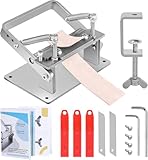
5. DIUDUS Clamp Skiving Machine is the compact choice with the deepest supply of included blades.
Manual Leather Splitter, Leather Paring Skiving Skiver…
3.15 inch width
30 blades
Clamp for 5 to 38mm tables
Pros
- Thirty blades included
- Fixed clamp
- Stainless steel
- Instructions included
Cons
- Narrow 3.15 inch capacity
- No stated warranty
This DIUDUS version is another 3.15-inch manual skiving machine, but its contents set it apart: 30 sharp blades, a fixed clamp, screws, L-keys, and two instruction manuals. For someone learning how blade condition affects a split, that supply creates more room to replace a questionable edge instead of trying to work around it.
Its stainless steel construction is presented as durable and rust-resistant, while the clamp fits tables from 5 to 38 mm thick. The stated 3.74-pound weight and clamped position should be more stable than a loose unit pushed across a bench.
The rating is 4.2 from 144 reviews, matching the review data reported for related DIUDUS machines. The documented limits still apply: manual operation takes practice, leather wider than 8 cm is outside the intended range, and no warranty is listed.
This clamped machine is best for learners who want spare blades ready at the bench.
A dull edge is one of the clearest causes of tearing and choppy results. With 30 supplied blades, I would designate one as the reference blade, compare it with a used blade when results worsen, and replace rather than forcing a poor cut.
The clamp also supports a repeatable setup. Mark a preferred place on the bench, check that the machine cannot rock, and keep the same feeding direction each time so muscle memory is built around a stable tool.
This machine remains a narrow-format manual tool, not a production splitter.
Its adjustable thickness is useful for small components, but the operator still controls feed pressure and alignment. Do not expect a long run of hard pulling to feel effortless; forum discussions specifically note fatigue with pull-through splitters during extended work.
For a small workshop, it makes most sense when the project list is dominated by wallets, narrow straps, and detail pieces. Pick a 7-inch machine instead if a large share of the work begins with broad leather and must stay broad after thinning.
6. WUTA 60mm Strap Cutter is the correct tool for repeatable strips from firm, thick leather.
WUTA Leather Strip Cutting Machine Leather Strap Cutter 60MM…
60mm width
For 2 to 8mm leather
G-clamp mounting
Pros
- Ten blades included
- G-clamps included
- Handles firm leather
- Handheld or mounted
Cons
- Does not thin full surfaces
- Not for soft thin leather
The WUTA is a leather strap cutter, not a thickness splitter. Its role is cutting regular strips up to 60 mm wide from leather recommended at 2 to 8 mm thick, which makes it relevant to belt straps and firm bridle-style material rather than to shaving a panel thinner.
It includes 10 black blades, one G-clip, and two hex wrenches. The cutter can be held by hand or fixed with G-clamps, but I would mount it whenever consistent strip width is the goal because the clamp removes a variable from each pass.
The product is stated to work with vegetable-tanned leather, bridle leather, belt leather, hard leather, and thick leather. It explicitly is not for soft, thin leather, a limitation worth taking literally rather than trying to overcome through extra force.
This WUTA is best when the main need is strap width, not thickness reduction.
Choose it to turn a suitable hide into parallel belt straps, bag straps, or long firm strips. Once the strip is cut, a separate leather skiver or splitter may still be needed to reduce a folded end, a buckle turn, or the whole strap’s thickness.
That two-tool workflow is normal in leathercraft. Separating width cutting from thickness work lets each blade geometry do its intended job and reduces the chance of forcing soft material through a cutter meant for firm stock.
This cutter needs firm leather and a secure, square setup.
Clamp the base, check the blade seating, and begin on a straight edge of leather. If the first few inches wander, stop and correct the starting edge; trying to steer a long strip back into line can waste the whole piece.
Because 2 to 8 mm is the recommended leather thickness, test a scrap from the same hide. The grain, temper, and thickness can vary within a hide, so the stated range is a guide rather than a substitute for a practical test.
7. TLKKUE Leather Skiver Set is the flexible hand-tool option for bags, wristbands, and local thinning.
TLKKUE Leather Skiver Carving Knife Metal Sharp Skiving…
Skiver and carving knife
Replaceable blades
Ruler included
Pros
- Multiple hand tools
- Replacement blades
- Stainless steel
- Ruler included
Cons
- Not a benchtop splitter
- May not suit professional heavy use
The TLKKUE set is for the leatherworker who needs a hand skiver, carving knife, cutting knife, replacement blades, and ruler in one collection. It is documented for DIY leatherwork such as backpacks, wristbands, and belts, where a small local taper or a precise line matters more than full-width, uniform splitting.
Stainless steel construction and replaceable blades are the core practical features. The listing says blade changes happen by loosening screws, a useful design for a tool that will eventually need a fresh edge after contact with firmer leather or a cutting surface.
With a 4.1 average from 82 ratings, it has a larger review base than the QWORK hand-tool set. The tradeoff is clear: it gives versatility at the bench but does not provide the roller-guided depth setting of a manual leather splitter.
This hand set works where a machine cannot reach a tight local area.
Skiving is selective thinning. It is useful at the inside of a fold, around a curved bag gusset, under a seam allowance, or at the end of a wristband where a full-width splitter would reduce more leather than intended.
I would use the ruler to mark the stop line before cutting and leave a small uncut margin on the first pass. It is much easier to remove another thin layer than to restore leather that has been taken too far.
This set depends on technique instead of a mechanical thickness setting.
Keep the blade angle low, work from the edge toward the marked stop line, and support the leather on a firm surface. A steep angle is more likely to dig in, especially on chrome-tanned leather with a softer feel.
Replace a blade as soon as the tool begins to drag or create fuzzy fibers. Blade maintenance is safer and more predictable than applying more pressure, which increases the chance that the blade will suddenly break through the leather.
8. WUTA Black Leather Skiver is the feature-rich wide machine for 7-inch thinning work.
WUTA Black Leather Skiver,Large Manual Leather Skiving…
7.08 inch width
Dual-bearing rollers
Depth to 0.5mm
Pros
- Wide capacity
- Dual-bearing rollers
- Blade lock
- Twenty blades
Cons
- Only 11 ratings
- Heavy 7.41 pound body
The WUTA Black Leather Skiver brings the most detailed mechanical feature list among the wide machines here. It has a stated 18 cm, or 7.08-inch, width capacity, dual-bearing rollers, a blade-lock system, G-clip mounting, and adjustment down to 0.5 mm.
Its 304 stainless steel body is described as having anti-rust plating, and the roller system is paired with an ergonomic wooden handle. Those are meaningful features for a manual wide splitter because smooth roller movement and a stable blade position can affect how evenly the leather enters across a broad pass.
Twenty sharp blades are included, but the review base is currently only 11 ratings at a 4.1 average. I would weigh the documented design and capacity against that smaller pool of buyer feedback, rather than treating the rating as a complete picture of long-term ownership.
This WUTA fits wide straps and panels that need more guided roller movement.
Dual-bearing rollers are intended to make operation smoother, and the blade-lock system is designed for precision. On a 7-inch pass, those details have more relevance than they would on a narrow hand skiver because a slight inconsistency can show across the finished width.
The wide capacity is useful for belt making and substantial strap work. Centering remains important: even with a 7.08-inch maximum, starting a piece too close to one side can make it harder to judge whether the blade gap is equal from edge to edge.
This machine still needs careful setup before very thin leather is attempted.
A stated minimum depth of 0.5 mm does not mean every hide will feed cleanly at that setting. Soft or stretchy leather can distort, so begin thicker than the desired result and make a second pass only after the first sample has stayed flat.
Use the G-clip mounting before testing. A 7.41-pound manual machine can still shift under pull force if the base is not anchored, and a secure mount lets both hands stay focused on the leather rather than holding the tool in place.
9. XIIW Leather Skiver Splitter is the straightforward 7-inch machine for controlled wide passes.
Leather Skiver Splitter, Stainless Steel Manual Leather…
7 inch capacity
304 stainless steel
Five blades
Pros
- Wide 7 inch opening
- Press handle roller lift
- Adjustable screws
- Sturdy steel
Cons
- Limited availability noted
- New users advised to stay under 5 inches
The XIIW is a manual leather skiving machine with a stated 7-inch maximum capacity, 304 stainless steel construction, five blades, four screws, and two L-keys. Its operating description is especially clear: press the handle to lift the rollers, insert the leather, and use screws at both ends to adjust thickness.
That direct roller-lift action can make feeding easier than trying to push leather into a tight fixed opening. It remains a manual machine, though, so the operator must establish a parallel setting and keep the piece straight during the pull.
It has a 4.0 average from 36 ratings. The product information says beginners should use leather no wider than 13 cm, or 5 inches, even though the machine’s maximum is 18 cm, and that advice is sensible because wide leather magnifies setup errors.
This XIIW gives beginners a practical path into wide-format splitting.
Start with a 4- or 5-inch test strip, not the full 7-inch capacity. That keeps enough leather on either side of the centerline to observe whether thickness is changing, while reducing the effort and alignment demands of a maximum-width pass.
The press-to-lift handle may also make the loading step more controlled. Once leather is positioned squarely under lifted rollers, lower them gently and pull with steady tension rather than yanking the piece into the blade.
This machine needs parallel adjustment checks at both outer edges.
Because adjustment is done with screws at both ends, test results must be checked at the center and sides. If one edge is thicker, make a tiny correction to that side and rerun a scrap; large turns make it hard to identify what changed.
The listing noted limited stock at the time the product data was gathered, so availability can change. More important than timing is the fit: buy this type of 7-inch machine only when the project work actually calls for wide leather rather than assuming wider is automatically easier.
10. QWORK Heavy Duty Strap Cutter is the compact cutter for firm 60mm straps.
QWORK Heavy Duty Leather Strap Cutting Tool, 7075 Aluminium…
60mm width
7075 aluminum
C-clamps and cutting heads
Pros
- 7075 aluminum plate
- Two C-clamps
- Ten cutting heads
- Pre-drilled mounting holes
Cons
- Not for soft thin leather
- 3.7 rating
- Not a thickness splitter
The QWORK Heavy Duty Strap Cutting Tool is the second specialty strip cutter in this guide, not a leather splitting machine. Its maximum cut width is 60 mm, and it is designed for thick, hard leather, so its natural use is producing regular narrow straps rather than thinning a whole surface.
The plate is made from 7075 aluminum alloy and measures 120 by 120 by 15 mm. Two C-clamps, three pre-drilled mounting holes, 10 machine-specific cutting heads, and eight wrenches are included, making its bench-mounting intent more explicit than a handheld cutter.
Its 3.7 average from 17 ratings is the lowest in this list, so I would keep expectations measured and inspect setup carefully. The stated limitation is equally important: it is not for soft, thin leather, where a different cutter or a hand tool is the more appropriate choice.
This QWORK is suitable for thick, firm straps up to 60mm wide.
Use it where repeatable strap width is the objective, such as firm belt material, handles, or simple straps. The included cutting heads and wrenches suggest a setup that rewards a careful initial adjustment followed by repeated cuts from similar stock.
Pre-drilled mounting holes give a second anchoring option beyond the two C-clamps. I would choose a solid bench, set the tool square to the bench edge, and confirm that the cutting line is straight with a scrap before feeding a long piece.
This cutter is not the answer when the leather must become thinner.
Cutting a strap and splitting a strap are separate operations. If the project needs a 60 mm strip reduced from thick leather to a smaller thickness, cut the strip first with a suitable strap cutter and then use a splitter rated for the strip’s width.
The lower rating and small review count are reasons to inspect blade seating, clamps, and alignment from the first use. Do not compensate for resistance by pushing harder; stop, check the blade and leather compatibility, and make a controlled adjustment.
How To Choose The Best Leather Splitters?
A leather splitter is best chosen by the widest piece you actually expect to process. Do not choose solely by the biggest stated number: a 7-inch machine is useful for wide straps, but a smaller 3-inch tool can be simpler to set up and control for wallet parts and narrow strap work.
Width capacity answers whether a piece can be split in one clean pass.
Measure the finished workpiece at its widest point, then leave some margin for feeding and alignment. The BAYSTMAM and compact DIUDUS models are around 3 to 3.15 inches, while the DIUDUS large, WUTA Black, and XIIW machines are about 7 inches.
A 60 mm strap cutter serves a different measurement question: it determines the width of a strip it can cut, not the width of material it can thin. This is why a belt-making setup can legitimately include both a strap cutter and a benchtop leather splitter.
Leather type decides how easily a manual tool feeds and how carefully it must be tested.
Vegetable-tanned leather is commonly used for belts and firm straps, and the BAYSTMAM, DIUDUS compact machines, and WUTA strap cutter are documented for vegetable-tanned or firm leather use. Firm leather generally holds its path better, but it can still resist a dull blade.
Chrome-tanned leather is often softer and more flexible. BAYSTMAM and the DIUDUS compact models state compatibility with chrome-tanned leather, yet softness can make any manual splitter more prone to bunching. Test on a matching offcut, begin with a conservative setting, and support the piece so it enters flat.
Parallel adjustment is the difference between a uniform split and a tapered mistake.
On machines with screws at both ends, turn each side in small equal increments. Run a scrap through the center, then compare thickness at the left edge, center, and right edge; a noticeable difference means the blade gap is not parallel.
Mark the adjustment position after finding a setting that works for a particular leather. The setting for stiff 8-ounce veg-tan should not be assumed correct for a soft chrome-tan hide, and even pieces from the same hide can vary.
Secure mounting makes manual pulling safer and more repeatable.
Clamp-compatible machines deserve a solid, clear bench. The DIUDUS clamped models fit tables 5 to 38 mm thick, while the WUTA and QWORK strap cutters include clamps; use them rather than bracing the machine with one hand.
Keep the feeding area clear, stand so the pull moves away from your body, and keep hands behind the leather. Gloves may be supplied with the large DIUDUS, but the safer habit is never placing fingers in the blade’s path in the first place.
Sharp blade care prevents chopping, tearing, and unnecessary force.
If a leather splitter chops the leather instead of splitting it, the likely suspects are a dull or damaged blade, an overly aggressive gap, leather entering crooked, or a roller and blade that are no longer parallel. Stop at the first bad pass instead of pulling harder, because force often deepens the damage.
Clean away leather fibers, inspect the blade edge under good light, and replace a disposable blade when it drags or leaves a rough surface. The DIUDUS clamp model’s 30 blades, WUTA Black’s 20 blades, and several other supplied blade kits make replacement more straightforward than trying to rescue an exhausted edge.
Splitting reduces overall thickness while skiving thins a selected area.
Splitting sends the whole width of a piece through a set blade-and-roller gap, producing a more uniform reduced thickness. Skiving removes material locally, usually from an edge, a fold, or a tapered end, and it is why the QWORK and TLKKUE hand tools belong in this list even though they are not full-width machines.
For a folded belt end, use a hand skiver if only the overlap needs thinning. For a wide strap that must feel consistent from end to end, use a properly adjusted manual leather splitter with enough width capacity for the full strap.
Practice strips make the first finished pass far less risky.
Cut a few scraps from the same hide and run them through before the finished panel. Begin at a thicker setting, inspect both surfaces, and move toward the target in small steps; removing leather gradually gives you a chance to spot drift before it ruins the actual project.
Manual pull-through work can tire the hands during a long session, as leathercraft forum discussions point out. Break large batches into manageable groups, keep the blade fresh, and do not mistake fatigue-related uneven pulls for a machine setting problem.
FAQs
What does a leather splitter do?
A leather splitter passes leather between a fixed blade and an adjustable roller to reduce the leather to a more uniform thickness. It is used for belts, straps, wallets, and other projects where even folds, stitching, and hardware fit matter.
How do you split thick leather?
Secure the splitter, fit a sharp blade, set a conservative blade-to-roller gap, and test an offcut from the same hide. Feed the leather squarely, pull evenly, inspect the result across its width, then make small parallel adjustments before processing the finished piece.
What is the difference between splitting and skiving leather?
Splitting reduces thickness across the full width of a piece with a roller-and-blade machine. Skiving thins only a chosen area, such as a fold, edge, or strap end, usually with a hand tool or a specialized skiver.
Why does my leather splitter chop the leather instead of splitting it?
Chopping usually points to a dull or damaged blade, a gap that is too aggressive, uneven left-and-right adjustment, or leather entering at an angle. Stop, clean and inspect the blade, reset the gap on scrap leather, and confirm the roller and blade are parallel.
What leather types work best in a benchtop splitter?
Firm vegetable-tanned leather is often easier to guide through a benchtop splitter because it holds its shape. Some listed machines also state compatibility with chrome-tanned leather, but softer hides should be tested first because they can stretch or bunch during a manual pull.
The best leather splitters for 2026 are selected by width and job, not by one universal label.
Choose the BAYSTMAM for a compact, adjustable 3-inch leather splitter machine; choose the DIUDUS large or WUTA Black when wide 7-inch belt and strap work needs a stable bench-mounted setup. The XIIW is another straightforward wide option if its press-to-lift roller arrangement suits your workflow.
For selective thinning, the QWORK and TLKKUE hand tools are the appropriate leather skivers. For making strips from firm material, choose a WUTA or QWORK strap cutter, then pair it with a splitter only when the strip also needs reduced thickness. Whichever tool you choose, mount it securely, test matching scraps, and let a sharp blade and small adjustments do the work.
