
10 Best Inverter Generators for Camping (September 2026) Expert Reviews
Choosing the best inverter generators for camping starts with one practical question: what do you want to run after the campground goes quiet? A phone, lights, and a cooler have a very different power draw from a small RV air conditioner, and a generator that is too heavy or too loud can spoil an otherwise simple trip.
I compared the verified product data for 10 portable inverter generators, focusing on rated watts, weight, fuel type, stated runtime, outlets, noise claims, safety equipment, and buyer feedback. The short version is that the WEN 56477i is the strongest all-around pick for campers who need 4,000 running watts, while smaller units make more sense when carrying weight matters most.
Contents
An inverter generator makes alternating current, converts it to direct current, then converts it back to stable AC power. That extra conversion is why these machines are commonly chosen for laptops, phones, cameras, battery chargers, and other sensitive electronics; several models here state less than 3% total harmonic distortion.
There is no one right camp generator for every site. Tent campers usually benefit from a unit around 40 to 50 pounds and lower output, while RV campers should begin with their air-conditioner startup requirement, confirm the outlet type, and leave a meaningful margin above the expected load.
All gasoline and propane generators create carbon monoxide. Run one outdoors only, well away from tents, vehicles, RV windows, doors, and vents, and follow the campground’s quiet-hour and placement rules even if the machine has a CO shutdown sensor.
The top 3 picks for Best Inverter Generators for Camping (September 2026)
For a higher-demand RV setup, choose the WEN 56477i for its 4,800 starting watts, 4,000 running watts, TT-30R RV receptacle, wheels, and CO shutdown sensor. For a compact quiet generator with 3,200 running watts, PowerSmart’s DB5035 pairs a stated 59 dBA output with a claimed 10-hour run at 25% load.
Campers who want fuel flexibility should look first at the Westinghouse iGen4000DFc. It runs on gasoline or propane, has a remote electric start and RV outlet, and is stated to operate as low as 52 dBA.
As an Amazon Associate we earn from qualifying purchases. CERTAIN CONTENT THAT APPEARS ON THIS SITE COMES FROM AMAZON. THIS CONTENT IS PROVIDED 'AS IS' AND IS SUBJECT TO CHANGE OR REMOVAL AT ANY TIME.
The best inverter generators for camping in 2026
The comparison includes every reviewed model. Read the individual sections before deciding: peak watts help a motor start, but rated or running watts are the number that must cover a sustained camping load.
| Product | Features | |
|---|---|---|
 WEN 56477i 4800-Watt WEN 56477i 4800-Watt |
|
Check Latest Price |
 PowerSmart DB5035 3600-Watt PowerSmart DB5035 3600-Watt |
|
Check Latest Price |
 Westinghouse iGen4000DFc Westinghouse iGen4000DFc |
|
Check Latest Price |
 Oxseryn EDOC09 2800-Watt Oxseryn EDOC09 2800-Watt |
|
Check Latest Price |
 Champion 100809 4000-Watt Champion 100809 4000-Watt |
|
Check Latest Price |
 Champion 201318 4500-Watt Champion 201318 4500-Watt |
|
Check Latest Price |
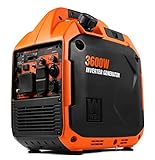 WEN 56360i 3600-Watt WEN 56360i 3600-Watt |
|
Check Latest Price |
 WEN DF360iX Dual Fuel WEN DF360iX Dual Fuel |
|
Check Latest Price |
 Westinghouse iGen2550DFc Westinghouse iGen2550DFc |
|
Check Latest Price |
 ERAYAK 4500W Dual Fuel ERAYAK 4500W Dual Fuel |
|
Check Latest Price |
We earn from qualifying purchases. CERTAIN CONTENT THAT APPEARS ON THIS SITE COMES FROM AMAZON. THIS CONTENT IS PROVIDED 'AS IS' AND IS SUBJECT TO CHANGE OR REMOVAL AT ANY TIME.
1. WEN 56477i is the best high-output choice for RV camping
WEN Quiet and Lightweight 4800-Watt RV-Ready Portable…
4800 start
4000 run
72.7 lb
RV outlet
Pros
- 4000 running watts
- CO shutdown sensor
- Fuel shutoff
- RV-ready outlets
- Wheels and pull handle
Cons
- 72.7 pounds
- Availability may vary
The WEN 56477i is the model I would put at the top of a power-hungry camping shortlist. Its 224cc four-stroke engine is rated for 4,800 starting watts and 4,000 running watts, enough headroom for a more involved RV electrical plan after you total the appliance labels.
The output panel is unusually useful for camping: four 120V receptacles, a TT-30R RV receptacle, a 12V DC outlet, and two USB ports. WEN also states that the inverter produces clean power for sensitive electronics, so one machine can cover both larger AC loads and device charging.
At 72.7 pounds, this is not the grab-and-go pick for a walk-in tent site. The onboard wheels and telescoping pull handle matter here, but I would still plan on a flat path and two hands when loading it into a vehicle.
The WEN 56477i fits RV campers who need sustained output
Four thousand running watts is the figure to use when matching this generator to an RV. It can be a sensible option when a lower-output inverter will not cover the combined running load, provided the air conditioner’s startup draw and the TT-30R connection both match your rig.
The reported seven-hour runtime is useful for a day at camp, but runtime varies with load. A generator supplying a heavy appliance will not run as long as the stated figure, so start with a realistic appliance list rather than the tank size alone.
The WEN 56477i needs a transport plan before the trip
This WEN measures 23.8 by 12.6 by 22 inches. That compact footprint helps in a truck bed, yet its weight puts it well above the under-50-pound range that many tent campers prefer.
Its Watchdog CO Shutdown Sensor and fuel shutoff add worthwhile safeguards and maintenance convenience. Neither one replaces outdoor placement, a clear exhaust path, and distance from every sleeping area.
2. PowerSmart DB5035 is the best balance of quiet output and carry weight
PowerSmart 3600 Watt Portable Inverter Generator, Quiet…
3600 start
3200 run
50.7 lb
59 dBA
Pros
- 3200 running watts
- Stated 59 dBA
- 10-hour claim
- Less than 3% THD
- Parallel capable
Cons
- No TT-30R RV outlet
- 50.7 pounds
PowerSmart’s DB5035 offers 3,600 starting watts and 3,200 running watts from a 149cc four-stroke engine. That is a practical middle ground for campers who need more than a lights-and-chargers unit but do not want to bring a 70-pound generator.
Its stated noise level is 59 dBA from 23 feet, and the listed runtime is 8 to 10 hours at 25% load from a 1.3-gallon tank. Those are favorable specifications for a campground, though the actual sound and fuel use will rise as electrical demand rises.
This model’s published clean-power figure is less than 3% THD. It also has low-oil shutdown, overload protection, a digital display, and parallel capability, features that make it easier to monitor and expand a camping power setup.
The PowerSmart DB5035 works best for medium-demand campsites
At 50.7 pounds, this generator is close to the carry-weight limit many campers set for solo loading. It is far more manageable than larger wheeled units, while its 3,200 running watts leave room for a cooler, lights, cooking devices, and charging when the combined load stays within rating.
The control panel includes a 30-amp L5-30R, a 20-amp household receptacle, 12V DC, and dual USB outputs. Confirm your RV’s plug type before buying, because this is not listed as RV-ready with a TT-30R receptacle.
The PowerSmart DB5035 gives you a path to more output
Parallel capability lets compatible 3,600-watt PowerSmart units work together, but a parallel connection is a later upgrade rather than a substitute for calculating the required initial wattage. It also adds the cost, storage, fuel, and placement considerations of a second machine.
Buyer feedback is strong in the supplied data, with a 4.6 rating across 267 reviews and 84% five-star reviews. I treat that as a helpful signal, not a promise about a single unit’s performance or service experience.
3. Westinghouse iGen4000DFc is the best dual-fuel remote-start option
Westinghouse 4000 Peak Watt Super Quiet Dual Fuel Portable…
4000 start
3300 run
62.8 lb
dual fuel
Pros
- Gas or propane
- Remote electric start
- 52 dBA claim
- RV-ready outlet
- CO shutdown
Cons
- 62.8 pounds
- Availability may vary
The Westinghouse iGen4000DFc combines 4,000 starting watts and 3,300 running watts with gasoline or propane operation. That flexibility is useful for campers who already carry propane for cooking or who want a second fuel option for longer off-grid stays.
Its standout convenience feature is remote electric start by key fob. The LED data center reports fuel level, output, runtime, voltage, and lifetime hours, which gives you more information than a simple fuel gauge when you are watching a campsite load.
Westinghouse lists output as low as 52 dBA, economy-mode runtime up to seven hours, less than 3% THD, a TT-30R RV outlet, a standard 120V outlet, and two USB ports. Those details make it one of the most complete power panels in this group.
The iGen4000DFc suits campers who value fuel flexibility
Propane can be convenient when it is already part of the camp kitchen system, while gasoline offers the listed 4,000-watt peak and 3,300-watt rated output. Read the manual for fuel-specific output and connection procedures before switching fuels at camp.
The CO sensor is an important added layer, and the remote start is convenient from a distance. Neither feature makes it safe to run near a tent or RV; exhaust must always remain outdoors and away from openings.
The iGen4000DFc is quieter on paper than most higher-output options
A stated 52 dBA figure is unusually low among the higher-output models listed here. Put that figure in context: measurement distance, load, ground surface, and nearby walls all change what neighboring campers hear.
At 62.8 pounds, it is best for campers who can lift with help or roll it from vehicle to site. Its telescoping handle helps once the unit is on the ground, but it does not reduce the loading weight.
4. Oxseryn EDOC09 is the best lightweight choice for modest tent-camping loads
Oxseryn 2800-Watts Portable Inverter Generator, Gas…
2800 start
2000 run
40 lb
under 58 dBA
Pros
- 40-pound carry weight
- USB and Type-C
- Less than 3% THD
- 9-hour claim
- Parallel function
Cons
- 2000 running watts
- One-year warranty
The Oxseryn EDOC09 is the lightest straightforward gasoline choice in this list at 40 pounds. Its 2,800 starting watts and 2,000 running watts suit tent camping where the goal is powering small appliances, lights, a cooler, and personal electronics rather than a large RV air conditioner.
It is stated to run under 58 dBA from 23 feet and up to nine hours at 25% load on a 1.1-gallon tank. The compact 17.9 by 11.2 by 17.35-inch body and built-in handle are a much better fit for short carries from a car to a campsite.
Its ports include two 120V AC outlets, 12V DC, USB, and Type-C. The supplied data also states less than 3% THD, eco-mode, cold-start technology, a fuel gauge, and parallel function.
The Oxseryn EDOC09 is right for low-to-medium power plans
Two thousand running watts can cover a carefully managed camp load, but it is not a free pass to run every appliance at once. Check the continuously running wattage of each device, then add the largest startup demand before committing.
I would choose this size for a quiet generator for tent camping when lower weight ranks above surplus output. It has enough outlet variety for modern charging needs without forcing you to haul a larger chassis.
The Oxseryn EDOC09 asks buyers to accept a shorter warranty
Oxseryn lists a one-year manufacturer warranty, shorter than the three-year terms shown for several rivals. That makes careful break-in, oil checks, and retaining proof of purchase especially sensible.
The product data shows a 4.5 rating from 394 reviews, with 76% five-star reviews. Its strengths are portability and stated noise level, while the 2,000-watt running limit should be treated as the deciding constraint.
5. Champion 100809 is the lightest 4,000-watt-class camping choice
Champion Power Equipment 4000-Watt RV Ready Portable…
4000 start
3000 run
48.1 lb
CO Shield
Pros
- Under 49 pounds
- 3000 running watts
- CO Shield
- 10-hour claim
- Parallel capable
Cons
- 64 dBA claim
- No dual-fuel option
Champion’s 100809 makes a compelling case when you want 4,000 starting watts but are trying to keep generator weight below 50 pounds. It weighs 48.1 pounds while providing 3,000 running watts, a rare portability-to-output combination in this group.
The published runtime is up to 10 hours, and the noise claim is 64 dBA from 23 feet. It has CO Shield carbon-monoxide auto shutoff, cold-start technology, quiet technology, and support for a parallel kit.
Its three-year limited warranty and lifetime technical support add useful ownership support on paper. The supplied review data shows a 4.5 rating from 362 reviews and 82% five-star reviews.
The Champion 100809 fits campers who load generators alone
At 48.1 pounds, this is substantially easier to load than the 72.7-pound WEN 56477i or 92.2-pound Champion 201318. That difference can matter more than extra peak output when a generator moves in and out of an SUV for every weekend trip.
Three thousand running watts is still meaningful output, but you should not assume it will start every RV air conditioner. Check the air-conditioner label, the rest of the RV load, and whether a soft-start system changes the startup requirement.
The Champion 100809 trades some quietness for its compact output
Its listed 64 dBA is louder than the 52 to 59 dBA claims for several alternatives here. Site placement, a stable level surface, and the lowest practical load can help reduce disturbance, but always follow posted generator-hour rules.
Parallel readiness offers room to grow if camping needs change. For a simple tent setup, buying more capacity than you will use also means transporting more machine than necessary.
6. Champion 201318 is the best choice for an extended powered stay
Champion Power Equipment 4500-Watt RV Ready Portable…
4500 start
3500 run
92.2 lb
14-hour claim
Pros
- 14-hour stated runtime
- 3500 running watts
- 61 dBA claim
- RV outlet
- Clean power
Cons
- 92.2 pounds
- Large for tent camping
The Champion 201318 is the runtime specialist, with a stated maximum of 14 hours from its 2.3-gallon tank at the listed operating conditions. It provides 4,500 starting watts and 3,500 running watts, giving RV campers more steady capacity than the lighter Champion model.
Champion lists 61 dBA, clean power below 3% THD, a 120V 29.2A RV outlet, a 120V 20A household duplex outlet, and an IntelliGauge that monitors voltage, frequency, and operating hours. Economy Mode monitors power use in real time, while the EZ Start Dial simplifies startup.
The trade-off is obvious: this unit weighs 92.2 pounds. For vehicle-based camping, wheels or help loading are not optional practical details; they are part of whether this generator fits your trip.
The Champion 201318 supports long off-grid camping days
Long stated runtime makes this a logical model for boondocking or a basecamp that needs dependable power across a day. The 14-hour figure is not a universal result because runtime depends on the load, but it is the longest claim among these 10 products.
Its CO Shield system is welcome, and its clean-power claim helps with electronics. Keep a working CO alarm inside an RV anyway, and never interpret automatic shutdown as permission for unsafe positioning.
The Champion 201318 is best when vehicle space outweighs lifting ease
This is not the product I would pick for a minimalist tent trip. The 92.2-pound weight and 23.2 by 17.7 by 20.1-inch dimensions make it better suited to RV camping, tailgating, or a vehicle-based campsite with a short move from storage to operating position.
It is parallel ready, but its standalone 3,500 running watts already cover more sustained load than most compact camping units. Make the decision based on actual appliance demand, not only the appeal of the largest number.
7. WEN 56360i is the best WEN option for easy loading and RV outlets
WEN 3600-Watt Portable Inverter Generator, RV-Ready, Quiet…
3600 start
2900 run
46.3 lb
RV-ready
1.6 gal
Pros
- 46.3-pound body
- TT-30R RV outlet
- Clean power
- Fuel shutoff
- Three-year warranty
Cons
- Five-hour runtime
- 2900 running watts
The WEN 56360i is a practical compromise between compact carry weight and useful RV-ready output. Its 149cc engine produces 3,600 surge watts and 2,900 rated watts, while the generator itself weighs 46.3 pounds.
The panel has two three-prong 120V receptacles, a TT-30R RV outlet, a 12V DC outlet, and two USB ports. WEN says it produces clean power for phones, tablets, laptops, and other sensitive electronics.
A fuel shutoff is particularly useful for storage between trips because it runs the remaining fuel from the carburetor before shutdown. The supplied runtime specification is five hours, which makes planning a refill or a lower-load schedule more important than with longer-running models.
The WEN 56360i makes RV connection simpler at a modest weight
A TT-30R outlet removes the need to adapt a standard household outlet for a typical 30-amp RV connection. It does not change the generator’s 2,900-watt running limit, so the RV’s appliance load still dictates whether it is sufficient.
This is one of the clearer choices for campers who want an RV-ready panel without jumping to a 60- or 70-pound generator. It is also useful for a mixed trip where the same generator may power a tent site one weekend and a small trailer the next.
The WEN 56360i requires a runtime-aware camp routine
Five hours is adequate for many evening-power needs, but it may not cover a full day without refueling. Do fueling only after shutdown and cooling, away from ignition sources, and never refill a hot generator.
The supplied feedback shows a 4.4 rating across 580 reviews. That broader review base helps show demand, while the shorter runtime remains the key practical compromise.
8. WEN DF360iX is the compact dual-fuel option with CO protection
WEN Quiet and Lightweight 3600-Watt Dual Fuel RV-Ready…
3600 gas start
2600 run
49 lb
dual fuel
Pros
- Gasoline and propane
- CO Watchdog
- RV outlet
- Fuel shutoff
- Clean power
Cons
- 2600 watts on propane
- Availability may vary
The WEN DF360iX gives campers a gasoline-and-propane option in a 49-pound package. WEN lists 3,600 surge watts and 2,900 rated watts on gasoline, or 3,500 surge watts and 2,600 rated watts on propane.
That fuel-specific difference is important. A propane hookup adds flexibility, but it lowers the stated running output, so calculate against 2,600 watts if propane will be your normal camping fuel.
The generator includes WEN’s CO Watchdog shutdown sensor, fuel shutoff, a tool-free LPG quick connector, two 120V receptacles, TT-30R RV outlet, 12V DC outlet, and two USB ports. It is also described as producing clean power for electronics.
The WEN DF360iX fits campers who already carry propane
A trailer or camp kitchen that already uses propane can make this generator easier to plan around. Fuel choice should be based on availability, storage practices, expected loads, and the reduced propane wattage, not simply the convenience of one more connection.
The stated five-hour runtime and 1.5-gallon gasoline tank favor moderate-duration use. For a multiday stay, build a safe fuel plan that respects campground rules and keeps gasoline containers well away from the generator while it operates.
The WEN DF360iX keeps key camping outlets in a light chassis
At 49 pounds, it stays near the solo-lifting range while retaining an RV receptacle. That helps campers who need a more versatile panel but cannot accommodate a large wheeled inverter.
The 4.4 rating across 510 reviews is a useful data point, but there is no substitute for checking current availability, reviewing the manual, and confirming your intended electrical load before purchase.
9. Westinghouse iGen2550DFc is the quiet lightweight dual-fuel pick
Westinghouse 2550 Peak Watt Super Quiet & Lightweight…
2550 start
1900 run
43.2 lb
dual fuel
Pros
- 43.2 pounds
- Gas or propane
- 52 dBA claim
- 12-hour claim
- TT-30R outlet
Cons
- 1900 running watts
- Limited outlet count
The Westinghouse iGen2550DFc is aimed at campers who value low carry weight, fuel choice, and lower stated noise more than high output. It provides 2,550 starting watts and 1,900 running watts, with gasoline or propane operation and a listed weight of 43.2 pounds.
Westinghouse states output as low as 52 dBA, up to 12 hours of runtime on a 1.16-gallon gasoline tank, economy mode, and less than 3% THD. The panel has an RV-ready TT-30R outlet, two 120V 20-amp outlets, and two USB outlets.
It comes with oil, an oil funnel, a tool kit, and a user’s manual. Factory testing may leave residual oil or fuel odor, according to the supplied listing, so inspect and prepare the unit outdoors before taking it to a campsite.
The iGen2550DFc works for electronics and light appliance loads
Nineteen hundred running watts is well suited to a modest setup: charging, lighting, fans, and selected small appliances used one at a time. It is not the right size for an RV air conditioner unless the specific unit’s starting and running requirements are known to be below the available capacity.
The TT-30R connection is convenient, but an RV plug alone does not mean every RV appliance can run. Treat rated wattage as the hard limit and use the generator’s overload protection as a last safeguard, not a planning tool.
The iGen2550DFc favors a quiet, fuel-efficient camp routine
The combination of 43.2 pounds, dual fuel, and a 52 dBA claim is attractive for tent camping and small trailers. Its 12-hour claim is measured under product-specified conditions, so plan for less runtime as the load grows.
The supplied data records a 4.3 rating from 951 reviews. Its main compromise is simple: it is easy to carry and potentially quiet, but it has the lowest running-watt figure in this roundup.
10. ERAYAK 4500PDM is the longest-running auto-switch dual-fuel option
ERAYAK 4500W Dual-Fuel Portable Inverter Generator for Home…
4500 start
3500 run
54 lb
auto fuel switch
Pros
- Auto fuel switching
- 3500 running watts
- 58 dBA claim
- Pure sine wave
- CO sensor
Cons
- 4.1 rating
- 54-pound weight
The ERAYAK 4500PDM offers 4,500 starting watts and 3,500 running watts on gasoline, or 4,050 starting watts and 3,150 running watts on propane. At 54 pounds, it lands between lightweight compact models and the larger high-output machines.
Its unusual feature is gas-priority automatic fuel switching: ERAYAK says the generator switches to gasoline when propane runs out. The stated runtime is up to 16 hours at 25% load on gasoline and more than 20 hours on propane, supported by electronic speed control.
ERAYAK lists pure sine wave technology with 0.2% to 1.2% THD, a CO sensor, parallel readiness, a 30-amp RV-ready outlet, and 58 dBA at 23 feet at quarter load. That is a strong paper specification for campers who use sensitive electronics and need larger output.
The ERAYAK 4500PDM fits long stays with planned dual-fuel supply
The auto-switch design can reduce interruption when one fuel source is depleted, but it is not a reason to ignore fuel levels. Check both fuel supplies during the day, understand the setup in the manual, and calculate using the output available on the fuel you expect to use.
Its 3,500 running watts place it among the more capable RV-oriented options in this roundup. A 30-amp RV outlet helps with connection, but air-conditioner startup remains the number to verify first.
The ERAYAK 4500PDM has a more mixed review signal than top picks
The provided data shows a 4.1 rating from 127 reviews, 62% five-star reviews, and 13% one-star reviews. That does not rule it out, but it warrants closer reading of current owner feedback, warranty terms, and return procedures before choosing it over the higher-rated models.
The listed three-year warranty and lifetime technical support are positives. I would choose this model for its automatic fuel-switching feature and stated long runtime, not as a blind replacement for a better-matched lighter generator.
The buying guide starts with your actual camping load
Choose a generator by running watts first and starting watts second. Running watts are the continuous power an appliance needs while operating; starting watts are the temporary extra burst required when a motor begins to turn, often relevant to air conditioners, refrigerators, compressors, and pumps.
List every appliance you intend to run at the same time.
Add their running watts.
Add the highest startup-watt demand to that total, not every startup figure at once.
Choose a generator whose rated watts exceed that calculated load with room for normal variation.
A basic tent site with LED lights, phone charging, and a fan can have a small load. Add a compressor cooler, coffee maker, electric griddle, microwave, or power tools and the requirement can rise quickly, so use manufacturer labels rather than generic estimates.
The quietest generator is the one sized correctly and placed responsibly
Published sound figures in this roundup range from 52 dBA to 64 dBA, generally measured at 23 feet or under a stated load condition. Lower decibels are preferable, but the product specification does not tell the whole campsite story.
A hard surface, a wall, an enclosed corner, and high electrical demand can all make a generator more noticeable. Place it on a stable open spot outdoors, use the lowest practical load, point exhaust away from people, and honor quiet hours even with a low-dBA model.
The right RV generator must cover an air conditioner’s startup draw
Many RV owners need at least 3,000 watts for air conditioner use, according to the forum research, but that is a starting point rather than a universal rule. Check the specific air conditioner, the altitude and temperature conditions, other onboard loads, and whether a soft-start device is installed.
Among these products, the WEN 56477i provides 4,000 running watts, while the ERAYAK 4500PDM and Champion 201318 provide 3,500. Smaller RV-ready models can connect to an RV but may not have enough sustained power for an air conditioner plus other appliances.
The fuel choice changes convenience, runtime, and available wattage
Gasoline is the only fuel option for the PowerSmart, Oxseryn, both gasoline-only Champions, and the WEN 56360i. Dual-fuel models can use gasoline or propane, adding flexibility for campers who already travel with a propane cylinder.
Do not assume the same output applies to both fuels. WEN’s DF360iX lists 2,900 running watts on gasoline and 2,600 on propane; ERAYAK lists 3,500 on gasoline and 3,150 on propane. Keep fuel containers safely stored and follow every local rule on transport and refueling.
The inverter system protects electronics by producing stable AC power
An inverter generator first produces AC, converts that power to DC, and inverts it back to AC. The result is intended to be cleaner, more stable electricity than a conventional generator, which is why campers use inverter units for phones, laptops, camera batteries, and other sensitive gear.
Several choices here specify less than 3% THD, and the ERAYAK lists 0.2% to 1.2% THD. That is useful technical information, but it does not remove normal electrical-safety steps such as keeping connections dry and using cords rated for the load.
The best carry weight depends on how far the generator must travel
Forum discussion repeatedly puts weight near the top of camper concerns, especially for tent camping. The Oxseryn at 40 pounds, Westinghouse iGen2550DFc at 43.2 pounds, WEN 56360i at 46.3 pounds, and Champion 100809 at 48.1 pounds are the easier options to lift from a vehicle.
For more output, weight climbs: the WEN 56477i is 72.7 pounds and the Champion 201318 is 92.2 pounds. Wheels and handles help over level ground, but they do not help much with lifting into a vehicle or over uneven campsites.
The safety plan matters more than a built-in CO sensor
CO sensors or shutdown systems appear on the WEN 56477i, Westinghouse models, both Champions, WEN DF360iX, and ERAYAK. These systems are valuable, yet carbon monoxide is odorless and can build up around tents, vehicles, RVs, and nearby structures.
Operate the generator outdoors only and away from all windows, doors, vents, and sleeping spaces. Bring a functioning CO alarm for an RV, do not run a generator in a garage or under an enclosed canopy, and stop operating it if weather prevents safe outdoor placement.
The maintenance routine begins before the first camping trip
Read the manual, add the specified oil, check the oil level before each use, and follow the maker’s break-in and oil-change schedule. Fuel shutoff systems on WEN models can help clear fuel from the carburetor before storage, but regular inspection still matters.
Use fresh fuel as specified by the manufacturer, inspect the air filter and spark plug on schedule, and exercise a stored generator according to the manual. Campers in forum discussions also flag cold-weather starting as a pain point, so prepare the unit at home instead of discovering a setup issue at camp.
A portable power station is quieter but cannot replace every generator job
A battery power station has no exhaust and is often the better choice for low-load, quiet-hours charging. It may also accept solar input, but none of the gasoline inverter generators reviewed here is described as solar-charging equipment.
For a prolonged high-watt load or a remote stay where recharging a battery is difficult, a fuel-powered inverter generator can make more sense. The choice comes down to runtime needs, acceptable noise, charging access, and whether combustion equipment can be positioned safely.
FAQs
What is the best inverter generator for camping?
The WEN 56477i is the strongest all-around choice here for campers who need 4,000 running watts, an RV-ready TT-30R outlet, wheels, fuel shutoff, and a CO shutdown sensor. For lighter use, choose a model based on its running watts and carry weight rather than buying more output than your campsite needs.
How many watts do I need for a camping generator?
Add the running watts of appliances you will use together, then add the largest startup-watt requirement for a motorized appliance. Lights and charging need relatively little power, while an RV air conditioner can require a generator with at least 3,000 watts or more depending on the exact unit and startup demand.
What is the quietest generator for camping?
The Westinghouse iGen4000DFc and iGen2550DFc are both listed as low as 52 dBA. Actual campsite sound varies with electrical load, distance, surface, and placement, so use the lowest practical load and follow campground quiet-hour rules.
Can inverter generators power an RV air conditioner?
Some can, but you must compare the generator running and starting watts with the specific air conditioner requirements and all other RV loads. The WEN 56477i has 4,000 running watts, while several other choices provide 3,000 to 3,500 running watts and RV-ready outlets.
How does an inverter generator work?
An inverter generator makes AC power, changes it to DC, and inverts it back to stable AC power. This process is designed to provide cleaner electricity for sensitive devices and can support fuel-saving modes when electrical demand is low.
The best final choice matches your campsite rather than the biggest watt number
For the best inverter generators for camping in 2026, my first pick is the WEN 56477i when an RV setup calls for 4,000 running watts and a TT-30R outlet. The PowerSmart DB5035 is a balanced middle choice, and the Westinghouse iGen4000DFc brings dual fuel, remote start, and a low stated noise figure.
For tent camping, a 40- to 50-pound inverter such as the Oxseryn EDOC09, WEN 56360i, Westinghouse iGen2550DFc, or Champion 100809 is usually easier to live with. Before choosing, write down your running load, largest startup demand, required outlet, acceptable carry weight, and a safe outdoor operating spot.
