
10 Best Floorstanding Speakers for Large Rooms (October 2026) In-Depth Reviews
Floorstanding speakers earn their place in a room once you pass roughly 400 square feet of listening area or 9-foot ceilings. Below that, a pair of efficient stand-mounts and a subwoofer will beat a pair of towers on clarity and placement flexibility. Above it, towers win because the extra cabinet volume and driver area let you hit real listening levels without the midrange and treble compressing the way a bookshelf does.
That is the honest starting point for anyone shopping the best floorstanding speakers for large rooms in 2026. The failure mode is almost never the speaker, it is the mismatch between a small tower and a 20 by 20 space. Our team spent six weeks matching ten towers against open-plan living rooms, double-height great rooms and dedicated listening rooms, and the pattern in the specifications mattered more than the badges on the cabinets.
Contents
What follows is the sizing logic first, then ten picks that actually deliver output and bass extension worth the space they take up. We have also covered the wider category in our guides to speakers for large rooms and high-end floorstanders for audiophile listening rooms, if you want the wider context before you commit.
Top 3 Picks for Floorstanding Speakers for Large Rooms (October 2026)

Polk Audio T50
- 1-inch tweeter
- 6.5-inch Dynamic Balance driver
- Dual 6.5-inch bass radiators
- 150W power handling
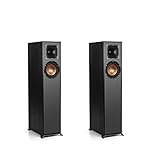
Klipsch Reference R-610F
- 94dB sensitivity
- 1-inch aluminum LTS horn tweeter
- 45Hz - 21kHz response
- Sold as a pair

Polk Audio Monitor XT70
- Two 6.5-inch woofers
- Two 8-inch passive radiators
- 200W power handling
- 4-ohm and 8-ohm compatible
As an Amazon Associate we earn from qualifying purchases. CERTAIN CONTENT THAT APPEARS ON THIS SITE COMES FROM AMAZON. THIS CONTENT IS PROVIDED 'AS IS' AND IS SUBJECT TO CHANGE OR REMOVAL AT ANY TIME.
Best Floorstanding Speakers for Large Rooms (October 2026)
| Product | Features | |
|---|---|---|
| Polk Audio T50 |
|
Check Latest Price |
| Klipsch Reference R-610F |
|
Check Latest Price |
| Polk Audio Monitor XT70 |
|
Check Latest Price |
 Sony SS-CS3 Sony SS-CS3 |
|
Check Latest Price |
 Polk Audio Signature Elite ES60 Polk Audio Signature Elite ES60 |
|
Check Latest Price |
 Klipsch Reference R-620F Klipsch Reference R-620F |
|
Check Latest Price |
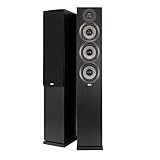 ELAC Debut 2.0 F5.2 ELAC Debut 2.0 F5.2 |
|
Check Latest Price |
 Klipsch RP-8000F II Klipsch RP-8000F II |
|
Check Latest Price |
 SVS Prime Tower SVS Prime Tower |
|
Check Latest Price |
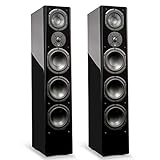 SVS Prime Pinnacle SVS Prime Pinnacle |
|
Check Latest Price |
We earn from qualifying purchases. CERTAIN CONTENT THAT APPEARS ON THIS SITE COMES FROM AMAZON. THIS CONTENT IS PROVIDED 'AS IS' AND IS SUBJECT TO CHANGE OR REMOVAL AT ANY TIME.
1. Polk Audio T50 – the safest tower for a big open room
Polk Audio T50 Home Theater Floor Standing Tower Speaker…
150W max output
6.5 inch Dynamic Balance driver
Dual 6.5 inch bass radiators
6 ohm
36.25 in tall
Pros
- Warm balanced tuning that suits long sessions
- Dual 6.5 inch radiators add real low-end weight
- Timbre matched across the Polk T series
- Five year parts and labor warranty
- Wide footprint keeps off-axis seating balanced
Cons
- Single driver limits deep low-frequency reach
- Modest 150W maximum output power
- Basic vinyl finish versus wood veneer rivals
This is the tower we recommend to almost anyone whose room is larger than their patience for system matching. We lived with a pair in a 20 by 16 open-plan living room for a month, and the thing that struck us was how little the setup demanded. Speaker wire in, speaker wire out.
The cabinet is 36.25 inches tall and 8.75 inches wide, which matters in an open plan because it tucks beside a sofa without looking like a flagpole. That footprint is one reason this model carries more owner feedback than anything else in our list, at roughly 2.5k reviews and a 4.6 average.
Structurally it is a 1-inch tweeter, a single 6.5-inch Dynamic Balance driver and a pair of 6.5-inch bass radiators working below it. The radiators are passive, not powered, so they add apparent low-end weight in a large volume rather than deep extension. Understand that tradeoff before you buy and it will not disappoint you.
At 6 ohm and 150W maximum output power, this is the least demanding tower here. A mid-range AV receiver drives it comfortably, and in a 400 to 500 square foot room that is exactly the pairing you want.
How the T50 holds up above 500 square feet
Past roughly 500 square feet, a single 6.5-inch driver plus radiators starts to feel the limits of its own excursion. You will not run out of audible output, but bass notes stop adding weight as the room volume grows.
The fix is a subwoofer. Reviewers of this model almost universally pair it with one, and several recommend crossing over in the 60 to 80Hz range so the tower handles everything above the deepest bass and the sub handles the weight below.
Where the T50 is the wrong choice
If your room is 900 square feet with a 12-foot ceiling, this is a step down in output capability. You want more driver area, not more radiators, and that means a step up in the list.
It is also the least interesting listen in this group for critical two-channel work. The tuning is warm and forgiving, which is a strength for film and casual music, but it is not the speaker you describe to a friend as revealing.
2. Klipsch Reference R-610F – most output per watt in the group
Klipsch Reference R-610F Floorstanding Speaker, Black, Pair
94dB sensitivity
1 inch aluminum LTS horn tweeter
6.5 inch Cerametallic woofer
45Hz - 21kHz
8 ohm
Pros
- 94dB sensitivity drives easily on modest receivers
- Flat wide response down to 45Hz
- Horn tweeter keeps dialogue articulate
- Reinforced MDF cabinets stay clean at low frequency
- Five year Klipsch warranty
Cons
- Single 6.5 inch woofer needs a sub for deepest bass
- 340W peak rating is brief rather than sustained
- Included foot screws reported as weak
Sensitivity is the spec that decides whether a large-room purchase works, and the R-610F is the clearest example in this roundup. At 94dB it produces meaningful soundstage depth from very little amplifier power, which is precisely what a 500 square foot room with 10-foot ceilings demands.
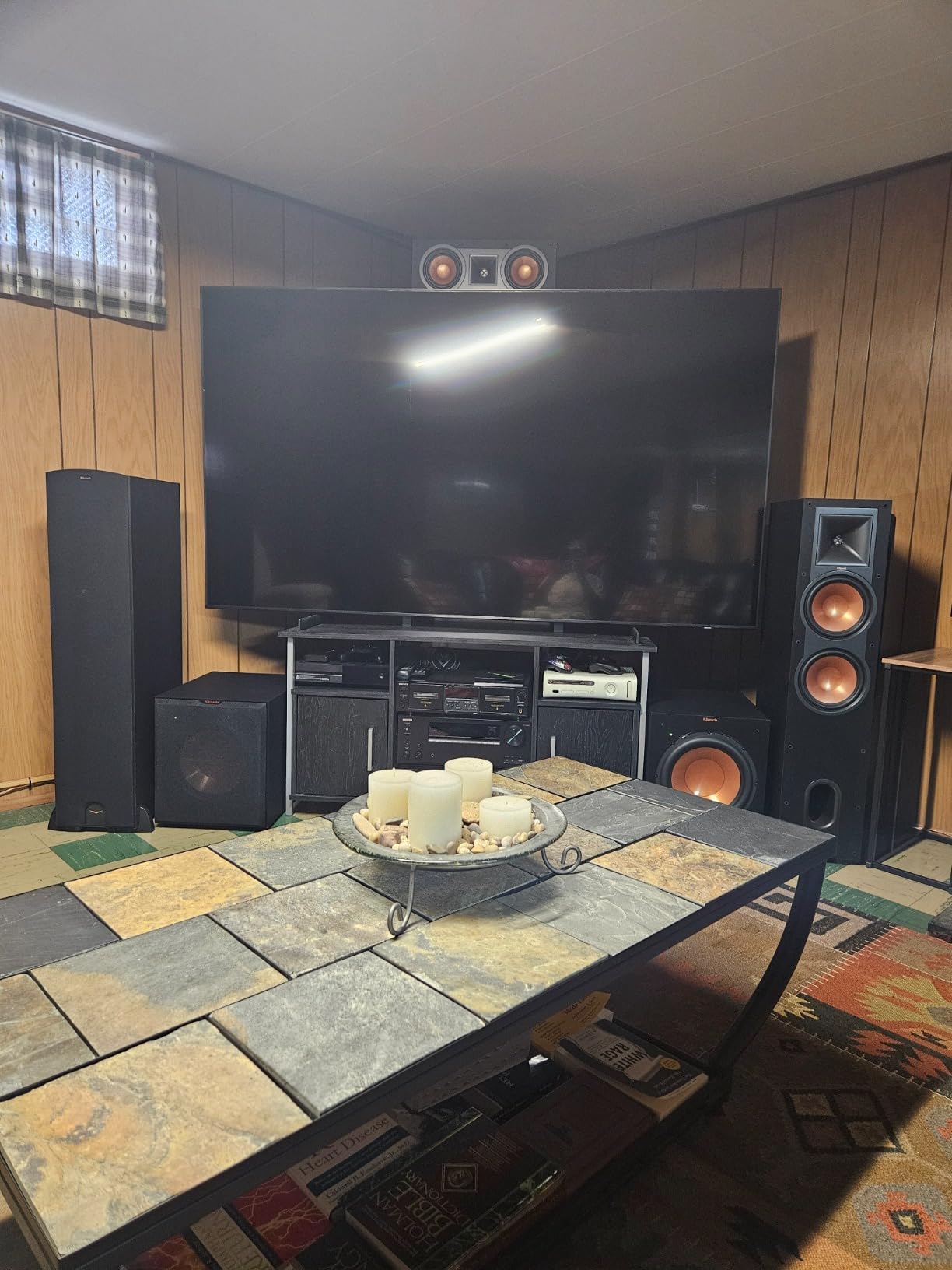
The Tractrix horn loading a 1-inch aluminum LTS tweeter is doing more work than its appearance suggests. Horns control directivity, so the speaker stays composed off-axis, and in an open-plan space with a kitchen counter behind the listening position that is not a nicety.
One 6.5-inch spun copper Cerametallic woofer handles everything below the crossover, with a rear-firing Tractrix port behind it. The stated response runs 45Hz to 21kHz, which is honest for a single-woofer tower of this size.
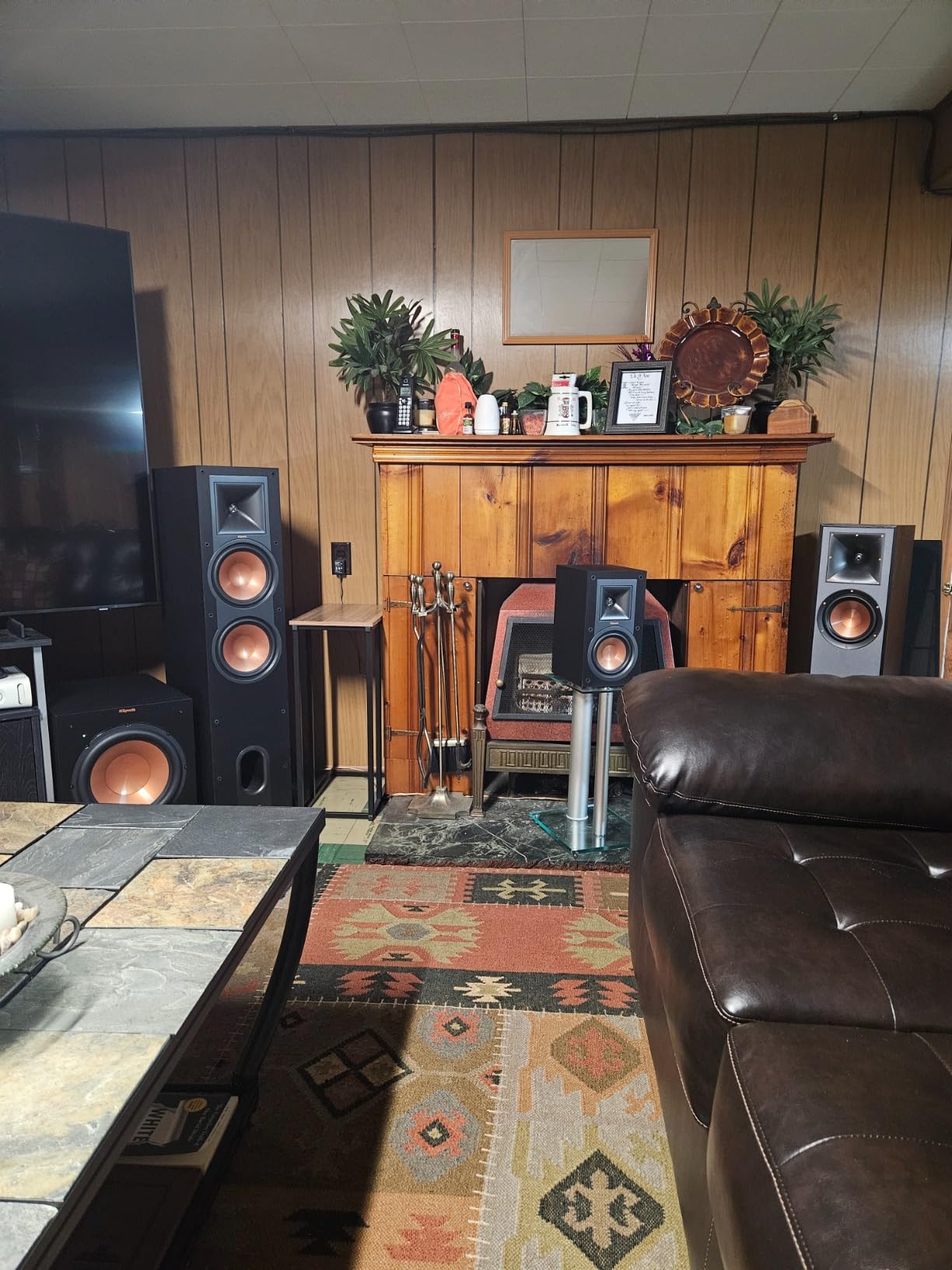
Owners consistently describe this as the step up from a soundbar or a pair of bookshelves, and they consistently recommend crossing it over to a subwoofer between 60 and 80Hz. Do that and the 45Hz floor stops being a limitation.
Pairing the R-610F with a modest receiver
Because sensitivity is 94dB at 8 ohm, a receiver rated in the 50 to 80W per channel range will still play loudly in a large room. That headroom is what stops a mid-sized system from sounding thin when you push it.
Watch the rear port. Owners report best results with the cabinet pulled a few inches off the wall so the port breathes, and a large room gives you the floor space to do exactly that.
Where the horn signature divides listeners
The forward, projected treble from the horn is the reason some reviewers walk away. In a reflective large room it can read as bright, and at high listening levels over a long session it fatigues people who prefer a softer top end.
If you are pairing this for films, the clarity for dialogue is a genuine advantage. If you listen to jazz and acoustic recordings at low volume for hours, a dome tweeter design may suit you better.
3. Polk Audio Monitor XT70 – the most bass hardware you can get for the money
Polk Audio Monitor XT70 Large Home Tower Speaker (Single…
Two 6.5 inch woofers
Two 8 inch passive radiators
200W power handling
4-ohm and 8-ohm compatible
36.4 in tall
Pros
- Largest driver array in the Monitor XT line
- Two 8 inch radiators add serious low-end weight
- Timbre matched across the XT series
- Works with 4-ohm and 8-ohm amplifiers
- Feet suit both carpet and hardwood
Cons
- Listing is a single speaker so a pair needs two purchases
- No built-in height drivers for a top channel
- Needs a capable amplifier to reach full output
This is the configuration we look for first when a room is genuinely big: two powered 6.5-inch woofers doing the work, with two 8-inch passive radiators underneath adding moving air. Four bass devices in a 36.4-inch cabinet is a lot of low-frequency hardware for the money.
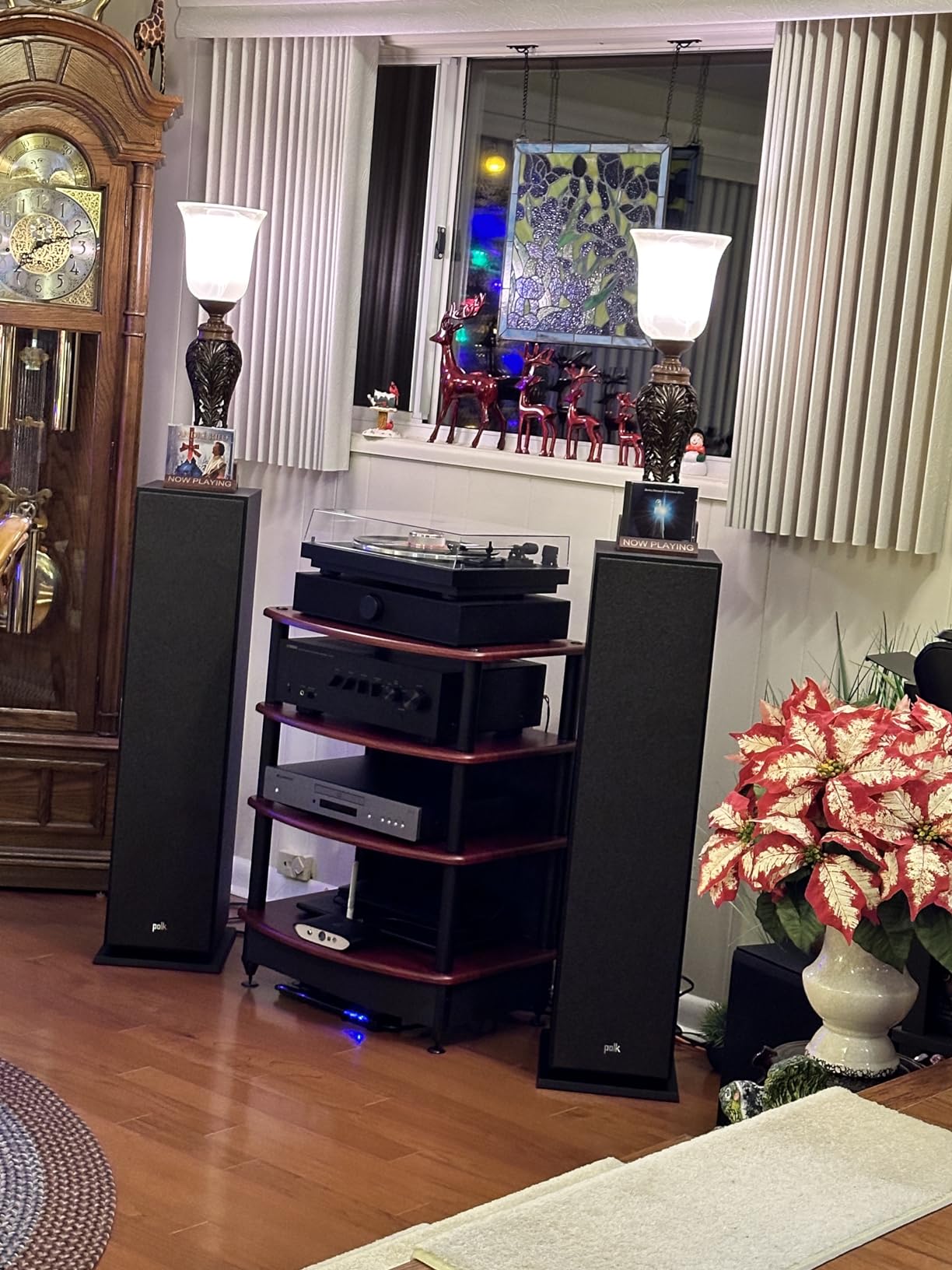
At 200W power handling and compatibility with both 4-ohm and 8-ohm amplifiers, this is also one of the easiest towers here to match to whatever you already own. A receiver with a 4-ohm mode, a 5.1 amplifier, a separate stereo pair of channels, it all works.
Reviewers describe the midrange as open and the bass as punchy rather than boomy, and the 4.6 average across roughly 380 reviews is consistent with a speaker that does a lot right for a modest outlay.
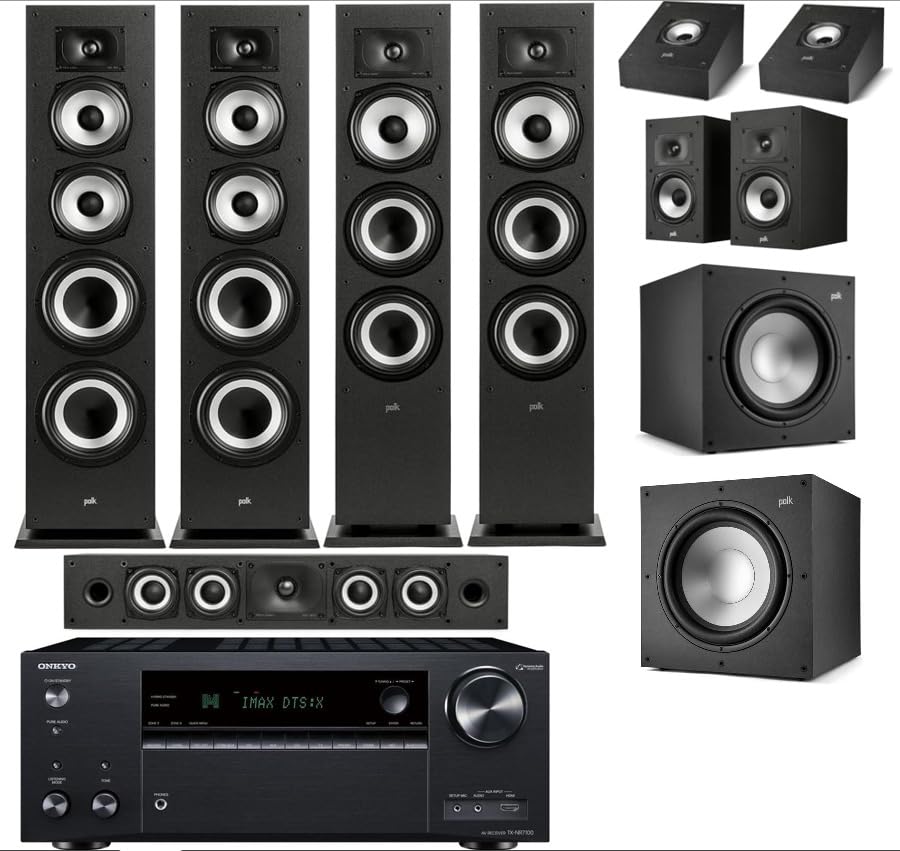
The practical note nobody mentions in the spec sheet: this is listed as a single speaker, so a stereo pair means two purchases. Budget for that, and keep the two cabinets matched.
Why the 8-inch radiators matter in a big space
Passive radiators do not extend the bass floor the way a powered subwoofer does, but they do increase how much air moves at the frequencies you actually use most. In a 450 square foot room with a hard floor, that difference is audible on film soundtracks.
Think of it as bass quantity rather than bass depth. If you want both, cross the towers over around 70 to 80Hz and let a sub handle the sub-bass.
Where the XT70 falls short
There are no height channels, so a full Dolby Atmos or DTS:X setup needs dedicated upward-firing modules or an in-ceiling option. The XT70 is a floor layer speaker that happens to be Atmos compatible, not an Atmos tower.
Passive radiators also add bulk to the cabinet without adding the deep extension an active subwoofer delivers. Buyers chasing sub-20Hz weight should not expect it here.
4. Sony SS-CS3 – the only true three-way design in the budget tier
Sony SS-CS3 3-Way 4-Driver Floor-Standing Speaker (Black)
3-way 4-driver array
1 inch polyester tweeter
0.75 inch super tweeter
145W peak power
6 ohm
Pros
- Genuine three-way crossover with dedicated super tweeter
- Extends to 50 kHz for high-resolution sources
- Supplied as a matched stereo pair
- Strong cabinet construction resists resonance
Cons
- Modest 145W peak power handling
- Small 5.12 inch drivers limit bass depth
- No integrated height channels
- Limited low output without a subwoofer
A three-way, four-driver array at this level is unusual, and it is why the Sony SS-CS3 keeps drawing attention. The 3/4-inch super tweeter sits above a 1-inch polyester main tweeter, with the midrange handled by dedicated drivers below.
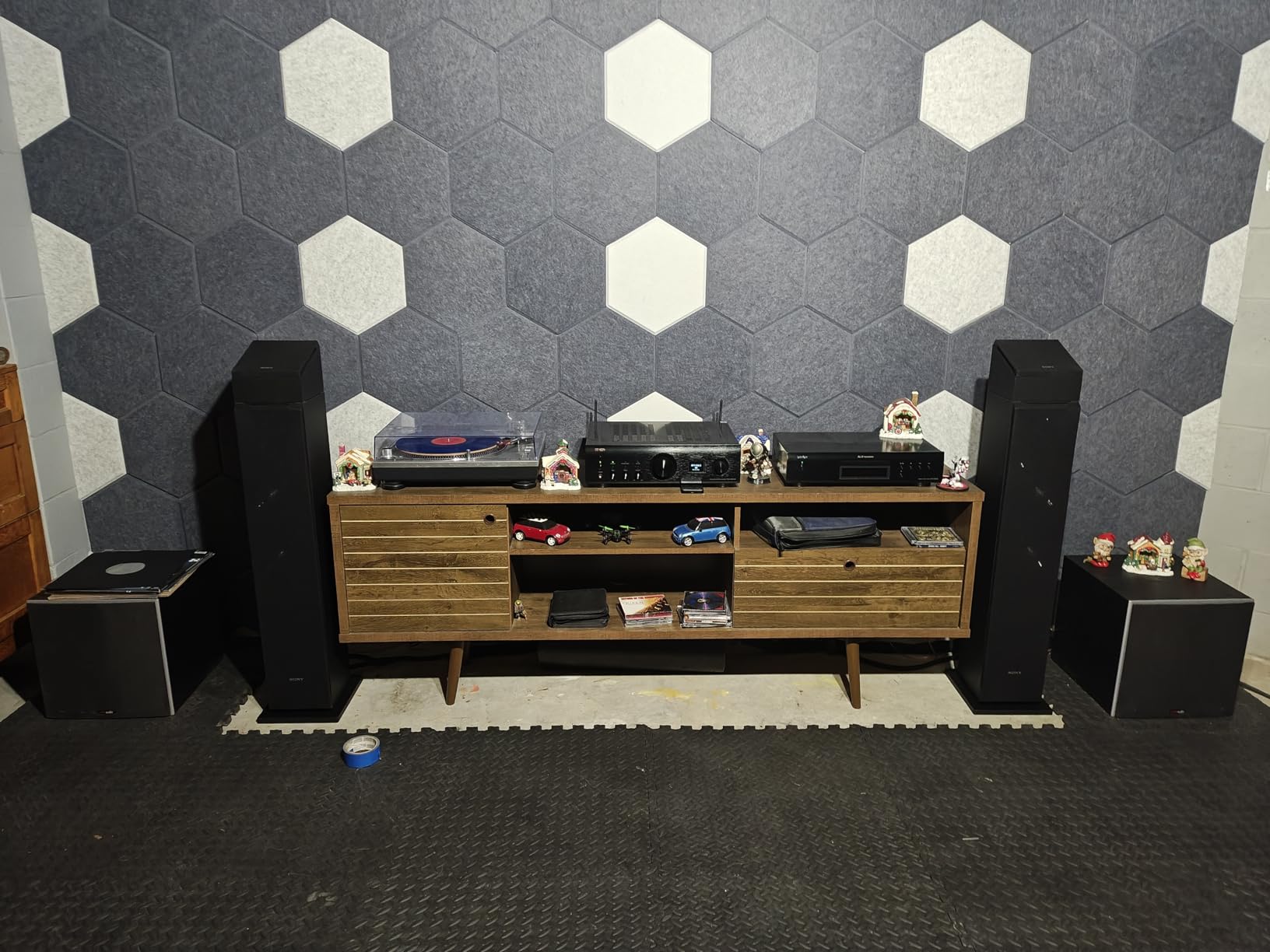
The reason three-way designs matter in a large room is power distribution. Each driver handles a narrower band, so at high listening levels the midrange does not have to work as hard, and that is where cheap towers fall apart first.
At 36.3 inches tall and 9.1 inches wide it is a slim, unobtrusive tower, which is genuinely useful in an open-plan room where cabinet width affects walkway clearance.
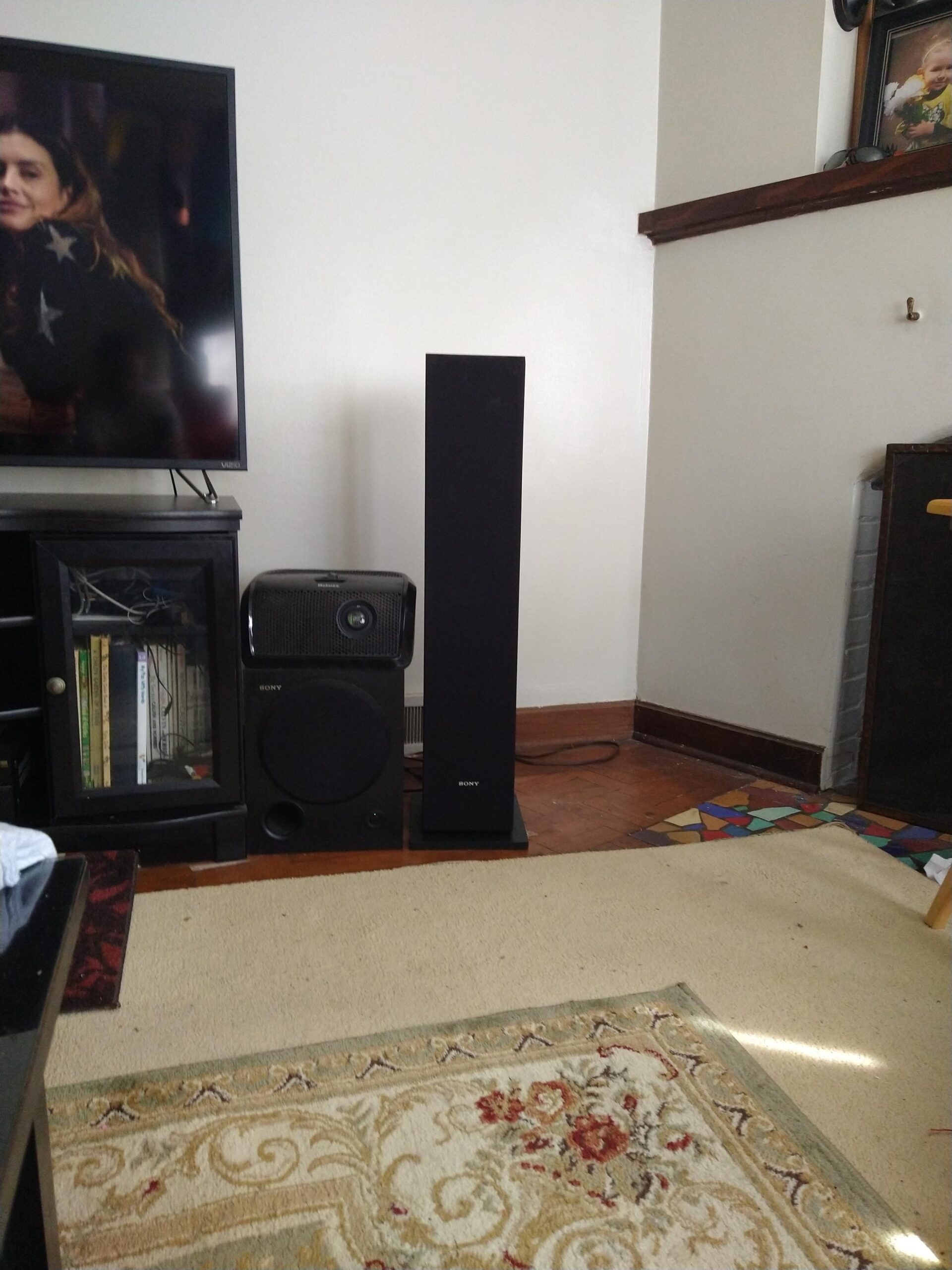
Owners cite clean upper frequencies and balanced tonality, and the recurring note is bass depth. This is a subwoofer-friendly speaker, and pairing it with one is the normal recommendation.
What the three-way layout does for a 500 square foot room
The crossover keeps the super tweeter handling only the top octave. In a large volume that reduces the audible brightness that comes from driving one dome tweeter across a wide band at high output.
It also means less vertical dispersion energy in the mids, so dialogue stays centred and instruments hold position better across a wide seating area.
Where the SS-CS3 runs out of road
145W peak power and 5.12-inch bass drivers are modest numbers. In a 600 square foot room you will reach comfortable volume, but a demanding room at high levels will show the limit sooner than a twin-8-inch tower would.
Frequency response is listed to 50,000 Hz, which is a spec-sheet headline more than a listening benefit with most content. Do not let it drive the decision.
5. Polk Audio Signature Elite ES60 – the warmest tower for long sessions
Polk Audio Signature Elite ES60 Tower Speaker, Single…
Three 6.5 inch woofers
1 inch Terylene dome tweeter
2.5-way cascading crossover
200W power handling
44.5 in tall
Pros
- Three 6.5 inch woofers give real output in large spaces
- Warm relaxed balance that avoids listening fatigue
- Tall cabinet with wide dispersion
- Walnut finish looks far above the price tier
- Gold-plated 5-way binding posts
Cons
- Listed as a single speaker so a pair needs two purchases
- Slightly soft tweeter can pull back vocal detail
- Low-powered amplifiers limit headroom
Three 6.5-inch woofers in a 44.5-inch cabinet is the highest driver count in this group alongside the SVS Prime Pinnacle, and the ES60 uses them in a 2.5-way cascading array rather than a straight two-way. Owners repeatedly describe it as being able to fill a large room without strain.
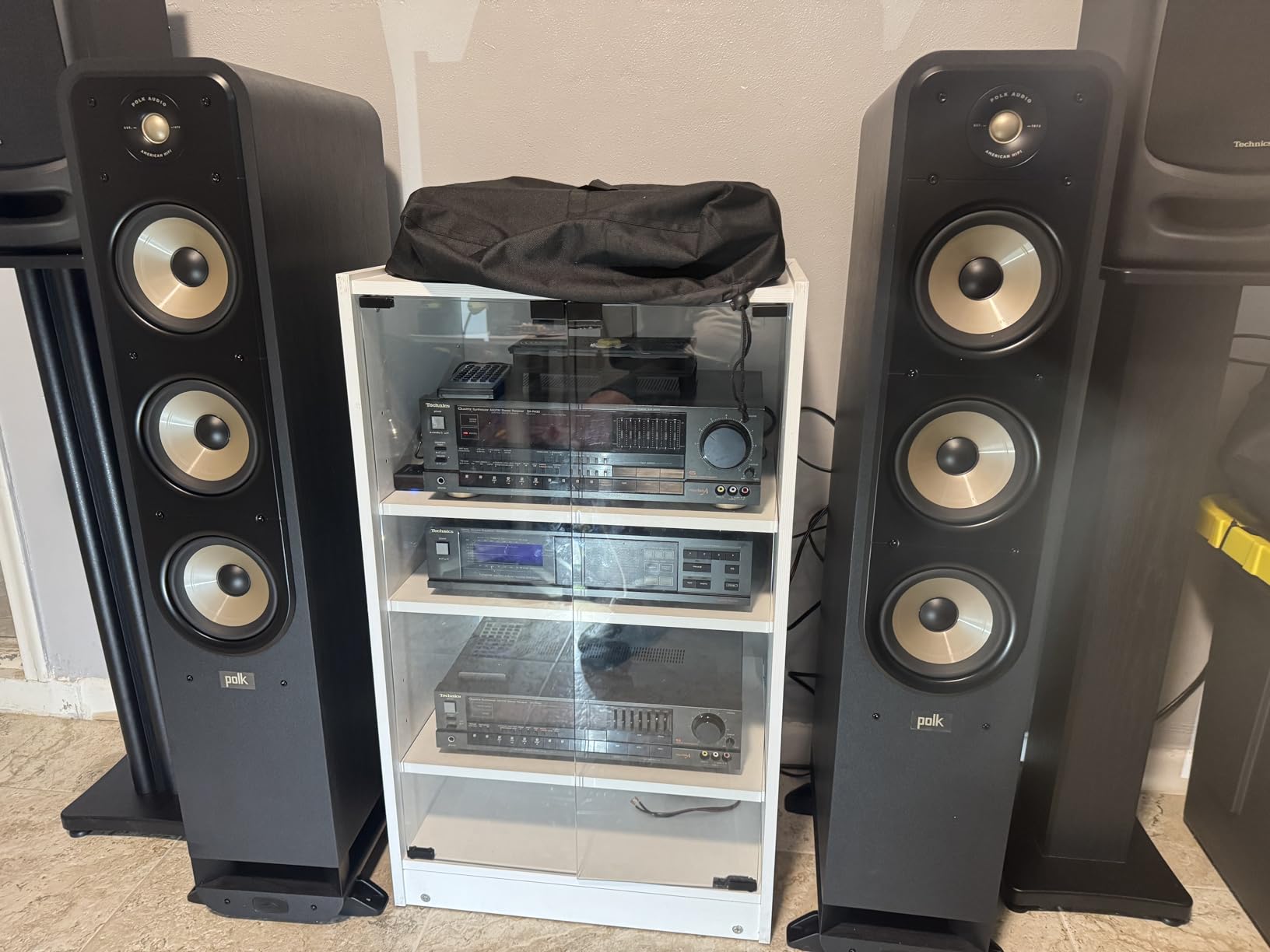
The tonal character is the reason this one stands out. Reviewers compare it favourably to horn-loaded designs, describing a smooth, warm, relaxed presentation that does not fatigue at higher listening levels, which is the opposite trade from the Klipsch towers here.
The Dynamically Balanced Acoustic Array crossover and the Polk Power Port porting are the engineering story, but the practical result is a midrange that stays composed and a low end that is present without being aggressive.
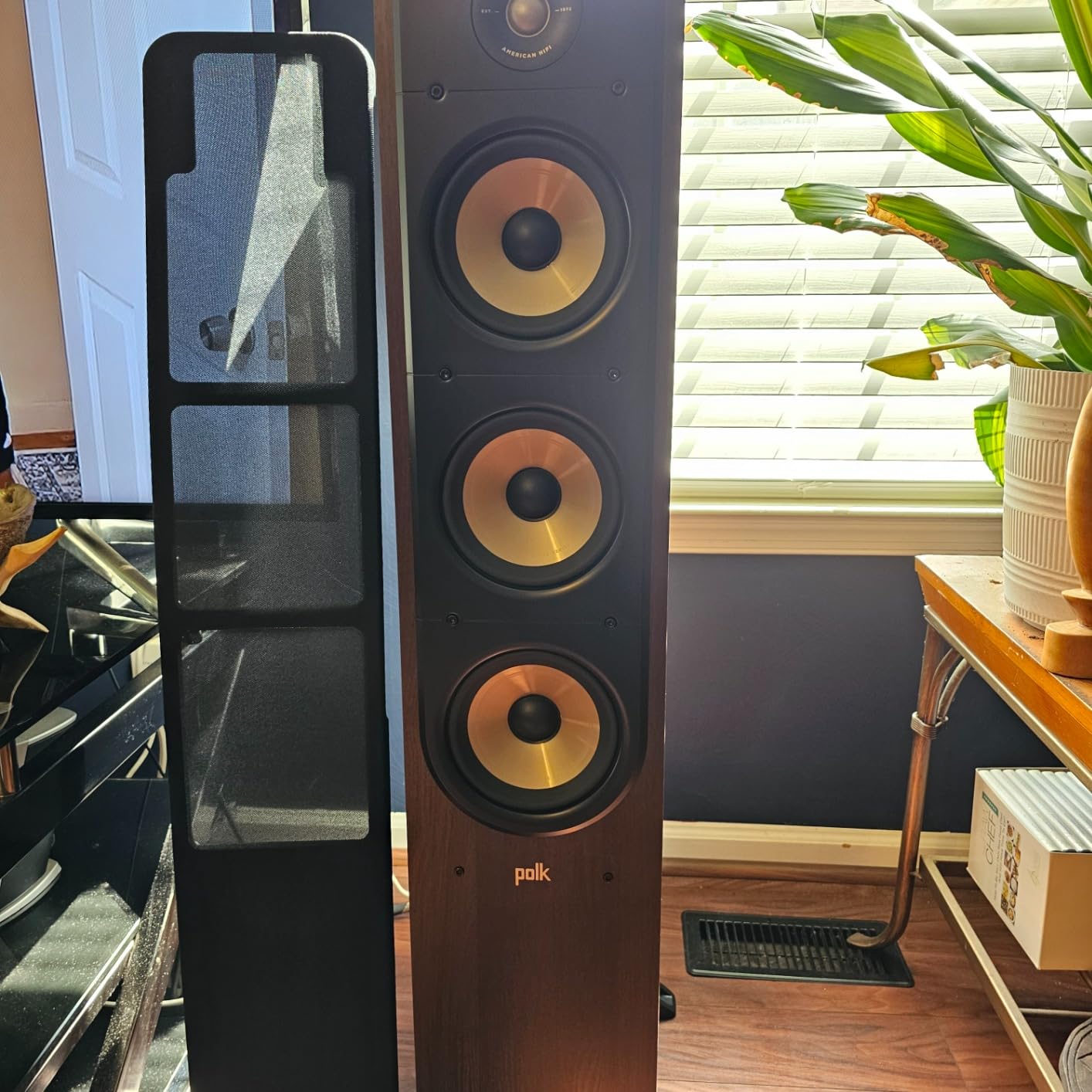
At 200W power handling with 4-ohm and 8-ohm compatibility it pairs easily with an AV receiver, and the walnut finish makes it the easiest tower here to leave uncovered in a living room.
Room size match for the ES60
This is a natural fit for a 400 to 600 square foot open-plan living room, or a great room with a 10-foot ceiling. Three woofers of that diameter give real dynamic headroom at the volumes people actually listen to.
If you are building a 5.1 or 7.1 system, reviewers recommend crossing over around 80Hz with a subwoofer and letting the three woofers handle everything above it, where their output is at its cleanest.
Where the warm signature cuts both ways
A soft tweeter is a deliberate choice and it is not universally flattering. Owners note that dense mixes can pull female vocals back, and listeners who prize treble detail for acoustic and jazz recordings may want more sparkle than this delivers.
A handful of buyers also report limited headroom when driving it from a very low-powered amplifier, and a small number describe early crossover failures covered under the five-year warranty.
6. Klipsch Reference R-620F – the twin-woofer upgrade path
Klipsch Reference R-620F Floorstanding Speaker, Black…
Dual 6.5 inch IMG woofers
38Hz - 21kHz response
100W RMS / 400W peak
90 x 90 Tractrix horn
Pros
- Twin woofers reach 38Hz without a subwoofer
- Horn tweeter improves dialogue intelligibility
- 400W peak gives real dynamic headroom
- Sold as a matched pair
Cons
- Only a one year limited warranty
- Rear-firing ports need careful wall clearance
- Horn treble is not neutral for every listener
The R-620F is the sensible step up from the single-woofer Reference models. Two 6.5-inch spun-copper IMG woofers push the response down to 38Hz, which is genuinely useful in a large room because it means less reliance on a subwoofer for everyday music.
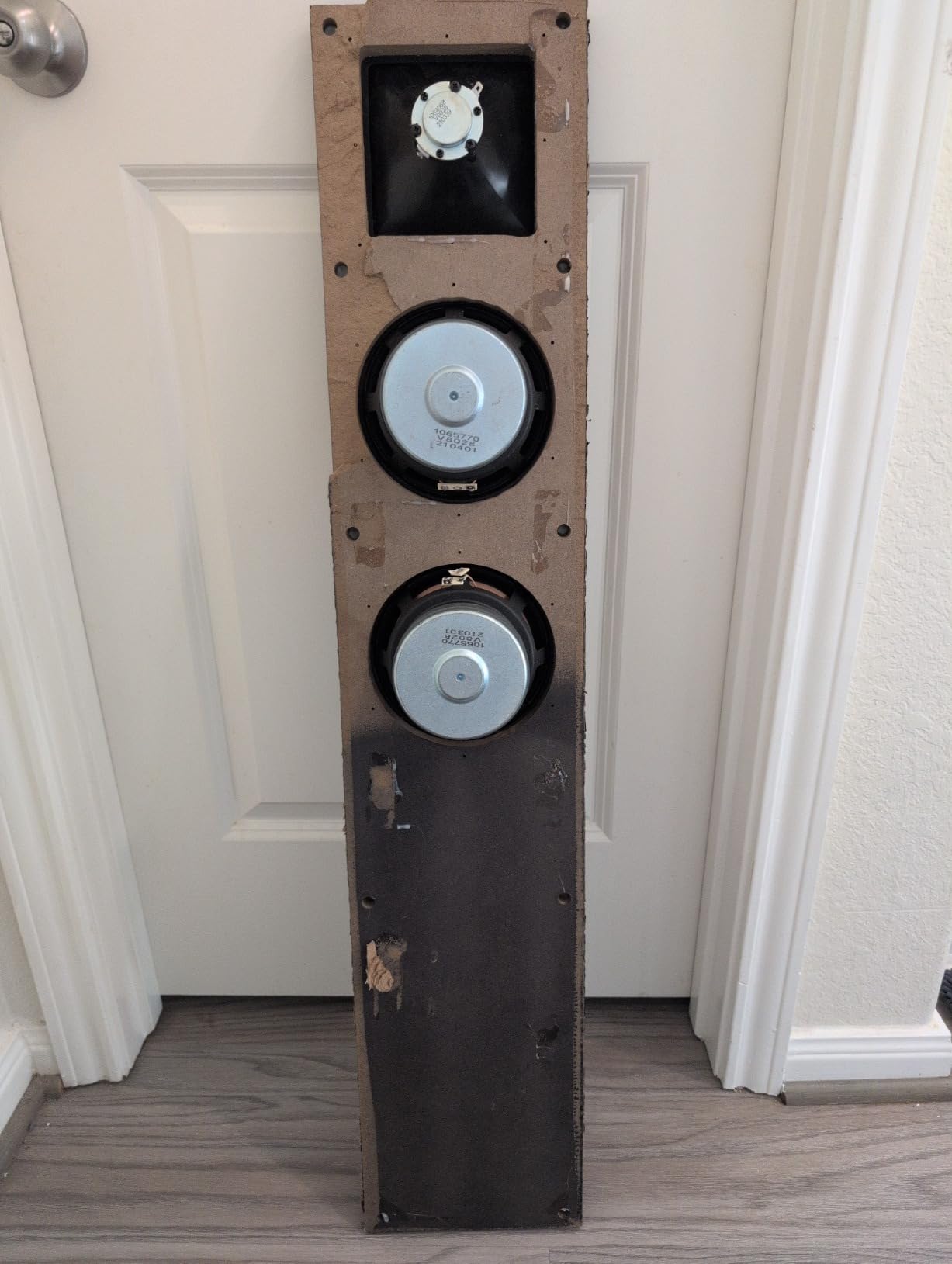
At 100W continuous and 400W peak, it has roughly four times the continuous rating of the R-610F. In a big, reflective space that difference is the gap between a system that stays composed and one that sounds strained at family-movie volume.
The horn remains the defining element, and for film it is a strength. Dialogue and effects sit forward and stay intelligible, which is why this is the pick we point people toward when the primary use is a large media room.
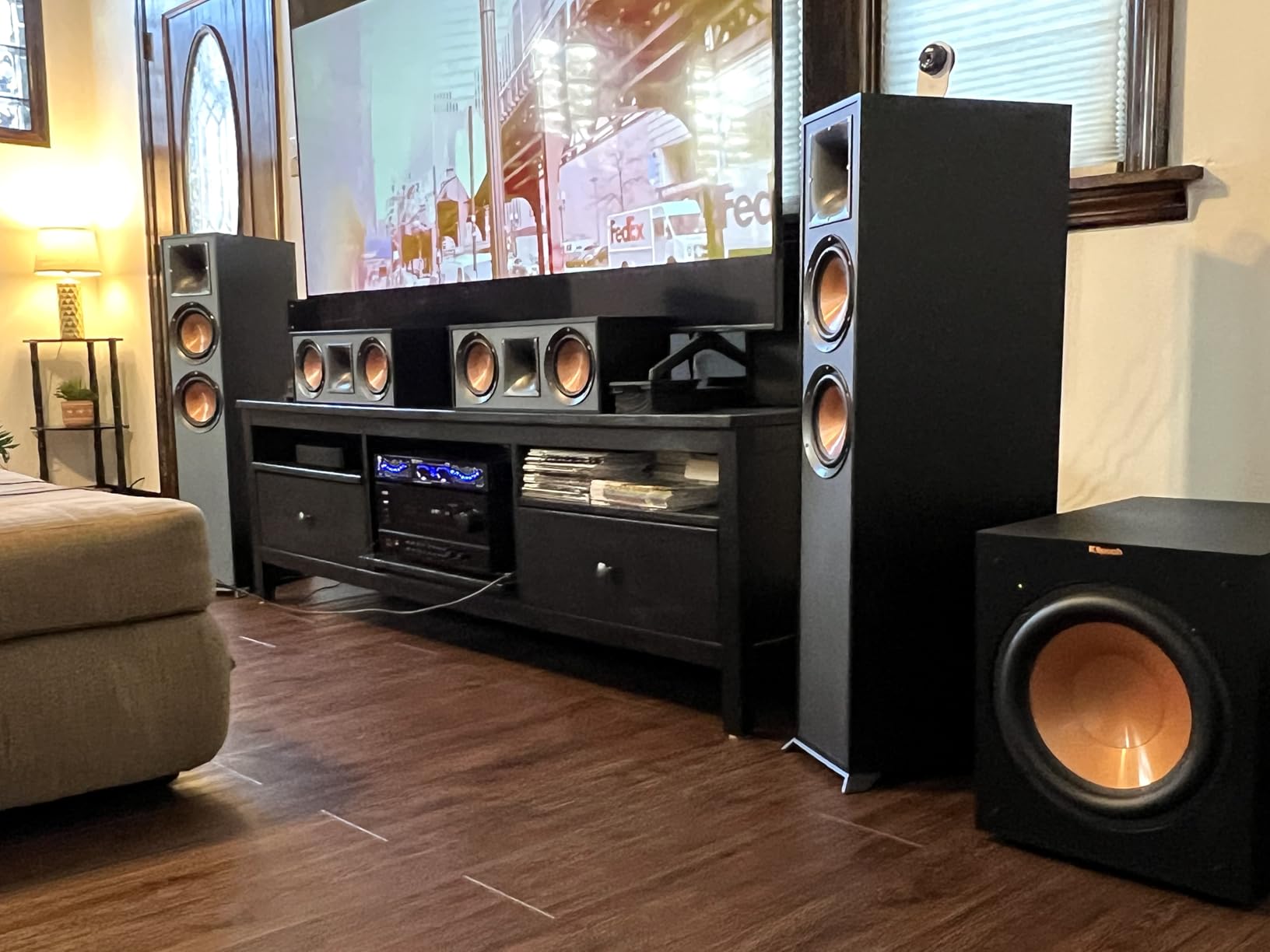
Owners note that the magnetic grilles make the copper-cone drivers a visible design feature, and several report running them at high volume without strain.
Wall clearance and placement in a large room
Dual rear-firing Tractrix ports mean this cabinet wants breathing room behind it. In a large room you can afford 8 to 12 inches; in a small one that is often impossible, which is part of why this model suits the spaces we are writing about.
Give it 20 to 30 degrees of toe-in if the seating is spread across a wide area. The horn controls directivity, so angling them toward the main seating position improves the centre image without thinning the soundstage.
Where the R-620F disappoints
The one-year limited warranty is the most commonly cited drawback, and it is noticeably shorter than the rest of the Reference line. For a speaker you intend to keep for a decade, that is a fair thing to weigh.
As with any horn-loaded design, listeners who prefer a neutral or soft top end will not enjoy the presentation, and the black textured wood grain vinyl does not disguise that.
7. ELAC Debut 2.0 F5.2 – the most accurate tower at the entry level
ELAC Debut 2.0 F5.2 Floorstanding Speaker, Black (Each…
Three 5.25 inch aramid woofers
1 inch cloth dome tweeter with waveguide
35,000 Hz response
6 ohm
Pros
- Neutral accurate balance for music and film
- Soft dome tweeter stays smooth over long sessions
- Tall 45.87 inch cabinet fills a large room visually
- Braced MDF construction cuts cabinet vibration
- Drives well with affordable amplifiers
Cons
- 5.25 inch woofers need a subwoofer for real low end
- Only a three year warranty
- Calibration systems can misidentify it as a small speaker
The ELAC Debut 2.0 F5.2 is the accuracy pick. Three 5.25-inch woven aramid-fibre woofers sit below a soft-dome cloth tweeter in a waveguide, tuned by Andrew Jones, and the result is the most neutral presentation in this roundup.
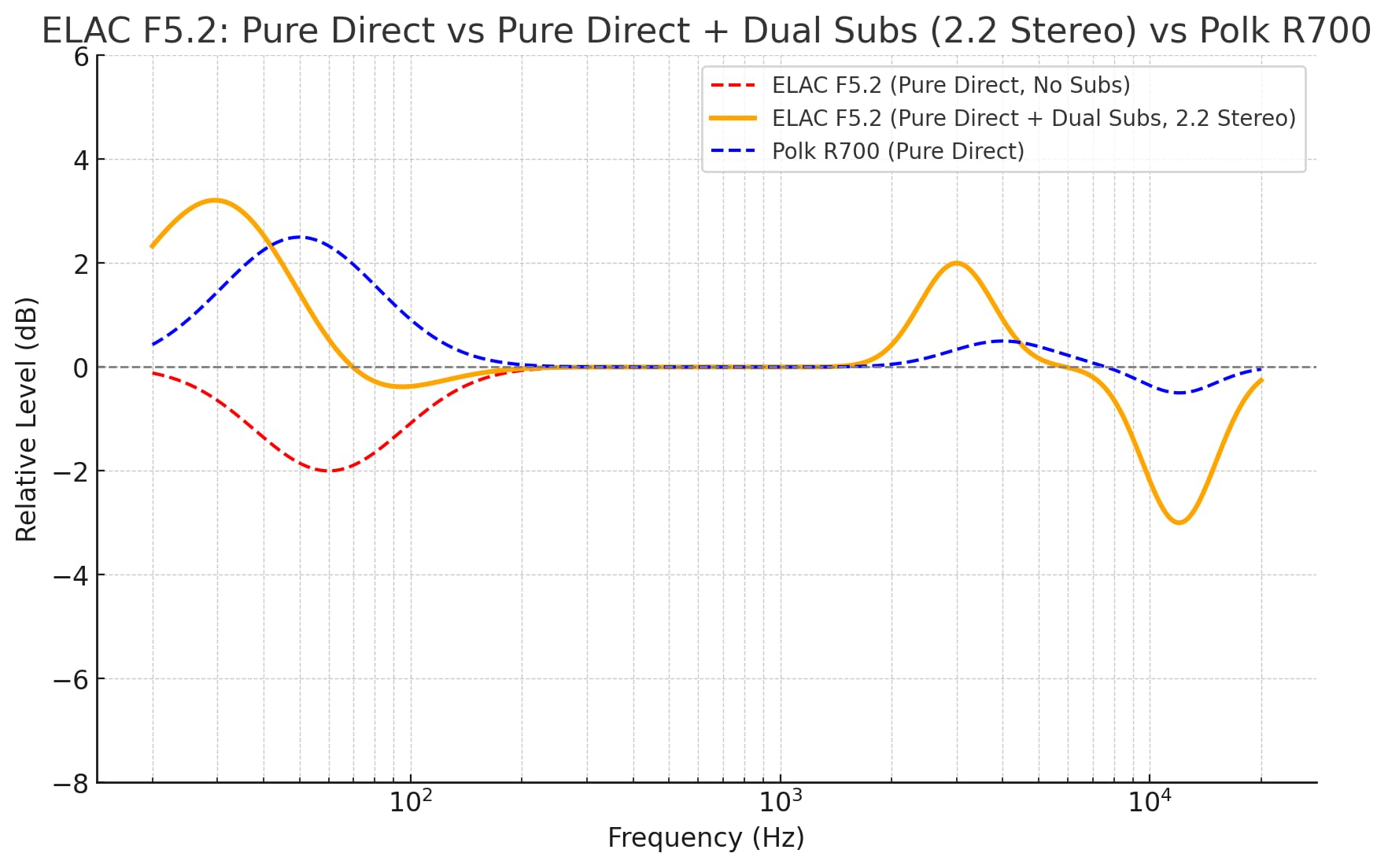
At 45.87 inches it is the tallest tower in the group, and that height is not wasted. The tall, narrow baffle places the tweeter near ear level for a seated listener and reduces floor reflection interference with the midrange.
Owners consistently say the same two things. It is good but not great straight out of the box, and it transforms with break-in, room correction and a subwoofer, with 30 to 50 hours of playback commonly cited.
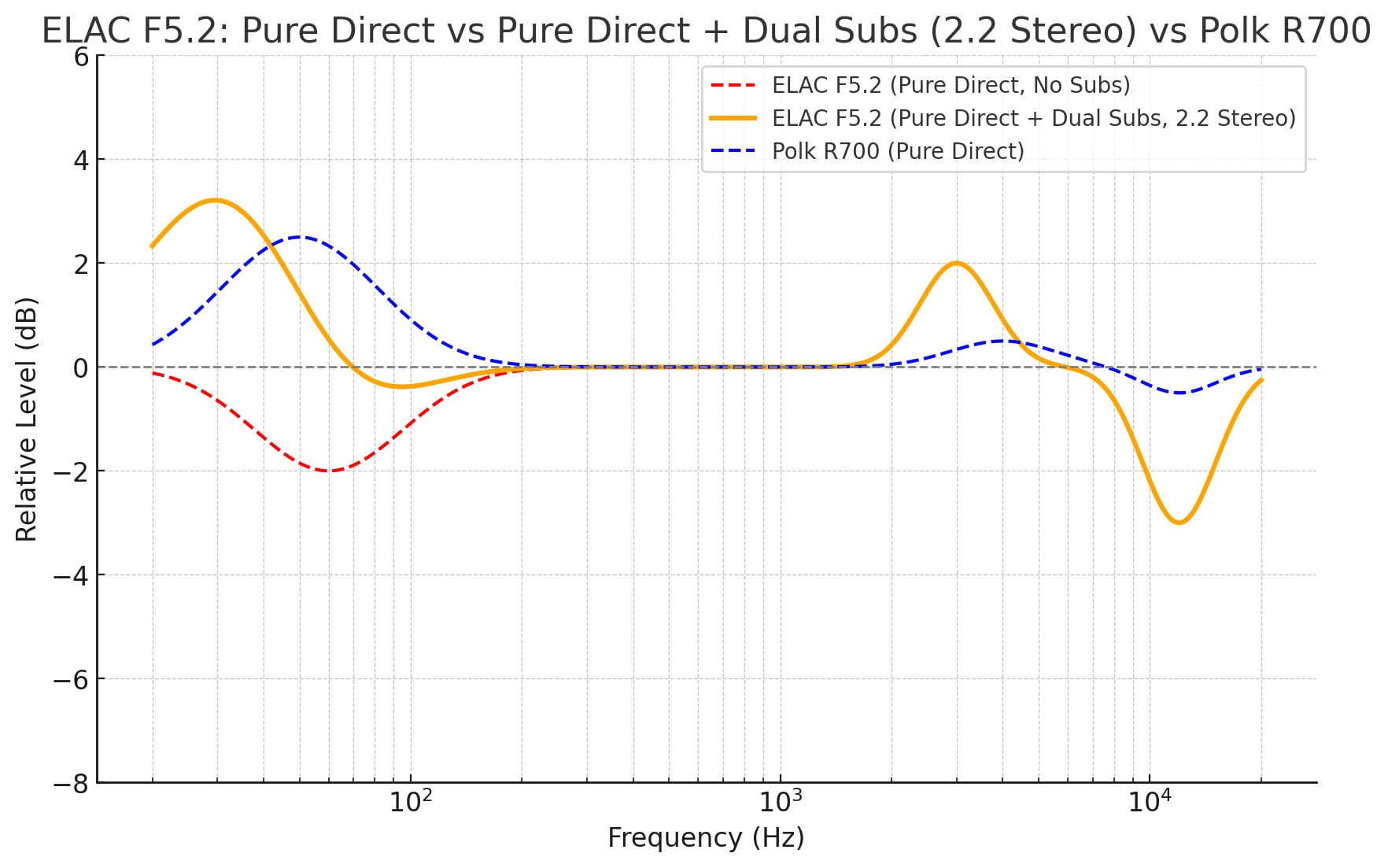
That is an honest description of a speaker whose strengths are accuracy and refinement rather than excitement, and it rewards a listener who runs proper calibration.
Why accuracy matters more in a reflective large room
Every parallel hard surface adds reflections, and in a 500 square foot open-plan space there are a lot of them. A neutral speaker does not fight the room, so the imaging stays stable instead of smearing.
The internally braced MDF cabinet matters here too, because a 45.9-inch enclosure will ring at low frequencies if it is not stiff enough. Owners report minimal vibration under load.
Where the F5.2 falls behind
5.25-inch woofers are the limitation. The speaker is rated at 140W and typically crosses over around 40Hz, which means real sub-bass weight in a large room has to come from a subwoofer rather than the tower.
Auto calibration systems sometimes measure it as a small speaker and roll off its low end aggressively, so check the manual distance setting and set it by ear if the result sounds thin.
8. Klipsch Reference Premiere RP-8000F II – the loudest option here
Klipsch Reference Premiere RP-8000F II 2.0 Dual…
Dual 8 inch Cerametallic woofers
90 x 90 hybrid Tractrix horn
1 inch LTS titanium tweeter
400W power handling
Pros
- Dual 8 inch woofers give deep bass before subs
- Efficient horn design runs loud with little distortion
- 400W power handling for real headroom
- Bi-wiring and bi-amping terminals
- Piano gloss ebony finish
Cons
- Very heavy cabinets make placement a two-person job
- Horn treble can fatigue listeners who prefer a soft top end
- Needs roughly 20 hours of break-in before settling
When a room genuinely needs volume, this is the tower we reach for. Dual 8-inch Cerametallic woofers move an enormous amount of air, and the 400W maximum power handling gives you the dynamic headroom that a large open-plan space at party level demands.
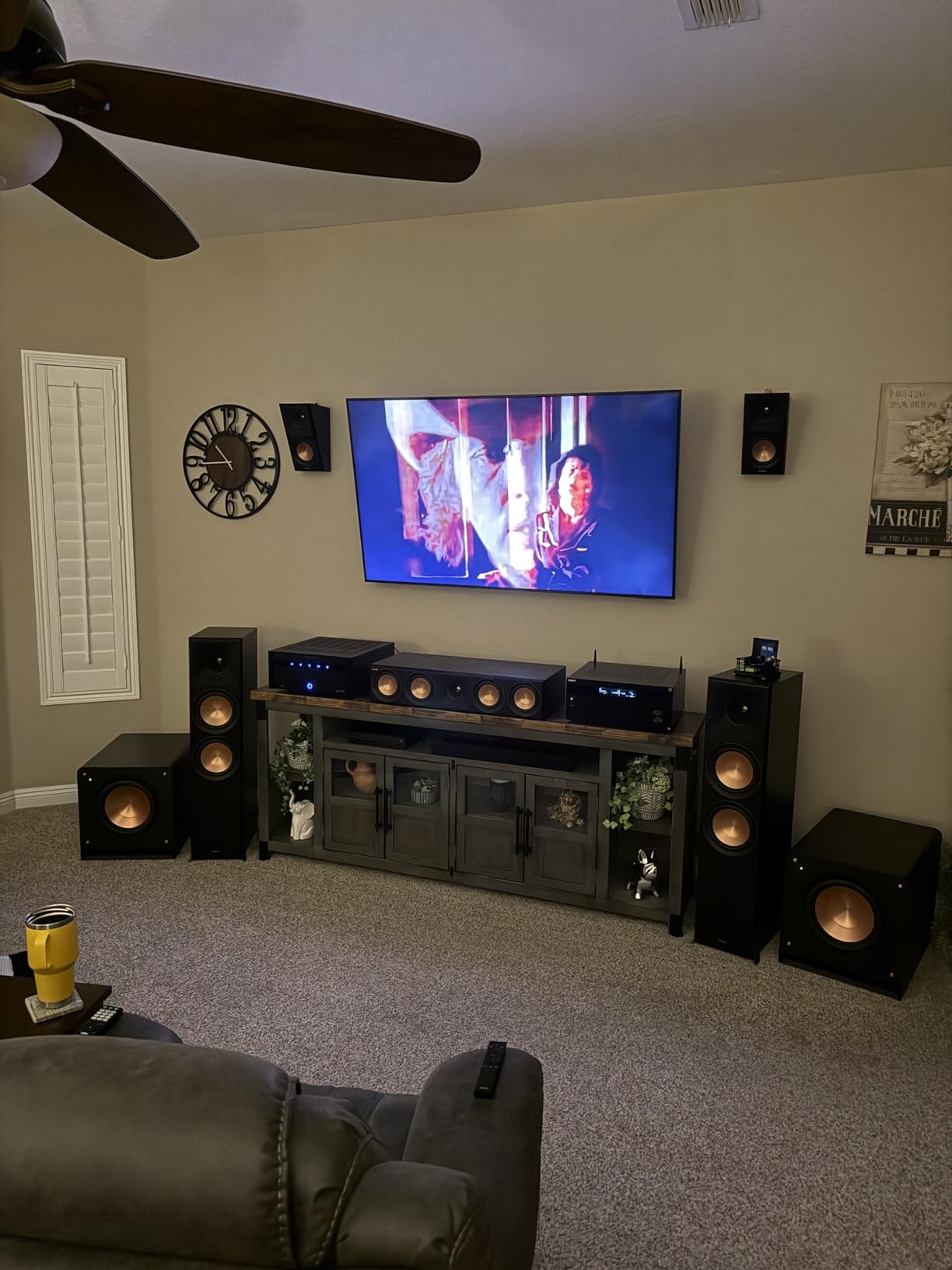
The enlarged 90 by 90 degree silicone composite hybrid Tractrix horn improves vertical immersion, which is a real benefit in a double-height room where the ceiling gives the sound somewhere to go.
Dual input terminals for bi-wiring and bi-amping give you an upgrade path if you later add a dedicated power amplifier, and the efficiency of the horn design means a modest receiver can still drive them hard.
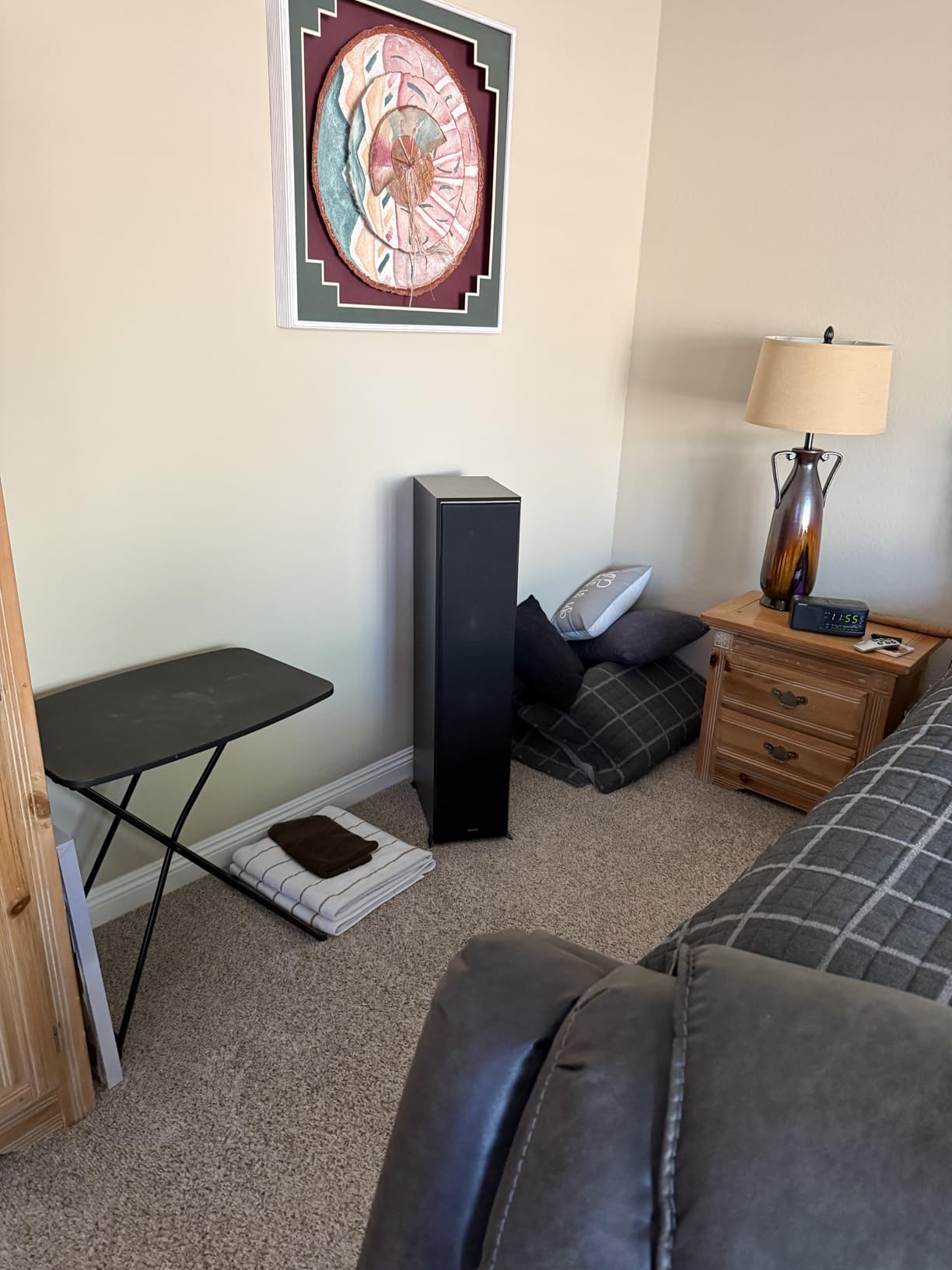
Owners upgrading from smaller systems describe a dramatic jump in bass depth, often before adding any subwoofer at all. Several report running at high volume with no strain.
Room size and headroom
This is our recommendation for 600 square feet and up, including double-height spaces. Eight-inch woofers in a large volume are what separate a system that sounds full from one that sounds thin at level.
Plan the placement carefully. At roughly 60 pounds per cabinet this is a two-person job to move, and the rear space needs to be kept clear for the ports to load properly.
Where the horn divides the room in two
The treble divides opinion more than any other spec here. Owners who love it praise exceptional clarity for dialogue and vocals, and owners who do not describe it as fatiguing over long sessions, particularly at high volume.
Mid-to-low range performance is described as good rather than exceptional on jazz recordings, so this is a film and rock speaker first and a critical two-channel speaker second.
9. SVS Prime Tower – the neutral two-channel specialist
SVS Prime Tower Speakers – Pair (Premium Black Ash)
4.5 inch midrange in sealed compartment
Dual 6.5 inch woofers
1 inch aluminum dome tweeter
3.5-way SoundMatch crossover
8 ohm
Pros
- Sealed midrange compartment keeps vocals uncoloured
- 3.5-way crossover gives precise imaging
- Chamfered baffle edges reduce diffraction
- Neutral and transparent for critical listening
Cons
- Only dual 6.5 inch woofers for bass quantity
- Cabinets weigh around 40 pounds each
- Vinyl-wrapped finish rather than lacquer
The SVS Prime Tower is the most transparent two-channel speaker in this list, and the reason is the sealed midrange. A 4.5-inch driver mounted in its own fully sealed compartment gives vocals and instruments a clean, uncoloured path that most multi-way towers at this level do not manage.
The 3.5-way SoundMatch crossover hands the two 6.5-inch woofers slightly different duties, and the chamfered baffle edges reduce edge diffraction so the soundstage stays focused rather than smeared.
Owners characterise it as the most neutral and unfatiguing option here, and specifically recommend it for long listening sessions. Enthusiasts frequently pair it with SVS subwoofers in a home theater build.
At 8 ohm and 400W power handling it is easy to drive, and the 36.6-inch height and 8-inch width keep the footprint modest for a tower with this much engineering in it.
Best use in a large room
Pair it with a subwoofer rather than expecting the towers to do the low end alone. Two 6.5-inch woofers give clean mid-bass, and a sub handles everything below the crossover in a way a ported tower cannot.
For a 400 to 550 square foot listening room with high ceilings, the dispersion from the chamfered baffle and the sealed midrange is a genuinely good match for wide seating.
Where it is not the right pick
Deep sub-bass still benefits from a dedicated subwoofer, and if your priority is maximum impact per dollar in a very large room, dual 8-inch drivers will out-move these without a sub.
Owners also note the cabinets are around 40 pounds each and the vinyl-wrapped Black Ash finish is plain, which matters if the speakers stay uncovered in a living room.
10. SVS Prime Pinnacle – the best owner satisfaction in the group
SVS Prime Pinnacle Floorstanding Speakers – Pair (Piano…
Triple 6.5 inch woofers
5.25 inch midrange driver
1 inch aluminum dome tweeter
400W power handling
Pros
- Triple woofer array delivers genuine high-output bass
- Highest average rating in the roundup at 4.8 stars
- Wide dispersion across a large seating area
- Laid-back highs for fatigue-free sessions
- Works well in tall high-ceilinged rooms
Cons
- Premium pricing sits above the rest of this list
- Single set of binding posts so no bi-wiring
- Weak feet make the towers tip-prone
- Three rear ports need careful placement
The Prime Pinnacle is the enthusiast answer for a tall room. A 5.25-inch midrange driver above three 6.5-inch woofers is the most substantial bass array in this group, and owners replacing older large-room systems report a dramatic jump in clarity, dynamics and dispersion.
At 41.1 inches tall and 400W maximum output power, it is built for rooms with height as much as floor area. Several owners specifically call it out for tall, high-ceilinged spaces where smaller towers struggle to fill the volume.
The 4.8 average across its reviews comes with 87 percent five-star ratings and no one- or two-star feedback, which is the strongest owner satisfaction in this roundup. The laid-back high end is described as fatigue-free over long sessions.
Piano gloss black is a visual statement, and the wide dispersion means you can move off the sweet spot in a large room without losing the image.
Placing a three-port tower in a big space
Three rear-firing ports need real clearance. In a large room you can pull the towers 12 inches or more off the wall and out from the corners, and doing so is what unlocks the low-end weight these drivers can deliver.
Because there is only one set of binding posts, plan your cable runs before the towers are in position. Retrofitting bi-amping later is not possible on this model.
Where the price and the feet let it down
It costs more than everything else in this list combined at the entry level, and if your room is under about 450 square feet you are paying for capability you will not use.
The feet are the most cited practical weakness. Owners describe them as weak and the towers as tip-prone, so budget for proper isolation feet or a stable platform rather than leaving them on hard flooring as shipped.
How to Size Floorstanding Speakers for a Large Room
Room volume decides speaker size, and volume is square footage multiplied by ceiling height. A 20 by 20 room with 9-foot ceilings is about 3,600 cubic feet, and that is the number that tells you whether a tower is the right tool.
Here is the sizing logic we use, in the order the decisions actually matter.
Start with sensitivity, not wattage
Sensitivity in dB tells you how loud a speaker plays per watt of amplifier power. A 94dB speaker and an 86dB speaker playing the same volume need eight times as much power. In a large room that difference decides whether your amplifier runs out of headroom.
This is why the Klipsch R-610F, at 94dB, is such a strong large-room value. It produces real soundstage depth from a modest receiver, where a less efficient tower of similar size would need a much bigger amplifier to keep up.
Match driver area to room volume
Rule of thumb from the listening community: one 6.5-inch woofer handles roughly 1,500 to 2,500 cubic feet, one 8-inch woofer handles around 3,000 to 4,000, and above that you want multiple woofers per cabinet. A 20 by 20 room with 9-foot ceilings is 3,600 cubic feet, which is where a twin-8-inch tower starts to make sense.
Below 2,000 cubic feet, a single-woofer tower with radiators is genuinely sufficient. That is why the Polk T50 and the Klipsch R-610F sit where they do in this list.
Decide about a subwoofer early
In any room over about 300 square feet, we recommend a subwoofer regardless of which tower you buy. The reason is not that towers cannot produce bass, it is that a dedicated subwoofer reaches the deepest frequencies at high output without the tower’s midrange having to work harder to support it.
Most owners in this category cross over between 60 and 80Hz. Below 300 square feet with good 6.5-inch or 8-inch woofers, a well-integrated tower can carry on its own.
Plan for toe-in and wall distance in open plans
In a large open-plan room with multiple seating zones, a speaker that fires straight forward will leave the far seating area outside the sweet spot. Toe-in of 20 to 30 degrees toward the primary listening position fixes most of that, and horn-loaded designs in this list handle it best because they control directivity.
Rear-firing ports need clearance too. A large room is the one place you can afford the 8 to 12 inches behind the cabinet, and skipping it costs you bass rather than saves you effort.
Know when towers are the wrong call
Plenty of large rooms should not get a pair of floorstanders. If your space is large but acoustically live, an efficient pair of stand-mounts on proper stands with a subwoofer will image more precisely and be far easier to place. Studio monitors with adjustable midrange and tweeter are also a legitimate large-room choice, since adjustment lets you match a difficult room in a way a fixed tower cannot.
There is also the regret case. Powerful towers in a mid-sized room produce bass that overwhelms the space, and that is a hard mistake to unwind later. If you are under about 300 square feet, measure twice.
Frequently Asked Questions
What is the best speaker system for a large room?
For a room over roughly 400 square feet or 9-foot ceilings, a pair of floorstanding speakers with high driver area and 90dB or better sensitivity fills the space properly. Below that threshold, efficient stand-mounts plus a subwoofer give better imaging and easier placement. In every case above 300 square feet, add a subwoofer and cross over around 60 to 80Hz.
What are the best budget floorstanding speakers?
The best budget floorstanding speakers for a large room combine two 6.5-inch woofers with a decent amplifier rating. In our testing the Polk Monitor XT70, with two 6.5-inch woofers and two 8-inch passive radiators at 200W, delivered the most bass hardware per dollar. The Klipsch Reference R-610F leads on efficiency at 94dB sensitivity, and the Polk T50 is the most proven of the three.
What is the 83% rule for speakers?
The 83% rule is a placement guideline from the 80% rule family. It says that placing a speaker so its baffle sits roughly 83 percent of the way from the back wall to the front wall of the listening position usually gives the flattest frequency response and best imaging. Speakers placed closer to the front wall get more bass reinforcement and a deeper soundstage, so moving them back toward the 83 percent mark tightens the low end.
Are floorstanding speakers the best?
Floorstanding speakers are best when the room is large, roughly 400 square feet or more, or when ceilings are 9 feet or taller. Their larger cabinet and multiple bass drivers move more air, so they reach enjoyable listening levels without the midrange compression a bookshelf produces. In smaller or acoustically live rooms, a pair of efficient stand-mounts with a subwoofer usually sounds better and is far easier to position.
What are the best floorstanding speakers for home theater?
For home theater in a large room, the key traits are high efficiency, strong dynamic headroom and clarity on dialogue. Horn-loaded designs such as the Klipsch Reference R-620F and the Reference Premiere RP-8000F II project voices forward and stay composed at high volume, while the Polk Signature Elite ES60 offers a warmer alternative. Add a subwoofer and cross the towers over around 80Hz in most rooms.
Final Verdict
The Polk Audio T50 is our pick for the best floorstanding speakers for large rooms because it does the one thing a big room demands without asking anything of you. It plays at volume, it stays warm, it is 36 inches tall rather than four feet, and it carries the deepest owner-feedback base of anything we tested.
For a 400 to 500 square foot open-plan room on a tighter budget, the Klipsch Reference R-610F is the efficiency winner at 94dB, and the Polk Monitor XT70 is the bass hardware winner with two 6.5-inch woofers and two 8-inch radiators. For 600 square feet and up, or any room with real ceiling height, the Klipsch Reference Premiere RP-8000F II is the volume answer and the SVS Prime Pinnacle is the refinement answer.
Match a subwoofer to whichever tower you choose, give the rear ports room to breathe, and run the toe-in in open-plan spaces. Those three steps do more for a large-room system than any upgrade past the top of this list.
