
12 Best Cameras for Vlogging (July 2026) Tested Reviews
The best cameras for vlogging make it easier to keep yourself in frame, stay in focus, and record watchable footage when you are walking, talking, or filming a product on a desk. For most new creators, the useful upgrade is not simply a larger sensor; it is a camera with a selfie screen, dependable autofocus, stabilization that fits the way you shoot, and a practical path to better audio.
I would not tell every beginner to put down a good phone immediately. A phone remains a smart way to learn whether you enjoy making videos, but a dedicated vlogging camera becomes persuasive when you need a microphone input, a wide lens that does not crop your face too tightly, longer sessions, purposeful controls, or footage that holds together in less forgiving light.
Contents
Our list covers 12 verified models across several approaches: rugged action cameras, simple fixed-lens cameras, pocket cameras with mechanical gimbals, and APS-C mirrorless systems. Each has a different compromise around lens flexibility, size, stabilization, video modes, and setup effort, so the right choice depends more on your format than a spec-sheet race.
For a walk-and-talk travel channel, I would start with stabilization and a wide field of view. For desk reviews, tutorials, and YouTube videos, a flip screen, subject tracking, and clean microphone options matter more; for vertical TikTok videos, easy portrait framing and fast phone transfer can save real editing time.
Top 3 Picks for Best Cameras for Vlogging (July 2026)
These are the shortest answers for creators who want to choose by use case rather than decode every camera term. The DJI Osmo Action 5 Pro is our all-weather action choice, the Sony ZV-E10 is the flexible interchangeable-lens route, and the Canon PowerShot V10 is the easiest compact option for straightforward face-to-camera work.
DJI Osmo Action 5 Pro: Best for moving outdoors, with 4K/120fps, 360-degree HorizonSteady, subject tracking, dual OLED touchscreens, and waterproof construction.
Sony ZV-E10: Best for creators who want APS-C image quality, a side-opening screen, 425-point autofocus, Product Showcase Setting, USB streaming, and the option to change lenses.
Canon PowerShot V10: Best for a small, self-contained setup, with a 1-inch sensor, 19mm wide view, flip screen, stereo microphones, three stabilization modes, and an external mic jack.

As an Amazon Associate we earn from qualifying purchases.
12 Best Cameras for Vlogging In 2026
The overview below puts every verified product in one place. Use it to narrow the field, then read the notes under each camera before deciding; details such as fixed versus interchangeable lenses and mechanical versus electronic stabilization change the day-to-day experience.
| Product | Features | |
|---|---|---|
| DJI Osmo Action 5 Pro |
|
View on Amazon |
 Canon EOS R100 kit Canon EOS R100 kit |
|
View on Amazon |
 Sony Alpha ZV-E10 Sony Alpha ZV-E10 |
|
View on Amazon |
 Lmzour 4K rotating lens Lmzour 4K rotating lens |
|
View on Amazon |
 Sony ZV-1F Sony ZV-1F |
|
View on Amazon |
 Canon EOS R50 kit Canon EOS R50 kit |
|
View on Amazon |
 Xtra Muse Xtra Muse |
|
View on Amazon |
 Canon EOS R50 V kit Canon EOS R50 V kit |
|
View on Amazon |
 FlyFrost 8K camcorder FlyFrost 8K camcorder |
|
View on Amazon |
 Insta360 Luna Ultra Insta360 Luna Ultra |
|
View on Amazon |
 Canon PowerShot V10 Canon PowerShot V10 |
|
View on Amazon |
 MWIRB 8K camcorder MWIRB 8K camcorder |
|
View on Amazon |
We earn from qualifying purchases.
1. DJI Osmo Action 5 Pro is the best choice for active outdoor vlogs
DJI Osmo Action 5 Pro Essential Combo, Waterproof Action...
1 over 1.3 inch sensor
4K 120fps
360 degree HorizonSteady
Pros
- 4K 120fps recording
- 360 degree HorizonSteady
- subject tracking
- up to 4 hour battery
- 20m waterproof
Cons
- Fixed-focus lens
- 2x digital zoom
- no viewfinder
The Action 5 Pro is the camera I would place in a jacket pocket before a bike ride, hike, ski day, or rainy travel day. Its 146-gram body, IP68 rating for 20m underwater use, and 360-degree HorizonSteady are a much more natural match for movement than a mirrorless camera held at arm’s length.
DJI pairs its 1/1.3-inch sensor with 4K/120fps capture, a stated 13.5-stop dynamic range, and a color-temperature sensor for automatic white balance. The camera also has 47GB of built-in storage, which is a welcome fallback when a card is full or has been left at home.
The Action 5 Pro works best when your vlog includes motion
Subject Tracking can keep a moving person centered, while the two OLED touchscreens make it easier to confirm framing from either side of the camera. RockSteady, RockSteady+, HorizonBalancing, and HorizonSteady give you several tools, but for ordinary walking footage I would test the look before committing to the strongest setting.
The listed battery life is up to four hours, an unusually helpful number for travel planning, although cold conditions and high-frame-rate filming can change any real session. Wireless support for DJI Mic 2 and Mic Mini also addresses a frequent creator complaint: action-camera footage is only as useful as its dialogue.
The Action 5 Pro is less suitable for close product demonstrations
The fixed-focus lens and limited 2x digital zoom mean it is not the natural choice for a beauty product held close to the lens or for distant details. Use it when the scene is wide, dynamic, and environmental, not when lens changes and shallow-depth portraits are your visual signature.
There is no viewfinder, so bright daylight composition depends on the screens. This is the best action camera for vlogging in this group, not a substitute for a flexible studio or photography system.
2. Canon EOS R100 is a straightforward entry into APS-C video and photos
Canon EOS R100 Mirrorless Camera with RF-S18-45mm F...
24.1MP APS-C sensor
4K 24fps
Dual Pixel autofocus
Pros
- 24.1MP APS-C sensor
- face and eye detection
- lightweight EOS R body
- RF mount
- kit includes card and bag
Cons
- 4K limited to 24fps
- no IBIS
- no touchscreen
The EOS R100 makes sense for the creator who wants a small mirrorless camera that can also take strong still photos. Its 24.1MP APS-C sensor, DIGIC 8 processor, and included RF-S 18-45mm lens establish a real step toward an interchangeable-lens setup without filling a bag with gear on day one.
For video, the important limitation is clear: 4K tops out at 24fps. Full HD reaches 60fps and HD goes to 120fps, so it offers usable choices, but it is not built around the higher 4K frame rates some creators expect for slow motion or very fluid movement.
The EOS R100 fits creators building a photo-and-video kit
Dual Pixel CMOS AF with 143 zones, face and eye detection, and animal and vehicle detection give new users meaningful autofocus assistance. The electronic viewfinder is also useful for still photography, which is a genuine advantage over many video-first bodies.
The kit bundles a 64GB card and shoulder bag with the lens, so a beginner can begin shooting without first assembling every basic accessory. Wi-Fi and Bluetooth make transfer and sharing less of a chore after a filming session.
The EOS R100 demands steadier shooting technique for vlogs
There is no in-body image stabilization, and the basic 18-45mm lens has an f/4.5-6.3 aperture range. That makes a tripod, a stable desk setup, or a deliberate handheld style more sensible than expecting smooth walking footage.
The absence of touchscreen functionality also makes it less friendly for self-recording adjustments than a fully articulating touchscreen model. I would choose it for seated YouTube segments, family content, and creators who value photos, rather than run-and-gun video blogging.
3. Sony Alpha ZV-E10 is the flexible lens-system choice for creators
Sony Alpha ZV-E10 - APS-C Interchangeable Lens Mirrorless...
24.2MP APS-C
4K from 6K
425-point autofocus
Pros
- Sharp oversampled 4K
- 425-point eye tracking
- Product Showcase Setting
- side flip screen
- USB live streaming
Cons
- No viewfinder
- no IBIS
- 4K limited to 30fps
The Sony ZV-E10 is the one to consider when a fixed lens feels limiting before you have even started. The 24.2MP APS-C sensor records 4K oversampled from 6K with full-pixel readout, and its included 16-50mm lens gives you a useful starting range for talking shots, B-roll, and a bit of reach.
Its 425-point focal-plane phase-detection autofocus, Real-Time Eye AF, and tracking are particularly relevant for solo work. A vlogging camera should not force you to repeat a full take because you leaned forward and the focus stayed on the background.
The ZV-E10 gives product reviewers useful camera-first controls
Sony’s Product Showcase Setting is made for moving an object from your face toward the lens without the focus hunting between them. The Background Defocus button is another accessible control for creators who want separation from the background without changing several exposure settings.
The side flip-out articulating touchscreen and directional three-capsule microphone with windscreen support normal self-recording. A single USB cable can handle live streaming, making this a practical camera for YouTube livestreams and webcam-style content.
The ZV-E10 needs stabilization planning before you walk with it
There is no in-body stabilization, so the kit lens’s OSS helps but does not replace a gimbal or careful technique. The body also has no viewfinder and maxes out at 4K/30fps, two points to weigh if you expect sports coverage or need a camera that works equally well for stills in bright light.
For creators willing to learn lenses, that tradeoff is reasonable. The E-mount route lets the camera grow with your channel, but interchangeable lenses also mean more choices, added bulk, and more decisions than a compact camera.
4. Lmzour 4K is a beginner bundle with a rotating lens
Lmzour 4K Vlogging Camera with 330° Rotating Lens & Face...
4K video
330 degree rotating lens
face tracking
Pros
- 330 degree rotating lens
- face tracking
- Wi-Fi
- card tripod and bag included
- compact design
Cons
- Limited low-light results
- 1.5 hour battery
- digital zoom only
The Lmzour 4K camera is built around convenience rather than a deep camera system. Its 330-degree rotating lens is the headline feature, allowing you to shift filming angles without turning the whole body, and face tracking is intended to help a solo creator stay centered.
You also get a 16GB card, mini tripod, and carrying bag in the package. For someone whose main barrier is having no tools at all, that is a cleaner first step than buying a camera and discovering that every simple filming accessory is separate.
The Lmzour camera suits simple indoor talking clips and experiments
The 79-degree wide-angle lens, Wi-Fi, time-lapse, slow motion, and interval options make it approachable for early YouTube and TikTok work. Its 1.72-inch screen is small, but the design is explicitly geared toward portable, hands-free self-recording.
The stated 1.5-hour battery life is worth treating as a session-planning detail rather than an afterthought. Charge before filming, and do a test recording to learn how your preferred resolution and Wi-Fi use affect the runtime.
The Lmzour camera has limits in difficult light and fast scenes
The 1/2.5-inch sensor and digital image stabilization are less forgiving than the larger-sensor or mechanical-gimbal options in this list. Digital zoom, rather than optical zoom, also means it is better to move closer to the subject than rely on zooming.
It is not water resistant, and its autofocus is described as basic in challenging conditions. I would consider it a low-complexity starter for controlled scenes, not a camera for night walks, action sports, or an ambitious cinematic workflow.
5. Sony ZV-1F is a compact wide-angle camera for face-to-camera vlogs
Sony ZV-1F Vlog Camera for Content Creators and Vloggers...
1-inch sensor
20mm F2 lens
Eye AF tracking
Pros
- 20mm ultra-wide lens
- 1-inch sensor
- F2 lens
- Eye AF
- articulating touch screen
- directional mic
Cons
- Fixed lens
- no viewfinder
- listed data specifies 1080p maximum
The ZV-1F is designed around the part of vlogging many cameras get wrong: fitting both your face and a little of the environment into a handheld selfie shot. Its fixed 20mm ultra-wide lens gives it a comfortable arm’s-length view, while the 1-inch sensor and F2 lens offer a stronger base for low-light work than small-sensor cameras.
At 254 grams, it is the compact vlogging camera I would look at for café updates, travel check-ins, and direct-to-camera clips where you want to carry one small object. Eye-AF and autofocus tracking support the point-and-shoot experience that beginners tend to value.
The ZV-1F keeps solo framing and voice capture uncomplicated
A side-articulating touchscreen is the right screen design for self-recording because it stays visible when a mini tripod or grip is attached. Sony also includes a directional three-capsule microphone and windscreen, giving the camera a more deliberate audio starting point than a phone with no wind protection.
The 425 autofocus points and slow-motion capability widen its use beyond a static monologue. Bluetooth, Wi-Fi, USB, and Micro HDMI cover normal transfer, connection, and output tasks without requiring a full mirrorless rig.
The ZV-1F asks you to accept a fixed perspective
A fixed 20mm lens is excellent when you need width, yet it cannot zoom optically or change character for portraits and distant B-roll. The product data lists 1080p as its maximum video resolution, so confirm that this meets your delivery plan before choosing it over a 4K model.
There is no viewfinder or built-in flash. This is a focused vlog camera for creators who like its wide framing, not an all-purpose replacement for a lens system.
6. Canon EOS R50 is a beginner-friendly mirrorless hybrid with strong autofocus
Canon EOS R50 Mirrorless Camera RF-S18-45mm F4.5-6.3 is STM...
24.2MP APS-C
6K over 4K
Dual Pixel AF II
Pros
- 6K-oversampled 4K
- Dual Pixel AF II
- subject detection
- fully articulated screen
- UVC UAC streaming
Cons
- 4K limited to 30fps
- 2x optical zoom
- no built-in flash
The Canon EOS R50 gives a first-time mirrorless buyer a reassuring mix of automation and room to learn. Its 24.2MP APS-C sensor, DIGIC X processor, and 6K-oversampled 4K/30p video provide a solid quality foundation without making the camera feel exclusively aimed at advanced videographers.
Canon’s Dual Pixel CMOS AF II has 651 autofocus points with subject detection and tracking. That is helpful for a creator who alternates between a face-to-camera opening, a pet or child in the frame, and B-roll in the same video.
The EOS R50 makes switching from a phone to a camera easier
The fully articulated flip screen is central to its appeal: you can see the composition, touch through settings, and work from a tripod without guessing. Advanced A+ Assist gives beginners more auto-compatible scenes, while 12 fps electronic first-curtain and 15 fps electronic shutter shooting make still photography a meaningful part of the package.
It can record longer than 30 minutes and offers UVC/UAC compatibility for webcam and streaming use. Those are sensible practical touches for a creator who films tutorials, classes, or live desk segments.
The EOS R50 is better for controlled movement than high-frame-rate 4K
The camera’s 4K capture is limited to 30fps, although Full HD can reach 120fps for slow motion. The kit’s 2x optical zoom is also modest, so think about the types of lenses you may want later rather than treating the first lens as a permanent answer.
Its listed three-axis image stabilization helps, but stabilization still benefits from walking slowly and holding the camera well. This is one of the best cameras for vlogging and photography when you want a compact learning platform, not a one-button action camera.
7. Xtra Muse is a pocket gimbal camera for smooth 4K/120fps clips
Xtra Muse, Vlogging Camera with 1'' CMOS & 4K/120fps Videos...
1-inch sensor
4K 120fps
3-axis gimbal
Pros
- 1-inch sensor
- 3-axis mechanical gimbal
- 4K 120fps
- 10-bit X-Log
- face and object tracking
Cons
- Not water resistant
- digital zoom only
The Xtra Muse takes the pocket-gimbal approach: put a 1-inch CMOS sensor, a three-axis stabilizer, and face or object tracking in a 281-gram handheld camera. That combination is attractive for creators who want smoother walking shots without carrying a separate gimbal and camera body.
It records 4K/120fps and offers true 10-bit X-Log color modes, two specifications that give more room for slow motion and color adjustment than a basic compact. The two-inch touchscreen can switch between horizontal and vertical orientation, which is helpful when one shoot needs both long-form and short-form clips.
The Xtra Muse keeps walking footage and vertical clips simple
Mechanical three-axis stabilization is a direct answer to the common complaint that gimbals add bulk and setup time. Master Follow is designed to keep a subject centered, so a parent, coach, or travel vlogger can move through a scene without manually correcting every framing shift.
The listed 161-minute battery life gives it a useful window for a planned outing. For a sequence of short clips, turn the camera off between locations and check the gimbal is free to move before recording.
The Xtra Muse does not replace a weather-ready action camera or lens system
It is not water resistant, and its zoom is digital rather than optical. That puts it in the smooth everyday-video category rather than the underwater, bike-mount, or wildlife category.
The 10-bit X-Log option is valuable only if you want to learn a color workflow. If you want footage ready to post with minimum editing, a normal color setting and reliable exposure will likely matter more than the log format.
8. Canon EOS R50 V is the vertical-ready kit for wider creator framing
Canon EOS R50 V Mirrorless Camera with 14-30mm f/4-6.3 RF-S...
24.2MP APS-C
14-30mm lens
vertical video mode
Pros
- 14-30mm wide lens
- fully articulating screen
- Dual Pixel autofocus
- vertical mode
- USB-C livestreaming
Cons
- Newer model with fewer reviews
- not Prime eligible
The EOS R50 V kit answers a very specific creator problem: a typical kit lens can feel too tight when held at arm’s length. Its included RF-S 14-30mm f/4-6.3 IS STM lens starts wider than the standard 18-45mm kits here, which is useful for room tours, cooking counters, group clips, and handheld face-to-camera framing.
The 24.2MP APS-C sensor and DIGIC X processor support uncropped 4K at 30p and Full HD at 120fps. Dual Pixel CMOS AF with eye and face detection, plus a fully articulating flip screen, supply the core self-recording tools a mirrorless vlogger needs.
The EOS R50 V is prepared for creators who publish in portrait and landscape
Vertical video mode removes one friction point when you are creating for TikTok, Reels, and Shorts. The camera is also USB-C livestream-ready, so it can move from a location shoot to a live desk session without a separate capture routine.
The kit includes a bag and 64GB card, making the first day more straightforward. The wide lens and image stabilization are the strongest reasons to favor this package over a more generic entry mirrorless kit for video work.
The EOS R50 V is a growing system, not the smallest grab-and-go option
At the listed 4.4 pounds, this kit is far from pocketable, especially compared with the V10, Xtra Muse, or Action 5 Pro. A larger system brings wider framing and lens options, but also requires a bag, spare power, and a little more attention to setup.
The review count is lower than some established choices, which is reasonable to keep in mind for a newer option. I would select it for a creator already certain they want an RF-mount workflow and a deliberately wide vlogging lens.
9. FlyFrost 8K is an accessory-rich camcorder for simple bundled recording
FlyFrost 8K Video Camera 88MP UHD WiFi Vlogging Cameras for...
8K at 15fps
IR night vision
external microphone
Pros
- External microphone included
- IR night vision
- rotatable touch screen
- Wi-Fi
- webcam function
- stabilizer bundle
Cons
- 8K limited to 15fps
- digital zoom only
- fixed-focus lens
The FlyFrost camcorder offers the kind of bundle that can reduce first-time setup anxiety: an external microphone, lens hood, handheld stabilizer, remote, and two batteries are included. It also has a three-inch rotatable touchscreen, Wi-Fi with the iSmart DV2 app, webcam capability, and support for SD cards up to 256GB.
The headline 8K setting records at 15fps, a detail that matters far more than the resolution label. For normal movement, its 6K, 5K, or 4K modes at 30fps and 1080p at up to 60fps are likely to be the more practical choices.
The FlyFrost camcorder helps creators who want a full starter package
The external microphone is valuable because viewers notice unclear voice faster than they notice a bigger resolution number. Infrared night vision also creates a distinctive black-and-white low-light option for events, wildlife observation, or a niche night-time project.
Its six-axis gyroscope autofocus, face detection, time-lapse, slow motion, and pause features add variety without requiring a second device. For a creator who wants to record a family event, tutorial, or casual YouTube sequence, the controls and included accessories are approachable.
The FlyFrost camcorder requires realistic expectations about zoom and focus
The 18x zoom is digital, not optical, and the lens is fixed focus. Moving physically closer and recording in good available light will provide more dependable results than relying on maximum zoom or night-vision mode for every dim scene.
It is a camcorder-style solution, not an interchangeable-lens camera with advanced tracking or a waterproof action body. Pick it for the bundle, rotatable screen, microphone, webcam role, and creative night-vision feature rather than the 8K label alone.
10. Insta360 Luna Ultra is the advanced pocket camera for polished remote framing
Insta360 Luna Ultra - 8K Vlogging Camera with Dual Leica...
Dual Leica lenses
8K HDR
3-axis stabilization
Pros
- 1-inch main sensor
- dual Leica lenses
- 8K Dolby Vision HDR
- 6x lossless zoom
- detachable OLED screen
- 10-bit I-Log
Cons
- Larger commitment than simple compacts
- advanced features need editing workflow
The Luna Ultra is the most production-minded pocket camera in this lineup. It combines dual Leica lenses, a one-inch main sensor, a 1/1.3-inch F2.0 telephoto lens, 8K/30fps Dolby Vision HDR, and a three-axis mechanical stabilizer in one handheld platform.
For a creator who has outgrown a single wide fixed lens, the 6x lossless zoom and 12x total zoom make framing more flexible without bringing a bag of lenses. AI tracking and 10-bit I-Log also point toward a more deliberate shoot-and-edit workflow.
The Luna Ultra makes remote self-recording more practical
The detachable two-inch OLED touchscreen can operate at up to 20m, allowing a solo presenter to set the camera on a stand and monitor framing from a distance. That is unusually useful for fitness, cooking, demonstrations, or any scene where the presenter cannot stay behind the camera.
The listed four-hour battery and 80% charge in 23 minutes are strong operational details for longer days. Mechanical stabilization and smart tracking help preserve a polished look when you need movement but do not want to build a separate gimbal rig.
The Luna Ultra rewards creators who will use its advanced capture tools
Dolby Vision HDR, I-Log, and a telephoto lens are meaningful features, but they are not automatically better for a beginner publishing quickly from a phone. Shooting, sorting, and color-correcting higher-resolution files takes time and adequate storage.
I would choose this for a committed creator who values remote framing, zoom flexibility, and post-production control. For basic daily updates, the extra capability can be more than the job requires.
11. Canon PowerShot V10 is the easiest compact camera for direct-to-camera clips
Canon PowerShot V10 Compact Vlogging Camera, 1" CMOS Sensor...
1-inch sensor
4K 30fps
19mm wide lens
Pros
- Pocket-size body
- 1-inch sensor
- flip stand
- stereo mics
- external mic jack
- three stabilization modes
Cons
- Fixed 19mm lens
- no water resistance
- 3x digital zoom
The PowerShot V10 is one of the clearest examples of a camera designed around getting a video done rather than managing a camera system. Its 15.2MP one-inch BSI CMOS sensor, fixed 19mm wide-angle lens, two-inch flip touchscreen, and built-in stand make it a natural fit for a tabletop update, hotel-room intro, or quick daily vlog.
Canon records 4K/30fps and Full HD/60fps, while the three image-stabilization modes let you choose off, on, or enhanced stabilization. It is compact at 0.47 pounds, so it is substantially easier to bring along than an interchangeable-lens kit.
The PowerShot V10 places audio and fast setup ahead of lens choices
Stereo microphones with noise reduction and an external mic jack give you two paths for dialogue. That is a sound setup I like for beginners: start simple, then add an external microphone only when the content and recording environment demand it.
The built-in stand folds forward or backward, which creates a useful hands-free filming angle without packing a tripod. Wi-Fi, Bluetooth, USB-C charging, and Micro HDMI also support normal transfer, charging, and connection tasks.
The PowerShot V10 is best when the fixed 19mm view is your preferred view
The wide 19mm equivalent lens is excellent for selfie framing, but there is no optical zoom and only 3x digital zoom. It is not water resistant, so use a separate action camera if rain, water, or sports mounts are central to your channel.
For a beginner vlogging camera, its appeal is honest simplicity. If you need distant subjects, interchangeable lenses, or deep background blur, choose a mirrorless system instead.
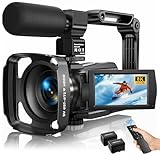
12. MWIRB 8K is a flexible camcorder bundle with webcam and night-vision modes
MWIRB 8K Video Camera Camcorder Latest 88MP Ultra HD Video...
8K at 15fps
6-axis anti-shake
external stereo mic
Pros
- Rotatable touch screen
- IR night vision
- external X-Y mic
- Wi-Fi
- webcam function
- accessory bundle
Cons
- Digital zoom only
- not water resistant
- digital stabilization
The MWIRB HDV-255K is another all-in-one camcorder-style option, with 8K at 15fps, 6K and 5K at 30fps, 4K at 30fps, 1080p at 60fps, 18x digital zoom, and a three-inch 270-degree rotatable touchscreen. Its included external X-Y stereo microphone, remote, stabilizer, lens hood, two batteries, and bag support a ready-to-film approach.
It can also work as a USB webcam, and Wi-Fi through the iSmart DV2 app supports quick sharing or remote control. Infrared night vision is a specialized feature that can be useful for particular low-light concepts, though it should not be confused with natural-color low-light quality.
The MWIRB camcorder supports a creator who needs one package for several roles
The ability to record while charging, shoot time-lapse or slow motion, use a rotatable screen, and switch into webcam duty gives it range for beginners who make different types of casual content. Six-axis anti-shake aims to smooth handheld clips, while the external mic gives voice recording more attention than many basic cameras.
For family documentation, classroom projects, simple YouTube videos, and a computer-camera backup, these bundled functions can be more useful than a sophisticated lens ecosystem. The touch screen also helps with self-recording composition.
The MWIRB camcorder is not built for extreme weather or optical reach
Its zoom is digital, the camera is not water resistant, and stabilization is digital rather than mechanical. It is sensible to keep the lens wide, provide good light, and use the included stabilizer or a tripod when you want the cleanest footage.
As with the FlyFrost, focus on the practical 30fps modes for ordinary vlogs rather than selecting 8K purely for the label. This is the best fit for a creator who values included accessories, webcam capability, and night-vision experimentation.
The right vlogging camera follows your actual filming routine
Start with the videos you will make every week, not an imaginary future channel. A travel creator who films while walking needs stabilization, weather resistance, a wide view, and power management; a makeup, cooking, or review creator needs a screen that faces forward, accurate autofocus at close distance, stable tabletop support, and an external-mic route.
A larger sensor usually helps image quality but does not fix every vlog
A one-inch sensor, APS-C sensor, or larger sensor can collect more light than the small sensors often found in entry camcorders and action cameras. That can improve low-light footage and background separation, but a larger camera may be heavier, need a lens, and be less likely to come with you.
Choose APS-C if you value photos, want interchangeable lenses, and are happy to learn a small system. Choose a one-inch compact or pocket camera if the priority is a smaller setup with better image potential than a basic small-sensor camera.
Reliable autofocus matters more than a high resolution label for solo work
Face and eye tracking reduce missed takes when you move, step closer, or turn slightly. Product-focused creators should look for a feature such as Sony’s Product Showcase Setting or use a camera’s close-up demo mode, because the camera must shift focus from your face to the item at the right moment.
Check how the camera behaves with your real subject: a talking head, a moving child, a pet, a recipe, or a product held near the lens. No spec alone can tell you whether a lens is wide enough for your room or whether tracking matches your movement.
Mechanical stabilization is best for walking, while a tripod is best for talking
A three-axis gimbal physically smooths movement, which is why pocket-gimbal cameras suit walk-and-talk footage. Action-camera stabilization is also a strong answer for outdoor use, while digital stabilization may crop the image and cannot always hide a bouncy walking technique.
For a desk video, a small tripod or the V10’s built-in stand is often the better answer. It eliminates movement rather than asking the camera to correct it, and it helps you keep the lens at eye level.
Audio should be planned before you press record
Forum discussions repeatedly make the same point: viewers will forgive an imperfect image more readily than distracting voice audio. Built-in directional or stereo microphones can work in a quiet room, but wind, traffic, and echo change the result quickly.
Prioritize an external microphone input or supported wireless-mic connection if you film outdoors or speak at a distance. A headphone jack would also help you monitor sound, but several cameras omit it, so record a short test, listen back with headphones, and keep the microphone close when possible.
A selfie screen and a wide lens prevent avoidable framing mistakes
A side-opening or fully articulating screen lets you check your headroom, background, and focus status as you record. A lens around 19mm or 20mm equivalent is especially friendly for handheld selfie work; a standard kit zoom can work, but it may feel tight in small rooms.
For vertical video, use the camera’s dedicated vertical mode where available or rotate the camera deliberately before you start. Leave extra room around a subject when you may crop a horizontal master into a 9:16 clip later.
Battery, storage, and repair support are part of camera ownership
Creators frequently report that recording time becomes the first real limitation. Check the stated battery figure, carry charged spares where possible, use an appropriate fast memory card, and learn the recording limits before an important shoot; a camera with 47GB built-in storage, for example, can be a useful backup rather than a replacement for cards.
Also check the brand warranty, battery availability, and local repair support before committing to a system. A camera you can keep powered, protected, and serviced is more useful over time than one with an impressive headline feature that stays at home.
A phone is enough until it limits the videos you are already making
Use your phone first if you are still proving your posting habit, prefer automatic sharing, and can get clean audio and stable shots with simple support gear. Move to a dedicated camera when the phone’s lens, stabilization, audio options, battery, heat, or selfie framing is regularly getting in the way.
That approach keeps the decision grounded. Buy the camera that removes your current bottleneck, whether that is action stability, better close-up focusing, a wider selfie lens, microphone support, or a camera body that can grow with new lenses.
FAQs
Which camera do most vloggers use?
Vloggers use different cameras based on format. Compact cameras with flip screens suit daily face-to-camera clips, action cameras suit outdoor movement, and mirrorless cameras suit creators who need interchangeable lenses and stronger photo capability. The DJI Osmo Action 5 Pro, Sony ZV-E10, and Canon PowerShot V10 represent those three common approaches.
What camera should I get as a beginner vlogger?
A beginner should choose a camera with a forward-facing screen, dependable face tracking, a wide enough lens for their filming space, and an easy audio plan. The Canon PowerShot V10 is simple for direct-to-camera work, while the Canon EOS R50 is a better fit if you also want an interchangeable-lens photo and video system.
What camera do TikTok creators use?
TikTok creators often use a phone, a compact camera, an action camera, or a pocket-gimbal camera. The best option depends on the clips: the Canon EOS R50 V has vertical video mode, the Xtra Muse switches between horizontal and vertical framing, and the DJI Osmo Action 5 Pro suits active vertical clips with strong stabilization.
Is it worth getting a vlogging camera?
A dedicated vlogging camera is worth it when it solves a recurring limitation of your phone, such as unstable walking footage, weak sound options, tight selfie framing, limited low-light quality, or a need for lenses. If you are still learning whether you will post consistently, start with your phone and add a camera when a clear need appears.
The best camera for you is the one you will carry and use
For outdoor movement, choose the DJI Osmo Action 5 Pro; for a flexible APS-C creator setup, choose the Sony ZV-E10; and for a compact, uncomplicated talk-to-camera option, choose the Canon PowerShot V10. The best cameras for vlogging in 2026 are not one-size-fits-all, so match the camera to your usual location, audio needs, and the amount of equipment you genuinely want to carry.
