
All Shelter Upgrades and License Keys in Pragmata (August 2026)
If you are working your way through Capcom’s sci-fi action-adventure Pragmata, you will quickly realize that the Shelter is the backbone of your entire progression. Pragmata shelter upgrades determine which weapons you can craft, what abilities you can equip, and how far you can push into each new sector. Every Shelter License Key you earn opens up new terminals, new gear, and new ways to approach combat encounters.
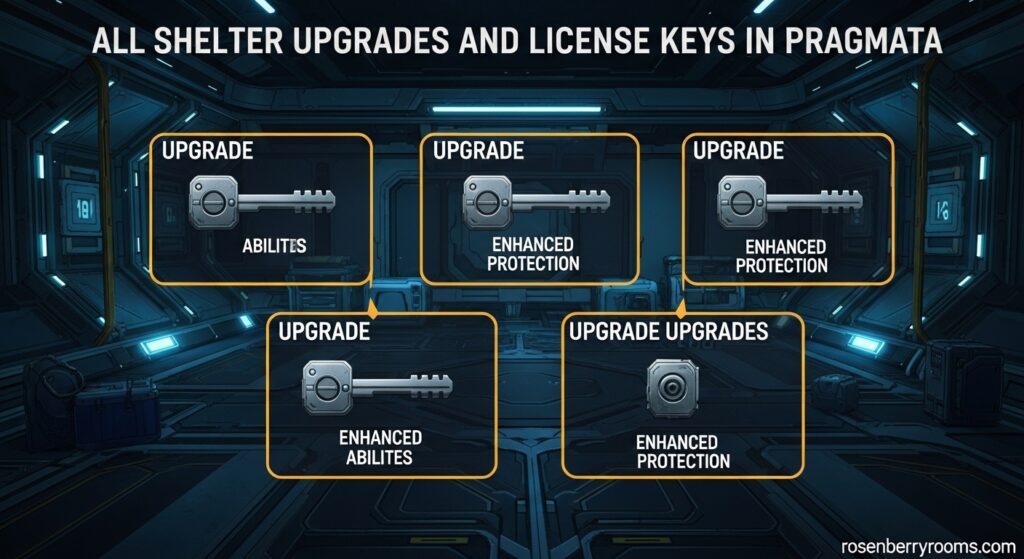
In this guide, I break down every shelter upgrade from Level 1 through the post-game Level 5, explain exactly where to find each Shelter License Key, and share the loadout prioritization strategy that the community has settled on after weeks of playtime. Whether you just finished your first sector or you are chasing the endgame, this article covers everything you need to know about all shelter upgrades and license keys in Pragmata.
Contents
Pragmata puts you in control of Hugh and Diana as they explore a lunar research station overrun by hostile machines. The Shelter acts as your home base between missions, and upgrading it is not optional. It is the only way to keep pace with increasingly difficult enemies across the game’s four main sectors and beyond. The game blends exploration, hacking puzzles, and real-time combat into a loop that keeps pushing you forward, and the Shelter is where you prepare for each new challenge.
How Shelter Upgrades Work in Pragmata?
Shelter upgrades in Pragmata follow a straightforward loop: defeat a sector boss, receive a Shelter License Key, return to the Shelter, and watch your available equipment expand. The Shelter starts at Level 0 with minimal functionality, and each License Key raises it by one level up to a maximum of Level 5.
When the Shelter levels up, three main terminals gain new inventory. The REM Replicator unlocks fresh weapons and gear for crafting. The Firmware Updater grants new abilities like Object Scan and Auto-Hacking. The Unit Printer expands your mod and node slot options. You still need Lunafilament, the game’s primary crafting currency, to actually purchase most of these items from the terminals.
This creates a two-part progression gate. First, you need the right Shelter License Key to access the item. Then, you need enough Lunafilament to craft it. Players on the Pragmata subreddit consistently point out that misunderstanding this economy leads to wasted resources, especially in the early game when Lunafilament is scarce.
It is worth noting that you cannot skip ahead. Each Shelter License Key raises the level by exactly one, and you need the previous level unlocked before you can apply the next key. There is no way to jump straight to Level 3 without first earning and applying the Level 1 and Level 2 keys. This linear structure keeps the difficulty curve steady but also means every boss fight matters.
All Shelter License Keys and Upgrades in Pragmata 2026
There are five Shelter License Keys in total. Four come from defeating sector bosses during the main story, and one is earned through a post-game Hidden Chamber mission. Here is a quick overview of every level, the boss or event that unlocks it, and the primary rewards:
Level 1: Defeat the SectorGuard in Sector 1. Unlocks Riot Blaster, Charge Piercer, and Hacking Node at the REM Replicator Beta.
Level 2: Defeat the Gigantic Bot in Sector 2. Unlocks Object Scan, Auto-Hacking, Decoy Generator, and Stamp Club access. This is widely considered the most impactful upgrade tier.
Level 3: Defeat the Large Bot in Sector 3. Unlocks Pulse Carbine, Sticky Bombs, Bot Scan, and additional Hacking Gauge capacity.
Level 4: Defeat the LunaDigger in Sector 4. Unlocks Homing Missiles, EC Thrusters, Training Simulations, and expanded Upgrade Limits.
Level 5: Complete Hidden Chamber Mission 1 after finishing the main story. Unlocks Fast Moves, Critical Shot, Mod Slot expansions, Node Slot expansions, and Overdrive.
Each level builds on the previous one, adding new options without making older weapons completely irrelevant. The REM Replicator upgrades from Beta to Gamma to Sigma as you progress, and each version carries forward the inventory from prior tiers while adding new items on top.
Complete Shelter Level Breakdown (Levels 1-5)
Shelter Level 1: SectorGuard Boss (Sector 1)
The SectorGuard is the first major boss you encounter in Pragmata, waiting at the end of Sector 1. The fight serves as a tutorial for the game’s hacking and combat mechanics. Once you take it down, you receive your first Shelter License Key automatically.
At Shelter Level 1, the REM Replicator Beta comes online with three key items. The Riot Blaster gives you a reliable mid-range weapon that handles most early-game enemies. The Charge Piercer is a high-damage single-target weapon that many players gravitate toward because of its burst potential. The Hacking Node lets you interact with more terminals scattered throughout the environment, opening up optional paths and hidden collectibles.
From the community’s perspective, the Charge Piercer carries early game encounters hard, but it does fall off in relevance once you unlock weapons at Level 3 and beyond. If you are tight on Lunafilament, grab the Riot Blaster first since you will use it as a baseline weapon throughout the entire game.
The Firmware Updater also activates at Level 1 with the Decode function. Decode lets you interpret encrypted logs and data points scattered throughout the station, many of which contain hints about hidden items, shortcuts, and bonus Lunafilament caches. Several players on the Steam Community forums admit to reaching Sector 3 without ever using Decode, which means they walked past dozens of useful secrets without realizing it.
Shelter Level 2: Gigantic Bot Boss (Sector 2)
The Gigantic Bot guards Sector 2 and hits significantly harder than the SectorGuard. You need solid fundamentals with hacking and dodging before attempting this fight. The reward is absolutely worth the effort, because Shelter Level 2 is the turning point that nearly every player on the Pragmata forums talks about.
Object Scan is the headliner ability here. It reveals hidden items, secret passages, and interactable objects throughout every sector. Players consistently report that Object Scan completely changes how you explore Pragmata, turning what felt like linear corridors into dense, layered environments full of secrets. If you have been walking past what look like dead ends, Object Scan will likely prove you wrong.
Auto-Hacking is the second major unlock. It reduces the number of input steps required for every hacking interaction, which dramatically cuts down on the mental load during combat. Instead of fumbling through a hack while enemies close in, Auto-Hacking streamlines the process so you can stay focused on positioning and timing. The difference is immediately noticeable, and most players say they could never go back to manual hacking after experiencing it.
The Decoy Generator rounds out the Level 2 combat tools by letting you draw enemy attention away from Diana during hack-intensive encounters. You also gain access to the Stamp Club, a side activity that provides bonus Lunafilament and cosmetic rewards through a collection system tied to exploration milestones. The Stamp Club is easy to overlook but generates meaningful passive income throughout the rest of the game.
Shelter Level 3: Large Bot Boss (Sector 3)
The Large Bot in Sector 3 continues the difficulty ramp. By this point in the game, you are expected to use your shelter upgrade tools fluidly, combining weapons and abilities in combat. The Shelter Level 3 unlocks reflect that expectation with more specialized gear.
The Pulse Carbine replaces the Riot Blaster for many players. It fires faster, deals more sustained damage, and handles the shielded enemies that become common in Sector 3 and beyond. Sticky Bombs give you an area-denial option that works well against groups of smaller bots, letting you set traps and focus on bigger threats.
Bot Scan is the exploration ability for this tier. While Object Scan reveals environmental secrets, Bot Scan gives you detailed information about enemy weaknesses, resistances, and attack patterns before you engage. This intelligence is invaluable for planning your approach, especially in rooms with mixed enemy types where knowing which bot to prioritize can save you significant health and ammunition.
You also get an expanded Hacking Gauge at Level 3, which lets you chain more hacks together without waiting for a recharge. This pairs naturally with the Auto-Hacking ability from Level 2, creating a smoother combat rhythm overall. The synergy between these two upgrades is one of the reasons players consistently say that the game really opens up around the mid-point of Sector 3.
Shelter Level 4: LunaDigger Boss (Sector 4)
The LunaDigger is the final story boss and arguably the most demanding fight in the main campaign. It combines every mechanic you have learned so far into one encounter, testing your weapon switching, ability timing, and spatial awareness simultaneously. Bring your best loadout and be ready to use every tool at your disposal.
Shelter Level 4 brings Homing Missiles, which are a significant power spike for dealing with agile enemies that dodge your primary weapon fire. They lock on and track targets, letting you maintain offensive pressure while repositioning. EC Thrusters improve your movement options, giving you faster dashes and more evasive capability during intense combat sequences.
Training Simulations unlock at this level as well. These are repeatable combat challenges inside the Shelter that reward bonus Lunafilament and let you practice weapon combinations without risking story progress. Players who skipped side content earlier in the game find Training Sims to be an efficient way to catch up on resources before the final push.
Level 4 also raises your Upgrade Limits across all terminals, meaning you can push weapons and abilities to higher power tiers than before. This is the level where your loadout really starts to feel complete, and many players report that the difficulty curve smooths out noticeably once you have crafted the Level 4 essentials.
Shelter Level 5: Hidden Chamber Mission 1 (Post-Game)
Shelter Level 5 is the only upgrade that does not come from a story boss. After completing the main campaign, a new Hidden Chamber Mission becomes available. Completing this mission grants the fifth and final Shelter License Key. The mission itself is a significant challenge that assumes you have mastered the game’s mechanics.
The rewards here are powerful but designed for players pushing into endgame content or New Game Plus. Fast Moves increases your base movement speed and reduces animation recovery times across the board. Critical Shot adds a critical hit mechanic to your weapons, giving you burst damage potential that scales with accuracy.
Mod Slots and Node Slots expand significantly at Level 5, letting you equip more passive buffs and ability modifications simultaneously. This is where build diversity really opens up, since you are no longer constrained to just a few active enhancements. Overdrive, the final ability unlock, temporarily boosts all your stats when activated, serving as a panic button or a burst window for tough encounters.
Players on the Steam Community forums note that Level 5 is not strictly necessary to finish the main story, but it makes post-game challenges and higher-difficulty modes far more manageable. If you plan to keep playing after the credits roll, this upgrade is essential. The combination of Fast Moves, Critical Shot, and expanded slots creates build possibilities that simply do not exist at Level 4.
Which Pragmata Shelter Upgrades Should You Prioritize?
Not all upgrades are created equal, and Lunafilament is a limited resource in the early and mid game. Based on community consensus and my own experience, here is a clear prioritization path that avoids wasted resources.
At Shelter Level 1: Craft the Riot Blaster first. It is your workhorse weapon for the entire game. Skip the Charge Piercer if Lunafilament is tight, since it loses relevance after Level 3. The Hacking Node is worth grabbing early because it opens up optional areas with extra resources.
At Shelter Level 2: This is where you should spend freely. Object Scan and Auto-Hacking are both essential. Object Scan reveals content you literally cannot see without it, and Auto-Hacking makes every subsequent combat encounter smoother. The Decoy Generator is a nice-to-have but not critical. Do not skip either of the two core abilities here.
At Shelter Level 3: The Pulse Carbine is your next mandatory craft. It directly outclasses the Riot Blaster in most scenarios once you reach Sector 3. Bot Scan is extremely useful for the rest of the game and costs relatively little Lunafilament. Sticky Bombs can wait if you are still saving up.
At Shelter Level 4: Homing Missiles first, then EC Thrusters. The missiles solve a real problem with evasive enemies in late-game sectors. Training Simulations are free to access once unlocked, so start running them immediately for extra Lunafilament income.
At Shelter Level 5: Fast Moves and Critical Shot should be your first picks. Expanded Mod and Node Slots are extremely valuable for build variety but can be spread out over multiple crafting sessions as you accumulate Lunafilament from post-game content.
Lunafilament Economy Tips
Lunafilament is the currency that makes all of these upgrades possible, and managing it poorly is one of the most common mistakes new players make. Here are a few principles that will keep your resource pool healthy throughout the game.
Always explore thoroughly before fighting a sector boss. Hidden chambers, optional rooms, and collectible caches contain significant Lunafilament rewards, and you want to enter each new shelter level with enough currency to buy the most important items immediately.
The Stamp Club, which unlocks at Shelter Level 2, generates passive Lunafilament over time as you discover stamps through normal exploration. Do not ignore this system. Several players on the Pragmata subreddit reported earning enough from stamp rewards alone to fund their entire Level 3 crafting needs.
Training Simulations at Level 4 offer repeatable Lunafilament farming, but they are time-intensive. Use them to top off your currency when you are short, not as a primary income source. The main story and side exploration provide more than enough Lunafilament if you are thorough.
Finally, resist the urge to fully upgrade every weapon the moment you unlock it. Most weapons perform well at their base level, and the incremental gains from early upgrades are small compared to the cost. Save your Lunafilament for unlocking new items at each shelter tier, then go back and upgrade your favorites once you have spare currency.
Common Mistakes When Leveling Up Your Shelter
After reading through dozens of forum threads and Steam discussions, a few recurring mistakes stand out. Avoiding these will save you time and frustration.
Ignoring the Hacking Node at Level 1. Many players rush straight for weapons and skip the Hacking Node entirely. This locks you out of optional areas that contain Lunafilament and lore entries, making later levels harder than they need to be. The Hacking Node is cheap and pays for itself quickly.
Blowing Lunafilament on the Charge Piercer. The Charge Piercer feels powerful early on, but community consensus is that it becomes obsolete by Level 3. If you are saving for Object Scan and Auto-Hacking at Level 2, skip the Charge Piercer entirely and invest in abilities that remain relevant throughout the entire game.
Not returning to the Shelter after boss fights. Some players push forward into the next sector without heading back to spend their new Shelter License Key. This means missing out on weapons and abilities that make the next sector significantly easier. Always return to the Shelter after earning a new key.
Missing the Decode ability early. Several forum posts describe players reaching Sector 3 without realizing they had access to a Decode function at the Firmware Updater starting at Level 1. Decode lets you interpret encrypted logs and data points that contain hints about hidden items and shortcuts. Check the Firmware Updater every time you gain a shelter level.
Over-upgrading early weapons. Dumping Lunafilament into maxing out the Riot Blaster or Charge Piercer before reaching Level 3 means you will not have enough for the abilities and weapons that actually matter at Level 2 and Level 3. Keep early upgrades modest and save for the bigger unlocks.
FAQs
How do I upgrade my shelter in Pragmata?
To upgrade your shelter in Pragmata, defeat the boss at the end of each sector. Each boss drops a Shelter License Key that automatically raises your Shelter level by one when you return to base. The REM Replicator, Firmware Updater, and Unit Printer terminals will then offer new weapons, abilities, and upgrades for purchase with Lunafilament.
Where are all the shelter license keys in Pragmata?
There are five Shelter License Keys in Pragmata. Levels 1 through 4 come from defeating sector bosses: the SectorGuard (Sector 1), Gigantic Bot (Sector 2), Large Bot (Sector 3), and LunaDigger (Sector 4). The Level 5 key comes from completing Hidden Chamber Mission 1, which unlocks after you finish the main story campaign.
What does Level 2 shelter unlock in Pragmata?
Shelter Level 2 unlocks Object Scan, Auto-Hacking, the Decoy Generator, and access to the Stamp Club. Object Scan reveals hidden items and secret passages throughout every sector, and Auto-Hacking simplifies the hacking minigame during combat. Most players consider Level 2 the most impactful upgrade tier in the entire game.
Is Pragmata shelter progression tied to bosses?
Yes, shelter progression in Pragmata is directly tied to defeating sector bosses. Levels 1 through 4 each require you to beat a specific boss at the end of Sectors 1 through 4. The only exception is Level 5, which comes from a post-game Hidden Chamber mission rather than a boss fight.
What is Lunafilament in Pragmata?
Lunafilament is the primary crafting currency in Pragmata. You use it to purchase weapons, abilities, and upgrades from the Shelter terminals after unlocking them with Shelter License Keys. You earn Lunafilament through story progression, exploration, hidden chambers, the Stamp Club, and Training Simulations.
Is Pragmata a story game?
Yes, Pragmata is a story-driven sci-fi action-adventure game developed by Capcom. It follows Hugh and Diana through a lunar research station, combining narrative progression with combat, hacking puzzles, and shelter base upgrades.
Final Thoughts on Pragmata Shelter Upgrades and License Keys
Understanding Pragmata shelter upgrades is the difference between struggling through each sector and moving through the game with confidence. The progression system rewards boss kills with Shelter License Keys, and each key transforms your available loadout in meaningful ways. Level 2 stands out as the biggest power spike thanks to Object Scan and Auto-Hacking, while Levels 3 and 4 round out your combat toolkit with stronger weapons and movement options.
The key takeaway is simple: always return to the Shelter after every boss fight, prioritize Object Scan and Auto-Hacking at Level 2, and manage your Lunafilament carefully in the early game. By the time you reach the post-game Level 5 upgrades, you will have the foundation to handle anything Pragmata throws at you.
If you found this guide helpful, keep it bookmarked as a reference while you work through each sector. The shelter upgrade path is linear, but the choices you make about what to craft first have a real impact on your experience. Good luck out there, Hugh and Diana are counting on you.
