10 Best Headphone Amplifiers for Studio Monitoring (October 2026) Trusted Reviews
A headphone jack on an audio interface is built for convenience, not for driving a pair of 250 ohm or 300 ohm studio headphones. It will give you sound, but the voltage on tap is small, and under-powered high-impedance headphones lose exactly the things an engineer needs most: bass weight, dynamic range and the sense of depth in a mix.
That is the whole reason to look at the best headphone amplifiers for studio monitoring. Every amp in this guide was picked for the job it does in a control room rather than on a listening desk: driving hard closed-backs for tracking, feeding four musicians their own cue level, or giving a mix engineer enough headroom to hear a high-impedance open-back reference without turning the volume pot to the top of its travel.
Contents
We compared 10 headphone amplifiers side by side, spanning four-way distribution boxes, eight-channel rack units, pure desktop amplifiers and all-in-one DAC/amp boxes. Several of the picks here appear on our studio headphone amplifier guide, and the headphone pairings we reference sit alongside our closed-back studio monitoring headphone picks.
One thing worth saying up front: most engineers do not need the most expensive box on the market. They need an amp with enough voltage for their impedance, a low noise floor at the gain setting they actually use, and a volume control that stays in the useful part of its rotation.
Top 3 Best Headphone Amplifiers for Studio Monitoring (October 2026)


Fosi Audio PH04
- Four independent volume controls
- Ultra-low-noise op-amps
- Compact metal chassis
As an Amazon Associate we earn from qualifying purchases. CERTAIN CONTENT THAT APPEARS ON THIS SITE COMES FROM AMAZON. THIS CONTENT IS PROVIDED 'AS IS' AND IS SUBJECT TO CHANGE OR REMOVAL AT ANY TIME.
All 10 Headphone Amplifiers Compared in 2026
| Product | Features | |
|---|---|---|
| Mackie HM-4 4-Channel Headphone Amplifier |
|
Check Latest Price |
| Fosi Audio K7 DAC Headphone Amp |
|
Check Latest Price |
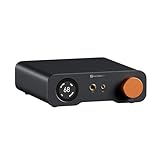 Fosi Audio ZH3 Balanced DAC Headphone Amp Fosi Audio ZH3 Balanced DAC Headphone Amp |
|
Check Latest Price |
 Rupert Neve Designs RNHP Rupert Neve Designs RNHP |
|
Check Latest Price |
 Schiit Magni Unity Discrete Amp and Preamp Schiit Magni Unity Discrete Amp and Preamp |
|
Check Latest Price |
| Fosi Audio PH04 4 Channel Headphone Amplifier |
|
Check Latest Price |
 Behringer HA8000 V2 8-Channel Distribution Amp Behringer HA8000 V2 8-Channel Distribution Amp |
|
Check Latest Price |
 ART HeadAMP4 Eight Output Headphone Amplifier ART HeadAMP4 Eight Output Headphone Amplifier |
|
Check Latest Price |
 Topping DX3pro+ DAC Headphone Amplifier Topping DX3pro+ DAC Headphone Amplifier |
|
Check Latest Price |
 Zoom ZHA-4 Portable 4-Channel Headphone Amp Zoom ZHA-4 Portable 4-Channel Headphone Amp |
|
Check Latest Price |
We earn from qualifying purchases. CERTAIN CONTENT THAT APPEARS ON THIS SITE COMES FROM AMAZON. THIS CONTENT IS PROVIDED 'AS IS' AND IS SUBJECT TO CHANGE OR REMOVAL AT ANY TIME.
1. Mackie HM-4 Headphone Amplifier – Four Listeners, One Small Box
Mackie HM-4 Headphone Amplifier (4-Channel), Compact…
4-channel solid-state amp
Per-channel volume control
6.35mm and 3.5mm outputs
Metal chassis at 8 ounces
Pros
- Drives four headphones at once with one level control per listener
- Clean noise-free amplification with extended bass
- Compact enough to fix to a desk or rack
- Accepts both 1/4 inch and 1/8 inch headphones
Cons
- No dedicated power switch beyond an LED indicator
- Some reports of hum when placed next to noisy gear
- Single stereo input with no separate cue feed
The Mackie HM-4 is the amp we come back to for most home and project studios because it solves the most common studio problem, which is not fidelity at all. It is four people needing four different levels at the same time.
Recording engineers and home-studio owners consistently report a measurable clarity and bass improvement over an interface headphone output when they move to the HM-4, with clean low-noise amplification and no audible distortion at high level. Perceived hum complaints are widely attributed to placement near noisy gear or incorrect cabling rather than to the unit itself.
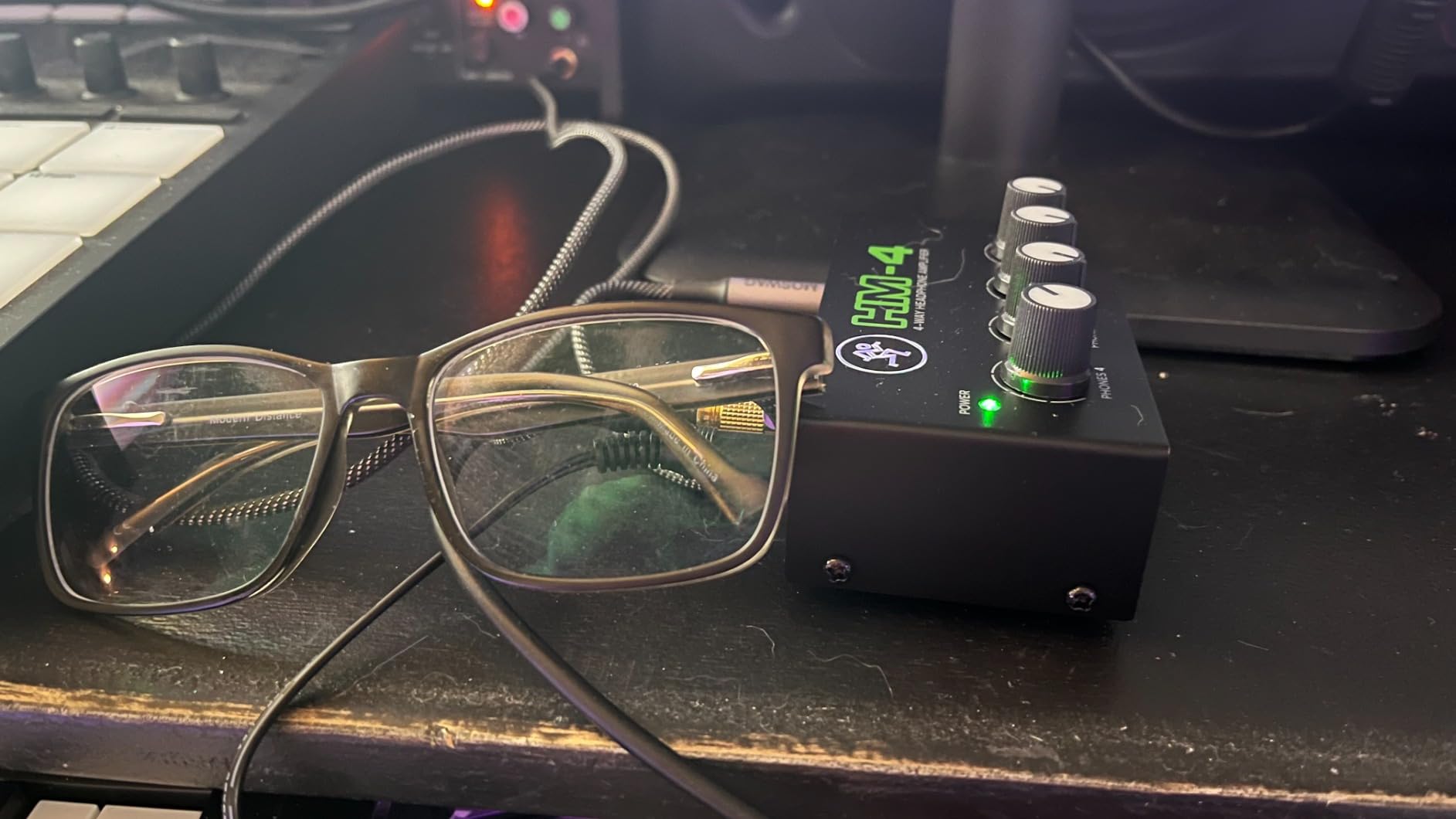
Physically it is tiny: 2.3 inches deep, 4.3 inches wide, 2 inches tall and 8 ounces. Reviewers routinely mention velcroing it under a desk or to a rack rail, which matters more than it sounds like, because a four-way box that lives on the floor gets tripped over.
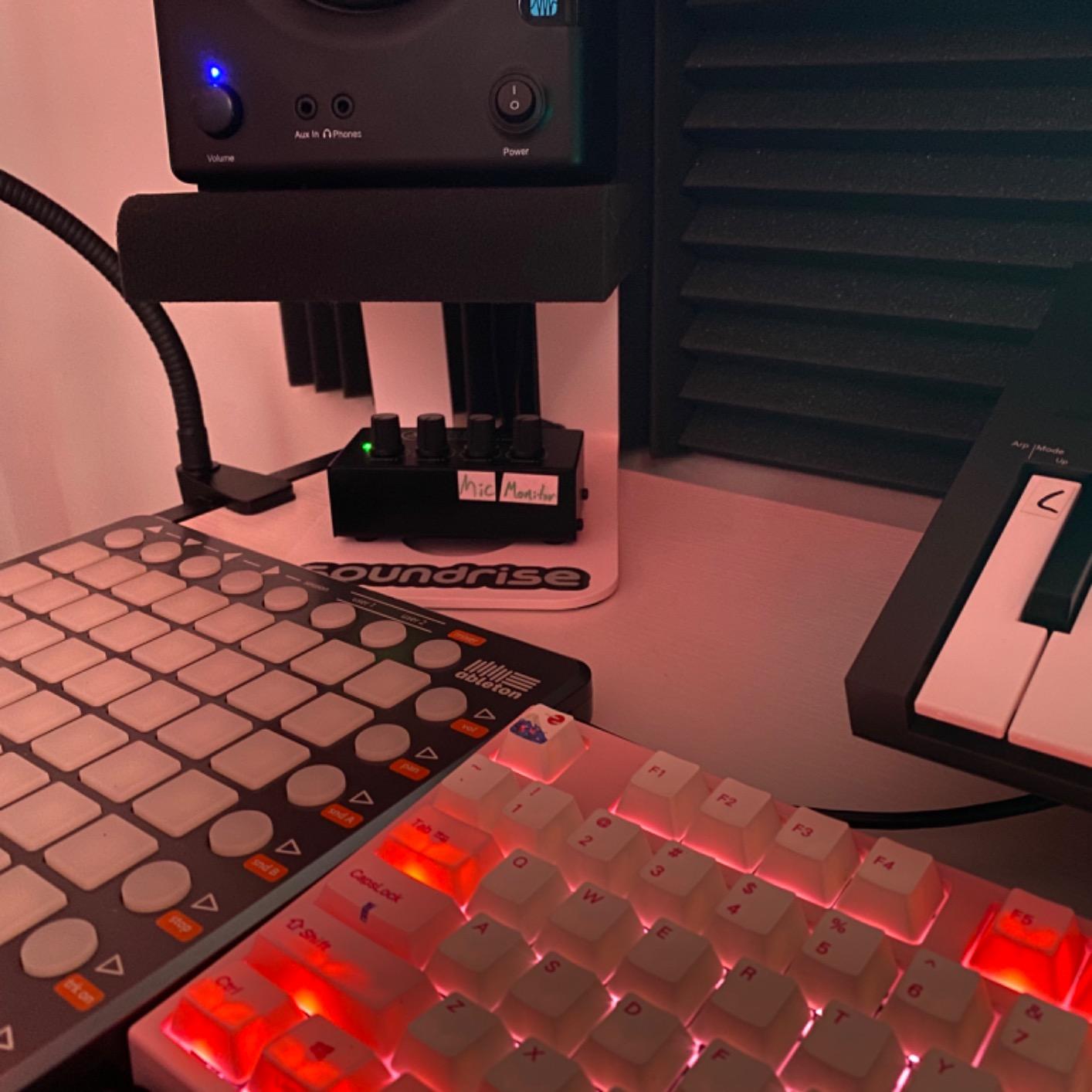
The four output sections are genuinely independent, so each performer gets a pot rather than a splitter and a fight over one knob. That is the difference between a cue mix people can actually monitor and a session where the drummer keeps turning everything down.
Who the Mackie HM-4 works for
It is built for a singer, a guitarist and an engineer tracking at once, or for a band rehearsal room where everyone shares one interface. The metal enclosure survives repeated handling, and the volume pots are described as smooth and solidly weighted with no crackle at the bottom of the rotation.
Pair it with mid-impedance closed-backs such as the Audio-Technica ATH-M50x or the Beyerdynamic DT 770 Pro at 80 ohm, where four-way distribution matters more than maximum output voltage.
Who should skip the Mackie HM-4
Skip it if you are the only person in the room. One headphone out is wasted capability, and a desktop amp with a preamp out would serve you better. It also takes a single stereo input, so building a true two-source cue mix means splitting upstream.
There is no dedicated power on/off switch, only an LED indicator, and a small number of buyers report units arriving dead. Both are minor, but worth knowing before a session.
2. Fosi Audio K7 – The All-in-One Desktop Amp With Real Power
Fosi Audio K7 DAC Headphone Amp, Desktop Headphone Amplifier…
2100mW output
AK4493S DAC with XMOS XU208
4.4mm balanced and 3.5mm outs
Aluminium chassis
Pros
- Up to 2100mW drives demanding planar headphones with authority
- Clean neutral signature with no obvious coloration
- Works across USB-C optical coaxial Bluetooth and analog sources
- Bright display with volume readout and onboard EQ
Cons
- Endless volume knob with no hard stops
- Pressing the knob switches gain rather than muting
- No balanced XLR output
- Chunky footprint and no remote control
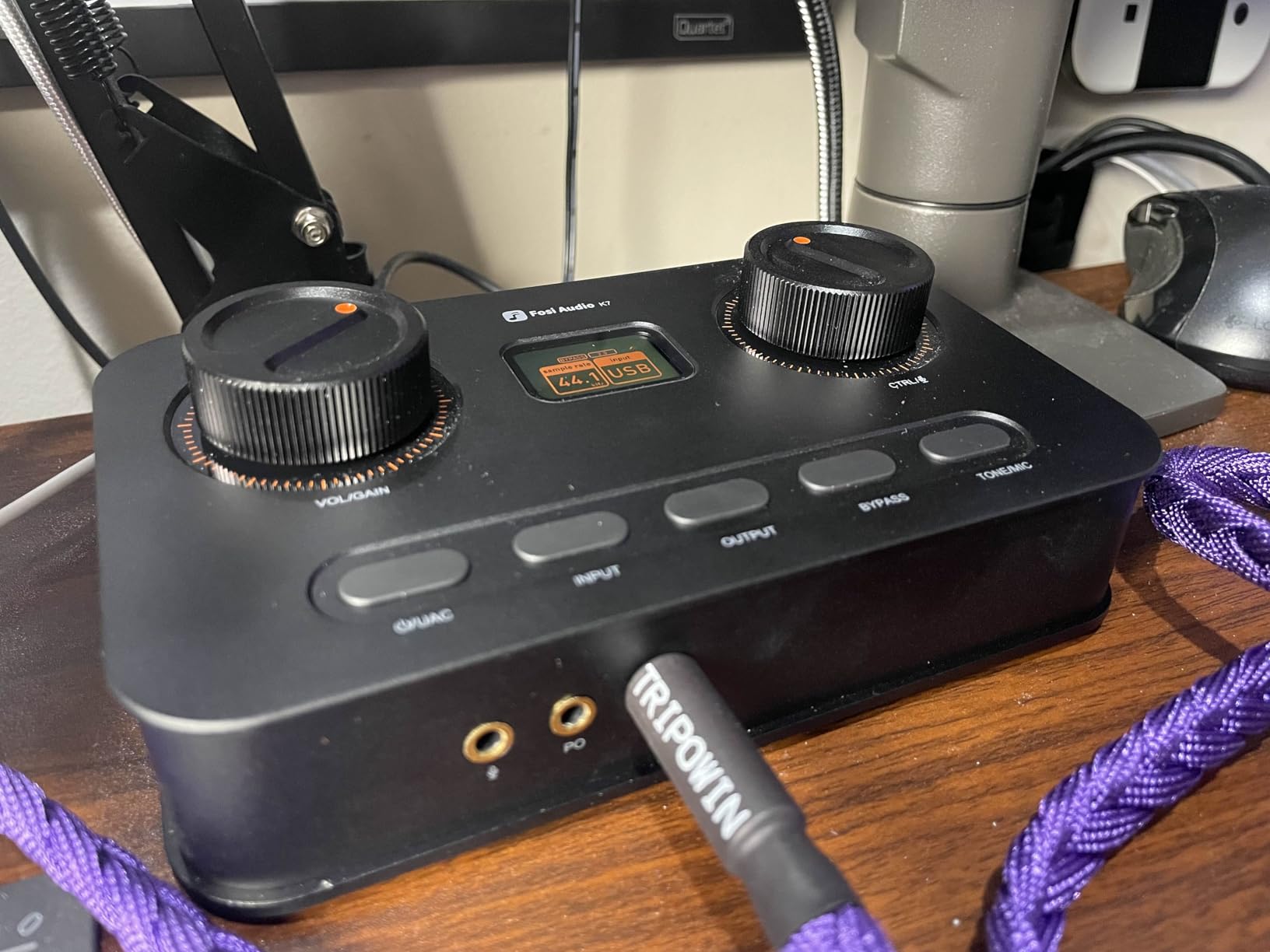
The K7 is the box you buy when you want one device to sit between your interface and your headphones and stay out of the way. It carries an AK4493S DAC, an XMOS XU208 USB processor and TPA6120 headphone amplification, with up to 2100mW of output power available.
Owners treat the K7 as a high-value entry DAC/amp that delivers genuine detail, separation and positional cues over onboard PC audio. Praise centers on power reserves and solid metal construction, while criticism concentrates on ergonomics rather than sound quality.
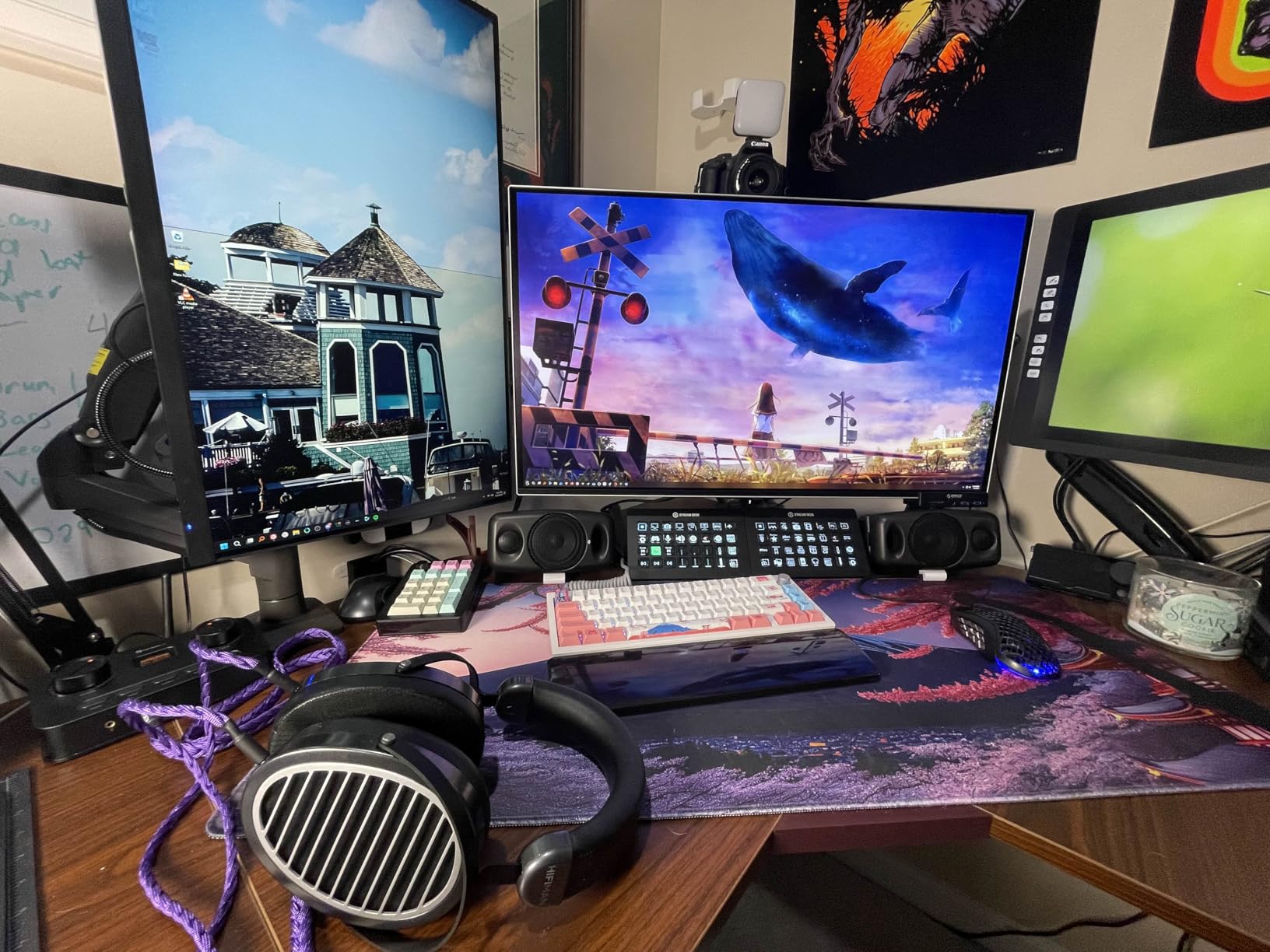
Input coverage is unusually broad for a desktop box: USB-C, coaxial, optical, Bluetooth with aptX HD and LL, and a 3.5mm microphone input for talkback. Output side gives you 4.4mm balanced, 3.5mm single-ended and RCA, with a bright display showing a real-time volume readout plus onboard bass and treble EQ.
Decoding runs to PCM 384kHz/32bit and DSD256. In the box you get the unit, a USB-A/C to USB-C cable, a Y-splitter, a Bluetooth antenna and a 12V supply, with a 24-month manufacturer warranty behind it.
Where the K7 earns its place in a studio
It is a good match for a producer working at one desk with several headphone types, because the power headroom covers both low-impedance planars and high-impedance dynamics without a gain switch. The metal chassis and EMI shielding also make it a reasonable box to keep near a noisy computer.
For tracking with a guitar amp or a live drum kit, that 2100mW headroom means you are not fighting the amp for clean level.
What to watch out for with the K7
The volume knob rotates continuously with no hard stops, so the position is hard to read at a glance. Pressing that knob switches gain rather than muting, which is an unpleasant surprise if you reach for it to silence playback.
Bluetooth audio quality trails the wired inputs, macOS gives you no driver control, and there is no XLR output if your interface or monitor controller is balanced only.
3. Fosi Audio ZH3 – Balanced Power for Planar Magnetics
Fosi Audio ZH3 DAC Headphone Amp, Fully Balanced Preamp with…
2570mW balanced at 32 ohm
640mW single-ended at 32 ohm
Three-level gain switch
1.9 microvolt noise floor
Pros
- Exceptionally clear and detailed with a wide soundstage
- 2570mW balanced output drives high-impedance and planar headphones
- Collapses a two-box DAC plus amp chain into one unit
- Bass and treble EQ with six filters and swappable op-amps
Cons
- XLR and RCA line outs are fixed level rather than a true preamp
- External wall-wart power supply
- Only a basic two-band EQ
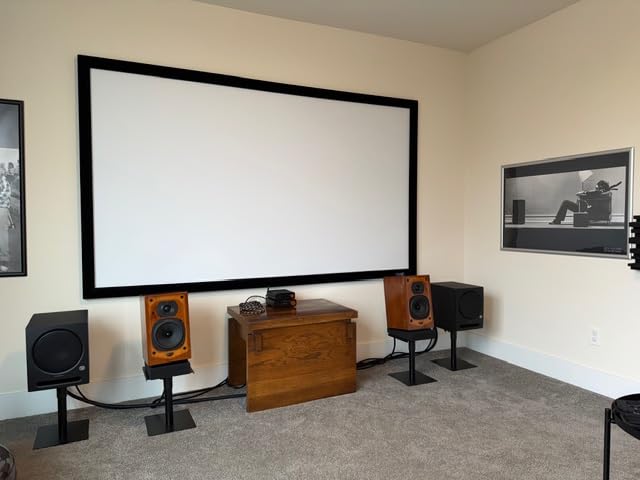
The ZH3 is the most powerful amplifier in this group, and it is the one to look at if your headphones are a low-impedance planar magnetic that other amps struggle to move. Its balanced output is rated at 2570mW per channel into 32 ohm, with 640mW per channel from the single-ended 6.35mm jack.
Reviewers overwhelmingly value the ZH3 as a compact all-in-one that collapses a two-box desktop chain into one unit while adding balanced power, filters and a remote. The most common documented complaint concerns the fixed-level XLR and RCA outputs not behaving as a true preamp.
Decoding is handled by an AKM4493SEQ with an XMOS XU316 USB processor, running to PCM 768kHz/32bit and DSD512. The stated noise floor is as low as 1.9 microvolts, which is the figure that matters when you mix quietly.
Four OPA1612 op-amps sit in the signal path, and two of them are swappable, so you can change the character of the amplification without changing the machine. There is a three-level gain switch covering 16 ohm through 300 ohm headphones.
Headphone pairings that suit the ZH3
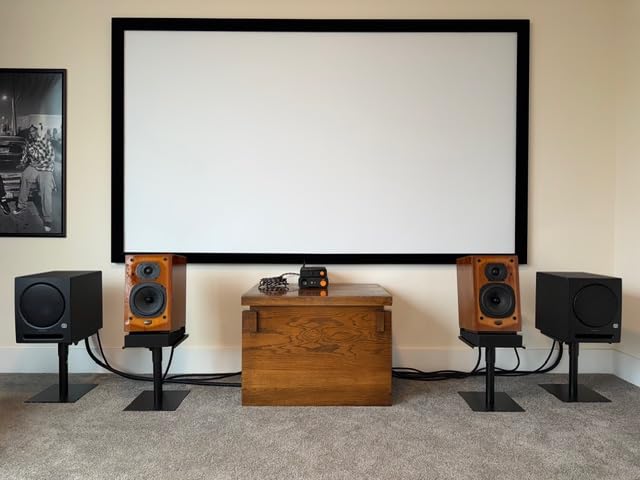
This is the amp for a planar magnetic that needs current, and for high-impedance dynamics that need voltage, because the gain switch plus balanced output covers both ends of the studio headphone range. The wide, dimensional soundstage reviewers describe also helps when you are checking a mix’s front-to-back placement.
Its XLR and RCA line outputs are useful for feeding monitors, though at a fixed level rather than following the volume control.
Where the ZH3 falls short
Do not buy it expecting a variable preamp for your monitor speakers; despite the preamp wording in the listing, the XLR and RCA outputs are fixed level. If your monitors need their own level control, keep your interface preamp in the chain.
Some users also find the amp stage slightly sterile with less bass heft than a dedicated external amplifier, and the EQ is a basic two-band rather than a parametric.
4. Rupert Neve Designs RNHP – The Tracking Amp Engineers Name Most
Rupert Neve Designs RNHP Stereo Precision Headphone…
24V stereo headphone amplifier
90 dB signal-to-noise ratio
RCA and 1/8 inch inputs
Stainless steel enclosure
Pros
- Smooth wide bandwidth with a warm non-fatiguing presentation
- Very low noise floor that clears hiss on quiet passages
- Adequate power for 250 ohm and 300 ohm headphones
- Solid build with a dedicated 24V supply and 2-year warranty
Cons
- Modest power output for the price against very hard-to-drive planars
- Some reports of audible hum
- Bright green power LED with no dimmer
The RNHP is the amp that shows up again and again in tracking conversations, and engineers on gear forums regularly pair it with closed-back isolation headphones like the Neumann NDH 20 when they record. It is a 24V stereo headphone amplifier with a +4dBu line, a 90 dB signal-to-noise ratio and a stainless steel enclosure.
Long-standing critical and audiophile reviews describe the RNHP as a reference-neutral, remarkably clean headphone amp whose warmth and lack of fatigue make long mixing sessions easier, with a service department praised for turnaround. Its main limitation is power headroom relative to its price.
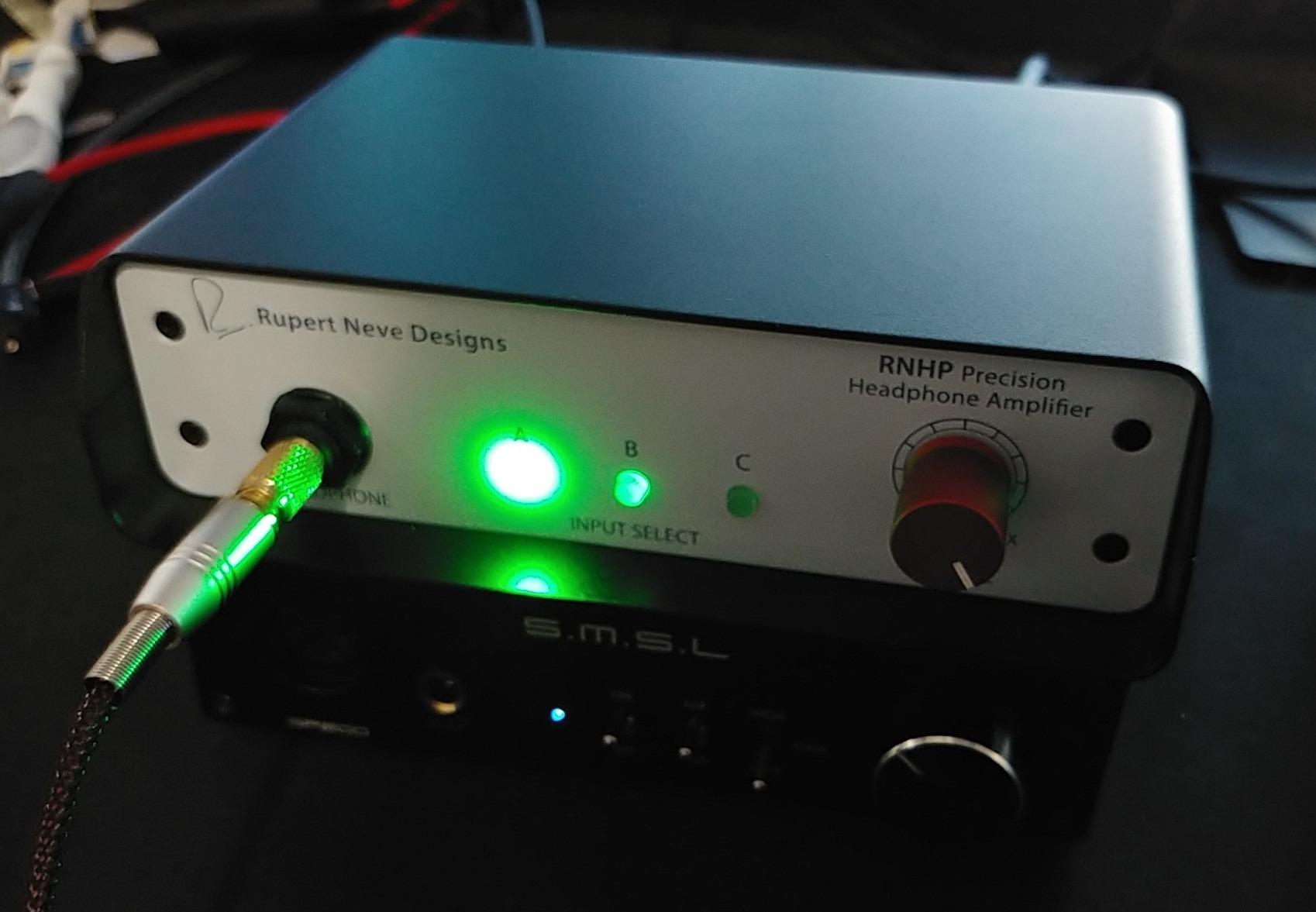
Inputs are 1/8 inch stereo and RCA, with RCA outputs for a line-level path onward. It weighs 3 pounds and measures 10.2 by 3.94 by 1.9 inches, so it sits flat on a desk or slides into a shallow drawer between sessions.
The dedicated 24V power supply is worth noting. External supply noise is one of the most common causes of the faint hum engineers report on cheaper desktop amps, and separating it from the chassis keeps the noise floor down at low monitoring levels.
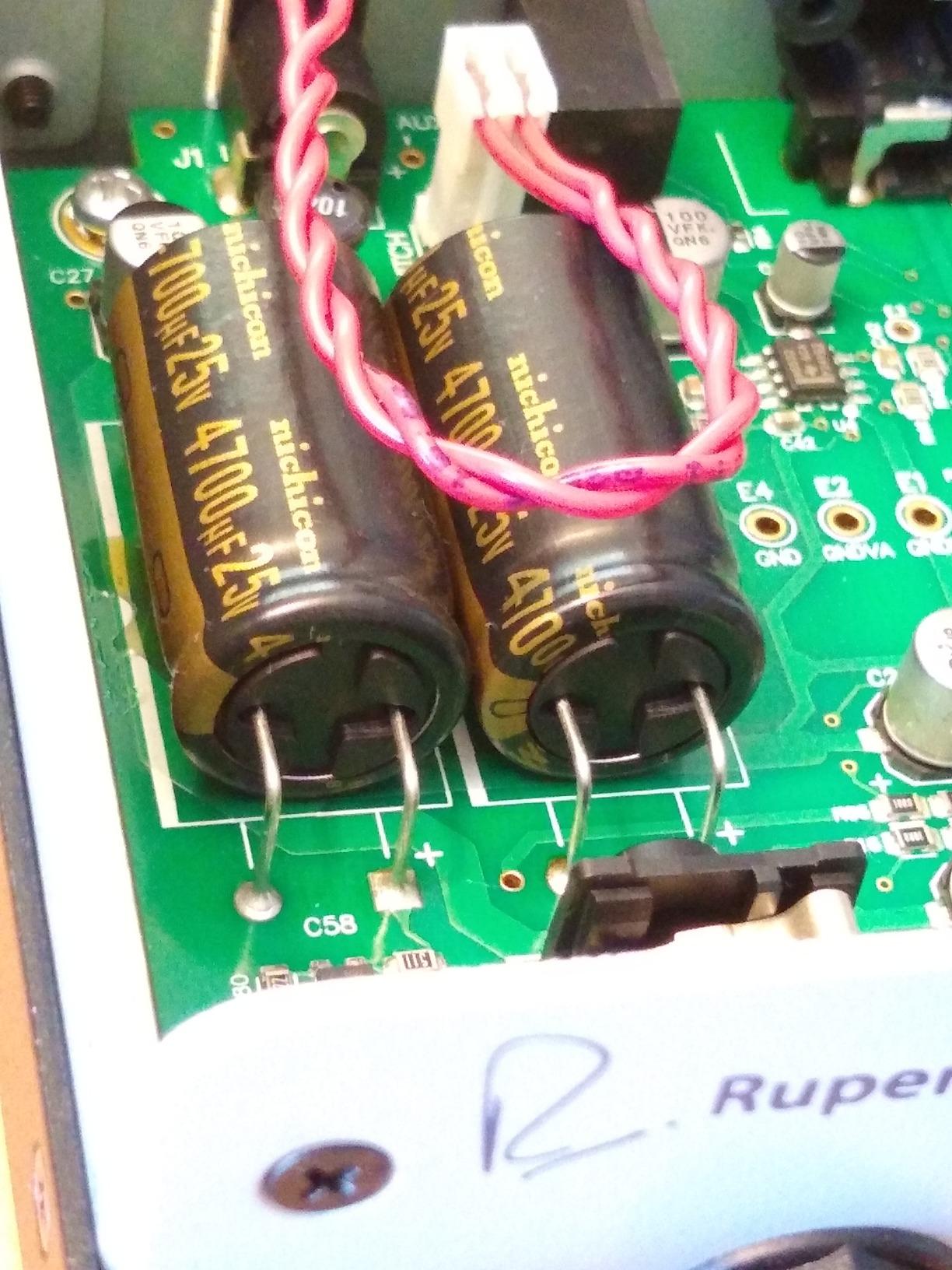
Why engineers reach for the RNHP
Tracking is where this box earns its reputation. When you are recording a vocalist or an acoustic player at a consistent level, the RNHP’s low noise floor means the silence between takes stays silent, and its 90 dB signal-to-noise ratio leaves headroom above that.
It handles spoken-word editing and general critical listening well, and reviewers consistently mention that its presentation is comfortable across a full session.
Where the RNHP is the wrong choice
It is not the strongest choice for very hard-to-drive planar magnetics, where output power per pound of spend is modest. Beating its tonal character is also possible with similarly priced tube-based options if warmth matters more to you than neutrality.
The bright green power LED has no dimmer, and a small number of buyers report audible hum, so keep it away from dimmer packs and power conditioners.
5. Schiit Magni Unity – Pure Desktop Amplification Without a DAC
Schiit Magni Unity Fully Discrete Headphone Amp and Preamp…
2.5W single-ended output
Three gain levels including negative gain
Optional internal DAC slot
Made in Texas with 3-year warranty
Pros
- 2.5W from a standard single-ended jack covers virtually any headphone
- Three gain levels including negative gain for sensitive in-ears
- Fully discrete topology with a claimed 10dB improvement over earlier discrete Magnis
- Preamp outputs and upgradeable internal DAC slot
Cons
- No DAC in this version so a separate DAC is required
- Uses TRS or TS style connectivity rather than standard 1/4 inch TRS
- 115VAC power supply only
The Magni Unity is the option when you already have a good DAC or your interface has excellent line outputs, and you want the amp stage to be the only thing in the signal path. Its fully discrete topology delivers 2.5W from a single-ended output across three gain levels, the lowest of which is negative for sensitive in-ears.
Owners describe the Magni Unity as a compact, punchy, warm-sounding desktop amp that adds clarity and impact over an interface headphone output, especially with high-impedance closed-backs. Reviews are limited in number but consistently positive on sound and build for the price.
The first modular Magni, it carries an optional internal DAC slot, so the box you buy today can take a DAC board later without being replaced. Preamp outputs are included, which makes it easy to feed monitors from the same source. Overcurrent and DC correction systems sit fully out of the signal path, and the design is built in Texas with a 3-year warranty and spare part availability listed for three years.
That service commitment is unusual at this level and matters for a studio tool. For a mastering engineer who wants zero added conversion stages, running interface line outputs into the Magni is a clean two-box chain that adds only amplification.
Which headphones suit the Magni Unity
The 2.5W single-ended figure means it covers virtually any dynamic headphone, including the 250 ohm and 300 ohm open-backs used for critical checking. Reviewers specifically call out high-impedance closed-backs such as the DT-770 Pro 250 ohm as a good match.
The three-position gain switch, including negative gain, means you can also use sensitive in-ear monitors for cueing without hunting for a very quiet volume position.
Who should pass on the Magni Unity
If you have no external DAC, skip this version. Connectivity also takes some planning: it uses TRS or TS style RCA connections rather than standard 1/4 inch TRS, so budget for conversion cables. The 115VAC supply means it is not usable in 220-240V countries.
A small number of users report a slightly flattened soundstage on some open-back models, and the preamp labelling can mislead turntable buyers expecting a phono stage.
6. Fosi Audio PH04 – Four Channels of Budget Monitoring
Fosi Audio PH04 4 Channel Headphone Amplifier with 12V 1A…
4 channel stereo headphone amplifier
Per-channel output level control
Ultra-low-noise op-amps
Metal chassis at 6.08 ounces
Pros
- Four independent volume controls for tracking with multiple listeners
- Clean flat essentially noiseless reproduction in normal setups
- Compact enough to sit between cushions or tuck into a small space
- Smooth wide-range volume pots that generate no heat
Cons
- Distortion appears near maximum knob position with weak sources such as laptop headphone jacks
- Requires a 3.5mm to 6.35mm adapter for quarter-inch studio headphones
- Some audible electrical noise when powered but idle
With close to 700 reviews behind it, the PH04 is one of the most widely used four-way headphone splitters in home studios, churches, podcast setups and gaming rigs. It uses four independent high-power stereo amplifier sections with ultra-low-noise operational amplifiers.
Users praise clean, hum-free output and per-channel volume, with the recurring criticism that weak sources, notably laptop headphone jacks, drive it into distortion near maximum knob position. That single caveat decides who should buy it and who should not.
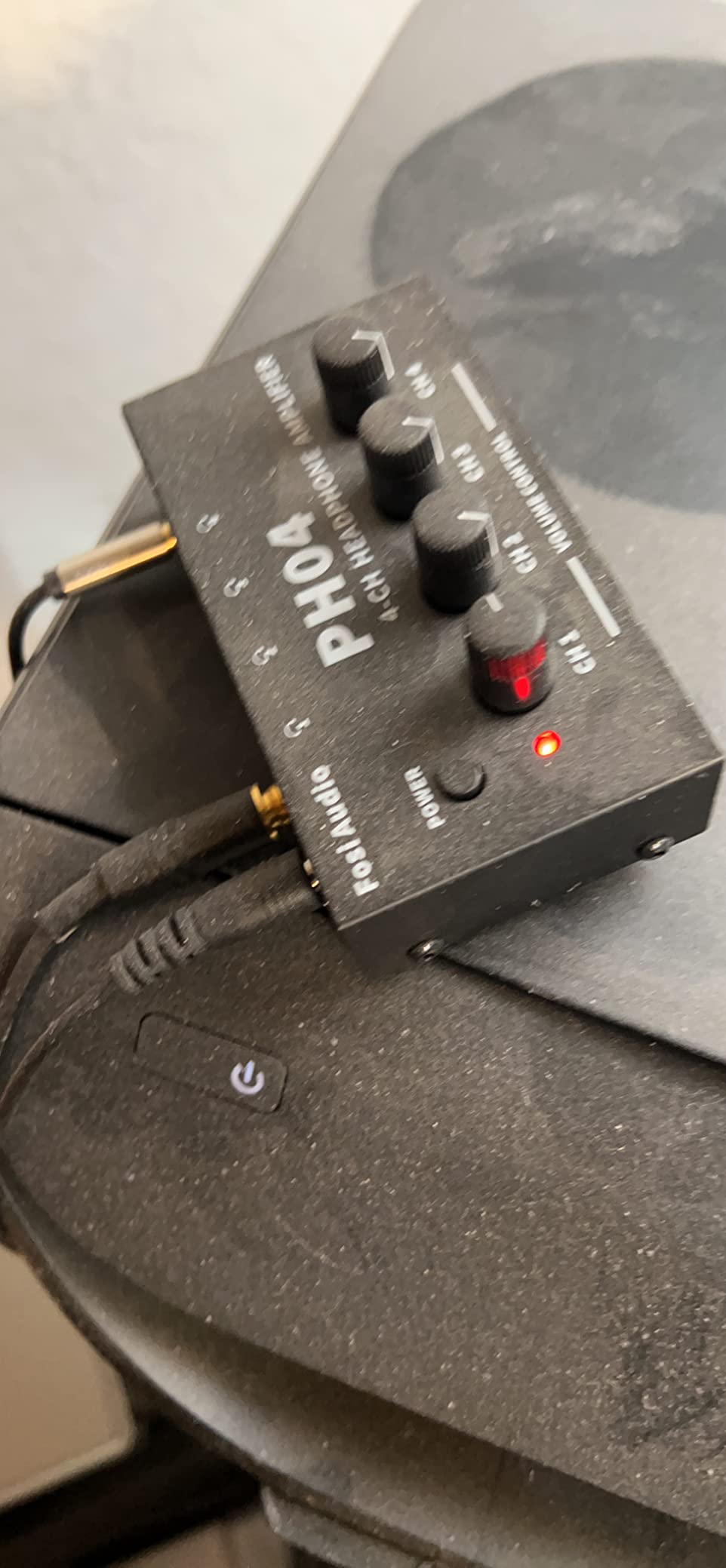
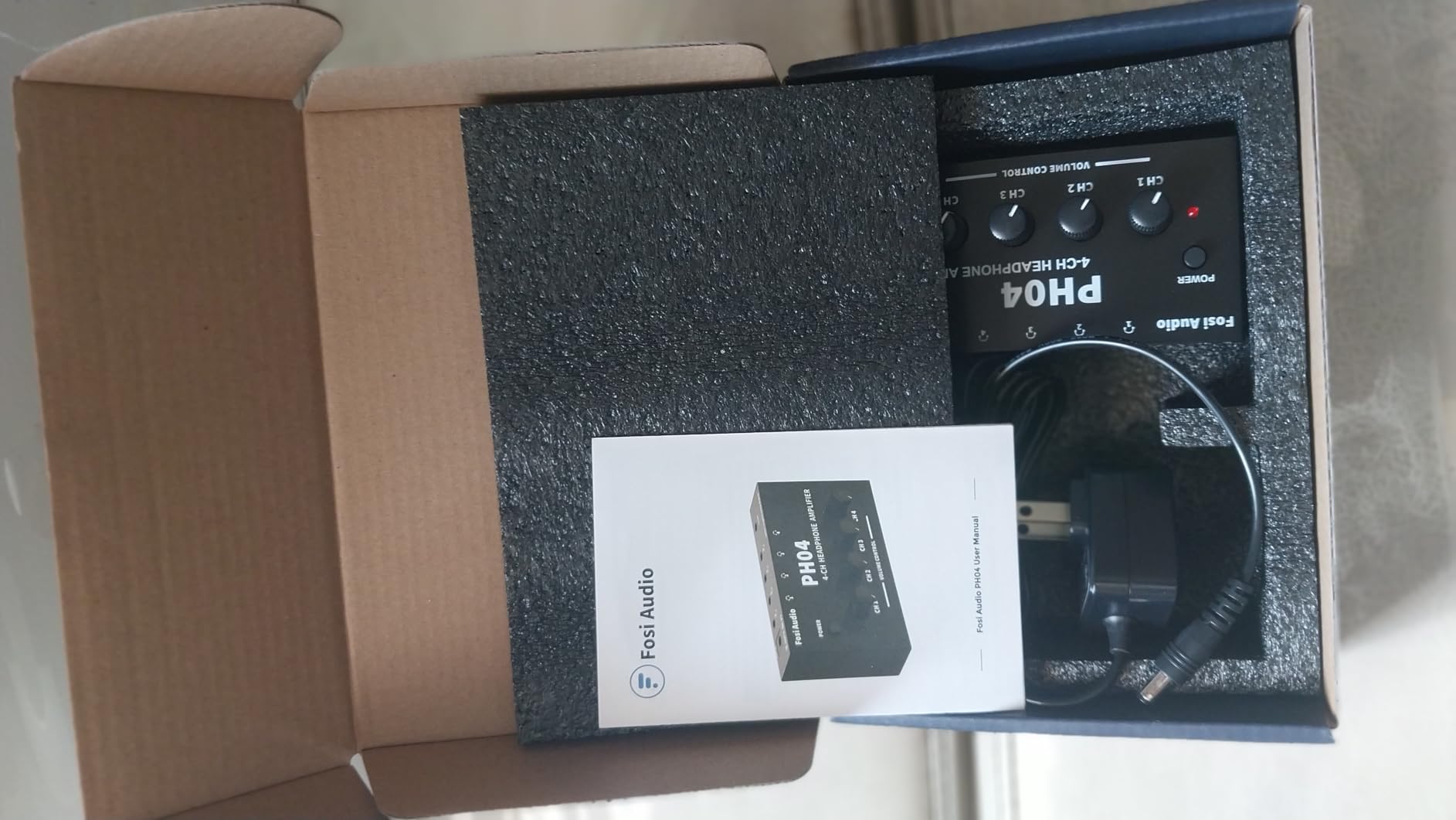
The chassis is metal and weighs 6.08 ounces, with a red face and a dedicated power switch. In the box you get a 12V DC power adapter and a user manual, backed by an 18-month manufacturer warranty.
Connectivity is 6.35mm on the output side, with 3.5mm support via an adapter. If your studio standard is quarter-inch Beyerdynamics or Sennheiser cans, buy a short adapter cable and keep it with the amp.
When the PH04 is the right buy
It is the right pick for a tracking session where four people share one interface and the interface itself is a decent source. At 80 ohm and below, the four independent sections behave exactly as advertised and each performer gets a real pot.
It is also the box to reach for when the budget is small and the priority is count of outputs rather than absolute volume.
When the PH04 will disappoint you
Do not feed it from a laptop headphone jack and expect clean level at the top of the rotation; reviewers report distortion there, and some units deliver less volume than a direct connection would. Weak sources are the failure mode, not the amp section.
You may also hear electrical noise when it is powered but idle or when touching the chassis and plug together. Older V1 units had power supply failures, and the V2 revision addresses that.
7. Behringer HA8000 V2 – Eight Channels for Full Sessions
Behringer HA8000 V2 8-Channel High-Power Headphone Mixing…
8 discrete high-power channels
Loads down to 8 ohm
Per-channel 8-digit LED meters
19-inch rack mountable
Pros
- Eight independent channels with ample power
- Per-channel LED meters make level matching quick
- Back-panel phones outputs support up to 16 headphone pairs
- Rack-mountable 19-inch format saves studio space
Cons
- Main in 1 and 2 do not reach channels with a direct input connected
- Only 1/4 inch TRS connectivity so 3.5mm headphones need adapters
- No balanced XLR main inputs
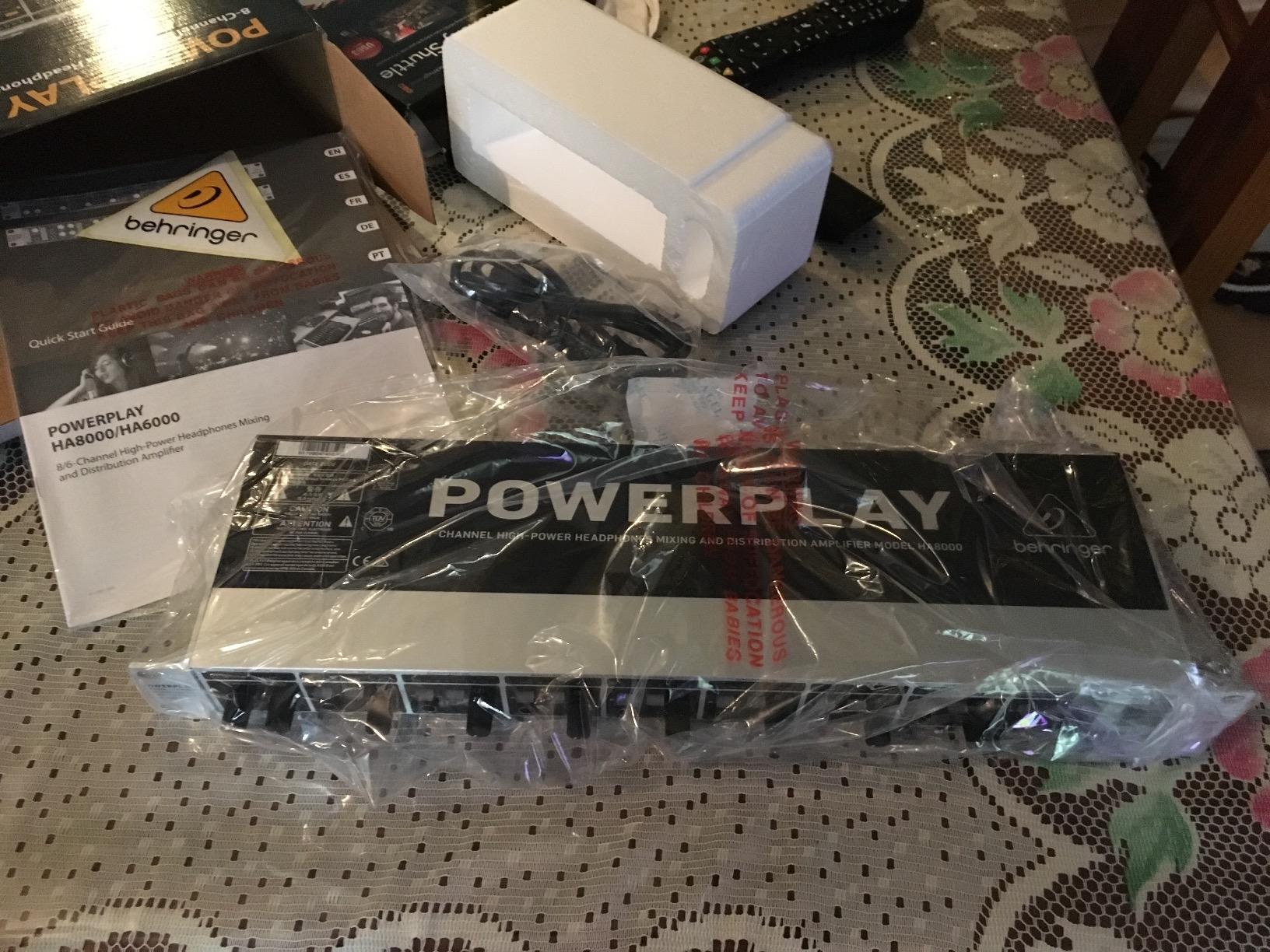
The HA8000 V2 is the distribution unit for a full tracking day. Eight discrete high-power amplifier sections drive loads down to 8 ohm, and up to 16 headphone pairs can listen to eight separate mixes through the per-channel rear phones outputs.
Church, rehearsal, live and home-studio users rely on it to feed multiple headphone and in-ear mixes, calling the sound quality and affordability excellent for the job. The most repeated caveat concerns routing behavior rather than audio quality.
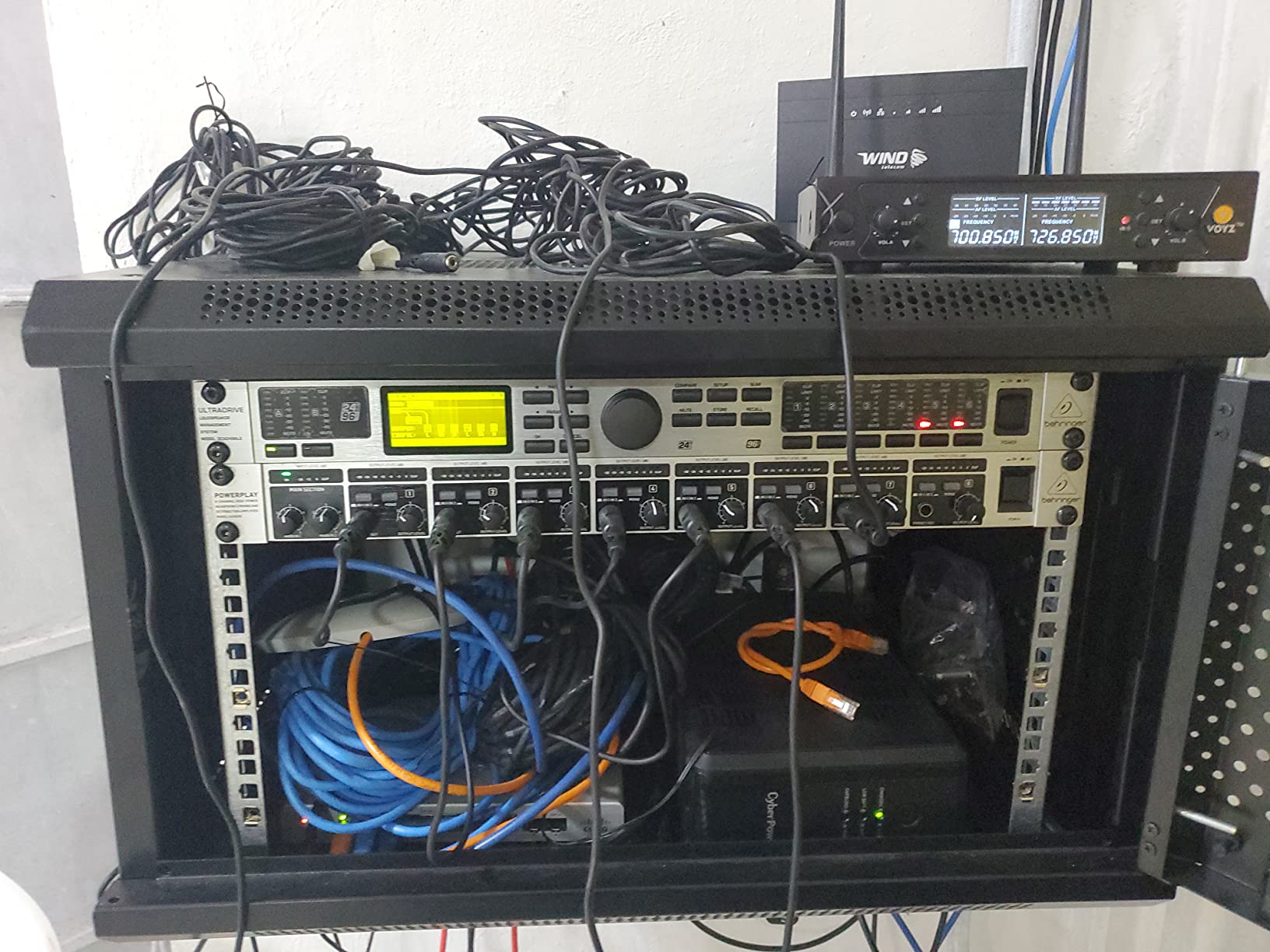
Each channel gets an 8-digit LED output level meter, a Main In 1 or Main In 2 select switch, and a stereo/mono or dual-mono select. That flexibility is what makes it useful for a band tracking, where the drummer may want a mono cue while the bassist wants a full stereo blend.
Per-channel 1/4 inch direct inputs let you feed a separate source straight into one channel, which is how you give a guest performer their own mix without touching the main routing.
Why studios reach for the HA8000 V2
Eight channels remove the need to max out interface headphone outputs, which is where hiss usually creeps in during a session. The LED meters make matching levels between performers quick, and the rack format keeps 16 headphone feeds out of the desk space.
It weighs 5.3 pounds and mounts in a standard 19-inch rack, so it lives next to your interface converters.
The routing behaviour to learn before you buy
Main in 1 and main in 2 signal only reaches channels that do not have a direct input engaged. That surprises buyers, so map your routing before the session rather than during it.
Connectivity is 1/4 inch TRS throughout, so plan cables or adapters for any 3.5mm headphones, and note that there are no balanced XLR main inputs. Older V1 units had power supply failures; this is the V2 revision.
8. ART HeadAMP4 – Eight Outputs in a Stackable Case
ART HeadAMP4 Eight Output Stereo Headphone Amplifier
8 outputs across 4 channels
3.5mm and 6.35mm jacks
4 watts output wattage
Stackable metal case at 1.1 pounds
Pros
- Eight independent headphone outputs at an unusually low price
- Lower noise lower distortion and more output than earlier small headphone amps
- Accepts both 1/8 inch and 1/4 inch inputs and outputs
- Stackable metal case suits home or project studios
Cons
- Older design with no USB input mute or meters
- Full 1/4 inch TRS outputs need adapters for 3.5mm headphones
- Identical per-channel level with no independent calibration
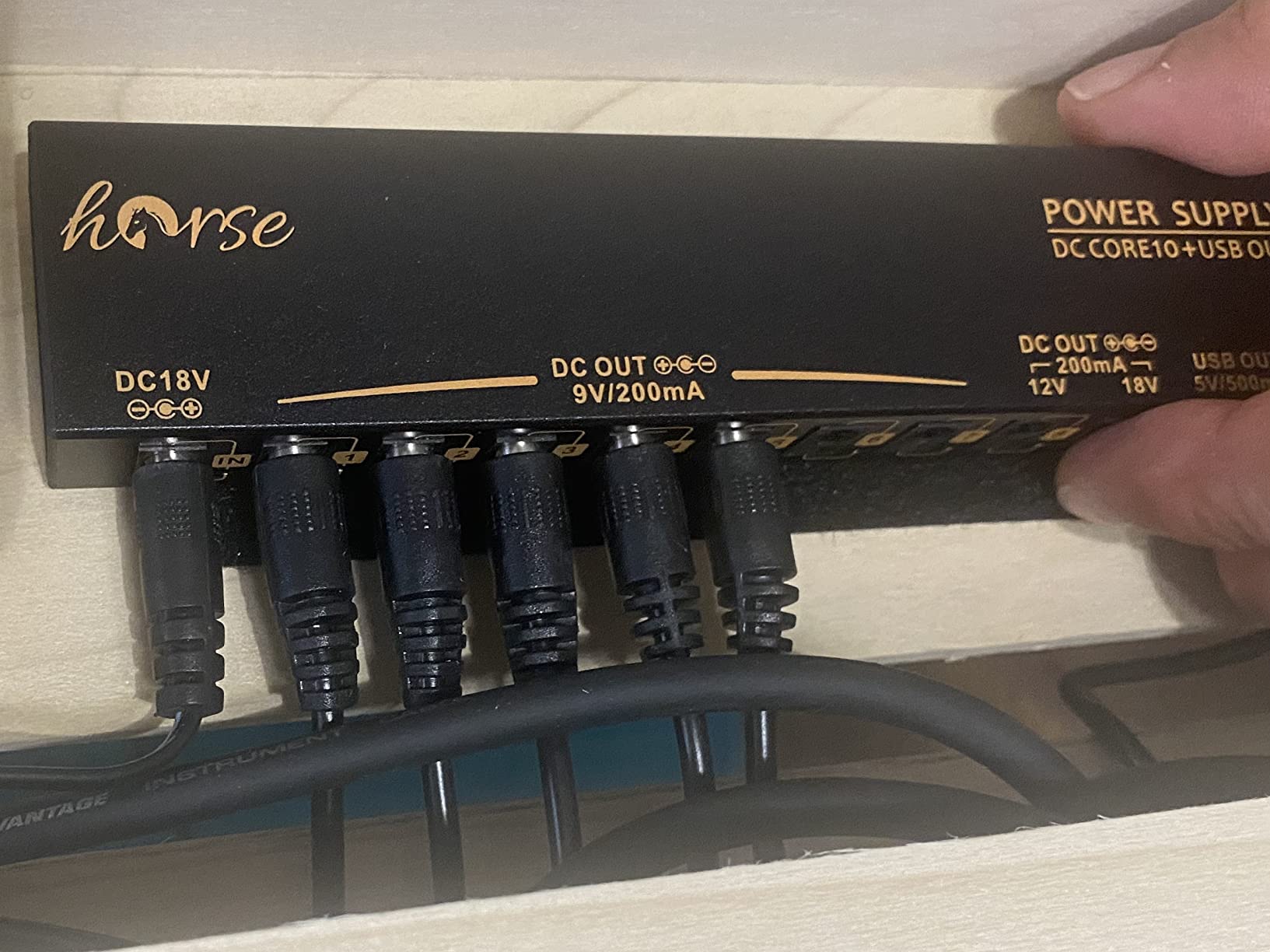
The ART HeadAMP4 has been a project-studio fixture for years, and its appeal has not moved: eight headphone outputs in a small metal case that stacks with other ART boxes. Each of the four channel sections delivers an output wattage figure of 4 watts.
A long-running budget favorite for anyone needing many headphone feeds, it is consistently rated as clean and low-noise for its price, with its stackable case and dual 3.5mm and 6.35mm connectivity making it a common home-studio choice. Feedback is functional rather than excited, focused on distribution utility.
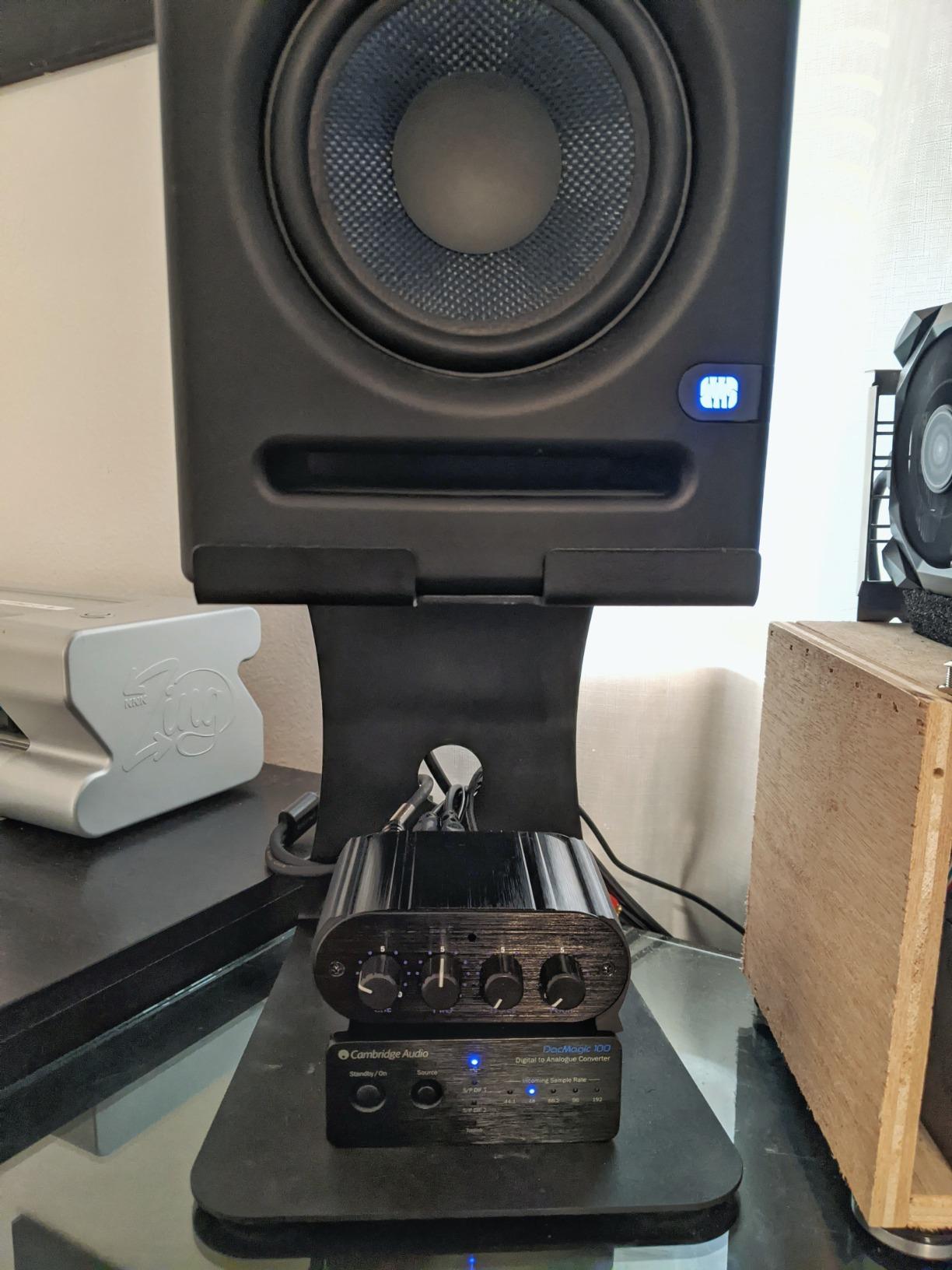
Inputs are equally flexible, accepting any device with a line-level source or a headphone output. That means you can feed it from an interface line out, a mixer bus, or a small DAC, which makes it easy to build a distribution layer that is not tied to one interface.
At 1.1 pounds it is light enough to reposition, and the metal construction tolerates the kind of moving a mobile rehearsal kit gets.
Where the HeadAMP4 fits
It is the sensible eight-feed answer for a rehearsal room, a church or a project studio that does not need meters or per-channel routing switches. Feed it a stereo bus and everyone hears the same mix at their own level.
Because it is solid-state with no tone controls, it does not colour what your engineers hear, which is the right behaviour for a mixing reference.
The limits worth knowing
It is an older design with no modern conveniences: no USB input, no mute, no meters. All outputs deliver an identical level, so you cannot calibrate one channel against another.
Some buyers report hum or channel imbalance on individual boxes, and the full 1/4 inch TRS outputs need adapters if your session mixes 3.5mm and quarter-inch headphones.
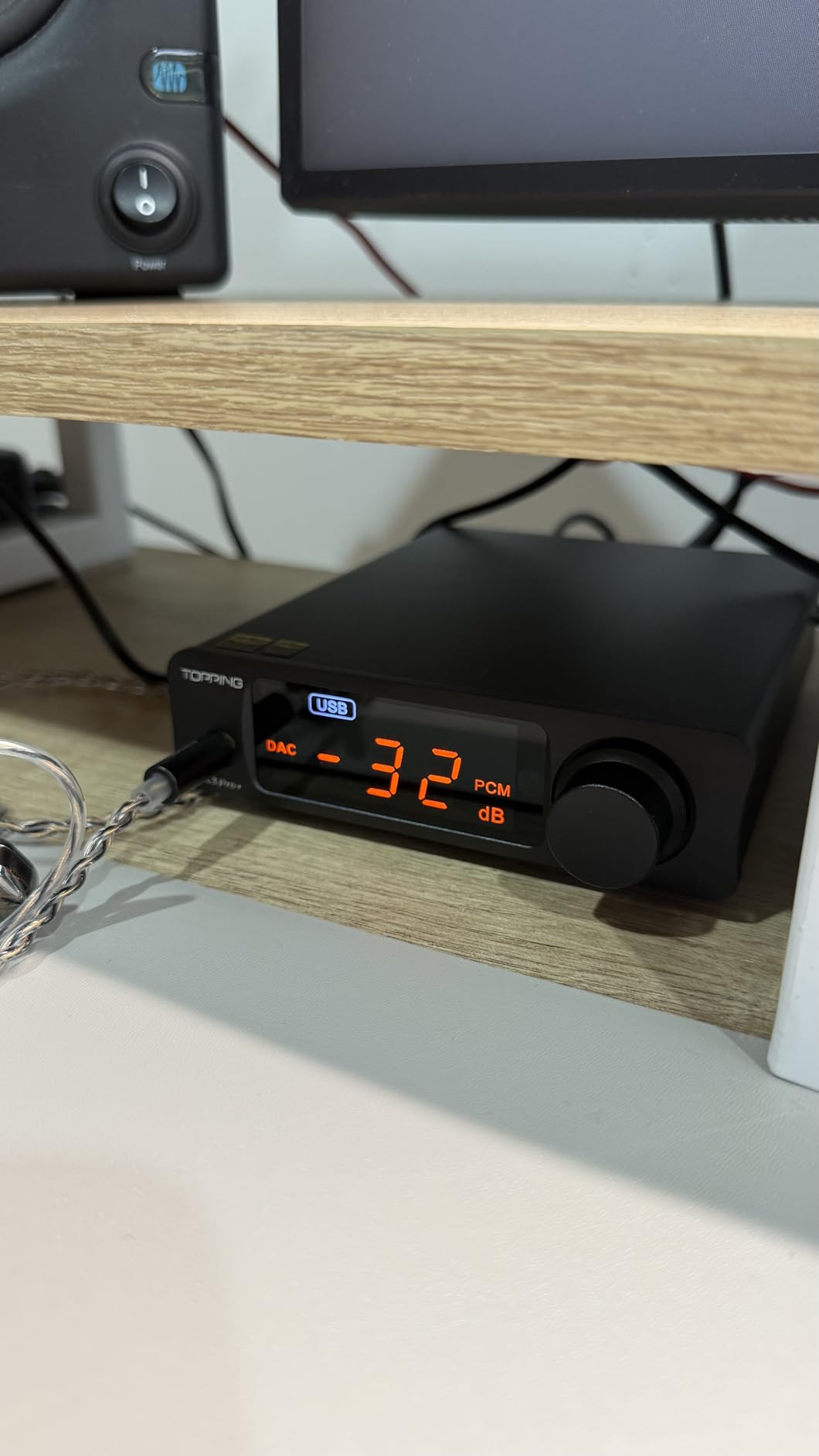
9. Topping DX3pro+ – Desktop Monitoring With Bluetooth
Topping DX3pro+ LDAC Headphone Amplifier – ES9038Q2M XU…
ES9038Q2M DAC with XMOS XU208
700mW balanced output
Bluetooth 5.0 with LDAC
Digital preamp with channel balance
Pros
- Clean ES9038Q2M decoding with plenty of detail and low noise
- 700mW balanced output drives most studio and hi-fi headphones
- Bluetooth 5.0 with LDAC aptX HD and aptX LL
- Digital preamp volume stays balanced between channels
Cons
- Digital volume control lacks true analog attenuation for sensitive setups
- Only 700mW so very hard-to-drive planars may struggle
- Balanced output is 4.4mm only with no XLR
The DX3pro+ is built around an ES9038Q2M DAC with an XMOS XU208 interface running NFCA topology, and it adds Bluetooth 5.0 with LDAC, AAC, SBC, aptX, aptX LL and aptX HD. For a producer checking a mix from a phone or tablet between takes, that wireless path is the reason to buy it.
Owners rate it as a capable, feature-rich one-box DAC/headphone amp whose decoding, balanced 700mW output and LDAC Bluetooth satisfy most desktop and studio monitoring needs. Criticism centers on volume implementation, limited power for difficult planars and occasional connectivity friction.
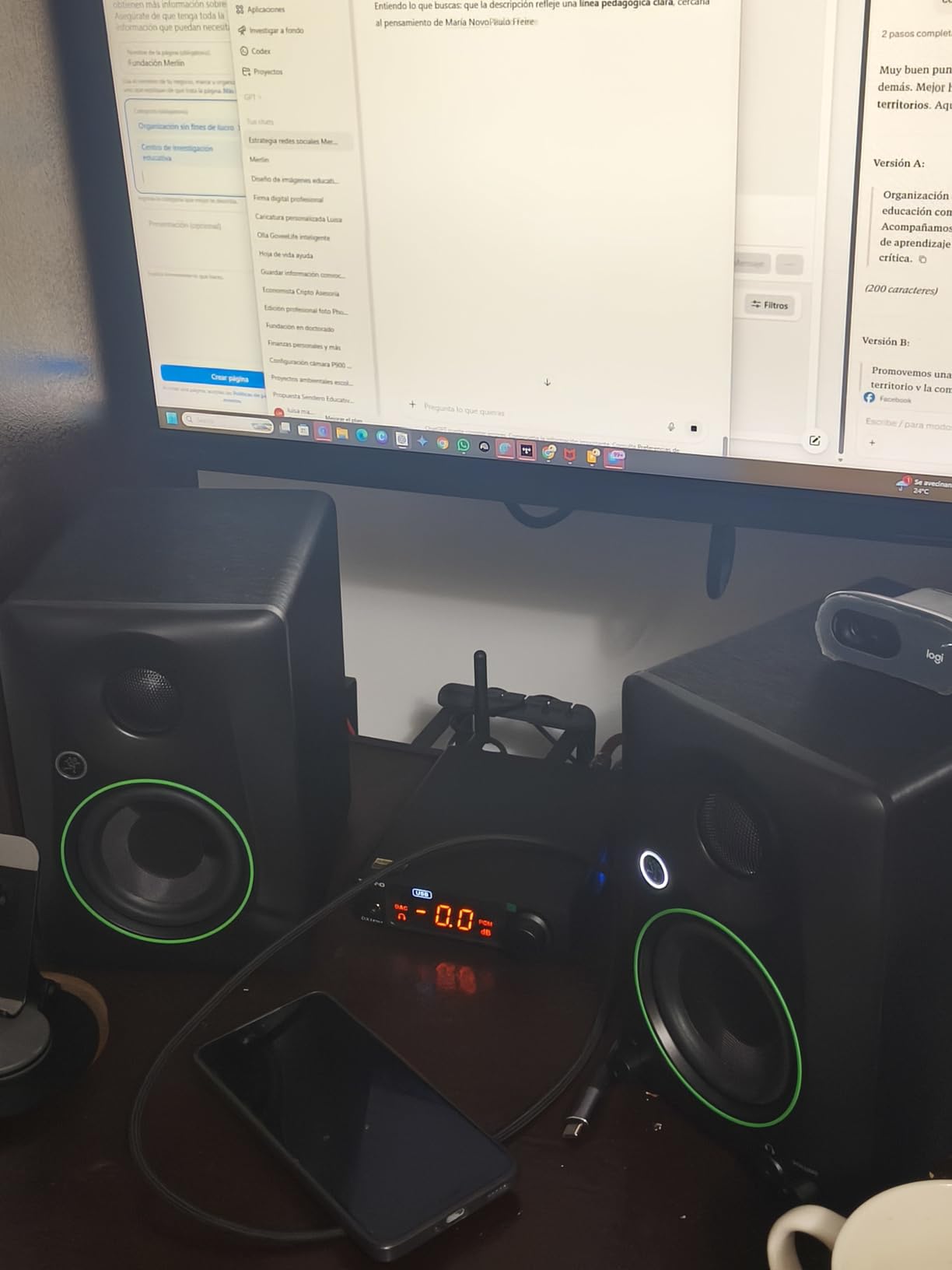
Inputs cover USB, optical, coaxial, Bluetooth and RCA line in. Outputs are 4.4mm balanced, 6.35mm single-ended and an RCA line out, with a digital pre-amplifier volume control that maintains channel balance through the attenuation range.
The chassis is aluminium at 5.08 by 6.54 by 1.61 inches, and the box includes a 15V adapter, remote control, USB cable and Bluetooth antenna.
Good fits and poor fits
It works well for reference checking on 80 ohm and 150 ohm headphones, spoken-word and voiceover work, and any setup where you want to audition mixes wirelessly. The remote control makes it usable from a listening position away from the desk.
Planar magnetics that demand real current are the poor fit, since 700mW is modest against the hardest loads. The digital volume control also lacks true analog attenuation, which sensitive in-ear monitors can expose as level imbalance.
Ownership details to factor in
Some buyers report Bluetooth pairing or firmware and driver friction, and the listing shows a higher share of critical one-star reviews than competing Fosi units. The brand is listed as a third-party seller rather than Topping directly, which affects warranty handling.
There is a 30-day return policy and a one-year free repair period or more, so buy it where returns are straightforward.
10. Zoom ZHA-4 – Portable Four-Channel Monitoring
Zoom ZHA-4 4-Channel, Battery-Powered Headphone Amplifier…
4 independent 3.5mm outputs
Per-channel volume and mute
Two AA batteries or USB Type-C
367 g
Pros
- Portable battery-powered four-channel monitoring for location and podcast work
- Per-channel volume and per-channel instant mute
- Runs on two AA batteries or USB Type-C from a wall adapter battery pack or computer
- Straightforward controls suited to fast session setup
Cons
- 3.5mm outputs only so 6.35mm studio headphones need an adapter
- Lower output power than mains-powered studio headphone amps
- Modest feature set with no EQ tone shaping or digital input
The ZHA-4 is the only battery-powered amp here, and that changes what it is for. It gives you four independent 3.5mm headphone outputs, each with a dedicated volume knob and its own mute button, running from two AA batteries or USB Type-C.
Buyers value it as a portable, battery-capable four-way headphone splitter for podcasting, rehearsal and mobile recording, where per-channel mute is the standout feature. Feedback is mixed overall, with lower ratings tied to limited output power and the small 3.5mm-only connector format.
USB Type-C means it can run from a wall adapter, a battery pack or a laptop, so a location recording has no power dependency at all. It weighs 367 g and comes with a stereo mini audio cable and quick guide.
Where the ZHA-4 earns its place
Podcast and voiceover recording is the clearest case: four speakers, per-channel mute for handing the floor to each guest in turn, and no dependence on mains power. Rehearsal and drum-tracking sessions on location benefit from the same combination.
A one-year replacement warranty covers the risk of taking it out of the studio.
Why it is not a control room choice
The output power is lower than any mains-powered amp on this list, so it will not drive 250 ohm or 300 ohm studio headphones to a working reference level. The 3.5mm-only outputs also mean an adapter for every quarter-inch headphone in the session.
There is no digital input and no tone shaping, so it cannot act as a standalone DAC/amp for a tracking chain.
How to Choose a Headphone Amp for Your Studio
Match the amp to your headphone impedance
Impedance is the first filter. It tells you how much voltage the driver needs to reach level and how much current your amp must supply.
16 to 32 ohm (planar magnetic, some in-ears): low impedance but high current demand. You need an amp rated for real power into 32 ohm, and you want steady current delivery rather than a large voltage swing.
38 to 80 ohm (ATH-M50x, DT 770 Pro 80 ohm): the easiest studio category. Most amps, including the four-way splitters, drive these comfortably.
150 to 250 ohm (DT 880, HD 650/HD 6XX, many open-backs): voltage-hungry. Interface outputs often fall short here, which is where an external amp pays for itself.
300 to 600 ohm (DT 990 Pro): the hardest dynamic loads in common studio use. Look for a stated output voltage figure, not just wattage.
The consensus across Head-Fi and Audio Science Review discussion is that constant-current drive improves instrument separation and transient speed on high-impedance monitoring headphones, which is precisely what you want when judging whether a reverb tail has really ended.
Output voltage beats milliwatts into 32 ohm
Milliwatts into 32 ohm is a marketing number. It tells you almost nothing about whether an amp can drive a 300 ohm dynamic headphone or a low-impedance planar, and it rewards products designed for gaming headsets.
What matters is stated output voltage in volts peak-to-peak, because that is what raises the level in a high-impedance load. An amp that quotes several volts peak-to-peak will drive 250 ohm and 300 ohm open-backs. An amp that only quotes 100mW into 32 ohm probably will not.
Forum guidance makes the same point from the studio side: a good studio headphone amp should perform equally well into 8 ohm and 600 ohm headphones, since traditional studios encounter both.
DAC or pure amplifier: which upgrade comes first
A DAC converts a digital signal to analogue. A headphone amplifier raises a line-level analogue signal to headphone level. They solve different problems, which is why you can buy either one alone.
If your interface already has clean line outputs, a pure amplifier such as the Schiit Magni Unity keeps the chain short and adds no conversion stage. If you want one box to handle a laptop, a game console or optical sources, a DAC/amp combo such as the Fosi K7 or Topping DX3pro+ makes the desk simpler.
For mixing decisions, the shorter chain is generally the safer one, because every stage is a chance for something to alter the signal.
Balanced output and when it actually helps
A balanced connection carries audio on a plus and minus signal pair, and it cancels interference picked up along a long run. In a studio the benefit is modest, because the cable from interface to amp is short and inside your own rack or desk.
It helps when your headphones are genuinely balanced internally, which many high-end planars are. Amp output here is 4.4mm balanced on the Fosi K7 and Topping DX3pro+, with 4.4mm plus XLR on the Fosi ZH3.
Check that your interface can feed it. A 4.4mm balanced output needs a true balanced source, not an unbalanced RCA jack.
Gain settings and sensitive in-ear monitors
Gain is the amp’s internal amplification factor, and a multi-position gain switch is the feature that separates a monitoring amp from a general headphone amp. Two positions force mid-impedance headphones into an uncomfortable volume spot. Three positions, ideally including a negative or low step, cover in-ear monitors and 600 ohm dynamics without the volume pot fighting back.
Channel balance matters too. An amp with a potentiometer and poor matching can shift the image when you turn down, which is a genuine problem in a mixing context. Digital volume controls in DAC/amp combos solve it at the cost of true analog attenuation.
Tube versus solid-state for mixing decisions
Solid-state is the default for studio monitoring because it measures flatter, adds less harmonic distortion, and behaves predictably as level changes. Every amp in this roundup is solid-state, and that is a deliberate choice.
Tube amplification adds harmonic coloration that some producers prefer for a particular sound. That preference is a mixing decision, not a fidelity one, and it changes what you hear between projects.
Latency and direct monitoring paths
Latency is the delay between the audio leaving your interface and returning to your headphones. When you monitor through the interface headphone jack in direct mode, that path is the shortest available.
Adding an external DAC or amp introduces a second conversion and buffering stage. For mixing and mastering that delay is irrelevant, because you are not performing to it. For tracking a live performance, small delays add up and can affect timing on a singer or drummer.
Building the shortest chain for tracking means monitoring from the interface, or confirming your interface buffer setting before you rely on it. Forum threads about low-volume direct monitoring on popular interfaces come back to exactly this tradeoff.
Cue mixes and multi-performer headphone distribution
A cue mix is the per-performer headphone blend a tracking engineer builds, and no consumer headphone amp roundup addresses it because it is not a consumer problem. For three or more performers, set up cue mixes like this:
Build each blend as its own bus in your DAW or on a hardware mixer.
Route each bus to an independent output on your interface, or through a small mixer with enough buses.
Feed those outputs into a multi-channel distribution amp with one volume pot per channel.
Give each performer their own level and confirm with them that they are not clipping their ears to get a signal.
Keep the engineer’s own reference feed separate so your monitoring level never moves with the performers’.
For four performers, the Mackie HM-4 or Fosi PH04 cover the job. For eight channels with per-channel routing and meters, the Behringer HA8000 V2 is the one to build around. Our guide to headphone amplifiers and distribution systems for studio sessions covers the routing side in more detail.
Monitoring level discipline matters here too. Mix at a consistent level rather than chasing perceived loudness, and take breaks: long sessions on high-impedance headphones at high level are the main hearing risk in a control room.
One more practical note from forums and our own testing: inexpensive extension cables and passive splitters are repeatedly blamed for monitoring problems. Use a short cable from the amp and keep long runs out of the signal path where you can.
Frequently Asked Questions
Do I need a headphone amp if my audio interface has a headphone jack?
Usually not, if your interface has a current-feedback headphone stage and your headphones are 80 ohm or lower. You do need one when your headphones are 250 ohm, 300 ohm, 600 ohm or a low-impedance planar, when you need to track loud, or when the jack runs out of clean level and starts adding noise.
What impedance headphones do I need an amplifier for?
Plan for an external amplifier at 150 ohm and above, and for any planar magnetic regardless of its rated impedance. Headphones at 38 to 80 ohm, such as the Audio-Technica ATH-M50x or the Beyerdynamic DT 770 Pro at 80 ohm, are driven comfortably by most interface outputs and by every four-way splitter in this guide.
What is the best headphone amp for in-ear monitors?
Pick an amp with a low or negative gain step and a low noise floor, because sensitive in-ears amplify hiss along with signal. The Schiit Magni Unity offers negative gain, and the Fosi ZH3 has a three-level gain switch with a stated 1.9 microvolt noise floor. Keep the gain low and turn the volume down rather than pushing an amp harder.
What is the best headphone amp to buy right now?
For most studios the Mackie HM-4 is the best overall buy because four independent level controls solve the cue mix problem that most engineers actually have. For a single-engineer desk, the Fosi Audio K7 handles power and conversion in one box. For hard planars, the Fosi ZH3. For eight performers, the Behringer HA8000 V2.
Is a tube headphone amplifier appropriate for mixing work?
It can be, but understand that a tube stage colours the signal, and that changes what you hear between sessions. Solid-state amplifiers measure flatter and add less distortion, which is why every amp recommended here is solid-state. Choose a tube design only when you like how it colours your mixes and can live with that consistency.
Which headphone amp has the lowest latency for tracking?
The lowest-latency path is the one with the fewest stages, which is usually your interface headphone jack in direct monitoring mode. Any external DAC or amp adds a conversion and buffering stage, though the added delay is rarely a problem for mixing or mastering. For live tracking, confirm your interface buffer size before committing to an external chain.
How many watts do I need to drive 300 ohm headphones?
For a 300 ohm dynamic headphone, output voltage matters more than wattage. Look for an amp quoting several volts peak-to-peak rather than a milliwatt figure into 32 ohm. The Rupert Neve Designs RNHP handles 250 ohm and 300 ohm models comfortably, and higher-impedance loads need more voltage again, not more power.
Which Studio Headphone Amp Fits Your Room
Start with the number of people on headphones. One engineer, 80 ohm closed-backs and a good interface: you may not need to buy anything at all. One engineer with high-impedance open-backs or a planar magnetic: the Fosi Audio ZH3 gives you the most voltage and current headroom in this group, while the Schiit Magni Unity is the cleanest two-box chain if your interface line outputs are already excellent.
Two to four performers: the Mackie HM-4 is the pick, and the Fosi PH04 does the same job for less if your source is a solid interface output rather than a laptop. Eight performers or a rehearsal room: the Behringer HA8000 V2 with its per-channel meters and routing switches, or the ART HeadAMP4 when count matters more than meters.
On the road: the Zoom ZHA-4, because battery power and per-channel mute solve problems that mains-powered rack gear cannot.
Whichever one you land on, match the amp to the headphone impedance, keep your gain setting low when the volume pot is low, and mix at one consistent monitoring level. Those habits matter more to the quality of your decisions than any upgrade past this list. If you are still comparing headphone pairs, start with our headphone stand picks so your new amp is not sitting next to tangled cables.