
12 Best Air Compressors for Garage (July 2026) Buyer’s Reviews
The best air compressors for garage work match the air demand of the tool, not just the largest tank that fits in the corner. A compact oil-free unit can make tire inflation, brad nailing, and dusting off a bench easy, while a larger compressor with stronger CFM at 90 PSI is the more sensible choice for ratchets, sanders, paint work, and repeat automotive tasks.
For 2026, I compared the 12 analyzed models by their listed tank size, airflow, pressure, voltage, noise rating, pump type, portability features, rating, and review volume. I did not treat a high maximum PSI as a substitute for airflow; a tool that consumes air continuously cares most about the compressor’s delivery rate at its working pressure.
Contents
A garage air compressor is an electric motor and pump that compresses air into a tank, then sends it through a regulator and hose to a pneumatic tool. That makes one machine useful for tire inflation, nailers, blowing debris, light automotive repair, and selected paint jobs, provided its CFM and duty cycle fit the job.
Noise deserves the same attention as output in a home garage. Community discussions repeatedly warn that many pancake compressors are loud enough to make a short task unpleasant, while quieter listed ratings around 66 to 70 dB can be easier to live with when the garage is attached to the house.
Top 3 Picks for Best Air Compressors for Garage (July 2026)
If I were narrowing this list quickly, the ECOMAX covers portable light-duty work, the Klutch supplies a useful step up for a wired home workshop, and the AAIN makes a compact, quiet alternative for owners who want a small tank with a stated high airflow figure. Check your specific tool manual before choosing any of the three.
ECOMAX 6 Gallon: Choose it for a carryable 120V oil-free compressor with 150 PSI, dual couplers, and a hose kit for tires and intermittent fastening.
Klutch 20-Gallon: Choose it for a vertical 120V unit with 5.2 SCFM at 90 PSI and 175 PSI storage when a six-gallon tank would have frequent recovery breaks.
AAIN 6.3 Gallon: Choose it for an oil-free, 110V twin-cylinder model listed at 70 dB with a stated 5.5 to 6 CFM figure.
As an Amazon Associate we earn from qualifying purchases.
12 Best Air Compressors for Garage in 2026
The quick comparison below includes every model in this guide. Treat it as a shortlist tool: the stated CFM, voltage, tank capacity, and form factor show which products deserve a closer look for your garage workshop compressor setup.
| Product | Features | |
|---|---|---|
 ECOMAX 6 Gallon Pancake ECOMAX 6 Gallon Pancake |
|
View Product Details |
 RyanTek 15-Gallon Vertical RyanTek 15-Gallon Vertical |
|
View Product Details |
 Limodot 5-Gallon Quiet Limodot 5-Gallon Quiet |
|
View Product Details |
 Klutch 20-Gallon Klutch 20-Gallon |
|
View Product Details |
 Nessxa 8-Gallon Nessxa 8-Gallon |
|
View Product Details |
 VEVOR 13-Gallon VEVOR 13-Gallon |
|
View Product Details |
 AAIN 6.3 Gallon AAIN 6.3 Gallon |
|
View Product Details |
 VEVOR 20-Gallon 220V VEVOR 20-Gallon 220V |
|
View Product Details |
 DEWALT 20V MAX 2.5 Gallon DEWALT 20V MAX 2.5 Gallon |
|
View Product Details |
 VEVOR 14-Gallon VEVOR 14-Gallon |
|
View Product Details |
 MZB 13.2 Gallon MZB 13.2 Gallon |
|
View Product Details |
 DEWALT 25-Gallon Vertical DEWALT 25-Gallon Vertical |
|
View Product Details |
We earn from qualifying purchases.
1. The ECOMAX 6-Gallon Pancake is the practical portable pick for light garage tasks.
ECOMAX Air Compressor 6 Gallon 150 PSI Pancake Portable...
6 gal
150 PSI
3 CFM at 90 PSI
120V
Pros
- 4.7 rating from 273 reviews
- dual quick couplers
- oil-free pump
- hose included
Cons
- 3 CFM limits continuous tools
- pancake form needs floor space
ECOMAX pairs a six-gallon tank with a 1.5 HP oil-free pump, 150 PSI maximum pressure, and listed 3 CFM air delivery at 90 PSI. Its 4.7 rating from 273 reviews is the strongest combination of rating and review depth in this group, which is why it leads this roundup.
I like the practical package here: a 25-foot PVC hose, dual gauges, a flip-up carry handle, and two quick couplers are all listed. At 34.17 pounds, it is a portable garage compressor rather than a fixed installation, so it can come out for a task and return to a shelf afterward.
Three CFM at 90 PSI points this model toward tire inflation, blowing dust from work areas, brad or finish nailing, and short bursts from lower-demand tools. It will not keep an air-hungry sander or a sustained spray session supplied without pauses for recovery.
The ECOMAX fits intermittent tools and shared workstations.
The two couplers make this a convenient choice when two people need air access, though the tank and airflow are still finite. I would use one connection for a tire chuck or nailer and reserve the second for quick accessory swaps rather than trying to run two continuous-demand tools.
The 150 PSI ceiling gives the tank more stored pressure than many small compressors, which can extend a short work burst before the motor restarts. The useful question is still your tool’s CFM requirement at its specified working PSI.
The ECOMAX needs recovery time for sanding and painting.
A six-gallon pancake tank is not a substitute for high free-air delivery. If your paint gun, die grinder, or air sander calls for more than 3 CFM at its operating pressure, expect pressure drop and motor cycling.
The oil-free pump removes oil changes from the routine, but draining condensed water from the tank after use remains smart practice. Put it on a firm, level surface with room around the intake and motor for airflow.
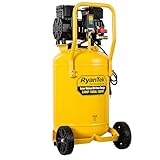
2. The RyanTek 15-Gallon Vertical gives a quiet, space-conscious step up.
15-Gallon Air Compressor,2HP,Vertical Tank...
15 gal
4.5 CFM at 90 PSI
66 dB
110V
Pros
- Quiet 66 dB listing
- vertical storage
- dual outlets
- wheels and handle
Cons
- Only 19 reviews
- 125 PSI maximum
The RyanTek uses a 15-gallon vertical tank, 2 HP motor, and oil-free twin-cylinder pump, with a listed 4.5 CFM at 90 PSI. It is a middle ground for a residential garage compressor: notably more reserve than a pancake model without taking the floor length of a horizontal tank.
The stated 66 dB rating is one of the lowest in the analyzed data. Forum discussions show why that matters: owners of attached garages often care as much about the startup sound as they do about maximum pressure.
Its 4.6 rating is based on 19 reviews, so I would read the newest owner feedback carefully instead of assuming the score tells the whole durability story. The integrated wheels, handle, and dual outlets make the physical design more flexible than a fixed vertical compressor.
The RyanTek works well when noise and footprint come first.
A vertical tank places its storage height upward, making it useful beside a bench or along a wall where floor depth is limited. Measure the full height and leave clearance for hose routing, the drain valve, and the controls before committing to a location.
The 110V supply is a major convenience for many home garages. A dedicated circuit is still preferable, because compressors draw a strong startup load and long extension cords can reduce voltage at the motor.
The RyanTek is best for light-to-medium pneumatic demand.
At 4.5 CFM at 90 PSI, it has a better basis for repeated nailer use and intermittent automotive jobs than the smallest tanks here. It is not presented as a continuous-duty industrial compressor, so leave recovery time during heavier tasks.
The 125 PSI maximum pressure is adequate for common regulated air-tool settings. Higher tank PSI can add stored air, but it does not by itself raise the rate at which the pump can maintain a running tool.
3. The Limodot 5-Gallon Quiet is a compact low-noise choice for nailers and inflation.
Quiet Oil-Free Air Compressor, 68 dB, 2.8 CFM @ 90 PSI...
5 gal
2.8 CFM at 90 PSI
120 PSI
110V
Pros
- Quiet operation claim
- 80-second refill
- accessory kit
- compact steel tank
Cons
- 2.8 CFM is modest
- 5 gallon reserve
Limodot lists a five-gallon steel tank, a 1.2 HP motor, and 2.8 CFM at 90 PSI. Its feature list calls out 68 dB operation, while the supplied specifications record 70 dB, so I would treat it as a quieter small compressor rather than assume a precise sound result in every garage.
The oil-free design, 25-foot hose, and 13-piece accessory kit make it approachable for a first air compressor for home garage use. The listing also says it refills from empty to full in 80 seconds, a helpful figure for understanding how quickly a small tank can return to service.
With a 4.5 rating across 191 reviews, the Limodot has more feedback behind it than several similarly sized alternatives. I would choose it for a garage where occasional tasks and lower perceived noise matter more than extended run time.
The Limodot suits woodworking trim and car-care basics.
A finish nailer, brad nailer, tire chuck, blow gun, and similar short-burst accessories fit the capacity and airflow profile. The five-gallon tank also keeps the unit compact enough to store under a sturdy bench if ventilation and access to the drain are maintained.
Oil-free pumps are attractive for owners who do not want oil checks as part of every maintenance routine. You still need to inspect hose fittings for leaks and release tank moisture, since water collection is not related to pump lubrication.
The Limodot is not a continuous-air solution.
Its 2.8 CFM at 90 PSI is below the needs of many air sanders, larger spray guns, and continuous blow-off work. A tool can operate briefly from tank reserve, then force a pause while the compressor recovers.
That limitation is normal for compact models, not a defect. I would rather pair it with low-demand jobs than buy it for a project that requires the motor to run near nonstop.
4. The Klutch 20-Gallon is the strongest all-round 120V workshop upgrade.
Klutch 20-Gallon Air Compressor, 2 HP, 120 Volts, 175 PSI
20 gal
5.2 SCFM at 90 PSI
175 PSI
120V
Pros
- 20 gallon reserve
- 175 PSI
- 5.2 SCFM at 90 PSI
- wheels and handle
Cons
- 80 dB listing
- 90 pound machine
The Klutch combines a 20-gallon vertical tank, 175 PSI maximum pressure, and 5.2 SCFM at 90 PSI on 120V power. That data makes it the clearest choice here for an owner who has outgrown a small pancake tank but does not have 220V service available.
Its 4.4 rating is based on 636 reviews, the largest review count in the list. That is meaningful context for a product meant to sit in a garage for years, though individual reviews should still be checked for installation, support, and long-term ownership patterns.
A 90-pound weight and tall 41.5-inch vertical body put it in the semi-stationary category. Large rubber wheels and an ergonomic handle can help reposition it, but I would plan its home first instead of expecting to carry it around the garage.
The Klutch supports broader home-shop tool use.
At 5.2 SCFM at 90 PSI, the Klutch has more headroom for repeated impact-wrench work, air ratchets, nailers, and other intermittent tools than the sub-3-CFM options. It is also more comfortable when several short tasks happen in sequence because the 20-gallon tank stores more usable air.
The thermal overload protection adds a stated safeguard against motor overheating. It does not change the duty cycle, so a demanding tool should still be matched to available CFM rather than run until the protection trips.
The Klutch needs a realistic noise and circuit plan.
The listed 80 dB noise level is louder than the quiet models in this guide. Positioning it away from a shared wall, using appropriate hearing protection, and avoiding late-night use can matter in a residential setting.
Although it uses ordinary 120V power, a compressor of this size should have a suitable dedicated circuit according to its manual and local electrical requirements. Avoid undersized extension cords because voltage drop can make motor starts harder.
5. The Nessxa 8-Gallon is a quiet, compact option with two quick couplers.
Ultra Quiet Air Compressor 8 Gallon, 1.5HP 4.52 CFM Max...
8 gal
4.52 CFM
115 PSI
110V
Pros
- 8 gallon anti-rust tank
- 70 dB claim
- two quick couplers
- overheat protection
Cons
- 115 PSI maximum
- CFM operating point not specified
Nessxa lists an eight-gallon anti-rust steel tank, a 1.5 HP oil-less motor, 115 PSI maximum pressure, and 4.52 CFM. That extra tank capacity is appealing for garage owners who want more reserve than a pancake compressor but still want a comparatively compact machine.
The 70 dB claim, muffler, and filter cotton are its main quiet-operation story. I would call it a sensible candidate for an attached garage, while remembering that room acoustics, flooring, and how close you stand all affect the sound you hear.
Two quick couplers and automatic overheating protection round out a feature set aimed at everyday garage work. Its 4.4 rating comes from 219 reviews, giving it a larger feedback base than many of the newer vertical products.
The Nessxa balances stored air with simple portability.
An eight-gallon tank is useful for stretching the time between motor cycles during tire work and fastening. The oil-free pump also suits an owner who wants a lower-maintenance routine and clean output for general shop tasks.
I would keep a short, quality hose on the machine and use a longer hose only when needed. That arrangement can keep the compressor near power and away from the work area without turning the garage floor into a tripping hazard.
The Nessxa needs CFM verification for demanding tools.
The supplied product data lists 4.52 CFM but does not state the pressure at which that airflow is measured. Since pneumatic tool requirements are typically expressed at a set PSI, compare the manual’s verified delivery rating with your tool before choosing it for sanding or painting.
Its 115 PSI maximum is enough for many regulated tools, but it has less pressure reserve than the 150, 175, and 200 PSI models here. Capacity and true delivery count more than headline pressure when a tool runs continuously.
6. The VEVOR 13-Gallon is a quiet 120V model for versatile garage projects.
VEVOR 13-Gallon Air Compressor, 2HP, 4.6 SCFM@90PSI...
13 gal
4.6 SCFM at 90 PSI
66 dB
120V
Pros
- 4.6 SCFM at 90 PSI
- quiet 66 dB claim
- wheeled tank
- oil-free pump
Cons
- 125 PSI maximum
- 70.99 pound weight
This VEVOR uses a 13-gallon tank and 2 HP motor, with 4.6 SCFM at 90 PSI and 125 PSI maximum pressure listed in the product data. It offers a useful blend of delivery and tank reserve for a home garage where light automotive repair and woodworking happen regularly.
The stated 66 dB sound level is a major differentiator on paper, especially compared with the 78 to 80 dB products in this list. VEVOR also says air buildup takes under three minutes, which gives a practical sense of its recovery behavior from an empty tank.
At 4.4 from 184 reviews, it has a decent amount of customer feedback, but it is still worth checking review dates and recurring concerns before a long-term purchase. The two reinforced seven-inch wheels add mobility for a 70.99-pound unit.
The VEVOR 13-Gallon handles medium-demand garage routines.
The 4.6 SCFM at 90 PSI figure is a meaningful step above compact nailer compressors. I would look at this size for tire inflation, repetitive fastening, air ratchet tasks, blowing debris, and paint work only when the gun’s CFM requirement leaves adequate headroom.
The oil-free configuration removes oil changes, which is useful when maintenance simplicity is a priority. Let the machine cool between extended demands and keep its intake clean so it can breathe freely.
The VEVOR 13-Gallon still needs a parking spot and airflow.
Its listed 17.5 by 16.5 by 33.3 inch dimensions make it more upright than a long horizontal compressor. A corner location can work well, provided the wheels do not block the drain and you can reach the regulator and outlets without moving it every time.
Do not box a compressor tightly into a cabinet to hide noise. The motor and pump need surrounding air, and a confined enclosure can retain heat and make maintenance less convenient.
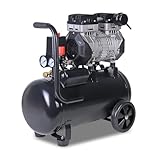
7. The AAIN 6.3-Gallon is the compact pick with a high listed airflow claim.
AAIN 6.3 Gallon Air Compressor | 1.5 HP 5.5-6 CFM...
6.3 gal
5.5-6 CFM stated
116 PSI
110V
Pros
- Twin-cylinder induction motor
- 70 dB listing
- fast 2.75 minute fill
- leak-resistant tank design
Cons
- 31-review feedback base
- airflow claim needs tool matching
The AAIN has a 6.3-gallon tank and a 1.5 HP oil-free twin-cylinder induction motor. Its listing states 5.5 to 6 CFM actual SCFM at 116 PSI, a notably ambitious delivery figure for a compact 110V compressor and one that deserves close comparison with the air demand of your tools.
The tank is described as triple-layer, explosion-proof, and leak-proof, while the product listing gives a 2.75-minute empty-to-116-PSI fill time. It also lists 70 dB noise, placing it with the quieter compact choices in this review.
Its 4.4 rating is based on 31 reviews, so this is a case where I would give more weight to the underlying specifications, warranty terms, and recent owner reports than to the average rating alone. The compact tank can be handy in a crowded DIY air compressor garage.
The AAIN offers a small-footprint path to stronger claimed delivery.
If the delivered airflow specification holds at your tool’s operating pressure, this compressor could fit repeated nailing, inflation, and air-blowing work better than lower-output pancake units. Its twin-cylinder layout is designed around faster filling and useful output from a modest tank.
It is also a reasonable model to consider when the compressor must move between a garage, shed, or project location. The listed 46.3-pound weight is more manageable than the 13- to 25-gallon vertical machines.
The AAIN calls for careful specification reading before painting.
“Displacement,” “maximum CFM,” and SCFM measured at a particular pressure are not interchangeable labels. I would verify the manual’s stated delivery conditions and compare them against the exact CFM recommendation from a spray gun or other continuous-demand tool.
The 116 PSI maximum provides less stored-pressure margin than the Klutch or DEWALT vertical units. For light and medium jobs that may not matter, but long air-tool sessions still depend on delivery and duty cycle rather than tank size alone.
8. The VEVOR 20-Gallon 220V is the higher-output choice for demanding shop tools.
VEVOR Air Compressor, 20 Gallon Steel Tank, 4HP 10.6 CFM...
20 gal
10.6 CFM at 90 PSI
4 HP
220V
Pros
- 10.6 CFM at 90 PSI
- 4 HP motor
- 20 gallon tank
- cooling protection
Cons
- Needs 220V power
- 134.7 pound weight
This VEVOR is a different class of machine from the 110V compact units. It pairs a 20-gallon steel tank with a 4 HP motor, 10.6 CFM at 90 PSI, 125 PSI maximum pressure, and a required 220V, 60Hz supply.
That 10.6-CFM figure creates much more room for air-hungry pneumatic tools, including automotive work and selected spray or sanding workflows, provided the tool’s demand is below the compressor’s actual sustained delivery. The 4.2 rating comes from 647 reviews, the second-largest review base in this group.
At 134.7 pounds, this is not the portable garage compressor to pick for carrying to a driveway. Think of it as a dedicated shop station with hose run to the work area, a safe electrical installation, and a location chosen before delivery.
The VEVOR 220V model answers heavy-demand air-tool needs.
A larger motor and 10.6 CFM at 90 PSI can reduce the frustration of stopping frequently for a small tank to recover. It is the logical selection from this list when a die grinder, sander, or production-like cycle needs more than the four-to-five-CFM range can provide.
The stated cooling fan and automatic overheating protection are useful support features. They do not make any compressor unlimited, so confirm the manual’s duty-cycle guidance before planning continuous operation.
The VEVOR 220V model requires an electrical commitment.
A standard 120V wall outlet cannot power a 220V compressor. Have a qualified person assess the circuit, receptacle, breaker, conductor size, and local requirements before selecting a 220V machine.
The listed 78 dB sound level is lower than some conventional loud compressors but not in the 66 dB quiet class. Its size, weight, and noise favor a detached workshop or a garage spot away from living-space walls.
9. The DEWALT 20V MAX is the cordless answer for small remote tasks.
DEWALT 20V MAX* Portable Cordless Air Compressor Kit...
2.5 gal
1 SCFM at 90 PSI
140 PSI
20V battery
Pros
- Cordless design
- battery and charger included
- heavy-duty roll cage
- precise regulator
Cons
- 1 SCFM at 90 PSI
- small 2.5 gallon tank
The DEWALT DCC2520T1 is the outlier here because it is a 20V battery-powered 2.5-gallon compressor rather than a plug-in garage machine. It is listed at 140 PSI and 1.0 SCFM at 90 PSI, with a brushless motor, battery, charger, and heavy-duty roll cage.
That profile makes it about access, not sustained airflow. I would bring it to a remote work area, punch-list job, or location without convenient AC power rather than ask it to replace a standard compressor for automotive repair.
DEWALT states up to 970 nails per charge, which is a task-specific battery claim rather than a universal runtime number. The 4.2 rating across 76 reviews gives some feedback context, but your own nail size, pressure setting, temperature, and work rhythm will affect battery use.
The DEWALT cordless compressor solves power-access problems.
The battery system can be genuinely helpful when work moves around a property or when an outlet is far from the job. A OneTurn regulator is listed for fast, accurate pressure changes, which is useful when moving between fastening tasks.
The roll-cage body is another practical fit for a tool that may travel in a vehicle or sit near an active project. The small tank also makes it easier to lift and store than a vertical shop compressor.
The DEWALT cordless compressor has a narrow airflow lane.
One SCFM at 90 PSI is suited to lower-demand nailers and brief inflation-related work, not impact tools, grinders, sanders, or serious spraying. The 2.5-gallon tank can only supply a limited burst before the compressor must recharge air.
For a permanent home garage setup, a 120V or 220V model gives much more sustained capacity. Choose this one only when cordless mobility is worth more to you than tank reserve and running-tool output.
10. The VEVOR 14-Gallon is a wheeled 120V middleweight for routine garage jobs.
VEVOR 14-Gallon Air Compressor, 2HP 4.3 SCFM at 90PSI, Max...
14 gal
4.3 SCFM at 90 PSI
125 PSI
120V
Pros
- 4.3 SCFM at 90 PSI
- wheels and pull handle
- oil-free pump
- 125 PSI maximum
Cons
- 80 dB listing
- 25-review feedback base
The 14-gallon VEVOR is a 120V, 2 HP oil-free compressor with a stated 4.3 SCFM at 90 PSI and 125 PSI maximum pressure. Its 14-gallon tank puts it in a useful middle range for owners who need more reserve than an eight-gallon unit but do not need 220V output.
The product data says it reaches 125 PSI in 2.97 minutes and includes a 2.5-millimeter-thick carbon steel tank with powder coating. Wheels and a pull handle help move its 63.05-pound mass, though it still makes more sense as a semi-permanent garage machine.
Its 4.1 rating comes from 25 reviews. That small review base does not disqualify it, but I would treat it as a reason to verify support details and compare its warranty coverage with your expected use.
The VEVOR 14-Gallon fits regular DIY and auto-maintenance sessions.
Four-point-three SCFM at 90 PSI should be more comfortable for repeated impacts, fastening, and air-blowing than compact sub-3-CFM compressors. It can also be a candidate for modest paint jobs if the spray equipment’s CFM requirement leaves room for recovery.
The oil-free motor is useful where simple upkeep is the priority. Drain the tank after humid-day work, check couplers and hose seals, and clean debris away from the intake to protect any oil-free compressor.
The VEVOR 14-Gallon trades quiet operation for capacity.
Its listed 80 dB noise rating aligns it more with louder workshop compressors than the 66 dB models above. A rubber isolation mat may reduce vibration passed into a concrete floor, but it will not turn an 80 dB compressor into a quiet unit.
Set it far enough from the workbench that air intake remains clear and the hose can reach the project. That reduces the temptation to keep moving a wheeled machine back and forth through an already busy garage.
11. The MZB 13.2-Gallon is a quiet on-paper option that needs extra scrutiny.
MZB 13.2 Gallon Ultra Quiet Air Compressor 115PSI Steel...
13.2 gal
14.83 CFM listed
115 PSI
110V
Pros
- 13.2 gallon tank
- 70 dB listing
- wheels and handle
- automatic shut-off
Cons
- 3.7 rating
- small 34-review base
The MZB combines a 13.2-gallon steel tank, 3 HP motor, oil-free pump, 115 PSI maximum pressure, and 110V operation. It is also listed at 70 dB and 14.83 CFM, an unusually high airflow figure for the stated class that should be confirmed in the manual before it drives a purchase decision.
The product data includes wheels, a handle, and automatic shut-off, all appropriate for a garage compressor that may need occasional repositioning. Its 72-pound weight puts it between compact units and fully stationary shop compressors.
The important caution is the 3.7 rating across 34 reviews, the lowest rating in this roundup. I would not ignore a lower rating merely because a specification list is attractive; recent feedback about reliability, service, and actual performance matters greatly for a motor-driven tool.
The MZB may appeal where quiet stated operation is important.
A listed 70 dB noise level and a larger-than-pancake tank could make this appealing to a homeowner trying to keep sound manageable. The steel tanks and oil-free design also point to straightforward garage use without oil-change tasks.
Automatic shut-off can simplify day-to-day use by stopping the compressor when it reaches its pressure setting. It is still wise to switch off and depressurize according to the manual when the machine will sit unused.
The MZB requires more buyer verification than higher-rated choices.
Before choosing this model for a spray gun, sander, or automotive tool, confirm how the 14.83-CFM figure was measured and at what pressure. Compare that information with the tool’s CFM requirement and look for owner accounts describing actual recovery and runtime.
The 115 PSI maximum is lower than several alternatives with similar tank size. I would favor a better-established model with a clearly stated CFM-at-90-PSI rating if the garage depends on predictable daily pneumatic work.
12. The DEWALT 25-Gallon Vertical is the oil-lubed, high-pressure shop pick.
DEWALT 25 Gallon Vertical Air Compressor, Portable, Oil...
25 gal
200 PSI
2 HP belt drive
120V
Pros
- 200 PSI maximum
- oil-lubed belt drive
- 25 gallon tank
- heavy-duty wheels
Cons
- 3.7 rating
- airflow rating not supplied
This DEWALT has a 25-gallon vertical tank, 2 HP motor, 200 PSI maximum pressure, 120V supply, oil-lubed belt drive, high-flow regulator, and 10-inch pneumatic wheels. It is the only oil-lubricated model among these twelve, which makes it relevant for owners who accept routine servicing in exchange for that pump style.
The 200 PSI tank rating can store substantial compressed air, allowing longer bursts before the pressure falls to the cut-in point. However, the supplied product data does not include a CFM rating, so I would not select it for a high-demand tool without confirming delivery specifications from the manufacturer.
It has a 3.7 rating from 30 reviews, another reason to research current ownership reports closely. Brand familiarity alone should not replace a check of the specific model’s airflow, maintenance instructions, and service experience.
The DEWALT 25-Gallon suits owners who prefer oil-lubed belt-drive design.
Forum conversations often associate oil-lubed pumps with longer life, but that reputation comes with maintenance: check the oil as directed, use the specified lubricant, and watch for leaks. The belt-drive design is built for consistent performance, while the vertical tank uses floor area efficiently.
The ten-inch pneumatic wheels make it easier to roll across a garage than a bare steel-wheel design. At nearly 49 inches tall, it still needs a clear route and a stable spot where the controls and drain stay accessible.
The DEWALT 25-Gallon needs airflow confirmation before tool matching.
Maximum PSI and a 25-gallon tank tell you about stored reserve, not how fast the pump can supply a running sander, grinder, or paint gun. Get the published SCFM figure at the pressure your tool uses before treating this as a heavy continuous-use choice.
The 79 dB listed noise level is also a factor for a residential garage. Hearing protection, considerate operating hours, and a location away from shared walls are sensible parts of owning a larger belt-drive compressor.
The right garage compressor starts with your tool’s CFM requirement.
CFM means cubic feet per minute, the volume of air a compressor can deliver. SCFM is a standardized version of that measure, and the most useful listed number is usually CFM or SCFM at 90 PSI because many air tools are rated at that pressure.
Start with the highest-CFM tool you plan to run, then select a compressor that can deliver more air at the same pressure. A buffer helps the motor recover, accounts for hose loss, and keeps performance from sagging as the tank pressure changes.
Tires, blow guns, and brad nailers: Small tanks and lower delivery can work because demand arrives in short bursts.
Finish nailers, framing nailers, and air ratchets: Look for moderate CFM and enough tank reserve to reduce frequent motor cycling.
Impact wrenches: Check both the tool’s CFM requirement and the length of each burst; the 4.3-to-5.2-SCFM models offer more flexibility than compact units.
Spray guns, sanders, and die grinders: These can demand air continually, so use the tool manual and select delivery well above its stated consumption.
PSI means pounds per square inch, the air pressure stored in the tank. A 175 or 200 PSI compressor has more pressure reserve than a 115 or 125 PSI model, but a regulated tool only receives the pressure you set, and a high PSI label cannot compensate for insufficient CFM.
A tank size of 6 to 20 gallons fits most garage work, depending on runtime.
A good size air compressor for a garage is often six gallons for inflation and occasional nailer work, 13 to 20 gallons for recurring DIY and automotive tasks, or 20 gallons and higher for tools that need stronger sustained output. Tank size is a storage buffer, not a direct power rating.
A small tank may be perfectly enjoyable when each task takes seconds. It becomes frustrating when an air sander, a spray gun, or a grinder empties it faster than the pump can refill it, a pain point that comes up often in garage-owner discussions.
For painting a car, a 20-gallon air compressor can be big enough only if its delivered CFM at the gun’s spraying pressure exceeds the spray gun’s requirement and the duty cycle supports the job. Tank size alone does not make a compressor suitable for a full-car paint session; many jobs need a larger reserve, higher delivery, or planned work breaks.
110V is easiest to install, while 220V supports higher-output compressor choices.
Most home garages already have 110V or 120V circuits, which makes models such as the ECOMAX, Klutch, RyanTek, and smaller VEVOR units simpler to place. The tradeoff is that plug-in power restricts motor output compared with machines designed around a 220V supply.
The 220V VEVOR in this guide lists 10.6 CFM at 90 PSI, illustrating the output advantage available when a garage has suitable electrical service. Do not assume an adapter makes a 220V compressor usable from an ordinary outlet; circuit design and installation requirements matter.
For either voltage, follow the compressor manual on breaker and cord requirements. I would avoid long, light-duty extension leads because a hard-starting motor needs stable voltage, and a warm cord is a sign that the setup needs attention.
Oil-free pumps simplify upkeep, while oil-lubed pumps need scheduled care.
Oil-free compressors dominate this list because they avoid pump oil checks and oil changes. They are a natural fit for many homeowners who use a compressor periodically and want to focus on draining moisture, inspecting fittings, and keeping the intake clean.
Oil-lubed designs such as the DEWALT 25-Gallon need oil-level checks and manufacturer-specified service. Some long-term users prefer them for the durability reputation of lubricated pumps, but that preference only makes sense if you will follow the maintenance routine.
Every tank style needs water management. Compressed air creates condensation, so open the drain after use according to the manual, particularly in humid weather; stored water can contribute to internal tank corrosion and contaminate air tools.
Noise, placement, and duty cycle decide whether a compressor feels easy to own.
Noise ratings in this group range from listed 66 dB units to models listed around 80 dB, while forum participants specifically complain that some pancake compressors exceed 90 dB. A difference in dB is not just a number on paper when the compressor starts near a shared wall.
Place the unit on a level surface where its controls, tank drain, and intake remain accessible. Keep it out of direct traffic paths, allow air around the motor, and use a longer properly rated air hose to reach the car or bench instead of dragging the compressor repeatedly.
Duty cycle describes how long a compressor can run within a time period before it needs a rest. Manufacturers do not list a duty-cycle figure for every product here, so use a conservative approach: if the motor runs for most of the task, stop and reassess whether your tool demand exceeds the compressor class.
Energy use also follows runtime. A compressor that meets your CFM needs can finish a task with fewer long recovery stretches, but no motor should be left running unattended; switch it off when work ends and address air leaks that cause needless cycling.
Routine maintenance keeps a garage compressor safer and more dependable.
After a work session, turn the compressor off, release stored pressure following the manual, and drain tank moisture. Before the next job, inspect the hose, couplers, regulator, power cord, and tank exterior for damage or leaks.
Keep the intake filter clean and free of paint dust, sawdust, and garage debris. For oil-lubed models, check oil condition and level on the schedule specified by the manufacturer rather than copying a generic interval.
Listen for a compressor that starts cycling without a tool connected, because that can point to a hose or fitting leak. Fixing a small leak helps reduce noise, wasted energy, and unnecessary motor run time.
FAQs
What is a good size air compressor for a garage?
A six-gallon compressor is usually enough for tire inflation, blow guns, and occasional brad or finish nailing. For regular automotive tasks and repeated pneumatic-tool use, a 13- to 20-gallon unit with enough CFM at 90 PSI is more comfortable. Choose by your highest-demand tool and its required CFM, not tank size alone.
What is the most reliable air compressor brand?
There is no single most reliable brand for every garage because reliability varies by model, pump type, maintenance, duty cycle, and support. Check the specific model’s review volume and recent owner feedback, then follow its maintenance requirements. In this list, the ECOMAX, Klutch, and VEVOR 20-Gallon models have the largest analyzed review bases.
Which brand of compressor is best?
The best brand is the one with a model that matches your tool demand, available voltage, noise tolerance, space, and maintenance preference. A well-matched 120V oil-free model can be better for a home garage than a more powerful 220V machine that the garage cannot support safely.
Is a 20 gallon air compressor big enough to paint a car?
A 20-gallon compressor can be big enough to paint a car only when its delivered CFM at the spray gun’s working pressure is higher than the gun’s CFM requirement and its duty cycle fits the work. The tank stores reserve air, but sustained spraying depends on air delivery. Confirm the gun and compressor manuals before starting a full-car project.
The best choice is the compressor that meets your garage’s real workload.
For light, portable work, the ECOMAX six-gallon package is my leading pick because its listed accessories, 150 PSI capacity, oil-free pump, and strong rating-and-review combination make the use case clear. For a step up in 120V garage capability, the Klutch 20-Gallon brings 5.2 SCFM at 90 PSI and more stored reserve.
Choose the VEVOR 20-Gallon only when the garage can properly support 220V and your tools call for higher output. The best air compressors for garage owners in 2026 are not necessarily the largest machines; they are the models whose verified CFM, voltage, tank capacity, noise, and maintenance needs fit the work you actually do.
Before ordering, write down the CFM and PSI requirement of your most demanding tool, measure the intended location, and confirm your electrical supply. That short check gives you a much better chance of buying a compressor you will enjoy using for years.
